Attention and F ace Processing
Robert Jenkins
Department o f Psychology
University College London
Submitted for the degree o f PhD
ProQ uest Number: U6 4 2 6 4 3
All rights reserved
INFORMATION TO ALL U SE R S
The quality of this reproduction is d ep en d en t upon the quality of the copy subm itted.
In the unlikely even t that the author did not sen d a com plete manuscript
and there are m issing p a g e s, th e se will be noted. Also, if material had to be rem oved,
a note will indicate the deletion.
uest.
ProQ uest U 6 42643
Published by ProQ uest LLC(2015). Copyright of the Dissertation is held by the Author.
All rights reserved.
This work is protected against unauthorized copying under Title 17, United S ta tes C ode.
Microform Edition © ProQ uest LLC.
ProQ uest LLC
789 East E isenhow er Parkway
P.O. Box 1346
Abstract
Table of contents
ABSTRACT... 2
ACKNOWLEDGEMENTS...5
CHAPTER 1 Selective Attention And Face Processing: General Introduction...6
1.1 H o w DOES FACE PROCESSING RELATE TO ATTENTION?... 7
1.2 Ea r l yversu slates e l e c t io n...8
1.3 Principlesk n o w ntom o deratedistr ac to rpr o c e s sin g...9
1.3.1 S patial separation an d se g r e g a tio n... 9
1.3.2 D isplay c lu tte r...11
1 .3 3 P erceptu al lo a d...12
Ev id en cethatprocessingoffacesm a yb e ‘spe c ia l’ ...15
1.4.1 P sych ological evid en ce...15
1.4.2 N europsych ological evid en c e...20
1 .4 3 N eural e v id e n c e... 22
1.5 Previousb e h a v io ur a lstudieso fa ttentio ntof a c e s...23
1.6 Gen era lmethodologicala pproacha n do v e r v ie w... 33
CHAPTER 2 Dilution Of Response-Competition Effects From Distractor Faces... 39
In t r o d u c t io n...40
Experim ent 1 ... 42
Experim ent 2 ... 48
In t r o d u c t io n... 55
Ex perim ent 3 ... 56
Experim ent 4 ... 60
CHAPTER 4 Dilution Of Long-Term Incidental Memory For Distractor Faces By Additional Distractors... 69
In t r o d u c t io n...70
Experim ent 5 ... 73
Experim ent 6 ... 80
CHAPTER 5 Effects Of Perceptual Load On Long-Term Incidental Memory For Irrelevant Faces...87
In t r o d u c t io n... 88
Experim ent 7 ... 95
Experim ent 8 ... 102
CHAPTER 6 Dilution Of Interference By Load In Visual Short-Term Memory... 108
In t r o d u c t io n... 109
Experim ent 9 ... 112
Experim ent 1 0 ... 123
Ex perim ent 1 1 ... 127
CHAPTER 7 General Discussion And Future Directions... 133
Acknowledgements
I would like to thank Jon Driver and Nilli Lavie for their support and
Chapter 1
Selective Attention And Face Processing:
1.1 How does face processing relate to attention?
Although the brain is fed a constant stream o f information from the senses, only
a small fraction o f this information enters our awareness (e.g., Broadbent, 1958; Cherry, 1953; Sperling, 1960). Selection o f information for further processing is contingent upon at least two factors: firstly, the relevance o f that information
in terms o f current behavioural goals, and secondly its ability to capture attention regardless o f such priorities. Thus, selective attention often results in task-relevant stimuli receiving more processing than task-irrelevant, unattended
stimuli (e.g., Broadbent, 1958; Treisman, 1960); but irrelevant yet salient stimuli may undergo considerable processing, despite observers’ attempts to ignore them, when they are capable o f capturing attention (e.g., Moray, 1959; Yantis & Jonides, 1990). To date, studies o f visual selective attention have focused almost exclusively on the processing o f fairly neutral stimuli such as letters, neutral words, or abstract shapes (e.g., Posner, 1978; Sperling, 1960; Stroop, 1935; Treisman, 1993; Eriksen & Eriksen, 1974). Stimuli o f intrinsic biological significance, such as faces (e.g., Fantz, 1961, 1963, 1966; Johnson,
Dziurawiec, Ellis & Morton, 1991; Morton & Johnson, 1991), have seldom been presented as irrelevant distractors. This is unfortunate because although a great deal is known about both attention (e.g., Pashler, 1998; Styles, 1997) and face perception (e.g., Bruce, 1988; Young, 1998), rather little is currently known about their interaction.
This thesis explores the interaction between attention and face processing by
information faces carry is o f adaptive importance (e.g., sex, identity, emotion), it is possible that distractor faces might still be processed even under conditions that are optimal for the rejection o f other classes o f distractor. Moreover, it has
often been argued that there are dedicated neural systems for the processing o f faces in particular (e.g., Farah, 1995; Kan wisher, 2000; Farah, Levinson &
Klein, 1995; Farah, Wilson, Drain & Tanaka, 1995; Kanwisher, M cDermott & Chun, 1997). I f faces are indeed ‘special’ in this sense, their relation to
attention may differ from that of other stimulus classes. I begin with a short review o f some principles o f selective attention already known to influence and
delimit distractor processing for the much-studied case o f irrelevant letters and words. I then consider the possible implications o f such studies for the ability to ignore salient biological stimuli, such as faces. The few studies that have attempted to relate face perception and attention are then discussed. I end this introductory chapter by describing the general methodologies used in the current work.
1.2 Early versus late selection
A central question in selective-attention research is w hether irrelevant distractors can ever be fully ignored. In particular, whether distractors are
excluded only from responses (late selection), or can also be excluded from perceptual processing (early selection), has been the subject o f much debate
paradigm (Stroop, 1935), in which distractor processing is measured indirectly via its effects on target reaction times (RTs). Standard Stroop stimuli conjoin a
target dimension to which the subject responds (usually ink colour, e.g., green), and a distractor dimension which can be congruent or incongruent with the response (usually a printed colour name, e.g., “RED”). Distractor processing is
then assessed by measuring target RTs as a function o f distractor congruency. Typical results show that subjects are unable to ignore irrelevant information
(i.e. the identity o f the printed word) com pletely in Stroop-like displays. However, since Stroop stimuli conjoin target and distractor information in a single visual object, it may not be surprising that distractor processing occurs, since subjects are required to ignore information that appears at the focus o f their attention. Consequently, many follow-up studies have been devoted to identifying conditions that allow more efficient distractor rejection in Stroop like displays.
1.3 Principles known to moderate distractor processing
1.3.1 Spatial separation and segregation
The classic Stroop finding suggests that distractor rejection can be rather ineffective when the target and distractor are both parts o f the same object. Thus, it is possible that clear target-distractor segregation may be necessary for
efficient distractor rejection. Numerous studies have examined this possibility, either by m anipulating the spatial separation betw een the target and an
& Jacobson, 1991). Such studies have typically found that while Stroop-like
interference cannot usually be elim inated m erely by increasing spatial separation (e.g., Hagenaar & Van der Heiden, 1986), it can be significantly reduced by this manipulation (e.g., Gatti & Egeth, 1978; M erikle & Gorewich,
1979; Hagenaar & Van der Heijden, 1986). This finding is also characteristic o f other Stroop-like paradigms such as the fla n k e r paradigm (Eriksen & Eriksen, 1974), in which a distinct target letter appears centrally at fixation flanked by irrelevant distractor letters. The locational certainty here should in principle allow attention to be focused exclusively on the relevant location in advance o f the display onset. Nevertheless, some degree o f distractor processing (as evidenced by flanker congruency effects on target RTs) has still been demonstrated in numerous flanker studies, even under conditions o f fairly clear
spatial separation between target and distractor (e.g., Eriksen & Eriksen, 1974; Miller, 1987).
Although spatial separation between the target and distractors typically reduces distractor processing somewhat, several studies have shown that this reduction can be overcome by arranging displays such that distant distractors fall in the same perceptual group as the target. For example, even distant distractor letters have been shown to produce substantial interference on responses to an
incongruent central target letter, when they are perceptually grouped with the target by common motion (Driver & Baylis, 1989), common colour (Baylis &
Driver, 1992), or connectedness (Kramer & Jacobson, 1991). Collectively, these results imply that both spatial separation and perceptual segregation may
distractor processing can still arise even under these conditions (e.g., Gatti &
Egeth, 1978) suggest that clear segregation between targets and distractors is not sufficient on its own to eliminate distractor processing entirely.
1.3.2 Display clutter
The studies described in the previous section typically exam ined distractor effects for relatively uncluttered displays, in which the target and critical distractor were the only stimuli present. It is possible that some distractor congruency effects continued to be found, even with spatial separation and perceptual segregation, because the critical distractor appeared alone with no other objects. Indeed, studies that have examined distractor processing in
displays containing more items have typically found no congruency effects from
distractors presented more than 1° o f visual angle from the target in cluttered
displays (e.g., Eriksen & Hoffman 1972, 1973), or separated from the target by an intervening item (e.g., Eriksen & Hoffman 1972, 1973; Yantis & Johnston, 1990). Such findings imply that processing can be restricted to a relevant
location or target quite effectively in cluttered displays.
Since processing o f relatively distant distractors has been reliably demonstrated in uncluttered displays (e.g., Gatti & Egeth, 1978), such findings suggest that clutter, in conjunction w ith spatial separation and/or grouping, plays an
important role in determining the extent o f distractor processing. In fact, the processing o f a critical distractor can be impaired merely by adding one extra
would be expected, the distractor influenced target RTs, producing a Stroop-like congruency effect, despite its clear spatial separation from the central target. However, this interference could be substantially reduced (in Kahneman &
Chajczyk's terminology, '"diluted') merely by adding an additional response- neutral word, or even a row o f Xs, to the display. Kahnem an & Chajczyk
(1983) concluded that the additional item disrupted the processing o f the critical distractor, thereby diminishing its ability to interfere with the relevant task.
1.3.3 Perceptual load
The preceding experiments suggest that at least three factors have a combined influence in determining the extent o f distractor processing: target-distractor
spatial separation, grouping, and clutter. Lavie (1995) offered an explanation o f how these factors may combine. According to her perceptual load theory o f selective attention, while a clear physical distinction betw een relevant and irrelevant information is a necessary condition for efficient distractor rejection,
it is not in itself sufficient to prevent irrelevant distractor processing. The major determinant is the perceptual load o f the relevant task. A central assumption of Lavie’s (1995) load theory is that attentional resources cannot be voluntarily withheld. Consequently, distractor processing can only be prevented if the
perceptual load o f the relevant task is sufficiently high to exhaust available attentional capacity. If the relevant task does not exhaust capacity, the excess capacity will be involuntarily allocated to the processing o f irrelevant stimuli.
findings o f the studies outlined above (and also for the m any seem ingly discrepant results within the long-running early- versus late-selection debate).
Those studies that reported distractor processing (apparently supporting Tate selection’) even under conditions o f clear segregation tended to involve
situations o f low perceptual load (e.g., small display set sizes). Conversely, those studies that reported no processing o f distractors at irrelevant locations
(apparently supporting ‘early selection’) tended to involve cluttered displays containing multiple stimuli, that is, situations o f high perceptual load (see Lavie & Tsai, 1994, for a review).
Considerable empirical evidence in support o f load theory has now been accumulated (e.g., Lavie, 1995, 2000, 2001; Lavie & Cox, 1997; Lavie & Fox, 2000; Rees, Frith & Lavie, 1997). Although in early studies, perceptual load was always equated with display set size, further support for load theory has since been obtained using load manipulations that are independent o f the visual display itself (e.g., manipulation o f processing requirem ents for exactly the
same display; Lavie, 1995). The m ajor finding, which holds true for various manipulations o f load, is that interference from distant and irrelevant distractors is found only under conditions o f low perceptual load in the relevant task, being eliminated under conditions o f high perceptual load in the relevant task. Recent
evidence from functional imaging is also consistent with these behavioural findings. For example, Rees et al. (1997) asked subjects to perform tasks o f
duration o f psychophysical motion aftereffects) when subjects were engaged in the high load central task, again supporting the view that irrelevant perceptual
processing (here for the surrounding motion) depends on the relevant processing load (Lavie, 1995).
However, with the exception o f Rees et al.’s (1997) fMRI study o f irrelevant
motion processing, all o f these studies have been concerned solely with distractors that are o f no intrinsic biological significance (e.g., letters, words). Such studies cannot address the issue o f whether distractors o f particular biological significance, such as faces, can ever be truly ignored. It is possible that some biologically significant distractors may undergo full processing even under conditions that are optimal for ignoring less important distractors. In this
respect, faces form a particularly interesting class o f stimuli. Almost all o f our social encounters involve the extraction o f information from faces. Not only do we use faces to recognise familiar people, we also use them to judge the sex and
age o f unfamiliar people, to infer the emotional states o f others via their facial expressions, to infer where others are attending via their direction o f gaze, and to assist in the interpretation o f speech (e.g., Bruce, 1988; Young, 1998). Faces thus carry a great deal o f biologically significant information that has direct implications for everyday social behaviour. Moreover, there is also substantial
evidence that face processing may be qualitatively different from other forms o f visual processing, and may be subserved by face-specific neural systems (e.g.,
Evidence that processing of faces may be ‘special’
Many studies have shown that face processing may be mediated by different perceptual sub-system s than nonface (object) processing. There is psychological, neuropsychological, and neural evidence for this. I begin with
the psychological evidence.
1.4.1 Psvchological evidence
Face processing seems to be especially dependent on configurai information (possibly in the form o f information about the spatial relations between component parts; see Hancock, Bruce & Burton, 2000), rather Xhdin featural
information about the parts themselves. For example. Young, Hellawell & Hay (1987) constructed ‘chim eric’ face stimuli by combining the top halves and bottom halves o f different famous faces (see Figure 1.1).
F ig u re 1.1 A n ex a m p le o f the ‘c h im erie’ face e ffe c t dem onstrated b y Y o u n g et al. (1 9 8 7 ). The
top and bottom h a lv es o f fam ou s faces are ty p ic a lly harder to id en tify w h en c lo s e ly align ed (left)
than w h en m isa lig n e d (right). T he fa ces in this e x a m p le b e lo n g to R ow an A tk in so n (top) and
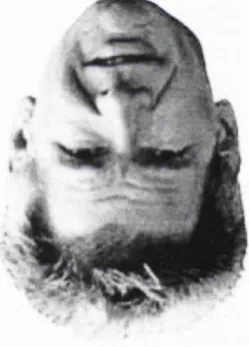
They found that when the two halves were closely aligned, subjects experienced great difficulty in naming the separate halves. However, their performance was much better when the two halves were not closely aligned. Presumably, close alignment produced a new configuration, making it difficult to process the two halves independently. Importantly, this effect disappears when the stimuli are inverted. The effect that o f inversion on face processing has been studied extensively (e.g., Eimer, 2000; Valentine, 1988; Yin, 1969; Carey & Diamond, 1977; Farah, Wilson, Drain & Tanaka, 1995; Valentine & Bruce, 1986). There is clear evidence that upside-down faces are more difficult to recognize than upright faces (e.g., Goldstein, 1965; Hochberg & Galper, 1967; see Figure 1.2).
F ig u r e 1.2 A n e x a m p le o f the particularly d isru p tive e ffe c t o f in v ersio n on fa ce p ercep tion .
F ace p ro cessin g is often found to b e m ore orientation se n sitiv e than n o n fa ce ob ject p ro cessin g
(e .g ., Y in, 1969; V alen tine & Bruce, 1986). T he face in this exam p le b elo n g s to Harrison Ford.
Diamond, 1977; Valentine & Bruce, 1986). For example Yin (1969) found that when photographs o f faces, houses, aeroplanes and schematic men in motion
were presented and tested upright, recognition was better for faces than for the other classes o f objects, but when presented and tested inverted, faces became the m ost difficult stim uli to recognize. This effect has generally been
interpreted as evidence that faces engage processes that are not engaged by other
stimuli, probably configurai processes (but see Gauthier & Tarr, 1997; Gauthier, Behrm ann & Tarr, 1999 for an alternative view). In support o f this interpretation, there is considerable evidence that face processing may be more dependent than nonface object processing on configurai representations. For example, in a study of recognition memory for parts o f studied faces, Tanaka & Sengco (1997) found that the individual parts were recognized best when presented in the context o f the original face configuration, less well in a transformed configuration (e.g., with the eyes slightly further apart), and most poorly in isolation (see Figure 1.3). By contrast, none o f their tests with control stimuli (such as scrambled faces, inverted faces, or houses; see Figure 1.4)
revealed any advantage for recognizing parts em bedded in their studied configurations. This contrast suggests that upright faces may be processed in a more ‘holistic’ fashion than other objects, and thus may be more sensitive to
Study Face
Isolated Part Test Hem
Ü
New Configuration Test Item
V» a f'
@
Old Configuration Test Hem
F ig u r e 1.3 E x a m p le d is p la y s from T anaka & S e n g c o (1 9 9 7 ; E x p er im en t 1). N o te the
p o sitio n in g o f the e y e s in the study face (top row ). In the recogn ition test, a sin g le feature from
the stu d y fa c e (in this c a s e , the n o s e ) is p resen ted in is o la tio n ( s e c o n d r o w ), in a n ew
co n figu ration (third ro w ), or in the origin al co n fig u r a tio n (b ottom ro w ). P erform an ce is b est
Study House
H
Isolated Part Test Item
n
New C o n figuration T est Item
. . n
Old C on fig u ratio n T est Item
F ig u r e 1 .4 E x a m p le d isp la y s from Tanaka & S e n g c o (1 9 9 7 ; E x p er im en t 2 ). N o te the
p o sitio n in g o f the w in d o w s in the study house (top row ). In the reco g n itio n test, a sin g le feature
from the stu d y h o u se (in this c a se, the door) is p resented in iso la tio n (se c o n d ro w ), in a n ew
c o n fig u r a tio n (third ro w ), or in the origin al co n fig u r a tio n (b o tto m r o w ). P erfo r m a n ce is
1.4.2 Neuropsychological evidence
These psychological demonstrations o f apparently face-specific effects raise the possibility that face processing may be subserved by a specialized neural system
that is not shared by other stimulus classes. Several lines o f evidence support this view. Firstly, numerous developmental studies o f neonatal head and eye
m ovem ents suggest that some face-specific processes m ay already be operational at birth. For example, infants reliably demonstrate a preference for face-like patterns over scrambled faces or blank face outlines even within an
hour o f birth (Goren, Sarty & Wu, 1975; Johnson, Dziurawiec, Ellis & Morton 1991; Maurer & Salapatek, 1976; Morton & Johnson, 1991), and will also track a moving face further than a nonface control (Morton & Johnson, 1991). Such early findings defy explanation in terms o f long-term social learning. Rather, they imply that some face-specific processes may be biologically ‘hardwired’.
Moreover, many neuropsychological reports have described adult patients with damage to the occipitotemporal region o f the right hemisphere (or bilaterally, to
both hemispheres) who have selectively impaired face-processing abilities (e.g.. De Renzi, 1986; Farah, 1995; Farah, Levinson & Klein, 1995; Farah, Wilson, Drain & Tanaka, 1995; McNeill & W arrington, 1993; Sergent & Signoret, 1992). This condition is known as prosopagnosia. Although prosopagnosic
patients are characteristically unable to recognise most familiar human faces, some have little difficulty in recognising familiar nonface objects (or nonhuman faces), even when requiring within-category discriminations o f similar subtlety (De Renzi, 1986; Farah, Levinson & Klein, 1995; McNeill & Warrington, 1993,
a prosopagnosic farmer who had become proficient at recognizing the faces o f
sheep. They compared his ability to recognize the faces o f humans and sheep with that o f neurologically normal sheep experts. Although for normal subjects, perform ance was m uch worse for sheep faces than hum an faces, the
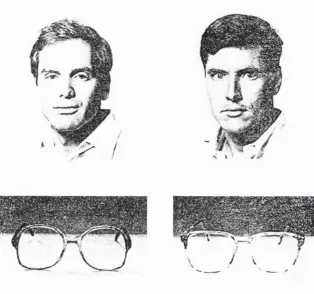
prosopagnosic showed the opposite pattern. In a logically similar study, Farah, Levinson & Klein (1995) compared the ability o f another prosopagnosic patient
to recognize particular faces and particular spectacle-frames against normal subjects’ performance for the same stimuli (see Figure 1.5). As expected, the normal subjects were considerably better at recognizing the different faces than the different spectacle-frames. However, the prosopagnosic’s performance was equally poor for both categories, suggesting a selective face impairment. Although the issue has long been debated (e.g., Damasio, Damasio & Van Hoesen, 1982; DeRenzi, 1986), and remains controversial (e.g., see Kanwisher 2000; Tarr & Gauthier, 2000), such cases suggest that prosopagnosia can be a highly face-specific disorder. Conversely, a few ‘pure’ object agnosics, whose low-level perception is often remarkably well-preserved, have been reported to suffer impaired object recognition while their face recognition is relatively
spared (Humphreys & Rumiati, 1998; Moscovitch, W inocur & Behrmann, 1997; Rumiati & Humphreys, 1997). This pattern o f double dissociation is
com pelling evidence that face and object processing can involve both functionally and structurally separate system s; w ithout some structural
I
F ig u re 1.5 E xam p les o f the fa ces (top) and sp ecta cle frames (b o tto m ) used b y Farah, L ev in so n
& K lein ( 1 9 9 5 ) to co m p a r e r e c o g n itio n m em o r y for fa c e s v e r s u s n o n fa c e o b je c ts in
p rosop agn osic and n eu ro lo g ica lly intact subjects.
1.4.3 Neural evidence
Puce, Allison, Gore & M acCarthy, 1995; Sergent & Signoret, 1992; but see Gauthier et al., 1999 for a contrary view; see also recent discussion by Kanwisher, 2000, and Tarr & Gauthier, 2000, for summ aries o f ongoing
controversies on this topic).
This seemingly converging evidence from highly diverse studies has led some researchers (e.g., Farah 1995; Kanwisher et al., 1997) to propose that face- processing may involve a specialized m odule or modules. The concept o f modularity may relate to attentional issues - and particularly to the question o f whether irrelevant distractors can be ignored - since according to some views (e.g., Farah, 1995), modular processing may proceed independently o f attention, and cannot be voluntarily withheld. If face processing is indeed conducted by a specialized module or modules o f this type, it is possible that an irrelevant distractor face will always be processed, despite the view er’s intentions to ignore it, even under conditions that are optimal for ignoring other types o f distractor (i.e. the words, letters etc. studied in most psychology experiments on attention to date). However, this possibility has not been directly tested before.
1.5 Previous behavioural studies of attention to faces
Possible relations between visual attention and face perception have been examined in past research using several attentional paradigms, including visual
search, spatial cuing, and change blindness. It should be noted that none o f these paradigms are ideal for m easuring distractor processing for faces, in situations where the faces are entirely task-irrelevant (which will provide the
& Gelade, 1980), subjects are presented with displays containing a variable
number o f nontarget stimuli (e.g., green Xs). A target stimulus (e.g., a red X) is present on half o f the trials and absent on the other half, and the subjects’ task is
to decide as quickly as possible whether the target is present in the display. Response times are then measured as a function o f display set size (i.e. the number o f nontargets in which the target may be embedded). Serial search (as indicated by a steeply linear function o f RT against set size) implies that the
processing o f each search item was dependent on focused attention, or at least could not proceed in an efficiently parallel manner. Conversely, parallel search (as indicated by a relatively flat set size function, with little or no increase in RT
against set size) implies that the search items could be processed efficiently in parallel, without subjects having to focus attention on each individual item in turn. Thus, if faces can be processed independently o f attention, as some proponents o f m odularity for face-processing m ight claim, they m ight be
amenable to parallel visual search. This hypothesis has been tested in several recent studies. The results o f these studies, however, have not been conclusive.
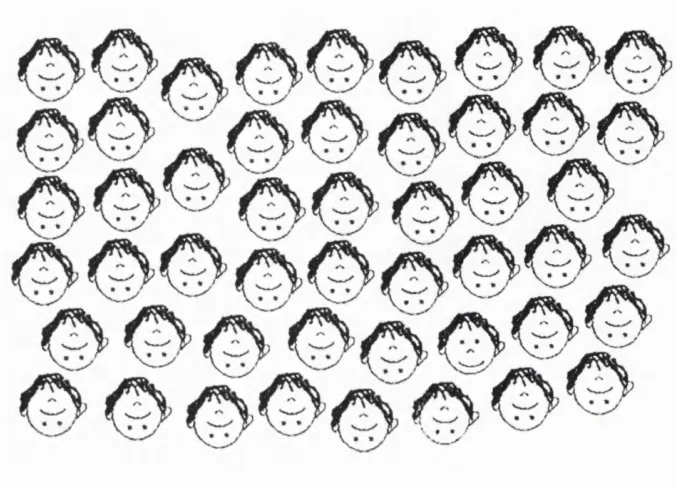
Nothdurft (1993) asked subjects to detect targets (either faces or specific facial expressions) among a variable num ber o f distractors (either ‘nonfaces’ i.e.
rearranged or inverted faces, or nontarget facial expressions). In all cases, the stimuli were simple schematic drawings. The nontargets were created either by
F ig u re 1.6 D em on stration o f the failure o f an intact sc h e m a tic face a m o n g rearranged fa ces to
‘pop o u t’ (adapted from Nothdurft, 1993; S eries 7).
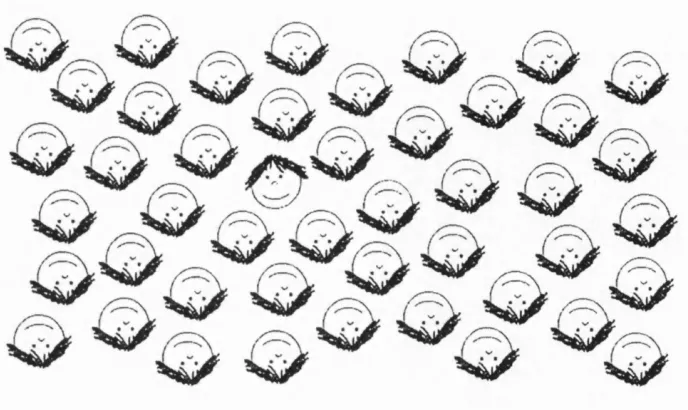
Nothdurft (1993) found no evidence of parallel search for either faces or facial expressions. Parallel search was only observed when the target could be identified on the basis of a unique and salient low-level feature. For example, when the schematic faces included a black chevron for hair (his Series 1), subjects appear to have been able to reduce the search for a face among nonfaces to a simple feature search for an upright chevron among inverted
F ig u r e 1 .7 A n upright sc h e m a tic fa ce ean ‘pop o u t’ from an array o f inverted fa c e s, but on ly
w h en the target con tains a unique and salien t lo w -le v e l feature (e .g ., an upright chevron; Figure
adapted from Nothdurft, 1993; S eries 1).
F ig u re 1.8 E xam p les o f search arrays used by Suzuki & C avanagh (1 9 9 5 ). T h e left array sh o w s
a feature (upturned curve) search w ithou t facial configuration . T he right array sh o w s a feature
(upturned curve) search w ith facial configuration. Search tim es w ere ty p ic a lly slo w e r for targets
em b ed ded in a facial configuration.
However, the visual search task may not be the most appropriate test for deciding whether or not face processing can truly proceed independently of covert attention. As the differences between target and distractor items in a visual search array become increasingly subtle (e.g., an upright face among inverted faces as opposed to, say, a red X among green Xs), it becomes increasingly implausible that nonfoveated items can be reliably distinguished. Thus in order to determine whether or not the target is present in a given display, subjects may have to foveate each item in turn. Since foveation is a serial process, it may not be surprising if a serial search function is often obtained for displays containing multiple face stimuli. Such acuity problems are exacerbated when a large set-size enforces small individual items (as in Nothdurft, 1993; Kuehn & Jolicoeur, 1994; Brown et al., 1997).
1999) can trigger reflexive attention shifts in the observer. In all three studies,
subjects responded more quickly to a peripheral nonface target when it appeared in the location cued by the direction o f gaze o f a central face, even when they
knew the direction o f its gaze was completely nonpredictive. In fact. Driver et al. (1999) found that targets on the side that the face gazed towards were
processed faster even when subjects knew the direction o f gaze was 80% counter-predictive (i.e. when targets were more likely to appear on the side the face gazed away from ), suggesting that perceived gaze can induce a corresponding shift in attention even when contrary to the observer’s intentions. However, while these studies do suggest that some automatic processes can be
triggered by a central face presented in isolation, they did not m easure the overall distracting effect o f a face, but rather the effect o f one specific face
component (gaze) when no competing object was present. Thus they have not addressed the current question o f whether faces in general are more difficult to ignore than other objects.
One recent study by Ro, Russell & Lavie (2000) compared the attention- capturing properties o f faces versus other objects in multiple object arrays, using the ‘change-blindness’ paradigm (Rensink, Oregan & Clark, 1997). Observers
in change-blindness studies are often remarkably poor at detecting large changes between two alternating displays when these are separated by a brief transient
across the whole display. Ro et al. (2000) found that changes in upright faces (but not inverted faces) were detected far more rapidly and accurately than changes in other everyday objects (e.g., plants, musical instruments) when all
potentially being the changing item. This suggests that faces m ay be particularly strong com petitors for attention compared w ith other objects.
However, the change-blindness paradigm presents a situation in which all the stimuli are potentially task-relevant, since any o f the stimuli may contain the
change. It therefore offers little insight in to the processing o f task-irrelevant stimuli; the fact that a relevant face can summon attention when presented among other relevant items does not guarantee that the same face would
summon attention spontaneously when entirely task-irrelevant (i.e. when the observer is trying to ignore faces).
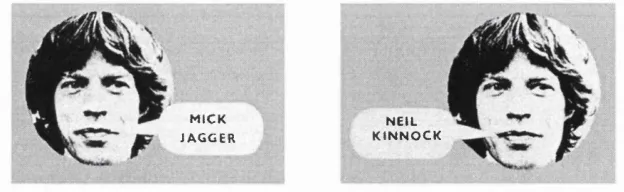
A study by Young, Ellis, Elude, McWeeny & Hay (1986) addressed the possible automaticity o f processing for task-irrelevant faces more directly. Young et al. (1986) presented subjects with displays composed o f a printed famous name (either a pop-star’s or a politician’s), presented inside a ‘speech b ubble’ extending from the m outh o f a famous face (also either a pop-star’s or a
politician’s). The subjects’ task was to categorize the famous name as a pop- star’s or a politician’s, while ignoring the distractor face, which could be either congruent with the correct response (e.g., Mick Jagger’s face for Mick Jagger’s name) or incongruent (e.g., M ick Jagger’s face for Neil Kirmock’s name; see Figure 1.9). They found that target RTs were slower in trials containing an
M I C K J A G G E R
N E I L K I N N O C K
F ig u re 1.9 E xam p les o f d isp la y s from Y o u n g et al. ( 1 9 8 6 ). O ccu p ation al ca tegorization o f the
target printed n am e (pop -star v s. p o litic ia n ) w as faster w h en the d istractor fa ce w a s co n g ru en t
w ith the correct resp o n se (le ft e x a m p le h ere) than w h en it w a s in c o n g r u e n t w ith the correct
resp onse (right exam p le here).
These results suggest that subjects were unable to prevent sem antic categorization o f the distractor face under the experimental conditions (i.e. coding o f the face in terms o f its ow ner’s occupation, presumably via its owner’s identity; Bruce & Young, 1986; Burton, Bruce & Johnston, 1990). However, it is not clear from this study whether distractor faces are particularlv hard to ignore as compared with other stimulus classes. Similar picture-name semantic interference effects can be obtained with nonface stimuli (e.g.. Smith & Magee, 1980). Indeed, even within the Young et al. (1986) study, similar congruency effects from printed names were found when these served as distractors, and the faces as targets. Hence the results to date do not show that distractor faces are any more special than distractor words, or other stimulus types.
However, none o f these issues have yet been tested directly. Although several
recent studies have explored the role o f attention in face perception (e.g., Nothdurft, 1993; Ro et al., 2000), only one (Young et al., 1986) has addressed the question o f whether faces are still processed even when presented as task- irrelevant distractors. Importantly however, even Young et al.’s study does not
reveal whether faces are particularlv difficult to ignore, such that they may be processed even under conditions that are optimal for ignoring other types o f
irrelevant stimuli (e.g., letters, words, nonface objects). Hence the role o f attention in the processing o f irrelevant distractor faces rem ains poorly understood. It is not even clear, for example, whether faces are subject to the same principles o f selection that apply to other classes o f stimuli, or whether irrelevant faces may attract more attention than irrelevant distractor objects that are less biologically significant. The aim o f the current dissertation is to address these issues directly, by comparing the processing o f face distractors and other types o f distractor under varying conditions o f perceptual load.
1.6 General methodological approach and overview
The processing o f irrelevant distractor faces was examined here using two com m on psychological m easures o f distractor processing, namely on-line response-competition (or ‘distractor congruency’) effects (Chapters 2, 3, and 6), and subsequent recognition m em ory for previously presented irrelevant
distractors (Chapters 4 & 5). Chapter 2 examined the effects o f display clutter on irrelevant face processing using a variation o f Young et a l.’s (1986) face-
and a suitable adaptation o f Kahneman & Chajczyk’s (1983) manipulation o f additional distractors was used to examine whether additional objects, o f various types, could ‘d ilute’ interference from a concurrently presented critical
distractor face. Subjects classified a printed famous target name as a pop-star’s or a politician’s, while trying to ignore a famous distractor face which was
always clearly separated from the target name (unlike Young et al.’s (1986) study, in which the target name had been presented close to the face inside a ‘speech bubble’ extending from the face’s mouth; see Figure 1.9). The role o f clutter (or ‘load’) was assessed by examining whether interference effects from
the critical distractor face (on reaction tim es to the printed name, when congruent versus incongruent) could be ‘diluted’ by adding another item to the display (see Kahneman & Chajczyk, 1983, for such findings with distractor words). To address claims that face-processing may involve face-specific mechanisms (e.g., Farah, 1995; Kanwisher, 2000; Farah, Levinson & Klein, 1995; Farah, Wilson, Drain & Tanaka, 1995; Kanwisher et al., 1997), these experiments also examined whether dilution o f distractor effects from a face
m ight require a specific type o f clutter, namely the addition o f another face stimulus. To determine this, the effects o f cluttering the display with an additional face were contrasted with the effects o f adding a scrambled face (Experiment 1) or an inverted face (Experiment 2).
In the experiments o f Chapter 3, the response-competition task fi*om Chapter 2 was again used, but now to assess any effect o f an additional m eaningful
4, which examined the effect o f an additional face or nonface distractor on response-com petition effects from a critical nonface distractor object in a categorization task for printed object names.
The purpose o f these response com petition (i.e. distractor congruency)
experiments was to explore interactions between particular types o f clutter and on-line interference effects on target RTs due to the processing o f distractor faces. However, much o f the everyday and applied interest in face processing
(e.g., as in eyewitness testimony) concerns our ability to remember seen faces. In order to explore possible links between attentional issues and memory for faces. Chapter 4 examined the effect o f perceptual clutter (i.e. Toad’) at exposure on subjects’ later ability to recognize previously unknown faces, that were com pletely task-irrelevant when first presented. Two experim ents assessed the effect o f visual clutter at exposure on incidental long-term recognition memory for faces (Experiment 5) and nonface objects (Experiment 6), following exposure as entirely task-irrelevant stimuli in a colour judgem ent task. As in Chapter 3, the level o f clutter was manipulated by adding another face or nonface object to the exposure display. At the end o f the experiment,
incidental m em ory for the faces (Experim ent 5) and nonface objects (Experiment 6) was assessed using a surprise recognition test. In this way the
ability o f an additional face or nonface object in the display to ‘dilute’ subsequent incidental memory for faces (Experim ent 5) or nonface objects (Experiment 6) could be compared, analogous to the preceding studies on possible dilution o f on-line distractor interference effects.
can ever eliminate the formation o f incidental memories for a task-irrelevant
face presented at fixation. Perceptual load was manipulated in a letter-string task superimposed on a task-irrelevant face. The faces could be presented under
conditions o f either high load or low load in the relevant letter task. At the end o f the experiment, a surprise recognition test was used to compare incidental memory for faces that had appeared under these two load conditions.
The earlier empirical chapters (Chapters 2 & 3) had exam ined w hether perceptual clutter in the display can disrupt the processing o f an irrelevant face.
In view o f recent claims that mental images may have some perception-like properties (e.g., Kosslyn, 1994; Behrmann, M oscovitch & W inocur, 1999), Chapter 6 examined whether face-like clutter ‘in the m ind’s eye’ (i.e. an imagined face) is sufficient to dilute the perception o f a face that is physically present in the display. To test this possibility, I examined the effect o f ‘clutter’ in visual short term mem ory (VSTM) on the processing o f an irrelevant
distractor face, using the response-com petition paradigm that was used in Chapter 2. In order to m anipulate clutter in VSTM (Experim ent 9), the response-competition task was interleaved with a visual short term memory
task, in which subjects had to memorize a face or a nonface image presented before the response-com petition task and report whether or not it m atched
another image presented after the response-competition display. This matching task ensured that subjects had to retain the image presented in the VSTM display while performing the interleaved response-competition task. As before, the potential diluting effects o f maintaining an image in VSTM were contrasted
distractor processing, two follow -up experim ents assessed the effect o f
passively-viewed face and nonface images on response-competition effects from distractor faces (Experiment 10) and nonface distractors (Experiment 11).
The general aim o f all these experim ents was to bring two intensively researched but previously disparate fields together for the first tim e (i.e. selective attention and face processing). In so doing, the experiments sought to
determine whether faces are particularly difficult stimuli to ignore, and also to assess the consequences o f various attentional manipulations for both on-line
processing o f task-irrelevant faces, and for subsequent incidental memory for these faces. Addressing such issues should be o f both theoretical and practical significance. For example, one long-standing debate within cognitive science
concerns the extent to which the m ind may be ‘m odular’ in its functional organization (e.g., see Fodor, 1983; Coltheart, 1998). The debate over modularity for face processing has often been treated as a microcosm o f this broader debate (e.g., Kanwisher, 2000; Tarr & Gauthier, 2000). Testing
whether face processing can occur without attention should make a substantial contribution to this debate, since mandatory operation (i.e. independence from attention) is widely held to be a characteristic feature o f Fodorian modules (e.g., Farah, 1995; Fodor, 1983; Farah, W ilson, Drain & Tanaka, 1995; see also
Coltheart, 1998, for a ‘neo-Fodorian’ account o f modularity).
The findings presented in this thesis may also have direct practical implications for the assessment o f eyewitness testimony. In legal cases, enormous weight
identification (e.g., Devlin, 1976; Wells & Loftus, 1984; see also Wells, 1993; Laughery & Wogalter, 1989; Wells, Malpass, Lindsay, Fisher, Turtle & Fulero, 2000, for reviews o f applied eyewitness research). Yet eyewitness identification
can often be highly unreliable (Devlin, 1976; Egeth, 1993; W ells, 1993; Hancock et al., 2000; Wells & Loftus, 1984). To date, efforts to improve
reliability have typically focused on reducing bias at the time o f mem ory retrieval (e.g., im proving the m ethodology o f identity parades; Bruce, Henderson, Greenwood, Hancock, Burton & Miller, 2000; W ells et al., 2000).
A ttentional factors at the tim e o f encoding have so far received little consideration. The emphasis on facilitating accurate retrieval reflects an assumption that there exists some accurate memory trace (however weak) o f the crim inal’s face, and that the difficulty lies in accessing that veridical memory
Chapter 2
Dilution O f Response-Competition
Introduction
As reviewed in Chapter 1, there is considerable evidence that face perception may involve some different perceptual principles than other forms o f visual
perception (e.g., Yin, 1969; Young et al., 1987; Tanaka & Sengco, 1997), and may be conducted by a specialized face-processing ‘m odule’ (Fodor, 1983) or
set o f modules operating automatically in the presence o f face input (Farah, 1995; Farah, Wilson, Drain & Tanaka, 1995). I f faces are indeed processed in a strongly automatic manner, they should be processed even when a different target is attended, regardless o f the level o f clutter in the display. In other
words, it should be particularly difficult to avoid processing a face in the visual field, even if it is entirely irrelevant in terms o f current task priorities. The present experiments examined this possibility by testing whether irrelevant faces are particularly difficult distractors to ignore, and exploring the conditions w hich m ay reduce their distracting effects. A lthough some previous experiments have shown that isolated irrelevant faces can produce distractor effects (Young et al., 1986), these findings alone are similar to those for other classes o f stimuli, such as famous names (Young et al., 1986), colour-words (Stroop, 1935), and nonface objects (Smith & Magee, 1980). Thus, Young et
a l.’s (1986) pioneering study cannot address the issue o f whether faces are particularlv hard to ignore, producing distractor effects even under conditions that are optimal for the rejection o f other types o f distractor. To address this, I
used a variation o f Young et a l.’s (1986) task, with several m odifications designed to provide optimal conditions for distractor rejection. As in Young et al. (1986), subjects were asked to classify a central printed target name as a pop-
could be congruent or incongruent with the target name. The target name was now always presented at fixation, while the distractor face was presented in the
periphery, clearly separated from the target name. In addition, I examined any effects o f presenting other response-neutral objects, to ‘clutter’ the array and
thus increase perceptual load, on the processing o f the critical famous face distractor.
I f famous face distractors are processed similarly to other classes o f distractor
stimuli, then any distractor interference found from peripheral face distractors
should be ‘diluted’ when more objects are added to the display (see Kahneman
& Chajczyk, 1983, Lavie & Cox, 1997, for such findings with word or letter
stimuli as the critical distractors). Such results would be predicted from Lavie’s
(1995) perceptual load model (unless faces are an exception to this) and would
indicate that distractor faces, like other distractors, may be subject to general
capacity limits. I f however, unlike other stimuli (e.g., letters, words, nonface
objects), the processing o f faces is automatic in the strong sense o f being
capacity-free (or independent o f general nonface capacities), then distractor
faces should continue to produce interference even when other potentially
diluting objects are added to the display. Finally, if any capacity limits for faces
concern only face-specific processes, then only an additional face distractor
should be able to dilute the interference effect from the critical famous distractor
face. Adding other nonface objects should not reduce interference from the
Experiment 1
In Experim ent 1 subjects were requested to make a speeded categorization
response as to whether a printed name at fixation was a politician’s or a pop-
star’s, while ignoring an irrelevant politician’s or pop-star’s face presented to
the right or left o f the name. This famous distractor face could be either
congruent or incongruent with the correct response, and congruency effects on
target RTs were measured under three conditions. The famous distractor face
was either presented: i) alone except for the central target name; ii) with an
intact anonymous face on the opposite side o f the central target name; or iii)
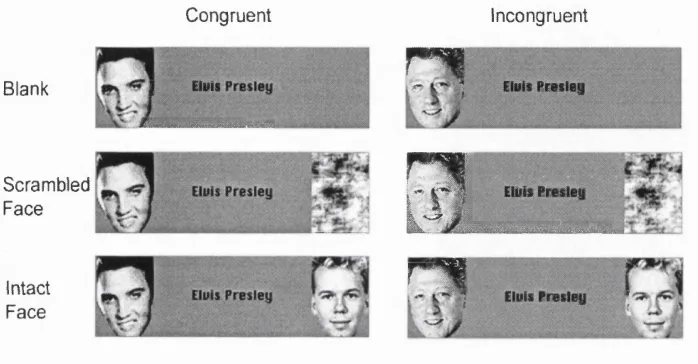
with a scrambled anonymous face on that side (see Figure 2.1). The scrambled
anonymous face was intended to serve as a control for low-level visual energies
o f the intact anonymous face. As stated in the introduction, if face processing is
fully automatic not only in the sense that it cannot be voluntarily withheld, but
also in that it is capacity-free, then the famous distractor faces should produce
congruency effects regardless o f the nature and number o f any other objects in
the display. On the other hand, if faces are processed no differently to other
distractor stimuli, in terms o f the rules dictating whether they will interfere, then
congruency effects from the critical distractor face should arise only when it is
the sole distractor; these effects should be reduced once any other object is
added to the display (see Kahnem an & Chajczyk, 1983). Finally if any
capacity-lim its are specific to the processing o f intact faces, then only an
additional intact face should dilute interference from the famous distractor; the
Method
Subjects 26 students from University College London, whose ages ranged from 18-28, were paid £3 to participate in the experiment. All subjects had normal or
corrected vision by self-report and recognised the famous faces they were to encounter in the experiment, as tested at the beginning.
Apparatus & Stimuli An Apple M acintosh com puter attached to a colour m onitor was used to present the stimuli and record the responses. Viewing distance was fixed at 60 cm using a chinrest. The experiments were created and
run using SuperLab 1.68. The names and faces o f 6 male pop stars (David Bowie, M ick Jagger, Elton John, John Lennon, Jim M orrison, and Elvis
Presley), and 6 male politicians (Tony Blair, George Bush, Bill Clinton, William Hague, John Major, and Ronald Reagan) were used as targets and critical distractors. A further set o f 12 anonymous faces was used in conditions containing additional (response-neutral) distractors as potential diluters. A phase-scrambled version o f each o f the anonymous faces was also made, by randomly shifting the phase o f the component spatial frequencies o f each intact anonymous face after Fourier analysis (see McCarthy, Puce, Gore & Allison,
1997). Note that this scrambling procedure preserves the amplitude o f the component spatial frequencies across the spectrum in comparison with the
original intact face. It is thus a good control for such low-level visual energies. All intact faces were greyscale images derived from photographs, and measured
2.1 cm by 2.8 cm (subtending 2.0° x 2.7° o f visual angle at the viewing distance
spatial frequencies present in the surrounding background from contaminating the scrambled face images. Each display contained one name (shown in black
12 point Arial font) centred at fixation, and measuring between 2.3 cm (the
shortest name) and 3.4 cm (the longest name) in width (2.2°-3.2° o f visual
angle). A famous distractor face was presented either to the left or to the right o f the name. The nearest contours o f the target word and critical distractor face
were separated by 1.2 cm (1.1°o f visual angle). The concurrent name and
famous face in each display were equally likely to be congruent (i.e. a face that
matched the target name, e.g., David Bow ie’s face with David Bow ie’s name), or incongruent (a face that matched a name from the opposite category, e.g.,
David Bow ie’s face with Bill Clinton’s name). For the incongruent condition, all 6 potential incongruent faces (i.e. faces from the other category) were equally likely to be paired with each target name, and likewise for the neutral faces. The space on the opposite side o f the famous distractor face was equally likely to be blank (in the Blank condition), to contain an intact anonymous face (in the
Intact condition), or to contain a scrambled anonymous face (in the Scrambled
condition). Combining each o f the 12 target names with a congruent or an incongruent famous distractor face under 3 levels o f the flanker on the other side
Congruent Incongruent
B lan k I «uis
Scrambled F ace
Intact F ace
n i
-- , Elut* Presieg
S
EUiisPrMlegrm
Eluls Presley 'F ig u r e 2.1 E xam p le d isp la y s from the six c o n d itio n s o f E xp erim en t 1. T h e critical distractor
face co u ld be eith er C o n g r u e n t (le ft co lu m n ) or I n c o n g r u e n t (right c o lu m n ) w ith the central
target n am e, and w a s p resented alon e {B lank con d ition ; top row ), a cco m p a n ied by a scram bled
a n o n y m o u s fa ce { S c r a m b le d con d ition ; m idd le row ), or a cco m p a n ied by an intact a n o n y m o u s
face {In tact condition; bottom row ).
Procedure Prior to the onset of each display, a black fixation point appeared at the centre of the screen for 500 msec. This was immediately replaced by the target-plus-flanker(s) display, which appeared for 200 msec (i.e. too briefly for a stimulus-responsive saccade to be initiated during its exposure) against a light grey background. Subjects made a speeded judgement concerning whether the
impair their performance. Following a short block o f 12 example trials, each subject underw ent seven blocks o f 72 trials each. All the experim ental
conditions were randomly intermixed within each block. The example block and the first experimental block were discarded as practice. Subjects were able
to rest between blocks, initiating the next block by pressing the space bar.
Results
Incorrect responses and RTs exceeding 2 sec (less than 2% o f correct responses) were excluded from the RT analysis. Data from 2 subjects, one whose error rate
was 36%, and one whose response latencies were exceptionally slow (1.9 SD from the group mean), were also excluded. Mean correct reaction times (RTs) and percentage error rates were computed for the rest o f the group for each level
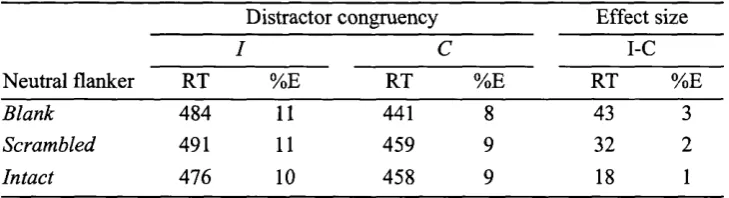
o f congruency (i.e. Congruent versus Incongruent) and display type {Blank, Scrambled, and In ta ct). The average o f these RTs and error rates across subjects is shown in Table 2.1.
T a b le 2.1 M ean R ea ctio n T im e s (in m se c ) and Error R ate (% ) acro ss S u b jects (n = 2 4 ) as a
F un ction o f D istractor C on g ru en cy and N eu tral Flanker T y p e in E xp erim en t 1.
Distractor congruency Effect size
/
c
I-C
Neutral flanker RT %E RT %E RT %E
Blank 484 11 441 8 43 3
Scrambled 491 11 459 9 32 2
Intact 476 10 458 9 18 1
RTs A two-way within-subjects analysis o f variance (ANOVA) on the mean RT data, with the factors o f distractor congruency (2 levels) and display type (3
levels) showed a main effect o f congruency [F(l,23)=37.9, p < .01], with slower responses to incongruent displays, but no reliable main effect o f display type
[F(2,46)=2.55, p = .08]. More importantly, the main effect o f congruency was modified by an interaction with display type [F(2,46)=3.7, p < .05]. As can be seen in Table 2.1, although congruency effects from the critical famous
distractor face were found in all conditions (p < .05 in each case), one-tailed t- tests showed that these distractor effects were significantly smaller in the condition with an additional intact face as the potential diluter than in the condition with an additional scrambled face [t(l,23)=1.82, p < .05], or in the
Blank condition where the distractor appeared alone [t(l,23)=2.54, p < .01]. There was no difference in the distractor effects betw een the Blank and
Scrambled conditions [t < 1].
Errors Comparable analyses were conducted on the error data. A two-way
ANOVA (congruency x display type) found only a main effect o f congruency [F(l,23)=19.38, p < .01]. As can be seen in Table 2.1, Incongruent conditions resulted in a small (2% ± 1%) increase in the number o f errors under all display
conditions. There were no significant effects in the analysis o f error rates (F < 1 for all), but any trends support the RT pattern.
Discussion
These results extend Young et al.’s (1986) finding that an irrelevant face can
finding corroborates previous claims that spatial separation between a target and
an isolated distractor is not on its own sufficient to prevent distractor processing (e.g., Lavie, 1995). The more specific aim o f this study was to determine
whether the processing o f a famous distractor face can be affected by the presence o f an additional, response-neutral flanker. The RT results show that
face-name interference can indeed be diluted, by adding an anonymous intact face as a further distractor in addition to the critical famous face. This is an important finding since it runs counter to claims that face identification may be
fully automatic in the sense o f being entirely capacity-free. I f identification of famous faces were automatic in this strong sense, the introduction o f a second anonymous face in the display ought not to disrupt the influence o f the famous face. Finally, these results show that face-nam e interference cannot be significantly diluted merely by anv additional stimulus. Although an upright unknown face produced significant dilution, a scrambled face did not produce any reliable dilution, despite sharing sim ilar low-level energies w ith the effective intact face. Thus, distractor interference from an irrelevant face may be more robust than other forms o f interference (e.g., color-word interference, Kahnem an & Chajczyk, 1983), which can apparently be diluted by any
additional item, however meaningless it may be (e.g., a row o f Xs in Kahneman & Chajczyk’s (1983) study).
Experiment 2
The results o f Experiment 1 provide initial support for the hypothesis that the distracting effect o f a famous face can be diluted, albeit only by the presence o f
have been due simply to the low-level visual energies o f that additional
stimulus, as no modulation was found from scrambled faces which preserved the component spatial frequencies and amplitudes o f the intact distractors. Thus the reduced effect from the famous distractor face in the presence o f another face
cannot simply be attributed to the elimination o f attention capture by an isolated peripheral object; in statistical terms, the famous face distractor produced as
m uch interference when accompanied by the scrambled face as when alone. How ever, an objection could be raised as to whether the ‘nonface’ (i.e. scrambled face) control stimulus was adequate. Although the scrambled faces control for several important low-level features (energy at different parts o f the spatial frequency spectrum, overall contrast and size) they do not control for edge or structural information. To assess whether the observed difference in
diluting power between neutral faces and nonfaces was due m erely to such differences, inverted faces were used as the ‘nonface’ control in the next experiment. Although inverted faces are identical to upright faces in every respect except orientation (thus preserving many intrinsic stimulus properties), they are poorly perceived and recognised com pared w ith their upright equivalents (e.g., Yin, 1969; Carey & Diam ond, 1977; Valentine, 1988).
Moreover, the disruption caused by inversion can be greater for faces than for other stimulus classes. It has often been argued that inverted faces undergo less ‘configurai’ processing than upright faces (e.g., Carey & Diamond, 1977; see
also Valentine, 1988, for review o f face inversion effects). If interference from the critical famous face distractor is unaffected by adding an inverted face
distractor face. On the other hand, if an inverted face can also disrupt processing o f the critical distractor face, this position w ould be weakened considerably.
Method
Subjects and Apparatus 26 new subjects (15 female) from University College London, whose ages ranged from 18-30 years, were paid £3 for participating in
the experiment. All had normal or corrected vision by self-report and recognised the famous faces they were to encounter in the experiment. The apparatus was the same as for Experiment 1.
Stimuli and Procedure The stimuli and procedure were identical to those o f Experiment 1 except for the following changes (see Figure 2.2). The set o f scrambled faces was replaced by a set o f inverted faces produced by rotating each o f the intact anonymous faces through 180°. The original outlines o f the famous, anonymous upright, and anonymous inverted faces were now all preserved (i.e. the images were no longer cropped). Consequently, the images
were slightly larger than those used in Experiment 1; height was fixed at 3.5 cm
(3.3° o f visual angle), and width varied slightly between images (2.6-3.0 cm;
2.5°-2.9° o f visual angle). Each target-plus-flanker(s) display occupied an
imaginary rectangle measuring 11.8 cm x 3.5 cm (11.1° x 3.3° of visual angle).
As in Experiment 1, the nearest distractor contours were 1.2 cm (1.1° of visual
angle) away from the target name. Following an example block o f 12 trials and
Congruent Incongruent
Blank
Inverted Face
Intact Face
^ I Eluls Pref ley EtolePretley
Ouie Presley Ekrts Precfey
EttfiePrertey l a wc
F ig u re 2 .2 E xam p le d isp la y s from the six c o n d itio n s o f E xp erim en t 2. T he critical distractor
face co u ld b e eith er C o n g r u e n t (le ft co lu m n ) or I n c o n g r u e n t (right c o lu m n ) w ith the target
n a m e , and w a s p resen ted a lo n e {B lan k co n d itio n ; top r o w ), a c c o m p a n ie d b y a in v erted
an on ym ou s face {In v e r te d con d ition ; m idd le row ), or a cco m p a n ied by an intact an o n y m o u s face
{In ta ct condition; bottom row ).
Results
RTs Incorrect responses and RTs exceeding 2 sec (less than 2% of the correct responses) were excluded from the RT analysis. The mean RTs and error rates across subjects are shown in Table 2.2 as a function o f the experimental conditions.
T able 2 .2 M ean R eaction T im es (in m sec) and Error R ate (% ) across Subjects (n = 2 6 ) as a
Function o f D istractor C on gru en cy and N eutral Flanker T y p e in E xperim ent 2.
Distractor congruency Effect size
/ C I-C
Neutral flanker RT %E RT %E RT %E
Blank 530 22 491 19 39 3
Inverted 533 21 503 20 30 1
Intact 520 20 514 21 6 -1