Control vs. Uncertainty for Construction in a
Volatile Environment;
Environment;
A review of Dutco Balfour Beatty’s tender process
by
Maarten Wessels
Submitted to the Faculty of Management & Governance in partial fulfilment of
the degree of Bachelor of Science
at the
University of Twente
December 2007
Bachelor Thesis Industrial Engineering & Management 20thof December 2007
Author: Maarten A.J. Wessels Student number 0015938
Faculty of Management & Governance University of Twente
Supervisor: Drs. Johan A.M. de Kruijf
Faculty of Management & Governance Department of Finance & Accounts University of Twente
Co-reader: Ir. F.M.J.W. van den Berg
Faculty of Management & Governance
Management Summary
The hardest part of construction is controlling (balancing) uncertainties deriving from the external environment. This control process starts with devising a qualitative and mature tender, on which the contractual agreement for the project rests. If mistakes are made here, they will be hard to recover from once the construction starts. Construction contracts are awarded based on the tender handed in. The better the tender, the higher the possible profit. For DBB the performance of its tender process appears to be declining; the level of quality and maturity of its tenders is too low.
To create a qualitative and mature tender you need to adequately identify and assess the uncertainties deriving from the external environment (risk management). The key factor in controlling uncertainties in the tender process is sufficient experienced personnel, who can only work properly if they are supported by the right operating tools (i.e. facilities, IT) and organization structure. In this thesis several possibilities for improvement of these tools and thus improvement of the risk management are given.
Now the number of experienced staff is getting too low to ensure quality and maturity of tenders. The Dubai construction market has a high demand for experienced personnel. Experienced staff is lost to competitors who offer better compensation and few new experienced staff is searched and trained to fill the gap. Better compensation for experienced personnel and more active training of staff can ensure a higher level and higher number of experienced personnel.
Corporate culture in DBB is not suited for the tender process to deal with its environment. Motivation and high performance in large parts of the staff is low. Especially amongst Asian staff there are highly educated personnel with low motivation. In an environmental situation with high risk decision and fast feedback, management should steer towards a culture in which high performance is stimulated through rewards. This can bring about undiscovered or overlooked talent in the current staff.
Right now DBB pays little attention in maintaining and developing the knowledge and intellectual assets it has embodied in its staff. The wheel is frequently reinvented and valuable expertise is easily lost. IT solutions should be implemented to promote KM. Knowledge Management (KM) can be very valuable in assessing risk and opportunity.
The vertical rigid organization structure in DBB isn’t suited for the environment, strategy and current state of technology that apply to the tender process. A horizontal matrix approach provides a better structure. In this approach room can be created for two new closely related departments that cover the responsibility for Planning & Engineering and Estimating (and Quantity Surveying) for the whole of DBB. This type of organization stimulates efficient use of human resources (experienced staff), adaptability to a changing environment, development of both general and specialist skills, better possibilities for communication and cooperation, expertise available to all divisions and the facilitation of KM. Effectively this will lead to better risk management in the tender process and less double work.
Preface
In the beginning of May 2006, I got a very pleasant email from Mr. Nagarajan, Senior Manager Sales & Marketing for Dutco Tennant LLC, telling me he had arranged for me to do my internship to finish my bachelor thesis in Dubai with Dutco Balfour Beatty. For this I owe him my gratitude. The same goes for Mr. Grahame McCaig, General Manager for DBB, who authorized and prepared final arrangements. All the arrangements made and the guidance were perfect. For this I would also very much like to thank Santhosh Kumar Parayil. He was there whenever I needed him.
Once I started my internship, Angelo Manesero took me under his very friendly wing and guided me through the pleasant world of DBB. Without him I would have been lost from the start. The continuous stream of advice and information he provided, whether asked for or not, were very welcome in my research and in my experience of Dubai.
Furthermore I would like to express my gratitude to all the employees in Dutco Balfour Beatty Group’s head office and to all the people who were willing to take the time to show me around the different construction sites DBB occupies. Every single person, especially those in the Estimating department, made me feel at home right from the start and put everything out of their way to answer my many questions, a large number of which had nothing to do with my research.
Much oblige goes to Frank van den Berg, my co-supervisor, who has helped me fine tune my thesis and supported me by in great detail reading and correcting my work wherever he deemed it necessary. His advice has proven to be very useful in writing a fulfilling report.
Last but definitely not least I would like to take the opportunity here to very much thank Johan de Kruijf, my internship supervisor from the University of Twente. Whenever I emailed him with updates and questions he would have an answer ready for me within several hours, I even got emails timed at nine or ten o’clock at night.
His feedback and quick responses have made me feel much more at ease with and confident about my research and findings. His help with and critique on writing the final report has made this a true learning experience for me.
Without all of you I would not have been able to do this. I hope everyone who reads this paper will enjoy themselves, gets interested and maybe pick up a few things here and there.
Contents
1 Introduction ... 4
1.1 The Dutco Balfour Beatty Group (DBBG) ... 4
1.2 Civil and Building Engineering Operations (DBB) ... 4
1.3 The Tender Process... 4
1.4 Motivation ... 5
1.5 The Research ... 6
1.5.1 Research Question and Objective... 6
1.5.2 Methodology ... 7
1.5.3 Information Gathering ... 7
2 Theory ... 9
2.1 Uncertainty ... 9
2.1.1 The Dubai Business Environment ... 9
2.2 The Internal Environment ...10
2.3 The Organization of the Tender Process ...11
2.4 Planning and Estimating ...13
2.4.1 Risk Management ...13
2.4.2 Knowledge Management ...14
2.5 Targets and Performance ...15
2.6 Strategic Thinking ...15
2.7 Summary ...16
3 A Review of the Current Tender Process...17
3.1 The External Environment ...17
3.1.1 General Environment...17
3.1.2 Task Environment ...18
3.1.3 Short Term ...19
3.2 DBB’s Internal Organization...19
3.2.1 The Internal Environment ...19
3.2.2 The Organization of the Tender Process...21
3.2.3 Planning and Estimating ...22
3.3 Targets and Performance ...25
3.4 Strategic Thinking ...26
4 Looking for Possibilities ...28
4.1 The Internal Environment ...28
4.2 The Organization behind the Tender Process...28
4.3 Planning and Estimating ...29
4.3.1 Departmentalization...29
4.3.2 Knowledge Management ...30
4.3.3 Risk Management...30
4.4 Strategic Issues ...30
5 Conclusions and Recommendations ...31
5.1 Conclusions ...31
5.2 Recommendations ...31
Literature and References ...33
Definitions of Terms and Abbreviations Used...34
Appendix I: Organization Chart...35
Appendix II: Estimating Flow Chart (provided by DBB)...36
1 Introduction
Since the mid nineties large plans have been and are still made, to develop Dubai as the gateway to the Middle East. Tourism and trade were to be the main economic drivers for Dubai. Thanks to this development, the Dubai construction market has been a booming business for the past decade and the end is still not in sight. One of the construction companies that has seen immense growth this past decade is Dutco Balfour Beatty (DBB), part of the Dutco Balfour Beatty Group (DBBG).
DBB wants to keep growing and performing well. Therefore it is always trying to improve its processes. According to DBB’s management, several contingencies for DBB may lie in its tender process, the subject of this thesis. So for this tender process a case study was performed to help understand and learn from some of the problems DBB has in maintaining an efficient and effective process that can deal with this growth and rapidly changing environment.
1.1 The Dutco Balfour Beatty Group (DBBG)
The group was originally established in 1977, when the Dubai Transport Company (Dutco), an established local contractor, and UK based Balfour Beatty joined forces and were incorporated by Emiri Decree together with another major international contractor to form the Mina Jebel Ali Construction Company (Private) Limited (MJAC), to construct the Port of Jebel Ali. In the following year, 1978, the partnership was further strengthened through the introduction of Balfour Kilpatrick Gulf (BK Gulf), a specialist Mechanical / Electrical contractor, to the Region.
DBBG continued to develop and expand its established independent construction capability. In April 2002, in recognition of the unique and tangible benefits the expanding Dubai construction market offered to both parties, the shareholders formed the Dutco Balfour Beatty Group, systematically joining their individual construction interests to create a more effective, powerful and diverse Regional construction capability. DBBG is now a leading player in the Dubai construction market.
1.2 Civil and Building Engineering Operations (DBB)
DBBG comprises independently managed Construction and Mechanical / Electrical divisions. Each of these divisions operates unique individual subsidiaries and the entire Group is supported by a common “shared” services function (financial accounting, administration, personnel, IT, purchasing, QMS, safety, etc.). The research was done for the Construction division, called Dutco Balfour Beatty (DBB).
DBB, which employs around 15,000 people, is one of the larger civil engineering, marine works, building and engineering contractors in the UAE. It consists of four different Divisions.
? Dutco Construction Co LLC. Housing, buildings, bridges, road works;
? Dutco Balfour Beatty LLC. Marine works and related heavy civil works, piling, earthworks;
? Balfour Beatty Abu Dhabi, the Abu Dhabi building division, managed out of DBB headquarters in Dubai;
? Middle East Scaffolding LLC. A separate cost centre. They supply scaffolding commercially and to DBB.
1.3 The Tender Process
construction time usually wins and gets to execute the project. To determine the contract price and construction time a tender is made. This process of creating a tender incorporates most of the internal and external influences belonging to DBB’s operations and is used for all divisions in DBB, except for Middle East Scaffolding LLC. Their core business is different from the other three divisions and therefore requires different practice and procedures.
Now what is a tender? In this thesis a tender is defined as a set of documents that form a formal proposal to build a construction project at a specified price and planning horizon. The importance of a tender is explained by the fact that the financial outcome of the project depends on the fulfilment of the contractual agreements signed based on this tender. Creating a mature and adequate tender is therefore of critical importance. The difficulty of creating such a tender lies in uncertainty. Controlling construction has everything to do with controlling and balancing uncertainties deriving from the external environment. For the tender process this means that as many uncertainties as possible have to be identified and be responded to internally, to create a mature and adequate tender. The tender process is where control starts for the project.
Tenders consist of six documents and may vary in complexity. DBB tenders for projects for which a design is already made and DBB tenders for projects that include design and build (D&B). For the first a Method for Construction, a Programme for Construction and a Price Estimate are made, which DBB bases on a Bill of Quantities (BOQ), Construction Specifics (Specs) and Drawings provided by a consultant in service of the client. This is usually a low level complex task. When DBB is responsible for D&B, DBB also has to create the BOQ, Specs and Drawings, which involves a high level of complexity. These six items together with the contract between the contractor and the client form the entire tender, which usually can be measured in kilograms of paper.
DBB’s tender process in short contains several main steps. Tenders are made through the cooperation between different departments, primarily under management and accountability of the Estimating Department. Within this Estimating department a tender team will gather the tender documents from potential clients to whom DBB has expressed an interest in bidding on a project it has been invited to bid on. A Method Statement (the way in which the project should be built step by step) and the Programme (planning for what needs to happen and when during construction) for the project are developed by Planning & Engineering. The price estimates are based on inquiries made with suppliers and subcontractors, for what is required according to the BOQ.
After the estimates are ready and commercial and financial feasibility, resource availability and value engineering have been analysed and discussed, the tender will be approved for submission and handed in, or the tender will be regretted. This decision is made during an incremental meeting held at the end of the tender process. For a more detailed process lay-out the reader is referred to Appendix II for the Estimating Flow Chart. For D&B the tasks are more complex and more in number, but this description should give a good idea of what happens during the tender process.
1.4 Motivation
projects within boundaries set by the contract. The contract is based on the tenders produced by DBB. Therefore DBB’s management is concerned with the performance of the tender process and wants to know if improvement of this process is needed and possible.
Of course the delays and actual costs are made during the construction phase, but it is the responsibility of the people involved in the tender process to predict contingencies and risk deriving from the environment which cause these extra costs or delays. In previous time periods these contingencies were better predicted according to financial statements and statements made by personnel for the same type of projects in the same environment. This implies that it can be done better.
To get a better understanding of the tender process and where we can look for improvements, first we need to define what the main characteristics of a successful tender are. Two main indicators of a successful tender used by DBB are the maturity and the quality of the tender, which are strongly interdependent.
Thematurity of a tender is expressed within DBB as the level at which contingencies and risk are covered in the planning and estimates in a tender. When DBB can spend enough time and manpower to adequately assess the possible contingencies and risks in their tender they can achieve a high level of maturity.
The quality of a tender can be expressed by the level at which the lowest possible price and shortest possible construction period is determined. An accurate tender price is made up of the right estimated amount of labor needed, the right estimated expenses and the right material choices in the right measurements with prices given by the lowest possible (certified) bidder.
From these indicators it can be inferred that time and dealing with uncertainties (risk) are two of the most important factors in creating a successful tender. This is not really surprising since “ most of the problems the construction industry faces derive from the uncertainty that is inherent to construction” (Al-jibouri, 2004). Uncertainty and short time boundaries appeared to be a major cause of the problems DBB faces with devising their tenders.
1.5 The Research
The research question and objective are stated in this section. Subsequently several sub-questions are asked to help guide the research to obtain our goal.
1.5.1 Research Question and Objective
It can be assumed that the maturity and quality of the produced tenders appears to be declining. Since the tenders are produced during this process, the problem must lie somewhere within the boundaries of the tender process and thus within the organization behind this process and the management thereof. So the main question to ask is:
“ How can DBB improve the management of and organization behind its tender process resulting in higher quality and maturity in the tenders produced in this process?”
It is a fact that the internal organization and its characteristics are easier to alter and improve than elements deriving from the external environment, so the focus shall be on the influences the external environment has on DBB’s tender process and how DBB handles these. The objective for this research can now be stated as follows:
1.5.2 Methodology
To help answer the research question a series of sub-questions has been prepared. In the research question the central object of research was the tender process. Therefore it would be a good start for this research to define what a (successful) tender process is according to literature. This leads us to our first sub-question:
1. What is a tender process?
a. How can a tender process be described? b. What are its characteristics?
c. What are conditions for success for a tender process?
The research question focuses on improving the organization behind and management of DBB’s tender process. Therefore firstly the questions of how a tender process should be organized and managed according to what appropriate literature tells us must be answered. Thus the second and third sub-questions are defined:
2. How should a tender process be organized?
3. How should a tender process be managed?
When a better understanding is obtained of what a tender process is and how this process theoretically should be managed and organized, we need to define how this is done in DBB. This leads us to our fourth sub-question:
4. How does DBB organize and manage its tender process?
The answer to this question can be found through extensive empirical research. This research will focus on documents provided by DBB, interviewing DBB staff, searching for appropriate external information and monitoring the actual tender process. When the answers we need are found, the next step is to compare DBB’s tender process with theory:
5. How can DBB’s tender process be compared with how theoretically a tender process needs to be managed and organized, and what can be concluded and recommended from this comparison?
The thesis will read as follows:
Chapter 2 is devoted to creating a theoretical framework that provides the answers for the first three sub-questions. In chapter 3 the current situation in DBB’s tender process will be described by using this framework and employing the answers found in the empirical research in this framework. In chapter 4 the theory from chapter 2 will be used to describe where discrepancies exist between DBB and these theories. Concurrently the possibilities these theories offer for DBB and its tender process will be provided, thus offering an answer to the last sub-question. Chapter 5 will state the conclusions and recommendations.
1.5.3 Information Gathering
The needed information to answer the questions stated above is gathered in five different ways:
The documents provided by DBB are the second source of information. These include financial statements, flowcharts, staff overviews, work procedures, work instructions, data and specifics on actual projects, price estimates, tenders and contracts.
The third source of information is gathered during interviews. In total 21 people are interviewed. The people that will be interviewed include the General Manager, the Financial Manager, The Estimating Manager, the Purchasing Manager and his second, the main accountant, three Chief Engineers, three Estimators, two full-time Planners, two Project Managers, two on-sight Planners, two Quantity Surveyors and the Human Resource Manager. These staff members can provide information on all the topics of interest to this research. By interviewing as many people as possible, a wide perspective can be gained.
The fourth source of information is found externally. These may include newspapers, official governmental statements and data, publications by the Dubai Chamber of Commerce (DCCI) and information provided by non-partial parties.
2 Theory
The theories that can be very useful in helping to find the answers to the first three sub-questions stated earlier are discussed in this chapter.
2.1 Uncertainty
In this chapter we will start with a focus on uncertainty, since adequately dealing with uncertainty is the main defining factor of a mature and qualitative tender as was apparent in the previous chapter. This has also been confirmed by Al-jibouri (2004) who stated that: “It is well known that controlling construction is all about balancing uncertainty”. Uncertainty is an event whose outcome cannot be accurately predicted, caused by the external environment (Al-jibouri, 2004).
Rule of thumb in the construction industry is that there are no certainties, every day is a new. Although we cannot accurately predict the eventual outcome, we can assess the possible outcomes. According to Al-Jibouri (2004), these outcomes form two distinct categories based on the nature of their consequences:
- Risk: The possibility that an uncertain event, whose consequence is damaging, will occur.
- Opportunity: The possibility that an uncertain event, whose consequence is beneficial, will occur.
Balancing the uncertainties (balancing risk and opportunity) deriving from the external environment adequately to produce a decent and mature tender is the responsibility of the staff involved in the tender process. To be held accountable for this responsibility, these staff should have enough of the right ‘tools’ available internally.
Shirazi et al. (1996) discussed the link between the theoretical issues influencing the structure and organization of construction projects. They describe the impact the environment and technological sophistication in IT have on the shape and form of the project organization. From this article several tools can be filtered that are crucial for the performance of project organizations. These tools consist of:
- experienced personnel;
- structure and organization in the process;
- access to operating solutions (IT, planning and estimating tools, facilities, staff);
To make sure these ‘tools’ are available and adequate is the responsibility of senior staff (Shirazi et al., 1996). The adequacy of the ‘tools’ depend on the type of external environment and on the technological sophistication that is available.
2.1.1 The Dubai Business Environment
According to Daft (2000), if an organization is to be successful, the internal organization should be suited to deal with influences deriving from the external environment. To create a clear understanding of what is meant by the external environment, source of the influences a tender process faces and the origin of the uncertainties, this thesis shall use the description Daft (2000) has given. “The external organizational environment includes all elements existing outside the boundary of the organization that have the potential to affect the organization.” The organizations external environment can further be conceptualized in 2 layers:
demographic characteristics as well as the norms, customs and values of the general population. The legal/political dimension includes government regulations at the local, state and federal levels as well as political activities designed to influence corporate behaviour. International factors represent events originating in foreign countries. Technological factors include scientific and technological advancements in a specific industry as well in society at large (Daft, 2000). The more complex the technological factors, the more flexible the organization should be and vice versa.
Thetask environment is closer to the organization and includes sectors that perform day-to-day transactions with the organization. It includes competitors, customers, suppliers and the labour market. The suppliers provide the ‘raw’ materials the organization uses to produce its output. The customers (in this thesis referred to as clients) are the entities that acquire the service of the organization. The labour market represents those people in the external environment who can be hired to work for the organization. The competitors are those companies who tender for the same projects (Daft, 2000).
After the external environment has been analysed the complete environment can be classified using Duncan’s (1971) 2 dimensions, which are represented by the simple-complex and the static-dynamic continuum. Simple-complex refers to the level of complexity that exists in the external environment. The static-dynamic continuum refers the pace in which the external environment changes. When structured within these two continuums a statement can be made about the state of uncertainty of the environment.
Shirazi et al. (1996) can then be used to determine what type of project organization can be useful in regards to centralized vs. decentralized project organization and flexibility and informality vs. a rigid structure and formality. The more complex an environment is, the more decentralized, informal and flexible the project organization needs to be. In a simple environment a centralized, rigid and formal project organization is more effective. This can then help define what type of organization is best suited to deal with the environment at hand.
In this section we discussed several parameters to define whether an organization should be organized traditionally and rigid or horizontally and flexible. Later on in this chapter we will discus the differences that exist between these extremes and the possibilities and contingencies they inhibit.
2.2 The Internal Environment
The internal environment according to Daft (2000) includes elements within the organizations boundaries. It is composed of current employees, management and especially the corporate culture, which defines employee behaviour and how well the organization will adapt to the external environment. Therefore the internal environment will be regarded as an important characteristic of how DBB is to organize and manage the tender process to deal with uncertainty. Researching the internal environment can give us a better understanding of how experienced personnel works and is maintained, and how well DBB’s current organization structure works in regards to producing a mature and qualitative tender. This will help us find the answers to the second sub-question.
Non-visible culture consists of expressed ideas and beliefs, and underlying assumptions and deep believes. Expressed ideas and beliefs can be discerned from how people explain and justify what they do. These are the values members of a company hold at conscious level. Some values become so deeply imbedded in a culture that members are no longer aware of them. These underlying assumptions and values are the essence of culture and subconsciously guide behaviour and decision making. The concept of culture helps managers understand the hidden, complex aspects of organizational life. (Daft, 2000)
The corporate culture should embody what it takes to succeed in the environment, which is to be able to adapt to the demands set by the external environment (Kotter and Heskett, 1992). They described the visible behaviour and the expressed values in adaptive and unadaptive cultures (table 1).
Another way to think about corporate culture was suggested by Sonnenfeld (1988) and included four types of culture that are stated below. Each culture has somewhat different potential for supporting a healthy, successful company, depending on the environment it operates in. Once the environment can be defined, this theory can help define what type of culture would be the right one for DBB and which type is applicable now.
? The baseball team culture emerges in an environmental situation with high risk decision making and fast feedback from the environment. Companies scramble for the services of top performers and persons with ‘low batting averages’ are quickly dropped.
? The club culture is characterized by loyalty, commitment and fitting into the group. This stable, secure environment values age and experience and rewards seniority.
? Theacademy culture hires young recruits interested in a long term association and a slow steady climb up the organization. Each person enters a specific ‘track’ and gains a high level of experience in that area.
? Thefortress culture may emerge in an environmental survival situation. It offers little job security or opportunity for professional growth while companies restructure and downsize to fit the new environment.
2.3 The Organization of the Tender Process
With the help of Daft (2000) we will break down the official organization structure of DBB and the organization behind the tender process. With this breakdown a better understanding of the internal processes, communications and responsibility sharing in a tender process can be gained.
Organization structure: Organization structure can be defined as the set of formal tasks assigned to individuals and departments, formal reporting relationships and the design of systems to ensure effective coordination of employees across departments (Child, 1984).
Adaptive Unadaptive
bureaucratically. As a result they do not change their strategies quickly enough to adjust to or take advantage of changes in their business environment that work group. They value the orderly and risk reducing management process.
Departmentalization:Refers to the basis for grouping positions into departments and departments into the total organization (Daft, 2000). According to Daft (2000) there are different approaches to the structural design of the organization. Two of these arethe divisional approach in which the departments are grouped together into separate self-contained divisions based on a common product, program or geographical position, and the horizontal matrix approach, wherein functional and divisional chains of command are implemented simultaneously and overlay one another in the same departments. This horizontal matrix approach is a useful way of structuring in what would be a complex and dynamic environment as described by Shirazi et al. (1996) (section 2.1).
Two opposite concepts of organizing a company or process are the traditional vertical organization and the learning organization (Daft, 2000). Understanding of these extremes can help us place the tender process organization in the current situation and the desired situation. The traditional organization has a tall structure in which higher management makes all the decisions. Few teams, vertical communication, centralized decision making, specialized tasks and a rigid culture are typical for a traditional organization.
A learning organization can be defined as an organization in which everyone is engaged in identifying and solving problems, enabling the organization to continuously experiment, improve and increase its capacity. The main characteristics are horizontal teams, open information and communication, decentralised decision making, empowered employees and a strong and adaptive culture.
To help define how an organization should design its structure, which guides us to the answers to sub-question 3 and 4, Daft (2000) defined four contingency factors that influence organization structure.
Strategic goal contingency factor: In finding its competitive edge, Porter (1980) suggests a company follows one of three competitive strategies:
- Differentiation: Involves an attempt to distinguish the firm’s products and/or services from others in he industry. A horizontal and informal structure is desired.
- Cost Leadership: The organization aggressively seeks efficient facilities, pursues cost reductions and uses tight cost control to produce products more efficiently than competitors. A functional structure is desired.
- Focus: The organization concentrates on a specific regional market or buyer group. The company will use either a differentiation or low-cost approach, but only for a narrow target market.
If we identify the competitive strategy an organization follows, we can use this information to help determine the type of organization structure is best suited for this organization in managing its tender process.
Environmental contingency factors: In a stable external environment a company should have a more traditional functional structure, because there is little need for change and flexibility and the company can emphasize on specialization and wide span of control.
In an unstable, rapidly changing environment a horizontal structure is needed. Departments must cooperate and the company has to be flexible because the organization has to figure out sudden changes in market influences as it goes along.
Departmental interdependence contingency factors: Interdependence means the extent to which departments depend on each other for resources or materials to accomplish their tasks. The highest level of interdependence isreciprocal interdependence. In this type departments should be located physically close together so that communication is facilitated. Project teams, unscheduled meetings and task forces are familiar elements in reciprocal interdependence.
way to think about technology is as “ work flow”’. It comprises machinery, employee skills and work procedures. When Shirzai et al. (1996) is followed and the technological complexity of the field a tender process like that of DBB operates with can be defined, statements can be made whether the organization of this tender process needs to be flexible or rigid.
2.4 Planning and Estimating
Theories useful for understanding the core tasks in a tender process are stated here. The main tasks in the tender process, according to Schuette and Liska (1994), are planning the project and estimating the costs of the project that is tendered for. The essence of estimating is described by Schuette and Liska (1994) as ‘forecasting future events and placing a value on those events. The estimate is the basis for all of the functions involved with the construction process. It is based on the planning, method statement and the BOQ’.
Schuette and Liska (1994) define two general rules in estimating which paint a picture of the art of estimating and can help us understand what estimating entails:
? ‘If it’s different, keep it separate.’ This represents the fact that the more detailed an estimate is broken down, the more accurate it will be. Breaking down an estimate is time bound. If there were an endless amount of time, the estimate could be done perfectly. The estimator has to decide between the right amount of precision and the time it wants to spend on the estimate. This is also referred to as ‘the art of estimating’.
? ‘Another person should be able to duplicate the work in the estimate in a reasonable amount of time.’ Somebody else should be able to pick up the estimate and quickly understand the process. Consistency and the use of standards are the key to a successful estimate.
Schuette and Liska also name the two basic purposes of a detailed estimate:
? Procuring work;
? Forming the project control basis.
Understanding the risks (uncertainties) and managing knowledge are the hardest part of planning and estimating. They determine the time necessary and the consistency needed to produce a mature, qualitative tender. They are the next two main characteristics that are of concern to DBB in organizing and managing its tender process and are closely linked since knowledge of managing risk, and thus the management of knowledge, is crucial to balancing uncertainties as can be made clear through the theories provided by Al-jibouri (2004) and Carrillo, Anumba and Kamara (2000) (see next two sections). Understanding of knowledge and risk management can provide answers about how a tender process should operate.
2.4.1 Risk Management
Risk management, according to Al-jibouri (2004), is the name given to a formalised process of balancing the risks and opportunities a decision may produce and taking action to produce an acceptable balance between the two. “This balancing forms the basis of decisions which we use to plan and estimate our future” (Al-jibouri, 2004).
According to Al-jibouri (2004), the way in which this process is usually performed, when using experience and gut feeling, is largely unknown or person specific, but certain procedures seem to be integral to it:
? The uncertainties in the project or venture are identified;
? The significance of each is assessed in terms of the consequence and chance of occurrence;
? The risks and opportunities are balanced to show the overall uncertainty;
? The balance produced is judged against acceptability criteria to determine the need for actions to produce an acceptable balance;
“These procedures also form integral parts of the formalized risk management process. Due to the formalized nature of risk management, all the procedures must be documented, and the order in which they are undertaken must be known. This provides a need for a well working knowledge management system” (Al-jibouri, 2004).
When risk management is performed in an unformulated manner, the uncertainties identified, and hence those included in the balance, are usually those which the manager/engineer believes will have a significant effect on the outcome of the project. Such a process is unsatisfactory in a formalized process, as uncertainties considered insignificant might actually be important when considered along with others. Standard checklist-like tables are suggested as a means of documenting the uncertainties identified as it is thought this helps to focus the mind. This is intended to identify those uncertainties which would otherwise be ignored in the unformalized system (Al-jibouri, 2004).
2.4.2 Knowledge Management
“Most business organisations often cite the staff as their greatest asset but have no appropriate mechanisms for managing the knowledge or intellectual capital that is embodied in these staff”, according to Carrillo, Anumba and Kamara (2000). They wrote an article that examines the information technology (IT) and contextual issues involved in formulating an appropriate Knowledge Management (KM) strategy for construction firms. As Al-jibouri (2004) already put it: “Due to the formalized nature of risk management, all the procedures must be documented, and the order in which they are undertaken must be known.” A better understanding of the KM in DBB will also provide us with more understanding of the state of technological IT sophistication (Shirazi et al., 1996).
‘KM can be defined as the identification, optimization and active management of intellectual assets to create value, increase productivity, and gain and sustain competitive advantage’ (Webb, 1998). ‘It involves the capture, consolidation, dissemination and reuse of knowledge within an organization’ (Kazi, Hannus, and Charoenngam, 1999).
Within the construction industry it is increasingly being acknowledged that KM can bring about the much needed innovation and improved business performance the industry requires. Failure to capture and transfer knowledge generated within one project are lost because people move on. This leads to wasted activity and poor project performance (Webb, 1998).
Information Technology (IT) has long been recognized as critical for successful KM. While it is now also recognized that good knowledge management does not result from the implementation of information systems alone (Davenport, 1997), the role of IT as a key enabler remains undiminished (Anumba, Bloomfield, Faraj and Jarvis, 2002).
For any IT system to be classified as a KM system, it must fulfil a number of requirements: 1. It must support the full KM lifecycle – from knowledge creation through distribution and
management to retirement – and not just a subset thereof.
2. There should be appropriate mechanisms for validation and authentication of the knowledge encapsulated in the system.
3. The system should be able to seamlessly integrate with existing legacy IT systems within a real or virtual organization.
4. Flexibility and ease of use are essential components of the system, as they are crucial for ensuring its acceptability and utilization.
5. The knowledge contained within the system must be well maintained and up-to-date. 6. The system must be designed in accordance with an organization’s goals, culture and
Laudon and Laudon (1998) classify information systems for knowledge management into four main categories:
? Systems for knowledge creation (knowledge work systems): these support the activities of highly skilled knowledge workers and professionals as they create new knowledge and try to integrate it into firms;
? Systems for knowledge processing(office automation systems): these help disseminate and co-ordinate the flow of information in an organisation. They enable the processing manipulation (storage, etc) of knowledge in an organisation;
? Systems for knowledge sharing (group collaboration systems): these support the creation and sharing of knowledge among people working in groups. Knowledge sharing systems are utilized to support groups working together such that members of the group can share data, information and knowledge within a given context;
? Systems for knowledge capture and codification(artificial intelligence system): these provide organizations and managers with codified knowledge that can be reused by others in the organisation.
Carrillo, Anumba and Kamara’s (2000) conclusion is construction organizations need to better manage their knowledge assets if they are to remain competitive. With the help of what was said here we can determine if DBB manages its knowledge adequately.
2.5 Targets and Performance
As a final tool for assessment of the tender process, several Key Performance Indicators (KPI’S) will be introduced. These KPI’s can help relatively evaluate the past, present and short term future of the state of control in the tender process (Hope and Fraser, 2003). KPI’s are performance measures used to set goals and assess an organization’s/process’s performance based on its critical success factors (Hope and Fraser, 2003). Control using budgets is slow, inaccurate, expensive and ads little value in today’s rapidly changing business environment according to Hope and Fraser (2003). They promote to base control on effective governance and a range of relative performance indicators. With KPI’s, monitoring performance of the tender process against medium term goals is very well possible and performance can be monitored within agreed upon boundaries (Hope and Fraser, 2003).
Hope and Fraser (2003) state that KPI’s provide two levers of control. One is based on monitoring performance against medium term goals, and the other is based on monitoring performance within agreed upon boundaries. They tend to be few in number and when put together they provide a performance picture that tells the appropriate level of management what is happening now and is likely to happen in the short term future. KPI’s are usually based on ratios.
2.6 Strategic Thinking
“Strategic management is the set of actions used to formulate and implement strategies that will provide a competitive superior fit between the organization and its environment as to achieve organizational goals (Prescott, 1986).” The theories in this section are aimed at aligning the different aspects described so far to review and assess how DBB has managed and organized its tender process to achieve its strategic goals.
external events may indicate a need to redefine the mission or goals and to formulate a new strategy at either the corporate, business or functional level. Daft (2000) described these levels as follows:
Corporate level strategy pertains to the organization as a whole. The main question to be asked here is ‘What business are we in?’. The question ‘How do we compete?’ is the main focus of the
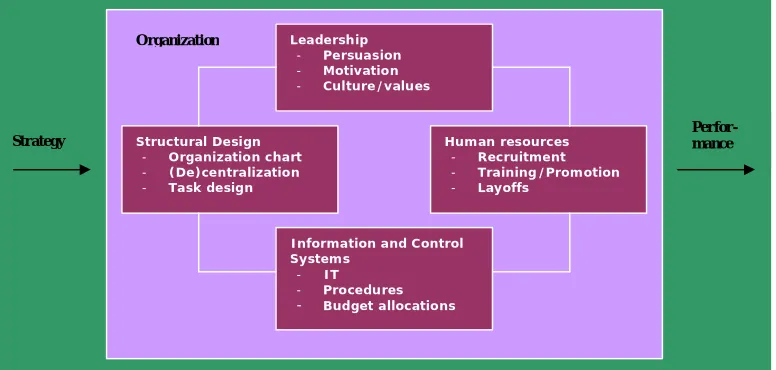
Business level strategy. This question is to be asked by every business unit or product line (e.g. the tender process). In this thesis we will regard the answers to these two questions as a given. For the Functional level strategy the question is ‘How do we support the business level strategy? and is the focus of this thesis. ‘It pertains to the major functional departments within the business units… Improving operations, structures and strategies (objective of this thesis) is a reciprocal process in which analyzing what is happening now and organizational goals and missions, based on a long term view, are critical for (strategic) decision making’ (Prescott, 1986). On this level there are four major tools to be found to put strategy into action which are stated in figure 2, devised by Prescott (1986). There should exist coherence between these tools, since they are closely linked and performance on one of the tools can very well influence performance on other tools.
2.7 Summary
The characteristics and influences described in the theory in this chapter can be used to review how DBB has organized and managed its tender process. The external influences, characteristics and the current organization and structure can be defined. This will provides us with the answer to the first two sub-questions. When we have found these answers the same theory can be used to answer the third and the fourth sub-questions; what are the contingencies and problems now and where can we find the possibilities for the organization behind the tender process to better deal with the influences found? An assessment is possible for the organization and management of the tender process out of which we hopefully will be able to distill conclusions and recommendations as to what DBB can learn to improve the maturity and quality of the tenders it produces.
What still should be considered in regards to the answers found is that ‘western’ theory and logic do not always apply to an environment like Dubai. The culture and ways of doing business vary wildly from for instance the Netherlands. This was already shown by Hofstede (1984). So, for all the solutions the theories stated in this chapter offer, an assessment has to be made if it will
3 A Review of the Current Tender Process
This chapter is devoted to describing the current situation in DBB’s tender process by using the theoretical framework from chapter 2 and employing the answers found in the empirical research in this framework. To
parties have a direct or indirect influence on the tender process. It was made in accordance with experienced personnel.
3.1 The External Environment
The first sub question, which was about the main external influences on DBB’s tender process, is answered in this section. A division has been made according to Daft (2000) in a general and a task environment. Also a description is given of what is meant by the short term.
3.1.1 General Environment
The Sociocultural environment is hard to describe because of its diversity. Approximately 70% of the population is Asian, mainly from Indian, Pakistani, Sri Lankan or Philippine origin. Around 25% of the population consist of Arabs, of which the majority is local to the Emirates (Emiratis). Most of the Emiratis aren’t involved in the construction industry, unless they’re involved as owners or clients. Non-local Arabs in construction are usually higher educated and are in the higher section of the workforce. The third section that can be defined in the population is made up of people from the western world and South Africa. This is a rough division which can be used for the purposes stated in this report.
Because of this wide variety in cultures, no one set of norms and values can be described. The larger part of Dubai’s inhabitants is of working age. 75% of the population is of the male gender. There are a lot of poorly educated immigrants, mainly in the Asian section. In construction, these perform the simpler jobs. Also a wide variety of higher educated immigrants (at least a bachelor’s degree) are available, which are deployed in the offices (Source: Gulf News, July 31st). This accurately reflects the situation for DBB as well.
The Legal/Political environment makes it expensive to bring in expatriates. Initially DBB will spend around AED 10,000 on each new employee according to the HR department. That is just to cover the visa and work permit (1 Euro = AED 4.71).
The Economic environment is more positive. An annual growth in the construction industry of 5% is predicted by the DCCI. Also there is much demand for highly qualified construction companies, which DBB can count itself amongst. In Dubai, unlike most other countries worldwide where as a company you usually subscribe to a project, construction companies usually get invited to bid on a project. On average 4 to 6 companies get invited for each project.
General Manager
DBB gets more invitations then they can actually handle. No certainties can be given about how long this positive atmosphere will be sustained in Dubai. The threat of the ‘bubble bursting’ hangs in the air. A comparison can be made with the internet hype of the late nineties.
The most important technological factor is the technological sophistication in IT that is available (Shirazi et al., 1996). The technological sophistication is, according to Shirazi et al. (1996), of great importance to the shape the organization. Worldwide a lot of IT tools are available for construction companies. Later on we will examine if the technological sophistication in DBB is up to date with available IT solutions for construction companies. International factors hardly apply to DBB or its tender process. It does no real business with companies from foreign countries. DBB only deals with Dubai based suppliers and clients.
3.1.2 Task Environment
Suppliers cannot hold a steady flow of materials in comparison to Europe. A large part of the building material has to be shipped in, since Dubai produces too little steel, concrete, and timber. (Sources: DCCI, Purchasing department). The Gulf is a restless area and competition locally and internationally for building materials can be fierce. This causes uncertainty and shortages of materials which means that prices tend to fluctuate. Inquiries can not be relied upon in the long term. At the moment of writing this paper, inquiries for concrete, timber and steel were only valid for 24 hours and fluctuations of 20% in material prices over 1 week were regular.
Thanks for the longstanding association of DBB and local banks and shareholders it isn’t hard for DBB to obtain loans and bonds. Cash flow needed for growth and development is reasonably easy to come by, according to Finance & Accounts.
The customers (clients) are very focussed on short lead times. The customers and the market require both low cost and diverse projects in different gradations depending on the type of project. The time from invitation to tender and deadline for tender varies between 2 weeks and 2 months. This means hardly any time is given to produce an accurate and mature tender. In comparison: in the Netherlands on average a period of 1 to 5 years is available for devising a tender for major projects.
DBB has an outstanding name and an excellent sponsor (influential local major shareholder), which in Dubai is critical for getting invited to tender on projects. These are driving forces why DBB gets invited to tender for so many projects, which means plenty of work for staff in the tender process.
Because of the high demand for construction, the contractors have more power in negotiations over price and responsibility than normal in the construction industry elsewhere in the world.
In the main labour market there is not enough qualified and experienced staff available for the construction market (according to management and HR). This makes it very hard to maintain experienced personnel; the market for experienced personnel is very strongly led by demand (sources: Gulf News, June 2006, and experienced staff).
DBB of course has its share of competitors, but they are of no importance to the results produced in the tender process. The will not change the outcome of the planning and the estimates. Higher management may strategically decide to alter prices set by the tender process, but this falls outside the scope of operations in the tender process.
When studying the general and task environment, according to the 2 continuums stated by Duncan (1971) (chapter 3), the external environment can be seen as dynamic and complex. This means the environment for DBB has high perceived uncertainty. This is confirmed by DBB’s management and the Dubai Chamber of Commerce and Industry (DCCI, http://www.dcci.ae); both the general and task environment in Dubai can be characterized as young, rapidly changing and unstable.
3.1.3 Short Term
The short term which this thesis refers to several times, can be seen as 6 months. The 6 month term is used by the Estimating department to look ahead for upcoming tenders. It is also used by the HR department as the maximum time they look ahead to foresee personnel requirements. Management uses a 6 month time interval to assess performance of the different departments. Experience has lead DBB to believe that it is very hard to predict within the needed established accuracy boundaries for a longer period. This is due to the project based work they deliver. DBB has no real certainties over the workload they will incur in 6 months.
3.2 DBB’s Internal Organization
In this section we will hope to answer the second sub question structured according to the subdivision given in this question. The main problems and contingencies when dealing with influences from the external environment (sub question 3) are covered according to this structure as well.
3.2.1 The Internal Environment
The internal environment consists of management, employees and the corporate culture (Daft, 2000). A description of the internal environment can give a good understanding of an important element to adapting to the external environment, as was described in section 21.2. Section 3.2.1.1 covers the corporate culture and the staff characteristics that are typical to the Estimating department and others involved in the tender process. Relevant influences in Human Resources are described in section 3.2.1.2.
3.2.1.1 Staff and Corporate Culture in DBB
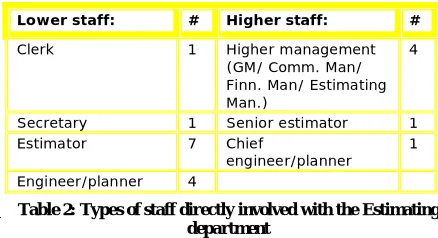
As previously described, the workforce diversity is high, which particularly became clear when working along side the staff and informal questioning. For DBB’s head office the staff build up is a reflection of the higher educated section of the labour market. This diversity yields everything from very subordinate staff members to very self assured managers. Everyone in the Estimating department has at least a
A majority of the experienced personnel has been with DBB for a long time, although a lot of experienced staff has left DBB the last years for different companies (e.g. in 2002 six people in the Estimating department could be seen as experienced in comparison to the three that are now present). By experienced personnel in this thesis is meant staff that is the backbone of the tender process. These are the engineers and managers with sufficient practical experience, knowledge and ingenuity in the specified field. They make the rules, find the solutions and manage most of the risk.
There are just a few managers and senior engineers who make the decisions. The majority of the staff in DBB’s head office wouldn’t really know what to do when higher staff isn’t there to tell them. Not all personnel is being used to their full qualifications.
Loyalty, motivation and involvement in DBB personnel are not optimal. There are clear differences between the higher staff and the lower staff. Higher staff is willing to put in more effort than lower staff. Lower staff treats the higher staff with the utmost respect. If someone is willing to work hard and has the talent, he or she has opportunities for promotion in DBB.
In DBB’s head office there are hardly any stories, symbols, ceremonies and heroes. Dress is pretty casual. The office lay-out is open. A walk-inn culture is maintained. The expressed ideas can be read as follows: The experienced personnel want to please the shareholders and be profitable. For the lower staff the expressed ideas are based on the job description they have been given.
Underlying belief for the higher staff is the desire to deliver fulfilling work. One of the foremost underlying beliefs for a majority of the employees is that working at DBB is just a job. They try to do their jobs as good as is required to keep the job, the level of ambition in most of the lower staff is very low. Some of the lower staff however is very motivated to go up the corporate ladder though.
3.2.1.2 Human Resources
As stated earlier, the experienced staff is a key factor for the tender process. The average age of current experienced personnel involved in the tender process (around 50 years) is too high to ensure continuity. Most of them are planning on leaving Dubai or DBB in several years time. The difference between the higher staff and lower staff in age and experience (On average around 25 years with 3 exceptions that are much older; These exceptions have been performing the same tasks for many years and are not likely candidates for taking over the tender process) forms a big gap which means that at the moment there is no staff in the middle region that will be able to take over in a few years. According to the people in the tender process there is no real shortage of staff at the moment to deal with the work load. But in a year’s time there will be because of personnel leaving and the workload is expected to increase.
To try and fill the gap, DBB uses successive management practices. According to the GM there exists a list of people that now work on site and are eligible to play a future role in the tender process. These people are scouted internally and have years of experience in on site planning and estimating. This is the primary group of the workforce DBB will use to fill the gap when an experienced member of the tender staff leaves. The last few years however, the gap in the tender process has not adequately been filled so it could be said, according to staff members, that this way of attaining and maintaining experienced personnel does not suffice.
are slowly being made. So, both keeping staff and hiring new staff, as shown in section 4.1.2., is very expensive for DBB.
3.2.2
The Organization of the Tender Process
This section illustrates a breakdown of the organization relevant to the tender process. Difference has been made between structure and departmentalization.
3.2.2.1 Organization Structure
DBB on paper has a traditional vertical organization structure. DBB is structured using a
divisional approach. This approach is based on departmentalization according to a common product (for the different types of departments see appendix I). DBB also has several service departments that serve the different product departments. Officially the entire company and all basic operations are written down and audited, and communication is kept on file. DBB has been structured this way for a long time, created after example of Balfour Beatty. DBB is run by mainly South African and English management which has influenced the structure and decision making.
During interviews and actually working along side staff, it appeared that in practice, the assignment of work is often done based on which staff member is known to be the right person for the task and not so much on having the person which should be assigned according to policy in the department officially delegated with the task at hand. Assignments are based on a short term view and on short term need. Staff is often shifted back and forth between departments, responsibilities, and head office and site. No official policy or guidelines exist for this shifting of staff. Experienced personnel are used to bounce off all kinds of ideas. Whoever might know best is asked for a solution. This is nowhere to be found in any of the job descriptions or procedures but is actually one of the main pillars for problem solution and the creation of ideas. This means that in practice work is done less traditionally than DBB is officially organized.
3.2.2.2 Interdependence between the Different Parties
When analysing the different flowcharts (appendix II), operating procedures belonging to different parties involved in the tender process, and figure 3 at the beginning of this chapter, a high level of entanglement and relations between the different parties can be defined. To cover the exact procedures and relations is outside the scope of this report. What is important to understand is the high level of reciprocal interdependence between all internal parties.
Communication is done in every way possible: face-to-face, memos, email, telephone, meetings, unscheduled meetings, and walk-inn. According to the personnel it takes time to learn to communicate efficiently and effectively and the official channels are not accurately suited for this. These official channels take too long and there seem to be a lot of unnecessary steps that need to be taken.
Purchasing, QMS, HR, Finance & Accounts, Estimating, Sites and the different product departments are strongly related in the tender process, with the Estimating department being the central hub. QMS has set up a Work Procedures (WP) and Work Instructions (WI) system that tries to capture the communication and responsibility sharing between these parties.
assistance when the tender process has to divert from the standard track. Experienced staff say they can work more effectively when they work the way they feel is best.
The WI’s are an official form of communication. In practice the WI’s are filled out when the decisions have already been made and are hardly used as an aid to help communicate or help with decision making. Often they are the paperwork that follows at the end of a process. Once filled out and checked they disappear in the archives only to be used whenever an argument arises. Access to these documents can be quite difficult.
In conclusion, work delegation, communication and responsibility sharing is actually done based on experience and on knowing who’s who in the company and not how these procedures are officially organized. Higher management has recognized and promoted these methods. This is the most effective way to deal with reciprocal interdependence and it has worked very well for DBB in the past. The risks of operating this way however, when using Dafts (2000) theories (section 2.3), are unclear communication channels and work procedures, unofficial shifting of staff and loss of information, and thus a chance of loss in efficiency.
During interviews it became clear that to experienced personnel working this way of operating makes perfect sense, but for other staff members it was unclear what was expected from them. Therefore it is of great importance to DBB to have enough people with sufficient experience and know-how of the company. The growth of the past years has not made this way of organizing the tender process any easier. Increasingly more parties and people have to be fit in to this ‘unofficial’ system and the relative number of experienced personnel has been dropping.
3.2.3
Planning and Estimating
Planning and estimating are the two main activities in the tender stage (Schuette and Liska, 1994). In this section these activities and the way they are performed are analyzed. For planning and estimating the core business evolves around performance on the major order winners to get projects awarded. According to planners and estimators these order winners are:
? finding the lowest, up-to-quality, price estimates,
? sensible planning and engineering of the temporary works (solutions needed during the construction phase to facilitate work on site and, when needed, normal life surrounding the site) and
? ensuring short durations and minimal resource requirement for the program.
High performance on these three points is what effectively lowers the total cost for the project, which is always the most important issue to the client. (The client is assured of the quality he seeks, because he will only invite companies with the appropriate reputation.)
The main difficulty with high performance here are the short time boundaries given by the client. These boundaries are made even harder by the many changes made in design and wishes by clients during the tender process, called amendments. These difficulties arise for both high complex and low complex tenders as described in section 1.3, so for this thesis no more distinction will be made between the two. Of course in high complexity time boundaries are more stringent, but more time is granted for design and build projects than on standard projects where only the Method Statement, Planning and Estimates need to be devised. So the idea of and difficulties stemming from time restrictions remains the same for both ends.
3.2.3.1 Specifics and Numbers in Planning and Estimating
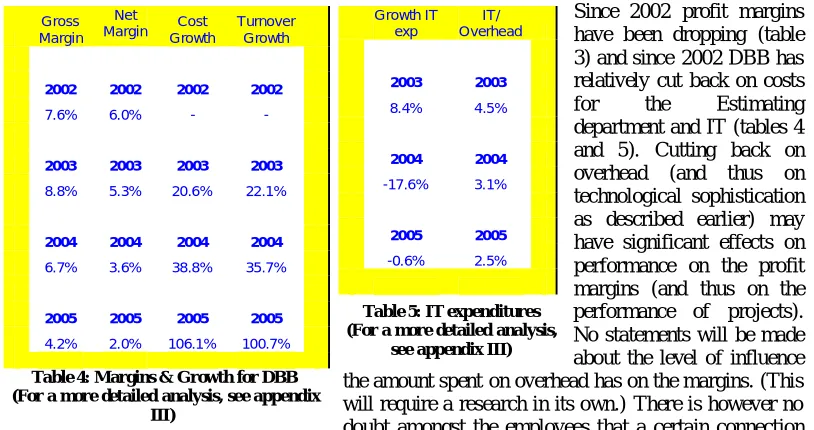
created as an overview of the whilst for instance the turnover for DBB has risen with 330% with AED 6,60. It can also be shown that the contract costs have grown faster than turnover. The absolut net profit has remained the same for DBB since 2002. The relative growth shown per employee is created largely because there are fewer of them. Of course the estimating department is not solely responsible for turn-over and cost figures, but it can be said (according to management and Schuette and Liska, 1994) that they do hold a large part of the responsibility.
From January 1st till May 31st 2006 the Estimating department delivered 82 tenders with a total value of AED 4.8 billion. Of the 82 tenders handed in, 28 projects were awarded to DBB. This means DBB has a win rate of 1 in 3. This is a very high score, according to benchmarking done by DBB. The 28 projects had a total value of AED 350 million. At the moment of writing this report it is very likely that another 3 large projects will be awarded with a total value of near AED 600 million.
3.2.3.2 Procedures and Methods
To get an impression of the routine jobs and procedures the reader is referred to the Estimating flowchart in Appendix II. For the different types of projects DBB undertakes (civil, marine, road works, etc.) the basic operations remain the same. The details in the tender do differ per type of project. This contingency is covered by the different specialists in the tender process or by using specialists elsewhere assigned in the company.
The main IT system used for estimating is called Construction Cost Control System (CCS, or better known by its nickname ‘CANDY’). CANDY is a single-package, project control system designed by construction professionals specifically for the construction industry. The estimating, valuations, planning, cash flow and forecasting components integrate all aspects of a project’s construction process. In this program price estimates and planning can dynamically be linked. This system is greatly appreciated by estimators and can be classified, when fully used, within the last three of the four types of IT stated by Laudon and Laudon (section 2.4.2), so it can be of great assistance in KM.
Planning is done using different IT systems, mainly Primavera and Superprojects. Primavera is usually mandatory because of client demand. Planning is never prepared using CANDY. This means not all the possibilities this IT solution has to offer are used. So it can be concluded that
Figure 3: Relative growth responsibility per experienced employee in the Estimating department in Turnover (TO), Gross Profit (GP), Net Profit (NP), Contract Costs (CC) compared to 2002.