Spelling Error Patterns in Spanish for Word Processing Applications
Flora Ramírez Bustamante, Enrique López Díaz
Microsoft Corporation
One Microsoft Way, Redmond WA, 98052-6399, U.S.A. {florarb, eldiaz}@microsoft.com
Abstract
This paper reports findings from the elaboration of a typology of spelling errors for Spanish. It also discusses previous generalizations about spelling error patterns found in other studies and offers new insights on them. The typology is based on the analysis of around 76K misspellings found in real-life texts produced by humans. The main goal of the elaboration of the typology was to help in the im-plementation of a spell checker that detects context-independent misspellings in general unrestricted texts with the most common con-fusion pairs (i.e. error/correction pairs) to improve the set of ranked correction candidates for misspellings. We found that spelling er-rors are language dependent and are closely related to the orthographic rules of each language. The statistical data we provide on spell-ing error patterns in Spanish and their comparison with other data in other related works are the novel contribution of this paper. In this line, this paper shows that some of the general statements found in the literature about spelling error patterns apply mainly to English and cannot be extrapolated to other languages.
1.
Introduction
This paper reports results on a research on error types in Spanish found in real-life texts. These human produced errors can be grouped in two main types: cognitive errors (i. e. misconceptions about orthographic rules or lack of language knowledge), and errors related to typing mis-takes (motoric errors when using a computer keyboard).
These results have been applied to the implementation of a spell checker that detects context-independent mis-spellings in general unrestricted texts. This speller pro-vides isolated-word error correction by offering a set of candidate corrections that are close to the misspelled word. The technique that underlies the spelling correction algorithm is that of minimum edit distance (number of ad-ditions, substitutions, omissions, and transpositions of two adjacent characters), as explained in Damerau (1964). Every operation is rated with a score. The best suggestion is the one with the lowest score. In this context, the elabo-ration of the error typology aimed at (a) finding a catego-rization based on the frequency of the above mentioned four edit operations in Spanish, and (b) discovering the most frequent error/correction pairs. These two factors al-lowed us to improve the ranking of suggestions offered by the speller as candidate corrections for misspellings.
This paper discusses the most common generalizations about spelling error patterns, and presents further results about frequency and types of misspellings found in real-life corpora. Our findings confirm Damerau’s results in that the majority of errors tend to be single instances of in-sertions, deletions, substitutions and transpositions. We have also found that the majority of misspelling errors in Spanish are:
1. omissions (mainly, of accent or one character), 2. substitutions of lower case for upper case at the be-ginning of a proper noun,
3. cognitive errors, 4. addition,
5. substitution of one character, and 6. transposition.
Other conclusions are:
a) the percentage of errors in the first letter of a word is higher than that reported in other studies,
b) keyboard adjacency effects are less important than other factors, and
c) there is no necessarily direct correlation between frequency of a character in a corpus and its chances to be an error.
2.
The Error Data Collection
The corpus used contains over 8 million words of ed-ited and uneded-ited texts. It comprises three different sets of texts. The first one, with about 4 million words, is a bal-anced set of edited and unedited texts. The second one is a highly edited corpus with about 2 million words. The third one, with about 2 million words, contains unedited data
from the Original Works Creation (OWC) sites.1 Table 1
below shows the breakdown for each set.
The corpus was analyzed morphologically using a knowledge-based syntactic parser (the parser which un-derlies the Microsoft Office grammar checkers developed by Microsoft). This task produced a list of unknown
words.2 The total number of unique unknown words
dis-covered in the corpus was 76K, of which almost 27K (over 35%) were unique misspellings. The rest of them (65%) were not misspellings, but proper nouns, foreign words, derived words, etc. The misspellings were manu-ally revised, and a correction was assigned to each of them based on the context, with the result that the same mis-spelled word could have more than one correction and therefore appear in more than one error pair. Every mis-spelling was classified as belonging to a more general class of errors (i.e. error type). The frequency of each er-ror type and erer-ror pair occurrence was calculated.
1 The Original Works Creation (OWC) sites were created to gather unedited text. The participants from Madrid and Mexico City chose from several topics and wrote for about 30 minutes. The configuration of the software and the hardware was set in such a way that authors were only allowed to make minimal im-mediate corrections. The files have only been sentence-separated, and were not spell-checked or grammar-checked. 2 Our goal was to find the most common spelling error patterns in Spanish. For this reason, we started looking for unknown words in the corpus. In this sense, it was not the aim of this study to look for errors in which a correctly spelled word is substituted for another word that exists in the same language (e.g.,
This typology shows that a full 51% of the misspell-ings found in our corpus are omissions of a diacritic on a vowel.3 An analysis of the error rate variation across the different sets of texts ratifies that the high frequency of this error type is not due to a lack of balance among the various texts (Table 3).
Error type BAL HE MEX MAD
Omission of diacritics 57% 33% 52.6% 52%
Table 3. Breakdown of diacritic omissions
Conversely, capitalization at the beginning of the word is remarkably more frequent in one of the sets than in the others (as shown in Table 4).
Error type BAL HE MEX MAD
Cap. word 1.10% 1.8% 14.22% 2.15%
Table 4. Breakdown of word initial capitalization
Regarding cognitive errors, in Spanish this error type mostly consists of substitutions of a phonetically correct but orthographically incorrect sequence of letters (i.e. homophones, mistakes on similar phonetic pairs such as
b-v, s-x, c-s, ll-y for instance, as in *archibo-archivo,
*estención-extensión, *llendo-yendo). This type of error is common in single and multi-error patterns. A breakdown of the total number of cognitive errors found in the corpus shows that unedited sets exhibit more frequently this error type than edited sets (Table 5). Most of cognitive errors are instances of substitutions (*biene-viene), omission (*acer-hacer), and addition (*hacerca-acerca).
Error type BAL HE MEX MAD
Cogn. Errors 2.17% 6.67% 4.67% 4.62%
Table 5. Breakdown of cognitive errors
Although it could be argued that the cause of the sub-stitution of a b for v could be a keyboard adjacency effect rather than a cognitive error, the overwhelming high fre-quency of this error pair (614; see Table 6 below), in comparison to the lower frequency rate of other adjacent keys (*i-u (51) and *u-i (38), for instance) would remain unexplained.
On the other hand, the source of errors involving dia-critics and case could be considered a misconception on the part of the writer, and, hence, cognitive errors. This fact would imply that a full 63% of the errors found in the
corpus would be instances of cognitive errors.4 This figure
suggests that prioritizing some instances of this error type
3 Ren & Perrault (1992) also found that accents are a special class of errors in French. They subdivide these errors into four types: accent insertion, accent deletion, substitution of one ac-cent for another and repositioning of the acac-cent.
4 Veronis (1988) reports the importance of phonetic errors for French. See Kukich (1992) and references therein for similar re-ports for Dutch and English.
may be very helpful for a spelling correction application for Spanish.
In addition, Figures in Table 2 show that in Spanish
omission is the most common spelling error,5 followed by
substitution, addition, and transposition in that order.
4.
Findings on Error Patterns
The error patterns in Spanish seem to corroborate only partially some of the pattern findings reported by Kukick (1992). Kukick’s conclusions are the following:
1. most errors (i.e. roughly 80%) tend to be single in-stances of insertions, deletions, substitutions, or transposi-tions,
2. most errors tend to be within one letter in length of the intended word,
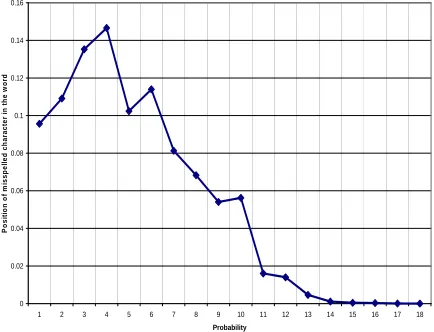
3. few misspellings occur in the first letter of a word, 4. strong keyboard adjacency effects,
5. strong letter frequency effects, and
6. phonetic errors are harder to correct because they result in greater distortion of the misspelled string.
In the following sections we revisit these statements and compare them with our data from Spanish.
4.1. Most errors are single letter errors
The vast majority of errors found in the corpus, as shown in Table 2, are single error misspellings (over
89%).6 Multi-error misspellings are less than 9%. There is
an insignificant remaining percentage of noise related to spaces in multiple locations, extreme multi-error words and indecipherable strings of characters. Demarau (1964), Pollock and Zamora (1984) and Ren and Perrault (1992) report similar rates.
4.2. Most errors tend to be within one letter in length of the intended word
Our data also confirm this statement: 77% of misspell-ings are in length distance 0; 12.2% are 1 character shorter than the intended word, and 9% are 1 character longer than the correction. See Figure 1. These findings are con-sistent with the frequency of error types in Spanish: omis-sion of diacritics, substitution of upper case and of one character, followed by omission and addition of one char-acter.
ent characters that have the same pronunciation in some dialects. Substitutions of strictly adjacent keys d (20), v (8), x (2) for c, however, are much more scarce.
An interesting example are the adjacent keys m and n. The substitution of n for m happens 238 times and that of
m for n, 122 times. There is a specific orthographic rule in
Spanish that says that before a b or a p the only nasal letter that can be written is m, hence the expected higher amount of n for m error substitutions.
This frequency is similar to other substitutions totally unrelated to keyboard effects, as the ones with vowels: e (292 times) ) that was wrongly substituted for vowel a, and a for e (306 times). These figures are indicative enough to suggest that some additional explanation is needed for adjacent keys that get a significant higher score than the other adjacent keys (cf. Armenta et al., 2003).
The keys adjacent to a, such as s , q and z were typed 32, 7 and 2 times, respectively, instead of a. á was typed 310 times when the intended character was a. Note that the reverse case (i.e. substitution of a (unaccented vowel) for á (accented vowel)) appears 7,584 times in the corpus.
Errors concerning accented vowels in Spanish could be attributed to mechanical reasons due to the configura-tion of the Spanish keyboard: two key strokes, one for the accent and another one for the vowel, are necessary to type an accented vowel and the user could miss one of the strokes. French refutes this hypothesis: we found that in French, the first, second and fourth most frequent single letter errors are related to e and its combination with dia-critics é and è. Errors involving é represent an 18% of the errors; errors involving e represent 9%, and errors involv-ing è amount 3.5%. The French keyboard, however, does have its own specialized keys for é and è, so misspellings on these accented vowels cannot be attributed to the omis-sion of a keystroke for the accent.
Another reason to discard keyboard motivations for the high numbers of misspellings in Spanish that are re-lated to accented vowels is that when an accented vowel is misspelled, it is substituted by its unaccented counterpart in almost all the cases (see Table 2 above). Only a very small number of errors in accented vowels are due to the omission of the vowel with the result of a diacritic by it-self (´ instead of á), or to the insertion of the wrong dia-critic that is in a key close to the key for the ´ accent (ë in-stead of é, ì inin-stead of í). If errors in accented vowels were related to keyboard mistyping, one would expect that the omission of the diacritic were less frequent and the omis-sion of the vowel or the insertion of a wrong diacritic were more frequent. These facts imply that when diacritics in a language represent sounds close to those of the characters without diacritics, missing diacritics cannot be reduced to an explanation based on merely keyboard reasons.
In summary, although keyboard adjacency effects are indeed relevant for a taxonomy on the nature of human misspellings, the frequencies in Table 6 suggest that other factors can be much more relevant.
4.5. Strong letter frequency effects
This statement could not be verified either. An abso-lute correlation between frequency of a character in a cor-pus and its chances to be an error in Spanish was not found. If this were the case, we should have expected that
most frequent errors should have happened on the most frequent characters in the corpus. The most frequent char-acters in a Spanish edited corpus are unaccented vowels, and the consonants l, r, t, d, n and s, as it is shown in Fig-ure 5. However, most errors affect the least frequent char-acters: accented vowels and capital letters.
4.6. General agreement that phonetic errors are harder to correct
Kukich (1992) also states that phonetic errors are harder to correct because they result in greater distortion of the misspelled string. However, this fact depends on how close or how far the orthographic system of a given language is from its phonetic system. In Spanish, correc-tion of phonetic errors usually implies one of the edit op-erations, mainly substitution of one/two letters, as we have already explained in previous sections. Veronis (1988) re-ports the high complexity of this task for French when us-ing a correction technique based on an edit distance model (cf. the Spanish error/correction pair
*ipotenusa-hipotenusa vs. the French pair
*ippeautaineuz-hypotenuse).
5.
Conclusions
This paper shows that some of the general statements found in the literature about spelling error patterns apply mainly to English and cannot be extrapolated to other lan-guages. It also reveals the beneficial and productive ef-fects of working with real-life data in the targeted lan-guage for the elaboration of an error typology. This type of data provides clues about which error patterns should be promoted to enhance the generation of suggestions lists for corrections and, if dealing with context-dependent er-rors, to promote those flags related to the most common error patterns. It is obvious that errors involving homoph-ony in Spanish are the most likely contextual errors to be flagged.
6.
References
Armenta, A., Escalada, J. G., Garrido, J. M. & Rodríguez, M. A. (2003). Desarrollo de un corrector ortográfico para aplicaciones de conversión texto-voz. In
Procesa-miento del Lenguaje Natural, 31, pp. 65-72.
Damerau, F. (1964). A technique for computer correction of spelling errors. In Communications of the ACM, 7 (3), pp. 171-176.
Kukick, K. (1992). Techniques for automatically correct-ing words in text. In ACM Computcorrect-ing Surveys, 24 (4), pp. 377-439.
Pollock, J. J. & Zamora, A. (1984). Automatic spelling correction in scientific and scholarly text. In
Communi-cations of the ACM, 27 (4), pp. 358-368.
Ren, X. & Perrault, F. (1992). The typology of unknown words: an experimental study of two corpora. In
Pro-ceedings of Coling, pp. 408-414.
Veronis, J. (1988). Morphosyntactic correction in natural language interfaces. In Proceedings of the 12th
confer-ence on Computational linguistics, pp. 708-713.
Yannakoudakis, E. & Fawthrop, J. D. (1983). The rules of spelling errors. In Information Processing &
Figure 5: Frequency of characters in the corpus and frequency of misspelled characters
X
NULL SP a b c d e f g h i j k l m Y
n o p q r s t u v w x y z á é í ó ú ü ñ NULL 0 1606 655 15 294 229 726 10 14 314 526 4 0 155 75 588 370 99 6 889 586 138 209 18 1 4 3 11 49 82 12 27 5 1 6 SP 357 0 0 0 0 0 0 0 0 0 0 0 0 0 0 0 0 0 0 0 0 0 0 0 0 0 0 0 0 0 0 0 0 0 0 a 518 0 0 0 0 2 306 0 0 0 13 0 0 0 0 2 85 0 2 0 40 0 6 0 0 0 0 1 7584 4 0 1 0 0 0 b 108 0 0 0 1 2 0 0 6 0 0 1 0 0 2 10 0 9 0 1 0 1 0 614 1 0 0 0 0 0 0 0 0 0 0 c 179 0 0 4 0 16 2 3 13 0 0 2 1 1 0 3 0 1 1 6 140 3 0 3 0 2 0 5 0 0 0 0 0 0 0 d 163 0 1 45 20 0 3 3 1 0 0 0 0 2 0 7 1 0 0 2 28 24 0 3 0 0 0 5 0 0 0 0 0 0 0 e 538 0 292 0 6 0 0 0 0 0 77 0 0 1 0 0 47 0 0 17 6 0 6 0 0 0 0 0 8 5776 1 0 2 0 0 f 57 0 0 1 1 5 0 0 6 0 0 1 0 0 0 0 0 0 0 4 1 2 0 2 0 0 0 0 0 0 0 0 0 0 0 g 32 0 0 4 9 1 0 6 0 2 0 162 0 0 0 0 0 0 2 0 0 0 1 0 0 0 1 0 0 0 0 0 0 0 0 h 287 0 0 0 0 0 0 0 2 0 0 6 0 1 0 0 0 0 0 2 0 0 1 0 0 0 0 0 0 0 0 0 0 0 0 i 371 0 5 0 0 0 75 0 0 0 0 0 0 3 0 1 77 0 0 1 1 0 51 0 0 0 39 0 1 12 13590 5 0 0 0 j 36 0 0 0 0 0 0 2 229 3 3 0 0 3 0 0 0 0 0 0 3 0 0 0 0 0 6 0 0 0 0 0 0 0 0 k 55 0 0 0 18 0 0 0 0 1 0 2 0 7 0 0 0 0 0 0 0 0 0 0 0 0 0 0 0 0 0 0 0 0 0 l 226 0 0 1 0 9 0 0 1 2 3 1 0 0 1 7 1 0 0 23 1 7 0 0 0 0 0 0 0 0 0 0 0 0 3 m 142 0 0 3 3 0 0 0 1 0 0 0 0 1 0 122 0 2 0 0 0 0 1 0 0 0 0 0 0 0 9 0 0 0 1 n 385 0 0 9 8 6 0 0 1 0 0 0 0 2 238 0 0 0 0 11 21 0 0 9 0 1 0 1 0 0 0 0 0 0 298 o 284 0 63 0 0 0 26 0 0 0 57 0 0 1 0 1 0 12 0 0 0 0 40 0 0 0 0 0 1 1 1 8641 2 0 0 p 122 0 0 10 1 1 0 0 1 0 0 1 0 0 0 0 20 0 0 0 1 1 0 0 0 0 0 1 0 0 0 0 0 0 0 q 59 0 7 0 12 0 1 0 5 0 0 0 0 0 0 0 0 0 0 0 9 0 0 0 0 0 0 0 0 0 0 0 0 0 3 r 492 0 1 0 2 7 17 1 5 2 0 0 0 31 4 13 0 0 0 0 45 25 0 0 0 0 0 0 0 1 1 0 0 0 0 s 430 0 32 2 399 27 2 0 2 0 0 0 0 3 0 8 2 0 0 33 0 2 0 0 0 138 0 292 0 0 0 50 0 0 0 t 145 0 0 0 5 30 2 2 0 0 2 0 0 1 0 3 0 0 0 24 4 0 0 1 0 0 4 1 0 0 0 0 0 0 0 u 141 0 4 0 0 0 9 0 0 0 38 0 0 0 0 1 63 0 0 2 0 1 0 0 0 0 0 0 1 0 3 0 2194 95 0 v 54 0 1 470 8 1 0 2 0 0 0 1 0 0 0 1 0 1 0 0 1 1 0 0 2 0 0 0 0 0 0 0 0 0 0 w 58 0 2 0 0 0 3 0 0 0 0 0 0 0 0 0 0 0 1 1 1 0 1 2 0 0 0 0 0 0 0 0 0 0 0 x 27 0 0 0 2 0 0 0 1 0 0 12 0 0 0 0 0 0 0 0 38 0 0 0 0 0 0 10 0 0 0 0 0 0 0 y 57 0 0 0 0 0 0 0 0 0 21 23 0 0 1 0 0 0 0 0 0 9 7 0 0 0 0 0 0 0 5 0 0 0 0 z 13 0 2 0 141 4 0 0 0 0 0 0 0 0 0 0 0 0 0 0 91 0 0 0 0 2 0 0 0 0 0 0 7 0 0 á 0 0 310 0 0 0 1 0 0 0 0 0 0 0 0 0 0 0 0 0 0 0 0 0 0 0 0 0 0 8 1 1 0 0 0 é 0 0 0 0 0 0 550 0 0 0 0 0 0 0 0 0 0 0 0 0 0 0 0 0 0 0 0 0 2 0 0 0 0 0 0 í 4 0 0 0 0 0 1 1 0 0 853 0 0 0 0 0 0 0 0 0 0 0 0 0 0 0 0 0 1 0 0 3 2 0 0 ó 2 0 0 0 0 0 0 0 0 0 0 0 0 0 0 0 424 0 0 0 0 0 0 0 0 0 0 0 1 1 1 0 1 0 0 ú 1 0 0 0 0 0 0 0 0 0 0 0 0 0 0 0 0 0 0 0 0 0 75 0 0 0 0 0 0 0 0 0 0 0 0 ü 0 0 0 0 0 0 0 0 0 0 0 0 0 0 0 0 0 0 0 0 0 0 20 0 0 0 0 0 0 0 0 0 0 0 0 ñ 54 0 0 0 0 0 0 0 0 0 0 0 0 4 1 7 0 0 0 0 0 0 0 0 0 0 1 0 0 0 0 0 0 0 0
Table 6. Substitution[X(error), Y(correct)]
0 5 10 15 20 25
í ó á é ú WÓ Í E Á C ñ MÉ h O v Ú J z ü x b j A H w Y Z N k B R V ë ç Ñ Ü ƒ F Â Ç P & X º G ¡ K I ` Q S D ' U T - L y g f q . , m p c u i t r d l s n o a e Letters
P
e
rc
e
n
ta
g
e