Adapting and evaluating a generic term extraction tool
Anita Gojun, Ulrich Heid, Bernd Weissbach, Carola Loth and Insa Mingers
Institute for Natural Language Processing Dr¨ager Safety AG & Co. KGaA
University of Stuttgart L¨ubeck, Germany
gojunaa,[email protected], Bernd.Weissbach,Carola.Loth,[email protected]
Abstract
On the basis of the term candidate extraction tools under development in the EU project TTC, we designed an application for German and English data that serves as a first evaluation of the approach and of the techniques for monolingual term candidate extraction used in the project. The application situation highlighted, among others, the need for tools to remove incomplete word sequences from multi-word term candidate lists, as well as the fact that the provision of German citation forms requires more morphological knowledge than TTC’s slim approach can provide. In the detailed evaluation of our extraction results, we profited from interaction with domain experts and from the fact that the same texts were used for both manual and automatic term extraction.
Keywords:Terminology extraction, comparable corpora, metadata
1.
Introduction
We present the extraction of term candidates from German and English texts from the domains of chemical protection suits and of alcohol and drug detection provided by Dr¨ager Safety AG & Co. KGaA1.
Our extraction tools are based in part on the tools under development in the EU project TTC2: these are aimed at
genericity and at the use of slim linguistic knowledge. The present assessment serves as a test of these tools.
A major source of noise in multi-word term (MWT) extrac-tion is the fact that often only parts of longer MWTs are extracted, which are either not terms or even formally in-complete. Therefore, we designed a tool to find the longest text-specific word sequences among those extracted by a set of terminologically relevant part-of-speech (POS) patterns. We produce XML output with text-related metadata, and we correct lemma and citation forms for both languages. Section 2 gives an overview of the term extraction tech-niques used; we also describe the tool for removing in-complete sequences from the term candidate lists. Section 3 is devoted to the interplay between term extraction and computer–assisted translation (CAT), with emphasis on de-vices for producing morphologically correct data, such as lemma forms and citation forms. The latter problem clearly shows limitations of linguistically slim approaches. In sec-tion 4, we report on the evaluasec-tion of our tools and discuss general questions concerning the evaluation methodology.
2.
A slim approach to term extraction
We make use of the term extraction approach adopted in the TTC project (cf. e.g. (Weller et al., 2011)). The extraction consists in two steps: (i) extraction of single-word (SWTs) and multi-word term (MWTs) candidates based on part-of-speech tags, and (ii) filtering of term candidate lists in order to identify domain-specific terms. For the second step, we
1http://www.draeger.com/GC/en/
2TTC: Terminology extraction, translation tools and
compara-ble corpora,www.ttc-project.eu.
useweirdness ratio, the domain specificity value defined by (Ahmad, 1992).
In the literature, many other statistical measures were pro-posed for the second step, e.g. frequency-based filtering (Daille et al., 1994), C/NC value (Frantzi and Ananiadou, 1999), TF/IDF (Paslaru et al., 2005), the log-likelihood ra-tio test (Rayson and Garside, 2000), etc.
The TTC approach is a hybrid one (cf. the classification provided by (Cabr´e et al., 2001)); for the first step (POS-based extraction of term candidates), we use the linguistic knowledge provided by POS-taggers, and for the second step, we only rely on (relative) frequency; thus, the tool only use tagging and frequency data. For the weirdness cal-culation, frequency data from a general language corpus are used, i.e. from texts which are not biased to any particular topic or domain. Thus, we avoid the use of tools requiring more (detailed) linguistic knowledge, as the term extractor is designed to operate analogously for several typologically different languages.3
In this paper, we do not propose a novel approach to ter-minology extraction: we rather explore the appropriateness of a well-known extraction method in a real application and show extensions needed in order to fulfill requirements aris-ing in a practical workaris-ing context.
2.1. Corpus preprocessing
The corpus preprocessing includes tokenization, lemmati-zation and POS tagging.
As our extraction tool considers lemmas and their fre-quency counts (cf. section 2.2.), it is important that lemma annotation is correct. Since we observed that the taggers we use often lemmatize domain-specific words incorrectly, we implemented an additional preprocessing tool which per-forms the correction of lemmas output by the taggers. Lemma correction The lemma correction component is
3TTC deals with German, English, Spanish, French, Latvian,
mor-Pattern English example German example
ADJ gastight gasdicht
N flammability Entflammbarkeit
V bleach bleichen
ADJ N switch-over valve umschaltbares Ventil
N (PREP ADJ N)+ protection from mechanical stresses Schutz vor mechanischen Belastungen
N (N)+ drug type
-N (ART -N)+ - Innenraum des Anzugs (inside of the suit)
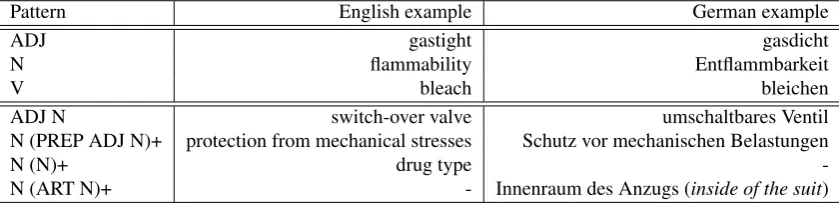
Table 1: Sample extraction patterns for German and English. Upper part: patterns for SWTs (nouns, adjectives, verbs), lower part: sample of the MWT patterns. Some parts of a pattern can be repeated, which is marked with“+”.
3.1. Citation forms
German.For inflecting languages such as German, it is in-sufficient to provide term candidate lists with lemmatized entries (e.g. automatisch + Umschalter (automatic switch-over)). In TTC, we search for citation forms of the term candidates in the set of the extracted inflected forms. But given the rather small size of the specialized texts, we can-not assume that the nominative singular of all terms can be found (in our texts, only for 40% of all terms).
The generation of citation forms requires more knowledge than available in the standard slim approach of the TTC project. Therefore, we implemented an additional function to generate correct German citation forms which is applied to term candidates whose head nouns are modified by an adjective. We resort to a full-scale morphological analy-sis and generation tool for German (SMOR (Schmid et al., 2004)) to overcome problems of German syncretism and weak vs. strong inflection. In a first step, it is used to derive the gender of the head noun. Secondly, we run SMOR to generate the corresponding adjective form in the nomina-tive from the adjecnomina-tive lemma. In the citation form inven-tory, optional prepositional or genitive post-modifiers are given in the form most frequent in the corpus.
Given the lemmatized term candidatebeweissicher + Nach-weis + von Droge (probative proof of drug), the generation of its citation form includes the following steps: (i) deriva-tion of the gender of the head nounNachweis(masculine), (ii) generation of the appropriate adjective form ( beweis-sicherer), and (iii) derivation of the most commonly used form of the prepositional phrase modifying the head noun (von DrogenP l). The resulting citation form which is then provided to the user is thusbeweissicherer Nachweis von Drogen (probative proof of drugs), even if the term was found in the formden beweissicheren Nachweis von Dro-gen(accusative) in the data.
English. For English, there is no need for the use of mor-phological processing tools. For the head noun and an op-tional modifier, lemmas are used, while the non-heads are derived in the same way as described for German.
3.2. Term information in XML format
Terminologists and translators are not only interested in lists of term candidates but also in a number of additional types of information concerning each term: morphological information, as well as text type, document type, domain, etc. Such information may be encoded as metadata.
Our extraction tool outputs the required (language-specific) information, e.g. for German, the gender and number of the head noun is provided, derived from the corpus. To support interactive contextual checking of term candidates, we provide two example sentences per candidate, as well as metadata about their source.
The generated XML files, which are compatible with the CAT toolSDL MultiTerm, contain all relevant information from the tool output, as well as a feature that informs about their being a result of automatic term extraction. This in-formation allows MultiTerm users to distinguish between terms provided by automatic means and manually collected ones.
4.
Experiments and evaluation
4.1. Experimental setup
We tested our term extraction system on texts from the do-mains of alcohol and drug testing and of chemical protec-tion suits. The alcohol and drug testing corpora contain 110,614 words (DE) and 370,176 words (EN). The corpora on chemical protection suits have 48,664 (DE) and 57,464 words (EN). Most of the texts are part of Dr¨ager’s technical documentation.
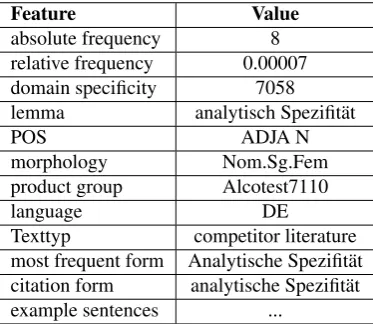
The extraction process follows the methodology described in section 2.. The English corpora were tagged with Tree-Tagger (Schmid, 1995), while the German texts were pre-processed with RFTagger (Schmid and Laws, 2008). We built two versions of each corpus: one with corrected lem-mas and one with unmodified output of the two used tag-gers. For the filtering step, we used newspaper corpora as general language corpora. For German, we used die tageszeitung (1987-1993)consisting of 97 mio. tokens and for EnglishBritish National Corpuswith 117 mio tokens. The extraction system outputs lists of term candidates or-dered by their domain specificity values which contain ad-ditional information about the candidates (cf. section 3.2.). A sample term candidate list entry is shown in table 2.
4.2. Evaluation methodology
Feature Value
200 400 600 800 1000 1200
top 100 top 200 top 300 top 400 top 500
not corrected lemmas 31 61 97 128 151
corrected lemamas 35 74 112 137 154
Table 4: Number of found reference terms in top n of the German term candidates extracted from the alcohol and drug measurement corpus.
0 1000 2000 3000 4000 5000
50
100
150
200
250
300
Term candidates
F
ound ref
erence ter
ms
with lemma correction without lemma correction
Figure 2: Evaluation results of the German noun candidates extracted from the corpus on alcohol and drug measure-ment, sorted by their domain specificity vales.
200 400 600 800 1000 1200 1400
100
200
300
400
Term candidates
F
ound ref
erence ter
ms
with lemma correction without lemma correction
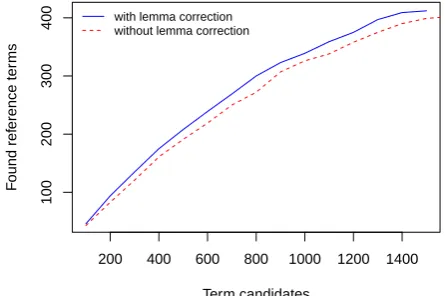
Figure 3: Evaluation results of the German noun candidates extracted from the corpus on chemical protective suits, sorted by their domain specificity vales.
4.3.3. Discussion
Recall. Many of the non-identified terms do not occur in the texts. This is because terminologists often add (generic) terms to their collection in order to make it logically con-sistent. Furthermore, text-preprocessing steps may lead to errors which affect negatively the extraction process.
Precision. Much noise stems from related domains such as computational control of analytical tools: Codezahl (code number), Dateneingabe (data entry), Druckerpa-pier (printer paper), etc. Furthermore, there are general-language candidates which are used very often in the domain-specific texts and therefore get a relatively highds
value (e.g. Querrichtung (transverse direction), Temperat-urausgleich (temperature compensation), etc.). These is-sues concern all technical domains as most of them rely
on basic techniques from other sciences; to identify such “common” scientific terms, contrastive extraction across different domains may be a useful approach (cf. (Fritzinger et al., 2009)).
Methodology. The strict string comparison does not iden-tify a number of equivalent terms which show some varia-tion. For example, the tool may find only inflected forms in the text (e.g. plural, considered to be the lemma), while the reference list contains singular (gef¨ahrliche Stoffe (hazardous substance(s)). Furthermore, the text may con-tain orthographical variants of the reference terms, e.g.
Chemikalien-Schutzanzug vs. Chemikalienschutzanzug or compounds with or without transitional elements: Anzug-material (suit Anzug-material) vs. AnzugsAnzug-material.
There are two ways to overcome this problem. With a simple string similarity measure like Levenshtein dis-tance ratio(cf. (Levenshtein, 1966), (Wagner and Fischer, 1974)), such terms can be identified as equal and counted as a hit, e.g. Schutzanzug-Trocknungsanlage (equipment for drying of chemical protective suits) and Schutzanzug-Trockenanlage. The drawback of this simple method is the possibility to also consider similar, but unrelated words/phrases as hits, e.g. Analyt (analyte)vs. Analyst (analyst). A more precise method consists in identifying term variants (e.g. orthographic, syntactic, etc. (cf. (Daille, 2005))) and considering them as hits. This implies (i) that the extraction tools also have to identify the term vari-ants (which is the case for the tool being developed within TTC7) and (ii) that the reference lists contain not only
refer-ence terms, but also their variants and inflected forms. Such reference lists have been produced within the TTC project (cf. (Loginova et al., 2012)); within Dr¨ager, the main inter-est in term variants is to include terms as forbidden variants into the terminological database; in the medium term, such knowledge will be used in style and consistency checking, by technical authors and translators.
Finally, reference lists may be more or less detailed, de-pending on terminologists’ needs and preferences which has a significant impact on the evaluation results.
5.
Conclusion and Future work
The TTC project develops a generic term extractor whose processing component is language-independent and which is parametrized by means of language-specific patterns and frequency data. This slim approach cannot cater for Ger-man citation forms. Therefore, we extended the existing tool and enabled the use of a full morphological system. The evaluation against manually created reference data showed an acceptable recall (65% and 77%, resp., of the7TTC TermSuite:
reference terms found by automatic means, approx. 50% in the top 500). It also provided inclusion candidates for the domain of alcohol and drug testing: 35% of the top 500 candidates not contained in the reference lists would indeed qualify for inclusion into these lists. This clearly shows that the identification of terminologically relevant data is highly dependant on numerous external influences which are hard to control; all figures of recall and precision of term extrac-tion must thus be interpreted with cauextrac-tion.
Furthermore, our evaluation was based on strict string iden-tity; accepting orthographical, morphological and some syntactic variants in the matching process and signalling the variants to the technical authors (e.g. for inclusion as “unwanted variants”) is under way.
The output of the described term extraction tool will be used in experiments towards automatic provision of equiv-alence pair candidates, by means of term alignment, e.g. from translation memory data and, as planned in the TTC project, from comparable corpora.
Acknowledgement
The research leading to these results has received partial funding from the European Community’s Seventh Frame-work Programme (FP7/2007-2013) under grant agreement n° 248005.
6.
References
K. Ahmad. 1992. What is a term? the semi-automatic extraction of terms from text. In M. Snell-Hornby, F. Poechhacker, and K. Kaindl, editors,Translation stud-ies: an interdiscipline, pages 267–278. 1st edition. M. T. Cabr´e, R. Estop`a, and J. Vivaldi. 2001. Automatic
term detection: a review of current systems. Recent Ad-vances in Computational Terminology, pages 53–87. B. Daille, E. Gaussier, and J.-M. Lange. 1994. Towards
automatic extraction of monolingual and bilingual termi-nology. InProceedings of COLING-94.
B. Daille. 2005. Variants and application-oriented termi-nology engineering.Terminology, 11:181–197.
K. Frantzi and S. Ananiadou. 1999. Automatic recogni-tion of multi-word terms: the c-value/nc-value method.
International Journal of Digital Libraries, 6:145–179. F. Fritzinger, U. Heid, and N. Siegmund. 2009. Automatic
extraction of the phraseology of a legal subdomain. In
XVII European Symposium on Languages for Specific Purporses.
V. I. Levenshtein. 1966. Binary codes capable of correct-ing deletions, insertions, and reversals. Soviet Physics Doklady, 10:707–710.
E. Loginova, A. Gojun, H. Blancafort, M. Gu´egan, T. Gornostay, and U. Heid. 2012. Reference lists for the evaluation of term extraction tools. InProceeding of Ter-minology and Knowledge Engineering Conference. E. Paslaru, D. Schlangen, and S. Niepage. 2005. Ontology
eegineering for the semantic annotation of medical data. In4thworkshop on web semantics – DEXA2005. P. Rayson and R. Garside. 2000. Comparing corpora using
frequency profiling. InProceedings of the workshop on comparing corpora.
Helmut Schmid and Florian Laws. 2008. Estimation of conditional probabilities with decision trees and an ap-plication to fine-grained pos tagging. InProceedings of COLING 2008.
H. Schmid, A. Fitschen, and U. Heid. 2004. Smor: A german computational morphology covering derivation, composition, and inflection. InProceedings of the IVth International Conference on Language Resources and Evaluation (LREC 2004).
Helmut Schmid. 1995. Improvements in part-of-speech tagging with an application to German. InACL SIGDAT Workshop.
T. Vu, A. Aw, and M. Zhang. 2008. Term extraction through unithood and termhood unification. In Proceed-ings of the 3rdinternational joint conference on natural language processing.
R. A. Wagner and M. J. Fischer. 1974. The string-to-string correction problem.Journal of the ACM (JACM), 21. M. Weller, H. Blancafort, A. Gojun, and U. Heid. 2011.