Pruning the Search Space of the Wolof LFG Grammar
Using a Probabilistic and a Constraint Grammar Parser
Cheikh M. Bamba Dione
Department of Linguistic University of Bergen (Norway)
Abstract
This paper presents a method for greatly reducing parse times in LFG by integrating a Constraint Grammar (CG) parser into a probabilistic context-free grammar. The CG parser is used in the pre-processing phase to reduce morphological and lexical ambiguity. Similarly, the c-structure pruning mechanism of XLE is used in the parsing phase to discard low-probability c-structures, before f-annotations are solved. The experiment results show a considerable increase in parsing efficiency and robustness in the annota-tion of Wolof running text. The Wolof CG parser indicated an f-score of 90% for morphological disambiguaannota-tion and a speedup of ca. 40%, while the c-structure pruning method increased the speed of the Wolof grammar by over 36%. On a small amount of data, CG disambiguation and c-structure pruning allowed for a speedup of 58%, however with a substantial drop in parse accuracy of 3.62.
Keywords:Wolof, LFG, c-structure pruning, probabilistic context-free grammar, Constraint Grammar.
1.
Introduction
This paper presents a method for greatly reducing parse times in LFG parsing of Wolof by combining disambigua-tion models based on constituent structure pruning (Crouch et al., 2013; Cahill et al., 2007; Cahill et al., 2008) and Constraint Grammar (CG) (Karlsson, 1990). Traditional LFG analyses focus on two levels of syntactic representa-tion (Kaplan and Bresnan, 1982): Constituent structure (c-structure) models the surface exponence of syntactic infor-mation (e.g. word order, dominance and phrasal groupings), and functional structure (f-structure) represents grammati-cal functions like subject and object. C-structure pruning constitutes a way of dealing with structural ambiguity: it al-lows to make parsing faster by discarding low-probability c-structures, before functional annotations are solved. Like-wise, the use of CG disambiguation in a pre-processing step allows to resolve morpholexical ambiguity.
This work takes place within a broader context of an on-going process of creating language resources and tools for Wolof. In previous work, a Wolof Morphological Analyzer (WoMA) (Dione, 2012) has been developed using finite-state techniques (Beesley and Karttunen, 2003). Subse-quently, the main linguistically important aspects of Wolof have been described and analyzed within the LFG frame-work. This includes the treatment of clitics and the analy-sis of the Wolof constituent structure (Dione, 2013b). Fur-thermore, Dione (2013c) discussed the treatment of va-lency changes and complex predicates found in Wolof, in-cluding causative and applicative derivation. Dione (2013a) presents the development of a large-scale LFG compu-tational grammar for this language. At the current state, the grammar has 250 XLE rules (with regular expression-based right-hand sides) which compile into an automaton with 2737 states and 39189 arcs. The expansion of the Wolof grammar has led to serious efficiency and perfor-mance problems that result from a variety of causes, includ-ing long-distance dependencies, functional uncertainty,
re-stricted unification, but especially morpholexical and syn-tactic ambiguities. To cope with these problems and to en-hance coverage and parsing quality, robust parsing tech-niques were adopted. However, as is typical for grammar development, large-scale grammars tend to be massively ambiguous, while parsing natural texts needs to be robust. Loosening rules to allow robustness increases ambiguity. In particular, when parsers are applied to large-scale linguistic data, it becomes critically important to control ambiguity and increase parsing performance and efficiency. Thus, the present work is a further step in reducing ambiguity and pruning the search space of the Wolof parser.
The parsing model used by XLE is a unification-based parsing system. Basic components of the XLE architec-ture include components for morphological analysis, a chart parser and a unifier. Unification is typically the most computation-intensive part of LFG parsing (Cahill et al., 2007), and this is a practical reason for experimenting with the parse pruning method in this work. XLE usually spends most of its time in the unifier, “searching for valid f-structures (dependency attribute value matrices) within the space of the many valid c-structures (phrase structure trees)" (Cahill et al., 2007). Since a particular grammar gen-erates many valid c-structure trees for a given input, the uni-fier then processes all of these trees (as packed structures). Consider for example the Wolof sentence “Xale bi moom
doon ree." shown in (1). The sentence has more than 100
valid c-structure trees according to the current Wolof gram-mar.1 However, once the CG disambiguator has removed
the unintended readings and the unifier processed all of these trees (in a packed form), only one c-structure and f-structure pair is valid (see Figure 1).
1For example,bican be a determiner, a bound or a free relative
(1) Xale child
bi the
moom adv.TOP
doon
AUX.PST.PROG
ree.
laugh ‘As for the child, (s)he was laughing.’
Figure 1: C- and f-structure for sentence (1)
The structure of this paper is as follows: Section 2. presents the constraint-based model of morphological disambigua-tion used for Wolof. Secdisambigua-tion 3. describes the chart pruning mechanism used for syntactic disambiguation. Section 3.1. introduces the chart pruning mechanism of XLE. Section 3.2. discusses experiments conducted on the Wolof devel-opment set, from which the most successful cutoffvalue is selected to annotate the test set. Both the c-structure prun-ing mechanism and the Wolof morphological disambigua-tor are evaluated against manually constructed gold stan-dards. Section 4. concludes the discussion.
2.
CG Disambiguation for Wolof
In a recent past, robust NLP systems based on Constraint Grammar have been reported for several languages, includ-ing English (Karlsson et al., 1995), Norwegian (Hagen et al., 2000), French (Bick, 2004) and Spanish (Bick, 2006). The CG formalism (Karlsson, 1990) has been developed at the University of Helsinki. As a methodological paradigm for handling token-linked information in a contextual, rule-based fashion, the CG formalism is “used for parsing wherethe grammar statements are closer to real text sentences and more directly address some notorious parsing problems, es-pecially ambiguity" (Karlsson, 1990, p. 1).
Accordingly, a CG disambiguator is integrated into the Wolof parser to handle morpholexical (but not syntactic) ambiguity in the pre-processing phase. The implementa-tion of the CG model is developed by Didriksen (2003) within the VISL NLP framework.2The disambiguator uses
the third generation compilervislcg3(Bick, 2000). As is typical within the CG framework, contextual rules are used to add, remove, select or replace tags in a token-based fashion. CG rules are usually ordered in task batches, also called sections. Within each section, there is an heuristicity order: the rules are usually divided into safer rules (i.e. rules to be used earlier) and heuristic rules (rules to be used later). The rules are applied in a deterministic and sequential way, so that removed information can’t be recovered; yet it re-mains the task of the grammar writer to place the safest rules first. Also, the CG compiler uses very robust features to always assign an analysis to a given input. For instance, it does not allow to remove the last remaining reading of a given type. Consequently, the rules applied late can’t cause harm, if safer rules already have disambiguated a token.
2.1. The Morphological Analyzer
In the preprocessing phase, the Wolof grammar uses a cas-cade of finite-state transducers (Kaplan et al., 2004).
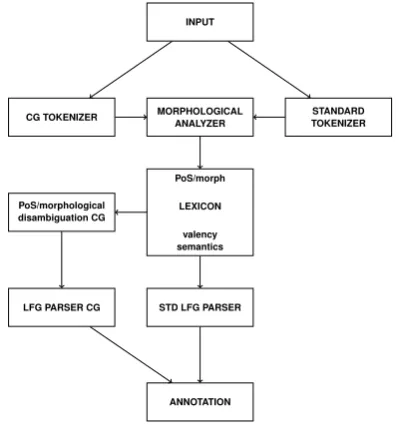
MORPHOLOGICAL ANALYZER
CG TOKENIZER STANDARD
TOKENIZER INPUT
PoS/morph
LEXICON
valency semantics
ANNOTATION PoS/morphological
disambiguation CG
LFG PARSER CG STD LFG PARSER
Figure 2: Anatomy of the Wolof parsing system
As Figure 2 shows, the input is first tokenized either by a deterministic CG tokenizer or by a non-deterministic stan-dard tokenizer. Next, morphological analysis (Dione, 2012) is carried out. The output of the morphology is either dis-ambiguated prior to syntactic analysis or directly fed into the standard (std) LFG parser (i.e. without CG disambigua-tion), before the morphosyntactic annotation is produced. Some relevant components of this system are presented in the next sections.
REMOVE ( Det Def ) + $$NC IF ( NEGATE -1 NOM + $$NC )
( NEGATE * -1 Pron + $$NC BARRIER CLB );
In (4), a definite determiner, (Det Def), that contains a noun class index is removed from a cohort, if and only if the two following conditions match: (i) if there is no nominal (NOM), with the same class, occurring immediately to the left (-1); (ii) if there is no pronoun with the same noun class anywhere (*) to the left from the first neighbouring posi-tion, and if there is no clause boundary (CLB) in between (BARRIER). A barrier context blocks the preceding con-text search, if the barrier condition is instantiated before the unbounded context can be instantiated. Hence, in this rule, the matching condition is to be formulated as an agreement feature shared between the noun and its dependent. For this purpose, the third generation compiler vislcg3 allows the use of sets as to-be-unified variables, prefixing $$ before the set name (i.e. $$NC). All occurrences of such a set in a given rule will be unified to mean the same set member, and the rule operation will only apply if the set does have a member that satisfies all occurrences of the set in both target and contexts at the same time.
Example (4) illustrates a very simple rule. More complex rules will often incorporate more than one context as well as conditioned (LINK) contexts and rule templates.
2.3.2. Disambiguating Relative Pronouns
Like determiners, relative pronouns agree in singular or plural noun class with the noun they relate to. Thus, a sim-ilar rule to (4) applies for this grammatical category. In ad-dition, relative pronouns can be directly removed in a more general context, e.g. if the right adjacent constituent is a prepositional phrase, a conjunction or a punctuation symbol (’.’, parenthesis, etc.). Also, this reading can be removed if none of the following conditions holds: (i) a transitive verb or a predicate noun occurs anywhere to the right from the first neighbouring position; (ii) the left adjacent word is a nominal, a locative PP, a personal or quantitative pronoun; (iii) if there is no relative pronoun anywhere (*) to the left from the second neighbouring position. Such remove oper-ations can be accomplished by the rule given in (5).
(5) REMOVE ( Pron Rel )
IF (1 T: PP | CONJ | PUNCTUATION ) ( NEGATE -1 Nominal | ( PP Loc ) | ( Pron QuantPron ) | ( Pron PersPron ) | Quotes )
( NEGATE *1 Verb | PredNoun | COMMA BARRIER CLB ) ( NEGATE * -2 ( Pron Rel ));
2.3.3. Disambiguating Copular Elements
Conditioned context rules are exemplified in (6) which re-moves the copular reading if both contexts (left and right) contain a verb.
(6) Constraint: remove the non-subject copular reading if left adjacent and right adjacent word are verbs.
REMOVE (Icop) IF (-1 Verb LINK 2 Verb);
The contexts, chained by the word LINK, are applied as AND-linked conditions, i.e. all conditions of this rule must be true for the rule to apply. The second, linked context con-dition is written in the same way as the first one, however, its relative position is calculated from the instantiated first context rather than the rule target.
2.3.4. DisambiguatinglaComplementizer
(7) Constraint: removelaas a complementizer if a tran-sitive verb occurs anywhere to the right from the first neighbouring position, and if there is no clause boundary in between.
REMOVE (" la ’’ Comp )
IF (*1 C ( Verb Trans ) BARRIER CLB );
The rule in (7) removes laas a complementizer if an un-ambiguous (C) transitive verb occurs anywhere to the right from the first neighbouring position, and if there is no clause boundary in between.
Having applied the rules in (4-7), only three cohort lines of lawill be retained, as shown in (8).
(8) <" fas ">
fas +V+ Base + Main + Active fas +N+ Common +w+y+ Count + Anim fas +N+ Common +g+y+ Count + Inanim <" la ">
la + Pron + Free +l+ Sg + Dist + NonHum la + INFL + CompFoc +3 SgSubj + Indic la + Clt + Obj + Pers +2+ Sg + Weak + Acc <" gis ">
gis +V+ Base + Main + Active
gis +N+ Common +b+y+ Count + Inanim <".">
.+ PERIOD
In general, a great number of lexical ambiguities can be reduced by looking at the local context. However, in some cases it is difficult to fully disambiguate. This is particularly true for contexts including Wolof nouns which, similar to Arabic nouns (Attia, 2008), are multifunctional. This mul-tifunctionality is characterized by the fact that many Wolof nouns are derived from verbs and can take verbal functions in the sentence (some nouns can also become prepositions, adverbs, etc.). Thus, disambiguating free relative pronouns and object clitics in some cases is a task which requires a careful rule design. Considering the example shown so far, in the current Wolof CG disambiguator, the surviving co-hort lines may remain undisambiguated.
3.
C-structure Pruning
As noted above, XLE usually spends considerable time in the unification phase. Thus, previous works (Cahill et al., 2007; Cahill et al., 2008) concentrated on exploring techniques to reduce the number of c-structure trees to be processed by the unifier. Cahill et al. (2008) evaluate the methodology on data from English, German and Norwe-gian and show that the same patterns hold across languages. The English and German LFG parsing system was respec-tively trained on (WSJ) Penn Treebank and on (FR) TIGER Treebank data. For both, a significant speed-up (67% and 49%, respectively) with a stable parsing accuracy could be observed. For Norwegian, this technique allows for a speedup of 40% in parsing time, but causes a slight loss in accuracy. According to Cahill et al. (2008), this parsing quality could probably be improved using more data. Similar to the work carried out by Cahill et al. (2008), the c-structure pruning mechanism of XLE (Cahill et al., 2007; Crouch et al., 2013) is applied to Wolof. In an experiment, I investigate ways to improve the overall parsing time con-sisting in pruning the search space at an earlier stage of the parsing process. Section 3.1. presents the basic idea of the c-structure pruning mechanism of XLE. Section 3.2. dis-cusses the experiments conducted for Wolof and reports on the experimental evaluation results.
3.1. The C-structure Pruning Mechanism of XLE
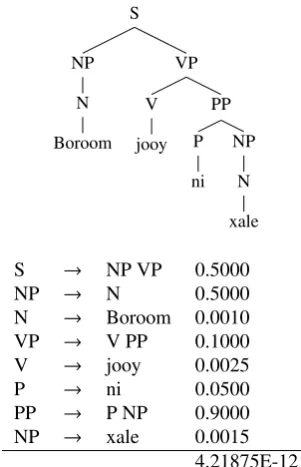
The pruning process starts by training a probabilistic context-free grammar on a corpus annotated with syntac-tic bracketing. Such a grammar typically has context-free rewrite rules with one non-terminal symbol on left-hand side (LHS) and a combination of terminal and/or non-terminal symbols on right-hand side (RHS). XLE grammar rules are context-free rules augmented with functional an-notations. The probabilities associated with these rules can be estimated as relative frequencies found in a parsed (and disambiguated) corpus. More specifically, during the train-ing, XLE uses a chart-based mechanism to build parses and collect probabilities for subtrees stored in the chart. The probability of a tree is defined as the product of the prob-abilities of each of the rules used to form the tree, includ-ing the rules that lead to lexical items. The probability of a rule is basically the number of times that particular form of the rule occurs in the training data divided by the num-ber of times the rule’s category occurs in these data, plus a smoothing term. The pruning mechanism occurs then at the level of individual constituents in the chart. Having esti-mated the probabilities of each of the constituent subtrees, XLE compares them (i.e. the probability of each subtree is compared with the best subtree probability for that con-stituent). If a subtree’s probability is lower than the best probability by a given factor, then the subtree is pruned. The cutoffvalue is the natural logarithm of that factor. So a value of 5 means that a subtree will be pruned if its proba-bility is about a factor of 100 less than the best probaproba-bility. To illustrate how this works, consider the sentence “Bo-room jooy ni xale”. As Figures 4 and 5 show, this sentence has two different analyses which are provided with hypo-thetical probabilities for each rule. These analyses come together at the S constituent that spans the whole
sen-tence. The probability of the first and the second analysis is 8.4375E-14 and 4.21875E-12, respectively. This means that reading 1 in Figure 4 is 50 times less probable than reading 2 in Figure 5.6Depending on how the c-structure pruning
cutoffis set — e.g. if the threshold is less than the natural logarithm of 50, (about 3.9) — reading 1 may be discarded even before corresponding f-annotations are solved. If so, the sentence will only get one solution rather than two.
S
NP
N
Boroom N
jooy VP
V
ni NP
N
xale
S → NP VP 0.5000
NP → N N 0.1500
N → Boroom 0.0010
N → jooy 0.0015
VP → V NP 0.2000
V → ni 0.0050
NP → N 0.5000
N → xale 0.0015
8.4375E-14
Figure 4: Analysis 1 for the stringBoroom jooy ni xale“the crying owner says children” with hypothetical probabilities
S
NP
N
Boroom
VP
V
jooy PP
P
ni NP
N
xale
S → NP VP 0.5000
NP → N 0.5000
N → Boroom 0.0010
VP → V PP 0.1000
V → jooy 0.0025
P → ni 0.0500
PP → P NP 0.9000
NP → xale 0.0015
4.21875E-12
Figure 5: Analysis 2 for the stringBoroom jooy ni xale“the owner cries like children" with hypothetical probabilities
3.2. Experiments on Wolof
To test the effect of c-structure pruning, a number of parsing experiments have been conducted. The experiments aimed at evaluating the parsing system against both accuracy and
6The hypothetical probabilities are reproduced from Crouch et al.
XLE Output: (ROOT (IP (DP (DP (NP (N xale)) (D bi)) (ADVP (ADV moom))) (S (VPaux (AUX doon) (VP (V’ (V ree)))))) (PER .)) Labeled:\[ROOT\[IP\[DP\[DP Xale bi\] moom\]\[S doon\[VP ree\]\]\] .\]
Unlabeled:\[\[\[\[ Xale bi\] moom\]\[ doon\[ ree\]\]\] .\]
Figure 3: Example of bracketed sentences as input to the c-structure pruning training method
parsing time. Because the pruning algorithm of XLE prunes the c-structure chart using information that is only available in this chart, a corpus of bracketed sentences as gold stan-dard is needed in order to train the chart pruner. Accord-ingly, the experiment process consists first in parsing the unlabeled training data using the Wolof hand-crafted pars-ing system.
First, the short stories in Cissé (1994) and Garros (1997) are annotated using the Wolof standard LFG parser. Then, using the LFG Parsebanker (Rosén et al., 2009), a discriminant-based approach is taken to manually biguate the parsed sentences and to collect fully disam-biguated sentences as gold standard. This tool also allows to automatically export the training data as bracketed sen-tences. Thus, the gold standard sentences could automat-ically be extracted and used to pre-bracket input to XLE, constraining the valid c-structure space for each sentence. Thus, only those sentences which could get a full parse and be fully disambiguated were included in the gold standard, meaning that fragments and other non-full sentences were not used as gold standard.
An additional step required to train the pruner was to cus-tomize the Wolof grammar so that it can deal with the for-mat of the sentences in the gold standard corpus. Therefore, the grammar rules are rewritten to integrate the brackets LSB (left square bracket) and RSB (right square bracket) and to convert the relevant rules into the form XP –>LSB XP RSB. The LSB and RSB symbols were introduced since XLE expects that the brackets are named so. If the input to the XLE parser is bracketed, the parser will only generate c-structures that respect these brackets, i.e. only c-c-structures with brackets that are compatible with the input brackets are considered during the unification stage. However, when gathering statistics, XLE will ignore rules of this form.
There are 4125 features in the final pruning model, which is relatively small compared to the 52,959 features in the Ger-man pruning model (Cahill et al., 2008). With this input, the Wolof LFG parser was trained in two different ways: (i) only using the regular Wolof grammar without CG dis-ambiguation and (ii) using the CG parser for morphologi-cal disambiguation. The c-structure algorithm was trained on randomly selected sentences: (i) 380 sentences extracted from Cissé (1994) and Garros (1997), and (ii) 246 sentences
fromSo Long a Letter(Ba, 2007). Figure 3 gives an
exam-ple of bracketed sentences used as input to the c-structure pruning algorithm.
The typical time of XLE components with the Wolof gram-mar is: Morphology (0.1%), Chart (3.1%) and Unifier (85.5%). The c-structure pruning technique was first ex-perimented with different values of the pruning cutoff on the development set. Tables 1 and 2 show the experiment results on this set without and with CG disambiguation, re-spectively. The LFG evaluation metric for the development and test set is based on the comparison of full f-structures,
represented as triplesrelation(predicate,argument).7Thus,
the f-structures (i.e. the triples) of the system are compared to the triples-based gold standards. For each comparison, the best match, i.e. the reading that comes closest to the in-tended analysis (from all source analyses) is chosen. Thus, the oracle f-score refers to a regular f-score calculated from the set of the triples in best match solution.8
As similarly experienced by Cahill et al. (2008), the experi-ments results in Wolof show that the lower the cutoffvalue, the quicker the sentences can be parsed. This is true for both experiments (i.e. with or without CG disambiguation). Using a cutoffof 4 and without CG disambiguation, the de-velopment sentences can be parsed in 180 CPU seconds, while with a cutoffof 10, the same experiment takes 414 CPU seconds. With no cutoffand no CG disambiguation, the experiment takes 710 CPU seconds. In contrast, using a cutoffof 4 combined with CG disambiguation, the develop-ment set can be parsed very much more quickly, i.e. in 93 CPU seconds, while with a cutoffof 10, the same experi-ment takes 297 CPU seconds. Using the CG disambiguator with no cutoff, the experiment takes 520 CPU seconds. However, this increase in speed comes at a price. For both experiments, the number of fragment parses increases, meaning that there are more sentences that failed to get a complete parse, which impacts negatively on the results. With no pruning, the number of fragment parses for the experiment without or with CG disambiguation is 29 and 46, respectively. However, with the most aggressive prun-ing factor 4, there are 121 and 138 fragment parses, respec-tively. There are also many more skimmed sentences with no c-structure pruning.
The c-structure pruning has also a negative impact on the quality of the f-structure. With c-structure pruning, the number of fragment parses increases for all thresh-olds, independently of CG disambiguation. Note that the Wolof gold standard only consists of sentences that can be parsed by the grammar, thus excluding fragment parses and skimmed sentences. Theoretically, the oracle f-score for the experiment with no pruning should be 100. The relatively slight drop is due to the fact that the gold standard was man-ually built by allowing all possible parse solutions and then selecting the best parse, while during the experiment some parse possibilities may be blocked, e.g. due to the use of OT marks (Frank et al., 2001). Without CG disambiguation, a cutoffof 10 seems to provide the best tradeoffbetween time and accuracy. In contrast, if CG disambiguation is used, a cutoffof 9 seems to perform best on the development data.
7For more details about the LFG triples-based metric, see e.g.
Rie-zler et al. (2002).
8For instance, ifSis the set of dependency triples in the (best)
Pruning Level None 4 5 6 7 8 9 10
Time (CPU seconds) 710 180 276 374 419 518 404 414
Oracle F-Score 96.83 79.67 80.98 83.08 86.13 87.98 89.51 90.90
# Fragment Parses 29 121 119 100 74 66 58 48
# Skimmed Sentences 27 2 7 12 8 14 16 17
# Time Outs 1 0 0 0 0 1 0 0
Table 1: Results of c-structure pruning experiments on Wolof development data without CG disambiguation
Pruning Level None 4 5 6 7 8 9 10
Time (CPU seconds) 520 93 112 134 200 202 177 297
Oracle F-Score 90.94 80.70 82.07 83.73 85.04 86.47 87.34 88.16
# Fragment Parses 46 138 113 92 74 74 67 60
# Skimmed Sentences 13 2 2 5 9 11 10 11
# Time Outs 2 0 0 0 0 0 0 0
Table 2: Results of c-structure pruning experiments on Wolof development data using CG disambiguation
Without CG With CG
Pruning Level None 10 None 9
Total Time 7374 4779 4473 3164
Oracle F-Score 93.02 92.05 90.52 89.40 # Full Parses 1712 1613 1551 1434 # Fragment Parses 627 737 775 917
# Time Outs 10 5 8 6
# Skimmed Sentences 348 240 191 125
Table 3: Results of the c-structure pruning experiments on Wolof test data
Having established the cutoffs that perform best on the de-velopment data, c-structure pruning was applied on the test set for final evaluation. This consists of 2364 unseen sen-tences randomly selected from Ba (2007) and disjoint from those sentences included in the training and development set. Table 3 shows the results on the test set. Note that for the test set, automatic measurement was not possible in Wolof, since gold standards to match against the whole test sentences are not available. Instead, I took a random sam-ple of 50 sentences from the test set and build gold standard for this subset. Thus, the f-scores provided in Table 3 refer to the results obtained via f-structure comparison between this gold standard and the system output for this subset. In the test set, c-structure pruning with and without CG dis-ambiguation gives a huge reduction in parsing time. Again, this increase in speedup results in a relatively significant drop in f-score quality. A cutoffof 10 leads to speedup over 36% and a drop in oracle f-score of 0.97 points. With CG disambiguation, a cutoffof 9 allows for a speedup of 30% and a drop in f-score of 1.12. In total, a threshold of 9 com-bined with CG disambiguation leads to a speedup of 58% and a drop in f-score of 3.62.
Table 4 shows the ambiguity reduction achieved by using the c-structure pruning algorithm and CG.9 Combining c-structure pruning with CG disambiguation (row 3.) pro-vides the best results with over 80% ambiguity reduction.
9Because the ambiguity rate was measured relative to the common
full parse solutions produced by the specific test run, the values for ambiguity rate are not absolute, but rather relative values.
Ambiguity Ambiguity
Rate Reduction
1. w/o CG w/o Pruning 209.77 72.92% cutoff10 56.81
2. w/o CG w/o Pruning 174.38 77.64% with CG w/o Pruning 56.45
3. w/o CG w/o Pruning 154.66 80.66% with CG cutoff9 29.92
Table 4: Ambiguity reduction when using c-structure prun-ing and CG disambiguation
4.
Conclusion
This paper has presented a method for greatly reducing parse times in LFG parsing of Wolof by combining the c-structure pruning of XLE with CG-based models for morphological disambiguation. The CG disambiguator pre-sented in this paper is still in progress. It shows that a mod-est number of CG rules can improve both efficiency and performance of the LFG parser, while significantly reduc-ing the large number of lexical and morphological ambi-guities. By using the c-structure pruning mechanism, the number of the c-structures built in the chart reduced consid-erably, allowing for a significant improvement of the pars-ing time. Combinpars-ing the c-structure mechanism with CG disambiguation greatly increased the parsing efficiency by 58%, however at the expense of the accuracy of the overall system. With such a combination, the parsing quality de-creased by ca. 3.62. With more training data one can expect this figure to increase. The Wolof LFG grammar is avail-able electronically and can be accessed for public use from http://clarino.uib.no/iness/.
5.
Acknowledgements
6.
References
Mohammed Attia. 2008. Handling Arabic Morphological and Syntactic Ambiguity within the LFG Framework with
a View to Machine Translation. Ph.D. thesis, University
of Manchester.
Mariyaama Ba. 2007. Bataaxal bu gudde nii. Nouvelles Editions Africaines du Sénégal (NEAS).
Kenneth R. Beesley and Lauri Karttunen. 2003. Finite
State Morphology. Center for the Study of Language and
Information, Stanford, CA.
Eckhard Bick. 2000. The Parsing System “Palavras": Au-tomatic Grammatical Analysis of Portuguese in a
Con-straint Grammar Framework. Aarhus University Press,
Aarhus.
Eckhard Bick. 2004. Parsing and Evaluating the French Europarl Corpus. Méthodes et outils pour l’évaluation des analyseurs syntaxiques (Journée ATALA, May 15,
2004), pages 4–9.
Eckhard Bick. 2006. A Constraint Grammar Parser for Spanish. In Proceedings of the International Joint
Conference IBERAMIA/SBIA/SBRN 2006 - 4th
Work-shop in Information and Human Language Technology
(TIL’2006).
Eckhard Bick, 2009. Basic Constraint Grammar Tutorial
for CG-3 (Vislcg3). Southern Denmark University.
CG-3 how-to 4/2009.
Aoife Cahill, Tracy Holloway King, and John T. Maxwell III. 2007. Pruning the Search Space of a Hand-Crafted Parsing System with a Probabilistic Parser. In
ACL 2007 Workshop on Deep Linguistic Processing,
pages 65–72, Prague, Czech Republic. Association for Computational Linguistics.
Aoife Cahill, John T Maxwell III, Paul Meurer, Christian Rohrer, and Victoria Rosén. 2008. Speeding up LFG Parsing Using C-structure Pruning. In Proceedings of the Workshop on Grammar Engineering Across
Frame-works, pages 33–40. Association for Computational
Lin-guistics.
Mamadou Cissé. 1994. Contes wolof modernes. L’harmattan.
Dick Crouch, Mary Dalrymple, Ron Kaplan, Tracy King, John Maxwell, and Paula Newman. 2013. XLE
Docu-mentation. On-line documentation, Palo Alto Research
Center (PARC).
Tino Didriksen. 2003. Constraint Grammar Manual. ApS, GrammarSoft.
Cheikh M. Bamba Dione. 2012. A Morphological Ana-lyzer For Wolof Using Finite-State Techniques. In Pro-ceedings of the Eigth International Conference on
Lan-guage Resources and Evaluation (LREC’12), Istanbul,
Turkey, may. ELRA.
Cheikh M. Bamba Dione. 2013a. A Large-Scale LFG Grammar for Wolof. Unpublished manuscript. Submit-ted for publication, aug.
Cheikh M. Bamba Dione. 2013b. Handling Wolof Cl-itics in LFG. In Christine Meklenborg Salvesen and Hans Petter Helland, editors, Challenging Clitics, Am-sterdam. John Benjamins Publishing Company.
Cheikh M. Bamba Dione. 2013c. Valency Change and
Complex Predicates in Wolof: An LFG Account. In Miriam Butt and Tracy Holloway King, editors,The
Pro-ceedings of the LFG ’13 Conference, Stanford, CA. CSLI
Publications.
Jean-Léopold Diouf. 2003. Dictionnaire wolof-français et
français-wolof. Editions Karthala, Paris.
Jean-Léopold Diouf. 2009. Grammaire du wolof
contem-porain. L’harmattan.
Anette Frank, Tracy Holloway King, Jonas Kuhn, and John T. Maxwell III. 2001. Optimality Theory Style Constraint Ranking in Large-scale LFG Grammars. In Peter Sells, editor,Formal and Empirical Issues in
Op-timality Theoretic Syntax. CSLI Publications, Stanford,
CA.
Nataali Dominik Garros, editor. 1997. Bukkeek "perigam"
bu xonq: teeñ yi. Dakar: SIL; Paris: EDICEF. Dr. Moren
ak mbootayu “xale dimbale xale". trad. du français en wolof par Momar Touré.
Kristin Hagen, Bondi Johannessen, and Anders Nøklestad. 2000. A Constraint-Based Tagger for Norwegian. In Carl-Erik Lindberg and Steffen Nordahl Lund, editors,
17th Scandinavian Conference of Linguistics, volume 19
ofOdense Working Papers in Language and
Communi-cation, pages 31–48. Syddansk Universitet, Odense.
R. M. Kaplan and J. Bresnan. 1982. Lexical-Functional Grammar: A Formal System for Grammatical Represen-tation. In J. Bresnan, editor,The Mental Representation
of Grammatical Relations, pages 173–281. MIT Press,
Cambridge, MA.
Ronald M. Kaplan, John T. Maxwell III, Tracy Holloway King, and Richard Crouch. 2004. Integrating Finite-State Technology with Deep LFG Grammars. In Pro-ceedings of the ESSLLI’04 Workshop on Combining
Shallow and Deep Processing for NLP.
Fred Karlsson, Atro Voutilainen, Juha Heikkilae, and Arto Anttila. 1995. Constraint Grammar: A
Language-Independent System for Parsing Unrestricted Text.
Mou-ton De Gruyter.
Fred Karlsson. 1990. Constraint Grammar as a Framework for Parsing Running Text. In Proceedings of the 13th
Conference on Computational Linguistics, volume 3,
pages 168–173, Helsinki. Association for Computational Linguistics.
Stefan Riezler, Tracy H. King, Ronald M. Kaplan, Richard Crouch, John T. Maxwell, and Mark John-son. 2002. Parsing the Wall Street Journal using a Lexical-Functional Grammar and Discriminative Esti-mation Techniques. In Proceedings of the 40th Annual Meeting of the Association for Computational
Linguis-tics (ACL’02), Philadephia.
Victoria Rosén, Paul Meurer, and Koenraad de Smedt. 2009. LFG Parsebanker: A Toolkit for Building and Searching a Treebank as a Parsed Corpus. In Frank Van Eynde, Anette Frank, Gertjan van Noord, and Koenraad De Smedt, editors,Proceedings of the 7th International
Workshop on Treebanks and Linguistic Theories (TLT7),