Automatic Long Audio Alignment and Confidence Scoring for Conversational
Arabic Speech
Mohamed Elmahdy
⋆, Mark Hasegawa-Johnson
†, Eiman Mustafawi
⋆⋆Qatar University, Doha, Qatar
†University of Illinois at Urbana-Champaign, USA
[email protected], [email protected], [email protected]
Abstract
In this paper, a framework for long audio alignment for conversational Arabic speech is proposed. Accurate alignments help in many speech processing tasks such as audio indexing, speech recognizer acoustic model (AM) training, audio summarizing and retrieving, etc. We have collected more than 1,400 hours of conversational Arabic besides the corresponding human generated non-aligned transcriptions. Automatic audio segmentation is performed using a split and merge approach. A biased language model (LM) is trained using the corresponding text after a pre-processing stage. Because of the dominance of non-standard Arabic in conversational speech, a graphemic pronunciation model (PM) is utilized. The proposed alignment approach is performed in two passes. Firstly, a generic standard Arabic AM is used along with the biased LM and the graphemic PM in a fast speech recognition pass. In a second pass, a more restricted LM is generated for each audio segment, and unsupervised acoustic model adaptation is applied. The recognizer output is aligned with the processed transcriptions using Levenshtein algorithm. The proposed approach resulted in an initial alignment accuracy of 97.8-99.0% depending on the amount of disfluencies. A confidence scoring metric is proposed to accept/reject aligner output. Using confidence scores, it was possible to reject the majority of mis-aligned segments resulting in alignment accuracy of 99.0-99.8% depending on the speech domain and the amount of disfluencies.
Keywords:conversational Arabic, audio alignment, speech processing
1.
Introduction
In many cases, audio speech data is available with the corre-sponding human generated transcriptions; however they are not aligned (or synchronized) as in the case of meetings, lectures, podcasts, audio books, etc. Long Audio Align-ment is a known problem in speech processing in which the goal is to automatically align a long audio input with the corresponding transcriptions. The problem usually deals with very long audio that can exceed one hour length. Ac-curate long audio alignments can help in many speech pro-cessing tasks such as audio indexing, speech recognizer acoustic model training, audio summarizing and retrieving, etc. Manual alignment for large amounts of speech data could be very costly and inefficient.
Our goal, in this research, is to develop an approach that is capable of automatically align long speech audio files, in particular for conversational Arabic. Most of prior work in long audio alignment has focused on English language as in (Hazen, 2006; Liu et al., 2003; Moreno et al., 1998) and to the best of our knowledge there is no prior work done for conversational Arabic long audio alignment. Conversa-tional Arabic speech is mostly spontaneous with the dom-inance of dialectal Arabic that differs significantly from standard Arabic.
In (Moreno et al., 1998), a recursive long audio alignment approach was proposed . The approach is based on Au-tomatic Speech Recognition (ASR) and evaluated on En-glish speech. A biased language model (LM) is prepared using the corresponding text to the audio file. ASR is ap-plied on the entire audio file. Speech recognition results are aligned with the original text. ASR is then reapplied on smaller segments with a more restricted LM between
An-chors. Anchors are common strings between ASR results and the original transcriptions. In (Hazen, 2006), some preliminary analysis of manual transcriptions is provided which show that there is a significant difference between human generated transcripts and what is actually being ut-tered in the audio file. Thus, a long alignment approach is designed in such a way to detect and correct errors in the initial manually generated transcription.
Since disfluencies occur frequently in spontaneous speech, in (Liu et al., 2003), a number of knowledge sources for disfluency identification were investigated. An automatic alignment system was proposed that was based on acoustic-prosodic features, word-based, and repetition pattern lan-guage models.
Sec-Figure 1: Speech recognizer’s output aligned with corre-sponding transcription text.
differs from the AM training data. It is also affected by the amount of speech disfluencies. In order to increase an-chor rate and hence improving alignment accuracy, simi-larly to what was proposed in (Elmahdy et al., 2010), un-supervised AM adaptation is applied. Results from first alignment pass along with corresponding audio data have been used in unsupervised acoustic model adaptation using Maximum Likelihood Linear Regression (MLLR) (Legget-ter and Woodland, 1995). In the second pass, a bet(Legget-ter AM is used with a mixture of 16 Gaussian densities per state.
4.3.2. Restricted Language Modeling
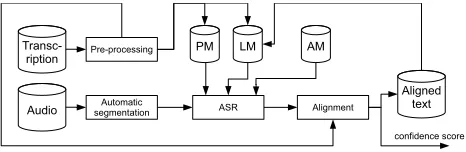
It was noticed that most of mis-alignmets in the first pass occurs at segment boundaries with only one or two mis-aligned words. For this reason, it is more efficient to use a more restricted LM rather than a LM trained with the whole episode’s text. Alignment results from the first pass are used to generate small restricted LMs for each seg-ment. Each restricted model is trained using aligned text of the current segment along with the alignment of the pre-vious and following segments. Similarly to the first pass, the adapted AM along with the restricted LMs are used in batch decoding for all the segments. In Figure 2, a high level block diagram is shown to summarize the whole long audio alignment framework.
Figure 2: A Block diagram illustrating the proposed long audio alignment framework.
4.4. Alignment Results
We started by evaluating alignment accuracy on the conver-sational evaluation setconv-eval-setwhich is characterized with the presence of many speech disfluencies like: hesita-tions, truncated words, ah, etc. First alignment pass has re-sulted in an anchor rate of 84.6% and word alignment accu-racy of 95.4% as shown in Table 1. In the second alignment pass, by using AM adaptation, alignment was significantly improved with anchor rate of 87.1% and word alignment accuracy of 96.2% as shown in Table 1. The significant in-crease in accuracy in the second pass is mainly interpreted
to the mismatch between the acoustic model (standard Ara-bic) and the speech domain (conversational AraAra-bic). Due to the adaptation applied in the second pass, the impact of this mismatch on ASR is decreased. By using restricted LM for each segment along with the adapted AM, anchor rate was significantly increased to 91.9% achieving word alignment accuracy of 97.7%.
It was noticed that the majority of mis-aligned words tends to be with relatively shorter words. This can interpret the slightly better alignment accuracy when calculating the ac-curacy in terms of characters rather than words as shown in Table 1.
Alignment pass Anchor Align. Accuracy rate words char. pass 1 84.6% 95.4% 95.8% pass 2adapt. 87.1% 96.2% 96.3% pass 2adapt./LM restrict. 91.9% 97.7% 97.8%
Table 1: Alignment accuracy and anchor rate results on the
conv-eval-set.
By applying the proposed alignment approach on the read-eval-set which is characterized with the presence of rare disfluencies. First alignment pass has resulted in an anchor rate of 91.3% and word alignment accuracy of 98.9% that is significantly better than the case of as theconv-eval-set
as shown in Table 2. In the second alignment pass, by us-ing AM adaptation, anchor rate was further improved to 93.9% as shown in Table 2, however, word alignment ac-curacy was not improved as in the case of the conv-eval-set. By using restricted LM for each segment along with the adapted AM, anchor rate was significantly increased to 96.4%, however, alignment accuracy was slightly increased to 99.0%.
Alignment pass Anchor Align. Accuracy rate words char. pass 1 91.3% 98.9% 98.9% pass 2adapt. 93.9% 98.9% 98.9% pass 2adapt./LM restrict. 96.4% 99.0% 99.0%
Table 2: Alignment accuracy and anchor rate results on the
read-eval-set.
5.
Confidence Scoring
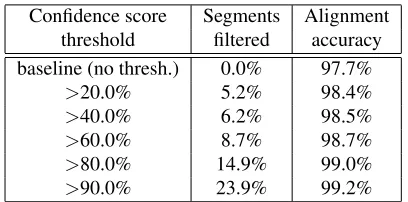
Most of the mis-alignment errors were found to be with segments having significant background noise, like: mu-sic, channel noise, cross-talk, etc., or significant speech disfluencies (truncated words, repeated words, hesitations, etc.). It should be noted that, in human generated transcripts which are associated with long audio files, disfluencies are rarely transcribed.
Elmahdy, M., Gruhn, R., Minker, W., and Abdennad-her, S. (2009). Survey on common Arabic language forms from a speech recognition point of view. In Pro-ceedings of the International Conference on Acoustics (NAG/DAGA), pages 63–66.
Elmahdy, M., Gruhn, R., Minker, W., and Abdennadher, S. (2010). Cross-lingual acoustic modeling for dialec-tal Arabic speech recognition. InProceedings of INTER-SPEECH, pages 873–876.
Elmahdy, M., Gruhn, R., and Minker, W. (2011). Novel Techniques for Dialectal Arabic Speech Recognition. Springer, New York, first edition.
Elmahdy, M., Hasegawa-Johnson, M., and Mustafawi, E. (2013). A framework for conversational arabic speech long audio alignment. In Proceedings of the 6th Lan-guage and Technology Conference (LTC), pages 290– 293.
Ferguson, C. A. (1959). Diglossia. Word, 15:325–340. Hazen, T.J. (2006). Automatic alignment and error
cor-rection of human generated transcripts for long speech recordings. In Proceedings of INTERSPEECH, pages 1606–1609.
Huggins-Daines, D., Kumar, M., Chan, A., Black, A.W., Ravishankar, M., and Rudnicky, A.I. (2006). Pocket-sphinx: A free, real-time continuous speech recogni-tion system for hand-held devices. In Proceedings of ICASSP, volume 1, pages 185–188.
Leggetter, C.J. and Woodland, P.C. (1995). Maximum likelihood linear regression for speaker adaptation of the parameters of continuous density hidden Markov mod-els. Computer Speech and Language, 9:171–185. Liu, Y., Shriberg, E., and Stolcke, A. Y. (2003).
Auto-matic disfluency identification in conversational speech using multiple knowledge sources. In Proceedings of Eurospeech, pages 957–960.
Maamouri, M., Graff, D., and Cieri, C. (2006a).
Arabic Broadcast News Speech, LDC Catalog No.: LDC2006S46. Linguistic Data Consortium, Philadel-phia.
Maamouri, M., Graff, D., and Cieri, C. (2006b). Ara-bic Broadcast News Transcripts, LDC Catalog No.: LDC2006T20. Linguistic Data Consortium, Philadel-phia.