DOI : https://doi.org/10.32628/CSEIT1952313
Progressive Localization using Mobile Anchor in Wireless Sensor Network
Ajay Kumar, Raj Kumar Paul
Department of Computer Science and Engineering, Vedica Institute of Technology, Bhopal Madhya Pradesh, India
ABSTRACT
Wireless sensor network (WSN) is employed to gather and forward information to the destination. It is very crucial to know the location of the event or collected information. This location information may be obtained using GPS or localiza-tion technique in wireless sensor networks. Randomly deployed WSN needs a large amount of GPS-enabled sensor nodes for localization, this necessitates progressive approach. However, nodes with sparse connectivity remain unlocalized. In this paper, a progressive mobile anchor based technique is proposed for node localization. Initially, sensor nodes are localized using anchors in the neighborhood, then these localized nodes progressively localized remaining nodes using multilateration. Mobile anchor node moves randomly in field and broadcast position information. Its localized nodes with sparse connectivity. Simulation results show that proposed approach localize all sensor nodes with good accuracy.
Keywords : WSN, GPS, Localization
I. INTRODUCTION
In WSNs, sensor nodes are deployed in the real geo-graphical environment and observe some physical behaviors. WSNs have many analytical challenges. Sensors are a small device in size, low-cost accounting, and having low pro-cess capabilities.
WSN’s applications attracted great attention interest of researchers in recent years [1]. WSNs have a different application such as monitor environmental aspects and physical phenomena like temperature, audio and optical data, habitat monitoring, traffic control monitoring, patient healthcare monitoring, and underwater acoustic monitoring. Data collection without their geographical positions would be useless. Localization of nodes can be achieved by using GPS (global positioning system), but it becomes very expensive if a number of nodes are large in a given network. So far, Many algorithms have been come up to solve the localization issue, but due to their application-specific nature, most of the solutions are
The rest of the paper is organized as follows. Section 2 discusses related work of localization. Section 3 describes proposed approach in brief. Section 4 provides an overview simulation and results analysis. Section 5 concludes the paper.
II. RELATED WORK
Recently, many localization techniques have been proposed for WSNs, and simultaneously many studies have been done to analyze existing localization techniques and algorithms. In [4], Mao et al. first provide an overview of measurement techniques that can be used for WSN localization. Then the one-hop and the multi-hop localization algorithms based on the measurement techniques are presented in detail, respec-tively, where the connectivity-based or range-free localization algorithms. In [5], an overview of localization techniques is presented for WSNs. The major localization techniques are classified into two categories: centralized and distributed based on where the computational effort is carried out. Based on the details of localization process, the advantages and limitations of each localization technique are discussed. In addition, future research directions and challenges are highlighted. This paper point out that the further study of localization technique should be adapted to the movement of sensor nodes since node mobility can heavily affect localization accuracy of targets. However, the localization techniques proposed for mobile sensor nodes are not discussed in [5].
In [6] Mustafa Ilhan Akbas, et al. proposed a localization algorithm for wireless networks with mobile sensor nodes and stationary actors. The proposed localization algorithm overcomes failure and high mobility of sensors node by a locality preserving approach complemented with the idea that benefits from the motion pattern of the sensors. The algorithm aims to retrieve location information at the actor nodes rather than the sensors and it
adopts one-hop localization approach in order to address the limited lifetime of the WSN. The accuracy of the proposed algorithm can be further improved with RSS or other measurement techniques at the expense of increased energy consumption.
Fig. 1. The performance of proposed approach with varying communication range
could not be defined yet, and thus a suitable localization algorithm needs to be designed on the specificities of the situations, taking into account the size of the network, as well as the deployment anchors are necessary for constructing the global coordinates, which significantly reduces the system cost.
III. MULTILATERATION
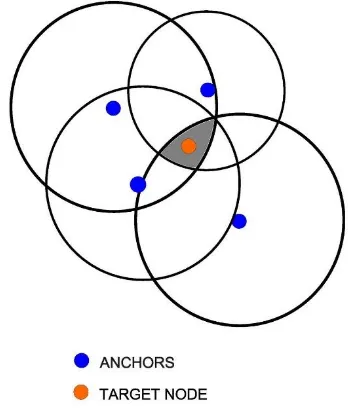
the anchor nodes and the non-anchor node) are located in the same 2-dimensional coordinate plane. As shown in Fig. 1, blue circle are the A anchor nodes S1; S2; : : : SA with fixed two-dimensional coordinates (x1; y1); (x2; y2); : : : ; (xA; yA) and S0 is the non-anchor node with coordinate (x; y). Suppose the distances from the non-anchor node S0 to each correctly, the coordinate (x; y) of the non-anchor node S0 can then be estimated unbiasedly, which is an ideal case in the applica-tions
IV. NETWORK MODEL
In this section assumption about the network model is described.
Sensor nodes and base station are static. The base station does not limit by energy. Anchor nodes are aware of their geographic location.
The distributions of sensor nodes are random over the sensing area. The sensor nodes are densely deployed in the sensing area. Sensor nodes are homogeneous in energy level. A mobile node work as anchor node and do not limit to energy.
V. PROPOSED METHOD
In this section, a range-based iterative distributed localiza-tion method has been proposed. In this work, we categories all the sensor nodes into two types viz. anchor and non-anchor node. Initially, non-anchor nodes are localized using multilateration technique.
After that, an iterative mechanism is used to localized remaining non-anchor nodes progressively. Nodes with less connectivity (less than three neighbors) are lo-calized using a mobile beacon. The proposed method consists three phases: Initial, progressive and mobile. In the first phase, nodes with more than two anchor neighbors are localized using multilateration. In the second phase, localized non-anchor nodes are used as a pseudo-anchor for nodes localization. In the last phase, a mobile anchor node moves randomly and broadcast its position for node localization.
A. Initial Phase
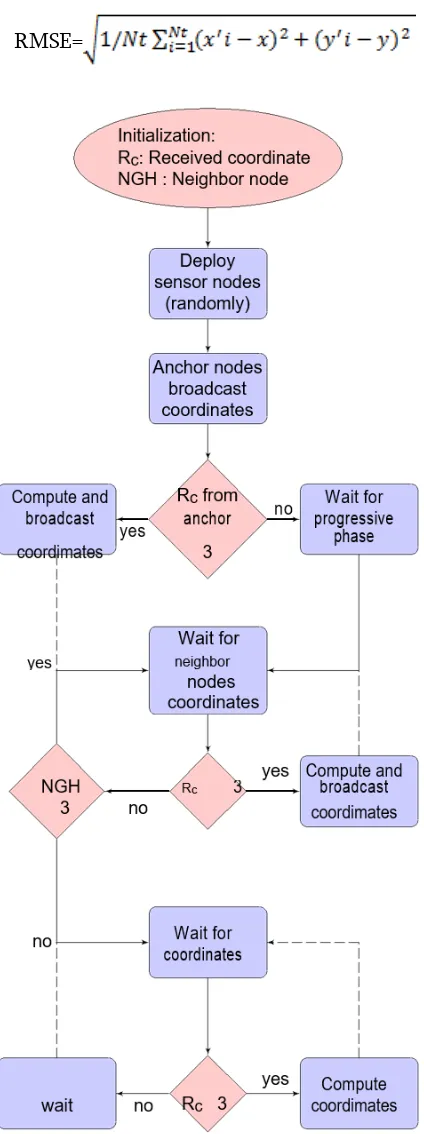
At the very beginning, all the anchor nodes broadcast their position beacon packets within communication range. This beacon packet consists of the anchor node location and the node id. Once a non-anchor node receives the beacon packet, it stores the beacon location along with the RSSI value. After receiving beacon packet from minimum three anchor nodes, each non-anchor sensor node calculates positional coordinates using the multilateration method by taking into considering the distance calculated through the RSSI value of the corresponding anchor node and its coordinates. After that, broadcast computed coordinates within communication range. These coordinates information is useful for non-anchors that do not have neighbor anchor nodes.
B. Progressive localization
In this phase, non-anchor nodes are localized using their neighbor which is already localized. This is an iterative phase
location which is well connected to the network; it means has more than three neighbors. The remaining nodes are localized in next phase.
TABLE I. SIMULATION PARAMETERS
Parameters Values
Deployed area 100 100 meter2 Total deployed nodes 100 1000
Anchor nodes 10 %
Communication range 20 meters Error in distance estimation 01 % to 20 %
C. Localization using mobile anchor
A non-anchor with less connectivity is not able to compute their location. To solve this problem we used a mobile node as an anchor, which moves randomly in field and periodical broadcast location coordinates. As soon as non-anchor node get three beacon packet from the static or moving anchor, it computes location coordinate.
The selection of beacon coordinates depend on the RSSI value degrades localization accuracy. The topological arrange-ment of the node is not a constraint. Hence, the all beacon packet considers for location computation. Localized non-anchor nodes may also use new position coordinates to update their estimated location. The process of localization is shown in Fig. 2.
VI. SIMULATION AND RESULTS
In this section, we discuss the performance of the pro-posed approach. To measure the performance, the proposed approach simulate through MatLab simulator. We varied the different parameters to observe the performance of proposed mechanism. The parameters are a number of nodes deployed in the field, the number of anchor nodes, the
communication range of sensor node, the area of interest and error in distance estimation. The measuring metrics for performance are time taken by a mobile anchor for localization, total node localized and Root Mean Square Error (RMSE) [14].
RMSE=
A. Total number of deployed sensor nodes
To observe the performance of proposed approach we simulate with anchor nodes as 10% of the total node, deployed area 100m 100m, node communication range is taken as 10% of deployed area. The error in the distance is considered as 10% of the respective distance.
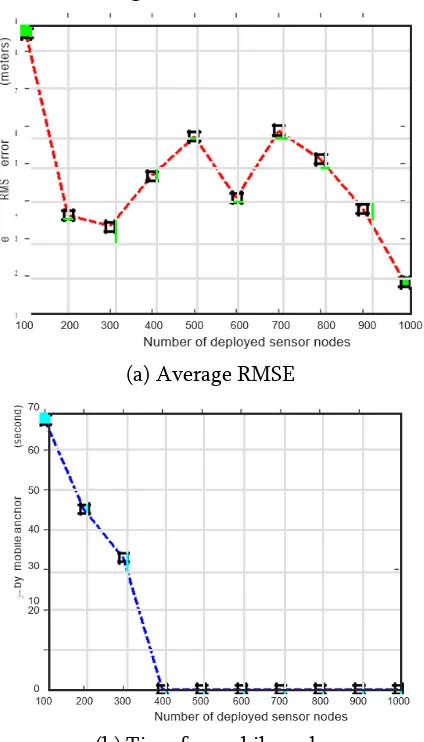
Figure 3 shows the performance of proposed approach increases with increase in the sensor nodes. It is observed that the time taken by mobile node decreases with increase in sensor node as shown in Fig 3(b). It happens because with an increase in sensor node nodes connectivity increases which increases the chance of getting more neighbor for localization as shown in Fig. 3(c). The average error of localization varies for node densities. However, localization accuracy increases with deployed sensor nodes shown in Fig 3(a).
(a) Average RMSE
(b) Time for mobile node
Fig. 4. The performance of proposed approach with anchor nodes
Fig. 5. The performance of proposed approach with varying communication range
ten anchor nodes are deployed in 100m 100m area. The error in the distance is considered as 10% of the respective distance.
It is observed that the localization error decreases with increase in communication range of the sensor nodes as shown in Fig. 5. This is because the probability of getting more anchor nodes as a neighbor is increased.
(c) Number of node localized
B. Anchor nodes
To observe the performance of proposed approach for vary-ing anchor nodes we deploy 200 sensor nodes in 100m 100m area with 10 meters radio range. The error in the distance is considered as 10% of the respective distance.
It is observed that the localization error decreases with increase in anchor nodes as shown in Fig. 4. This is because anchor nodes provide the true distances for location computa-tion.
C. Communication range
To observe the performance of proposed approach with varying connectivity, a different value of communication range has been taken for simulation. For this 100 sensor nodes with
D. Deployed area
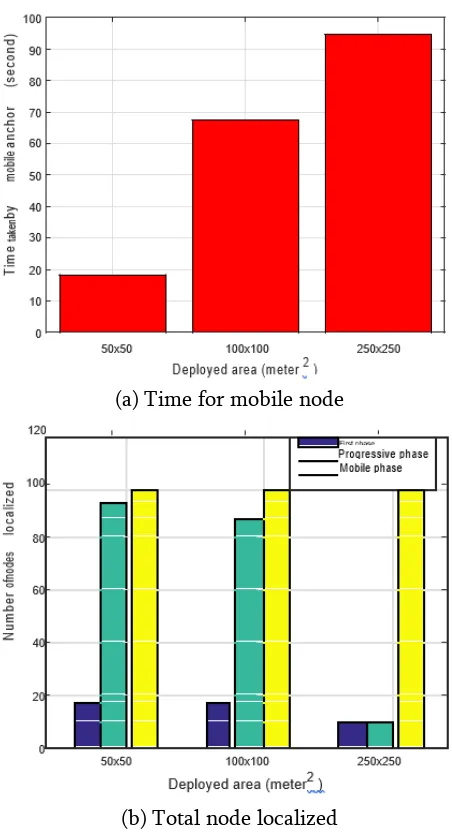
To observe the performance of proposed approach for scalability, different size of deployed area has been taken for simulation. For this 100 sensor nodes with ten anchor nodes are deployed. The communication range of a node is taken as 10% of deployed area. The error in the distance is considered as 10% of the respective distance. Fig. 6(a) shows that the time taken by the mobile node increases with deployed area. It is also observed that increase in deployed area decreases the localized node in initial two phases but finally all the nodes localized. This happens because mobile nodes provide location information of the sparsely connected node.
E. Error in distance estimation
To observe the performance of proposed approach for noise tolerance, a different value of measurement noise has been taken for simulation. For this 100 sensor nodes with ten anchor nodes are deployed in 100m 100m area. The communication range of a node is taken as 10% of deployed area.
(a) Time for mobile node
(b) Total node localized
Fig. 6. The performance of proposed approach with deployed area
in Fig. This is because the probability of getting true distance decreases with measurement error.
F. Performance comparison
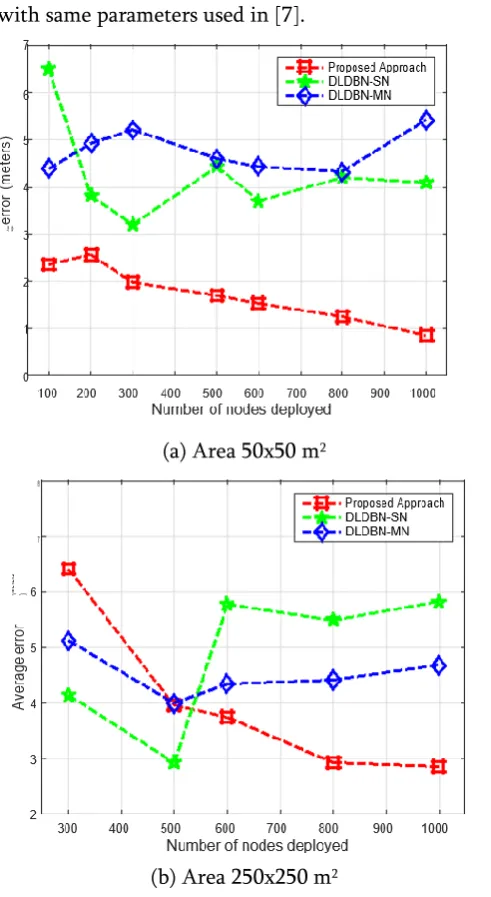
In this section, we compare the performance of proposed approach with other existing techniques. The Distributed lo-calization using a Dynamic Beacon Node (DLDBN) [7] taken two scenarios for performance analysis. In the first scenario, the static anchor is considered for localization and in second, mobile nodes as taken as anchor nodes for localization. We simulate the proposed approach with same parameters used in [7].
(a) Area 50x50 m2
(b) Area 250x250 m2
Fig. 8. The performance comparison with DLDBN
Fig. 8 shows the performance comparison between the proposed approach and DLDBN [7] for varying node density. The average error in localization is taken as the performance measure. It is observed that proposed approach perform better than existing techniques for a small area as shown in Fig. 8(a). For a large area, proposed approach lacks for low density, but for higher density, it performs far better than existing methods as shown in Fig. 8(b).
VII.CONCLUSION
In this paper, we proposed a distributed iterative localiza-tion algorithm that uses the mobile anchor nodes that move randomly and send location information to their neighbors to compute their approximate location. A progressive technique also helps to localize sensor nodes with low anchor density. The proposed algorithm is based on the multilateration which used the distance between nodes for location computation. It is found that the localization error is further reduced by receiving multiple beacons from the mobile anchor nodes from the different position during their mobility. The most significant advantages of mobile anchor node over static anchor node are that with less number of mobile anchor nodes the localization over the whole network is achieved, which is preferable for energy constrained WSN.
VIII. REFERENCES
[1]. I. F. Akyildiz, W. Su, Y. Sankarasubramaniam,
and E. Cayirci, “Wireless sensor networks: a survey,” Computer networks, vol. 38, no. 4, pp.
393–422, 2002.
[2]. A. Savvides, H. Park, and M. B. Srivastava, “The
n-hop multilateration primitive for node
localization problems,” Mobile Networks and
Appli-cations, vol. 8, no. 4, pp. 443–451, 2003. [3]. N. Jain, S. Verma, and M. Kumar, “Locally
wireless sensor networks,” in Computational
Intelligence and Communication Networks (CICN), 2015 International Conference on. IEEE, 2015, pp. 126–130.
[4]. X. Li, Y. Zhang, K. Xu, G. Fan, and H. Wu,
“Research of localization and tracking
algorithms based on wireless sensor network,”
Journal of Information & Computational Science, vol. 8, no. 4, pp. 708–715, 2011.
[5]. G. Mao, B. Fidan, and B. D. Anderson,
“Wireless sensor network localization
techniques,” Computer networks, vol. 51, no.
10, pp. 2529–2553, 2007.
[6]. M. I. Akbas¸, M. Erol-Kantarcı, and D. Turgut, “Localization for wireless sensor and actor
networks with meandering mobility,” IEEE
Transac-tions on Computers, vol. 64, no. 4, pp. 1015–1028, 2015.
[7]. S. K. Rout, A. Mehta, A. R. Swain, A. K. Rath,
and M. R. Lenka,“Algorithm aspects of dynamic
coordination of beacons in localization of
wireless sensor networks,” in 2015 IEEE
International Conference on Computer Graphics, Vision and Information Security (CGVIS). IEEE, 2015, pp. 157–162.
[8]. C. Nguyen, O. Georgiou, and Y. Doi,
“Maximum likelihood based multihop
localization in wireless sensor networks,” in
2015 IEEE International Conference on Communications (ICC). IEEE, 2015, pp.6663–
6668.
[9]. S. Tomic, M. Beko, R. Dinis, and L. Berbakov,
“Cooperative local- ization in wireless sensor
networks using combined measurements,” in
Telecommunications Forum Telfor (TELFOR), 2015 23rd. IEEE, 2015, pp. 488–491.
[10]. J. Cota-Ruiz, P. Rivas-Perea, E. Sifuentes, and R. Gonzalez-Landaeta,“A recursive shortest
path routing algorithm with application for
wirelesssensor network localization,” IEEE
Sensors Journal, vol. 16, no. 11, pp. 4631–4637, 2016.
[11]. S. Shen, B. Yang, K. Qian, and X. Jiang, “An
efficient localization algorithm in wireless
sensor networks,” in 2015 Third International
Symposium on Computing and Networking (CANDAR). IEEE, 2015, pp. 291–294.
[12]. X. Zhang, J. Fang, and F. Meng, “An efficient
node localization approach with rssi for
randomly deployed wireless sensor networks,”
Journal of Electrical and Computer Engineering, vol. 2016, 2016.
[13]. D. Wang, L. Yang, and X. Cheng, “A low -complexity cooperative algorithm for robust
localization in wireless sensor networks,” in
2016 International Conference on Computing, Networking and Communica- tions (ICNC). IEEE, 2016, pp. 1–5.
[14]. V. K. Chaurasiya, N. Jain, and G. C. Nandi, “A
novel distance estimation approach for 3d localization in wireless sensor network using
multi dimensional scaling,” Information Fusion,
vol. 15, pp. 5–18, 2014.
Cite this article as :
Ajay Kumar, Raj Kumar Paul, "Progressive Localization using Mobile Anchor in Wireless Sensor Network", International Journal of Scientific Research in Computer Science, Engineering and Information Technology (IJSRCSEIT), ISSN : 2456-3307, Volume 5 Issue 2, pp. 996-1003, March-April 2019. Available at doi :
https://doi.org/10.32628/CSEIT1952313