Distributional Semantics for Resolving Bridging Mentions
Tim Feuerbach and Martin Riedl and Chris Biemann Language Technology Group, CS Department, TU Darmstadt, Germany
[email protected], {riedl, biem}@cs.tu-darmstadt.de
Abstract
We explore the impact of adding distri-butional knowledge to a state-of-the-art coreference resolution system. By inte-grating features based on word and context expansions from a distributional thesaurus (DT), automatically mined IS-A relation-ships and shallow syntactical clues into the Berkeley system (Durrett and Klein, 2013), we are able to increase its F1 score on bridging mentions, i.e. coreferent men-tions with non-identical heads, by 8.29 points. Our semantic features improve over the Web-based features of Bansal and Klein (2012). Since bridging mentions are a hard but infrequent class of coreference, this leads to merely small improvements in the overall system.
1 Introduction
Automatically recognizing coreference – relating lexical items that refer to the same entity or con-text in a con-text – is an important semantic processing step for text understanding tasks such as fact ex-traction, information retrieval, and entity linking.
A common problem of coreference systems is their inability to resolve bridging mentions, i.e. coreferent mentions with non-identical heads (Vieira and Poesio, 2000). For example, a system requires semantic knowledge to detect the hyper-nymic relationship that holds between mentions likea preliminary agreement andthe pact. Simi-larly, modeling selectional preference relies on in-formation beyond the pronoun context itself.
There are two different kinds of approaches em-ployed in the past to make this knowledge avail-able as features to a coreference resolution system. The first class uses manually crafted resources like WordNet or Wikipedia (Poesio et al., 2004; Ponzetto and Strube, 2006). Despite their quality,
they may decrease the performance when added to the system (Lee et al., 2011; Zhou et al., 2011). Further disadvantages are their limited size, slow growth and general-purpose nature. In contrast, using unsupervised/semi-supervised methods for generating knowledge is only limited by the size of input data and adapts to the target domain.
We present features exploiting automatically obtained distributional knowledge, following the distributional hypothesis formulated by Harris (1954) that words in similar contexts bear simi-lar meanings. For that we resort to a distribu-tional thesaurus (DT; Lin, 1998) listing semanti-cally similar terms, as well as hyponym-hypernym relations (IS-As) acquired with Hearst patterns (Hearst, 1992), both made available by the JoBim-Text Project (Biemann and Riedl, 2013). When added to the state-of-the-art Berkeley Corefer-ence Resolution System (Durrett and Klein, 2013), these features show a significant positive impact on bridging mentions.
2 Related Work
Our work is very similar to Bansal and Klein (2012), who created, among others, features based on IS-As, distributional clusters, and pronoun con-texts. However, we chose to use a DT’s list of sim-ilar words instead of clustering, and dependency relations as context features instead of N-gram neighborhood. We will compare our approach to Bansal and Klein’s features below.
Distributional methods for coreference resolu-tion are mostly pattern-based (Haghighi and Klein, 2009; Kobdani et al., 2011). Recent work by Re-casens et al. (2013) used news events as context and exploited rewordings of the same story in dif-ferent sources.
Semantic similarity for the resolution of bridg-ing mentions has been employed by Poesio et al. (1998), Gasperin et al. (2004), and Versley (2007), yet all three works are applied to oracle anaphoric
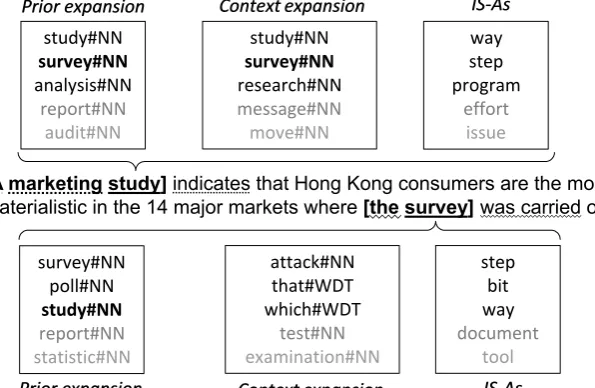
Feature values: PRIOR(t1,t2) = 2, PRIOR(t2,t1) = 3, SHARED PRIOR = 0.4, IS-IS-A(t1,t2) = false, IS-IS-A(t2,t1) =
false, SHARED IS-As = 0.7, IN C-EXPANSION(t1,t2) = 2, IN C-EXPANSION(t2,t1) = 13.
Figure 1: Expansions and feature values for an example pair of bridging mentions from the development set. Dotted and wavy lines indicate dependency relations used in the context expansion.
A mentionm0
iis considered a false positive (fp) if it is bridging in the system chain CS, but is not coreferent with its immediate predecessor from
C∗
S(m0i)in the gold standard.
5 Additional Features
We added pairwise features from four different categories to the system, of which the last one (at-tribute features) is only loosely tied to a DT. Rank-based features have been discretized using equal-width binning (bin size: 20), though values from the interval[−2,20]were spelt out explicitly. Real values from the interval[0,1]were discretized by simply rounding to the first decimal digit. In the following feature description, t1 and t2 denote the heads of the current and antecedent candidate mention in term form. Each asymmetrical fea-ture has an additional instance witht1 andt2 re-versed. Furthermore, the function expansion(·)
takes a term as its argument and returns the 200 most similar terms according to the DT. The po-sition of a term tin an expansion is reported by rank(t,·).
1.Priorfeatures target a head word’s list of se-mantically similar terms as returned by the DT’s expansion.
• PRIOR: Its value is 0 if t1 = t2, -2 if expansion(t2) = ∅, -1 if t1 ∈/
expansion(t2), and rank(t1,expansion(t2))
otherwise.
• SHARED PRIOR: The overlap of two ex-pansions:(|expansion(t1)∩expansion(t2)|) /min(|expansion(t1)|,|expansion(t2)|). 2. IS-A features operate on open class head words’ hypernyms. To keep things simple, we treated all clusters equal.
• IS-IS-A:Trueift1is among any of the IS-As of any cluster oft2,falseotherwise.
• SHARED IS-As: Calculates the Dice index (Dice, 1945) between each IS-A cluster of
t1 and each of t2 and returns the maximum value.
Since the data contains some noisy IS-As like bit (originating from is a bit), we added an ad-ditional lexicalized feature for SHARED IS-A = truewith the shared IS-A that has the highest fre-quency in the model.
MUC B3 CEAF e
P R F1 P R F1 P R F1 Average
De
velopment
BASELINE 69.88 63.25 66.40 61.86 52.98 57.08 57.69 54.31 55.95 59.81
DUMMY 69.81 63.92† 66.74† 61.86 53.74† 57.52† 58.03 55.23† 56.60† 60.28†
P 69.62 63.98† 66.68† 61.85 53.91† 57.60† 58.11 55.35† 56.69† 60.33†
PI 69.73 64.12† 66.81† 62.00 54.13† 57.80† 58.24† 55.42† 56.79† 60.47†
PIC 69.60 64.13† 66.76† 62.00 54.14† 57.81† 57.99 55.56† 56.75† 60.44†
PICA 69.59 64.54† 66.97† 61.90 54.73† 58.09† 58.31 56.04† 57.15† 60.74†
B&K (2012) CO 70.09 63.48 66.62 62.77† 53.35 57.68† 58.22† 54.69 56.40† 60.23†
—”— +DUMMY 69.78 64.19† 66.87† 62.23 54.08† 57.87† 58.02 55.21† 56.58† 60.44†
Test
BASELINE 69.69 65.98 67.79 58.68 53.59 56.02 54.31 53.88 54.09 59.30
PICA 69.17 66.87† 68.00 57.77 54.49† 56.08 54.45 54.44† 54.44 59.51
B&K (2012) CO 69.30 66.11 67.67 58.10 53.62 55.77 54.31 53.63 53.97 59.14 —”— +DUMMY 68.57 66.56† 67.55 57.12 54.12† 55.58 53.70 53.80 53.75 58.96
Table 1: Metric results achieved by the baseline, dummy setting, and incrementally adding features to the baseline (P = prior expansion, I = IS-A, C = C-expansion and A = attribute features). Also comparing to the Bansal and Klein (2012) co-occurrence feature. Scores with a dagger (†) are significantly better than the BASELINE(paired bootstrap resampling test withN = 10000andp= 0.05(Koehn, 2004)).
andT = {t1, . . . , tn}the set of terms for which there exists a cj ∈ C such that the pair (ti, cj) is a member of the model. We sort the mem-bers of T in the descending order of their prob-abilityP(ti|C) and take the first 200 elements as the target term’s C-expansion. DefiningP(ti|C), we assume conditional independence and calcu-late the plus-one-smoothed MLE asQcj∈C(sig(ti,
cj) + 1)/(V +Psig(∗, cj)), withsig(·,·) return-ing the significance value of a term-feature pair stored in the model, andV as the vocabulary size. The coreference feature IN C-EXPANSION then returns the rank of t1 in t2’s C-expansion with PRIOR’s result semantics. If t1 is from a closed word class, it is first mapped to the first open word class term from its own C-expansion. Unlike typ-ical takes on selectional preference, we expand all mention heads, not only pronouns, to take their contextual role (Bean and Riloff, 2004) into ac-count and to have at least some semantic knowl-edge for out-of-vocabulary terms.
4. Attribute features inspired by Vieira and Poesio (2000, 556 f.;560) guessing properties of mentions from dependency relations in the text. We consider as attributes all words in a copula, ap-positive, relative clause, or compound relation to a mention’s head and added the following features:
• ATTR PRIOR = {no attributes, −2, . . .,
200}: Expands t2, looks up each attribute of t1 in t2, and reports the best rank as in PRIOR.
• ATTR IS-IS-A = {true,false}: Its value is true if t1 is among any IS-A set of any at-tribute oft2,falseotherwise. Iftrue, adds an additional version with the lexicalized IS-A.
Figure 1 illustrates the first three feature groups by means of a sentence from the development set. While the baseline treats those mentions as sep-arate entities, our distributional features lead to their correct resolution.
6 Results
We present the results3of the modifications in
Ta-ble 1. We also compare to a dummy system with the full feature set whose prior expansions return the identity, while the C-expansion and IS-A clus-ters are empty. This system profits from lemma-tization as well as the syntactic clues provided by the attribute features.
While the BASELINE was unable to solve the introductory example, the distributional features provide the system enough confidence in assign-ing the mentions with the non-identical headspact andagreement to the same entity. C-expansions had only low impact on performance. In a man-ual analysis, we observed many cases in which the sematically less preferable antecedent was se-lected, or in which non-coreferent pronouns were assigned to an entity, for example linkingyou in
3differences to reported scores in (Durrett and Klein,
Thank you for your visitto a previous occurrence ofGodbecause of the common phraseThank God. In comparison to PI, the recall on singleton pro-nouns decreased by 1 point, while the pairwise re-call on anaphoric pronouns increased only by 0.4 points.
The final results on the test set in Table 1 were obtained by training on the conjunction of training and development data. We sacrifice some preci-sion for better recall. Unfortunately, the increase in average F1 is not significant.
For comparison, we also integrated the feature set by Bansal and Klein (2012), computed on the Google Web N-gram corpus (Brants and Franz, 2006), into the Berkeley system. It includes the following features:General co-occurrencetargets the general frequency of two head words appear-ing near to each other. Hearstworks like our IS-IS-A feature.Entity-based contextcollects lists of seedsyin the patternh (is|are|was|were) (a|an|the)? y in decreasing order of fre-quency, and reports whether there is a match in the topkseeds of the two head words. It also returns the dominant POS of the matched words.Pronoun contextsubstitutes pronouns with their antecedent and estimates the likelihood of the new sequence. Finally, theclusterfeature returns the sum of the earliest match positions of the two headwords’ cluster ID lists, using phrasal clusters obtained by Lin et al. (2010).
We experimented with different permutations of these features, including the sets proposed in Bansal and Klein (2012), but found a set contain-ing only the co-occurrence feature to perform best with regards to the average metrics score.4 The
results can be found in Table 1 noted as B&K. Remarkably, the feature rather increases precision than recall. The cluster feature led to a perfor-mance decrease already on the development set. This may stem from the many semantically unre-lated word pairs, likeswords – elephantsor defini-tion – horror, which share the same top cluster.
The models’ results on bridging mentions are displayed in Table 2. We outperformed the base-line on both sets (F1 increased on test by 8.29 points). The positive impact on the metric scores is minor though, since only 7.6% of all mentions in the development set are bridging.
Again, we compare to the Bansal and Klein
4For binning, we tried bin sizes1,0.5, and0.25. For the
entity features, we triedk∈ {10,20,50,100,200}.
Bridging P R F1
BASELINE-Dev 36.21 15.51 21.72 DUMMY-Dev 41.36 17.45 24.55 PICA-Dev 44.87 23.82 31.12 B&K (2012)*-Dev 39.15 19.67 26.18 B&K (2012)*+Dummy-Dev 42.81 21.98 29.04 B&K (2012)*+PICA-Dev 44.19 24.56 31.57
BASELINE-Test 38.06 17.32 23.81 PICA-Test 39.47 27.05 32.10
B&K (2012)*-Test 37.97 21.56 27.50 B&K (2012)*+PICA-Test 36.84 27.33 31.38
Table 2: Precision, recall and F1scores on bridg-ing mentions. Bolded improvements are signifi-cant over the baseline (p= 0.05, N = 10000).
(2012) features, this time choosing the set per-forming best with regards to bridging mentions, which contains all features except pronoun con-text, which achieved an increase of 3.69 absolute F1 points on the test set. To assess whether these features are subsumed by our set or provide addi-tional value, we also show the results of combining both in Table 2. The decrease in precision on the test set suggests that the Web features introduce too much noise to the system.
7 Error Analysis
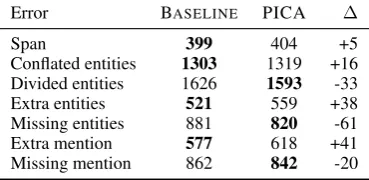
Error BASELINE PICA ∆
Span 399 404 +5
Conflated entities 1303 1319 +16 Divided entities 1626 1593 -33 Extra entities 521 559 +38 Missing entities 881 820 -61
Extra mention 577 618 +41
Missing mention 862 842 -20
Table 3: Development set error counts comparison
ACR ATT CAN DAT DISC HEAD HYP TATT LEM MET SYN INV P
BASELINE 2 77 0 2 1 26 46 0 0 6 5 3
PICA 3 99 1 3 4 31 97 1 1 6 9 3
Total 23 235 50 32 171 58 409 13 10 38 32 12 1083
Table 4: Comparison of the numbers of resolved bridging mentions in the development set, broken down per type.
linking mentions with diverse heads if they bear at least some semantic similarity, creating spurious chains, which is punished by MUC and B3 preci-sion.
This intuition is backed by a manual analysis we conducted on 100 random errors not made by the baseline. When examining each of the system’s antecedent decisions and their weights, we found that 23% of the wrong links were chosen because of distributional semantics features. The major-ity of these semantic errors were triggered by the PRIOR feature, whereas only one of them could be ascribed to the IS-A feature. Here, the recall-oriented clustering of IS-As in the DT (Gliozzo et al., 2013) produced an incorrect hypernymic rela-tion betweenChaidamun Basinandthe country.
We classified the 1083 bridging mentions from the development set according to the knowledge required for resolution or their semantic relation-ship with a previous mention into the following categories:
ACR One head is an acronym of the other.
ATT One head is an attribute of the other as de-fined in Section 5.
CAN One head is in a CAN-BE relationship with the other, e.g.pilotandman.
DAT Temporal deixis liketoday – the 30th. We attribute the low recall of this class to the fact that the Berkeley system’s FINALfeature set does not make use of named entity labels.
DISC Bridging mentions requiring textual entail-ment techniques, e.g.my motherandThelma Wahl, sophisticated world knowledge as in the case of Martha Stewart – the come-back queen, or a discourse model to identify speakers or deixis.
HEAD Both heads are identical, but the system’s head detection made a mistake. A large por-tion of these cases were Asian names, where
the family name precedes the first name, and thus a strategy selecting the last word falls flat.
HYP The head of one mention is a hyponym of the other.
TATT Transitive attributes, i.e. one head is a hy-pernym, hyponym, acronym or synonym of one of the other mention’s attributes, e.g. Doctor Hunterandthe physician.
LEM Both heads have the same lemma.
MET The heads are in a metonymous rela-tionship, e.g. the Japanese government and Japan.
SYN The heads are synonyms or near-synonyms, e.g.dadandfather. This class also contains spelling variants and typos of proper names.
INV Invalid: At least one mention’s head is a pro-noun, but does not have the appropriate POS tag.
Alessandro Lenci. 2011. Composing and updating verb argument expectations: A distributional seman-tic model. InProc. CMCL, pages 58–66, Portland, OR, USA.
Alessandro Lenci. 2014. Will distributional se-mantics ever become semantic? Talk at the 7th International Global WordNet Conference, Tartu, Estonia. http://gwc2014.ut.ee/lenci_ distributional_semantics_gwc2014. pdf.
Dekang Lin, Kenneth Ward Church, Heng Ji, Satoshi Sekine, David Yarowsky, Shane Bergsma, Kailash Patil, Emily Pitler, Rachel Lathbury, Vikram Rao, et al. 2010. New tools for web-scale n-grams. In
Proc. LREC, Valletta, Malta.
Dekang Lin. 1998. Automatic retrieval and cluster-ing of similar words. InProc. COLING, volume 2, pages 768–774, Montreal, QC, Canada.
Xiaoqiang Luo. 2005. On coreference resolution per-formance metrics. InProc. HLT-EMNLP, pages 25– 32, Vancouver, BC, Canada.
Vincent Ng. 2007. Shallow semantics for coreference resolution. InProc. IJCAI, pages 1689–1694, Hy-derabad, India.
Massimo Poesio, Sabine Schulte im Walde, and Chris Brew. 1998. Lexical clustering and definite descrip-tion interpretadescrip-tion. In Proc. AAAI Spring Sympo-sium on Learning for Discourse, pages 82–89, Stan-ford, CA, USA.
Massimo Poesio, Rahul Mehta, Axel Maroudas, and Janet Hitzeman. 2004. Learning to resolve bridging references. InProc. ACL, Barcelona, Spain. Simone Paolo Ponzetto and Michael Strube. 2006.
Exploiting semantic role labeling, WordNet and Wikipedia for coreference resolution. In Proc. NAACL-HLT, pages 192–199, New York, NY, USA. Sameer Pradhan, Lance Ramshaw, Mitchell Marcus, Martha Palmer, Ralph Weischedel, and Nianwen Xue. 2011. CoNLL-2011 shared task: Model-ing unrestricted coreference in OntoNotes. InProc. CoNLL, pages 1–27, Portland, OR, USA.
Sameer Pradhan, Xiaoqiang Luo, Marta Recasens, Ed-uard Hovy, Vincent Ng, and Michael Strube. 2014. Scoring coreference partitions of predicted men-tions: A reference implementation. InProc. ACL, pages 22–27, Baltimore, MD, USA.
Marta Recasens, Matthew Can, and Daniel Jurafsky. 2013. Same referent, different words: Unsupervised mining of opaque coreferent mentions. In Proc. HLT-NAACL, pages 897–906, Atlanta, GA, USA. Yannick Versley. 2007. Antecedent selection
tech-niques for high-recall coreference resolution. In
Proc. EMNLP-CoNLL, pages 496–505, Prague, Czech Republic.
Renata Vieira and Massimo Poesio. 2000. An empir-ically based system for processing definite descrip-tions.Computational Linguistics, 26(4):539–593. Marc Vilain, John Burger, John Aberdeen, Dennis
Con-nolly, and Lynette Hirschman. 1995. A model-theoretic coreference scoring scheme. In Proc. MUC-6, pages 45–52, Columbia, MD, USA. Huiwei Zhou, Yao Li, Degen Huang, Yan Zhang,