Evaluating Various Linguistic Features on Semantic Relation Extraction
Marcos Garcia Center for Research in Information Technologies (CITIUS) University of Santiago de Compostela [email protected]
Pablo Gamallo Center for Research in Information Technologies (CITIUS) University of Santiago de Compostela
Abstract
Machine learning approaches for Information Extraction use different types of features to acquire semantically related terms from free text. These features may contain several kinds of linguistic knowledge: from orthographic or lexical to more complex features, like PoS-tags or syntactic dependencies. In this paper we select four main types of linguistic features and evaluate their performance in a system-atic way. Despite the combination of some types of features allows us to improve the f-score of the extraction, we observed that by adjusting the positive and negative ratio of the training examples, we can build high quality classifiers with just a single type of linguis-tic feature, based on generic lexico-syntaclinguis-tic patterns. Experiments were performed on the Portuguese version of Wikipedia.
1 Introduction
With the exponential growth of data, the interest in learning semantic information related to named en-tities has been increased. For instance, from the sen-tence Ernest Hemingway (July 21, 1899 - July 2,
1961) was an American author, a system may learn
various properties about Hemingway (his birth and death dates, his origin as well as his occupation).
Many techniques employ Machine Learning (ML) algorithms for the extraction task. They ar-range into a set of features the contexts or sentences in which pairs of related entities occur. These fea-tures are then used to train a classifier. The start-ing point is a number of labeled trainstart-ing examples
(“Ernest Hemingway - author”), as well as a corpus-based strategy to identify and represent as features those sentences (contexts) in which the training ex-amples occur. These techniques may have different degrees of supervision, from manually constructed corpora to weakly supervised on unsupervised meth-ods. Moreover, it must be pointed out that features can be represented at different levels of generality, according to different types of knowledge. However, there are no much work on the importance of know-ing what lknow-inguistic information is actually useful in order to increase the performance of these systems.
In this article, we evaluate and compare the im-pact of different types of linguistic features for Re-lation Extraction (RE). We built and tested a distant supervision system with different types of linguis-tic features: bags of lemmas and PoS-tags, lexico-syntactic patterns and lexico-syntactic dependencies. We evaluated the performance of these types of features individually and in several combinations. Prelimi-nary results in Portuguese data show that, usually, the combination of some types of linguistic features allows us to increase recall without losing precision. Furthermore, we also observed that a deep analysis of the positive/negative (P/N) ratio of the training examples improves the f-score of the classifiers.
Sect. 2 introduces some related work. Then, 3 shows the method for obtaining the data and Sect. 4 presents the features. In Sect. 5 we show the results. Finally, Sect. 6 draws the conclusions of our work.
2 Related Work
for extracting related terms, such as Brin (1998). More recent works (Mann, 2002; Fleischman et al., 2003; Agichtein, 2005) use different features (words, lemmas, PoS-tags, etc.) for training ML sys-tems with several algorithms. Other works (Snow et al., 2005; Bunescu and Mooney, 2005) created sta-tistical models using the results of syntactic parsing. Despite that some preliminary results show that the use of deep linguistic knowledge is better for RE, Bunescu and Mooney (2005) warn of the importance of knowing what of this information is actually use-ful to increase the performance of an IE system.
In this sense, some works must be cited: Kamb-hatla (2004) and Zhou et al. (2005), which eval-uate the effectiveness of diverse lexical, syntactic, and semantic information on RE, and Zhao and Gr-ishman (2005), which use a more complex kernel-based strategy to combine features of different lin-guistic levels. However, their work differs from ours in a key point: the linguistic feature space is not the same, in particular they do not make use of lexico-syntactic patterns. Moreover, our evaluation con-cerns other languages than English as well as a deep analysis of the impact of negative examples on the training data (see Garcia and Gamallo (2011) for some other evaluations in Spanish).
Finally, Wu and Weld (2010) present woe, an Open Information Extraction method based on data obtained from Wikipedia semi-structured resources.
3 Method Overview
In order to easily evaluate the performance of vari-ous types of features, we use the following distant supervision method (Mintz et al., 2009):
We get a large set of entity pairs of a desired relation from (semi)structured resources, such as Wikipedia infoboxes. For instance, for the
Occupation relaOccupation we get pairs such as “Michel Tournier
-writer”, “Edgar Snow - journalist”, etc. (with about 95% precision). We use these pairs to select from the unstructured text of Wikipedia sentences that con-tain both a named entity and an occupation, so no bootstrapping is required. If the two terms match a known pair of the initial list, the example is anno-tated as positive. Otherwise, it is annoanno-tated as neg-ative. Then, we lemmatize, PoS-tag and recognize the proper names with FreeLing (Padr´o et al., 2010;
Garcia and Gamallo, 2010). Syntactic dependencies are identified by a robust, partial, and rule-based de-pendency parser (Gamallo and Gonz´alez, 2011).
The two target entities are replaced by both X and
Y (standing for the first and the second entities of
the pair, respectively) and put labels to mark the left, middle, and right contexts.
All the process is performed without human revi-sion. Let us note this method may lead us to auto-matically annotate false positives (“Linus Torvalds discussed with a software engineer in Italy”, true) or false negatives (“Fernando Pessoa was a
liter-ary critic”, false, since this attribute does not
ap-pear in the infobox). The manual revision of the test set showed that this method has a precision of about 80%. This issue will be addressed by using ML al-gorithms that are tolerant to noise by minimizing the effect of the false samples.
4 Feature Space and Types of Features
Each selected, tagged, and parsed sentence repre-sents a linguistic structure containing all the rele-vant information required by the systems. Linguis-tic structures can be conceived as knowledge-rich spaces incorporating several levels of linguistic in-formation. These spaces should be as complete as possible in the sense that all features potentially use-ful for RE are included. A linguistic structure con-tains the surrounding context of the related entities:
X stands for the named entity and Y for the
occupa-tion name. We include within a linguistic structure the left context of the first entity, the middle con-text, and the right context of the second entity. Left and right contexts have a maximum size of 3 tokens (from pos -1 to -3 and +1 to +3), while middle con-text may contain 12 tokens (from pos 1 to 12). The window size was empirically set to 3 and 12 after having tested different values in preliminary experi-ments. We will distinguish experiments taking into account all contexts (left, right, and middle) from those considering only the middle one.
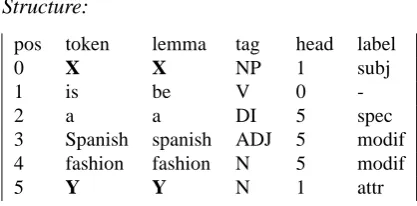
Sentence: Amancio Ortega Gaona is a Spanish
fashion entrepreneur.
Structure:
pos token lemma tag head label
0 X X NP 1 subj
1 is be V 0
-2 a a DI 5 spec
3 Spanish spanish ADJ 5 modif 4 fashion fashion N 5 modif
5 Y Y N 1 attr
Figure 1: Example of a linguistic structure.
a partial parser, not all possible word dependencies are identified. These linguistic structures are used to extract the different types of features needed by our classifiers. We use 4 main different types of linguis-tic features in order to build the RE systems:
Basic Patterns: The first type of feature uses all the explicit information contained in the linguistic structures except two elements: dependency rela-tions and some lemmas. We only take into account lemmas of verbs, common nouns and prepositions. We have observed in preliminary experiments that the performance of classifiers decreased when either these types of lemmas were removed or all lemmas including grammatical words (stop words), adjec-tives and proper names were retained. It follows that verbs, common nouns and prepositions are critical pieces of information to define the lexico-syntactic contexts of the target terms. An example of basic patterns associated to the relation “Occupation” is the following (for the same sentence as in Figure 1):
Pattern:<X be V DI ADJ fashion N Y>
(where V means verb, DI indefinite article, ADJ ad-jective, and N noun). We have to note that this kind of approach requires a huge training corpus, due to the lack of flexibility of the patterns. With this type of feature, the problem of sparse data is crucial.
Pattern Generalization: To minimize the sparse data problem, we apply an algorithm based on simi-larity between basic patterns, generalizing them and thus increasing the coverage of the model. In or-der to generalize two patterns, we check first if they are similar and then we remove all those units that
they do not share. After computing the similarity
between two patterns p1 and p2, the longest
com-mon string (lcs) is extracted if and only ifp2 is the
most similar pattern of p1 and the similarity score
is higher than a particular threshold. The lcs of two patterns is considered as their generalized pattern.
Bags of Lemmas and Tags: Instead of using a set of entire patterns as features, a common method that allows us to increase the coverage of the extrac-tor is the utilization of smaller items, such as lem-mas with PoS annotation. In this case, the exam-ple sentence (Figure 1) would generate the following features (notice again that for some categories only the tag is retained): <be V>,<DI>,<ADJ>and <fashion N>.
Syntactic Dependencies: We consider a subset of all the syntactic dependencies derived from the full linguistic structures. Given a sentence, two types of dependencies are retained: (i) dependencies be-tween the two target terms (X or Y), and (ii) depen-dencies between one of the two target terms and one entity of the (left, middle, or right) context.
For instance, from the previous example sentence the selected dependencies would be the following: <subj;X;be V>, <attr;be V;Y>, <spec;Y;DI>, <modif;Y;ADJ>and<modif;Y;fashion N>.
Each feature is a triple constituted by the de-pendency label, the head, and the dependent token. Only dependencies with at least one term (X or Y) were selected from the linguistic structure. The se-lected information, thus, corresponds to the local de-pendency context around the related terms. Finally, labels of dependencies (e.g., modifier, subject, etc.) are also taken into account to define the features.
Note that the analysis is very partial. In many cases, the parser is not able to complete the depen-dency path between the two terms. Grammars for other languages than English are often not complete or they are not freely available.
5 Experiments
we also performed some experiments concerning the ratio of positive and negative examples in the training set. The experiments were performed with WEKA (Witten and Frank, 2005), using its im-plementation of the SMO algorithm. This choice was made because in preliminary experiments (us-ing Naive Bayes, Decision Trees as well as SMO algorithms), SMO scored the best.
The training examples were obtained from the Portuguese Wikipedia with the method showed in Section 3. We focused on examples of the semantic relation “Occupation”, which is a kind of is a
rela-tion. We first selected about 50,000 relation pairs
from infoboxes. Then, we identified near 500,000
sentences containing a named entity and an occu-pation noun, which were automatically classified as positive or negative. Finally, we randomly selected
an initial set of2000 sentences for training, 50% of
them being positive examples. For testing, we
ran-domly extracted and manually revised a set of 700
sentences (different than those used for training).
5.1 Results
The evaluated classifiers were built with the types of features explained in Section 4:
pattern-all and pattern-mid use the basic patterns
as features. The former was trained with all contexts (left, right, and middle), while the latter was only trained with the middle context.
pattern gen-mid uses as features the generalized
patterns and the middle context.
bow-all and bow-mid were built with the bag of
lemmas and tags technique.
dep-all and dep-mid are the dependency-based
models described in the previous section.
Precision is the number of correct positive deci-sions divided by the number of positive decideci-sions (true and false positives). Recall here refers to the number of correct positive decisions divided by the total number of positive examples in the test set.
Single Types of Features: Our first experiment consists of the evaluation of seven classifiers built with the individual types of features, extracted from the training set. Table 1 let us observe that the best features are those based on lexico-syntactic patterns with middle contexts: pattern gen-mid and
pattern-mid, with f-score values between 72%/77%. The
Model Prec. Rec. f-score
pattern-all 91.66% 2.65% 5.16%
pattern-mid 94.9% 58.45% 72.34%
pattern gen-mid 93.26% 66.9% 77.9%
bow-all 74.14% 67.87% 70.87%
bow-mid 74.13% 31.15% 43.87%
dep-all 79.21% 48.79% 60.38%
dep-mid 76.92% 41.06% 53.54%
Table 1: Precision, Recall and f-score of 7 classifiers
based on different types of linguistic features.
0 500 1000 1500 2000
Training Sentences 0
20 40 60 80 100
f-score
pattern_gen-mid pattern-mid dep-all bow-all
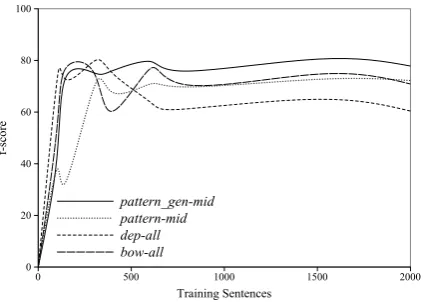
Figure 2: F-score vs training size (0−2000sentences) of
the4best features for each linguistic type.
score reached by pattern-all is much lower because of very poor recall values. This is due to the fact that, in this case, both left and right contexts tend to be too sparse. By contrast, bow and dep classifiers improved their performance using all contexts.
Learning Curves: Figure 2, shows the f-score of the best individual features (for each of the main
types) in different partitions. It can be observed
that the curve stabilizes when the training corpus is constituted by about 1000 sentences. So, no more training corpus is required to improve results. We can also observe that, except for pattern-mid, f-score
slightly decreases with more than1500examples.
The results of these tests allow us to know the per-formance of the classifiers based on individual types of features. In the next experiment we evaluate sev-eral combinations of individual types of features.
0 500 1000 1500 2000 Training Sentences
0 20 40 60 80 100
f-score
bow-mid&dep-mid&pattern_gen-mid pattern_gen-mid&dep-all pattern-mid&dep-all bow-mid&dep-all
Figure 3: F-score vs training size (0−2000sentences) of
the4best combinations of features.
find whether the decisions taken by two models are or not on the same instances. In general, a high Dice coefficient may imply that there are few correct de-cisions taken on different instances and, conversely, a low Dice coefficient means that there are many correct decisions taken on different instances. Only pairs of models with low Dice coefficient were com-bined since they are likely to be complementary.
Figure 3 shows the results of combining the best individual features. The results of several combina-tions based on a similarity analysis show that these classifiers may help to achieve a trade-off between precision and recall. Furthermore, the best com-bined classifiers also improve the general f-score of the best single type of feature, pattern gen-mid.
5.2 On-Going Experiments
We are evaluating the impact of negative examples in the training corpus, taking into account that the
initial set of 2000 sentences had a 50%/50% ratio
of positive and negative examples. In order to know the best P/N distribution, we collected several sets of sentences differing in the P/N ratio they have. Note that this kind of evaluation also deals with the amount of positive or negative instances, and not only with the P/N ratio. So, in order to avoid this effect, we performed two major experiments: (i) we
automatically collected9sets of 500sentences
dif-fering in the P/N ratio: from 10%/90% to 90%/10% (positive/negative) and (ii) we did the same
distribu-tional partitions from a larger corpus (sets of 2000
sentences). Finally, we analyzed how the learning process is influenced by the P/N ratio as well as by
10 20 30 40 50 60 70 80 90
Percentage of positive examples 0
20 40 60 80 100
f-score pattern_gen-mid
bow-all dep-all bow-mid pattern-mid dep-mid pattern-all
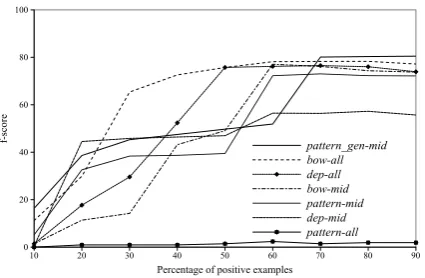
Figure 4: F-score vs P/N ratio of7classifiers. Training
sets are9partitions of500sentences with different ratio
of P/N examples (from 10%/90% to 90%/10%).
Model Prec. Rec. f-score Diff. P/N
p-all 81.3% 3.1% 6.1% +0.9 90%
p-mid 91% 68.4% 78.1% +5.7 90%
p gen-m. 90.1% 76.6% 82.8% +4.9 90%
bow-all 67.9% 87.2% 76.3% +5.4 70%
bow-mid 76.3% 78.5% 77.4% +33.5 60%
dep-all 73.4% 84.1% 78.4% +18.0 70%
dep-mid 63.5% 54.4% 57.4% +3.9 90%
Table 2: Precision, Recall and f-score of7classifiers. The
distribution of P/N examples in the training was adjusted for each classifier (p models are the pattern models).
the number of positive and negative examples. Figure 4 shows the f-score values of each model according to the P/N examples distribution. In most cases, the peak of the f-score curve is reached when the training sentences contain between 60% and 70% of positive examples, except for pattern-based features, whose performance gradually improves with more positive samples. This tendency occurs
in both experiments (500and2000sentences), so we
can infer the best P/N ratio for each type of feature. The results from the previous experiment provide us information to train new models with the P/N dis-tribution adjusted to each model. So, we built classi-fiers based on the same individual types of features described above. We randomly selected seven sets
of 2000 sentences, each one with a distribution of
perfor-mance of the models. We observed that the precision values present some decrease (namely in pattern-all,
bow-all and dep-mid). However, since all the
sys-tems show dramatically recall improvements, the f-score of the seven classifiers increase. Column 5 in Table 2 shows the f-score differences compared to those classifiers trained with a 50%/50% P/N ratio. Column 6 shows the percentage of positive training samples for each classifier.
We have to note that with this adjustment in the P/N ratio, the performance of the best classifiers based on individual features (pattern gen-mid, with 82.77% f-score) scored similar to the best combina-tions of features (pattern gen-mid & dep-all, reach-ing maximum values of 83.2%).
6 Conclusions and Further Work
This paper analyzes the impact of various linguistic features in a distant-supervision system for extract-ing semantic relations from unstructured text.
Experiments performed in Portuguese data show that features based on lexico-syntactic patterns achieve higher precision values than those with bags of lemmas and tags or syntactic dependencies. Pattern-based models performed better with middle contexts than with all contexts, but in case of dep models, all contexts behave better. Models based on bags of lemmas and tags tend to be more unstable.
Moreover, the combination of some types of fea-tures helps to achieve a trade-off between precision and recall, improving the performance of the single features. However, we observed that the adjustment of the positive and negative examples ratio in the training set involves dramatically increases in recall. Further experiments will analyze the performance of combinations of the single features with an
ad-justed training set. Moreover, we will test these
classifiers with different text genres, as well as with other relations and languages.
Acknowledgments
This work has been supported by the MICINN, within the project with reference FFI2010-14986.
References
Agichtein, Y. E. 2005. Extracting Relations from Large
Text Collections. Ph.D. thesis, Columbia University.
Brin, S. 1998. Extracting patterns and relations from the world wide web. WebDB Workshop at EDBT’98: 172–183.
Bunescu, R. C. and Mooney, R. J. 2005. A Shortest Path Dependency Kernel for Relation Extraction.
Proceed-ings of HLT/EMNLP’05: 724–731. ACL, Vancouver.
Fleischman, M., Hovy, E., and Echihabi, A. 2003. Of-fline strategies for online question answering: Answer-ing questions before they are asked. ProceedAnswer-ings of
ACL’03: 1–7.
Gamallo, P. and Gonz´alez, I. 2011. A Grammatical Formalism based on Patterns of Part-of-Speech Tags.
Journal of Corpus Linguistics 16(1): 45–71.
Garcia, M. and Gamallo, P. 2010. An´alise Morfos-sint´actica para Portuguˆes Europeu e Galego: Prob-lemas, Soluc¸˜oes e Avaliac¸˜ao. Linguam´atica. Re-vista para o Processamento Autom´atico das L´ınguas Ib´ericas 2 (2): 59–67.
Garcia, M. and Gamallo, P. 2011. An Exploration of the Linguistic Knowledge for Semantic Relation Ex-traction in Spanish. Proceedings of Joint Workshop
FAM-LbR/KRAQ’11 at IJCAI 2011. Barcelona.
Hearst, M. A. 1992. Automatic acquisition of hyponyms from large text corpora. Proceedings of COLING’92, 2: 539–545.
Kambhatla, N. 2004. Combining lexical, syntactic and semantic features with Maximum Entropy models for extracting relations. Proceedings of ACL’04.
Mann, G. S. 2002. Fine-Grained Proper Noun Ontolo-gies for Question Answering. SemaNet’02: Building
and Using Semantic Networks. Taipei, Taiwan.
Mintz, M., Bills, S., Snow, R. and Jurafsky, D. 2009. Distant supervision for relation extraction without la-beled data. Proceedings of the ACL/IJCNLP, 2. Padr´o, Ll., Collado, M., Reese, S., Lloberes, M. and
Castell´on, I. 2010. FreeLing 2.1: Five Years of Open-Source Language Processing Tools. In Proceedings of
LREC’10, ELRA. La Valletta, Malta.
Snow, R., Jurafsky, D. and Ng, A. Y. 2005. Learning Syntactic Patterns for Automatic Hypernym Discov-ery. Advances in Neural Information Processing
Sys-tems 17: 1297–1304.
Witten, I. H. and Frank, E. 2005. Data mining:
prac-tical machine learning tools and techniques with java implementations. Elsevier Inc., San Francisco.
Wu, F. and Weld, D. S. 2010. Open information ex-traction using Wikipedia. In Proceedings of ACL’10: 118–127.
Zhao, S. and R. Grishman 2005. Extracting Rela-tions with Integrated Information Using Kernel Meth-ods Proceedings of ACL’05: 419–426.
Zhou, G., Su, J., Zhang, J., and Zhang, M. 2005. Explor-ing Various Knowledge in Relation Extraction