R E S E A R C H
Open Access
Sequence spaces
M
(
φ
)
and
N
(
φ
)
with
application in clustering
Mohd Shoaib Khan
1, Badriah AS Alamri
2, M Mursaleen
2,3*and QM Danish Lohani
1*Correspondence:
[email protected] 2Operator Theory and Applications Research Group, Department of Mathematics, Faculty of Science, King Abdulaziz University, P.O. Box 80203, Jeddah, 21589, Saudi Arabia 3Department of Mathematics,
Aligarh Muslim University, Aligarh, 202002, India
Full list of author information is available at the end of the article
Abstract
Distance measures play a central role in evolving the clustering technique. Due to the rich mathematical background and natural implementation oflpdistance measures,
researchers were motivated to use them in almost every clustering process. Besidelp
distance measures, there exist several distance measures. Sargent introduced a special type of distance measuresm(
φ
) andn(φ
) which is closely related tolp. In thispaper, we generalized the Sargent sequence spaces through introduction ofM(
φ
) andN(φ
) sequence spaces. Moreover, it is shown that both spaces areBK-spaces, and one is a dual of another. Further, we have clustered the two-moon dataset by using an inducedM(φ
)-distance measure (induced by the Sargent sequence spaceM(φ
)) in the k-means clustering algorithm. The clustering result established the efficacy of replacing the Euclidean distance measure by theM(φ
)-distance measure in the k-means algorithm.MSC: 40H05; 46A45
Keywords: clustering; double sequence; k-means clustering; two-moon dataset
1 Introduction
Clustering is a well-known procedure to deal with an unsupervised learning problem ap-pearing in pattern recognition. Clustering is a process of organizing data into groups called clusters so that objects in the same cluster are similar to one another, but are dissimilar to objects in other clusters []. The main contribution in the field of clustering analysis was the pioneering work of MacQueen [] and Bezdek []. They had introduced highly signifi-cant clustering algorithms such as k-means [] and fuzzy c-means []. Among all clustering algorithms, k-means is the simplest unsupervised clustering algorithm that makes use of a minimum distance from the center, and it has many applications in scientific and indus-trial research [–] (for more information about the k-means clustering algorithm, see Section ). K-means algorithm is distance dependent, so its outputs vary with changing distance measures. Among all distance measures, a clustering process was usually carried out through the Euclidean distance measure [], but many times it failed to offer good re-sults. In this paper, we defineM(φ)- andN(φ)-distance measure. Further,M(φ)-distance is used to cluster two-moon dataset. The output result is compared with the result of Euclidean distance measure to show the efficacy ofM(φ)-distance over the Euclidean dis-tance measure.M(φ) andN(φ)-distance measures are the generalization of m(φ)- and
n(φ)-distance measures introduced by Sargent [] and further studied by Mursaleen [,
] (to know more aboutm(φ) andn(φ), refer to [–]). TheM(φ) andN(φ) spaces are closely related tolp distance measures.lp measures and its variance are mostly used to solve the problems evolving in the fields of Market prediction [], Machine Learning [], Pattern Recognition [], Clustering [] etc.
Throughout the paper, byωwe denote the set of all real or complex sequences. More-over, byl∞,candcwe denote the Banach spaces of bounded, convergent and null se-quences, respectively; and letlpbe the Banach space of absolutelyp-summable sequences with p-norm · p. For the following notions, we refer to [, ]. A double sequence
x= (xjk) of real or complex numbers is said to be bounded ifx∞<∞, the space of all
bounded double sequences is denoted byL∞. A double sequencex= (xjk) is said to con-verge to the limitLin Pringsheim’s sense (shortly, convergent toL) if for everyε> , there exists an integerN such that|xjk–L|<εwheneverj,k>N. In this caseLis called the
p-limit ofx. If in additionx∈L∞, thenxis said to be boundedly convergent toLin
Pring-sheim’s sense (shortly,bp-convergent toL). A double sequencex= (xjk) is said to converge regularly toL(shortly,r-convergent toL) ifxisp-convergent and the limitsxj:=limkxjk (j∈N) and xk:=lim
jxjk (k∈N) exist. Note that in this case the limitslimjlimkxjk and
limklimjxjk exist and are equal to the p-limit ofx. In general, for any notion of
conver-genceν, the space of allν-convergent double sequences will be denoted byCν and the limit of aν-convergent double sequencexbyν-limj,kxjk, whereν∈ {p,bp,r}.
Letdenote a vector space of all double sequences with the vector space operations defined coordinate-wise. Vector subspaces ofare called double sequence spaces. Let us consider a double sequencex={xmn}and define the sequences={smn}viaxby
smn:= m,n
i,j
xij (m,n∈N).
Then the pair (x,s) and the sequences={smn}are called a double series and a sequence of partial sums of the double series, respectively. Letλbe the space of double sequences converging with respect to some linear convergence rule μ-lim:λ→R. The sum of a double series∞i,j=,∞xijwith respect to this rule is defined byμ-i,j=∞,∞xij:=μ-limsmn. Başar and Şever introduced the spaceLpin []
Lp:=
{xmn} ∈:
m,n
|xmn|p<∞
(≤p<∞)
corresponding to the spacelp forp≥ and examined some of its properties. Altay and Başar [] have generalized the spaces of double sequencesL∞,CpandCbpto
L∞(t) =
{xmn} ∈: sup m,n∈N|xmn|
tmn<∞,
Cp(t) =
{xmn} ∈:p- lim
m,n→∞|xmn–|
tmn= ,
and
respectively, wheret={tmn}is the sequence of strictly positive realstmn. In the casetmn= , for allm,n∈N,L∞(t),Cp(t) andCbp(t) reduce to the setsL∞,Cp andCbp, respectively. Further, letCbe the space whose elements are finite sets of distinct positive integers. Given any elementσofC, we denote byc(σ) the sequence{cn(σ)}which is such thatcn(σ) = if
n∈σ,cn(σ) = otherwise. Further, let
Cs=
σ∈C:
∞
n=
cn(σ)≤s
be the set of thoseσ whose support has cardinality at mosts, and
=
φ={φn} ∈ω:φ> ,φn≥ and
φn
n
≤ (n= , , . . .)
,
whereφn=φn–φn–andφ= .
Forφ∈, the following sequence spaces were introduced and studied in [] by Sargent and further studied by Mursaleen in [, ]:
m(φ) =
x={xn} ∈ω:sup s≥
sup σ∈Cs
φs
n∈σ
|xn|
<∞
,
and
n(φ) =
x={xn} ∈ω: sup u∈S(x)
∞,∞
m,n=,
|un|φn
<∞ .
Remark .
(i) The spacesm(φ)andn(φ)areBK-spaces with their usual norms.
(ii) Ifφn= (n= , , , . . .), thenm(φ) =l[n(φ) =l∞], and ifφn=n(n= , , , . . .), thenm(φ) =l∞[n(φ) =l].
(iii) l⊆m(φ)⊆l∞[l⊆n(φ)⊆l∞] for allφ∈. (iv) For anyφ∈,m(φ)=lp[n(φ)=lq], <p<∞.
In this paper, we define Sargent’s spaces for double sequences x={xmn}. For this we first supposeUto be the set whose elements are finite sets of distinct elements ofN×N obtained byσ×ς, whereσ∈Csandς∈Ctfor eachs,t≥. Therefore, any elementζ of
Umeans (m,n);m∈σ andn∈ςhaving cardinality at mostst, wheresis the cardinality with respect tomandtis the cardinality with respect ton. Given any elementζofU, we denote byc(ζ) the sequence{cmn(ζ)}such that
cmn(ζ) =
⎧ ⎨ ⎩
; if (m,n)∈ζ,
; otherwise.
Further, we write
Ust=
ζ∈U:
∞,∞ m,n=
for the set of thoseζ whose support has cardinality at mostst; and
=
φ={φmn} ∈:φ> ,φmn≥ and
φmn
mn
≤ (m,n= , , . . .)
,
whereφmn=φmn–φm–,n–φm,n–+φm–,n–andφ,φm,φn= ,∀m,n∈I+. Through-out the paper, we writem,n∈ζ for
m∈σ
n∈ς, andS(x) is used to denote the set of all
double sequences that are rearrangements ofx={xmn} ∈. Forφ∈, we define the fol-lowing sequence spaces:
M(φ) =
x={xmn} ∈:xM(φ)=sup s,t≥
sup ζ∈Ust
φst
m,n∈ζ
|xmn|
<∞
and
N(φ) =
x={xmn} ∈:xN(φ)= sup u∈S(x)
∞,∞
m,n=
|umn|φmn
<∞ .
Then the distances betweenx={xmn}andy={ymn}induced byM(φ) andN(φ) can be expressed as
dM(φ)=sup s,t≥
sup ζ∈Ust
φst
m,n∈ζ
|xmn–ymn|
and
dN(φ)= sup u,v∈S(x)
∞,∞
m,n=
|umn–vmn|φmn
.
Remark . Ifφst= (s,t= , , , . . .), thenM(φ) =L [N(φ) =L∞], and ifφst=st(s,t= , , , . . .), thenM(φ) =L∞[N(φ) =L].
We now state the following known results of [] for single sequences (series) which can also be proved easily for double sequences (series).
Lemma . If the seriesunxnis convergent for every x of a BK -space E,then the
func-tional∞n=unxnis linear and continuous in E.
Lemma . If E and F are BK -spaces,and if E⊆F,then there is a real number K such
that,for all x of E,
xF≤KxE.
2 Properties of the spacesM(
φ
)andN(φ
)Theorem . The space M(φ)is a BK -space with the norm.
xM(φ)=sup s,t≥
sup ζ∈Ust
φst m,n∈ζ|
xmn|
Proof It is a routine verification to show thatM(φ) is a normed space with the given norm (.), and so we omit it. Now, we proceed to showing thatM(φ) is complete. Let{xl}be a Cauchy sequence inM(φ), wherexl={xl
mn}∞ ,∞
m,n=,for every fixedl∈N. Then, for a given ε> , there exists a positive integern(ε) > such that
xl–xr
M(φ)=sup s,t≥
sup ζ∈Ust
φst m,n∈ζ
xl
mn–xrmn
<ε
for alll,r>n(ε), which yields, for each fixeds,t≥ andζ∈Ust,
m,n∈ζ
xlmn–xrmn≤εφ for alll,r>n(ε). (.)
Therefore
m,n∈ζ
xlmn– m,n∈ζ
xrmn<εφ for alll,r>n(ε). (.)
This means that{m,n∈ζ|xl
mn|}l∈Nis a Cauchy sequence inRfor every fixeds,t≥ and
ζ ∈Ust. SinceRis complete, it converges, say
m,n∈ζ
xlmn→
m,n∈ζ
|xmn| asl→ ∞.
Since absolute convergence implies convergence inR, hence
m,n∈ζ
xlmn→
m,n∈ζ
xmn asl→ ∞. (.)
Hence we have
lim
l→∞
m,n∈ζ
xlmn– m,n∈ζ
xmn
M(φ)
= . (.)
Letyl=
m,n∈ζ|xlmn|. Then{yl} ∈l∞. Therefore
sup
l∈N
m,n∈ζ
xlmn≤k.
Since m,n∈ζ|xmn| ≤
m,n∈ζ|xmn–xlmn|+
m,n∈ζ|xlmn| ≤εφ+k, it follows thatx=
{xmn} ∈M(φ). Since{xl}l∈N was an arbitrary Cauchy sequence, the spaceM(φ) is com-plete. Now we prove thatM(φ) has continuous coordinate projectionspmn, wherepmn: →K andpmn(x) =xmn. The coordinate projectionspmnare continuous since|xmn| ≤
sups,t≥supζ∈UstφstxM(φ)for eachm,n∈N.
Remark . The spaceN(φ) is aBK-space with the norm
xN(φ)= sup u∈S(x)
∞,∞
m,n=
|umn|φmn
Lemma .
(i) Ifx∈M(φ)[x∈N(φ)]andu∈S(x),thenu∈M(φ)[u∈N(φ)]andu=x. (ii) Ifx∈M(φ)[x∈N(φ)]and|umn| ≤ |xmn|for every positive integerm,n,then
u∈M(φ)[u∈N(φ)]andu ≤ x.
Proof (i) Letx∈M(φ), thensups,t≥supζ∈Ustφ st
m,n∈ζ|xmn|<∞. So, we have
φst
m,n∈ζ
|xmn|<∞ for eachζ ∈Ustands,t≥.
Since the sum of a finite number of terms remains the same for all the rearrangements,
φst
m,n∈ζ
|umn|= φst
m,n∈ζ
|xmn| for eachu∈S(x) andζ∈Ust,s,t≥.
Hence
sup
s,t≥
sup ζ∈Ust
φst
m,n∈ζ
|umn|=sup s,t≥
sup ζ∈Ust
φst
m,n∈ζ
|xmn|<∞,
thusu∈M(φ) andu=x.
(ii) By using the definition, easy to prove.
Theorem . For arbitraryφ∈,we haveφ∈M(φ)andφM(φ)≤.
Proof Lets andt be arbitrary positive integers, letσ,ς ∈Ust, and letτ,τ constitute the element ofσ andςexceed bysandtrespectively, also from the definition we have φ≥ and(φmnmn)≤. Then
n∈σ,m∈ς
|φmn| ≤ s,t
n=,m=
φmn+
n∈τ,m∈τ
φmn
≤φst+
n∈τ,m∈τ
φm–,n– (m– )(n– )
≤φst+
φst
st +
φs,t+
s(t+) +
φs,t+
s(t+) +. .
φs+,t
(s+)t +
φs+,t+
(s+)(t+) +
φs+,t+
(s+)(t+) +. .
+ + + . . . . . ⎫ ⎪ ⎪ ⎪ ⎪ ⎬ ⎪ ⎪ ⎪ ⎪ ⎭
max(st)-terms
≤φst+st φst
st = φst.
Lemma . If x∈M(φ)and{c,c, . . . ,cn,c,c, . . . ,cn, . . . ,cm,cm, . . . ,cmn}is a
rear-rangement of{b,b, . . . ,bn,b,b, . . . ,bn, . . . ,bm,bm, . . . ,bmn}such that|c| ≥ |c| ≥
· · · ≥ |cn|,|c| ≥ |c| ≥ · · · ≥ |cn|, . . . ,|cm| ≥ |cm| ≥ · · · ≥ |cmn|and|c| ≥ |c| ≥ · · · ≥
|cm|,|c| ≥ |c| ≥ · · · ≥ |cm|,|cn| ≥ |cn| ≥ · · · ≥ |cnm|,then
m,n
i,j=,
|bijxij| ≤ xM(φ) m,n
i,j=,
Proof In view of Lemma .(i), it is sufficient to consider the case when bij =cij (i= , , . . . ,m;j= , , . . . ,n). Then writingXmn=
m,n
i,j=|xij|, we get
m,n
i,j=,
|bijxij|= m–
i= n–
j=
|cij|–|ci,j+|–|ci+,j|+|ci+,j+|
Xij+|cmn|Xmn
≤ xM(φ) m–
i= n–
j=
|cij|–|ci,j+|–|ci+,j|+|ci+,j+|
φij+xM(φ)|cmn|Xmn
=xM(φ) m,n
i,j=,
|cij|φij.
Hence we havem,ni,j=,|bijxij| ≤ xM(φ)
m,n
i,j=,|cij|φij.
Theorem . In order thatuijxijbe convergent[absolutely convergent]whenever x∈
M(φ),it is necessary and sufficient that u∈N(φ).Further,if x∈M(φ)and u∈N(φ),then
∞,∞
i,j=,
|uijxij| ≤ uN(φ)xM(φ). (.)
Proof Necessity. We now suppose thatuijxij is convergent wheneverx∈M(φ), then from Lemma . we have
∞,∞ i,j=,
uijxij
≤KxM(φ)
for some real numberKand allxofM(φ). In view of Lemma .(ii), we may replacexijby
xijsgn{uij}, obtaining
∞,∞ i,j=,
|uijxij| ≤KxM(φ). (.)
Letv∈S(u). Then takingxto be a suitable rearrangement ofφ, it follows from Eq. (.) and Theorem . and Lemma .(i) that
∞,∞
i,j=,
|vij|φij≤K,
and thusu∈N(φ).
Sufficiency. Ifx∈M(φ) andu∈N(φ), it follows from Lemma . that for every positive integermandn,
∞,∞ i,j=,
|uijxij| ≤ uN(φ)xM(φ).
Theorem . In order thatumnxmnbe convergent[absolutely convergent]whenever x∈
Proof Since sufficiency is included in Theorem ., we only consider necessity. We there-fore suppose thatumnxmn is convergent wheneverx∈N(φ). By arguments similar to those used in Theorem ., we may therefore have that
∞,∞ m,n=,
|umnxmn| ≤KxN(φ) (.)
for some real numberKand allxofN(φ). Letx=c(ζ), whereζ∈Ust. Thenx∈N(φ), and
xN(φ)= sup
ξ∈Ust
m,n∈ξ
φmn≤φst,
from Theorem . and Eq. (.) we have
m,n∈ζ
|umn| ≤Kφst (ζ ∈Ust;s,t= , , , . . .),
and thusu∈M(φ).
3 Inclusion relations forM(
φ
)andN(φ
)Lemma . In order that M(φ)⊆M(ψ) [N(φ)⊇N(ψ)],it is necessary and sufficient that
sup
s,t≥
φst ψst
<∞.
Proof Since each of the spacesM(φ) andN(φ) is the dual of the other, by Theorems . and ., the second version is equivalent to the first. Moreover, sufficiency follows from the definition of anM(φ) space. We therefore suppose thatM(φ)⊆M(ψ). Sinceφ∈M(φ), it follows thatψ∈M(ψ), and hence we find that, for every positive integers,t≥,
φst= s,t
i,j=,
φij≤ψstφM(ψ), where=.
Theorem .
(i) L⊆M(φ)⊆L∞[L⊆N(φ)⊆L∞]for allφof. (ii) M(φ) =L[N(φ) =L∞]if and only ifbp-lims,tφst<∞. (iii) M(φ) =L∞[N(φ) =L]if and only ifbp-lims,t(φst/st) > .
Proof We prove here the first version, while the second version follows by Theorems . and .. Sinceφ≤φmn≤mnφmnfor allφof, we have by Lemma . that (i) is satisfied. Further, from Lemma ., it follows thatM(φ)⊆L if and only ifsups,t≥φst<∞, while
L∞ ⊆M(φ) if and only ifsups,t≥(φst/st) <∞; since the sequences{φst}and{st/φst}are monotonic, (ii) and (iii) are also satisfied.
Theorem . Suppose that <p<∞andp+q= .Then
(i) Given anyφof,M(φ)=Lp[N(φ)=Lq].
(ii) In order thatLp⊂M(φ)[N(φ)⊂Lq],it is necessary and sufficient that
sups,t≥((st)φ/q
(iii) In order thatM(φ)⊂Lp[N(φ)⊃Lq],it is necessary and sufficient thatφ∈Lp. (iv) φ∈LpM(φ) =Lp[
φ∈LpN(φ) =Lq]. Proof (i) Let us suppose thatM(φ) =Lp.
Then, by Lemma ., there exist real numbersrandr(r> ,r> ) such that, for all
xofM(φ),
rxLp≤ xM(φ)≤rxLp.
Takingx=c(ζ), whereζ∈Ust, we have that
r(st)
p≤ st
φst ≤
r(st)
p (s,t= , , , . . .),
and hence that
r≤ (st)q
φst ≤
r (s,t= , , , . . .).
In view of Lemma ., this implies thatM(φ) =M(ψ), whereψ={(mn)q}. Sinceψ ∈ M(ψ) by Theorem ., butψ∈/Lq, this leads to a contradiction. Hence (i) follows.
(ii) IfLq⊂M(φ), arguments similar to those used in the proof of (i) show that
(st)/q≤Kφst (s,t= , , , . . .). (.)
For sufficiency, we suppose that (.) is satisfied. Then, wheneverx∈Lpandζ∈Ust,
m,n∈ζ
|xmn| ≤ m,n∈ζ
|xmn|p
p
m,n∈ζ
q
≤ xLq(st)
q <Kφ
stxLq,
and hencex∈M(φ). In view of (i), it follows thatLq⊂M(φ).
(iii) By Theorem ., we have φ∈M(φ). For sufficiency, we suppose thatφ∈Lp and thatx∈M(φ). Then{umnφmn} ∈Lwheneveru∈Lq, and it therefore follows from Lemma . that{umnxmn} ∈Lwheneveru∈Lq. SinceLpis the dual ofLqand sinceM(φ)=
Lp, it follows thatM(φ)⊂Lq.
(iv) By using (iii) we haveφ∈LpMφ⊆Lp. Now, for obtaining the complementary
re-lation Lp⊆
φ∈LpMφ, let us suppose that x∈Lp. Thenlimm,n→∞xmn= , and hence
there is an elementuofS(x) such that{|umn|}is a non-increasing sequence. If we take ψ={m,ni,j=,|uij|}, then it is easy to verify thatψ∈and thatx∈M(φ). Sinceψ∈Lp,
the complementary relation is satisfied.
4 Application ofM(
φ
)andN(φ
)in clustering4.1 Algorithm to computeM(
φ
) distanceLetx= [x,x,x, . . . ,xn]×nandy= [y,y,y, . . . ,yn]×nbe two matrices of size ×n, and letφm,n=φ,n=n.
() Calculateai=φ,i|xi–yi|,i= , , , . . . ,n.
() TheM(φ)-distance betweenxandyisd, where
d=max{a,a+a, . . . ,a+a+· · ·+an}.
4.2 K-means clustering algorithm forM(
φ
)-distance measureLetX= [x,x,x, . . . ,xn] be the data set.
() Randomly/judiciously selectkcluster centers (in this paper we choose firstkdata points as the cluster centery= [x,x, . . . ,xk]).
() By usingM(φ)orN(φ)distance measure (since both are dual of each other, in application point of view, we only considerM(φ)), compute the distance between each data points and cluster centers.
() Put data points into the cluster whoseM(φ)-distance with its center is minimum. () Define cluster centers for the new clusters evolved due to steps -, the new cluster
centers are computed as follows:ci=k
i ki
j=xi, wherekidenotes the number of points in theith cluster.
() Repeat the above process until the difference between two consecutive cluster centers reaches less than a small numberε.
4.3 Two-moon dataset clustering by usingM(
φ
)-distance measure in k-meansalgorithm
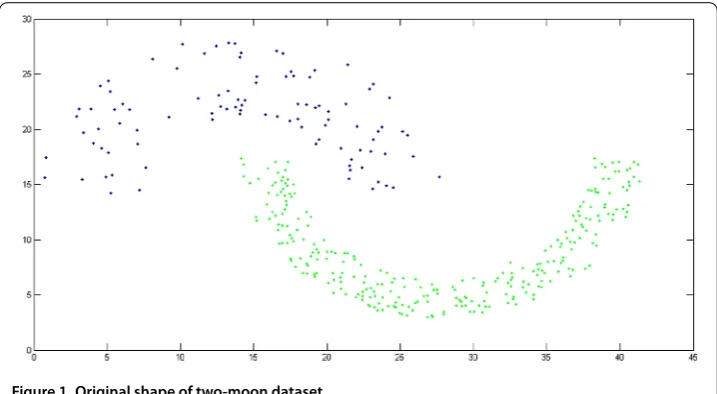
Two-moon dataset is a well-known nonconvex data set. It is an artificially designed two dimensional dataset consisting of data points []. Two-moon dataset is visualized as moon-shaped clusters (see Figure ).
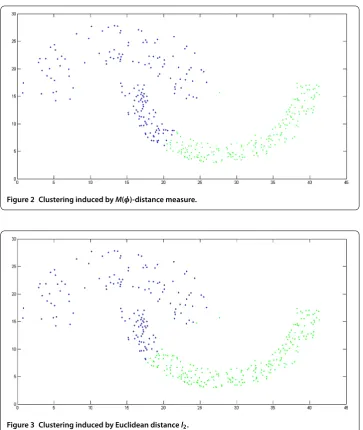
[image:10.595.118.477.527.724.2]By usingM(φ)-distance measure in the k-means clustering algorithm, the obtained re-sult is represented in Figure . In Figure , we represent the rere-sult obtained by using the Eu-clidean distance measure in the k-means algorithm (we measure the accuracy of the cluster
Figure 2 Clustering induced byM(φ)-distance measure.
Figure 3 Clustering induced by Euclidean distancel2.
by using the formula, accuracy = (number of data points in the right cluster/total num-ber of data points)). The experimental result shows that cluster accuracy ofM(φ)-distance measure is .% whilel-distance measure’s clustering accuracy is .%. Thus,M(φ )-distance measure substantially improves the clustering accuracy.
5 Conclusions
In this paper, we defined Banach spacesM(φ) andN(φ) with discussion of their mathe-matical properties. Further, we proved some of their inclusion relation. Furthermore, we applied the distance measure induced by the Banach spaceM(φ) into clustering to cluster the two-moon data by using the k-means clustering algorithm; the result of the experiment shows that theM(φ)-distance measure extensively improves the clustering accuracy.
Competing interests
Authors’ contributions
All authors of the manuscript have read and agreed to its content and are accountable for all aspects of the accuracy and integrity of the manuscript.
Author details
1Department of Mathematics, South Asian University, New Delhi, India.2Operator Theory and Applications Research
Group, Department of Mathematics, Faculty of Science, King Abdulaziz University, P.O. Box 80203, Jeddah, 21589, Saudi Arabia. 3Department of Mathematics, Aligarh Muslim University, Aligarh, 202002, India.
Acknowledgements
The second and third authors gratefully acknowledge the financial support from King Abdulaziz University, Jeddah, Saudi Arabia.
Received: 14 November 2016 Accepted: 14 February 2017
References
1. MacQueen, J, et al.: Some methods for classification and analysis of multivariate observations. In: Proceedings of the Fifth Berkeley Symposium on Mathematical Statistics and Probability, vol. 1, pp. 281-297 (1967)
2. Bezdek, JC: A review of probabilistic, fuzzy, and neural models for pattern recognition. J. Intell. Fuzzy Syst.1(1), 1-25 (1993)
3. Jain, AK: Data clustering: 50 years beyond k-means. Pattern Recognit. Lett.31(8), 651-666 (2010)
4. Cheng, M-Y, Huang, K-Y, Chen, H-M: K-means particle swarm optimization with embedded chaotic search for solving multidimensional problems. Appl. Math. Comput.219(6), 3091-3099 (2012)
5. Yao, H, Duan, Q, Li, D, Wang, J: An improved k-means clustering algorithm for fish image segmentation. Math. Comput. Model.58(3), 790-798 (2013)
6. Cap, M, Prez, A, Lozano, JA: An efficient approximation to the k-means clustering for massive data. Knowl.-Based Syst.
117, 56-69 (2016)
7. Güngör, Z, Ünler, A: K-harmonic means data clustering with simulated annealing heuristic. Appl. Math. Comput.
184(2), 199-209 (2007)
8. Sargent, W: Some sequence spaces related to thepspaces. J. Lond. Math. Soc.1(2), 161-171 (1960)
9. Mursaleen, M: Some geometric properties of a sequence space related top. Bull. Aust. Math. Soc.67(2), 343-347
(2003)
10. Mursaleen, M: Application of measure of noncompactness to infinite system of differential equations. Can. Math. Bull.
56, 388-394 (2013)
11. Chen, L, Ng, R: On the marriage ofp-norms and edit distance. In: Proceedings of the Thirtieth International
Conference on Very Large Data Bases, vol. 30, pp. 792-803 (2004)
12. Cristianini, N, Shawe-Taylor, J: An Introduction to Support Vector Machines and Other Kernel-Based Learning Methods. Cambridge University Press, Cambridge (2000)
13. Xu, Z, Chen, J, Wu, J: Clustering algorithm for intuitionistic fuzzy sets. Inf. Sci.178(19), 3775-3790 (2008) 14. Pringsheim, A: Zur theorie der zweifach unendlichen zahlenfolgen. Math. Ann.53(3), 289-321 (1900) 15. Mursaleen, M, Mohiuddine, SA: Convergence Methods for Double Sequences and Applications. Springer, Berlin
(2014)
16. Ba¸sar, F, ¸Sever, Y: The spaceLqof double sequences. Math. J. Okayama Univ.51, 149-157 (2009)
17. Altay, B, Ba¸sar, F: Some new spaces of double sequences. J. Math. Anal. Appl.309(1), 70-90 (2005) 18. Wilansky, A: Summability Through Functional Analysis. North Holland Math. Stud, vol. 85 (1984)
19. Jain, AK, Law, MHC: Data clustering: a users dilemma. In: Proceedings of the First International Conference on Pattern Recognition and Machine Intelligence (2005)