FORMULATION AND EVALUATION OF MOUTH DISSOLVING TABLET OF MELOXICAM USING
NATURAL SUPERDISINTEGRANTS
CHETAN V PAWAR*, SWATI S MUTHA, SAGAR V BHISE, PAYAL D BORAWAKE
Department of Pharmaceutics, Pune District Education Association’s, Seth Govind Raghunath Sable College of Pharmacy, Pune, Maharashtra, India. Email: [email protected]
Received: 09 July 2019, Revised and Accepted: 01 January 2020 ABSTRACT
Objective: The objective of the present work was the preparation and evaluation of mouth dissolving tablets (MDTs) of meloxicam using natural superdisintegrants.
Methods: Meloxicam is BCS Class II (low soluble, and high permeable) drug increasing the dissolution properties of the poorly water-soluble drug meloxicam using a solid dispersion method (solvent evaporation method). Solvent evaporation method using drug and carrier as polyethylene glycol (PEG)-6000 and PEG-15,000 the ratio of 1:1, 1:2 (drug:carrier), and acetone as solvent. In house prepared banana powder were used as natural superdisintegrant. Manufacturing of MDT was done by the direct compression method. In this MDTs, various excipients were used such as mannitol used as the diluent, sodium saccharin used as a sweetening agent, Avicel pH-102 used as a binding agent, and talc and sodium lauryl sulfate (SLS) used as lubricant and glidant. The best formula of the tablet was selected according to the disintegration time (DT) and friability tests.
Results: The results have shown that an increase in the meloxicam solubility was obtained using solid dispersion with the solvent evaporation method using PEG-15000 as a carrier in the ratio of 1:2 (drug:carrier). Taste masking was also done by a solid dispersion method. Tablet prepared with in house prepared banana powder gave less DT (70 s) as compared to tablet prepared with branded banana powder (80 s), but formulation F5 failed in friability testing. Improved strength of tablet obtained using SLS (<1%) also showed an increase in the dissolution performance of the tablet in formulation F6. This F6 formulation having 10% natural super disintegrating agent (in house prepared banana powder) has shown 99% cumulative drug release within 18 min. It also passed the friability test.
Conclusion: Accordingly, the solubility of meloxicam was successfully enhanced through solid dispersion with carrier PEG-15,000 and formulated as a MDT to improve its oral absorption. PEG has also been used as a taste masking agent in these formulations. It was concluded that in house banana powder had excellent DT as compared to branded banana powder. Banana powder is “economical” and “easily available” than other commonly used synthetic superdisintegrants. The process of banana powder preparation is eco friendly. The meloxicam MDT formulated with natural superdisintegrant in house prepared banana powder found to pass all pharmacopeial tests.
Keywords: Meloxicam, Banana powder, Solid dispersion, Taste masking, Direct compression.
INTRODUCTION
Mouth dissolving or oro-dispersible or fast dissolving tablets are defined as a solid dosage form comprising a medicinal constituent, which instantaneously disperses within seconds into the saliva when kept on the tongue. As per WHO, “MDT intended to be dispersed within few seconds in water before administration, giving a homogeneous dispersion”[1]. Some of the advantages of MDT are no need of water to swallow the dosage form, good mouths feel property produced by the use of flavors and sweeteners [2] especially in pediatric patient, it gives fast action when it comes in contact with saliva, superdisintegrants are the key ingredient which gives faster disintegration and/or dissolution of a drug in the form of MDT. MDTs are prepared using both natural and synthetic superdisintegrant [3].
Superdisintegrant facilitates the breakdown of the tablets within a second in the mouth in the presence of saliva without any complexity of swallowing. The term superdisintegrant, as its name proposes superior to disintegrates. Superdisintegrant is the substances that facilitate the lowering of disintegration time (DT) even at low concentration, typically 1–10% by weight relative to the total weight of the dosage unit [4]. Taste masking is must for bitter drug; therefore, different approaches are mentioned in the literature for taste masking. Solid dispersion is one of them [5].
Meloxicam is a potent COX II selective nonsteroidal anti-inflammatory drug used in the treatment of rheumatoid and joint pain in the geriatric patient. Unfortunately, meloxicam shows low water solubility being considered as a type-II BCS class drug. Therapy of meloxicam may have to continue for a longer duration in the case of rheumatoid arthritis disease [6]. The old people face the problem of swallowing the tablet and even made of dysphasia, therefore, in the present research work attempt is made to formulate MDTs of meloxicam in consideration with the geriatric patient.Solid dispersion technique is used to increase the solubility of poorly water-soluble drugs. Taste masking is also done by this technique. Solid dispersion by the solvent evaporation method was done using water-soluble carriers such as polyethylene glycol (PEG), polyvinyl pyrrolidone, polyvinyl alcohol, and poloxamers [7]. In most of the work, PEG is used as a carrier, as being nontoxic, fast soluble in water and stable at high temperatures. Different grades of PEG such as PEG 4000, PEG 6000, PEG 15,000, and PEG 20,000 as a carrier are tried to enhance the solubility [8]. Therefore, in this research work PEG was selected as a carrier to enhance the solubility of meloxicam in the form of solid dispersion.
Natural superdisintegrant has added advantages of biocompatibility, low cost of production, and more actability by patients. Therefore, the objective of the present research work is to develop a new, low-cost © 2020 The Authors. Published by Innovare Academic Sciences Pvt Ltd. This is an open access article under the CC BY license (http://creativecommons. org/licenses/by/4. 0/) DOI: http://dx.doi.org/10.22159/ajpcr.2020.v13i2.34838
effective, and easily available natural superdisintegrant from banana fruit to offer secure and effective drug delivery meloxicam as MDTs with better patient fulfillment or acceptance [9].
MATERIALS AND METHODS Materials
Meloxicam gift sample was given by Cipla Unit-1(Kurkumbh). Mannitol, sodium saccharin, talc, sodium lauryl sulfate (SLS), PEG 6000, PEG-15,000, acetone, methanol purchased from Research Lab Fine Chemical Industries Pvt. Ltd. (Mumbai). All other chemicals and reagents were analytical grade.
Methods of identification of drug
The drug was identified by, melting point determination (capillary tube method) on a Thiele’s tube, differential scanning calorimeter (DSC, METLER TOLEDO, and STARe), and Fourier-transform infrared spectroscopy (FTIR, SHIMADZU, 8400S). DSC thermograph was shown in Fig. 1 and FTIR spectrum of drug was shown in Fig. 2.
Solubility study of meloxicam
The solubility of meloxicam was check-in various common solvents such as water, ethanol, methanol, propanol, acetone, chloroform, and phosphate buffer (pH 6.8).
Calibration curve of meloxicam
Meloxicam stock solution was prepared by taking 10 mg of pure meloxicam in 10 ml volumetric flask and dissolved by adding of 4 ml of methanol (CH3OH) by continue shaking on a shaker for 10 min and
volume was made up to 10 ml with the help of distilled water. It will become 1 mg/ml, i.e., 1000 µg/ml (solution A). The 1 ml from the stock Solution A was withdrawn with the help of pipette and it was diluted to 100 ml by distilled water to get a concentration of 10 µg/ml (Solution B). Then from Solution B, 1 ml, 2 ml, 3 ml, 4 ml, and 5 ml, were pipette out into separate 10 ml volumetric flasks and volume make up using distilled water to get concentrations of 1 µg/ml, 2 µg/ml, 3 µg/ml, 4 µg/ml, and 5 µg/ml, respectively. The absorbance of these solutions was measured at 363 nm using ultraviolet (UV) spectrometer (JASCO, V–630).
Natural banana powder
Banana synonym is plantain and belongs to Family-Musaceae. It contains retinol (Vitamin A). It also contains pyridoxal (Vitamin B6), which is given for reducing stress. It has rich source carbohydrate and potassium and responsible for more brain functioning [10].
Method of preparation of banana powder
Take 6–8 unripe fresh bananas, peel them properly and cut them into small pieces. These pieces were dried under sunlight for 24 h. After that, dried pieces were grinded properly to form a powder. The process of banana powder preparation is eco friendly.
Evaluation of banana powder by swelling index
The swelling index characterizes the rate at which a tablet will dissolute and is also an indicative of the mechanism. The swelling index was determined using in house prepared banana powder and marketed banana powder. One gram of banana powder was accurately weighed and transferred to a 25-ml measuring cylinder. The initial volume occupied by the powder was noted, and the volume was made up to 25 ml with distilled water. The cylinder was, shaken gently, and set aside for 24 h. The volume occupied by the gum sediment was noted after 24 h [11].
Table 4: Pre‑compression study of F6 tablet formulation
Parameter Bulk density (g/ml) Tapped density (g/ml) HR Compressibility index % Angle of repose (°)
Result 0.677±0.08 0.8±0.06 1.180±0.01 15.26±0.05 25.50±0.08
*Mean±SD, n=3. HR: Hausner’s ratio
Table 1: Swelling index of banana powder
Sample name Swelling index (%)
In house prepared banana powder 400
Marketed banana powder 200
Table 3: Formulation table
Ingredients F1 F2 F3 F4 F5 F6
Meloxicam (SD) 45 45 45 45 45 45
In house banana powder 10 12 16 20 - 20
Branded banana powder - - - - 20
-F-Melt C 10 8 4 - -
-Mannitol 110.4 110.4 110.4 110.4 110.4 110.4
Avicel-102 20 20 20 20 20 20
Sodium saccharin 1 1 1 1 1 1
Talc 2 2 2 2 2 2
Magnesium stearate 1.6 1.6 1.6 1.6 1.6
-Sodium lauryl sulfate - - - 1.6
Total weight (mg) 200 200 200 200 200 200
Disintegration time (s)* 32 30 29 28 85 70
Thickness (mm)* 1.8±0.02 1.90±0.04 1.88±0.03 1.89±0.03 1.90±0.04 1.90±0.01
Hardness (kg/cm2)* 1.8±0.29 1.6±0.45 1.5±0.29 1.8±0.28 1.5±0.50 2.0±0.25
Weight variation (mg)** 199±0.05 198±0.06 200±0.03 199±0.05 200±0.04 200±0.03
Friability test (%)** 5.55 8.60 2.65 3.85 4.78 0.3
Drug content (%)* 95.64 102.6 97.23 101.45 104.06 99.86
*(Mean±SD, n=3), **(Mean±SD, n=20)
Table 2: Solubility study of meloxicam solid dispersion Formulation no. Carrier Ratio Avg. solubility (µg/ml)*
S1 PEG-6000 1:1 0.57
S2 PEG-15,000 1:1 0.74
S3 PEG-6000 1:2 0.63
S4 PEG-15,000 1:2 0.82
Where,
V0 is the initial volume of the powder in a graduated cylinder and
Vt is the volume occupied by the swollen gum after 24 h.
Preparation of meloxicam solid dispersion by solvent evaporation method
In the solvent evaporation method, in general, organic solvents such as acetone, chloroform, methanol, and ethanol are used. Here, acetone was used as an organic solvent and PEG 6000, PEG 15,000, as a carrier for the preparation of solid dispersion. Drug to carrier ratio tried was 1:1, 1:2 [12,13].
First, meloxicam was soluble in acetone. PEG was separately melted in a Petri plate, after that, solubilized drug solution was added in the molten carrier and heating continued by stirring till solid film form. Then, the film was further dried for 24 h and then grinds to form a powder. This solid dispersion powder was passed through sieve no 40 [14].
Solubility determination of meloxicam solid dispersion
Solubility determination of meloxicam solid dispersion was carried out in distilled water at 363 nm. The solubility data of solid dispersion are shown in Table 1 [15].
DSC and FTIR of selected solid dispersion formulation
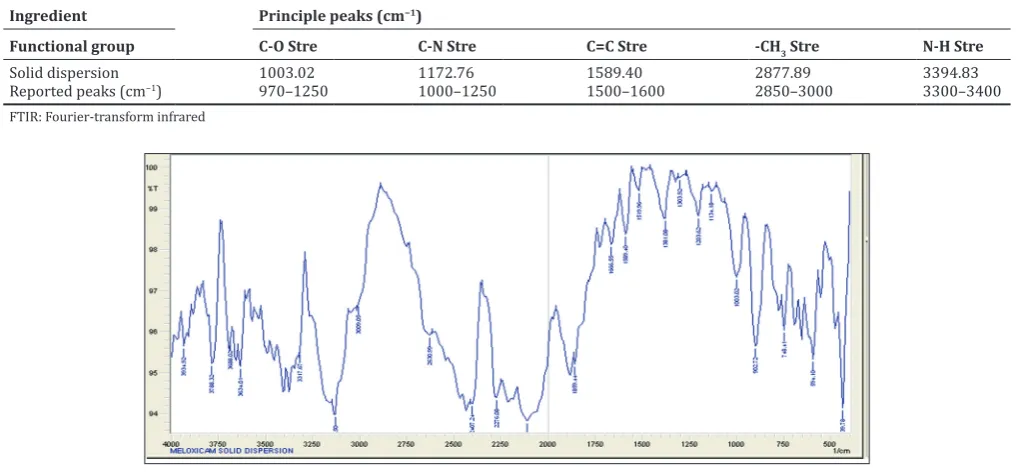
The solid dispersion formulation S4 with the highest solubility was further analyzed using DSC and FTIR spectra for drug and carrier compatibility study mentioned in Figs. 3 and 4 respectively.
MDT’s direct compression method for tablet preparation
The solid dispersion formulation S4 [Table 2] was selected for tablet preparation as it showed enhanced solubility in comparison with other formulations. The calculated amount of ingredients like in house prepared banana powder, mannitol, Avicel–102, and sodium saccharin, was taken in a mortar and pestle and mixed together. The solid dispersion was used with or without F-Melt C. This powder blend passed through sieve no 40. After that, lubricating blend talc and magnesium stearate with or without SLS were added within the powder blend. Then, this powder blend was subjected to direct compression using two tones pressure. The prepared tablets were further evaluated for DT, thickness, hardness, and weight variation [16,17].
The concentration of superdisintegrants used was 10% w/w in all formulations [18].
The F1, F2, and F3 formulations were prepared with a combination of natural superdisintegrant that is in house prepared banana powder and synthetic superdisintegrant F-Melt C, at concentration ratio 1:2, 3:2, and 4: 1 (natural:synthetic) The formulation F4 prepared with only one superdisintegrant, i.e., in house prepared banana powder. The formulation F5 was formulated with a single superdisintegrant as marketed banana powder. In the formulation F6, 0.8% SLS was added to enhance the strength of the tablet.
Evaluation parameters of MDT
All MDTs of meloxicam formulation were evaluated for DT, friability test, thickness, hardness, and weight variation as follows.
Disintegration test
The disintegration test was done. Take 100 ml beaker contains distilled water. Place the tablet into a beaker and continue stirring with stirrer till tablet get totally disperse in water and check the time required for complete disintegration of tablet into the water.
Table 5: Post‑compression study of F6 tablet formulation Parameter Wetting time (s) Average drug content (%)
Results 180 99.86
*Avg. mean where n=3 and SD<1
Fig. 1: Differential scanning calorimeter of meloxicam
Friability test
Friability test is a very important test that is used to check strength for the transportation of tablets. It was measured by tablet friability tester (Lab India, FT1020). Twenty initial weighted tablets (W initial) placed into the friability tester. Apparatus get started to make 100 rpm for 4 min (25 rpm/min). After completion of 4 min, the final weight of the tablet was taken (W final). Pharmacopeial limit is percent friability should not more than 1%. Percent friability of a tablet was calculated by the following formula;
% F W W
W
1 2
1
=
(
−)
×100Where, W1 = Weight of the tablets before friability test,
W2 = Weight of the tablets after friability test
Thickness
Tablet thickness was measured using digital Vernier calipers. The range varies ±5% using ten tablets.
Tablet hardness
Tablet hardness means the force applied for breaking or cracking a tablet. The hardness of tablet was checked by placing a tablet in center, force applied till the tablet gets broken. The hardness of tablet was determined using Monsanto or Pfizer hardness tester.
Weight variation test
Randomly 20 tablets were selected and the standard weight of each tablet was determined using the electronic weighing balance. Then, the deviation in the weight was calculated and recorded. Refer Table 3 for the result of all about the test.
Pre‑compression and post‑compression evaluation study of selected formulation
The successful F6 formulation with respect to the friability study was evaluated pre-compression and post-compression parameter. Flowability and compatibility of powder blend were analyzed using the following parameters and the results are mentioned in Tables 4 and 5.
Pre‑compression study
Bulk density – it is calculated by the following formula
Bulk density Mass Bulk volume =
Tapped density –it is calculated by the following formula
Tapped density Mass Tapped volume =
Hausner’s ratio –it is determined by the following formula
Hausner's ratio Tapped density Bulk density
=
Compressibility index – it indicates powder flow properties. The formula is given below
Compressibility index Tapped density Bulk density Tapped d
= −
e
ensity ×100
Angle of repose – it is calculated using the following formula
Tan =h r θ
Where,
h=height of the powder cone, r=radius of the powder cone
Post‑compression study Wetting time
Prepare the solution of 3 mg amaranth red added in 10 ml of water then put in the Petri plate containing a filter paper. Tablet was placed in the center of filter paper. The time required for water to reach the upper side of the tablet noted as the wetting time. It may be in the second or minute [19].
Drug content
Tablet was crushed. It is dissolved in 100 ml 0.1 N NaOH by vigorous shaking for 20 min. The solution was sonicated for 5 min. The solution
was filtered through a 0.45-μ filter. Then, 1 ml filtrate was withdrawn
and diluted up to 10 ml by 0.1 N NaOH and analyzed using UV spectrophotometer at 363 nm.
In vitro dissolution study
Percentage cumulative drug release of meloxicam MDTs was determined by United States Pharmacopeia Type II dissolution tester apparatus
Fig. 3: Differential scanning calorimeter of meloxicam solid dispersion
Table 6: FTIR spectrum of meloxicam
Ingredient Principle peaks (cm−1)
Functional group ‑C=C‑Stre N‑H Stre ‑S=O Stre ‑OH Stre ‑CH3 Stre
Pure drug 1558.54 3371.68 1072.46 3634.01 2978.19
Reported peaks (cm−1) 1500–1600 3300–3400 1000–1250 3580–3650 2850–3000
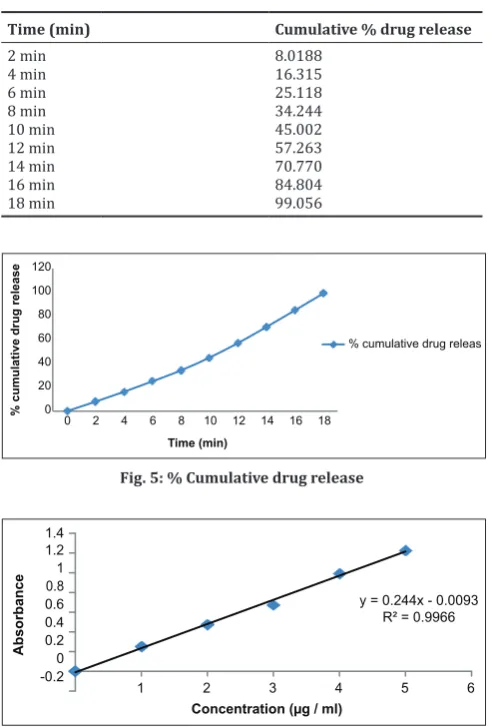
(Lab India Disso II) using the paddle method. The dissolution test was performed using 900 ml of phosphate buffer pH 6.8 at 37°C placed into the basket. A sample of 5 ml solution was withdrawn from the dissolution apparatus at a regular gap of 2 min for 20 min and placed into a 10 ml volumetric flask. The same quantity of the sample was replaced with a fresh dissolution medium by phosphate buffer (pH 6.8). The absorbance of these samples was analyzed at 363 nm using a UV spectrophotometer. The graph of cumulative % drug release versus time is shown in Fig. 5.
RESULTS AND DISCUSSION Identification of drug Melting point
The melting point was determined by the capillary method; it was observed at 252°C–260°C (standard melting point – 254°C). It gave authentication of pure drug [20].
DSC
DSC of pure drug
DSC analysis was performed to evaluate the thermal behavior of meloxicam. The meloxicam shows a sharp endothermic peak due to the melting of a drug at 254°C corresponding reported to the melting point of the pure drug at 254°C. The sharp endothermic peak shows the crystalline nature of the drug. DSC of the pure drug is shown in Fig. 1.
FTIR spectrum of meloxicam
The FTIR graph was derived for the identification of the various functional groups. The FTIR spectra of meloxicam consisted of many
sharp peaks that confirm the crystalline nature of the drug. The observed FTIR peaks of meloxicam were matching with the reported peaks, as shown in Table 6 [21].
Solubility of meloxicam
Meloxicam was found to be more soluble in phosphate buffer pH 6.8. It shows 1.2832 µg/ml. It shows the highest solubility in phosphate buffer (pH 6.8), as shown in Table 7.
Calibration curve of meloxicam
The calibration curve was determined by UV–spectrometer. Calibration curve prepared in a combination of distilled water and methanol at 363 nm. The data had a correlation coefficient of 0.9966, slope 0.244, and Y-intercept – 0.0093. These results indicate that there is a linear relationship between concentration (1–5 µg/ml) and absorbance, as mention in Fig. 6.
Preparation and evaluation of banana powder
Natural in house prepared fine banana powder and marketed banana powder found to have brown buff color. The swelling index was found, as shown in Table 1.
Preparation of solid dispersion
Hydrophilic carrier PEG was selected for the preparation of solid dispersion with meloxicam. PEG not only enhances the solubility but also used as a taste masking agent. The solid dispersion of meloxicam was prepared using a different grade of PEG to evaluate their efficacy as a solubility enhancer. It was tried to enhance the solubility with different concentration ratios such as 1: 1 and 1: 2. [9,13].
Solubility study of solid dispersion
The solubility of solid dispersion was prepared with two carriers, such as PEG–6000 and PEG–15000. Here, the effect of a drug to carrier ratio on solubility was studied and it was found that a 1:2 ratio gave maximum solubility of meloxicam in distilled water. Higher is the molecular weight, higher is the solubility [22]. Therefore, PEG–15,000 was found to be more effective in enhancing solubility than PEG–6000 based on molecular weight. The data of the solubility study of meloxicam solid dispersion are shown in Table 2.
DSC of meloxicam solid dispersion
The solid dispersion combination of Meloxicam + PEG 15000 (1: 2), solid dispersion exhibited a sharp endothermic peak at 59°C, which
Table 8: FTIR spectrum of meloxicam solid dispersion
Ingredient Principle peaks (cm−1)
Functional group C‑O Stre C‑N Stre C=C Stre ‑CH3 Stre N‑H Stre
Solid dispersion 1003.02 1172.76 1589.40 2877.89 3394.83
Reported peaks (cm−1) 970–1250 1000–1250 1500–1600 2850–3000 3300–3400
FTIR: Fourier-transform infrared
Fig. 4: Fourier‑transform infrared spectrum of meloxicam solid dispersion Table 7: Solubility of meloxicam
Media Avg. solubility* (µg/ml)
Water 0.0187
Ethanol 0.2455
Methanol 0.3570
Propanol 0.2376
Butanol 0.3084
Acetone 0.4345
Chloroform 0.3257
here to the reported at the melting point of PEG–15,000. The solid dispersion shows a broadened endothermic peak which indicates a reduction in crystallinity. DSC of meloxicam solid dispersion is shown in Fig. 3.
FTIR spectrum of meloxicam solid dispersion
In S4 formulation solid dispersion, there is no interaction found between meloxicam and PEG–15,000. A decrease in the peak intensity indicates decrease in the crystallinity of solid dispersion, as found in the FTIR profile of solid dispersion in Table 8 and Fig. 4.
Formulation of MDT of meloxicam
The compressed tablets were of round shape with buff color. The thickness of all the tablets was found approx 1.8–1.9 mm and they all have passed pharmacopeial weight variation test. As the proportion of
banana powder increases from F1 to F3 formulation, the slight decrease in hardness was observed. The addition of SLS also has shown an increase in the hardness of the tablet in the formulation F6.
In the case of formulation F1, F2, and F3, as we increase the proportion of natural superdisintegrant in a superdisintegrant blend, reduction in DT was observed. In F4 formulation in house prepared banana powder was used alone. This formulation has shown a further reduction in DT as 28 s. Then, to check the efficiency of in house prepared banana powder, formulation F5 was designed with branded banana powder (Baghban foods*) for comparison. In house prepared banana powder was found to be more superior to marketed banana powder in reducing the DT. All formulation F1 to F5 have shown satisfactory results for DT but they fail to pass the friability test. As per the literature survey addition of SLS in the formulation increases the tablet strength, therefore, in formulation F6 with 10% w/w in house prepared banana powder, 0.8% of SLS was added to increases the tablet strength. However, the addition of SLS gave the increase in the DT as 70 s, which was till within the pharmacopoeial limit and this formulation also gets succeeded in passing the friability test. Thus, formulation F6 was selected as a final formulation for further pre-compression and post-compression study.
Pre‑ and post‑compression study of selected formulation
Formulation F6 was selected based on the DT and friability testing data for pre- and post-compression study.
Pre‑compression study of selected formulation
The formulation F6 was selected for the pre-compression study. It depends mainly on particle size distribution, particle size, shape, and tendency of the particles to adhere together. It plays an important role in tablet preparation. The angle of repose was found to be 25.50°±0.08 which is in the range of 20–30° which indicates good flow. Further, it was confirmed with the compressibility index which is observed 15.26% (12–16%) which indicates good flow property, Hausner’s ratio was found to be 1.180 which also gave good flow property, as shown in Table 4.
Post‑compression study of selected formulation
The randomly selected F6 formulation was taken for the post-compression study. Wetting time was found to be 180 s, drug content was found to be 99.86%, and the dissolution study showed 99% of cumulative drug release within 18 min, as shown in Tables 5 and 9.
The result of the dissolution of F6 formulation is shown in Table 9.
As per Fig. 5, about 8% cumulative drug release was observed in 2 min and 99% cumulative drug release was observed in 18 min. Dissolution data were fitted in the kinetic model and were found that the MDTs meloxicam followed zero-order model with R2=0.9905, as a result, as
shown in Fig. 7.
CONCLUSION
This work was initiated to formulate and evaluate MDTs of meloxicam. From the study, it can be concluded that direct compression can be applied effectively in the preparation of MDTs. In this work, solid dispersion was used to increase the solubility of the drug, and it also to taste mask of a drug. PEG was used as a taste masking agent. Solid dispersion prepared with PEG 15,000 with the drug to carrier ratio 1:2 found to give maximum solubility in compare with PEG 6000. In house prepared banana powder was found to be superior as compared to the combination of natural and artificial superdisintegrant. In house prepared fresh banana powder gave a promising effect in comparison to the marketed banana powder as natural superdisintegrant. The addition of SLS in the formulation has shown an increase in the tablet strength to prevent failure of friability testing. It was concluded that the use of natural banana powder as a superdisintegrant in a formulation of MDTs of meloxicam is more promising with respect to economical and compatibility for geriatric patients.
Table 9: In vitro dissolution study
Time (min) Cumulative % drug release
2 min 8.0188
Fig. 5: % Cumulative drug release
Absorbance
ACKNOWLEDGMENT
The authors are thankful to Cipla Unit - 1 (Kurkumbh) for providing gift sample of Meloxicam and Research Lab Fine Chemical Industries Pvt. Ltd. Mumbai for providing Mannitol, Talc, Sodium Saccharin, Avicel (MCC), and Magnesium Stearate.
AUTHOR’S CONTRIBUTIONS
Experimental design, guidance, and supervision for the research were done by Mrs. S. Mutha. Literature review, experimental work, development, optimization of formulations, interpretation of results done by Mr. C. Pawar. Manuscript writing done by Mr. C. Pawar, Mrs. S. Mutha, Mr. S. Bhise, Miss. P. Borawake. All authors read and approve the final Manuscript.
CONFLICTS OF INTEREST
All authors declare that we have no conflicts of interest.
FUNDING None.
REFERENCES
1. Kalia A, Khurana S, Bedi N. Formulation and evaluation of mouth dissolving tablets of oxcarbazepine. Int J Pharm Pharm Sci 2009;1:12-3.
2. Patil HK, Patil GM, Jain VH, Tadvi SA, Pawar SP. A review on mouth dissolving tablet. J Appl Pharm Res 2017;5:09-15.
3. Karumuri K, Kumaran A, Nagalingam A. Comparative study of natural and synthetic superdisintegrants in the formulation of oral disintegrating tablets using bambuterol hydrochloride as model drug. Indo Am J Pharm Res 2013;7421-30.
4. Mohanachandran PS, Sindhmol PG, Kiran TS. Superdisintegrants-an overview. Int J Pharm Sci Rev Res 2011;6:105-9.
5. WangL, Sun Y, Kuang C, Zhang X. Preparation and evaluation of taste masked oral suspension of arbidol hydrochloride. Asian J Pharm Sci 2015;10:73-9.
6. Jafar M, Ali S. Development and evaluation of meloxicam solid dispersion loaded buccal patches. J Appl Pharm Sci 2011;1:77-82. 7. Amina MA, Myasar MA, Ahlam AK. Preparation and evaluation of
meloxicam solid dispersions by solvent evaporation method. Int Res J
Pharm 2014;5:838-45.
8. Oliveira CP, Ribeiro ME, Ricardo NM, Souza TV, Moura CL, Chaibundit C. The effect of water soluble polymers, PEG and PVP, on solubilisation of griseofulvin in aqueous micellar solutions of pluronic F 127. Int J Pharm 2011;421:252-7.
9. Nagalingam A, Kuppusamy G, Lakshmanan P, Arunachalam M, Veeraraghavan S, Dhanabalan S. Development of a patient friendly dosage form using a natural excipient. J pharm Res 2011;4:1216-18. 10. Raj A. Comparative evaluation of potato starch and banana powder as
a disintegrating agents in aceclofenac tablet formulation. Int J Pharm Pharm Sci 2013;5:204-7.
11. Poosarla A, Muralikrishna R. Viscosity, swelling index and moisture content in Gum Karaya. Int J Sci Res 2017;6:1189-92.
12. Deshmukh KR, Jain SK. Development of aceclofenac MDTs using solid dispersion technique: In-vitro evaluation. Ind J Pharm Educ Res 2012;46:97-104.
13. De los Santos CJ, Perez-Martínez JI, Gomez-Pantoja ME, Moyano JR. Enhancement of albendazole dissolution properties using solid dispersions with gelucire 50/13 and PEG 15000. J Drug Deliv Sci Technol 2017;42:1-12.
14. Kushawa A. Solid dispersion a promising novel approach for improving the solubility of poorly soluble drugs. Int J Pharm Sci Res 2017;2:2021-30.
15. Sorkhel AD, Chaudhari YS. Solubility enhancement of poorly absorbable drugs. World J Pharm Res 2016;5:933-64.
16. Dhahir RK, Al-Kotaji M. Formulation of orally disintegrating tablets of cinnarizine by using direct compression method. Int J Appl Pharm 2018;11:117-23.
17. Sreenivas SA, Gadad A, Patil M. Formulation and evaluation of ondansetron hydrochloride directly compressed mouth dissolving tablets. Indian Drugs 2006;4:35-7.
18. Anand N, Singh L, Sharma V. Emergence of natural superdisintegrants in oro-dispersible tablets: An overview. Int Res J Pharm 2013;4:33-7. 19. Ashish P, Harsoliya MS, Pathan JK, Shruti S. A review - formulation of
mouth dissolving tablet. Int J Pharm Clin Sci 2011;1:1-8.
20. Anggraeni Y, Haryanto J, Hendradi E. Physical and chemical characteristics of meloxicam from nanostructured lipid carriers system using some concentration ratios of monostearin and Alpha-tocopherol acetate lipid matrix. Asian J Pharm Clin Res 2017;10:231-8.
21. Hassan M, Dehghana G, Jafar M. Improving dissolution of meloxicam using solid dispersions. Iran J Pharm Res 2006;5:231-8.