DOI : https://doi.org/10.32628/CSEIT1951116
An Elementary Study on Various Techniques Involved in Face Recognition
Systems : A Review
Payal MakenSchool of Computer Science & Engineering, Shri Mata Vaishno Devi University, Kakryal, katra, Jammu & Kashmir, India
ABSTRACT
Face recognition has now become one of the interesting fields of research and has received a substantial attention of researchers from all over the world. Face recognition techniques has been mostly used in the discipline of image analysis, image processing, etc. One of the face recognition techniques is used to develop a face recognition system to detect a human face in an image. In face recognition system a digital image with a human face is given as an input which extracts the significant features of face such as (eyes, nose, chin, cheeks, etc) to recognize a face in a digital image which is an exhausting task. Security of information is very salient feature and is difficult to achieve. Security cameras are present in offices, universities, banks, ATMs, etc. All these security cameras are embedded with face recognition systems. There are various algorithms which are used to solve this problem. This paper provides an overview of various techniques which are often used for this face recognition in a face recognition system. This paper is divided into five parts, first section concludes various face detection techniques, second section describes about image processing ,third section have details about face recognition techniques, fourth section describes various classification methods and last section concludes all of these sections.
Keywords : Face Recognition, Face Detection, Features Extraction, Pre-Processing
I. INTRODUCTION
Face recognition techniques is used in wide variety of face recognition systems. A face recognition technique involves identification of faces and then comparing it with the images in the database. Human beings can easily differentiate the human face on the basis of various factors. But it is complicated to develop such a computer system which can imitate human capabilities of recognition and detection of a face in a digital image. In recent years we can see that researches related to face recognition have been escalating, and this is so because of the need of security in various areas. Person’s identification is
most important for the purpose of security. We can identify a person through its identity cards,
passwords; person identity numbers (PINs), etc. But identity cards can be easily stolen or misplaced; passwords and PINs can be forgotten. However
Face recognition system basically consists of following blocks:
1. Input image 2. Facial detection 3. Image processing 4. Facial recognition
a. Features extraction 5. Verification/Validation
A. Input Image
A physical or behavioral sample of image is captured from any physical image capturing device, which serves as an input the system.
B. Facial detection
It basically means locating a face in a given image.
C. Image processing
Images are cropped to avoid facial image remains and images are converted into black and white and then to gray images.
D. Facial recognition
It means to extract the features of a face (eyes, nose, etc) and make a template of it.
E. Verification
System recognizes a given individual and gives a decision.
F. Validation
In this system compares a given individual face with faces in the database to identify a given face.
Figure1. Block diagram of face recognition system
Figure 1 shows the block diagram of face recognition system. Nevertheless ample work has been done on face recognition problem, but still not any work is up to the mark for the implementation point of view.
Each year new techniques are developing for this purpose.
II. RELATED WORK
A. Face Detection
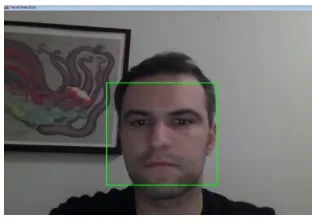
Face detection is the first step in any face analysis system. Face detection involves finding a face in any given input image. So, basically it means to find out where is the face irrespective of the background. For example in a figure 2, there is a photo frame over there but what it tries to do is extract from an image just a segment which represents a face.
Figure 2. Detecting a face in an image
There are number of techniques for detecting a face in an image.
1. Voila Jones face detection
This technique was given by Paul Viola and Michael Jones. It is also known as haar cascade algorithm, this algorithm detect a face in an image on the basis of various features like eyes, nose, upper body, lower body. A system is designed by giving input some faces and some non-faces and training a classifier. This classifier is known as haar cascade classifier. Now a cascade classifier is something that tells what we have to look in an image for detecting a face. For example, if we are distinguishing whether a person is overweight or not, then weight is the feature that is to be considered not their age or skin color [1]. So we basically train a classifier to detect a face. The data is then stored in a file in the system. By referring to that trained data one can detect a face.
This algorithm includes following:
• Haar features
• Adaboost
• Cascading
a. Haar features
A haar cascade is a series of “haar-like-features” that are combined together to shape a classifier.
Figure3. Haar-like features
So haar-like-features are on the whole are rectangular pattern data. These haar-like features have some sort of resemblance to facial features or characteristics of face (eyes, nose, cheeks, etc). These features are applied one by one to whole image and where the face features matches with it, it gives high intensity value. The sum of pixels under white rectangular is subtracted from the sum of pixels under black rectangular gives a single value. Figure 3 shows the Haar- like- features for face detection.
Figure4. Usage of haar-like-features
In figure 4 two haar features are applied to an image and these features are able to extract the nose and eyes from the image and this is done by applying the feature all over the face and get the high value only at the pixels where this pattern matches exactly, from
this we understand that this pattern is absorbed in this picture. Viola Jones uses 24*24 window as a base window size to start evaluating these features in any given image. Considering all possible parameters of the haar like features we get about 16000+ features in this window.
b. Integral image
In an integral image the value at pixel (x, y) is the sum of pixels above and to the left of (x, y).
Figure5. Input image to Integral image
c. Adaboost
Adaboost eliminates the redundant or irrelevant features and narrow it down to some 1000 features. So that we have to apply only useful features to an image instead of all the features to reduce the complexity and to make it time efficient. Adaboost find the best features among all the 16000+ features.
d. Cascading
In every 24*24 we need to evaluate 2500 features that we obtained after performing adaboost. But, instead of calculating 2500 features in every 24* 24 window, we use cascades. That is out of 2500 features, we make a set of 10 features in one classifier, then the next 20 or 30 features in next classifier and then 200 or 300 in next classifier and so on. Thus cascading results in a strong classifier as a linear combination of weak classifiers.
2. Face detection using skin color
Human skin color is proven to be most efficient method of detecting a human face than any other algorithms that uses facial features[2]. Using skin color for detection has several advantages, that the processing is much faster. The image for which face has to be detected must be in color picture not in grayscale. Although, different people have different skin colors and the difference lies between their intensities rather than chrominance [3]. Since the input color image is in RGB format, so this technique usually uses the color components in other color spaces such as YCbCr, because of the RGB components which may fail to detect the face.
In YCbCr format, luminance information is acquisition are not suitable for face recognition. Quality of image plays a crucial role in face recognition rate. Quality of image is compromised due to the certain factors such as noisy images, poor resolution, etc. So to overcome these problems image preprocessing is done before feature extraction (face recognition) which will increase the face recognition rate.
There are various image preprocessing techniques the can be used to improve the quality of input images such as image normalization, de-noising, image filtering, background subtraction etc.
Various steps involved in image pre-processing are [4]:
1. Background removal/subtraction or cropping 2. Converting RGB into gray image
3. Converting grayscale into binary image 4. Filtering or smoothing
1. Background subtraction or cropping
In background subtraction, the face is detected from the whole image, and this is done by face detection method with the help of features extraction (eyes, nose, lips, etc).
Figure 7. Background removal or subtraction
2. Converting RGB into gray image
RGB (red, green and blue) image is known as true color image, is stored as m*n*3 data array having red, green and blue color components for each pixel. The color of each pixel is decided by the combination of red, green and blue intensities. Now, Gray images are those in which the only colors are the shades of gray.
Figure 8. RGB to Grayscale image
3. Converting grayscale into binary image
Binary image is a digital image that has only two possible values for each pixel (0 for black and 1 for white). It uses only two colors black and white. Grayscale image can be converted into binary image by calculating its pixel value, if the intensity value/ pixel value is greater than 127 then change it to 255 or 1 and if the intensity value is less than 127 change it to 0, then the image is converted into binary image.
Figure 9. Grayscale to binary image
4. Filtering or smoothing
Filtering or smoothing is done to enhance the quality of the image by the removal of the noise (blurring, poor resolution, etc) from the image.
Median filter: Filtering set the value of the output pixel as the median of all the
neighborhood pixels that is taken as input. Other filters replace the pixels values by mean and average value:
a. Take the median value of pixels in a window in the neighborhood.
Median= sort all the pixels in an increasing order, take the middle one.
b. Replace the pixel value with the median value.
C. Face recognition
Face recognition primarily means extracting the features from face i.e. eyes, nose, chin, etc. Various techniques which are used for this purpose are following:
1. Principal component analysis (PCA) or Eigen faces
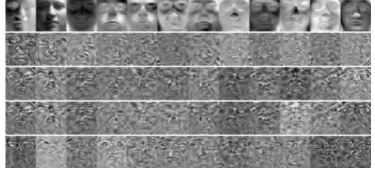
It is mostly used tool for data analysis making a predictive model (face recognition system). Face recognition technique based on PCA generally make use of an Eigenfaces. In face recognition system, training set consists of a set of M images, and each of these images is of m*m dimensions, so there will be m2 pixels. The PCA transforms the set of images into
low dimensional pictures known as Eigen faces. So basically, PCA is a mathematical method which use an orthogonal transformation to convert a set of values of possibly correlated M variables(face images in the training dataset) into a set of values of K
uncorrelated variables called principal
components(Eigen faces). The numbers of Eigen faces is always less than or equal to the number of test images in the training set i.e. K< =M.
Figure 10. Face images to Eigen faces
In Eigenfaces the first principal component shows the most dominant feature of the dataset and each succeeding component in turn shows the next dominant component.
To reduce the calculations that are needed for finding the principal components, the dimensionality of the original dataset is reduced before they are calculated. Since each preceding components how less features and more noise, only few first principal components are selected and rest of the last are discarded.
Figure12. Selected k useful Eigenfaces
Each image in the original dataset can be represented as a linear combination (weighted sum) of Eigenfaces.
Figure13. Weighted sum of Eigen faces
So, PCA reduces the number of values (from M to K) needed to recognize a face.
2. Linear Discriminant Analysis or Fisher Faces
LDA is also known as Fisher faces. LDA is derived
from Fisher’s Linear Discriminant (FLD) technique. It is considered as a classical technique in pattern recognition. It is used to find a linear combination of features which separate two or more classes into objects [5]. Data is assumed to be uniformly distributed in each class. It is used to convert the training samples into bases vectors. Linear combination that is obtained using FLD is known as Fisher faces while in PCA it is known as Eigen faces. LDA is preferred over PCA because it groups the classes into projected faces that can be linearly
separable and produces the good results even under varying illumination conditions and images with different poses and expressions.
Figure14. Fisher Faces
3. Independent Component Analysis
ICA is an abstract principle of PCA. PCA uses second order statistics while ICA uses high order statistics to form a better set of basis vector of face images. It represents faces as a linear combination of independent sources. It treats the images as random variables and pixels as outcomes. So, it constructs the face without face class information.
D. Verification/Validation
Verification and validation is the process of recognizing an individual.
1. Distance-wise classification
Once the features are extracted from face recognition techniques, it is then to classify whether the test face belongs to the training set or not. It is done by measuring the distance between the training dataset and the image. If the distance is minimum, the test image is verified and the person is recognized.
2. K-Nearest neighbor
In this method, nearest neighbor is searched, and if maximum number of neighbors belongs to one class, we can classify test image to that class. With increases k value, the classification rate decreases.
It is mostly used because of its similarities with the human brain. Neural networks make the mapping of
the images with the person’s expressions.
III. CONCLUSION
The research in face recognition has been an exciting area and it will keep attracting many engineers and scientists for many years in this field. In this paper different techniques that can be used in face recognition are discussed. It also gives the whole concept of face recognition system. According to this literature survey, Viola Jones gives real time performance for face detection. Skin detection technique also works well. Image preprocessing is necessary to reduce the noise from the images and to give better recognition rate. PCA and LDA works better for features extraction. Among PCA and ICA, ICA uses high order statistics. Neural networks, k- nearest neighbor techniques and Distance-wise classification methods are used for further recognition and classification. Combining all these techniques, a face recognition application or system can be developed.
IV.REFERENCES
[1]. D. Saini and R. Kaur, “Assembling of Human
Beings in an Image to Detect a Group on the basis of Distance using Digital Image
Processing,” International Journal of Current
Engineering and Technology, vol. 6, no. 2, pp. 462–466, 2016.
[2]. H. M. Z. Hewa Majeed Zangana, “A New
Algorithm for Human Face Detection Using
Skin Color Tone,” IOSR Journal of Computer
Engineering, vol. 11, no. 6, pp. 31–38, 2013. [3]. A. Amine, S. Ghouzali, and M. Rziza, “Face
Detection in Still Color Images Using Skin Color Information,” Network, vol. 24, no. July
2014, p. 4, 2002.
[4]. A. Sengupta and P. Mondal, “Estimating The
Age Of Human Face In Image Processing Using
Matlab,” vol. 4, no. 3, pp. 10899–10902, 2015. [5]. M. N. S. Zainudin et al., “Face Recognition
using Principle Component Analysis ( PCA )
and Linear Discriminant Analysis ( LDA ),” no.
05, 2012.
Cite this article as :
Payal Maken, "An Elementary Study on Various Techniques Involved in Face Recognition Systems : A Review", International Journal of Scientific Research in Computer Science, Engineering and Information Technology (IJSRCSEIT), ISSN : 2456-3307, Volume 5 Issue 1, pp. 519-525, January-February 2019. Available at doi :