© 2015, IRJET.NET- All Rights Reserved
Page 979
CONTENT BASED IMAGE RETRIEVAL (CBIR) USING ADAPTIVE GROUND
TRUTH COMPOSITION
Smt. M.Venkata Ramana
1, S.AnuRadha
2, E.Sreenivasa Reddy
3, Ch.SatyaNarayana
41
Assistant Professor, Department of CSE, GITAM UNIVERSITY, Visakhapatnam, A.P, India
2
Assistant Professor, Department of CSE, GITAM UNIVERSITY, Visakhapatnam A.P, India
3
Professor, Department of CSE , NAGARJUNA UNIVERSITY. GUNTUR A.P, India
4
Professor, Department of CSE, JNTU, Kakinada A.P, India
---***---Abstract -
In recent years, with the development ofdigital image techniques and digital albums in the Internet, the use of digital image retrieval process has increased dramatically. An image retrieval system is a computer system for browsing, searching and retrieving images from large databases of digital images. In order to increase the accuracy of image retrieval, a content-based image retrieval system (CBIR) based on adaptive ground truth is proposed. Color, texture and edge have been the primitive low level image descriptors in content based image retrieval systems. In this paper we propose a system that splits the retrieval process into two stages: Query and Evolution stage. In the Query stage, the feature descriptors of a query image are extracted and then used to evaluate the similarity between the query image and those images in the database. In the Evolution stage, the most relevant images are retrieved by using the Ground truths. Experimental results demonstrate the feasibility of the proposed approach.
Key Words:
CBIR,texture, wavelet,
Interactive Ground Truths.1. INTRODUCTION
This paper deals with Content Based Image Retrieval which uses the concept of ground truths in order to meet the user needs of similar images. Content-Based Image Retrieval (CBIR), also known as Query By Image Content (QBIC) and Content-Based Visual Information Retrieval (CBVIR) is the application of Computer Vision techniques to the image retrieval problem, that is,
the problem of searching for digital images in large databases. “Content-based” means that the search analyzes the contents of the image rather than the metadata such as keywords, tags, or descriptions associated with the image. The term "content" in this context might refer to colors, shapes, textures, or any other information that can be derived from the image itself. CBIR is desirable because searches that rely purely on metadata are dependent on annotation quality and completeness. Having humans manually annotate images by entering keywords or metadata in a large database can be time consuming and may not capture the keywords desired to describe the image. The term "Content-Based Image Retrieval" seems to have originated in 1992 when it was used by T. Kato to describe experiments into automatic retrieval of images from a database, based on the colors and shapes present. Since then, the term has been used to describe the process of retrieving desired images from a large collection, on the basis of syntactical image features. Image processing is any form of signal processing for which the input is an image, such as photographs or frames of video; the output of image processing can be either an image or a set of characteristics or parameters related to the image. Most image-processing techniques involve treating the image as a two-dimensional signal and applying standard signal-processing techniques to it. In Text Based Image Retrieval (TBIR) method, two users want to retrieve the same image, but each of them do not submit the same key, which may be difficult by TBIR, to determine, resulting to provide inaccurate results of retrieval.
© 2015, IRJET.NET- All Rights Reserved
Page 980
resources and time is needed, for classification andannotation of all the images in the database. Furthermore, different people's subjective awareness annotation will affect the overall retrieval results. For the above problems, Content Based Image Retrieval (CBIR) suits to be the best Image Retrieval System of main stream technologies.
1. Human Oriented IGA [1] provides more effective management and retrieval of images than the keyword-based approach. This system extracts the feature from images by wavelet transform, and provides a user-friendly means to retrieve an image from a large database when the user cannot clearly define what the image must be. 2. Generic applied evolutionary hybrid technique [5], that combines the effectiveness of adaptive multimodal partitioning filters and genetic algorithms’ (GAs) robustness has been designed, developed, and applied in real-world adaptive system modeling and information mining problems.
The method can be applied to linear and nonlinear real-world data, is not restricted to the Gaussian case, is computationally efficient, and is applicable to online/adaptive operation.
3.SIMPLIcity (semantics- matching for picture libraries)[8] an image retrieval system, which uses semantics classification methods, a wavelet-based approach for feature extraction, and integrated region matching based upon image segmentation. In other region based retrieval systems, an image is represented by a set of regions, roughly corresponding to objects, which are characterized by color, texture, shape, and location. An adaptive genetic algorithm (AGA) [2] for an active noise control (ANC) system. The conventional ANC system often implements the filtered extended least mean square (FXLMS) algorithm to update the coefficients of the linear finite-impulse response (FIR) and nonlinear volterra filters, owing to its simplicity.
4. Automatic target tracking in forward-looking infrared (FLIR) imagery is a challenging research area in computer vision as discussed in [7]. This task could be even more critical when real-time requirements have to be taken into account. In this context, techniques exploiting the target intensity profile generated by an intensity variation function (IVF) proved to be capable of providing significant results. In this paper, an alternative approach based on genetic algorithms (GAs) is proposed. In this paper, an optimized target search strategy relying on GAs and exploiting an evolutionary approach for the computation of the IVF is presented.
5 The existing methods [1, 4] of this kind prefer matching the given whole segmentation with ground truths for evaluation. However, the available human-labeled ground truths are only a small fraction of all the possible interpretations of an image. The available dataset of
ground truths might not contain the desired ground truth which is suitable to match the input segmentation. Hence such kind of comparison often leads to a certain bias on the result or is far from the goal of objective evaluation.
6 Researchers have found that human visual system (HVS) is highly adapted to extract structural information from natural scenes [5]. As a consequence, a perceptually meaningful measure should be error-sensitive to the structures in the segmentations. It is also known that human observers may pay different attentions to different parts of the images [2].
2.
SYSTEM
ANALYSIS
AND
DESIGN
2.1
Content comparison using image distance
measures
The most common method for comparing two images in content-based image retrieval (typically an example image and an image from the database) is using an image distance measure. An image distance measure compares the similarity of two images in various dimensions such as color, texture, shape, and others. For example a distance of 0 signifies an exact match with the query, with respect to the dimensions that were considered. As one may intuitively gather, a value greater than 0 indicates various degrees of similarities between the images. Search results then can be sorted based on their distance to the queried image. Many measures of image distance (Similarity Models) have been developed.
2.2 Color:
Computing distance measures based on color similarity is achieved by computing a color histogram for each image that identifies the proportion of pixels within an image holding specific values. Examining images based on the colors they contain is one of the most widely used techniques because it can be completed without regard to image size or orientation.[3] However, research has also attempted to segment color proportion by region and by spatial relationship among several color regions.
2.3 Texture:
© 2015, IRJET.NET- All Rights Reserved
Page 981
textures in an image is achieved primarily by modelingtexture as a two-dimensional gray level variation. The relative brightness of pairs of pixels is computed such that degree of contrast, regularity, coarseness and directionality may be estimated. The problem is in identifying patterns of co-pixel variation and associating them with particular classes of textures such as silky, or rough. Other methods of classifying textures include:
Co-occurrence matrix
Laws texture energy
Wavelet Transform
2.4 Shape:
Shape does not refer to the shape of an image but to the shape of a particular region that is being sought out. Shapes will often be determined first applying segmentation or edge detection to an image. Other methods use shape filters to identify given shapes of an image. Shape descriptors may also need to be invariant to translation, rotation, and scale. Some shape descriptors include:
Fourier transform
Moment Invariant
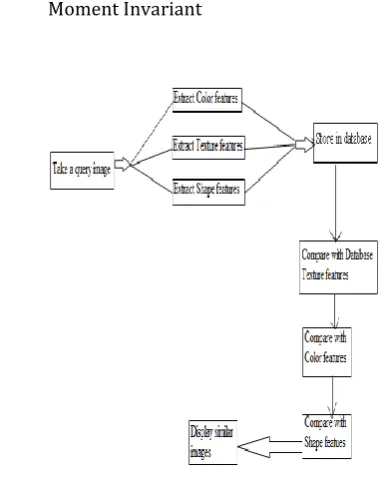
Fig 1: Flowchart of the proposed system
Module-1 (Constructing a Database): For each and every image we can extract texture, shape and color features of an image, perform clustering and store it in a database by using cell arrays.
Module-2 (Compare image features and Display similar images): Take a input image ,extract the features ,compare the features with the stored features in a database and display the relevant images. Finally we calculate efficiency of the system using Precision and Recall.
Steps performed in Module-1 :
Extracting Colour Features.
Extracting Texture Features.
Extracting Shape Features using Fourier Descriptors.
Form a feature vector consisting of all features.
Steps performed in comparing and display images are:
Take a query image from the user which is to be searched.
Extract Color, Texture and Shape Features of an input image.
Compare the extracting features with the features of all images that are stored in a database using some Distance measures.
Display all images that are similar to the given input image.
Calculate efficiency of the system by using Precisionand Recall.
The search process is repeated until the user is satisfied with the result or results cannot be further improved. If user is not satisfied with the search image module result then user gives the judgment value to the system to find the similar image.
© 2015, IRJET.NET- All Rights Reserved
Page 982
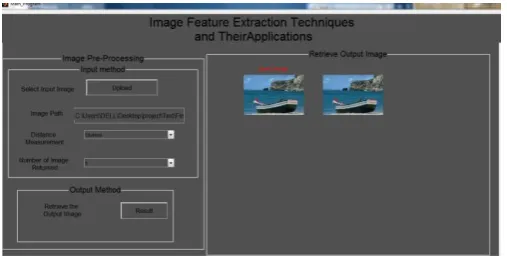
The image after uploading the query image:Fig 3: upload query image
Further, we can perform comparison and retrieval on the pre-processed image.
The image in Fig 2, when sent through the distance formulae, gives the following result.
Fig 4: Image after performing CBIR using relative deviation
Fig 5: Image when there exists no similarity
Table- 1: Comparision table
Test Total no. of relevant
images
No. of relevant
images retrieved
Total no. of retrieved
images
Recall Prec ision
13 18 6 10 33.33 60
29 11 5 10 45 50
91 32 10 10 31.25 100 126 32 10 10 31.25 100
74 21 7 10 33.33 70
139 44 6 10 13.6 60
183 35 5 10 14.28 50
239 53 7 10 13.2 70
35 11 5 10 45.4 50
269 53 7 10 13.2 70
3.
C
ONCLUSIONSAND
FUTURE WORK© 2015, IRJET.NET- All Rights Reserved
Page 983
REFERENCES
[1] Chih-Chin Lai, and Ying-Chuan Chen, “A User-Oriented Image Retrieval System Based on interactive Genetic Algorithm,” IEEETransactions on instrumentation and measurement, vol. 60, no. 10,October 2011.
[2] C.-Y. Chang and D.-R. Chen, “Active noise cancellation without secondary path identification by using an adaptive genetic algorithm,” IEEE Trans. Instrum. Meas., vol. 59, no. 9, pp. 2315–2327, Sep. 2010. [3] D. E. Goldberg, Genetic Algorithms in Search,
Optimization, and Machine Learning. Reading, MA: Addison-Wesley, 1989.
[4 Gonzalez R.C,Woods R.E:Digital Image Processing, Addison Wesley, 1992.
[5] G. Beligiannis, L. Skarlas, and S. Likothanassis, “A generic applied Evolutionary hybrid technique for adaptive system modeling and Information mining,”
IEEE Signal Process. Mag.—Special Issue on “Signal Processing for Mining Information”, vol. 21, no. 3, pp. 28–38,May 2004.
[6] K. Deb, Multi-Objective Optimization Using Evolutionary Algorithms. Hoboken, NJ: Wiley, 2001. [7] G. Paravati, A. Sanna, B. Pralio, and F. Lamberti, “A
genetic algorithm for target tracking in FLIR video sequences using intensity variation
BIOGRAPHIES
Smt. M.Venkata Ramana
Specialization in Image Processing.
Smt. S.Anuradha
Specialization in Image Processing.
Prof. E.Sreenivasa Reddy
Specialization in Image Processing, Compiler Design
Prof. Ch. Satyanarayana
Specialization in Image