R E S E A R C H
Open Access
Continuous solutions of 3rd-order iterative
equation of linear dependence
Pingping Zhang
1*and Xiaobing Gong
2**Correspondence:
[email protected]; [email protected]
1Department of Mathematics,
Binzhou University, Binzhou, Shandong 256603, China 2Department of Mathematics,
Neijiang Normal University, Neijiang, Sichuan 641100, China
Abstract
We study continuous solutions of the 3rd-order iterative equation of the linear dependence for hyperbolic cases and generalize the results to thenth-order polynomial-like iterative equation, in some cases recursively. This paper partly answers the question raised in Remark 7 in (Yang and Zhang in Aequ. Math. 67:80-105, 2004) and the open problem raised by Matkowski in (Aequ. Math. 37:119, 1989) in the 26th international symposium on functional equations.
MSC: 39B12; 37E05
Keywords: functional equation; iteration; characteristic root; continuous solution
1 Introduction
Consider a real functionf :R→R. Itsnth iterate is defined byfn(x) =f(fn–(x)),f(x) =
xfor allx∈Rrecursively. A functional equation involving the iterates of the unknown function is called an iterative functional equation. Some problems of dynamical systems such as iterative root [, ] and invariant curve [, ] reduce to those iterative equations, a more general and important form is the polynomial-like iterative equation
λnfn(x) +λn–fn–(x) +· · ·+λf(x) =F(x), (.)
an equation of the linear dependence of iterates. While attention was paid to the case of nonlinearF(seee.g.[–]) and further generalized forms [, ], the case of linearF, that is,
fn(x) +λn–fn–(x) +· · ·+λf(x) +λx=c, (.)
even the homogeneous equation
fn(x) +λn–fn–(x) +· · ·+λf(x) +λx= (.)
is also fascinating. In Nabeya [] investigated the generalized Euler equationf(p+ qx+rf(x)) =a+bx+cf(x), which actually is equivalent to (.) forn= . He showed all iteratesfkby a system of linear homogeneous difference equations and formulated
con-tinuous solutions by this system’s eigenvalues. However, all concon-tinuous solutions of (.) forn≥ have long been in suspense. In Matkowski [] raised an open problem
in the th international symposium on functional equations: ‘How to determine all the continuous solutions f :R→Rof the nth-order homogeneous iterative equation under the conditionλ= ,even for n= ?’, which has attracted attention of many scholars.
Letr,r, . . . ,rnbencomplex roots of the characteristic equation
P(r) :=rn+λn–rn–+· · ·+λr+λ= .
In Jarczyk [] discussed (.) defined on the interval not containing zero and gave the linear solutionf =cx, whereλi> >λ(i= , . . . ,n– ) andcis the unique positive
char-acteristic root. Tabor and Tabor [] investigated (.) defined on the same domain. As-suming thatris the unique positive and simple characteristic root and is smaller than the module of all complex ones, they proved that the equation has exactly a solutionf(x) =rx depending continuously on all coefficients. In Matkowski and Zhang [] established a characteristic theory of the second order (.) withλ= ,i.e., all continuous solutions
were represented by using two characteristic solutionsf(x) =rix(i= , ).
Characteristic theory of (.) for n≥, as we know, is more complicated. In Yang and Zhang [] constructed all continuous solutions of (.) for the hyperbolic cases: () <r<r<· · ·<rn; () <r<r<· · ·<rn< ; ()r<r<· · ·<rn< –;
() – <r<r<· · ·<rn< , and they proved no continuous solutions when the
character-istic roots are all complex roots, and they gave a lowing order method for then-multiple characteristic roots case. The authors pointed out [, Remark ] that when (.) has both positive characteristic roots and negative ones or some characteristic roots are greater than in absolute value and the others less than in absolute value, the construction of continuous solutions is not yet known. Recently, Zhang and Zhang [, Lemma ] indi-cated that a solution of (.) is a translation of that of (.) if allri= , (i= , , . . . ,n). The
authors gave a method to lower the order of (.) when the module of all complex char-acteristic roots is larger than that of the real charchar-acteristic roots. Furthermore, the paper obtained the continuous solutions of (.) for the nonhyperbolic case =r<r<· · ·<rn,
and proved no continuous solutions for (.) with c= in the case of all characteristic roots being .
So far, for n≥ there are no results on the theory of characteristics for (.) in the following cases:
(E+C+) All characteristics are positive but some are greater than and others are less than .
(E–C–) All characteristics are negative but some are greater than in absolute value and
others are less than in absolute value.
(E+C–) Some characteristics are positive and greater than but others are negative and less
than in absolute value.
(E–C+) Some characteristics are negative and greater than in absolute value but others
are positive and less than .
(C+C–) Some characteristics are positive and less than but others are negative and less
than in absolute value.
(E+E–) Some characteristics are positive and greater than but others are negative and
greater than in absolute value.
Following directly the idea from [] and referring to [, ], in this paper we first get the general iteratesfmof (.) with simple characteristic roots, wheremis a positive integer.
Using this formula we construct allCsolutions of the homogeneous equation
f(x) – (r+r+r)f(x) + (rr+rr+rr)f(x) –rrrx= , (.)
where|ri| = , (i= , , ) and have different modules. Those results are generalized to
thenth-order polynomial-like iterative equation, in some cases recursively. This paper is organized as follows: Section introduces the properties of linear difference form and prove the generally iterative formula. Section gives all continuous solutions for the cases (E+C+), (E–C–), and Section gives that of the cases (E+C–), (E–C+), (C+C–), (E+E–).
Fi-nally, we give continuous solutions of thenth-order polynomial-like iterative equation, in some cases. For convenience of statement, we write the dual equation of (.)
f–(x) –
r
+ r
+ r
f–(x) +
rr
+ rr
+ rr
f–(x) – rrr
x= . (.)
2 Preliminaries
In this section we state some notations and lemmas used in the proof of our results. Ap-plying the linear difference form
Fk[r, . . . ,rn](x)∈Z= n
j=
(–)j
≤s<···<sj≤n
rsrs· · ·rsjxk+n–j
first introduced in [], where (x)∈Z:= (. . . ,x–,x,x, . . .) is a bilateral sequence in vector
spaceXoverC, (.) is simplified to
F[r, . . . ,rn]
f(x)∈Z=c, ∀x∈R. (.)
Lemma .([, Lemma ]) Suppose that f :R→Ris a Csolution of(.).Ifλ = ,
then f is a homeomorphism.
Using Lemma ., ifλ= , the inversef–satisfies the dual equation
F
r– , . . . ,r–n f–(x)
∈Z= (–)nr–· · ·r–n c, ∀x∈R. (.)
Lemma .([, Lemmas , , ], [, Lemma ]) Suppose that n≥and k are integers, and r,r, . . . ,rn are complex numbers.If(˜r, . . . ,r˜n)is a permutation of (r, . . . ,rn),then
Fk[˜r, . . . ,r˜n] =Fk[r, . . . ,rn].Moreover,
(i) (Lower order)for integer≤q≤n,
Fk[r, . . . ,rn] = q
j=
(–)j
n–q+≤s<···<sj≤n
rsrs· · ·rsjFk+q–j[r, . . . ,rn–q];
(ii) (Reduce to dual)ifri= (i= , , . . . ,n)then
Fk[r, . . . ,rn]
f∈Z= (–)nr· · ·rnF–(k+n)
(iii) (Shift on iteration)if theCfunctionf:R→RsatisfiesF
[r,r, . . . ,rn](f)∈Z= , then
Fk+p[r, . . . ,rt–,rt+, . . . ,rn]
f∈Z=rptFk[r, . . . ,rt–,rt+, . . . ,rn]
f∈Z
for arbitrary positive integersp,twith≤t≤n.
Lemma .([, Lemma ]) Suppose that all numbers ri= (i= , , . . . ,n)are real and none of them is equal to.Then the equationF[r,r, . . . ,rn](f(x))∈Z=c for all x∈ |α,β| can be reduced to the equationF[r,r, . . . ,rn](f˜(x))∈Z= for all x∈ |α–ξ,β–ξ|by the substitutionf˜(x) =f(x+ξ) –ξ,whereξ:=c/ nς=( –rς),and vice versa.
Lemma . If a Csolution f :R→Rof(.)with c= has a nonzero fixed point,then
at least one of its characteristic roots equals.
Proof Assume that f(μ) =μ = . Substituting x=μ into (.) with c = , we have
F[r, . . . ,rn](μ)∈Z= ,i.e., n
i=
( –ri)μ= .
Then one ofri(i= , , . . . ,n) equals . This completes the proof.
Lemma . Suppose that the characteristic polynomial P(r)has n distinct roots r, . . . ,rn inC.If f :R→Ris a Csolution of(.)with c= ,then
fm=
n
i=
rmi
(r, . . . ;ri; . . . ,rn)F
[r, . . . ,ri–,ri+, . . . ,rn]
f∈Z, (.)
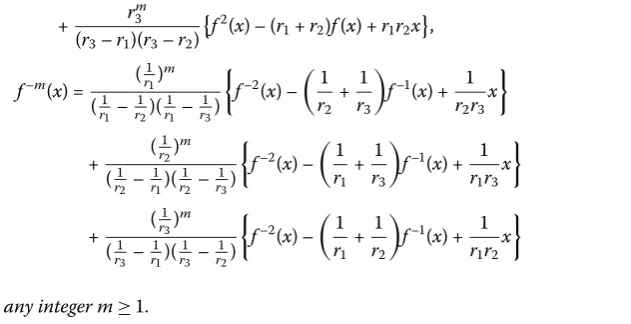
f–m=
n
i=
r–m i
(r–
, . . . ;r–i ; . . . ,r–n)
F
r– , . . . ,r–i–,ri–+, . . . ,r–nf–
∈Z (.)
for all integers m≥and i= , , . . . ,n,where(r, . . . ;ri; . . . ,rn) = nj=,j=i(ri–rj).
Proof Letf :R→Rbe aCsolution of (.) withc= , we have the shift on the iteration
Fm[r, . . . ,ri–,ri+, . . . ,rn]
f∈Z=rimF[r, . . . ,ri–,ri+, . . . ,rn]
f∈Z (.)
by using (iii) of Lemma .. For fixed integerm≥ andi= , , . . . ,n, (.) is a system ofn linear equations forfm+n–,fm+n–, . . . ,fm. Let
F:=fm+n–,fm+n–, . . . ,fmτ,
T:=rmF[r, . . . ,rn]
f∈Z, . . . ,rnmF[r, . . . ,rn–]
f∈Z,
where ‘τ’ stands for transposing a vector. Then (.) is rewritten as
in which
In order to obtainfm, our strategy is to transformAinto upper triangular matrix and every element of the principal diagonal is . More precisely, multiplying the first row by – and then adding other rows, we see that the first element of the ith (≤i≤n) row
has the same form as that ofA, using the same idea and arguments we obtain at last an upper triangular matrix such that
By using the above elementary invertible linear transformations, the augmented matrix [A|T] transforms into row-echelon form, which yields (.) from the last low.
The proof of (.) is the same as that of (.) by considering the dual equation (.) and
is omitted. This completes the proof.
From Lemma . we obtain the main tool used in our paper immediately.
+ r
3 Same signs with both expansion and contraction
In this section we construct allCsolutions of (.) for the cases (E
+C+) and (E–C–) listed
Proof In order to prove the monotonicity and divergence of the sequence (xn), we prove
that
xn+>rxn, n= , , , . . . . (.)
First of all, we claim that
(r+r)xn+–rrxn<xn+< (r+r)xn+–rrxn, n= , , , . . . . (.)
Table 1 Three characteristic roots with same signs
0 <r1< 1 <r2<r3 r1<r2< –1 <r3< 0
In fact (.) holds forn= by (.). Now, fix integerk≥ and suppose that (.) holds for n=k– . Then using (.) we get
xk+– (r+r)xk++rrxk
=rxk+– (rr+rr)xk+rrrxk–
=r
xk+– (r+r)xk+rrxk–
> , (.)
xk+– (r+r)xk++rrxk
=rxk+– (rr+rr)xk+rrrxk–
=r
xk+– (r+r)xk+rrxk–
< , (.)
implying (.) holds forn=k. Thus (.) is proved by induction fork, from which we get
(r+r)xn+–rrxn< (r+r)xn+–rrxn,
i.e., (.) holds. Sincer> , it follows that (xn)n≥is strictly increasing. From (.) we have
xn+>rxn>· · ·>rnx> . (.)
Hence for arbitrarily givenM> , there exists an integerNlarge enough such that
xN+>rNx>M> .
Consequently,limn→+∞xn= +∞. In a similar way as before, we get
r
+ r
x–n+–
rr
x–n+<x–n<
r
+ r
x–n+–
rr
x–n+ (.)
forn= , , , . . . . Hencex–n+< rx–n+,n= , , , . . . . This jointly withx–< implies
(xn)n≤is strictly increasing andlimn→–∞xn= –∞.
Lemma . Suppose that <r< <r<r.Then for x= and arbitrary points x,x
such that
x< and (r+r)x<x< (r+r)x, (.)
the sequence(. . . ,x,x;x,x–,x–, . . .)defined by(.)and(.)is strictly decreasing and
satisfies
lim
Proof Our strategy is similar to that of Lemma ., in order to prove the monotonicity and divergence of the sequence (xn), we first show that
xn+<rxn, n= , , , . . . . (.)
On the other hand, by a similar procedure we inductively prove that
constructed by Theoremof[]and
which are uniquely determined by two given functions f : [x,x]→ [x,x] and f :
[x,x]→[x,x].
(iii)If f(x) <x for all x∈R,then the set of f contains both f(x) <max{rx,rix}(i= , ) constructed by Theoremof[]and
f(x) :=
fn(x), x∈[xn+,xn],n= , , . . . , f–
–n(x), x∈[x–n+,x–n],n= , , . . . ,
(.)
where the bilateral sequence(xi)is given in Lemma.,and fn: [xn+,xn]→[xn+,xn+]
and f–n: [x–n+,x–n+]→[x–n+,x–n]are orientation-preserving homeomorphisms defined inductively as(.)which are uniquely determined by two given functions f: [x,x]→
[x,x]and f: [x,x]→[x,x].
Proof For an indirect proof, assume thatf is aCstrictly decreasing solution of (.). By
Lemma . we get
lim
m→∞
fm rm
=
(r–r)(r–r)
f(x) – (r+r)f(x) +rrx
(.)
for any integerm≥. The functionlimm→∞fm/rm
is both nondecreasing for evenmand
nonincreasing for oddm, there is a constantcsuch that
f(x) – (r+r)f(x) +rrx=c (.)
for allx∈R. Substituting (.) into (.), we getc=rc implyingc= sincer= .
Hence (.) reduces to the equation
f(x) – (r+r)f(x) +rrx= , (.)
which has only strictly increasing solutions by Theorem from []; a contradiction. In order to prove the case (i), letf be aCstrictly increasing solution with fixed points.
Thenf has the unique fixed point by Lemma ., which implies either <f(x) <xor f(x) >xforx> . In the case <f(x) <xwe havelimm→∞fm(x) = because is an
attract-ing fixed point, then (.) from (.) directly. Thus (.) yieldsf(x) =rxby Theorem
of [], which is theCstrictly increasing solution satisfying <f(x) <xforx> . The
other casef(x) >xcan be reduced to the first one by considering the dual equation (.). Using Lemma . and repeating the same method as the previous one to eliminate /rwe
have
f–(x) –
r
+ r
f–+ rr
x= , x> ,
that is,f is a solution of the equation
f(x) – (r+r)f(x) –rrx= , x> . (.)
Thusfis a solution given in Theorem of [] on (,∞). A similar discussion can be done for the half-line (–∞, ). Therefore, everyCsolutionf of (.) involving a fixed point has
In order to prove (ii), we use the formula inequality in (.) and the equality (.) are proved.
In addition, we see that (.) is equivalent to
Conversely, all solutions of (.) satisfyingf(x) >max{rx,rx}and all solutions of (.)
satisfyingf(x) >max{rx,rx}, constructed by Theorem of [], areCstrictly increasing
solutions of (.) satisfyingf(x) >xfor allx∈R. Moreover, everyCstrictly increasing
solutionf of (.) fulfilling (.) is uniquely determined up to two orientation-preserving homeomorphismsf: [x,x]→[x,x] andf: [x,x]→[x,x] and can be constructed
by the recursively orientation-preserving homeomorphisms
fn: [xn,xn+]→[xn+,xn+], n= , , , . . . , (.)
f–n: [x–n+,x–n+]→[x–n,x–n+], n= , , . . . , (.)
defined by (.), where the sequence (. . . ,x–,x–;x,x,x, . . .) is given in Lemma ..
Ac-tually, by induction the inequality (.) and the orientation-preserving homeomorphisms (.) yield
(r+r)fn(x) –rrx<fn+◦fn(x) < (r+r)fn(x) –rrx
for arbitraryx∈[xn,xn+],n= , , . . . , then the functionf defined by those
orientation-preserving homeomorphismsfnis the unique solution of (.) on [, +∞). On the other
hand, the inequality (.) and the orientation-preserving homeomorphisms (.) yield
r
+ r
f–n(x) –
rr
x<f–n–◦f–n(x) <
r
+ r
f–n(x) –
rr
x
for arbitraryx∈[x–n+,x–n+],n= , , . . . , then the functionf–defined by those
orien-tation-preserving homeomorphismsf–nis the unique solution of the dual equation (.)
on (–∞, ]. Finally, we definef as (.),i.e.,
f(x) :=
fn(x), x∈[xn,xn+],n= , , . . . ,
f–
–n(x), x∈[x–n,x–n+],n= , , . . . .
Thenf :R→Ris the uniqueCstrictly increasing solution of (.), depending on the
given initial functionsfandf. Thus all thoseCstrictly increasing solutionsf of (.),
fulfilling inequality (.), can be constructed by this method.
Using the same idea and arguments we prove the case (iii). Fromf(x) <xwe see that fm+(x) <fm(x) forx∈R. By using (.) and a similar discussion to (ii),f(x) <xshows
that one of three situations holds: (.) and (.), and
⎧ ⎪ ⎪ ⎪ ⎨ ⎪ ⎪ ⎪ ⎩
Ir,m:=
rm(r–) (r–r)(r–r){f
(x) – (r
+r)f(x) +rrx}< ,
Ir,m:=
rm(r–) (r–r)(r–r){f
(x) – (r
+r)f(x) +rrx}< ,
Ir,m:=
rm(r–) (r–r)(r–r){f
(x) – (r
+r)f(x) +rrx}< ,
i.e.,
(r+r)f(x) –rrx<f(x) < (r+r)f(x) –rrx, ∀x∈R. (.)
Conversely, all solutions of (.) satisfyingf(x) <max{rx,rx}and all solutions of (.)
solutions of (.) satisfyingf(x) <xfor allx∈R. Furthermore, everyCstrictly increasing
solutionf of (.) fulfilling (.) is uniquely determined up to two orientation-preserving homeomorphismsf: [x,x]→[x,x] andf: [x,x]→[x,x] and can be constructed
by the recursively orientation-preserving homeomorphisms
fn: [xn+,xn]→[xn+,xn+], n= , , , . . . , (.)
f–n: [x–n+,x–n+]→[x–n+,x–n], n= , , . . . , (.)
defined by (.), where the sequence (. . . ,x–,x–;x,x,x, . . .) is given in Lemma .. In
fact, the inequality (.) and the orientation-preserving homeomorphisms (.) yield
(r+r)fn(x) –rrx<fn+◦fn(x) < (r+r)fn(x) –rrx
for arbitraryx∈[xn+,xn],n= , , . . . , then the functionf defined by those
orientation-preserving homeomorphismsfnis the unique solution of (.) on (–∞, ]. On the other
hand, (.) and the orientation-preserving homeomorphisms (.) yield
r
+ r
f–n(x) –
rr
x<f–n–◦f–n(x) <
r
+ r
f–n(x) –
rr
x
for arbitraryx∈[x–n+,x–n+],n= , , . . . , then the functionf–defined by those
orienta-tion-preserving homeomorphismsf–nis the unique solution of the dual equation of (.)
on [, +∞). Finally, we see that the uniqueCstrictly increasing solution of (.),
depend-ing on the given initial functionsfandf, can be presented in the form
f(x) :=
fn(x), x∈[xn+,xn],n= , , . . . , f–
–n(x), x∈[x–n+,x–n],n= , , . . . .
All thoseCstrictly increasing solutionsf of (.), fulfilling inequality (.), can be
con-structed by this method. This completes the proof.
Corollary . Suppose that <r<r< <r.Then every Csolution f :R→Rof(.)
is strictly increasing and f–is a solution given in Theorem..
Theorem . Suppose that r<r< – <r< .Then all Csolutions f :R→Rof(.)
are strictly decreasing and x= is the unique fixed point of every f.Moreover: (i) Ifx= is attractive fixed point off,thenf(x) =rx.
(ii) Ifx= is repelling fixed point off,thenf(x)is a solution in the class given in Theoremof[].
Proof For an indirect proof, assume thatf :R→Ris aCstrictly increasing solution of (.). By using (.) and similar arguments to the preceding part of Theorem ., we get at last
f(x) – (r+r)f(x) +rrx= ,
which yieldsf(x) =rxandf(x) =rxby Theorem of []. This contradicts the strictly
x= is the unique fixed point of everyCstrictly decreasing solution by Lemma . and
fisCstrictly increasing satisfyingf() = . It follows that eitherlim
m→+∞fm(x) =
implyingf(x) is a solution given in Theorem of []. This completes the proof.
Corollary . Suppose that r< – <r<r< .Then all Csolutions f :R→Rof(.)
are strictly decreasing with the unique fixed point,and the inverse f–is a solution given
in Theorem..
4 Different signs with both expansion and contraction
In this section we construct allCsolutions of (.) for the cases (E
+C–), (E–C+), (C+C–),
and (E+E–), where Table contains one negative root and two positive ones, Table
con-tains two negative roots and one positive root.
Theorem . Suppose that < –r<r<r( <r< –r<r, <r<r< –r, < –r< <
Table 2 Two positive and one negative characteristic roots
1 < –r1<r2<r3 1 <r2< –r1<r3 1 <r2<r3< –r1
0 < –r1<r2<r3< 1 0 <r2< –r1<r3< 1 0 <r2<r3< –r1< 1
0 < –r1< 1 <r2<r3 0 <r2< 1 < –r1<r3 0 <r2< 1 <r3< –r1
0 <r2<r3< 1 < –r1 0 <r2< –r1< 1 <r3 0 < –r1<r2< 1 <r3
Table 3 One positive and two negative characteristic roots
1 < –r1< –r2<r3 1 < –r1<r3< –r2 1 <r3< –r1< –r2
0 < –r1< –r2<r3< 1 0 < –r1<r3< –r2< 1 0 <r3< –r1< –r2< 1
0 < –r1< 1 < –r2<r3 0 < –r1< 1 <r3< –r2 0 <r3< 1 < –r1< –r2
0 <r3< –r1< 1 < –r2 0 < –r1<r3< 1 < –r2 0 < –r1< –r2< 1 <r3
(i) Iff :R→Ris aCstrictly increasing solution of(.),thenf is a function in the class given in Theoremof[].
(ii) Iff :R→Ris aCstrictly decreasing solution of(.),thenf(x) =r x.
Proof We first consider the case < –r<r<r. Letf :R→Rbe aCstrictly increasing
solution of (.), then f–is aCstrictly increasing solution of the dual equation (.). Making use of Lemma . and the monotonicity off–to remove /r
, we get
f–(x) –
r
+ r
f–(x) + rr
x= ,
that is,
f(x) – (r+r)f(x) +rrx= ,
thusf is a function in the class given in Theorem of []. On the other hand, iff :R→R is aCstrictly decreasing solution of (.), by the same method as previous to remove
rof (.), the uniqueCstrictly decreasing solutionf(x) =rxis obtained by Theorem
of [].
In what follows attention is paid to the case <r< –r<r. Iff:R→Ris aCstrictly
increasing solution of (.), from Lemma . and the monotonicity off we have
lim m→+∞
fm rm
=
(r–r)(r–r)
f(x) – (r+r)f(x) +rrx
+ lim m→+∞
(r r)
m
(r–r)(r–r)
f(x) – (r+r)f(x) +rrx
. (.)
Note thatlimm→+∞fm/rmis nondecreasing for evenmand nonincreasing for oddm, the
left-hand side of (.) is a constant. We assert that
f(x) – (r+r)f(x) +rrx= . (.)
Otherwise,f(x) – (r
+r)f(x) +rrx= yields f(x)=rx, then we havef(x) – (r+
r)f(x) +rrx= by Theorem of []. Consequently, the limit of the right-hand side of
class given in Theorem of []. On the other hand, iff:R→Ris aCstrictly decreasing
solution of (.), the conclusion can be obtained by a similar argument to the first case < –r<r<r.
For the case <r<r< –r, assume thatf :R→Ris aCstrictly increasing solution
of (.). Using Lemma . and the monotonicity off to remover, we obtain
f(x) – (r+r)f(x) +rrx= ,
implying thatf is a function in the class given in Theorem of []. On the other hand, if f :R→Ris aCstrictly decreasing solution of (.), we consider the dual equation (.).
By Lemma . and the monotonicity off–to eliminate /r, we eventually have
f(x) – (r+r)f(x) +rrx= .
Thusf(x) =rxis the onlyCstrictly decreasing solution according to Theorem of [].
The proof for the case < –r< <r<ris the same as that of the case < –r<r<r
and is omitted. This completes the proof.
By considering the dual equation (.) we get the following corollary.
Corollary . Suppose that < –r<r<r< ( <r< –r<r< , <r<r< –r< ,
<r<r< < –r).If f :R→Ris a Csolution of(.),then f–is a function in the class
given in Theorem..
Theorem . Suppose that < –r<r< <r( <r< –r< <r).
(i) Iff :R→Ris aCstrictly increasing solution of(.),thenf is a function in the
class given in Theoremof[].
(ii) Iff :R→Ris aCstrictly decreasing solution of(.),thenf(x) =r x.
The proof is similar to that of the case < –r<r<r( <r< –r<r) in Theorem .
and is omitted. By using the dual equation (.) we have the following corollary.
Corollary . Suppose that <r< <r< –r( <r< < –r<r).If f :R→Ris a C
solution of(.),then f–is a function in the class given in Theorem..
Theorem . Suppose that < –r< –r<r( < –r<r< –r, <r< –r< –r, <r<
< –r< –r).
(i) Iff :R→Ris aCstrictly increasing solution of(.),thenf(x) =r x.
(ii) Iff :R→Ris aCstrictly decreasing solution of(.),thenf is a function in the
class given in Theoremof[].
Proof First we consider the case < –r< –r<r. Letf :R→Rbe aCstrictly increasing
solution of (.), then f–is aCstrictly increasing solution of the dual equation (.).
Making use of Lemma . and the monotonicity off–to eliminate /r
, we get the unique
Cstrictly increasing solutionf(x) =r
x according to Theorem of []. Assume that
f :R→Ris aCstrictly decreasing solution of (.). Removingr
monotonicity off we have
f(x) – (r+r)f(x) +rrx= ,
naturally,f is a function in the class given in Theorem of [].
For the case < –r<r< –r, assume thatf :R→Ris aCstrictly increasing solution
of (.). By removingr, we get
f(x) – (r+r)f(x) +rrx= ,
then the uniqueCstrictly increasing solutionf(x) =rxis obtained by Theorem of [].
Assume thatf :R→Ris aCstrictly decreasing solution of (.). By Lemma . we have
lim m→+∞
fm rm =
(r–r)(r–r)
f(x) – (r+r)f(x) +rrx
+ lim m→+∞
(r r)
m
(r–r)(r–r)
f(x) – (r+r)f(x) +rrx
.
Using the same idea and arguments as that of the case <r< –r<rin Theorem ., we
get
f(x) – (r+r)f(x) +rrx= .
Hence everyC strictly decreasing solutionf of (.) is a function in the class given in Theorem of [].
In the sequel we consider the case <r< –r< –r. Let f :R→Rbe a C strictly
increasing solution of (.), the proof is the same as the case < –r<r< –r. Iff :R→R
is aCstrictly decreasing solution of (.), thenf–is a solution of the dual equation (.).
By Lemma . and the monotonicity off–we get
f(x) – (r
+r)f(x) +rrx= ,
by removing /r. Thus allCstrictly decreasing solutions of (.) are in the class given in
Theorem of [].
The proof for the case <r< < –r< –ris the same as that of the case <r< –r<
–r. This completes the proof.
By considering the dual equation (.) we have the following corollary.
Corollary . Suppose that < –r< –r<r< ( < –r<r< –r< , <r< –r<
–r< , < –r< –r< <r).If f:R→Ris a Csolution of(.),then f–is a function in
the class given in Theorem..
Theorem . Suppose that < –r< < –r<r( < –r< <r< –r).
(i) Iff :R→Ris aCstrictly increasing solution of(.),thenf(x) =r x.
(ii) Iff :R→Ris aCstrictly decreasing solution of(.),thenf(x) =r
The proof is similar to that of < –r< –r<r( < –r<r< –r) of Theorem .. By
using the dual equation (.) we have the following corollary.
Corollary . Suppose that <r< –r< < –r( < –r<r< < –r).If f :R→Ris a
Csolution of(.),then f–is a function in the class given in Theorem..
5 Further discussion and remarks
As shown in the previous sections, we obtain allCsolutions of (.) for the cases listed
in Tables -. Consequently, allCsolutions of the rd-order equation (.) withc= can
be obtained by using Lemma .. In what follows we prove some cases, listed in Tables and , which can also be generalized to thenth-order polynomial-like iterative equation recursively. For example we consider the th-order equation (.) and take the first case < –r<r<rin Table . Addingr> as the th characteristic root, we have the following
result.
Theorem . Suppose that < –r<r<r<r( < –r<r<r<r, < –r<r<r<
r).
(i) Iff :R→Ris aCstrictly increasing solution of theth-order equation(.).Thenf is a solution given in Theoremof[]for the characteristic rootsr,r,r.
(ii) Iff :R→Ris aCstrictly decreasing solution of theth-order equation(.).Then f(x) =rx.
Proof We first consider the case < –r<r<r<r. Letf :R→Rbe aCstrictly
in-creasing solution of the th-order equation (.), thenf–is aCstrictly increasing
solu-tion of its dual equasolu-tion. Making use of Lemma . and the monotonicity off–to remove /r, we get
f–(x) –
r
+ r
+ r
f–(x) +
rr
+ rr
+ rr
f–(x) – rrr
x= ,
that is
f(x) – (r+r+r)f(x) + (rr+rr+rr)f(x) –rrrx= ,
thusf is a solution given in Theorem of [] for characteristic rootsri(i= , , ). On
the other hand, assume thatf :R→Ris aCstrictly decreasing solution of the th-order
equation (.). By using Lemma . and the monotonicity off to remover, we have
f(x) – (r+r+r)f(x) + (rr+rr+rr)f(x) –rrrx= .
Therefore,f(x) =rxfrom Theorem ..
The proof for the cases < –r<r<r<rand < –r<r<r<r is similar to the
previous one and is omitted. This completes the proof.
Assuming that the characteristic rootr< –, we have the following result.
Theorem . Suppose that < –r<r< –r<r( < –r< –r<r<r, < –r< –r<
(i) Iff :R→Ris aCstrictly increasing solution of theth-order equation(.).Thenf
is a solution given in Theorem..
(ii) Iff :R→Ris aCstrictly decreasing solution of theth-order equation(.).Then f is a solution given in Theorem..
The proof is similar to that of Theorem . and is omitted.
Using the same idea and arguments as previous, we can obtain allCsolutions of the
th-order equation (.) for some cases listed in Tables and by adding the th characteristic rootr. In general, for those cases that the characteristic root with the largest module has
different sign from the ones with the smallest module, we can obtain allCsolutions of the
nth-order polynomial-like iterative equation by using that of then– th-order polynomial-like iterative equation without essential difficulty.
Competing interests
The authors declare that they have no competing interests.
Authors’ contributions
The authors completed the paper together. They also read and approved the final manuscript.
Acknowledgements
The authors sincerely appreciate the referee for his/her excellent comments and suggestions, which have improved the presentations of the paper. Project was supported by Scientific Research Fund of Shandong Provincial Education Departments (J12L59), Scientific Research Fund of Sichuan Provincial Education Departments (12ZA086) and Doctoral Fund of Binzhou University (2013Y04).
Received: 29 September 2014 Accepted: 30 November 2014 Published:15 Dec 2014
References
1. Braon, K, Jarczyk, W: Recent results on functional equations in a single variable, perspectives and open problems. Aequ. Math.61, 1-48 (2001)
2. Targo ´nski, G: Topics in Iteration Theory. Vandenhoeck & Ruprecht, Göttingen (1981)
3. Kuczma, M, Choczewski, B, Ger, R: Iterative Functional Equations. Encyclopedia Math. Appl., vol. 32. Cambridge University Press, Cambridge (1990)
4. Ng, CT, Zhang, W: Invariant curves for planar mappings. J. Differ. Equ. Appl.3, 147-168 (1997)
5. Chen, J, Zhang, W: Leading coefficient problem for polynomial-like iterative equations. J. Math. Anal. Appl.349, 413-419 (2009)
6. Kulczycki, M, Tabor, J: Iterative functional equations in the class of Lipschitz functions. Aequ. Math.64, 24-33 (2002) 7. Tabor, J, Zoldak, M: Iterative equations in Banach spaces. J. Math. Anal. Appl.229, 651-662 (2004)
8. Trif, T: Convex solutions to polynomial-like iterative equations on open intervals. Aequ. Math.79, 315-325 (2010) 9. Xu, B, Zhang, W: Construction of continuous solutions and stability for the polynomial-like iterative equation. J. Math.
Anal. Appl.325, 1160-1170 (2007)
10. Zhang, W: On the differentiable solutions of the iterated equationni=1λifi(x) =F(x). Nonlinear Anal.15, 387-398 (1990)
11. Zhang, W: Solutions of equivariance for a polynomial-like iterative equation. Proc. R. Soc. Edinb. A130, 1153-1163 (2000)
12. Murugan, V, Subrahmanyam, PV: Existence of continuous solutions for an iterative functional series equation with variable coefficients. Aequ. Math.78, 167-176 (2009)
13. Murugan, V, Subrahmanyam, PV: Existence of solutions for equations involving iterated functional series. Fixed Point Theory Appl.2005(2), 219-232 (2005)
14. Nabeya, S: On the functional equationf(p+qx+rf(x)) =a+bx+cf(x). Aequ. Math.11, 199-211 (1974) 15. Matkowski, J: The twenty-sixth international symposium on functional equations, Remark 35. Report of meeting.
Aequ. Math.37, 119 (1989)
16. Jarczyk, W: On an equation of linear iteration. Aequ. Math.51, 303-310 (1996) 17. Tabor, J, Tabor, J: On a linear iterative equation. Results Math.27, 412-421 (1995)
18. Matkowski, J, Zhang, W: Method of characteristic for functional equations in polynomial form. Acta Math. Sin.13(3), 421-432 (1997)
19. Yang, D, Zhang, W: Characteristic solutions of polynomial-like iterative equations. Aequ. Math.67, 80-105 (2004) 20. Zhang, W, Zhang, W: On continuous solutions ofn-th order polynomial-like iterative equations. Publ. Math. (Debr.)
76(1-2), 117-134 (2010)
21. Morawiec, J: Around a problem of Nicole Brillouët-Belluot. Aequ. Math. (2014). doi:10.1007/s00010-013-0216-8 22. Morawiec, J: Around a problem of Nicole Brillouët-Belluot, II. Aequ. Math. (2014). doi:10.1007/s00010-013-0249-z 23. Matkowski, J, Zhang, W: Characteristic analysis for a polynomial-like iterative equation. Chin. Sci. Bull.43(3), 192-196
10.1186/1687-1847-2014-318
Cite this article as:Zhang and Gong:Continuous solutions of 3rd-order iterative equation of linear dependence.