From so simple a beginning –
what amphioxus can teach us about placode evolution
GERHARD SCHLOSSER*
School of Natural Sciences, National University of Ireland Galway, Ireland
ABSTRACT Cranial placodes are an evolutionary novelty of vertebrates that give rise to many cranial sense organs and ganglia, as well as to the neurosecretory anterior pituitary. Although amphioxus does not have placodes, it shares with vertebrates several of the ectodermal pattern-ing mechanisms and cell types that are important in placode development. Comparisons between amphioxus, vertebrates and other groups provide us with important insights into what the last common chordate ancestor probably looked like and allow us to propose a scenario for how placodes evolved by rewiring of gene regulatory networks. After reviewing ectodermal patterning and the cytodifferentiation of neurosecretory and sensory cells in amphioxus, this review will ar-gue that the evolutionary origin of cranial placodes involved 1) the concentration of sensory and neurosecretory cell types in the head by linking their development to ancient cranial ectodermal patterning mechanisms; and 2) the formation of high density arrays of sensorineural precursors by intercalating a progenitor expansion module into the gene regulatory network driving differentia-tion of sensory or neurosecretory cells.
KEY WORDS:
sensory cell, neurosecretory cell, ectodermal patterning, Hatschek’s pit, chordate, evolutionary innovation
Introduction
Amphioxus (cephalochordates) are the least specialized among all living chordates and presumably retain most of the developmental pathways and adult characters that are also found in the extinct ancestors of chordates and vertebrates. This view is supported not only by many structural similarities but also by extensive parallels in early development between amphioxus and vertebrates, both of which rely heavily on long range inductive tissue interactions and morphogen gradients (Bertrand and Escriva, 2011, Holland, 2014). Tunicates (urochordates), in contrast, are a highly divergent and rapidly evolving group with a radically different adult body plan, which is established by deviant developmental mechanisms that depend mostly on cell lineage and local cell interactions (Lemaire, 2009). However, recent molecularly based phylogenies have clearly shown that tunicates are the sister group of vertebrates whereas amphioxus are the sister group of the tunicate-vertebrate clade (Delsuc et al., 2006). The tunicate-vertebrate group is also known as “Olfactores”, an unfortunate name because it suggests olfac-tory organs as a shared derived trait of this group, which is not supported by current evidence (see below).
The revised phylogenetic relationships among chordates indicate that the developmental and morphological similarities between
www.intjdevbiol.com
*Address correspondence to: Gerhard Schlosser. School of Natural Sciences, National University of Ireland Galway, Biomedical Sciences Building, Newcastle Road,
Galway, Ireland. Tel: 00353-91-495978. Fax: 00353-91-494526. E-mail: [email protected]
Accepted: 6 June, 2017; Accepted: 11 July, 2017.
ISSN: Online 1696-3547, Print 0214-6282
© 2017 UPV/EHU Press Printed in Spain
Abbreviations used in this paper: GRN, gene regulatory network; RA, retinoic acid; TF, transcription factor.
amphioxus and vertebrates reflect shared primitive chordate traits (symplesiomorphies), many of which have been modified in the quickly evolving tunicate lineage but were preserved in the more slowly evolving stem lineages of amphioxus and the tunicate-vertebrate clade. Therefore, amphioxus, despite being relegated to a more basal position within the chordates remains in many respects our best living model for the vertebrate ancestor. The last common ancestor of tunicates and vertebrates was in most respects more amphioxus-like than tunicate-like even though it will have displayed a few characters which are shared derived char-acters (synapomorphies) of the tunicate-vertebrate clade and will have missed those few characters that were uniquely derived in the amphioxus lineage (reviewed in (Bertrand and Escriva, 2011, Holland, 2014, Schubert et al., 2006a).
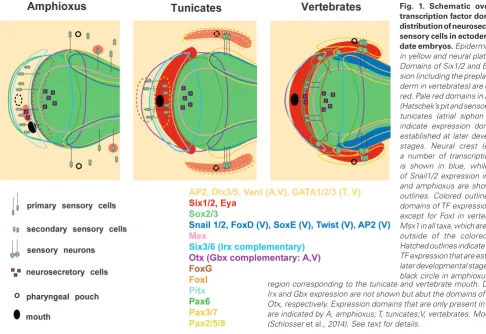
chemorecep-tive (olfactory placode) and mechanorecepchemorecep-tive (otic and lateral line placodes) sense organs of the vertebrate head, to the lens of the eye (lens placode), to sensory neurons of the cranial ganglia (pro-fundal/trigeminal, epibranchial, otic and lateral line placodes) and to neurosecretory (hormone producing) cells in the anterior pituitary (adenohypophyseal placode) and forebrain (GnRH cells derived from the olfactory placode) (reviewed in (Grocott et al., 2012, Saint-Jeannet and Moody, 2014, Schlosser, 2010). All of these placodes have a common embryonic origin from the pre-placodal ectoderm (PPE), a crescent shaped region of ectoderm surrounding the anterior neural plate and neural crest (Fig. 1) defined by the expression of Six1/2 transcription factors and their cofactors of the Eya family.
Cranial placodes are one of two embryonic tissues that originated in the vertebrate lineage and are not found in other chordates; the second tissue is the neural crest which also contributes sensory neurons to the peripheral nervous system as well as pigment cells, glial cells, some gland and muscle cells and some cranial cartilage and bone. Together, cranial placodes and neural crest form many of the evolutionary novelties of the vertebrate head – the “New Head” of Northcutt and Gans (1983) - which were acquired when stem vertebrates diverged from their filter-feeding last common ancestor with the tunicates and adopted a more active and ultimately preda-tory life-style (Northcutt and Gans, 1983).
Cranial placodes are considered evolutionary innovations of vertebrates because they are not homologous to any structures outside the vertebrates. However, like other evolutionary innova-tions, cranial placodes did not evolve from scratch but by tinkering with pre-existing components: old genes were rewired to form new gene regulatory networks (GRN) and this led to pre-existing cell types being redeployed in new developmental contexts (Arendt et
al., 2016, Schlosser, 2015). Based on comparisons between
am-phioxus, tunicates and vertebrates, I will argue in this review, that the evolutionary origin of cranial placodes in particular involved 1) the concentration of sensory and neurosecretory cell types in the head by linking their development to ancient cranial ectodermal patterning mechanisms; and 2) the formation of high density arrays of sensorineural precursors by intercalating a progenitor expansion module into the GRN driving differentiation of sensory or neurosecre-tory cells. Before I discuss this evolutionary scenario further in the last section of this review, I will first review ectodermal patterning mechanisms and the development of neurosecretory and sensory cells in amphioxus compared to vertebrates.
Ectodermal patterning
In amphioxus, different ectodermal territories along the dorsoven-tral and anteroposterior axis are specified in response to gradients of signalling molecules similar to vertebrates but different from tunicates. These signalling molecules act as morphogens which activate different transcription factors (TFs) at different concentration thresholds. The partly overlapping domains of TF expression along the dorsoventral and anteroposterior axis then in a combinatorial fashion map out a grid of regulatory states allowing to switch on distinct differentiation gene batteries at different positions (Peter and Davidson, 2015).
Dorsoventral patterning
Along the dorsoventral axis, a BMP gradient with high BMP levels ventrally and low BMP levels dorsally leads to induction of the neural
plate dorsally and epidermis ventrally.
As in vertebrates, BMP2/4 in amphioxus is expressed throughout the ectoderm in the blastula (Yu et al., 2008, Yu et al., 2007). A BMP activity gradient then appears to be established during gastrulation by BMP inhibitors such as chordin secreted from the dorsal blasto-pore lip, which sequester BMP and prevent binding to its receptor on the dorsal side (Kozmikova et al., 2013, Yu et al., 2007). The dorsal side in amphioxus is, thus, positioned at the low end of a BMP gradient similar to vertebrates but opposite to the situation in protostomes. Hemichordates, which together with the echinoderms comprise the ambulacrarians, the sister group of chordates within the deuterostomes, have their dorsal side on the high-BMP side similar to protostomes (Lowe et al., 2006). This suggests that the dorsoventral axis was inverted in the chordate lineage (Arendt and Nubler-Jung, 1994, De Robertis and Sasai, 1996) resulting in the loss of the old mouth on the low-BMP (now dorsal) side and the formation of a new mouth on the high-BMP (now ventral) side.
In vertebrates, many TFs with widespread ectodermal expres-sion are either directly or indirectly activated or repressed by BMP signalling. Consequently, they establish dorsally (SoxB1, Zic, Geminin) or ventrally (Dlx3/5, Msx1, GATA2/3, AP2, FoxI1/3, and Vent1/2) restricted expression domains during gastrulation in response to the developing BMP gradient (reviewed in (Grocott
et al., 2012, Saint-Jeannet and Moody, 2014, Schlosser, 2010).
Whereas in amphioxus GATA1/2/3 is not expressed in the ec-toderm (Zhang and Mao, 2009) and the expression of Geminin and FoxI1/3 is unknown, all other TFs show similarly restricted expression domains (Gostling and Shimeld, 2003, Holland et al., 2000, Holland et al., 1996, Kozmik et al., 2007, Kozmikova et al., 2013, Meulemans and Bronner-Fraser, 2002, Meulemans and Bronner-Fraser, 2007, Sharman et al., 1999, Yu et al., 2008, Yu et
al., 2007). Moreover, amphioxus Vent1 and Vent2 were confirmed
to be directly BMP responsive (Kozmikova et al., 2011) (Fig. 1). In addition, TFs Pax3/7 and Snail which define lateral neural plate identity in vertebrates are specifically expressed in the lateral neural plate in amphioxus (Holland et al., 1999, Langeland et al., 1998, Yu et al., 2008), where they are overlapping with the dorsalmost part of Vent and Msx. Taken together this suggests that general mechanisms of dorsoventral ectodermal patterning are conserved between amphioxus and vertebrates.
However, there are notable differences as well. Whereas in amphioxus Dlx extends dorsally into the anterior and lateral border region of the neural plate and AP2 is confined to the non-neural ectoderm (Holland et al., 1999, Yu et al., 2008), in vertebrates the situation is reversed with AP2 but not Dlx3/5 extending into lateral neural ectoderm. More strikingly, none of the many other vertebrate TFs involved in defining lateral neural plate identity (Myc, Id, Hairy, Irx) or in specifying the neural crest (Twist, Ets, FoxD, SoxE) are specifically expressed in this domain in amphioxus (Kaltenbach et
al., 2009a, Meulemans and Bronner-Fraser, 2004, Meulemans et al., 2003, Minguillon et al., 2003, Van Otterloo et al., 2012, Yasui et al., 1998, Yu et al., 2002c, Yu et al., 2008). Many of these genes
probably were only recruited to the lateral neural plate with the evolution of a neural crest in vertebrates (Yu et al., 2008).
along the dorsoventral axis (Kozmik et al., 2007). Six1/2 and Eya in amphioxus are instead expressed in many scattered domains including parts of the brain, Hatschek’s pit (see below), primary sensory cells and parts of endoderm and mesoderm (Kozmik et
al., 2007). In vertebrates, several ventrally restricted TFs (Dlx3/5,
GATA2/3, AP2 and FoxI1/3) have been shown to act as compe-tence factors, which are required in conjunction with BMP- and Wnt-inhibitors and FGF signals from the adjacent mesoderm and neural plate for induction of Six1/2 and Eya in the dorsal non-neural ectoderm (Ahrens and Schlosser, 2005, Bhat et al., 2012, Kwon
et al., 2010, Litsiou et al., 2005, Pieper et al., 2012). Similarly, in
tunicates Six1/2 and Eya1 expression domains are established during gastrulation in dorsal non-neural ectoderm and require BMP inhibition (Abitua et al., 2015, Mazet et al., 2005) although nothing is known about the role of other signals or competence factors. Taken together, this suggests that the domain of Six1/2 and Eya expression in the dorsal non-neural ectoderm first evolved in the stem lineage of tunicates and vertebrates.
Anteroposterior patterning
Anteroposterior ectodermal patterning in amphioxus also shows some remarkable similarities to vertebrates (Fig. 1). In both groups, the establishment of distinct TF domains along the anteroposterior axis depends on gradients of Wnt and retinoic acid (RA) signalling with increasing Wnt and RA levels from rostral to caudal and a posteriorising role of Wnt and RA (Escriva et al., 2002, Holland, 2002, Holland, 2005, Schubert et al., 2004, Schubert et al., 2006b). FGF acts as an additional posteriorising signal in vertebrates but
such a role has not been confirmed for amphioxus (Bertrand et
al., 2011). The Wnt gradient is established by Wnt antagonists
secreted from anterior endomesoderm, which prevent binding of Wnt to its receptor complex of frizzled and LRP5/6 proteins (Yu et
al., 2007), while the RA gradient is established by anteriorly
con-fined degradation of RA by the enzyme Cyp26 (Koop et al., 2014). As in vertebrates, high levels of Wnt in the posterior directly activate multiple TFs, such as Gbx, Cdx and Irx (Beaster-Jones et
al., 2008, Brooke et al., 1998, Castro et al., 2006b, Kaltenbach et al., 2009a) but repress FoxQ2 (a gene lost in several vertebrates)
(Yu et al., 2003), while high levels of RA activate Hox genes (Koop
et al., 2010, Onai et al., 2009, Pascual-Anaya et al., 2012, Schubert et al., 2004, Schubert et al., 2006b). Conversely, Otx, Six3/6 and
Fezf become confined to anterior ectoderm (Irimia et al., 2010, Kozmik et al., 2007, Onai et al., 2009, Williams et al., 1996), presumably by cross-repressive interactions between Otx-Gbx, Six3/6-Irx and Fezf-Irx as shown in vertebrates. Finally, Pax6 and transitorily Pitx (further discussed below) in amphioxus are also expressed in the anteriormost non-neural ectoderm just rostral to the neural plate as in vertebrates (Boorman and Shimeld, 2002, Glardon et al., 1998, Yasui et al., 2000).
In addition to the TFs mentioned so far, many other TFs are in-volved in the subdivision of the PPE and the specification of distinct placodes along the anteroposterior axis in vertebrates (reviewed in (Grocott et al., 2012, Saint-Jeannet and Moody, 2014, Schlosser, 2010). For example, FoxG1, FoxE1and FoxE4, Dmrt and Anf are involved (together with Six3/6, Pax6 and Pitx) in the specification of anterior (adenohypophyseal, olfactory, lens) placodes, Pax3/7
in the specification of trigeminal placodes and Pax2/5/8 and SoxB1 in the specification of posterior (otic, lateral line, epibranchial) placodes. Whereas Dmrt and Anf have not yet been described for amphioxus, FoxG1, FoxE4, Pax3/7 and Pax2/5/8 are not expressed in amphioxus non-neural ectoderm (Holland et al., 1999, Kozmik
et al., 1999, Kozmik et al., 2007, Toresson et al., 1998, Yu et al.,
2002b) indicating that they acquired a role for anteroposterior ectodermal patterning only in the ancestors of vertebrates or the vertebrate-tunicate clade. One of the three SoxB1 paralogues in amphioxus, SoxB1c, is expressed in non-neural ectoderm, but its expression is confined to a few scattered cells in the middle of the embryo and around the mouth (Meulemans and Bronner-Fraser, 2007) unlike Sox2 and Sox3 in vertebrates, which are expressed throughout the posterior placodal region. SoxB1c is, therefore, more likely to play a role in processes like progenitor maintenance rather than in regional specification.
Thus, there is little evidence that amphioxus has any ectodermal territories sharing a transcriptional signature with the posterior or trigeminal placodes of vertebrates. However, many genes ex-pressed in the posterior placodes of vertebrates (e.g. Pax2/5/8, Six1/2, Six4/5, Eya, SoxB1, Tbx1/10, Irx) are also co-expressed in the pharyngeal pouches of vertebrates and amphioxus. This has led to suggestions that a GRN from the pharyngeal pouches may have been recruited to pattern the posterior PPE (Schlosser, 2015). Since several of these genes (Pax2/5/8, Six1/2, Six4/5, Eya) are expressed in the ectoderm of the atrial siphon primordium of tunicates, which develop from posterior cranial ectoderm (Mazet
et al., 2005, Wada et al., 1998), this may have happened already
in the tunicate-vertebrate ancestor.
Only the anteriormost cranial non-neural ectoderm of amphioxus expresses a subset of TFs (Six3/6, Pax6, Pitx, Fezf) involved in specification of anterior placodes in vertebrates as well as Id pro-teins and a G-protein coupled receptor related to vertebrate odorant receptors (Meulemans et al., 2003, Satoh, 2005). This region of ectoderm may thus correspond to the ectodermal territory giving rise to the oral siphon primordium (stomodeum) in tunicates and the adenohypophyseal, olfactory and lens placodes in vertebrates. However, strong left-right asymmetries and the fusion of endomeso-dermal pouches with the ectoderm in this anterior region complicate the interpretation of homologies with vertebrates. I will, therefore, first briefly address these issues before returning to discuss its relation to the anterior placodes of vertebrates.
Left-right patterning
In contrast to vertebrates, amphioxus larvae show some re-markable left-right asymmetries affecting tissues derived from all germ layers particularly in the head region. While the mouth, Hatschek’s pit and Hatschek’s nephridium form on the left side, the endostyle (involved in food trapping) and the club shaped gland (which probably contributes to the secretion of pharyngeal mucus; (Holland et al., 2009)) form on the right side. Moreover, only the left series of gill slits develop in young larvae but they initially appear on the right side (Stokes and Holland, 1995). The proper right series of gill slits only forms much later at metamorphosis dorsal to the first series accompanied by a migration of the first series to the left side. Somites also form asymmetrically with left and right somites shifted by a half segment (Schubert et al., 2001). These morphological asymmetries are prefigured by the asym-metric expression of signalling molecules (Nodal, Lefty, Gdf1/3
in the left endomesoderm; cerberus in the right endomesoderm) and the TF Pitx (in the left endomesoderm and ectoderm) from neurula stage onwards (Boorman and Shimeld, 2002, Le Petillon
et al., 2013, Onai et al., 2010, Soukup et al., 2015, Yasui et al.,
2000, Yu et al., 2002a). In tunicates, a comparable left sided Pitx expression domain is driven by a different enhancer than the Pitx expression domain in the anteriormost non-neural ectoderm (see above) suggesting that these domains of expression are probably independently regulated (Christiaen et al., 2005, Yoshida and Saiga, 2008, Yoshida et al., 2012).
Additional signalling molecules (Dkk1/2/4) and TFs (Lxh3, FoxE4, Krox, FoxQ1, Nkx2.1, Hand) develop lateralized expression at later stages (Kaji et al., 2016, Soukup et al., 2015). Similar to vertebrates, nodal signalling in amphioxus was shown to be essential to set up these left right asymmetries. Pharmacological inhibition of nodal signalling leads to loss of left sided gene expression domains and structures (e.g. mouth and Hatschek’s pit) and to mirror image duplication of those on the right side (Kaji et al., 2016, Soukup et
al., 2015). This role of nodal signalling and its early downstream
TF target Pitx in generating left-right asymmetries is also observed in tunicates, echinoderms and snails indicating that it reflects an old panbilaterian patterning mechanism (Boorman and Shimeld, 2002, Duboc et al., 2005, Grande and Patel, 2009a, Grande and Patel, 2009b, Molina et al., 2013, Yoshida and Saiga, 2008). It is currently unclear how left-right symmetry breaking is achieved in amphioxus but it has been suggested that leftwards fluid flow mediated by cilia on the archenteron roof, which leads to degra-dation of the nodal inhibitor cerberus on the left hand side may be involved as in Xenopus (Blum et al., 2014, Schweickert et al., 2010, Schweickert et al., 2007).
The oral and preoral region of amphioxus
the mode of mouth formation in amphioxus.
Another pair of outpocketings anterior to the first somites develop into Hatschek’s left and right diverticula, which also have different fates. While the right diverticulum will expand to form the head coelom, the left diverticulum will fuse with the surface ectoderm to form the preoral pit, which gives rise to Hatschek’s pit in the adult (Glardon et al., 1998, Hatschek, 1884, Kaji et al., 2016). For simplicity, I will use “Hatschek’s pit” in this review to refer to both the larval (preoral pit) and adult structure. The differentiated cells in Hatschek’s pit have presumably both exocrine and endocrine function (see below) and contact the ventral side of the brain in a manner reminiscent of the vertebrate pituitary (Gorbman et al., 1999). Hatschek’s pit has, therefore, been often suggested to be homologous to the adenohypophyseal placode which gives rise to the anterior pituitary of vertebrates (reviewed in (Patthey et al., 2014, Schlosser, 2015). This idea was reinforced by the expres-sion of TFs marking the adenohypophyseal and other anterior placodes such as Pit1, Pitx, Lhx, Islet, Pax6, Six3/6, Six1/2 and Eya in Hatschek’s left diverticulum and pit (Candiani et al., 2008, Jackman et al., 2000, Kozmik et al., 2007, Wang et al., 2002) and of Pitx, Pax6 and Six3/6 in the adjacent ectoderm surrounding
the opening of Hatschek’s pit (Glardon et al., 1998, Kozmik et al., 2007, Yasui et al., 2000).
I will argue below that Hatschek’s pit does not qualify as a ho-mologue of the adenohypophyseal placode since it gives rise to very different cell types and lacks many other properties of proper placodes. Nevertheless, its position and TF signature suggest homology between the epithelial territory occupied by Hatschek’s pit and the vertebrate adenohypophyseal placode. However, there are two difficulties with this interpretation: 1) the left-sided position of Hatschek’s pit in front of a left-sided mouth versus the midline position of adenohypophyseal placode and mouth in vertebrates, and 2) the endomesodermal origin of Hatschek’s pit versus the ectodermal origin of the adenohypophyseal placode. I will discuss these two problems in turn.
First, in contrast to vertebrates neither the amphioxus mouth nor Hatschek’s pit appear to open into the Pitx expression domain in the anteriormost non-neural ectoderm immediately rostral to the neural plate but rather develop within the unilateral Pitx domain that develops slightly later on the left side in all germ layers (Yasui et
al., 2000). Taken together with its different embryonic development
(the details of which await further confirmation) this strongly
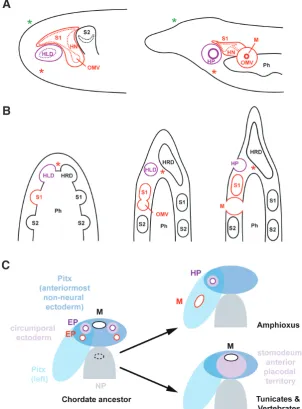
sug-Fig. 2. Origin of amphioxus mouth and Hatschek’s pit. (A) A recent study (Kaji et al., 2016) suggests that at early larval stages, an oral mesovesicle buds off from the left first somite (left panel), which later separates from the somite and connects to the pharynx and the outside forming the amphioxus mouth (right panel). The thickened posterior wall of the left first somite forms Hatschek’s nephridium. (B) Schematic horizontal section through the pharyngeal region of amphioxus showing the formation of endomesodermal pouches giving rise to Hatschek’s left and right diverticula and the somites. Hatschek’s pit develops from Hatschek’s left diverticulum. The mouth is here shown to develop from the oral mesovesicle budding off the first somite as proposed by (Kaji et al., 2016). Red asterisks in A and B indicate the ap-proximate position, in which the mouth forms in vertebrates and tunicates, green asterisks in A indicate the position of the anterior neuropore. (C) Scenario for the evolution of mouth openings and endomesodermal pouches in chordates. Hatched oval indicates presumptive position of old mouth prior to dorsoventral inversion (obliterated in chordate ancestor). See text for details. Abbreviations: EP: endomesodermal pouch, HLD: Hatschek’s left diverticulum, HRD: Hatschek’s right diverticulum, HN: Hatschek’s nephridium, HP: Hatschek’s pit, M: mouth, NP: neural plate, OMV: oral mesovesicle, Ph: pharynx, S1: somite1, S2: somite2. Fig. 2A adapted from (Kaji
et al., 2016). Fig. 2B adapted from (Soukup and Kozmik, 2016). gests that the amphioxus mouth is not homologous to the vertebrate mouth. Instead it has been suggested to have evolved by elaboration of the pore that connects the anterior coelom (protocoel) in ambulacrarians to the outside and forms the hydropore in echinoderms and the proboscis pore in hemichordates (Kaji et al., 2016, Stach, 2002). The association of the pore/mouth with the excretory system in ambulacrarians and amphioxus also lend support to this proposal. However, the same pore has alternatively been suggested to have evolved into Hatschek’s pit (Goodrich, 1917).
Although these two proposals appear to be in con-flict, they are not necessarily mutually exclusive since
B
metameric structures such as the endomesodermal pouches can usually not be homologized on a one to one basis (e.g. the neck vertebrae of birds are homologous between species even though their numbers vary and it is not appropriate to homologize a par-ticular vertebra between different species – such as neck vertebra number 3 between swans and hummingbirds).Thus, assuming that the chordate ancestor increased the number of endomeso-dermal pouches compared to the deuterostome ancestor, multiple pouches with protocoel-like characters may have been present, from which both the mouth and Hatschek’s pit of amphioxus may have developed (Fig. 2C). Possibly, some of these pouches may have been retained as preotic head cavities in some vertebrate embryos (with different numbers in different groups) (reviewed in (Kuratani and Adachi, 2016).
Apart from these questions of homology, another unresolved question is whether the position of these pores in the chordate ancestor was bilaterally symmetrical or lateralized to the left side. In echinoderms there is a strongly asymmetrical development of the coelomic system with the protocoel forming a pore (which becomes the hydropore of the water-vascular system) on the left hand side (Peterson et al., 2000). However, nodal dependent Pitx expression in sea urchins is established on the right side (Duboc
et al., 2005). Under the hypothesis of dorsoventral inversion at the
base of chordates, the right side of echinoderms does correspond to the left side of chordates suggesting that the laterality of Pitx expression may have been preserved throughout deuterostomes but the position of coelomic pores may have changed.
In hemichordates, protocoel pores (proboscis pores) are present on both sides in some species (pterobranchs and some enteropneusts) or unilaterally (either left or right) in others (most enteropneusts) (Benito and Pardos, 1997). These pores open into a medial Pitx expressing domain of the dorsal ectoderm and no asymmetric Pitx expression domains have been described (Lowe et
al., 2006). Recently, paired preoral outpocketings of the gut, each
opening into the medial Pitx expression domain in the anteriormost non-neural ectoderm have also been described in some actinopter-ygian fishes (bichirs, gars) (Cerny et al., 2017). Taken together this suggests that Pitx which probably had an ancient role in left-right patterning has adopted an additional symmetric expression domain in anterior ectoderm possibly already in stem deuterostomes while losing its role in left-right patterning in hemichordates. It further suggests that the striking morphological left-right asymmetries in echinoderms and amphioxus are likely independently derived and the chordate ancestor may have been largely symmetrical with a midline mouth and paired endomesodermal pouches that opened into the anteriormost non-neural ectoderm (the anterior, symmetric Pitx domain) (Fig. 2C). Under this scenario, amphioxus has lost - but tunicates and vertebrates retained - a midline mouth opening into the anterior Pitx domain and has elaborated some of its left endomesodermal pouches into a new mouth and Hatschek’s pit, possibly under control of left-sided Pitx expression.
A second problem with the proposed comparison of Hatschek’s pit with the adenohypophyseal placode is its partly endomesoder-mal origin. Moreover, even though the distinction between endo-mesodermally and ectodermally derived cells becomes indistinct once Hatschek’s left diverticulum has fused with the ectoderm, the expression of many “adenohypophyseal” TFs (Pit1, Pitx, Lhx, Islet, Pax6, Six3/6, Six1/2, Eya) in Hatschek’s pit appear to be confined predominantly or exclusively to its endomesodermally derived
por-tion. In contrast, the adenohypophysis in all vertebrates is completely ectodermally derived. This includes the hagfish adenohypophysis, which was initially described to be of endomesodermal provenience (Gorbman, 1983) but has now been shown to develop from the ectoderm (Oisi et al., 2013).
There are, however, a number of examples where complex organs have shifted in evolution across boundaries created by epithelial fusion. For example, teeth and taste buds may originate from either ectodermally or endodermally derived parts of the mouth cavity depending on the species (Northcutt, 2004, Soukup et al., 2008, Stone et al., 1995). Similarly, the endomesodermal preoral gut diverticula recently described in some actinopterygian fishes (bichirs, gars, sturgeons) contribute to cranial adhesive organs, which are ectodermally derived in other vertebrates (Cerny et al., 2017). This suggests that regions of epithelial fusion may offer opportunities for TF domains to extend into topologically continu-ous epithelia derived from different germ layers (for example by maintaining responsiveness to local signalling pathways while losing responsiveness to germ layer specific TFs in cis-regulatory regions for genes encoding these TFs). TFs expressed in the endomesoder-mal part of Hatschek’s diverticula may similarly have extended into adjacent circumporal ectoderm in the tunicate-vertebrate lineage followed by loss of the endomesodermal pouches and midline fusion of these ectodermal domains (Fig. 2C). Consequently, the oral/preoral ectoderm of the tunicate/vertebrate ancestor may have established its unique TF signature by the combination of TFs expressed in the anteriormost non-neural ectoderm of the chordate ancestor and those expressed in the adjacent endome-sodermal pouches.
Cell types
Neurosecretory cells
There is a large diversity of neurosecretory cells in vertebrates originating from all germ layers. However, the subset of neurosecre-tory cells arising from some cranial placodes (adenohypophyseal and olfactory placodes) play a particularly central role (reviewed in (Schlosser, 2015). The adenohypophyseal placodes gives rise to all neurosecretory cells of the anterior pituitary, which regulates and coordinates all major endocrine systems of vertebrates. The olfactory placode produces migratory cells expressing gonado-tropin releasing hormone (GnRH) and other neuropeptides. A subpopulation of these migrates into the forebrain and settles in the hypothalamus where cells release GnRH to stimulate secretion of gonadotropic hormones from the adjacent adenohypophysis. Although the main population of neurosecretory cells producing GnRH or adenohypophyseal hormones originate from the cranial placodes, smaller populations of cells producing these hormones also develop from the brain and other tissues (reviewed in (Schlosser, 2005, Schlosser, 2015).
In jawed vertebrates, six different endocrine cell types de-velop in the adenohypophysis: melanotropes (MSH – melanocyte stimulating hormone), corticotropes (ACTH - adrenocorticotropic hormone), thyrotropes (TSH - thyroid stimulating hormone), go-nadotropes (FSH - follicle stimulating hormone and LH – luteinizing hormone), lactotropes (PRL – prolactin) and somatotropes (GH – growth hormone) (reviewed in (Davis et al., 2013, Kelberman
et al., 2009). The hormones produced by these cells fall into 3
by proteolytic processing of larger precursor proteins, such as proopiomelanocortin (POMC); 2) dimeric glycoprotein hormones (TSH, FSH, LH), which are composed of a common alpha and a specific beta subunit; and 3) class I helical cytokines (GH, PRL) (Campbell et al., 2004). Only growth hormone but no prolactin producing cells are present in jawless vertebrates, which also have only one form of the glycoprotein beta subunits (GTHb). This suggests that PRL and TSH/LH/FSH evolved by duplication of GH and GTHb genes, respectively in early gnathostomes and that only four cell types were present in the adenohypophysis of ancestral vertebrates (Kawauchi and Sower, 2006, Nozaki, 2008, Sower et
al., 2009, Sower et al., 2006, Uchida et al., 2010).
The identity of different cell types in the adenohypophysis is established by combinations of TFs such as Tbx19 (Tpit) (mela-notropes, corticotropes), NeuroD (mela(mela-notropes, corticotropes), GATA2 (thyrotropes, gonadotropes), SF-1 (gonadotropes), POU1f1 (Pit1) (somatotropes, lactotropes, thyrotropes), and others (re-viewed in (Davis et al., 2013, Kelberman et al., 2009). We know less about how the identity of GnRH neurons is specified, although Msx, Dlx and FoxG1 TFs appear to be involved (Garaffo et al., 2015, Givens et al., 2005).
In amphioxus, as in vertebrates, different types of neurosecre-tory cells have been identified, for example in the neural tube and Hatschek’s pit. Most of our knowledge of these cells is based on immunostaining with antibodies raised against proteins from other animal groups (often vertebrates). However antibodies often recog-nize more than a single protein and cross-reactivity with amphioxus proteins may indicate binding to a protein that is not necessarily the orthologue of the vertebrate protein specifically recognized by the antibody. Therefore, data based on immunostaining have to be interpreted carefully and considered in combination with informa-tion on gene expression and genomics. Bearing these caveats in mind, what do we currently know about neurosecretory cells in amphioxus and their production of the 3 classes of hormones found in vertebrate placodes?
First, several cells immunoreactive for neuropeptides including FMRF amide, neuropeptideY, and GnRH were described in the neural tube and Hatschek’s pit of amphioxus (Castro et al., 2003, Chang et al., 1984, Fang et al., 1999, Massari et al., 1999, Nozaki and Gorbman, 1992), but GnRH immunoreactivity in Hatschek’s pit could not be confirmed in further studies (Castro et al., 2006a, Roch et al., 2014). The presence of many neuropeptides and their G-protein coupled receptors (GPCR) in amphioxus including one GnRH-like peptide and 4 GnRH receptors (two of those related to
the vertebrate GnRH receptors) could be confirmed in the amphioxus genome (Holland et al., 2008, Mirabeau and Joly, 2013, Osugi et
al., 2016, Putnam et al., 2008, Roch et al., 2014). However, none
of the neuropeptides produced by the vertebrate adenohypophysis (MSH, ACTH) was found in either the amphioxus, ascidian or any other invertebrate genomes suggesting that these are vertebrate innovations (Campbell et al., 2004, Dehal et al., 2002, Holland et
al., 2008, Putnam et al., 2008). Previous reports of POMC-related
peptides in protostomes can possibly be explained by contamination with vertebrate tissues (Salzet et al., 1997, Stefano et al., 1999).
Second, cells immunoreactive for the vertebrate gonadotropins FSH and LH belonging to the heterodimeric glycoproteins were originally described in Hatschek’s pit (Chang et al., 1984, Nozaki and Gorbman, 1992). However, it was subsequently shown that genes encoding the subunits of FSH, LH or TSH were not present in either the amphioxus or ascidian genomes (Dehal et al., 2002, Holland et al., 2008, Putnam et al., 2008) indicating that these are novel vertebrate hormones. There are, however orthologs for the two subunits (GPA2, GBP5) of the related heterodimeric glycoprotein thyrostimulin from which the vertebrate FSH/LH/TSH most likely evolved and of their GPCRs in amphioxus (Dos Santos
et al., 2009, Roch and Sherwood, 2014). Moreover, amphioxus
GPA2 is transitorily expressed in Hatschek’s left diverticulum (Dos Santos et al., 2009) suggesting that cells in Hatschek’s pit may produce hormones of the heterodimeric glycoprotein class in ad-dition to neuropeptides.
Third, and finally, no immunoreactivity for GH and PRL antibod-ies has been reported in amphioxus (Nozaki and Gorbman, 1992) and initially no class I helical cytokines including GH and PRL have been identified in amphioxus or ascidian genomes (Dehal et al., 2002, Putnam et al., 2008), although related hormones and their receptors were described in protostomes (Huising et al., 2006). However, a recent report describes a class I helical cytokine and an associated receptor from amphioxus, which may be related to GH in vertebrates (although bootstrap support is low and orthology remains unclear) and is widely expressed in the embryo including in Hatschek’s pit (Li et al., 2014). This suggests that Hatschek’s pit may also produce class I helical cytokines.
Taken together, currently only the GnRH producing cells in amphioxus are good candidates for neurosecretory cell types with homology to some of the specific, placodally derived neuro-secretory cell types of vertebrates although nothing is presently known about the TFs underlying cytodifferentiation of these cells in amphioxus. In amphioxus, these cells are localized in the brain
and not in Hatschek’s pit. All of the hormones produced in the vertebrate adenohypophysis (with possible exception of GH) ap-pear to be vertebrate innovations even though related hormones belonging to the same classes are found in Hatschek’s pit. In ad-dition, the TFs Pit1 and Islet, which play a role in specifying some adenohypophyseal cell types are expressed in Hatschek’s pit (Candiani et al., 2008, Jackman et al., 2000). This suggests that Hatschek’s pit does act as a neurosecretory organ although we currently know little about the precise complement of hormones it produces or their function.
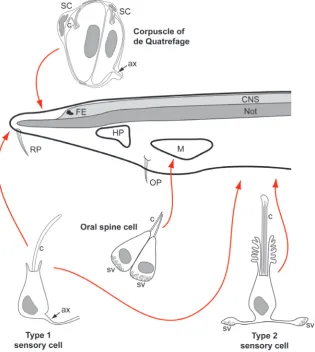
An endocrine function for Hatschek’s pit is also supported by ultrastructural evidence for small vesicles in the basal parts of many of the cells in the epithelium of Hatschek’s pit, which are located next to blood spaces (Fig. 3) (Sahlin and Olsson, 1986, Tjoa and Welsch, 1974). Large vesicles in the apical part of some of these cells suggest that they also have an additional exocrine function and probably contribute to the production of mucus for trapping food particles similar to the cells of the adjacent wheel organ (Lacalli, 2007, Tjoa and Welsch, 1974) (Fig. 3). Apically, the cells of Hatschek’s pit resemble sensory cells in bearing a cilium surrounded by microvilli (Fig. 3) but no evidence for synaptic vesicles or axonal processes could be found (Sahlin and Olsson, 1986, Tjoa and Welsch, 1974). A more recent study showed nerve fibers in the vicinity of Hatschek’s pit but did not clarify whether there is any innervation of the pit itself (Kaji et al., 2001). It has therefore been suggested that these cells may control endocrine (e.g. reproductive) functions by directly releasing hormones into the circulation in response to environmental signals (Gorbman, 1995, Nozaki and Gorbman, 1992). Recently, neurosecretory cells originating from the anteriormost non-neural ectoderm have also been identified in ascidians. However, in contrast to amphioxus, these ascidian cells produce GnRH and CNG channels and have an axon indicating that they are proper neurons, which combine neuroendocrine and chemosensory functions (Abitua et al., 2015). It is currently unknown whether any other neuropeptides, glycoprotein hormones or class I helical cytokines are produced by cells in the anteriormost non-neural ectoderm in tunicates.
Sensory cells
The cranial placodes of vertebrates give rise to several differ-ent sensory cell types. Two main types of chemosensory cells, olfactory and vomeronasal receptor cells, are produced by the olfactory placode (Maier et al., 2014). Both cell types are primary sensory cells with axons that transmit the information to the brain and they carry cilia, microvilli or both. Olfactory receptor cells ex-press one out of several hundred odorant receptors and activate cyclic nucleotide gated (CNG) ion channels, whereas vomeronasal receptor cells express the pheromone receptors VR1 and VR2 and activate transient receptor potential (TRP) channels (Elsaesser and Paysan, 2007, Kaupp, 2010). Odorant and pheromone receptors represent two different families of GPCRs, which are only found in chordates. The mechanosensory hair cells originate from the otic and lateral line placodes and mediate perception of sound, position in space and water movements. They have a bundle of microvilli arranged in a staircase like fashion next to a cilium and are activated by the mechanical opening of ion channels, when microvilli bend (Fritzsch et al., 2007). Hair cells are secondary sensory cells, i.e. they do not have an axon. Instead they release synaptic vesicles to activate somatosensory neurons derived
from the same placodes, which transmit the information to the brain. Other somatosensory neurons derived from profundal and trigeminal placodes as well as viscerosensory neurons derived from epibranchial placodes have either free nerve endings or supply non-placodal sensory cells and mediate touch, temperature and pain sensation in the skin and viscera, respectively (reviewed in (Patthey et al., 2014, Schlosser, 2010).
Basic helix-loop-helix (bHLH) TFs of the Achaete-scute, Atonal and Neurogenin families play a central role in initiating differentiation and defining the identity of these various sensory cells in verte-brates, with Ascl1, Atoh1 and Neurog1/Neurog2 being required for the differentiation of olfactory receptor cells, hair cells and sensory neurons, respectively (reviewed in (Bertrand et al., 2002, Huang et
al., 2014, Schlosser, 2006, Schlosser, 2010). Additional bHLH and
homeodomain TFs, in particular COE, LIM (Islet1, Lhx2), Paired like (Phox2a, Phox2b), and POU4 domain (POU4f1/Brn3a, POU4f3/ Brn3c) TFs also contribute to the specification of cell type identity (reviewed in (Alsina et al., 2009, Fritzsch et al., 2007, Maier et al., 2014, Schlosser, 2006, Schlosser, 2010). Tlx homeodomain TFs (Tlx1, Tlx3), which are widely expressed in placode and neural crest derived sensory neurons (Logan et al., 1998) have been implicated in promoting excitatory (glutamatergic) differentiation (Cheng et al., 2004).
Although our current understanding is far from complete, specific combinations of these TFs appear to be involved in conferring cell type identity to the different sensory and neuronal cell types derived from placodes including olfactory receptor neurons (Ascl1, Neurog1, Lhx2), hair cells (Atoh1, POU4f3 and the zinc finger protein Gfi1), somatosensory neurons (Neurog1, POU4f1, Islet1) and viscerosensory neurons (Neurog2, Phox2b) (reviewed in (Pat-they et al., 2014, Schlosser, 2015). It should be noted, however, that cell types with the same transcriptional signatures and similar phenotypes also originate from the brain and other tissues, such as epidermally derived mechanoreceptive Merkel cells (Atoh1, POU4f3, Gfi1) and neural crest derived somatosensory cells of the proximal cranial and dorsal root ganglia (Neurog1, POU4f1, Islet1). Such “serial sister cells” (Arendt et al., 2016) demonstrate that the same cell type (or evolutionarily related cell types) can be produced by different tissues in development (Arendt et al., 2016, Schlosser, 2015).
In amphioxus, sensory cells with potential homology to the chemo- and mechanosensory cells of vertebrates are widely scattered throughout the non-neural ectoderm (reviewed in (Hol-land, 2005, Holland and Hol(Hol-land, 2001, Lacalli, 2004). Two major subtypes of epidermal sensory cells have been described. Type I sensory cells have a long cilium surrounded by microvilli and are (predominantly or exclusively) primary sensory cells, while type II sensory cells possess a short cilium surrounded by a peculiar collar covered with microvilli and appear to be secondary sensory cells (Baatrup, 1981, Lacalli and Hou, 1999, Schulte and Riehl, 1977, Stokes and Holland, 1995) (Fig. 4). Whereas type I cells originate in early embryos, type II cells only appear weeks later just prior to metamorphosis (Stokes and Holland, 1995).
Hou, 1999, Stokes and Holland, 1995). There are also rostral epithelial cells without obvious specializations but which contain synaptic vesicles and are innervated (Lacalli, 2002). Finally small sensory organs, the corpuscles of de Quatrefages, composed of 1-4 sensory cells (with 2 cilia each) surrounded by up to 7 sheath cells, can be found in the rostral ectoderm (Baatrup, 1982) (Fig. 4). The cells forming the ciliated tufts of the rostral and oral papil-lae of amphioxus (Fig. 4) lack synaptic specializations and were, therefore, proposed to be more likely ciliary effectors than sensory cells (Lacalli et al., 1999).
Currently we do not know, which sensory modalities are mediated by each of these cells. Based on their morphology, corpuscles of de Quatrefages and oral spine cells are putative mechanoreceptors, while type I cells have proposed to be mechano- and/or chemore-ceptors and type II cells chemorechemore-ceptors, but this has never been confirmed by physiological studies (Baatrup, 1982, Lacalli et al., 1999, Lacalli and Hou, 1999). Some of the rostral primary (type I) sensory cell have been shown to express a vertebrate type odor-ant receptor (Satoh, 2005) suggesting that these cells are indeed chemosensory. Around 50 genes encoding vertebrate type odorant receptors (but no vomeronasal receptors) have been identified in
the amphioxus genome representing an independent expansion of odorant GPCRs in the amphioxus lineage (Churcher and Taylor, 2009, Niimura, 2009). Whether the expression of these genes is confined to mutually exclusive subsets of rostral chemosensory neurons as in vertebrates remains to be investigated.
Many of the TFs involved in sensory and neuronal specification of vertebrates are also expressed in amphioxus sensory cells or subsets of them (although expression of amphioxus Atonal has not been described) (Fig. 5A). Rostral sensory cells of amphioxus develop in regions of the ectoderm, which express Neurogenin and POU4 (Candiani et al., 2006, Holland et al., 2000). POU4 is also expressed around the mouth, where oral spine cells develop and in a large population of more caudal primary (presumably type I) neurons (Candiani et al., 2006). The latter have been shown to originate in the ventral ectoderm, where they delaminate and migrate dorsally before reinserting into the epidermis and differentiating into sensory neurons (Benito-Gutierrez et al., 2005b, Kaltenbach
et al., 2009b) (Fig. 5B). Various subsets of these cells probably
express TFs Ash, COE, Islet, POU4, Tlx, SoxB1c, Six1/2, Six4/5, Eya as well as the panneuronal marker Hu/Elav and the Notch ligand Delta, which represses neuronal fates in adjacent cells via
Fig. 4. A selection of sensory cells in amphioxus. Red arrows indicate locations of these cells in an amphioxus larva (left side of head region shown). Abbreviations: ax: axon, c: cilium, CNS: central nervous system, FE: frontal eye, HP: Hatschek’s pit, M: mouth, Not: notochord, OP: oral papilla, RP: rostral papilla, SC: sheath cells, sv: synaptic vesicles. Adapted from (Baatrup, 1982, Lacalli, 2004, Lacalli et al., 1999). See text for details.
lateral inhibition (Benito-Gutierrez et al., 2005a, Candiani et al., 2006, Kaltenbach et al., 2009b, Kozmik et al., 2007, Lu et al., 2012, Mazet et al., 2004, Meulemans and Bronner-Fraser, 2007, Ras-mussen et al., 2007, Satoh et al., 2001, Schubert
et al., 2004). Which TFs are expressed in type II
receptors and the neurons that innervate them is currently unknown due to their late development just prior to metamorphosis.
Since few double-labeling studies have been performed, we currently lack information, which of the TFs expressed in type I cells are indeed co-expressed in single cells. However, the dis-tribution of cells expressing the different TFs in amphioxus indicates that there can be only partial overlap suggesting that the population of type I sensory cells is molecularly heterogeneous. The TF expression patterns also do not suggest a one-to-one correspondence of any of the amphioxus sensory cells with a particular vertebrate sensory cell type (Patthey et al., 2014).
Evolution of placodes
domains in dorsal (neural: SoxB1, Zic) and ventral (non-neural: Dlx3/5, Msx1, AP2, and Vent1/2) ectoderm.
However, the non-neural ectoderm was relatively homogeneous and Six1/2 and Eya were not expressed in its dorsalmost part. It probably gave rise only to scattered sensory cells throughout its extent without forming any high density arrays of sensory cells or neurons unlike the vertebrate PPE. Other TFs were expressed in a regionalized fashion along the anteroposterior axis in a Wnt and RA dependent way (with anterior expression of Otx, Six3/6 and Fezf and FoxQ2 and posterior expression of Gbx, Cdx, Irx). However, many other TFs involved in the distinction of different vertebrate plac-odes along the anteroposterior axis were probably not expressed in the ectoderm of the chordate ancestor. There may have been some left-right asymmetries governed by left sided nodal signalling and Pitx expres-sion but the overall bodyplan was prob-ably largely symmetrical with a midventral mouth flanked by bilaterally symmetrical endomesodermal pouches opening into a separate and symmetric Pitx domain in the anteriormost non-neural ectoderm.
The anteriormost of these pouches pos-sibly opened to the outside to form a rostral neurosecretory organ, which may have helped to regulate various body functions by releasing different types of hormones (but neither GnRH nor any of the adenohypophy-seal hormones of vertebrates) into the blood stream in response to environmental stimuli. Anteriorly positioned TFs (e.g. Six3/6, Pitx) together with TFs specifying neurosecretory cytodifferentiation (e.g. Pit1, Islet) may have cooperated to specify cells in this organ. Chemo- and mechanosensory cells of dif-ferent types were probably scattered mostly as single cells throughout the surface of the
most of the sensory cells probably developed as single cells rather than as part of sensory organs. The evolution of placodes as novel structures thus required changes in gene regulatory interactions 1) to concentrate neurosecretory and sensory cells in dorsal and anterior parts of the non-neural ectoderm by establishing new links between ectodermal patterning mechanisms and TFs driving cytodifferentiation and 2) to expand the population of sensory and neurosecretory progenitors prior to differentiation thereby allowing the formation of large, multicellular sense organs.
Based on the expression of Dlx and Msx and the origin of sensory cells throughout the non-neural ectoderm of amphioxus embryos, it has previously been suggested that possibly the entire non-neural ectoderm in the neurula stage of ancestral chordates was equivalent to the PPE of vertebrates, which became confined to the neural plate border region when the embryos increased in size in the vertebrate lineage (Holland, 2009). However, sensory Fig. 5. Distribution and origin of sensory cells in amphioxus. (A) Distribution of different types of sensory cells and their pattern of transcription factor (TF) expression is indicated. Type 1 sen-sory cells are heterogeneous as indicated by different colors. TFs listed in parentheses are only expressed in subsets of sensory cells. The TFs expressed in type 2 sensory cells, which develop later, are currently not known. (B) Precursors of type 1 sensory cells delaminate from the ventral ectoderm, migrate dorsally and then reinsert into the ectoderm. (A) is adapted from Meulemans and Bronner-Fraser (2007). (B) was reprinted with permission from Macmillan Publishers Ltd: Nature Reviews Neuroscience (Holland, 2009).
ectoderm. Many of them were primary sensory cells, but second-ary sensory cells that were innervated by sensory neurons were also present. Specification of these cells most likely involved some of the same bHLH and homeodomain TFs (e.g. Achaete-scute, Neurogenin and possibly Atonal, COE, LIM, POU4, Six1/2) that also play a role in the specification of placodal cells in vertebrates and some of the TFs expressed in a regionalized manner along the anteroposterior axis probably contributed to cell fate specification. Thus, for some of the ectodermal territories and cell types of the chordate ancestors, corresponding (homologous) territories and cell types can be identified in vertebrates Beyond these similari-ties, however, two features of chordate ancestors as inferred from the comparison among living taxa were strikingly different from vertebrates: 1) neurosecretory cells in the rostral neurosecretory organ were possibly mostly endomesodermally derived and sensory cells were not confined to particular ectodermal territories; and 2)
cells scattered throughout the epidermis are found in many other invertebrates of various sizes; the non-neural ectoderm of amphi-oxus (and presumably of the ancestral chordates as well) does not give rise to high density arrays of sensory cells and neurons because there is no expansion of sensorineural progenitors prior to differentiation unlike in vertebrate placodes; and Dlx and Msx expression domains in vertebrates are not confined to the PPE but extend into the prospective epidermis in early embryos (Schlosser, 2015, Schlosser et al., 2014).Taken together this suggests that the non-neural ectoderm in the last common ancestor of chordates evolved into epidermis but does not support its homology to the PPE or placodes.
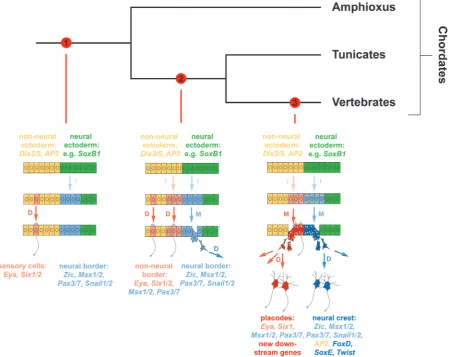
Due to their panplacodal expression in vertebrates and their essential dual role for both progenitor proliferation and cytodif-ferentiation in all vertebrate placodes, genes encoding Six1/2 (and Six4/5) TFs and their Eya cofactors have been proposed to play a central role for placode development and rewiring in the GRN up- and downstream of these genes has been suggested to account for many of the evolutionarily novel features of placodes
(Schlosser et al., 2014) (Fig. 6).
The role of these genes for sensory differentiation in many bilaterians together with their expression in isolated sensory cells in amphioxus suggests that they may have retained an ancient role in sensory differentiation in chordate ancestors (Schlosser, 2015, Schlosser et al., 2014). Recruitment of Six1/2 and Eya expression to the dorsalmost non-neural ectoderm may then have happened in the ancestors of tunicates and vertebrates by changes in their cis-regulatory sequences that made their expression dependent on dorsal and anterior signals (e.g. FGF and BMP-inhibitors, Wnt-inhibitors) and non-neural TFs acting as competence factors (e.g. Dlx, FoxI1/3, GATA1/2/3, AP2). Comparisons with tunicates suggest that in the tunicate-vertebrate ancestor Six1/2 and Eya were coexpressed with Six3/6, Pitx, and some additional TFs such as Dmrt and FoxG (which play a role for the development of an anterior group of placodes in vertebrates) anteriorly, whereas Six1/2 and Eya1 were coexpressed with Pax2/5/8 and FoxI (which are involved in the specification of a posterior group of placodes in vertebrates) further posteriorly. These anterior and posterior
placodal ectodermal territories then evolved, respectively, into the oral and atrial siphon primordia in tunicates and into an anterior and posterior group of placodes in vertebrates (Schlosser et al., 2014). However, in tunicates only small populations of sensory cells arise from the ectodermal domain expressing Six1/2 and Eya and many other sensory cells develop from other territories of the non-neural ectoderm (reviewed in (Holland, 2005, Schlosser, 2005, Schlosser, 2015). This suggests first, that in the tunicate-vertebrate ancestor as in extant tunicates Six1/2 and Eya were only able in conjunction with other cofactors to specify sensory or neurosecretory cells and, furthermore, that other TFs were able to substitute for Six1/2 and Eya in some parts of the ectoderm. Only when Six1/2 and Eya adopted a more central role for specification of sensory and neurosecretory cells in the vertebrate ancestor, did their confinement to the anteriormost non-neural ectoderm result in a concentration of sensory and neurosecretory cells in this region. Second, it suggests that in the tunicate-vertebrate ancestor, Six1/2 and Eya still acted mostly as differentiation genes and that they acquired an additional role in promoting the expansion of sensory and neuronal progenitors only in the vertebrate lineage.
In conclusion, current evidence suggests that proper plac-odes evolved as evolutionary novelties in the vertebrate lineage by rewiring the GRN both upstream and downstream of Six1/2 TFs, their cofactor Eya and other TFs involved in the regulation of ectodermal patterning and cytodifferentiation. This led to the concentration of pre-existing neurosecretory and sensory cells in dorsal and anterior parts of the non-neural ectoderm as well as the creation of large multicellular sense organs due to the expansion of the sensory and neuronal progenitor pool prior to differentiation. Modification of existing and evolution of novel cell types (e.g. hair cells) followed and placodes diversified into the various types now known in vertebrates. Amphioxus with its isolated sensory cells scattered throughout the ectoderm reminds us – to paraphrase the famous last line of Darwin’s Origin (1859) - from how simple a beginning many different placodes “most beautiful and most wonderful have been, and are being, evolved”.
References
ABITUA, P.B., GAINOUS, T.B., KACZMARCZYK, A.N., WINCHELL, C.J., HUDSON, C., KAMATA, K., NAKAGAWA, M., TSUDA, M., KUSAKABE, T.G. and LEVINE, M. (2015). The pre-vertebrate origins of neurogenic placodes. Nature 524: 462-5. AHRENS, K. and SCHLOSSER, G. (2005). Tissues and signals involved in the
induction of placodal Six1 expression in Xenopus laevis Dev.Biol. 288: 40-59. ALSINA, B., GIRALDEZ, F. and PUJADES, C. (2009). Patterning and cell fate in ear
development. Int.J.Dev.Biol. 53 1503-1513.
ARENDT, D., MUSSER, J.M., BAKER, C.V., BERGMAN, A., CEPKO, C., ERWIN, D.H., PAVLICEV, M., SCHLOSSER, G., WIDDER, S., LAUBICHLER, M.D. et al., (2016). The origin and evolution of cell types. Nat Rev Genet 17: 744-757. ARENDT, D. and NUBLER-JUNG, K. (1994). Inversion of dorsoventral axis? Nature
371: 26-26.
BAATRUP, E. (1981). Primary sensory cells in the skin of amphioxus (Branchiostoma lancelatum). Acta Zool 62: 147-157.
BAATRUP, E. (1982). On the structure of the corpuscles of de Quatrefages (Bran-chiostoma lanceolatum). Acta Zool. 63: 39-44.
BEASTER-JONES, L., KALTENBACH, S.L., KOOP, D., YUAN, S., CHASTAIN, R. and HOLLAND, L.Z. (2008). Expression of somite segmentation genes in amphioxus: a clock without a wavefront? Dev.Genes Evol. 218: 599-611.
BENITO-GUTIERREZ, E., ILLAS, M., COMELLA, J.X. and GARCIA-FERNANDEZ, J. (2005a). Outlining the nascent nervous system of Branchiostoma floridae (amphioxus) by the pan-neural marker AmphiElav. Brain Res.Bull. 66: 518-521.
BENITO-GUTIERREZ, E., NAKE, C., LLOVERA, M., COMELLA, J.X. and GARCIA-FERNANDEZ, J. (2005b). The single AmphiTrk receptor highlights increased complexity of neurotrophin signalling in vertebrates and suggests an early role in developing sensory neuroepidermal cells. Development 132: 2191-2202. BENITO, J. and PARDOS, F. (1997). Hemichordata. In Microscopic Anatomy of
Inver-tebrates. Vol. 15: Hemichordata, Chaetognatha, and the invertebrate chordates, (ed. HARRISON, F. W. and RUPPERT, E. E.). Wiley-Liss, New York, pp.15-101. BERTRAND, N., CASTRO, D.S. and GUILLEMOT, F. (2002). Proneural genes and
the specification of neural cell types. Nat.Rev.Neurosci. 3: 517-530.
BERTRAND, S., CAMASSES, A., SOMORJAI, I., BELGACEM, M.R., CHABROL, O., ESCANDE, M.L., PONTAROTTI, P. and ESCRIVA, H. (2011). Amphioxus FGF signaling predicts the acquisition of vertebrate morphological traits. Proc.Natl. Acad.Sci.U.S.A 108: 9160-9165.
BERTRAND, S. and ESCRIVA, H. (2011). Evolutionary crossroads in developmental biology: amphioxus. Development 138: 4819-4830.
BHAT, N., KWON, H.J. and RILEY, B.B. (2012). A gene network that coordinates preplacodal competence and neural crest specification in zebrafish. Dev Biol. BLUM, M., FEISTEL, K., THUMBERGER, T. and SCHWEICKERT, A. (2014). The
evolution and conservation of left-right patterning mechanisms. Development 141: 1603-13.
BOORMAN, C.J. and SHIMELD, S.M. (2002). Pitx homeobox genes in Ciona and amphioxus show left-right asymmetry is a conserved chordate character and define the ascidian adenohypophysis Evol.Dev. 4: 354-365.
BROOKE, N.M., GARCIA-FERNANDEZ, J. and HOLLAND, P.W.H. (1998). The Para-Hox cluster is an evolutionary sister of the Para-Hox gene cluster. Nature 392: 920-922. CAMPBELL, R.K., SATOH, N. and DEGNAN, B.M. (2004). Piecing together evolution
of the vertebrate endocrine system. Trends Genet. 20: 359-366.
CANDIANI, S., HOLLAND, N.D., OLIVERI, D., PARODI, M. and PESTARINO, M. (2008). Expression of the amphioxus Pit-1 gene (AmphiPOU1F1/Pit-1) exclusively in the developing preoral organ, a putative homolog of the vertebrate adenohy-pophysis. Brain Res.Bull. 75: 324-330.
CANDIANI, S., OLIVERI, D., PARODI, M., BERTINI, E. and PESTARINO, M. (2006). Expression of AmphiPOU-IV in the developing neural tube and epidermal sensory neural precursors in amphioxus supports a conserved role of class IV POU genes in the sensory cells development. Dev.Genes Evol. 216: 623-633.
CASTRO, A., BECERRA, M., MANSO, M.J., SHERWOOD, N.M. and ANADON, R. (2006a). Anatomy of the Hesse photoreceptor cell axonal system in the central nervous system of amphioxus. J.Comp Neurol. 494: 54-62.
CASTRO, A., MANSO, M.J. and ANADON, R. (2003). Distribution of neuropeptide Y immunoreactivity in the central and peripheral nervous systems of amphioxus (Branchiostoma lanceolatum Pallas). J.Comp Neurol. 461: 350-361.
CASTRO, L.F., RASMUSSEN, S.L., HOLLAND, P.W., HOLLAND, N.D. and HOLLAND, L.Z. (2006b). A Gbx homeobox gene in amphioxus: Insights into ancestry of the ANTP class and evolution of the midbrain/hindbrain boundary. Dev.Biol. 295: 40-51. CHANG, C.Y., LIU, Y.X., ZHU, Y. and ZHU, H. (1984). The reproductive endocrinology of amphioxus. In Frontiers in physiological research, (ed. CARLICK, D. G. and KORNER, P. I.). Cambridge Univ. Press, Cambridge, pp.79-86.
CHENG, L., ARATA, A., MIZUGUCHI, R., QIAN, Y., KARUNARATNE, A., GRAY, P.A., ARATA, S., SHIRASAWA, S., BOUCHARD, M., LUO, P. et al., (2004). Tlx3 and Tlx1 are post-mitotic selector genes determining glutamatergic over GABAergic cell fates. Nat Neurosci 7: 510-517.
CHRISTIAEN, L., BOURRAT, F. and JOLY, J.S. (2005). A modular cis-regulatory system controls isoform-specific pitx expression in ascidian stomodaeum. Dev Biol. 277: 557-566.
CHURCHER, A.M. and TAYLOR, J.S. (2009). Amphioxus (Branchiostoma floridae) has orthologs of vertebrate odorant receptors. BMC.Evol.Biol. 9: 242. DAVIS, S.W., ELLSWORTH, B.S., PEREZ MILLAN, M.I., GERGICS, P., SCHADE,
V., FOYOUZI, N., BRINKMEIER, M.L., MORTENSEN, A.H. and CAMPER, S.A. (2013). Pituitary gland development and disease: from stem cell to hormone production. Curr Top Dev Biol 106: 1-47.
DE ROBERTIS, E.M. and SASAI, Y. (1996). A common plan for dorsoventral pattern-ing in Bilateria. Nature 380: 37-40.
DELSUC, F., BRINKMANN, H., CHOURROUT, D. and PHILIPPE, H. (2006). Tuni-cates and not cephalochordates are the closest living relatives of vertebrates. Nature 439: 965-968.
DOS SANTOS, S., BARDET, C., BERTRAND, S., ESCRIVA, H., HABERT, D. and QUERAT, B. (2009). Distinct expression patterns of glycoprotein hormone-alpha2 and -beta5 in a basal chordate suggest independent developmental functions. Endocrinology 150: 3815-3822.
DUBOC, V., ROTTINGER, E., LAPRAZ, F., BESNARDEAU, L. and LEPAGE, T. (2005). Left-right asymmetry in the sea urchin embryo is regulated by nodal signaling on the right side. Dev Cell 9: 147-58.
ELSAESSER, R. and PAYSAN, J. (2007). The sense of smell, its signalling pathways, and the dichotomy of cilia and microvilli in olfactory sensory cells. BMC Neurosci 8 Suppl 3: S1.
ESCRIVA, H., HOLLAND, N.D., GRONEMEYER, H., LAUDET, V. and HOLLAND, L.Z. (2002). The retinoic acid signaling pathway regulates anterior/posterior pat-terning in the nerve cord and pharynx of amphioxus, a chordate lacking neural crest. Development 129: 2905-2916.
FANG, Y.Q., HUANG, W.Q., CHEN, L. and ZHANG, J.S. (1999). Distribution of gonadotropin-releasing hormone in the brain and Hatschek’s pit of amphioxus (Branchiostoma belcheri). Acta Zool Sinica 45: 106-111.
FRITZSCH, B., BEISEL, K.W., PAULEY, S. and SOUKUP, G. (2007). Molecular evolu-tion of the vertebrate mechanosensory cell and ear. Int.J.Dev.Biol. 51: 663-678. GARAFFO, G., CONTE, D., PROVERO, P., TOMAIUOLO, D., LUO, Z., PINCIROLI, P., PEANO, C., D’ATRI, I., GITTON, Y., ETZION, T. et al., (2015). The Dlx5 and Foxg1 transcription factors, linked via miRNA-9 and -200, are required for the development of the olfactory and GnRH system. Mol Cell Neurosci 68: 103-119. GIVENS, M.L., RAVE-HAREL, N., GOONEWARDENA, V.D., KUROTANI, R., BERDY, S.E., SWAN, C.H., RUBENSTEIN, J.L., ROBERT, B. and MELLON, P.L. (2005). Developmental regulation of gonadotropin-releasing hormone gene expression by the MSX and DLX homeodomain protein families. J.Biol.Chem. 280: 19156-19165. GLARDON, S., HOLLAND, L.Z., GEHRING, W.J. and HOLLAND, N.D. (1998). Isola-tion and developmental expression of the amphioxus pax-6 gene (amphipax-6): insights into eye and photoreceptor evolution. Development 125: 2701-2710. GOODRICH, E.S. (1917). “Proboscis pores” in craniate vertebrates, a suggestion
concerning the premandibular somites nad hypophysis. Quart.J.Microsc.Sci. 62: 539-553.
GORBMAN, A. (1983). Early development of the hagfish pituitary gland: evidence for the endodermal origin of the adenohypophysis. Amer.Zool. 23: 639-654. GORBMAN, A. (1995). Olfactory origins and evolution of the brain-pituitary endocrine
system: facts and speculation. Gen.Comp Endocrinol. 97: 171-178.
GORBMAN, A., NOZAKI, M. and KUBOKAWA, K. (1999). A brain-Hatschek’s pit connection in amphioxus. Gen.comp.Endocrinol. 113: 251-254.
GOSTLING, N.J. and SHIMELD, S.M. (2003). Protochordate Zic genes define primitive somite compartments and highlight molecular changes underlying neural crest evolution. Evol Dev 5: 136-144.
GRANDE, C. and PATEL, N.H. (2009a). Lophotrochozoa get into the game: the nodal pathway and left/right asymmetry in bilateria. Cold Spring Harb.Symp. Quant.Biol. 74: 281-287.
GRANDE, C. and PATEL, N.H. (2009b). Nodal signalling is involved in left-right asymmetry in snails. Nature 457: 1007-1011.
GROCOTT, T., TAMBALO, M. and STREIT, A. (2012). The peripheral sensory nervous system in the vertebrate head: a gene regulatory perspective. Dev Biol. 370: 3-23. HATSCHEK, B. (1884). Mittheilungen ueber Amphioxus. Zool.Anz. 7: 517-520. HOLLAND, L.Z. (2002). Heads or tails? Amphioxus and the evolution of anterior-
posterior patterning in deuterostomes. Dev.Biol. 241: 209-228.
HOLLAND, L.Z. (2005). Non-neural ectoderm is really neural: evolution of develop-mental patterning mechanisms in the non-neural ectoderm of chordates and the problem of sensory cell homologies. J.Exp.Zoolog. 304B: 304-323.
HOLLAND, L.Z. (2009). Chordate roots of the vertebrate nervous system: expanding the molecular toolkit. Nat.Rev.Neurosci. 10: 736-746.
HOLLAND, L.Z. (2014). Genomics, evolution and development of amphioxus and tunicates: The goldilocks principle. J.Exp.Zool. 324: 342-352.
HOLLAND, L.Z., ALBALAT, R., AZUMI, K., BENITO-GUTIERREZ, E., BLOW, M.J., BRONNER-FRASER, M., BRUNET, F., BUTTS, T., CANDIANI, S., DISHAW, L.J. et al., (2008). The amphioxus genome illuminates vertebrate origins and
cephalochordate biology. Genome Res. 18: 1100-1111.
HOLLAND, L.Z. and HOLLAND, N.D. (2001). Evolution of neural crest and placodes: amphioxus as a model for the ancestral vertebrate? J.Anat. 199: 85-98. HOLLAND, L.Z., SCHUBERT, M., HOLLAND, N.D. and NEUMAN, T. (2000).
Evolu-tionary conservation of the presumptive neural plate markers AmphiSox1/2/3 and AmphiNeurogenin in the invertebrate chordate amphioxus. Dev.Biol. 226: 18-33. HOLLAND, L.Z., SCHUBERT, M., KOZMIK, Z. and HOLLAND, N.D. (1999). Am-phiPax3/7, an amphioxus paired box gene: insights into chordate myogenesis, neurogenesis, and the possible evolutionary precursor of definitive vertebrate neural crest. Evol.Dev. 1: 153-165.
HOLLAND, N.D., PANGANIBAN, G., HENYEY, E.L. and HOLLAND, L.Z. (1996). Sequence and developmental expression of AmphiDll, an amphioxus distalless gene trabscribed in the ectoderm, epidermis and nervous system: insights into evolution of craniate forebrain and neural crest. Development 122: 2911-2920. HOLLAND, N.D., PARIS, M. and KOOP, D. (2009). The club-shaped gland of
amphi-oxus: export of secretion to the pharynx in pre-metamorphic larvae and apoptosis during metamorphosis. Acta Zoologica 90: 372-379.
HUANG, C., CHAN, J.A. and SCHUURMANS, C. (2014). Proneural bHLH genes in development and disease. Curr Top Dev Biol 110: 75-127.
HUISING, M.O., KRUISWIJK, C.P. and FLIK, G. (2006). Phylogeny and evolution of class-I helical cytokines. J Endocrinol 189: 1-25.
IRIMIA, M., PINEIRO, C., MAESO, I., GOMEZ-SKARMETA, J.L., CASARES, F. and GARCIA-FERNANDEZ, J. (2010). Conserved developmental expression of Fezf in chordates and Drosophila and the origin of the Zona Limitans Intrathalamica (ZLI) brain organizer. Evodevo 1: 7.
JACKMAN, W.R., LANGELAND, J.A. and KIMMEL, C.B. (2000). islet reveals seg-mentation in the amphioxus hindbrain homolog. Dev.Biol. 220: 16-26. KAJI, T., AIZAWA, S., UEMURA, M. and YASUI, K. (2001). Establishment of left-right
asymmetric innervation in the lancelet oral region. J.Comp.Neurol. 435: 394-405. KAJI, T., REIMER, J.D., MOROV, A.R., KURATANI, S. and YASUI, K. (2016).
Amphi-oxus mouth after dorso-ventral inversion. Zoological Lett 2: 2.
KALTENBACH, S.L., HOLLAND, L.Z., HOLLAND, N.D. and KOOP, D. (2009a). De-velopmental expression of the three iroquois genes of amphioxus (BfIrxA, BfIrxB, and BfIrxC) with special attention to the gastrula organizer and anteroposterior boundaries in the central nervous system. Gene Expr.Patterns. 9: 329-334. KALTENBACH, S.L., YU, J.K. and HOLLAND, N.D. (2009b). The origin and migration
of the earliest-developing sensory neurons in the peripheral nervous system of amphioxus. Evol.Dev. 11: 142-151.
KAUPP, U.B. (2010). Olfactory signalling in vertebrates and insects: differences and commonalities. Nat Rev Neurosci 11: 188-200.
KAWAUCHI, H. and SOWER, S.A. (2006). The dawn and evolution of hormones in the adenohypophysis. Gen.Comp Endocrinol. 148: 3-14.
KELBERMAN, D., RIZZOTI, K., LOVELL-BADGE, R., ROBINSON, I.C. and DAT-TANI, M.T. (2009). Genetic regulation of pituitary gland development in human and mouse. Endocr.Rev. 30: 790-829.
KOOP, D., CHEN, J., THEODOSIOU, M., CARVALHO, J.E., ALVAREZ, S., DE LERA, A.R., HOLLAND, L.Z. and SCHUBERT, M. (2014). Roles of retinoic acid and Tbx1/10 in pharyngeal segmentation: amphioxus and the ancestral chordate condition. Evodevo 5: 36.
KOOP, D., HOLLAND, N.D., SEMON, M., ALVAREZ, S., DE LERA, A.R., LAUDET, V., HOLLAND, L.Z. and SCHUBERT, M. (2010). Retinoic acid signaling targets Hox genes during the amphioxus gastrula stage: insights into early anterior-posterior patterning of the chordate body plan. Dev Biol. 338: 98-106.
KOZMIK, Z., HOLLAND, N.D., KALOUSOVA, A., PACES, J., SCHUBERT, M. and HOLLAND, L.Z. (1999). Characterization of an amphioxus paired box gene, Am-phiPax2/5/8: developmental expression patterns in optic support cells, nephridium, thyroid-like structures and pharyngeal gill slits, but not in the midbrain-hindbrain boundary region. Development 126: 1295-1304.
KOZMIK, Z., HOLLAND, N.D., KRESLOVA, J., OLIVERI, D., SCHUBERT, M., JONA-SOVA, K., HOLLAND, L.Z., PESTARINO, M., BENES, V. and CANDIANI, S. (2007). Pax-Six-Eya-Dach network during amphioxus development: conservation in vitro but context-specificity in vivo Dev.Biol. 306: 143-159.