R E S E A R C H
Open Access
Exploitation of 2D binary source correlation
using turbo block codes with fine-tuning
Mohd Azri Mohd Izhar
1*, Norsheila Fisal
1, Xiaobo Zhou
2, Khoirul Anwar
2and Tad Matsumoto
2,3Abstract
This article proposes a joint source-channel coding technique for two-dimensional (2D) binary Markov sources by using concatenated turbo block codes composed of two Bose, Chaudhuri, Hocquenghem (BCH) codes, of which output is followed by a rate-1 recursive systematic convolutional code. The source correlation of all rows and columns of the 2D source is well exploited by using a modified Bahl–Cocke–Jelinek–Raviv (BCJR) algorithm for the decoding of the BCH codes. Simulation results show that the proposed technique outperforms in terms of bit error rate the codes that exploits one-dimensional (1D) source correlation using the modified BCJR algorithm, and obviously the
conventional system without source correlation exploitation. In order to further improve the performance, this article aims to make fine-tuning of the code parameters, given the source correlation property, that can achieve
performance even closer to the theoretical limit than without the fine-tuning. Finally, results of image transmission simulations using two images, one having strong and the other weak 2D correlation, are presented to demonstrate the effectiveness of our proposed technique.
1 Introduction
According to the Shannon’s separation theorem, the opti-mal design of the source and channel codes can be sought for independently, so far as the source entropy rate is lower than the channel capacity [1]. However, this theorem assumes infinite code length, which imposes, in theory, infinite latency to the communication sys-tems. Furthermore, in many existing source coding schemes there remains residual redundancy left after source encoding, especially for the sources having multi-dimensional memory structure such as image and/or videos, and in fact, the residual redundancy can well be utilized to achieve further error protection. Such inferi-ority of the separation theorem-based design have moti-vated a considerable number of work towards establishing efficient joint source-channel coding (JSCC) techniques, especially towards best exploiting the source correlation in channel coding.
Since the discovery of the turbo codes by Berrou et al. [2], which achieves the bit error rate (BER) threshold at only 0.7 dB away from the Shannon limit, the research
*Correspondence: [email protected]
1UTM-MIMOS Center of Excellence, Faculty of Electrical Engineering, Universiti Teknologi Malaysia (UTM), 81310 Skudai, Johor, Malaysia
Full list of author information is available at the end of the article
community is experiencing significant paradigm shift in many areas of information theory and applications. So is the case of JSCC design, and it has been quite com-mon that JSCC techniques utilize the turbo or turbo-like codes. The JSCC techniques shown in [3-6] character-ize the source by a Markov model and exploit the source statistic during decoding process at receiver. Source statis-tic is taken into account in encoder design in [7-10], and correspondingly decoding algorithm modification is also proposed. Recently, exploitation of the memory structure inherent within the source using serial concatenated con-volutional codes has been proposed in [11], which demon-strates superiority in BER performance without requiring heavy decoding complexity. However, the JSCC methods that have been proposed so far operate at relatively low code rate (equal or less than a half rate), and furthermore they considered the exploitation of the source correla-tion in only one direccorrela-tion, such as line-by-line scanning of image, which can be referred as one-dimensional (1D) source correlation.
In our recent work presented in [12], we introduced a novel JSCC system which exploits the two-dimensional (2D) source correlation using turbo block codes (TBC) utilizing relatively high rate Bose, Chaudhuri, Hocquenghem (BCH) codes. The Bahl–Cocke–Jelinek– Raviv (BCJR) algorithm [13] used in decoding the two
component codes of TBC is modified based on the algo-rithm proposed in [11]. The proposed 2D technique achieves relevant performance gain in terms of BER compared to the system that exploits 1D source correla-tion only and apparently much significant gain over the conventional system without source correlation exploita-tion. Obviously, the stronger the source correlation, the larger gain can be obtained, in general. In fact, the multi-dimensional source correlation imposes restrictions on the values of neighboring symbols in multiple dimension-ality, and hence 2D source correlation is stronger than 1D correlation. The technique shown in [12] exploits this principle, and the technique proposed in [12] allows the use of high rate codes. Furthermore, the technique pre-sented in [12] utilizes excellent property of a memory-1 recursive systematic convolutional (RSC) code, referred to as accumulator, that follows the 2D TBC via random interleaver; with this structure, clear BER threshold can be achieved.
The aim of this article is to provide a clear and com-plete description of the proposed 2D source correlation utilization technique presented in [12]; since [12] is a con-ference publication, the shortage in space did not allow us to provide the algorithm details. On the top of the com-plete descriptions of the technique shown in [12], it is also shown in this article that further performance improve-ment is possible by replacing the symmetric TBC and accumulator used in [12] with asymmetric TBC and a longer memory RSC code, respectively. For the stone-by-stone comparison, this article applies the proposed new techniques we found after the publication of [12] to the cases where only 1D source correlation is utilized.
The remainder of the article is organized as follows. The 2D source model we assume in this article is described in Section 2. The proposed technique and the modi-fied BCJR algorithm are detailed in Section 3. Section 4 presents the results of simulations for the utilization of the 1D and 2D source correlation as well as for the case where no correlation information is taken into account. The results of the image transmission simulations are presented in Section 5. Finally, concluding remarks are provided in Section 6.
2 2D Markov sources
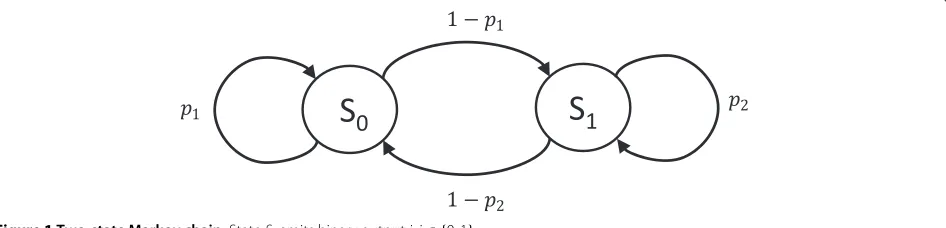
The model that we assume to characterize the source behavior is a first-order binary Markov source model. The 1D Markov source is described first, and then, we extend it to 2D Markov source. For 1D case, the stateUtat a time tis determined by its value att−1 according to the con-ditional probability Pr{Ut = i|Ut−1 = i} where i,i ∈ {0, 1}, and the behavior of the model can conveniently be expressed by the state transition matrix:
A=ai,i
=
p1 1−p1
1−p2 p2
, (1)
wherep1andp2are the state transition probabilities;p1
andp2stand for the probabilities that the state attis the
same as the previous state, as shown in the state diagram in Figure 1 where stateS0emits binary “0” whileS1emits
binary “1”.
The entropy rate of the stationary first-order Markov source [14] can be calculated by
H(S)= − i,i∈{0,1}
μiai,ilogai,i, (2)
where μi represents the stationary state distribution. With p1 = p2 = p, the Markov source is symmetric,
and hence μi = 0.5. In this case, Equation (2) can be simplified to
H(S)= −plog2p−(1−p)log2(1−p). (3)
For the 2D Markov source, the outputUn,tof the current state is determined by two factors; the previous state in the horizontal direction,Un,t−1and that in the vertical
direc-tion,Un−1,t, wheretandnare the timing indexes of the 2D source in the horizontal and vertical directions, respec-tively. This 2D source correlation model can be considered as a two-dimensionally coupled first-order Markov chains and the corresponding transition matrix of the 2D source can be represented by using a coupled Markov chain (CMC) model [15]. Following the CMC model, we can use the 1D source transition matricesAH andAV for the
horizontal and vertical directions, respectively, in order to obtain the 2D source transition matrixB, as
B=bi,j,k=Pr{Un,t=k|Un−1,t=i,Un,t−1=j} AV, respectively. The entropy rate for the 2D source can be calculated as entropy rate from (2) for the horizontal and vertical direc-tions, respectively, while H(Un,t) and H(Un−1,t,Un,t−1)
are obtained empirically via measurements. It is worth to mention that in the case of symmetric Markov chain of both directions,H(Un,t)=1.
3 Correlation exploitation
3.1 2D coding technique
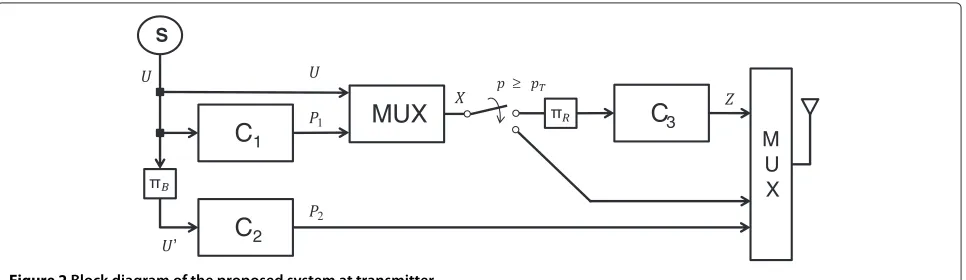
The block diagram of our proposed JSCC scheme at the transmitter side is shown in Figure 2. The sourceUis a 2D binary source, and the correlation of each row and column of the source is indicated by the state transition probabil-ities,p1andp2, respectively. Therefore, for a 2D source
with a sizeK×K, there are 2×K×Ktransition proba-bilities representing the 2D correlation of the source since the probability varies horizontal and vertical line-by-line.
In our proposed system, the average value for the source correlation,p¯, is required since this value will be used later to determine whether to fed or bypass the rate-1 inner code. For any value ofp< 0.5, the correlation is defined as 1− p, whereas forp ≥ 0.5, the correlation is equal top. Hence,p¯ has a value between 0.5 and 1, with which ¯
p= 0.5 indicates no correlation andp¯ = 1 indicates the full correlation, both in average sense.
The coding scheme shown in Figure 2 can be viewed as a serial concatenation of 2D TBC and the rate-1 inner code, where a random interleaver is in between. The TBC con-sists of two components of block codes,C1andC2, and
in this article, we use BCH codes as the component codes of TBC. BCH codeC1 has a parameter set(N1,K1,D1),
whereK1refers to the information bit length,N1the code
word length andD1the minimum Hamming distance of C1. In the same way as in C1, C2 has a parameter set (N2,K2,D2)whereK2refers to the information bit length, N2the code word length andD2the minimum Hamming
distance ofC2. Following the TBC structure, the
informa-tion bitU is directly fed into C1, whileC2 receives the
interleaved version of U. Block interleaver πB is used in the proposed scheme in order to maintain the source cor-relation in the vertical direction since the use of random interleaver breaks the correlation. However, this has a side effect that the extrinsic log-likelihood ratios (LLRs) are correlated, and the use of correlated LLR does not strictly follow the turbo concept. Therefore, to break the corre-lation, we need random interleaver, followed by an inner codeC3, which is a rate-1 RSC code. However, this
pro-cess breaks the 2D correlation. Hence, we need a trade-off of either we useC3or not, and the threshold depends on
the correlation of the source itself. Theoretical derivation of the optimal threshold is, however, out of the scope of this article and is left as future study.
The threshold value indicated by pT is determined empirically since, as indicated in [12], the inclusion of C3only yields benefit to the source having strong
corre-lation and it will degrade the performance when source correlation is weak. If the average source correlation, p¯,
C
2is equal or larger than the threshold valuepT, the parity sequence together with information sequenceU is mul-tiplexed and interleaved by using random interleaverπR. TheπR-interleaved sequence is then fed intoC3. In order
to avoid the performance degradation due to this obser-vation,C3is bypassed whenp¯ < pT. Assumingp¯ ≥ pT, the parity sequence fromC3is multiplexed with the parity
sequence fromC2, modulated by using binary-phase shift
keying (BPSK) and transmitted over additive white Gaus-sian noise (AWGN) channel where the variance of the complex noise isσ2. The overall code rate of the system is, therefore,K/(2N−K).
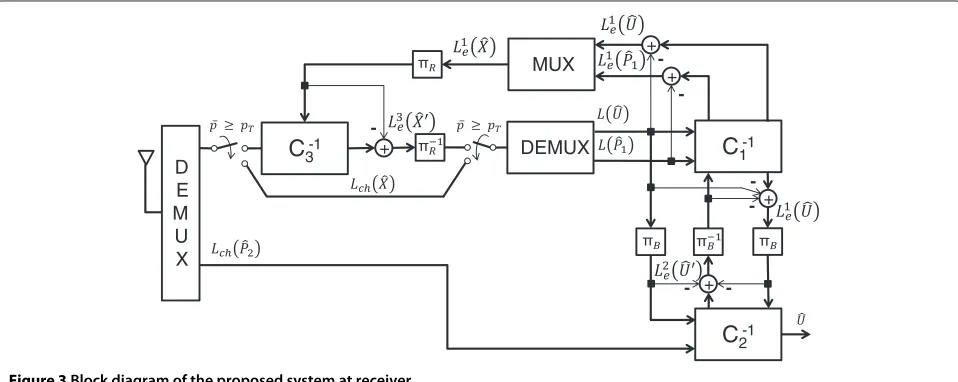
The block diagram of our proposed system at receiver side is shown in Figure 3 where C1−1, C2−1, and C3−1are the decoders of C1, C2, and C3, respectively. All three
decoders are activated if p¯ ≥ pT with activation order C3−1,C1−1,C2−1,C−11,C3−1,C1−1,C2−1,C−11,. . .; on the other hand, ifp¯ <pT, only two decoders are activated with acti-vation order C−11,C2−1,C1−1,C2−1,. . .. All decoders itera-tively exchanged information in the form of extrinsic LLR, Lie,i∈ {1, 2, 3}whereirepresents the component decoder indexes. The BCJR algorithm is used for input soft-output decoding of each component code. In order to exploit the source correlation during the decoding pro-cess, the modified BCJR algorithm is used inC1−1andC2−1. The correlation of each row of the 2D source is utilized by C1−1 while the correlation of each column of the 2D source is utilized byC−21. The modified BCJR algorithm is based on the 1D JSCC decoder modification shown in [11] for convolutional codes; however, we have made addi-tional minor modification to the algorithm in order to make the algorithm better suited with block codes. In this article, we assume that the source correlation property for the horizontal and vertical directions are known to the receiver. In practical, the source correlation property can be forwarded with the help of higher order protocol.
It is worth to mention that our 2D technique can also be used in serial concatenation of BCH codes with block interleaver separating the codes. We conducted a simple experiment of using our technique with serial concatena-tion and compared the results with parallel concatenaconcatena-tion. Code parameters are the same in both cases and the only difference is that in the case of the serial concatena-tion, “parity-of-parity” is transmitted and decoder uses it. There was no significant improvement observed by using serial concatenation, despite the decrease in code rate and the increase in decoding delay. This finding is consis-tent to the result presented in [16] for conventional TBC without source correlation exploitation.
3.2 Modified BCJR algorithm
The source correlation can be well utilized by making modifications of the BCJR algorithm. In this section, we will show how the information of the source tran-sition probability can be included in the standard BCJR algorithm [13] in the channel decoding process. Referring to the work in [11] for convolutional codes, a similar mod-ified BCJR algorithm can be derived. The Markovinity inherent in the model yields the a posteriori LLR, cor-responding to the state transition from i to b i where i,i∈ {0, 1}, as
whereYtis the received signal at the timing indext, and R1t is the set of the transitions from trellis state s to s corresponding toUt = 1 and likewise,R0t for the set cor-responding toUt = 0. The forward and backward state
C
1-1probabilitiesαt andβt are obtained by, respectively, the recursions Equations (8) and (9), and the state transition probabilityγtis given by (10) as
αt(s,i)=
s,i
αt−1(s,i)γt(s,i,s,i), (8)
βt−1(s,i)=
s,i
βt(s,i)γt(s,i,s,i), (9) and
γt(s,i,s,i)=Pr{St=s,Ut=i,Yt|St−1=s,Ut−1=i}, =Pr{St=s,Ut=i|St−1=s,Ut−1=i}
Pr{Yt|Ut=i},
(10)
respectively. The joint probability of the first term in (10) is influenced by the transition probability of the Markov source and the input bit Ut corresponding to the state transition from St−1 = s to the state St = s. Since
the Markov source output is equivalent to the inputUt to the outer code C1 and/or C2, the first term can be
approximated by
Pr{St,Ut|St−1,Ut−1} ≈Pr{Ut=i|Ut−1=i}Pr{Ut=i}, =ai,iPr{Ut=i}.
(11)
It is worth being noticed here that there is no differ-ence in terms of the calculation for the termsαt andβt as shown in (8) and (9), respectively, from the standard BCJR algorithm; the difference of the modified algorithm from the standard algorithm arises when calculating the
branch metricγt, where a new termai,iis added as shown in (11) in order to take into account the source correlation information. For block codes, the state and state transi-tion probabilities associated with the trellis diagram are evaluated untilt = N, which can be separated into two parts; the first part is the uncoded information data bit sequence and the second part is the parity bit sequence. The uncoded information data bits are corresponding to the index t ≤ K while the parity bits to the index K < t ≤ N. Accordingly, theγtcalculation is also sepa-rated into two parts; the first part is fort ≤ K where it is affected by the value ofai,iobtained from the Markov source transition probabilities. The second part is forK< t ≤ N, where the termai,i = 0.5 fori,i ∈ {0, 1}, since there is no correlation for the parity sequence, and hence for the second term in (11),Pr{Ut = i} fori ∈ {0, 1} is equal to 1 because the a prioriLLR feedback for the parity sequence is zero. The extrinsic information can be obtained by subtracting the a posterioriLLR calculated by (7) from thea prioriinformation and the soft channel output ofYt, according to the turbo principle.
4 Numerical results
4.1 BER performance evaluation
A series of simulations was conducted by using BPSK modulation over AWGN channel to evaluate the BER per-formance of our 2D technique. The source correlation property of each row and column of the 2D source was assumed available at the receiver and the source correla-tion in the horizontal and vertical direccorrela-tions was exploited by the decodersC−11andC2−1, respectively. For simplic-ity, this article only considers the results for symmetric
2.2 2.4 2.6 2.8 3 3.2 3.4 3.6
10−6 10−5 10−4 10−3 10−2 10−1
E b/N0(dB)
BER
p=0.7 without C 3 p=0.7 with C
3 p=0.71 without C
3 p=0.71 with C
3 p=0.72 without C
3 p=0.72 with C
3
−3 −2 −1 0 1 2 3 4 5 6
Figure 5Comparison of BER performance of the system utilizing 2D source correlation and 1D source correlation.Both systems used BCH(127, 120, 3)in component codesC1andC2, while RSC memory-2(7, 4)8used inC3,Rc=0.90.
Markov sources and hence, the strength of the source cor-relation is indicated by the transition probabilityp, where p= 0.5 corresponds to uncorrelated source due to equal and random appearance probability of binary values 0 and 1, regardless of the previous source value. The source cor-relation becomes stronger as the value ofpapproaches 1 or 0, however, as stated before, in this article, we only con-sider the value ofpbetween 0.5 ≤ p ≤ 1. In order to observe the effect of the different correlation strength, the same pvalue was used for each row and column of the 2D source. Memory-2 RSC(7, 4)8was used as the inner codeC3, while BCH(127, 120, 3)was used forC1andC2.
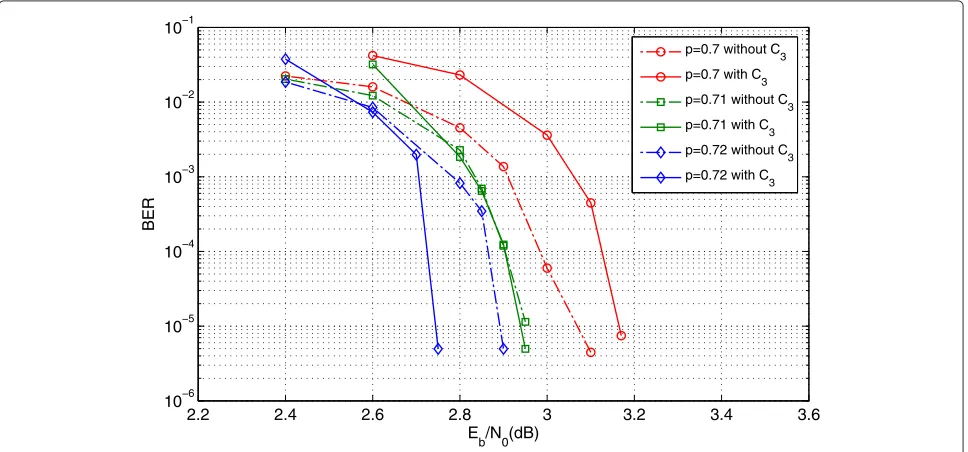
With this setting, the overall code rate of the system is Rc=0.90. The BER performance is shown in Figure 4 and it is found that by setting the threshold valuepT = 0.71 makes significant difference in performance.
It should be reminded that the threshold for selecting either theC3be used or not depends on the pros-and-cons
trade-off due to LLR correlation: block interleaver aims to keep the source correlation, while the correlation makes negative impact on the iterative decoding. The threshold value is obtained empirically, and its theoretical derivation is out of the scope, even though we recognize that it is a very important open question. In this simulation, we used 240×240 block interleaverπBand random interleaverπR
with a length of 60960.
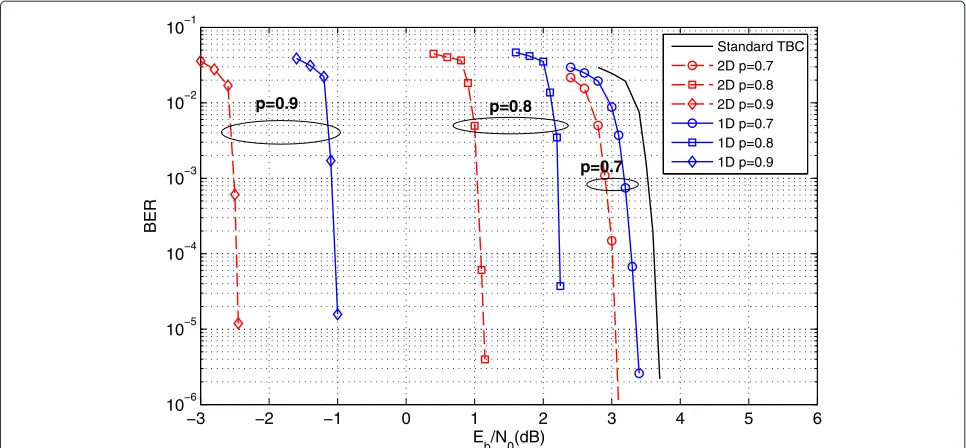
Figure 5 shows the comparison of BER performance between the proposed 2D system, the 1D system, and conventional TBC system [16,17]: the 1D system utilizes the modified BCJR algorithm inC−11, while the standard BCJR algorithm for C−21; the conventional TBC system
does not utilize the source correlation at all. BER perfor-mances were evaluated after 20 iterations for all the cases. It can be observed in the 1D and 2D BER curves that the stronger the source correlation, the better performance can be achieved, and hence, the gain from the conven-tional system increases. It is found from Figure 5 that larger gain can be achieved by exploiting the 2D source correlation. With p = 0.7, the 2D system outperforms the 1D system by 0.29 dB and as the source correlation becomes stronger, larger improvement can be achieved, for example, withp=0.9, the 2D system outperforms the 1D system by 1.46 dB.
The theoretical limit based on the constellation con-straint capacity (CCC) [18] is used to evaluate the gap in Eb/N0 values between that required to achieve a low
enough BER (=10−5) and the theoretical limit CCC for a set ofNpossible transmitted symbolsais given by
C=log2(N)− 1
Table 1 Gaps to the theoretical limit and gains from the
−4 −3 −2 −1 0 1 2 3 4 5 10−6
10−5 10−4 10−3 10−2 10−1 100
E b/N0(dB)
BER
p=0.7, C1:BCH(255,247),C2:BCH(15,11) C3:RSC(77,40)8,Rc=0.72
p=0.8, C1:BCH(255,247),C2:BCH(15,11) C3:RSC(777,400)8,Rc=0.72
p=0.9, C1:BCH(127,120),C2:BCH(15,11) C3:RSC(37,20)8,Rc=0.70
Figure 6BER performance of the 2D system with code parameter optimization after 30 iterations.
wherewis the complex Gaussian noise with variance of
σ2. For the source with memory, (12) is subjected to the constrains ofH · Rc ≤ C where Rc is the code rate of the system andHis the entropy rate defined by (6). The Hvalues for the several state transition probabilityp val-ues and their corresponding theoreticalEb/N0limits for
the BPSK transmission over AWGN channel are shown in Table 1. Based on the simulation results shown in Figure 5, the gaps at BER 10−5 in Eb/N0 to the theoretical limit
were determined and tabulated in Table 1. The gain over the conventional system increases, as the source corre-lation becomes strong. However, the stronger the source correlation the larger is the gap to the CCC limit; for example, withp=0.7, gap=2.88 dB, while withp=0.9, gap=4.22 dB.
4.2 Fine-tuning of code parameters
In the previous section, the main focus has been on the technique that well exploit the 2D source correlation. This section aims to further adjust the code parameters to achieve performance closest to the theoretical limit, based on the concept described in the previous section. In order to reduce the gap to the limit especially for strong source correlation case, we have evaluated the BER performance
by using different BCH codes for C1 and C2, and
dif-ferent RSC codes forC3. Within the Hamming distance
three codes, BCH (N,K,3), we conducted a brute-force code search towards the performance enhancement for C1 andC2 optimization with maximum N = 255. We
have limited our search forC3within the inner rate-1 RSC
codes having two-tap feedback polynomials that achieve for all 1’s input binary sequence result in better perfor-mance than any other generator polynomials, according to the results in [19]. We only consider the total memory size ofC3up to 8. We have tested all possible code
combi-nations from our code list and the code combination with performance closest to the theoretical limit was selected. Figure 6 shows the BER performance for p = 0.7, 0.8 and 0.9 after 30 iterations, all with the code parameters obtained by the brute-force search. Table 2 summarizes the code parameters obtained by the brute-force search forp = 0.7, 0.8 and 0.9 together with its gap to the the-oretical limit. Different combinations of codes have been found for differentpvalues. Withp = 0.7, gap = 0.71 dB and as the p-value increases, the BER performance of the 2D system tends to be further away from the theo-retical limit and for p = 0.9, the BER performance is 3.45 dB away from the limit, which is smaller than without
Table 2 Gaps inEb/N0at BER 10−5of our 2D system after code parameter optimization
p Codes Rc CCC(dB) BER 10−5(dB) Gap(dB)
0.7 BCH(255, 247),BCH(15, 11),RSC(77, 40)8 0.72 −0.60 0.11 0.71
0.8 BCH(255, 247),BCH(15, 11),RSC(777, 400)8 0.72 −2.97 −1.47 1.50
−4 −3 −2 −1 0 1 2 3 4 10−6
10−5 10−4 10−3 10−2 10−1 100
E b/N0(dB)
BER
p=0.7, C1:BCH(127,120),C2:BCH(7,4) C3:RSC(777,400)8,Rc=0.55
p=0.8, C
1:BCH(255,247),C2:BCH(15,11) C3:RSC(37,20)8,Rc=0.72
p=0.9, C1:BCH(255,247),C2:BCH(31,26) C3:RSC(377,200)8,Rc=0.82
Figure 7BER performance of the 1D system with code parameter optimization after 30 iterations.
the fine-tuning of the code parameters, i.e., 4.22 dB in Table 1. Further improvement may be possible by using C3with a longer memory and,C1andC2with BCH codes
having minimum Hamming distance larger than 3. How-ever, apparently, this approach suffers from exponentially increasing computational complexity.
Previously, we have proposed a TBC-based technique where the knowledge about the 2D correlation is exploited in the decoding process, resulting in better performance than the conventional techniques. This invokes another question of how much improvement can be exploited by the proposed 2D techniques when the source has indeed only 1D correlation, i.e.,H(Un,t|Un,t−1) = 1 and H(Un,t|Un−1,t)= 1. This is the case of, for example, con-ventional fax machine using line-by-line scanning only. Based on the same search technique as in the 2D sys-tem, the optimal code parameter search for 1D system was performed. Figure 7 depicts the BER performance with the optimal code parameters for differentpvalues for the 1D system. Table 3 summarizes the optimal code parameters forp=0.7, 0.8, and 0.9 together with their gaps to the the-oretical limits. With differentpvalues, the optimal code parameters are also different, nevertheless, the gaps to the theoretical limit are around 0.6 dB in all the cases tested.
Only a few techniques have been proposed for the uti-lization of 1D binary Markov source correlation and these techniques are designed for low code rate applications, say,Rc ≤ 0.5. Zhu and Alajaji [3] have proposed a JSCC system using turbo convolutional codes and the technique is known as joint source channel turbo codes (JSCTC). Meanwhile, Zhou et al. [11] have proposed serial concate-nated joint source-channel codes (SCJSCC), where it is shown that superior BER performance can be achieved with less decoding complexity than JSCTC. The compar-ison in terms of the gap to the theoretical limit between our 1D system with JSCTC and SCJSCC is summarized in Table 4. The 1D system proposed in this article for the case H(Un,t|Un,t−1) =1 andH(Un,t|Un−1,t) = 1 outperforms the other two reference systems.
5 Image transmission simulation
In this section, we demonstrate the effectiveness of our proposed technique through image transmission simula-tions. Two images were tested: one with strong correlation and the other with weak correlation, and the simula-tions were conducted over AWGN channel. The horizon-tal and vertical state transition probabilities, line-by-line, were evaluated before performing the simulations, and
Table 3 Gaps inEb/N0at BER 10−5of the 1D system after code parameter optimization
p Codes Rc CCC(dB) BER 10−5(dB) Gap(dB)
0.7 BCH(127, 120),BCH(7, 4),RSC(777, 400)8 0.55 −0.42 0.14 0.56
0.8 BCH(255, 247),BCH(15, 11),RSC(37, 20)8 0.72 −1.15 −0.56 0.59
Table 4 Comparison of gaps to the theoretical limit at BER
10−5between our 1D system with SCJSCC and JSCTC
p Our System(dB) SCJSCC(dB) JSCTC(dB)
0.7 0.56 1.17 0.73
0.8 0.59 1.03 0.94
0.9 0.66 1.11 1.36
were used in the modified BCJR algorithm, as stated in Section 3.2.
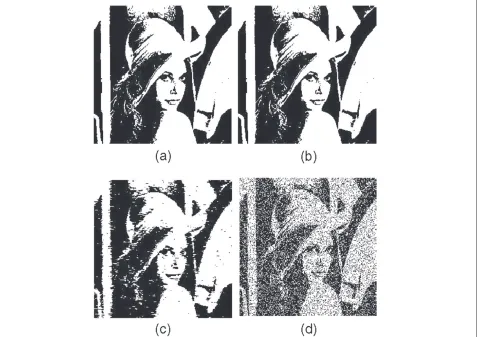
The first image example was a 240×240 pixels binary image of Lenna, shown in Figure 8a, with an average source correlationp¯ = 0.92. We used commonly BCH
(127, 120, 3)code as the TBC’s component codesC1and C2, and a rate-1 RSC code with generator polynomial (7, 4)8forC3throughout the simulations. The image was
transmitted over the same channel (even with the same noise samples) before decoded by using different tech-niques. We chose specificEb/N0value at which turbo cliff
happens in the BER performance with the 2D correlation-exploited case. From the BER curves shown in Figure 5, the turbo cliff for the first image example (p¯ = 0.92) is
estimated to happens at Eb/N0 = −3.8 dB. The result
of the decoded image by using the proposed 2D and 1D systems after 25 iterations atEb/N0 = −3.8 dB are
shown in Figure 8b,c, respectively. It is found that there is no degradation in image quality [indicated by pixel errors and peak signal-to-noise ratio (PSNR)] with the 2D system, while 4.70% pixel errors remains with the 1D system. The conventional TBC system without exploiting the source correlation results in the lowest image quality, with pixel errors of 19.36% and PSNR 7.14 dB as shown in Figure 8d. In order to give good consistency of the results due to the random channel state, we calculated the average PSNR (APSNR) over 300 samples (different noise sam-ple sequences were used, transmission-by-transmission, and the same sets of the noise sample sequences were commonly used for different decoding techniques). The corresponding APSNR for the 2D, 1D, and conventional TBC systems are 32.23, 13.36, and 7.13 dB, respectively.
The image used exemplifying relatively lowpvalue is a gray-scale image of Lenna with size 240×240 pixels where each pixel of the image is represented by eight binary digits. Before encoding this sample image, the gray-scale
image shown in Figure 9a was converted into a binary matrix withp¯ = 0.62. The second image example hasp value close enough withp = 0.7 (there is no BER curve forp=0.6 in Figure 5). From the BER curves in Figure 5, it is estimated that for the 2D correlation-exploited case withp=0.62 the turbo cliff is achieved aroundEb/N0 =
3.2 dB. The results of the decoded image at Eb/N0 =
3.2 dB after 25 iterations are shown in Figure 9b–d for various systems where eight transmissions in total were required to decode the full image. It is found from the results that the proposed 2D system achieves the highest image quality, with no pixel errors, similar to the previous image example in Figure 8b. The corresponding APSNR for the 2D, 1D, and conventional TBC systems are 52.11, 39.87, and 38.24 dB, respectively. From the two image transmission simulations, we can clearly see the advantage of our proposed systems over the conventional TBC sys-tem without utilizing source correlation especially in the case of source with strong correlation. As expected, the 2D system achieves better image quality than the less complex 1D system due to the extra source correlation information required in 2D system.
6 Conclusions
In this article, a JSCC technique utilizing the correlation of 2D binary Markov sources using high rate codes has been proposed. A rate-1 RSC code and two BCH codes were deployed, where the BCH decoders use the modified BCJR algorithm in order to exploit the source correlation. The threshold for selecting whether or not to use the rate-1 RSC code depends on the trade-off due to LLR tion: the block interleaver aims to keep the source correla-tion, while the LLR correlation causes negative impact on the iterative decoding. It has been shown through a series of simulations that significant BER performance improve-ment can be achieved by using the proposed technique over the 1D and conventional systems. In order to fur-ther enhance the performance, the code parameters were fine-tuned for different source correlation strengths. It has been shown that the utilization of the 1D source corre-lation, as exemplified by line-by-line scanned image, with our proposed technique achieves a BER threshold of only about 0.6 dB away from the theoretical limit, and outper-forms the other 1D techniques, JSCTC and SCJSCC. This new technique has many potential applications and in
this article, we have demonstrated the effectiveness of the proposed technique in image transmission application.
Competing interests
The authors declare that they have no competing interests.
Acknowledgements
This research was supported in part by the Research Management Center (RMC), Universiti Teknologi, Malaysia, under GUP research grants No. Q.J130000.2523.02H91, and in part by the Japan Society for the Promotion of Science (JSPS) KIBAN (B) No. 2360170.
Author details
1UTM-MIMOS Center of Excellence, Faculty of Electrical Engineering, Universiti
Teknologi Malaysia (UTM), 81310 Skudai, Johor, Malaysia.2Japan Advanced Institute of Science and Technology (JAIST), 1-1 Asahidai, Nomi, Ishikawa 923-1292, Japan.3Centre for Wireless Communications, University of Oulu, P.O. Box 4500, 90014 Oulu, Finland.
Received: 14 September 2012 Accepted: 25 February 2013 Published: 28 March 2013
References
1. CE Shannon, A mathematical theory of communication. Bell Syst. Tech. J.
27(3), 379–423 (1948)
2. C Berrou, A Glavieux, P Thitimajshima, inProceedings of the IEEE International Conference on Communications (ICC) 1993. Near, Shannon limit error-correcting coding and decoding: turbo-codes (Geneva, Switzerland (1993), pp. 1064–1070
3. G Zhu, F Alajaji, Joint source-channel turbo coding for binary Markov sources. IEEE Trans. Wirel. Commun.5(5), 1065–1075 (2006) 4. J Garcia-Frias, JD Villasenor, Combining hidden Markov source codes,
parallel concatenated. IEEE Commun. Lett.1(4), 111–113 (1997) 5. J Garcia-Frias, JD Villasenor, Joint turbo decoding and estimation of
hidden Markov sources. IEEE J. Sel. Areas Commun.19(9), 1671–1679 (2001)
6. H Belhadj, S Zaibi, A Bouallègue, Iterative joint source-channel decoding with source statistics estimation: application to image transmission. Signal Process. Image Enhance. Multimed. Process. Multimed. Syst. Appl. Ser.31, 301–311 (2008)
7. G Zhu, F Alajaji, Turbo codes for nonuniform memoryless sources over noisy channels. IEEE Commun. Lett.6(2), 64–66 (2002)
8. G Zhu, F Alajaji, J Bajcsy, P Mitran, Transmission of nonuniform
memoryless sources via nonsystematic turbo codes. IEEE Trans. Commun.
52(5), 855 (2004)
9. F Cabarcas, R Souza, J Garcia-Frias, inProceedings of the IEEE International Symposium on Information Theory (ISIT) 2004. Source-controlled turbo coding of non-uniform memoryless sources based on unequal energy allocation (Chicago, Illinois, USA, 2004), p. 164
10. F Cabarcas, R Souza, J Garcia-Frias, Turbo coding of strongly nonuniform memoryless sources with unequal energy allocation and PAM signalling. IEEE Trans. Signal Process.54(5), 1942–1946 (2006)
11. X Zhou, K Anwar, T Matsumoto, in6th International ICST Conference on
Communications and Networking (CHINACOM) 2011. Serially concatenated
joint source-channel coding for binary Markov sourcesin (Harbin, China, 2011), pp. 53–60
12. MAM Izhar, N Fisal, X Zhou, K Anwar, T Matsumoto, inProceedings of the 7th International Symposium on Turbo Codes and Iterative Information Processing 2012. Utilization of 2-D Markov source correlation using block turbo codes (Gothenburg, Sweden, 2012), pp. 56–60
13. L Bahl, J Cocke, F Jelinek, J Raviv, Optimal decoding of linear codes for minimizing symbol error rates (corresp.) IEEE Trans. Inf. Theory.20(2), 284–287 (1974)
14. TM Cover, JA Thomas,Elements of Information Theory, 2nd edn. (Wiley, USA, 2006)
15. AMM Elfeki, FM Dekking, A Markov chain model for subsurface characterization: theory and applications. Math. Geol.33(5), 569–589 (2001)
16. L Hanzo, TH Liew, BL Yeap,Turbo Coding, Turbo Equalisation and Space-Time Coding for Transmission Over Fading Channels, 1st edn. (Wiley-IEEE Press, 2002)
17. J Hagenauer, E Offer, L Papke, Iterative decoding of binary block and convolutional codes. IEEE Trans. Inf. Theory.42(2), 429–445 (1996) 18. G Ungerboeck, Channel coding, with multilevel/phase signalling. IEEE
Trans. Inf. Theory IT-28, 55–67 (1982)
19. Brink ten S, Code characteristic matching for iterative decoding of serially concatenated codes. Ann. Telecommun.56(7), 394–408 (2001)
doi:10.1186/1687-1499-2013-89
Cite this article as:Mohd Izharet al.:Exploitation of 2D binary source corre-lation using turbo block codes with fine-tuning.EURASIP Journal on Wireless Communications and Networking20132013:89.
Submit your manuscript to a
journal and benefi t from:
7Convenient online submission
7Rigorous peer review
7Immediate publication on acceptance
7Open access: articles freely available online
7High visibility within the fi eld
7Retaining the copyright to your article