R E S E A R C H
Open Access
Conditional linearization of the quintic
nonlinear beam equation
Nuntawan Sripana
1and Waraporn Chatanin
2,3**Correspondence:
2Department of Mathematics,
Faculty of Science, King Mongkut’s University of Technology Thonburi, Pracha-Uthit Road, Bangkok, 10140, Thailand
3Center of Excellence in
Mathematics, Bangkok, 10400, Thailand
Full list of author information is available at the end of the article
Abstract
In this paper, the linearization of third-order ordinary differential equations, which are the transformed equations of the quintic nonlinear beam equation, is presented. First of all, a third-order ordinary differential equation can be linearized if its coefficients satisfied the conditions of the linearization theorem. So, the conditions for
linearization are investigated. After that, in each case, the linearizing transformation is defined, and finally the linear third-order equation is obtained. Moreover, after calculating the solutions to linear third-order equations and substituting the original variables to the solutions, the exact solutions to the equation of motion are obtained.
Keywords: conditional linearization; quintic nonlinear beam equation; nonlinear ordinary differential equations
1 Introduction
A structural element for carrying a load in buildings, bridges and steel constructions is beam. The exact solution to the problem of beam was investigated in by Love (cited in Sedighi et al. [], p.). Afterward, many beam problems were formulated and solved by various methods. In the case of the equation of motion for the quintic nonlinear beam, the transversal oscillation of quintic nonlinear beam was solved in the paper of Sedighi et al. [] by using the homotopy analysis method. After that, in , Sedighi et al. [] used the stiffness analytical approximation method, the homotopy perturbation method with an auxiliary term, the max-min approach (MMA) and the iteration perturbation method (IPM) to solve the governing equation of a transversely vibrating quintic nonlinear beam. And then, the exact solution to beam vibration with quintic nonlinearity, including ex-act expressions for the beam curvature, was performed by using the parameter expansion method from Sedighi and Reza []. In , Sripana and Chatanin [] applied Lie sym-metry analysis for finding the exact solutions to the nonlinear vibration of Euler-Bernoulli beam which is the equation of motion with a quintic nonlinear term. The infinitesimal generators were used to reduce the partial differential equation to the ordinary differen-tial equation. In some cases, the ordinary differendifferen-tial equation could be solved analytically and give exact solution. On the other hand, some cases of nonlinear ordinary differential equations were difficult to solve analytically.
Linearization had been used to transform the nonlinear differential equations to lin-ear equations in many fields of reslin-earch. Sophus Lie [] used the idea of point
formations to solve the problem on linearization of second-order ordinary differential equations. After that, the linearization of a third-order equation using the idea of point transformation was studied by Guy Grebot [] but the problem solving in this research was not completed. In , Ibragimov and Meleshko [] presented the linearization of third-order ordinary differential equations by means of point and contact transfor-mations. The necessary and sufficient conditions for linearization were provided in ex-plicit forms. After that, the linearization of fourth-order ordinary differential equations by means of point transformations was studied by Ibragimov et al. [] in , and the solutions to these linearized problems were solved and presented. Moreover, a new method for reducing fourth-order autonomous ordinary differential equations (ODEs) to Lie linearizable second- and third-order ODEs was presented by Dutt and Qadir [] in .
In this paper, the linearization theorem from the research of Ibragimov and Meleshko [] is applied for linearizing third-order ordinary differential equations. All of those equa-tions are the transformed equaequa-tions for the quintic nonlinear beam in the research of Sripana and Chatanin []. When the conditions for linearization in each case are in-vestigated, linear equations are obtained. Therefore, the exact solutions to the quintic nonlinear equation of motion are obtained when all of the original variables are substi-tuted.
2 Review of the linearization theorem
The necessary and sufficient conditions for linearization of the third-order ordinary dif-ferential equation by using point and contact transformations were found by Ibragimov and Meleshko in []. The linearization theorem states that the nonlinear ordinary differential equation, which is in the form as follows:
U+AU+A
U+BU+BU+BU+B= , ()
is linearizable if and only if its coefficients satisfy the following five equations:
AU–Az= , ()
B–A– Az
U= , ()
Az–AA– B= , ()
AU+A– B= , ()
B– Az– A
Az+ (Bz–AB)U+ BUA– BUU= . ()
After that, the linearizing transformationst=ϕ(z),u=ψ(z,U) are defined by solving the Riccati equation
dχ
dz – χ
= B
–A– Az ()
forχ=ϕzz ϕz
and by solving the following integrable system of partial differential equations for ψ(z,U):
ψUU=AψU, ()
ψzU= (χ+A)ψU, ()
ψzzz= χ ψzz+BψU–
Az+A– B+ χ
ψz–ψ, ()
where χ is given by (). The variables are changed and a coefficient α(t) is found by
α=ϕ–z, ()
where
=
Azz+ AzA+ BU– Bz+ A– AB+ AB
. ()
Finally, the third-order linear equation will be obtained by
u+α(t)u= . ()
3 Equation of motion
The partial differential equation which is the quintic nonlinear equation of motion is in-teresting. The nonlinear vibration of Euler-Bernoulli beam has been explained by Zhang et al. [], whereas the governing equation which was studied by Sedighi et al. [] is studied in this paper. A hinged-hinged flexible beam model with length subjected to constant axial load is simplified to the quintic nonlinear equation of motion. This model is studied only in the fundamental transverse mode. The interaction between transverse and longitudinal vibrations is neglected to be an assumption.
The quintic nonlinear equation of motion is in the form
mwtt+cwt+EI
w
xwxx– wxx– wxwxxxx+
w
xwxxxx
+EIwxxxx+Pwxx+
Pw
xwxx= . ()
For explaining the variables and constants, the flexural deflection with respect tox,tis denoted byw. The five important constants are a constant axial forceP, the damping coefficient c, mass per unit lengthm, a modulus of elasticityE and a moment of iner-tiaI.
4 Lie symmetry reduction for the quintic nonlinear beam equation
Table 1 Two groups of nonlinear ordinary differential equations
Group Generators Ordinary differential equations
1 X1+X2,
Table 2 The conditions for linearization in each case
Group Nonlinear equations Conditions for linearization
1 EIU(1 – 3U2+9
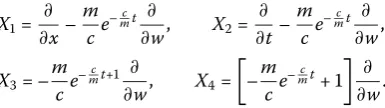
differential equation by using infinitesimal generators. After calculating the infinitesimal generators, four linearly independent generators were obtained as follows:
X=
The results of transforming the nonlinear partial differential equation to nonlinear ordi-nary differential equations are summarized in Table . In Group ,φis denoted byddzφand
z=t–x. In Group ,zis denoted byx.
5 Conditional linearization and exact solutions
The conditional linearization of third-order ordinary differential equations in each case from Table is presented by applying the linearization theorem of Ibragimov and Meleshko [], and then all of nonlinear ordinary differential equations are transformed to the linear equationu= . In summary, the conditions for linearization are shown in Table .
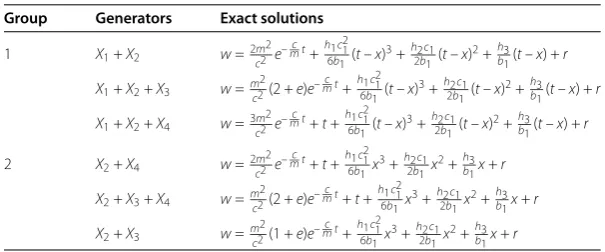
Table 3 The exact solutions to the quintic nonlinear equations of motion
The coefficients of Equation () are specified by using the general form of Equa-tion () that are A= , A= , B = ,B=cUEI(–U+
. From the necessary conditions, conditions () and () are satisfied.
Con-dition (), that is, dUd[(m+P+
c= . In the same way, the conditions for linearization in Group are satisfied by letting
U=
The linearizing transformation ζ =ϕ(z) is defined by solving the Riccati equation ddzχ – χ= , and the simplest solution isχ= . By considering the equationχ=ϕzz
, the coefficientα(ζ) is equal to zero. Therefore, the third-order linear equation
u+α(ζ)u= becomesu= . After calculating the solution to this third-order linear Finally, all of solutions are obtained by substituting the original variables in each case as shown in Table .
6 Conclusions
obtained. Furthermore, the exact solutions to the quintic nonlinear beam equation are also obtained after substituting all the original variables to the solutions.
Competing interests
The authors declare that they have no competing interests.
Authors’ contributions
All authors contributed equally to the writing of this paper. All authors read and approved the final manuscript.
Author details
1Faculty of Liberal Arts, Rajamangala University of Technology Tawan-Ok Chakrabongse Bhuvanarth Campus, Vibhavadi
Rangsit Road, Bangkok, 10400, Thailand. 2Department of Mathematics, Faculty of Science, King Mongkut’s University of
Technology Thonburi, Pracha-Uthit Road, Bangkok, 10140, Thailand.3Center of Excellence in Mathematics, Bangkok,
10400, Thailand.
Acknowledgements
This work was supported by Rajamangala University of Technology Tawan-Ok Chakrabongse Bhuvanarth Campus, Department of Mathematics, Faculty of Science, King Mongkut’s University of Technology Thonburi, Thailand and the Center of Excellence in Mathematics.
Publisher’s Note
Springer Nature remains neutral with regard to jurisdictional claims in published maps and institutional affiliations.
Received: 2 February 2017 Accepted: 11 April 2017
References
1. Sedighi, MH, Shirazi, HK, Attarzadeh, AM: A study on the quintic nonlinear beam vibrations using asymptotic approximate approaches. Acta Astronaut.91, 245-250 (2013)
2. Sedighi, MH, Shirazi, HK, Zare, J: An analytic solution of transversal oscillation of quintic non-linear beam with homotopy analysis method. Int. J. Non-Linear Mech.47, 777-784 (2012)
3. Sedighi, MH, Reza, A: High precise analysis of lateral vibration of quintic nonlinear beam. Lat. Am. J. Solids Struct.10, 441-452 (2013)
4. Sripana, N, Chatanin, W: Similarity reductions for the nonlinear vibration of Euler-Bernoulli beam. In: Proceedings of Ramkhamhaeng University International Research Conference 2015 Bangkok, 2-3 September 2015, pp. 178-185. Research and Development Institute, Ramkhamhaeng University (2015)
5. Lie, S: Klassifikation und integration von gewohnlichen differentialgleichungen zwischen x, y, die eine gruppe von transformationen gestatten iii. Arch. Math. Naturvidensk.8, 371-458 (1883)
6. Grebot, G: The characterization of third order ordinary differential equations admitting a transitive fiber-preserving point symmetry group. J. Math. Anal. Appl.206, 364-388 (1997)
7. Ibragimov, NH, Meleshko, SV: Linearization of third-order ordinary differential equations by point and contact transformations. J. Math. Anal. Appl.308, 266-289 (2005)
8. Ibragimov, NH, Meleshko, SV, Suksern, S: Linearization of fourth-order ordinary differential equations by point transformations. J. Phys. A, Math. Theor.41, 235206 (2008)
9. Dutt, MH, Qadir, A: Reduction of fourth order ordinary differential equations to second and third order lie linearizable forms. Commun. Nonlinear Sci. Numer. Simul.19, 2653-2659 (2014)