R E S E A R C H
Open Access
Analysis of superframe adjustment and beacon
transmission for IEEE 802.15.4 cluster
tree networks
Bih-Hwang Lee
1*, Muhammad Udin Harun Al Rasyid
1and Huai-Kuei Wu
2Abstract
Wireless sensor networks based on the IEEE 802.15.4 standard are able to achieve low-power transmissions in the low-rate and short-distance wireless personal area network (PAN). A cluster tree network consists of several clusters; each cluster has a coordinator, known as cluster coordinator, and several device nodes. In the cluster tree topology of IEEE 802.15.4, a PAN coordinator periodically transmits beacon frames to its coordinator nodes as well as a coordinator node periodically transmit beacon frames to their device nodes. The main challenge in the cluster tree network is the collisions between beacons or even between beacon and data frames, which degrades the network performance. In order to decrease collisions, this article proposes the superframe adjustment and beacon
transmission scheme (SABTS) by assigning the accurate values of beacon order and superframe order for the PAN coordinator, cluster coordinators, and device nodes, and deciding the precise time for the beacon transmission of PAN and coordinator nodes. A Markov chain model for the cluster tree network is developed with taking into account packet retransmission, acknowledgement, and defer transmission. Both analytical and simulation results show that SABTS performs better than IEEE 802.15.4 standard in terms of the probability of successful transmission, network goodput, and energy consumption.
Keywords:Wireless sensor network, IEEE 802.15.4, Personal area network, Cluster tree topology, Markov chain
Introduction
Wireless sensor networks based on the IEEE 802.15.4 standard have been designed to specify the physical layer (PHY) and medium access control (MAC) sublayer for low power consumption, short transmission range, and low-rate wireless personal area network (LR-WPAN) [1]. The IEEE 802.15.4 standard has three kinds of topology: star, peer-to-peer, and cluster tree topologies, which can operate on beacon- and non-beacon-enabled modes. The beacon-enabled mode has the most unique features of IEEE 802.15.4, while the beacons are used to synchronize the attached devices, to identify the per-sonal area network (PAN), and to describe the structure of the superframe.
A cluster tree network consists of several clusters; each cluster has a coordinator, known as cluster coordinator,
and several device nodes. A PAN coordinator serves as root to form the first cluster and initiates the network. The PAN coordinator and coordinator nodes broadcast beacon frames to their neighboring devices to complete the whole cluster networks. In a cluster tree topology, the PAN coordinator periodically transmits beacon frames to its coordinator nodes as well as the coordin-ator nodes periodically transmit beacon frames to their device nodes. However, if the coordinator nodes send beacon frames at the same time, collisions will happen among these beacon frames. Consequently, the children nodes in the cluster cannot synchronize and communi-cate with their coordinators. The main challenge in the cluster tree network of IEEE 802.15.4 beacon-enabled mode is the collisions between beacons or even between beacon and data frames, which degrades the network performance [2-4]. In other words, it is a crucial chal-lenge on the cluster scheduling and collision avoidance (CA) in a cluster tree network.
* Correspondence:[email protected] 1
National Taiwan University of Science and Technology, 43, Keelung Rd., Section 4, Taipei 106, Taiwan
Full list of author information is available at the end of the article
To solve the aforementioned problem, a time division beacon scheduling (TDBS) and superframe duration (SD) scheduling mechanisms are proposed [2]. The idea of TDBS is to manage beacon frame transmission from coordinator nodes in a non-overlapping way while the idea of SD scheduling is to decide the duty cycle of router nodes. A multi-dimensional scheduling (MDS) is proposed to avoid beacon collision in LR-WPAN, which uses the clean channel searching scan to change the time offset to transmit a new beacon frame during the in-active period [3]. MDS can minimize the possibility of beacon collisions, but the power consumption of the PAN coordinator is more than that of IEEE 802.15.4 standard due to the process of channel searching scan during inactive period. Therefore, in order to improve the network performance by decreasing beacon colli-sions as well as the collicolli-sions between beacon and data packets, this article proposes the superframe adjustment and beacon transmission scheme (SABTS) which is based on the IEEE 802.15.4 slotted carrier sense multiple access with CA (CSMA/CA), to assign the accurate values of beacon order (BO) and superframe order (SO) for the PAN coordinator, cluster coordinators and device nodes, and to decide the precise time for beacon trans-mission of PAN and coordinator nodes.
A number of mathematical analysis models have been proposed to analyze the performance of IEEE 802.15.4 based on the Markov chain model without considering packet retransmissions [5-11]. Several modified Markov chain models including packet retransmissions have been investigated but not consider the defer transmis-sion [12-15], while the authors of [16-18] improve the Markov chain models by considering the defer transmis-sion. An analytical model based on Markov chain for multi-hop cluster network has been studied without tak-ing into account the acknowledgement (ACK) to con-firm the successes of data packet transmission, the defer transmission, and packet retransmission [19]. Lastly, we propose an analytical model based on Markov chain for SABTS cluster tree network with taking into account packet retransmission, ACK, and defer transmission by modifying the Markov chain model from [17]. The major contribution of this article is to model the channel
access for a cluster tree network to obtain network goodput and energy consumption based on the proposed Markov chain.
Overview of IEEE 802.15.4
In the beacon-enabled mode of IEEE 802.15.4, each node employs two system parameters: BO and SO, which de-fine beacon interval (BI) and SD, respectively, i.e., BI = aBaseSuperframeDuration × 2BO and SD = aBaseSuper-frameDuration × 2SO, for 0≤SO≤BO≤14.
aBaseSuper-frameDuration denotes the minimum number of
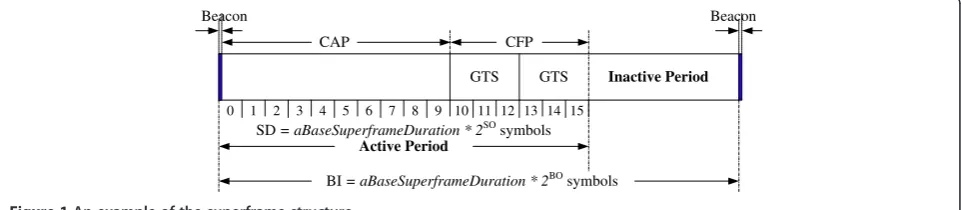
symbols in an active period, which is fixed to 960 sym-bols. The active period of each superframe consists of three parts: beacon, contention access period (CAP) and contention free period (CFP), while the active period is further equally divided into 16 time slots called aNum-SuperframeSlots. The length of one slot is equal to aBaseSlotDuration × 2SOsymbols, where aBaseSlotDura-tion is the minimum number of symbols in a slot and equal to 60 symbols. Figure 1 shows an example of the superframe structure. In IEEE 802.15.4 standard, BO and SO shall be equal for all superframes on a PAN. All devices shall interact with the PAN only during the ac-tive portion of a superframe.
In CAP, each node performs the CSMA/CA algorithm before transmitting data frame or MAC command frame. Each device maintains three parameters: the number of backoff (NB), contention window (CW), and backoff exponent (BE). NB denotes the required NB while attempting to transmit data; CW denotes the number of backoff periods that need to be clear before committing transmission; and BE denotes how many backoff periods a device need to wait before trying to ac-cess the channel. The initial value of NB, CW, and BE are equal to 0, 2, and macMinBE, respectively, where macMinBE is equal to 3.
In the located boundary of the next backoff period, a device takes delay for random backoff between 0 and 2BE – 1 unit backoff period (UBP), where UBP is equal to 20 symbols (or 80 bits). A device performs clear chan-nel assessment (CCA) to make sure whether the chanchan-nel is idle or busy, when the number of random backoff periods is decreased to 0. The value of CW will be
0 1 2 3 4 5 6 7 8 9 10 11 12 13 14 15
GTS GTS Inactive Period
P F C P
A C
SD= aBaseSuperframeDuration * 2SOsymbols Active Period
BI= aBaseSuperframeDuration * 2BOsymbols
Beacon Beacon
decreased by one if the channel is idle; and the second CCA will be performed if the value of CW is not equal to 0. If the value of CW is equal to 0, it means that the channel is idle after twice CCA; then a device is commit-ted the data transmission. However, if the CCA is busy, the value of CW will reset to 2; the value of NB is increased by 1; and the value of BE is increased by 1 up to the maximum BE (macMaxBE), where the value mac-MaxBE is equal to 5. The device will repeatedly take ran-dom delay if the value of NB is less than the value of macMaxCSMABackoff, where the value of macMaxCS-MABackoff is equal to 4; and the transmission attempt is decided to be failure if the value of NB is greater than the value of macMaxCSMABackoff.
Description of SABTS
SABTS aims to assign the accurate values of BO and SO for the PAN coordinator, cluster coordinators and device nodes, and to decide the precise time for the beacon transmission of PAN and coordinator nodes. In order to guarantee the data transmission from its coordinator nodes, the BI of the PAN coordinator should be the round function to the interarrival time (INTV) of data packets. Let us denote BOPAN be the BO for the PAN
coordinator, which can be obtained by Equation 1, where Ncoorddenotes the number of coordinator nodes;Rs,Bs,
and Ns denote symbol rate, aBaseSlotDuration, and aNumSuperframeSlots, respectively, e.g., Rs, Bs, and Ns are equal to 62,500 symbols/s, 60 symbols, and 16 slots, respectively. To reduce the beacon collisions between the parent and children coordinators, the different BO between coordinators at different depth can be obtained by Equation 2, whereBOcoord is the BO for coordinator.
The PAN coordinator might often be powered; there-fore, the SO for the PAN coordinator (SOPAN) can be set
to its BOPANas shown in Equation 3. For the SD, if we
assume there is no CFP, the SD of coordinator (SDcoord)
only consists of CAP and beacon as defined in Equation 4, whereEstimatedCAPcoordand Lbeacon denote the
esti-mated CAP for coordinator and the length of beacon, respectively, e.g.,Lbeaconis equal to 190 symbols.
BOPAN¼ Log2
NcoordINTVRs
BsNs
ð1Þ
BOcoord¼BOPAN1 ð2Þ
SOPAN¼BOPAN ð3Þ
SDcoord¼EstimatedCAPcoordþLBeacon ð4Þ
EstimatedCAPcoord is equal to the BI of coordinator
(BIcoord) divided by the number of coordinator nodes
(Ncoord), as shown in Equation 5. By using Equations 4
and 5,SDcoordcan be obtained by Equation 6. Therefore,
the value of SO for coordinator (SOcoord) can be
obtained by Equation 7. BO and SO for device nodes (BOdev andSOdev) are decided by its coordinator node,
which are equal to BO and SO of its coordinator node as shown in Equation 8.
EstimatedCAPcoord¼BIcoord Ncoord
¼BsNs2BOcoord
Ncoord
ð5Þ
SDcoord¼BsNs2SOcoord
¼BsNs2BOcoord
Ncoord
þ190 ð6Þ
SOcoord¼ Log2
2BOcoord Ncoord
þ0:2
ð7Þ
BOdev¼BOcoord;SOdev¼SOcoord ð8Þ
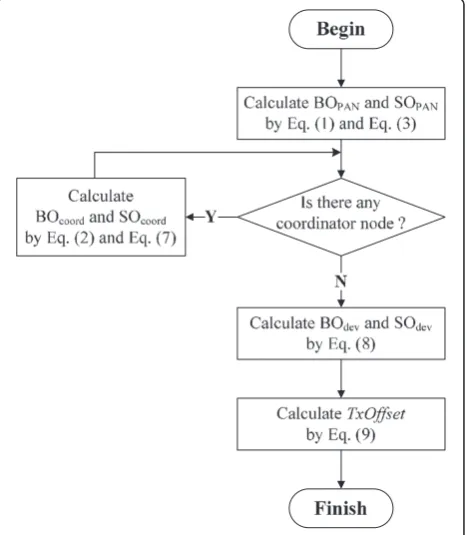
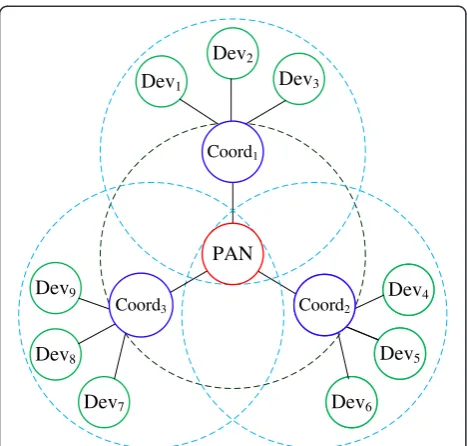
Based on the aforementioned description, SABTS can be resumed by flowchart as shown in Figure 2. In this article, we consider the cluster tree topology with one PAN, three coordinator nodes, and nine device nodes as shown in Figure 3. Figure 4 shows an example of the superframe adjustment and precise time for beacon transmission for the cluster tree topology of Figure 3,
while INTV of each device node is equal to 0.1. As shown in Figure 4, we get the different starting time of beacon transmission among coordinator nodes to avoid beacon collisions. Furthermore, the coordinator nodes and device nodes can save energy consumption during inactive periods. By using SABTS, we get the values of BO and SO for PAN to be equal to 4; the value of BO for each coordinator node and device node is equal to 3; and the value of SO for each coordinator node and de-vice node is equal to 1.
In order to reduce the collisions of the beacon trans-missions among coordinator nodes, SABTS adjusts the beacon starting times of PAN and coordinator nodes. Let us denoteTxOffsetPANandTxOffsetito be the beacon starting times of PAN and the ith coordinator node, re-spectively. TxOffsetPANstarts at the beginning of
super-frame, then TxOffseti is adjusted by Equation 9, where
SDcoordi−1denotes the SD of the (i – 1)th coordinator node.
TxOffseti¼
TxOffsetPANþLBeacon
Rs ;i¼1
TxOffseti1þLBeacon
Rs þSDcoordi1; 2≤i≤Ncoord
8 > > > < > > > :
ð9Þ
Analysis of SABTS
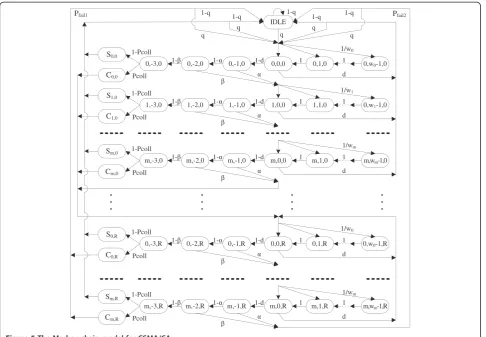
In this section, the Markov chain model for SABTS in the case of the acknowledged uplink data transmission is analyzed to obtain the stationary probabilities, whose state transition diagram is shown as Figure 5. Letbi,j,kbe the stationary probability at the stochastic state (s(t) =i, c(t) =j, and r(t) =k), where s(t), c(t), and r(t) represent backoff stage, backoff counter, and number of retrans-missions, respectively, shown as Equation 10, wherebi,-1,k,
bi,-2,k, and bi,-3,k are the stationary probabilities for the first CCA1, the second CCA2, and packet transmission,
respectively, at the ith backoff stage and the kth re-transmission. Let bSi,k and bCi,k be the stationary prob-abilities of the successful transmission and collision at the states of Si,k and Ci,k shown as Equations (11) and (12), respectively, wheremand Rare the maximum NB
Dev2
Dev3
Dev1
Dev4
Dev5
Dev6
Dev7
Dev8
Dev9 Dev4
Dev5
Dev6 Coord2
Coord2
Coord3
Coord1
PAN
Figure 3The selected cluster tree topology.
stage and retransmissions, i.e., they are equal to 4 and 3, respectively.
bi;j;k¼ lim
t→1P s tf ð Þ ¼i;c tð Þ ¼j;r tð Þ ¼kg;
fori∈ð0; mÞ;j∈ð3; wi–1Þ;k∈ð0;RÞ ð10Þ
bSi;k ¼tlim→1P SsðtÞ¼Si;r tð Þ ¼k
;i∈ð0; mÞ;k∈ð0;RÞ
ð11Þ
bCi;k ¼tlim→1P CsðtÞ¼Ci;r tð Þ ¼k
;i∈ð0;mÞ;k∈ð0;RÞ
ð12Þ
The parameters used in the Markov chain model are explained as follows. An IDLEstate means that a device node has no packet to transmit. Let wi = 2BEi be the backoff window at the ith backoff stage of a device, where BEi= 3, 4, 5, 5, and 5 for 0≤i≤m. Let us denote
q to be the probability that packet arrives during the active period, which can be obtained by Equation 13, whereLdata, Rb, andSDTare packet length (in bits), data rate (i.e., 250 kbps), and the SD time (in seconds),
respectively; where SDTis equals to SD Rs, and
1
INTV is the
number of packets inSDT.
q¼ Ldata
INTVRbSDT
ð13Þ
The MAC sublayer should transmit packet if the remaining CSMA/CA steps, i.e., two CCA analyses, frame transmission, and any ACK, can be completed be-fore the end of CAP. Conversely, if the current CAP has not enough slots to transmit data packets, it should defer transmission until the beginning of the CAP in the next superframe. Let us denotedto be the probability of defer transmission, which can be obtained by Equation 14, whereTtxcca, Ttx, Tack, and Ttxackare the CCA
trans-mission time, packet transtrans-mission time, time to wait for ACK, and time to transmit ACK from receiver to trans-mitter node, respectively.
d¼2TtxccaþTtxþTackþTtxack
SDT ð14Þ
Letαandβbe the probabilities that CCA1and CCA2
are busy, respectively. CCA1busy means that the tagged
node at one of the CCA1states while at least one of the
other nodes at packet transmission state, while CCA2
busy means that the tagged node at one of the CCA2
states while at least one of the other nodes at packet transmission state. Let us denotePcollto be the
probabil-ity of the collision of packet transmission, i.e., the tagged node at packet transmission state while at least one of other nodes in the packet transmission state at the same time. Let us also denote Pfail1 and Pfail2 to be the
prob-abilities of fail transmission due to the maximum num-ber of retransmissions after collisions and due to no channel to use after reaching the maximum backoff stage at the maximum retransmission stage, respectively. To analyze the Markov chain model, several state tran-sition probabilities are evaluated as shown from Equa-tions 15 to 23. Equation 15 states the probability that the backoff counter is decreased after each slot. Equation 16 gives the probability of finding busy channel either in CCA1 and CCA2. Equation 17 states the probability of
picking a backoff state in the next retransmission stage after the collision of packet transmission when having enough time to send packet in the remaining active period and channel idle in both CCA1and CCA2.
Equa-tion 18 states the probability of entering the IDLEstate after the collision of packet transmission while reach the maximum retransmission stage after finding the remaining active period to be enough to send packet and channel idle in both CCA1and CCA2. Equation 19
gives probability that the remaining CAP is not enough to send packet and need to defer and pick backoff state in the next superframe. Equation 20 states the probabil-ity of successful packet transmission and picking new random backoff at the first backoff stage. Equation 21 states the probability of entering the IDLE state if the node has no data packet to transmit after successful packet transmission. Equation 22 states the probability of entering theIDLEstate due to channel access failure. Equation 23 states the probability of going to the first backoff stage from the IDLE state if the node has data packet to transmit.
Pði;j;kji;jþ1;kÞ ¼1; for i∈ð0;mÞ;j∈ð0;wi2Þ;
k∈ð0;RÞ ð15Þ
P ið;j;kji1;0;kÞ ¼wij wi
ð1dÞðαÞ þ ð1dÞð1αÞβ
½
¼wij wi
ð1dÞ½αþ ð1αÞβ;
i∈ð1;mÞ;j∈ð0;wi1Þ;k∈ð0;RÞ
ð16Þ
Pð0;0;kji;0;k1Þ ¼ ð1dÞð1αÞð1βÞðPcollÞ;
k∈ð1;RÞ ð17Þ
PðIDLEji;0;RÞ ¼ ð1dÞð1αÞð1βÞðPcollÞð1qÞ
ð18Þ
Pð0;j;kji;0;kÞ ¼w0j w0
ðdÞ;k∈ð0;RÞ ð19Þ
Pð0;j;0ji;0;kÞ
¼w0j w0
ð1dÞð1αÞð1βÞð1PcollÞðqÞ;
i∈ð0;mÞ;j∈ð0;wi1Þ;k∈ð0;RÞ ð20Þ
PðIDLEji;0;kÞ
¼ ð1dÞð1αÞð1βÞð1PcollÞð1qÞ;
i∈ð0;mÞ;k∈ð0;RÞ ð21Þ
P IDLE mð j ;0;RÞ ¼ ð1dÞ½αþ ð1αÞβð1qÞ
ð22Þ
Pð0;j;0jIDLEÞ ¼w0j w0
ðqÞ;j∈ð0;wi1Þ ð23Þ
By using Equation 16, the stationary probability bi,j,k can be obtained by Equation 24. From Equation 17,b0,0,k can be obtained by Equation 25, whereYand X are the probabilities of entering the next backoff stage and the collision of packet transmission in a certain backoff stage, respectively. Similarly, bi,0,k can be obtained by Equation 26. Finally, the steady-state probabilities to per-form random backoff, CCA1, CCA2, packet transmission,
successful of packet transmission, collision of packet transmission, and idle can be obtained from Equations 27 to 33, respectively. Since the sum of probabilities in the Markov chain must be equal to one, we have Equa-tion 34. By using EquaEqua-tions 27 to 34, we can get the value ofb0,0,0easily by using excel spreadsheet.
bi;j;k¼wi
j wi bi1;0;k
ð1dÞ½αþ ð1αÞβ
¼wij wi bi;0;k
b0;0;k¼ ð1dÞð1αÞð1βÞPcoll
P packet transmission½
¼Xmi¼0XRk¼0bi;3;k
P successful of packet transmission½
¼Xm
P collision of packet transmission½
P IDLE½ ¼ ð1qÞXmi¼0XRk¼0bSi;k þ ð1qÞ
Letϕ1and ϕ2be the conditional probabilities that a tagged node will be at one of the CCA1states after backoff
and at one of the CCA2states after sensing channel idle in the CCA1, which can be obtained by Equations 35 and
36, respectively. Let us denoteτto be the probability that a tagged node can transmit a packet, i.e., the tagged node is in one of the CCA1states and senses the CCA2is idle, while the other nodes do not in the CCA1state, which can
be expressed by Equation 37, whereNchis the number of children nodes of certain coordinator nodes. Therefore, the
previous mentioned probabilities ofα,β,Pcoll,Pfail1, andPfail2can be expressed by Equations 38 to 42, respectively.
ϕ1¼
Y4for simplicity.
τ¼ϕ1ð1ϕ1ÞNch 1ð
1αÞð1βÞ ð37Þ
α¼ϕ1 1 ð1τÞ
ðNch1Þ 1
INTV ð Þ
ð Þ
ð38Þ
β¼ϕ2 1 ð1τÞ
ðNch1Þ 1
INTV ð Þ
ð Þ
ð39Þ
Pcoll¼Nchτ 1 ð1τÞððNch1ÞðINTV1 ÞÞ
ð40Þ
Pfail1¼Xmi¼0bCi;R ¼b0;0;0 X
RþZR
X ð41Þ
Pfail2¼bm;0;Rð1dÞðαþð1αÞβÞ
¼b0;0;0ðYmÞ XRþZR
ð1dÞðαþð1αÞβÞ
ð42Þ
Let us denote Pdr to be the probability of a packet being dropped due to collision retransmission, which can be expressed by Equation 43. Because the probability of collision increases as the value of INTV decreases, we definePINTVbe the fraction time of the total number of data packets and ACK packets to the CAP time of the superframe as expressed by Equation 44, where inter-frame space (IFS) is the minimum period between two successive frames transmitted from device [1]. Let us de-note Pdropcoord and Psuccoord to be the probabilities of
packet dropped and successful transmission from device node to its coordinator, respectively, which can be obtained by Equations 45 and 46. Similarly, let us denote PdropPAN and PsucPAN be the probabilities of packet
dropped and successful transmission from coordinator node to the PAN coordinator, respectively, which can be obtained by Equations 47 and 48.
Pdr ¼
XR
k¼1ðPcollÞ
k ð43Þ
PINTV ¼ Ldata
þIFSþACK
INTVSDT
Nch1
ð44Þ
Pdropcoord¼ Pfail11;if þPfail2þPdr;ifPINTV <1 PINTV ¼1
ð45Þ
Psuccoord¼1Pdropcoord ð46Þ
PdropPAN¼ ðPdropcoordÞ2 ð47Þ
PsucPAN¼ ð1PdropcoordÞð1PdropPANÞ ð48Þ
Based on the aforementioned analyses, the number of successful packets received by PAN (NrecvPAN) and the
network goodput (G), can be expressed by Equations 49 and 50, respectively, where Ndev, Nbeacon, and Tsim are
the number of device nodes in network, the number of observed BIs of PAN, and the observed simulation time (in seconds), respectively.
NrecvPAN¼NdevPsucPANTsim
INTV ð49Þ
G¼ NrecvPANLdata
NbeaconBIPAN ð50Þ
Basically, the total energy consumption of a cluster tree network consists of the energy consumptions by de-vice nodes, coordinator node, and the PAN coordinator, denoted byEdev,Ecoord, andEPAN, respectively. Let us
de-note PWidle, PWsleep, PWtx, and PWrx to be the power consumptions for idle, sleeping, transmitting a packet, and receiving a packet, respectively. Let us also denote Lcca, Lbeacon, andLack to be the lengths of CCA, beacon,
and ACK transmissions, respectively. Moreover, let us denote DCdev,DCcoord, andDCPANto be the duty cycles
of device nodes, coordinator nodes, and the PAN coord-inator, respectively.
The energy consumptions of a cluster tree network are analyzed as follows. The energy consumption of device nodes consist of seven parts as shown in Equation 51, i.e., the seven parts of energy consumptions are in order for backoff, CCA transmission, data packet transmission, idle, receiving beacon from its coordinator, receiving ACK, and sleeping, respectively, where dnodeis the
Edev¼NdevTsim
Rb Psuccoorddnode
Ecoord¼NcoordTsim
NchPWidle SDcoord
þ NchPsuccoord PWrx
INTV Ldata
Rb
þ NchdnodePsuccoord PWtx INTV
Rb Psuccoorddnode
Xm
Rb PsuccoordPsucPANdnode
Rb PsucPANNdev
þ PWtx INTV
Lack
Rb PsucPANdnodeNdev
Simulation and analysis results
In this section, simulation experiments are performed by using the extended network simulator NS-2 to validate the analysis and performance evaluation. We consider a cluster topology with 1 PAN coordinator, 3 coordinator nodes, and 9 device nodes as shown in Figure 3, where the distance between nodes (dnode) is equal to 10 m. The
packet arrival rate follows the Poisson distribution with the INTV of data packets from 0.1 to 1, where packets have the same length of 560 bits. To simulate the per-formance of power consumption, we consider the radio parameters of Chipcon’s CC2420 2.4 GHz for the IEEE 802.15.4 RF transceiver [20], where the transmitting power PWtx, the receiving power PWrx, the idle power
PWidle, and the sleeping power per time unitPWsleepare
31.32 mW, 35.28 mW, 712 μW, and 144 nW, respect-ively [16]. The BO and SO settings follow the proposed SABTS algorithm, but they are fixed for IEEE 802.15.4 standard, i.e., BO = SO = 6. Table 1 summarizes the simulation parameters. We compute the probabilities of collision of packet transmission and entering the next backoff stage in a certain backoff stage. We also
compare the analytical (ana) and simulation (sim) results between the proposed algorithm (SABTS) and IEEE 802.15.4 standard (Std) for network goodput, total net-work energy consumption, and the probability of suc-cessful packet transmission arriving at PAN.
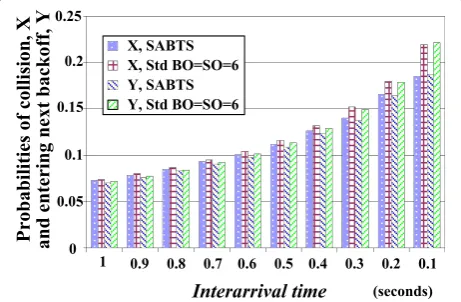
Figure 6 shows the probabilities of collision of packet transmission and entering the next backoff stage in a certain backoff stage, denoted as X and Y, respectively, against the INTV of data packets by analytical model. The probabilities of X and Y of SABTS are lesser than those of IEEE 802.15.4 standard. Normally, the lesser probabilities of X and Y, the higher probability of suc-cessful packet transmission, which implies the lesser en-ergy consumption needed for packet transmission, i.e., SABTS should have higher network goodput and lesser energy consumption than those of IEEE 802.15.4 standard.
Figure 7 shows the probability of successful transmis-sion arrives at the PAN coordinator (PsucPAN) against the
802.15.4 standard because the length of active period and the beacon transmission time are managed appro-priately. The probability of successful transmission of IEEE 802.15.4 standard decreases more as traffic load increases because the heavy collision occurs either be-tween beacons or bebe-tween beacon and data frame.
Figure 8 shows the network goodput against the INTV of data packets. The network goodput obtained by simu-lation is very close to that obtained by analysis model. It is obvious the network goodput of SABTS is higher than that of IEEE 802.15.4 standard especially when the traffic load increases. The probability of collisions of transmit-ting beacons and data packets can be decreased, because the beacon transmission time and active period length are accurately managed by SABTS. In the light traffic load (i.e., INTV is equal to 1 and 0.9), the network good-put of SABTS is almost same as those of IEEE 802.15.4 standard; however, SABTS outperforms IEEE 802.15.4 standard as the traffic load increases.
Figure 9 shows the network energy consumption against the INTV of data packets. SABTS consumes lesser network energy than that of IEEE 802.15.4
standard. The energy consumption is obtained by sum-ming the energy consumptions of the PAN coordinator, coordinator nodes, and children device nodes. By SABTS, the coordinator nodes and device nodes can save energy consumption during the inactive period as shown in Figure 4. Moreover, SABTS gains the greater probability of successful transmission than that of IEEE 802.15.4 standard especially in heavy traffic load, which means that SABTS minimizes the energy consumption when retransmitting data packets.
Conclusions
In this article, SABTS has been proposed to adjust two system parameters of superframe (i.e., BO and SO) and set the precise time for beacon transmission to achieve low energy consumption and to alleviate the collision of beacon and data packet transmissions. This article pre-sented a comprehensive Markov chain analysis of IEEE 802.15.4, specifically for cluster tree network, to predict the network goodput as well as the network energy
Table 1 The simulation parameters
Parameter Value
Channel bandwidth 250 kbps
Packet length (Ldata) 560 bits
UBP 80 bits
MAC header 2 UBP
ACK length (LACK) 88 bits
dnode 10 m
PWtx 31.32 mW
PWrx 35.28 mW
PWidle 712μW
PWsleep 144 nW
BO = SO (Std.) 6
Figure 6Probabilities of collision,X, and entering next backoff,
Y, against the INTV of data packets.
Figure 7The probability of successful transmission against the INTV of data packets.
consumption. The validity of the analytical model is shown by closely matching its predictions to the simula-tion results. The results obtained by analytical model and simulation experiments show that SABTS performs better than IEEE 802.15.4 standard especially in the net-work goodput and the netnet-work energy consumption. However, this article pays much attention to the slotted CSMA/CA channel access mechanism within the CAP of a superframe, but for certain applications with low la-tency or specific bandwidth requirements it needs dedi-cated guaranteed time slots (GTS) channel to transmit its data packets without contention. For further research, the SABTS algorithm will be expected to consider GTS within the CFP of a superframe to improve the network performance.
Abbreviations
ACK: Acknowledgement; BE: Backoff exponent; BI: Beacon interval; BO: Beacon order; CAP: Contention access period; CCA: Clear channel assessment; CFP: Contention free period; CSMA/CA: Carrier sense multiple access with collision avoidance; CW: Contention window; IFS: Interframe space; INTV: Interarrival time of data packets; LR-WPAN: Low-rate wireless personal area network; MAC: Medium access control sublayer; NB: Number of backoffs; PAN: Personal area network; SD: Superframe duration (in symbols); SDT: Superframe duration time (in seconds); SO: Superframe order; UBP: Unit backoff period (80 bits).
Competing interests
The authors declare that they have no competing interests.
Acknowledgments
This study was supported in part by the National Science Council (NSC) of Taiwan under Grant No. NSC 96-2221-E-011-055.
Author details
1
National Taiwan University of Science and Technology, 43, Keelung Rd., Section 4, Taipei 106, Taiwan.2Ling Tung University, 1, Ling Tung Rd., Taichung 408, Taiwan.
Received: 24 March 2012 Accepted: 4 June 2012 Published: 17 July 2012
References
1. IEEE 802.15.4, Part 15.4,Wireless Medium Access Control (MAC) and Physical Layer (PHY) Specifications for Low-Rate Wireless Personal Area Networks (WPANs)(IEEE standard for information technology, 2006)
2. A Koubaa, A Cunha, M Alves, E Tovar, TDBS: a time division beacon scheduling mechanism for ZigBee cluster-tree wireless sensor networks. Real-Time Syst. J.40(3), 321–354 (2008)
3. J-W Kim, J Kim, D-S Eom, Multi-dimensional channel management scheme to avoid beacon collision in LR-WPAN. IEEE Trans. Consum. Electron.54(2), 396–404 (2008)
4. J Lu, A Van Den Bossche, E Campo, A new beacon scheduling mechanism for mesh wireless personal area networks based on IEEE 802.15.4, inIEEE 16th Conference on Emerging Technologies & Factory Automation (ETFA), (Toulouse, France, 2011), pp. 1–4
5. TR Park, TH Kim, JY Choi, S Choi, WH Kwon, Throughput and energy consumption analysis of IEEE 802.15.4 slotted CSMA/CA. IEEE. Electron. Lett. 41(18), 1017–1019 (2005)
6. T-J Lee, HR Lee, MY Chung, MAC throughput limit analysis of slotted CSMA/ CA in IEEE 802.15.4 WPAN. IEEE Commun. Lett.10(7), 561–563 (2006) 7. S Pollin, M Ergen, S Ergen, B Bougard, L Der Perre, I Moerman, A Bahai,
P Varaiya, F Catthoor, Performance analysis of slotted carrier sense IEEE 802.15.4 medium access layer. IEEE Trans. Wirel. Commun.7(9), 3359–3371 (2008)
8. Y Zhang, F Shu, Packet size optimization for goodput and energy efficiency enhancement in slotted IEEE 802.15.4 networks, inIEEE Wireless
Communications and Networking Conference, (Budapest, Hungary, 2009), pp. 1–6
9. J He, Z Tang, H-H Chen, Q Zhang, An accurate and scalable analytical model for IEEE 802.15.4 slotted CSMA/CA networks. IEEE Trans. Wirel. Commun.8(1), 440–448 (2009)
10. Z Xiao, C He, L Jiang, An analytical model for IEEE 802.15.4 with sleep mode based on time-varying queue, inIEEE International Conference on Communications (ICC), (Kyoto, Japan, 2011)
11. C Buratti, Performance analysis of IEEE 802.15.4 beacon-enabled mode. IEEE Trans. Veh. Technol.59, 2031–2045 (2010)
12. Z Tao, S Panwar, D Gu, J Zhang, Performance analysis and a proposed improvement for the IEEE 802.15.4 contention access period, vol. 4, inIEEE Wireless Communications and Networking Conference, (Las Vegas, USA, 2006), pp. 1811–1818
13. P Park, P Di Marco, P Soldati, C Fischione, KH Johansson, A generalized Markov chain model for effective analysis of slotted IEEE 802.15.4, inIEEE 6th International Conference on Mobile Adhoc and Sensor Systems, (Macau, China, 2009), pp. 130–139
14. Y-K Huang, A-C Pang, H-N Hung, A comprehensive analysis of low-power operation for beacon-enabled IEEE 802.15.4 wireless networks. IEEE Trans. Wirel. Commun.8(11), 5601–5611 (2009)
15. M Khanafer, M Guennoun, HT Mouftah, Adaptive sleeping periods in IEEE 802.15.4 for efficient energy savings: markov-based theoretical analysis, in
IEEE International Conference on Communications (ICC), (Kyoto, Japan, 2011) 16. B Gao, C He, L Jiang, Modeling and analysis of IEEE 802.15.4 CSMA/CA with
sleep mode enabled, inInternational Conference on Communication Systems, (Guangzhou, China, 2008), pp. 6–11
17. CY Jung, HY Hwang, DK Sung, GU Hwang, Enhanced Markov chain model and throughput analysis of the slotted CSMA/CA for IEEE 802.15.4 under unsaturated traffic conditions. IEEE Trans. Veh. Technol.58(1), 473–478 (2009)
18. B Shrestha, E Hossain, S Camorlinga, A Markov model for IEEE 802.15.4 MAC with GTS transmissions and heterogeneous traffic in non-saturation mode, inIEEE International Conference on Communication Systems (ICCS), (Singapore, 2010), pp. 56–61
19. M Martalo, S Busanelli, G Ferrari, Markov chain-based performance analysis of multihop IEEE 802.15.4 wireless networks. Performance Eval. J.66, 722–741 (2009)
20. AS Chipcon,SmartRF® CC2420 datasheet (rev 1.2)(Chipcon Corp, 2004)
doi:10.1186/1687-1499-2012-219
Cite this article as:Leeet al.:Analysis of superframe adjustment and beacon transmission for IEEE 802.15.4 cluster tree networks.EURASIP Journal on Wireless Communications and Networking20122012:219.