R E S E A R C H
Open Access
Exponential synchronization of the coupling
delayed switching complex dynamical
networks via impulsive control
Anding Dai
1, Wuneng Zhou
1*, Jianwen Feng
2, Jian’an Fang
1and Shengbing Xu
3*Correspondence:
1College of Computer Sciences and
Technology, Donghua University, Shanghai, 201620, China Full list of author information is available at the end of the article
Abstract
In this paper, we investigate the exponential synchronization issue of coupling delayed switching complex dynamical networks via impulsive control. Basing on the Lyapunov functional method and establishing a new impulsive delay differential inequality, we derive some sufficient conditions which depend on delay and impulses to guarantee the exponential synchronization of the coupling delay switching complex dynamical network. Finally, numerical simulations are given to illustrate the effectiveness of the obtained results.
Keywords: exponential synchronization; complex dynamical network; switching topology; delayed coupling
1 Introduction
During the last two decades, synchronization and control problems of complex dynamical networks have been focused on in many different fields such as mathematics, engineering, social and economic science,etc.[–]. Many effective methods, like feedback control, adaptive control, sampled-data control and impulsive control, are used to stabilize and synchronize a coupled complex dynamical network. At the same time, a wide variety of synchronization criteria have also been presented for different network coupling such as switch topology, time delays, impulsive characters,etc.
Up to now, plenty of researchers have devoted much effort to guarantee synchronization of complex dynamical networks with fixed topology [–]. However, in real situations, many complex systems may be subject to abrupt changes in their connection structure or network mode switching caused by some phenomena such as link failures, component fail-ures or repairs, changing subsystem interconnections, and abrupt environmental distur-bance,etc.Although some synchronization criteria of networks with uncertain topological structure and continuous time-varying topology have been studied, those methods may not work for the network topology when it becomes discontinued or changes very quickly [, ]. Hence, to study the synchronization of the switched networks is still very useful and meaningful. Because of this reason, the synchronization of a complex network with switching topology has attracted researchers’ interest [–]. Wanget al.[] provided several synchronization criteria for switched networks, in which synchronization could be evaluated by the time average of the second smallest eigenvalue that corresponded to the Laplacians matrix of switching topology. Authors in [] studied the local and global
nential synchronization of switched networks with time-varying coupling delays, whose inner and outer coupling matrices take values in two finite sets of matrices via a switch-ing signal. An adaptive controller was designed to synchronize a switched network under arbitrary switching in []. Yuet al.[] explored the synchronization of switched neural networks, and some sufficient conditions were given to guarantee the global synchroniza-tion. Jiaet al.[] investigated the leader-following problem of network, in which the net-work topology is assumed to be arbitrarily switched among a finite set of topologies, and time-varying delay exists in the coupling of agents.
In many systems, the impulsive effects are common phenomena due to instantaneous perturbations at certain moments. In general, there are two kinds of impulse in terms of synchronization in complex dynamical networks: desynchronizing impulse and synchro-nizing impulse []. In previous literature, most of the results were devoted to investigat-ing the desynchronizinvestigat-ing impulse (the impulsive effect can suppress the synchronization of the complex dynamical networks) [–]. The global exponential synchronization was studied for linear coupled neural networks with impulsive disturbances in []. Zhuet al. gave some global impulsive exponential synchronization criteria for time-delayed coupled chaotic systems []. In [], some impulsive control schemes were given to guarantee the consensus of nonlinear multi-agent systems with switching topology. Yang and Cao [] studied the exponential synchronization of a coupling delay complex dynamical net-work with impulsive effects and proved that the netnet-work can achieve synchronization for a desynchronizing impulse. All of them have a common feature that the network must be synchronous. As we all know that the network is not always synchronous, there are some factors that will lead to an unstable network such as the change of topology structure, time delays and low strength of the coupling. Impulsive control (synchronizing impulse) may give an efficient method to deal with a dynamical system which is unstable. It is worth mentioning that synchronization and the control problems in complex networks with fix topology and synchronizing impulse have been widely studied [, –], but research into switched topology and synchronizing impulse is rare.
In this paper, we investigate the problem of exponential synchronization of a switching complex dynamical network via impulsive control. The contribution of this paper is to pro-pose a new impulsive delay differential inequality. By utilizing the Lyapunov stability and impulsive control theory on delayed dynamical networks, some sufficient conditions of exponential synchronization for a switching complex dynamical network are presented. It shows that impulsive controller (synchronizing impulsive) can control the coupling delay switching complex dynamical network to a homogenous solution. Numerical simulations are given to show the validity of the developed results.
2 Model and preliminaries
The switching complex dynamical networks investigated in this paper consist ofNnodes, whose state is described as
⎧ ⎪ ⎪ ⎨ ⎪ ⎪ ⎩
˙
xi(t) =f(xi(t)) +c
N
j=g
σ(t)
ij xj(t–τ), t=tk,
xi(tk) =xi(t+k) –xi(t–k) =bkxi(t–k), t=tk,
k∈Z+,i= , , . . . ,N,
()
wherexi(t) = (xi(t),xi(t), . . . ,xin(t))T∈Rnis the state vector of nodei;f :Rn→Rnis a
=diag(γ,γ, . . . ,γn) is an inner coupling matrix between the two connected nodes;σ(t) :
[,∞)→ ℵ={, , . . . ,m}is a switching signal, which is a piecewise constant function; Gσ(t)= (gσ(t)
ij )∈RN×Nis a Laplacian matrix associated with the switching functionσ(t), in
which the entries of matrixGσ(t)are defined as follows: if nodesiandj(i=j) are connected,
thengijσ(t)> ; otherwise,gijσ(t)= , and the diagonal entries of matrixGσ(t)are defined by
giiσ(t)= –Nj=,j=igijσ(t). Note that the coupling matrixGσ(t)is not assumed to be irreducible;
bkis theith node impulsive gain att=tk. The discrete set{tk}satisfies ≤t<t<· · ·<
tk<· · ·,tk→+∞ask→+∞, notex(tk–) =limt→t–kx(t), andx(tk+) =limt→t+kx(t) =x(tk).
We assume that the network () satisfies the following initial conditions: x
i(t) =
(xi(t),xi(t), . . . ,xin(t))T∈C([t–τ,t],Rn).
To discuss exponential synchronization, we define the set
s(t) =
N
j=
ξjxj(t), ()
which is the synchronization state for the network (), whereξi> and
N
j=ξj= . Remark In general, the synchronization states(t) may be an equilibrium point, a peri-odic orbit, or a chaotic attractor. In this paper, we did not need (ξ,ξ, . . . ,ξN) to be the left
eigenvector of coupling matrix G corresponding to eigenvalue .
Definition The network () is said to achieve exponentially synchronization if there exist some constantsε> andM> such that
lim
t→∞xi(t) –s(t)≤Me
–ε(t–t)
for all initial conditionsx
i(t)∈C([t–τ,t],Rn) andi= , , . . . ,N.
Definition [, ] LetP=diag(p,p, . . . ,pn) be a positive definite diagonal matrix, and
let=diag(δ,δ, . . . ,δn) be a diagonal matrix.QUAD(,P) denotes a class of continuous
functionsf(x) :Rn→Rnsatisfying
(x–y)TP f(x) –f(y) –(x–y)≤–α(x–y)TP(x–y)
for someα> , allx,y∈Rnandt>t
.
Remark It is easy to verify that the function class QUAD exists in almost all the well-known chaotic systems with or without time delays such as Lorenz systems, Rössler sys-tem, Chen syssys-tem, Chua’s circuit, delayed Hopfield neural networks and delayed cellular neural networks (cNN),etc.
Define error stateei(t) =xi(t) –s(t) (≤i≤N). It is easy to verify that
N
i=ξiei(t) =
and the dynamical equation ofs(t) andei(t) satisfies
˙ s(t) =
N
i=
ξi
f xi(t)
+c
N
j=
gijσ(t)xj(t–τ)
⎧
In order to derive the main results, it is necessary to propose the following lemmas.
Lemma Let u(t) : [t–τ,∞)→[,∞)satisfy the scalar impulsive differential inequality
The proof is given in the Appendix.
Lemma [] For real constant matrices Z,Z,Z∈RN×Nwith Z=ZT,Z=ZT,and
di-share the same eigenvalues, where IN indicates the N dimensional identity matrix and
Ki=
In this section, we investigate the exponential synchronization of error system (), in which coupling matrixGσ is divided into two cases: symmetric or asymmetric. Some new
criteria are presented for the exponential synchronization of the network () based on the Lyapunov functional method, linear matrix inequality approach and establishing an impulsive delay differential inequality.
Case . Asymmetric connected of switching topology
() (β+a)
Proof Condition () of Theorem implies that the impulsive gainsbk∈(–, ).
Choose the Lyapunov function as follows:
V(t) =
N
i=
ξieTi (t)Pei(t).
Then the derivative ofV(t) with respect to timetalong the solution of Eq. () can be calculated as follows:
Considering the time intervals in which theσth topology is being activated and using the QUAD condition, we have
According to Condition () of Theorem and linear matrix inequality, it is not difficult
Substituting () into () yields
˙
On the other hand, from the construction ofV(t), we have
V(tk) =
Using Condition () of Theorem , we get
V(t)≤
From the construction ofV(t), we have
V(t)≥ξieTi(t)Pei(t).
If the switching signalσ(t)≡, then the network () has only one coupling matrixG. SupposeGis irreducible andξT= (ξ,ξ, . . . ,ξN) is the left eigenvector of coupling matrix
Gcorresponding to eigenvalue . By the proof of Theorem , we can derive the exponen-tial synchronization criteria of the network () with only one topology, which is given as follows.
Corollary The network()with only one topology is exponential synchronization if there exist positive definite diagonal matrices P=diag(p,p, . . . ,pn)and Q=diag(q,q, . . . ,qn)
and positive constantsβandηsuch that
() f(x)∈QUAD(,P),
()
(δj– α–β)pj cpjγjG
cpjγjGT –qj
≤, j= , , . . . ,n,
() (β+a)
+ τ Tmin
+ln| +b| Tmax ≤
–η,
where a={maxminpjqi|i,j= , , . . . ,N}, =diag(ξ,ξ, . . . ,ξN),| +b|=max{| +bk||k∈Z+},
Tmin=min{tk–tk–|k∈Z+},and Tmax=max{tk–tk–|k∈Z+}.
Remark The result of Theorem in [] must satisfyp> , wherep=min≤j≤n{(σ– δi–γi)pj}. However, for almost chaotic systems there existsjsuch thatδj–σ> . It means
that the condition of Theorem (in []) is not true. In Corollary of this paper, there existsβ> such that δj– α–β< . So, Corollary is more common than Theorem
in [].
Case . Symmetric connected of switching topology
Theorem Suppose that Gσis a symmetric matrix.If there exist positive constantsβand
ηand positive definite diagonal matrices P=diag(p,p, . . . ,pn)and Q=diag(q,q, . . . ,qn)
such that
() f(x)∈QUAD(,P),
() ξP– (α+β)P+(cλ)
ξ PQ
–P≤,
() (β+a)
+ τ Tmin
+ ln| +b| Tmax
< –η,
then the network () is exponential synchronization, where a={maxminpjqi|i,j= , , . . . ,N}, | +b|=max{| +bk||k ∈Z+}, ξ =min{ξi|i= , , . . . ,N}, Tmin=min{tk –tk–|k∈Z+},
T =max{tk–tk–|k∈Z+}, λ=max{|λi(Gσ)||i= , , . . . ,n;σ∈ ℵ}andλi(Gσ)are the
eigenvalues of matricesGσ.
Proof Construct the following Lyapunov function:
V(t) =
N
i=
ξieTi (t)Pei(t) =eT(t)(⊗P)e(t),
Then, taking the derivative ofV(t) with respect to timetalong the solution of Eq. (),
Consider the properties of a symmetric matrix. There exists an orthogonal matrix Uσ = (uσ,uσ, . . . ,uσn)∈RN×N such that UσT(Gσ)Uσ =diag(λσ,λσ, . . . ,λσN) =σ and
σ ∈ ℵ. LetZσ(t) = ((Uσ ⊗In)e(t)). According to Eq. () and the properties of the
Kro-necker product, we can get
˙
Then, applying Lemma , we obtain
ξIN⊗(P– (α+β)P) cσ ⊗P
cσ ⊗P ξIN⊗Q
Hence,
˙
V(t)≤βeT(t)(⊗P)e(t) +eT(t–τ)(⊗Q)e(t–τ)≤βV(t) +aV(t–τ), ()
wherea={maxminpjqi|i,j= , , . . . ,N}.
According to Eqs. ()-() and (), for anyt∈[tk,tk+), we have
V(t)≤ sup t–τ≤s≤t
V(s)e[(β+a)(+Tminτ )+
ln|+b| Tmax](t–t).
Using Condition () of Theorem , we get
V(t)≤
sup t–τ≤s≤t
V(s)
e–η(t–t).
It is clear thatξieTi(t)Pei(t)≤V(t).
So,ei(t) ≤(
(supt
–τ≤s≤tV(s))
pξi )
e–
η
(t–t), wherep=min{pj|j= , , . . . ,n}.
The proof of Theorem is completed.
Let impulsive gainsbk=b, and choose the synchronization states(t) =N
N
i=xi(t). By
the proof of Theorem , we can derive the exponential synchronization criteria of the network () with the fixed impulsive gain, which is given as follows.
Corollary The network()with the fixed impulsive gain is exponential synchroniza-tion if there exist positive definite diagonal matrices P =diag(p,p, . . . ,pn) and Q = diag(q,q, . . . ,qn),and positive constantsβandηsuch that
() f(x)∈QUAD(,P),
() P– (α+β)P+ (cλ)PQ–P≤, () (β+a)
+ τ Tmin
+ ln| +b| Tmax
< –η,
where a={maxqi
minpj|i,j= , , . . . ,N},Tmin=min{tk–tk–|k∈Z
+},T
max=max{tk–tk–|k∈Z+},
λ=max{|λi(Gσ)||i= , , . . . ,n;σ∈ ℵ}andλi(Gσ)are the eigenvalues of matrices Gσ.
4 Numerical simulation
In this section, we give two numerical simulations to illustrate the feasibility and effective-ness of the theoretical results presented in the previous sections.
Consider a three-order Chua’s circuit [] (see Figure ) described as follows:
˙
x(t) =f x(t),
wherex(t) = (x(t),x(t),x(t))Tand the functionf(x(t)) was chosen as follows:
f x(t)=
⎡ ⎢ ⎣
m[x–h(x)]
x–x+x
–nx
⎤ ⎥ ⎦,
Figure 1 Chaotic behavior of Chua’s circuit.
Example Consider a network model consisting of five nodes and three connective topol-ogy. Each node in the network is three-order Chua’s circuit described by
⎧
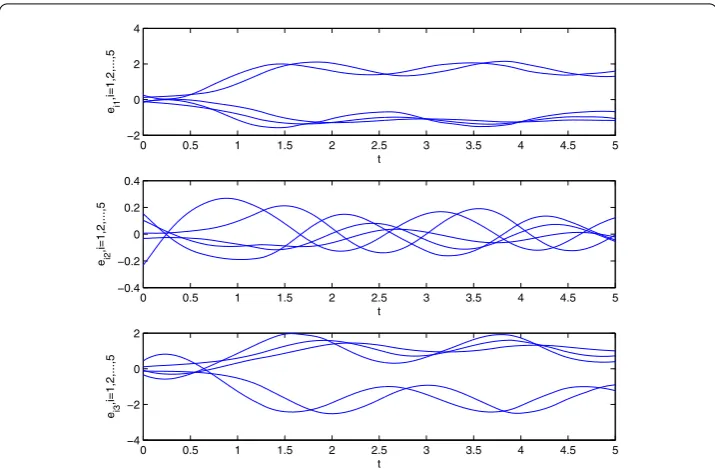
If the coupling matrices are selected as follows andbk= (without impulsive controller),
then the network () is not synchronized (see Figure ).
G=
Figure 2 Time evolution of errorseij(t),i= 1, 2, . . . , 5,j= 1, 2, 3 of the asymmetric coupled network (13) without impulsive controller.
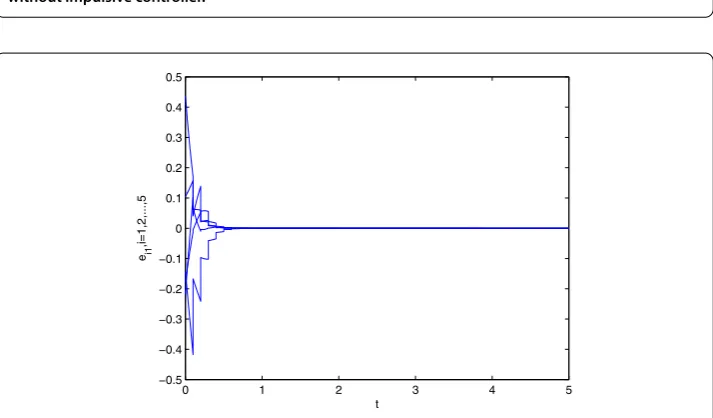
Figure 3 Time evolution of synchronization errorsei1(t),i= 1, 2, . . . , 5 of the asymmetric coupled network (13) with random initial values.
Example The network model is the same as Example . If the coupling matrices are
chosen as follows andbk= (without impulsive controller), then the network () is not
synchronized (see Figure ).
G=
⎡ ⎢ ⎢ ⎢ ⎢ ⎢ ⎢ ⎣
–
–
–
–
–
⎤ ⎥ ⎥ ⎥ ⎥ ⎥ ⎥ ⎦
, G=
⎡ ⎢ ⎢ ⎢ ⎢ ⎢ ⎢ ⎣
–
–
–
–
–
⎤ ⎥ ⎥ ⎥ ⎥ ⎥ ⎥ ⎦
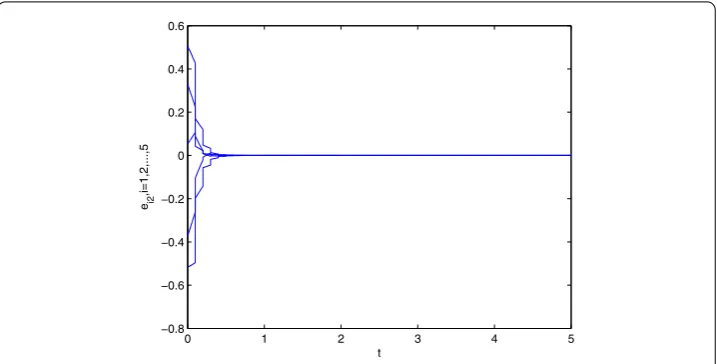
Figure 4 Time evolution of synchronization errorsei2(t),i= 1, 2, . . . , 5 of the asymmetric coupled network (13) with random initial values.
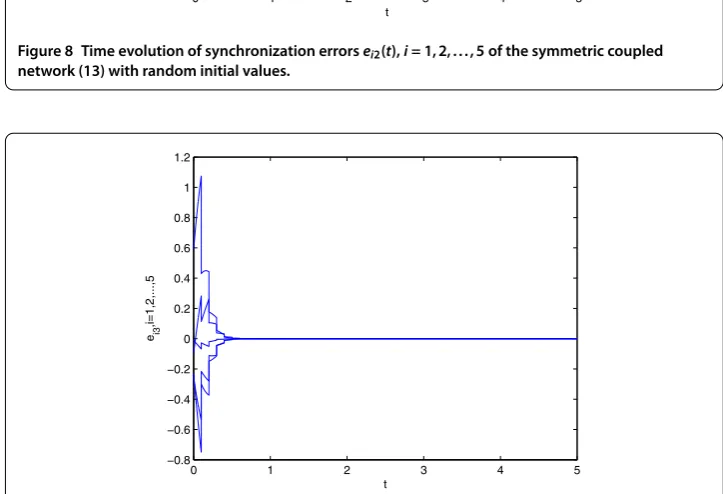
Figure 5 Time evolution of synchronization errorsei3(t),i= 1, 2, . . . , 5 of the asymmetric coupled network (13) with random initial values.
and
G=
⎡ ⎢ ⎢ ⎢ ⎢ ⎢ ⎢ ⎣
–
–
–
–
–
⎤ ⎥ ⎥ ⎥ ⎥ ⎥ ⎥ ⎦
.
Hence,λ={|λi(Gσ)||i= , . . . , ,σ= , , }= . Choose the synchronization states(t) =
.i=xi(t) and switch timet= .s. Ifβ= .,Q= .I,| +b|= ., andTmax=
Tmin= ., then all the conditions in Theorem are satisfied, andη= –.,a= ., so
simu-Figure 6 Time evolution of errorseij(t),i= 1, 2, . . . , 5,j= 1, 2, 3 of the symmetric coupled network (13) without impulsive controller.
Figure 7 Time evolution of synchronization errorsei1(t),i= 1, 2, . . . , 5 of the symmetric coupled network (13) with random initial values.
lation results are given in Figures -. It can be seen clearly from Figures - that all states of the symmetric coupled network () tend to the synchronization states(t).
5 Conclusions
Figure 8 Time evolution of synchronization errorsei2(t),i= 1, 2, . . . , 5 of the symmetric coupled network (13) with random initial values.
Figure 9 Time evolution of synchronization errorsei3(t),i= 1, 2, . . . , 5 of the symmetric coupled network (13) with random initial values.
control scheme to synchronize for an arbitrary given switch topology. Furthermore, the effectiveness of the presented method has been verified by numerical simulations.
Appendix
Proof of Lemma Fort∈[tk,tk+), integrating both sides of equation () fromtktot, we
can get
u(t) –u(tk)≤ t
tk
pu(s) +qu(s–τ)ds
=
t
tk
pu(s)ds+
t
tk
It is easy to obtain that
Now, we begin to prove that
u(t)≤
We shall show this by induction.
Fort∈[t,t), by Lemma in [], we have
In view of (), we see that () holds whenk= . Under the inductive assumption that () holds for somek≥, we shall show that () still holds fork+ .
Fort∈[tk+,tk+), without any loss of generality, we assume that there arelfirst-class
intermittent points, then () can be rewritten as
u(t)≤u(tk+) + derivative ofz(t) can be calculated as follows:
˙
It is not difficult to show that
Hence, we have
z(t)e–(p+q)(t–tk++τ)–z(tk+–τ)≤(p+q)u(tk+)
t
tk+–τ
e–(p+q)(s–tk++τ)ds.
Sincez(tk+–τ) = , one has
z(t)≤e(p+q)(t–tk++τ) t
tk+–τ
(p+q)u(tk+)e–(p+q)(s–tk++τ)ds
=u(tk+)e(p+q)(t–tk++τ)–u(tk+). ()
Substituting () into () yields
u(t)≤αk+u tk–+
e(p+q)(t–tk++τ) ≤
k+
i=
αi
sup t–τ≤s≤t
φ(s)e(p+q)(t–t+(k+)τ).
That is, () holds fork+ . Hence, by induction, () holds for allk≥.
The proof is complete.
Competing interests
The authors declare that they have no competing interests.
Authors’ contributions
AD carried out the main part of this manuscript. WZ participated in the discussion and corrected the main theorem. All authors read and approved the final manuscript.
Author details
1College of Computer Sciences and Technology, Donghua University, Shanghai, 201620, China.2College of Mathematics
and Computational Science, Shenzhen University, Shenzhen, 518060, PR China. 3City college of Dong Guan University of Technology, DongGuan, 523000, PR China.
Acknowledgements
This work is supported by the National Natural Science Foundation of China (61075060 and 61273220), the Key Foundation Project of Shanghai (12JC1400400) and the Innovation Program of Shanghai Municipal Education Commission (12zz064, 13zz050).
Received: 8 April 2013 Accepted: 10 June 2013 Published: 2 July 2013 References
1. Strogatz, SH: Exploring complex networks. Nature410, 268-276 (2001)
2. Boccaletti, S, Latora, V, Moreno, Y, Chevez, M, Hwang, DU: Complex networks: structure and dynamics. Phys. Rep.424, 175-308 (2006)
3. Arenas, A, Guilera, A, Kurths, J, Morenob, Y, Zhoug, CS: Synchronization in complex networks. Phys. Rep.469, 93-153 (2008)
4. Li, Z, Chen, G: Global synchronization and asymptotic stability of complex dynamical networks. IEEE Trans. Circuits Syst. II, Express Briefs53, 28-33 (2006)
5. Zhou, WN, Tong, DB, Gao, Y, Ji, C, Su, HY: Mode and delay-dependent adaptive exponential synchronization inpth moment for stochastic delayed neural networks with Markovian switching. IEEE Trans. Neural Netw. Learn. Syst.4, 662-668 (2012)
6. Wang, X, Chen, G: Synchronization in small-world dynamical networks. Int. J. Bifurc. Chaos12, 187-192 (2002) 7. Shen, B, Wang, Z, Liu, X: Bounded H-infinity synchronization and state estimation for discrete time-varying stochastic
complex networks over a finite-horizon. IEEE Trans. Neural Netw.22, 145-157 (2011)
8. Shen, B, Wang, Z, Liu, X: Sampled-data synchronization control of complex dynamical networks with stochastic sampling. IEEE Trans. Autom. Control57, 2644-2650 (2012)
9. Lü, JH, Chen, GR: A time-varying complex dynamical network mode and its controlled synchronization criteria. IEEE Trans. Autom. Control50, 841-846 (2005)
11. Li, CG, Chen, GR: Synchronization in general complex dynamical networks with coupling delays. Physica A343, 263-278 (2004)
12. Wu, W, Chen, T: Global synchronization criteria of linearly coupled neural network systems with time-varying coupling. IEEE Trans. Neural Netw.19, 319-332 (2008)
13. Zhao, J, Lu, J, Wu, X: Pinning control of general complex dynamical networks with optimization. Sci. China Ser. F: Inf. Sci.53, 813-822 (2010)
14. Wu, C: Synchronization in arrays of coupled nonlinear systems with delay and nonreciprocal time-varying coupling. IEEE Trans. Circuits Syst.52, 282-286 (2005)
15. Lu, W, Chen, T: Synchronization of coupling connected neural networks with delays. IEEE Trans. Circuits Syst.51, 2491-2503 (2004)
16. Liu, X, Chen, T: Exponential synchronization of nonlinear coupled dynamical networks with a delayed coupling. Physica A381, 82-92 (2007)
17. Wang, L, Wang, Q: Synchronization in complex networks with switching topology. Phys. Lett. A375, 3070-3074 (2011) 18. Liu, T, Zhao, J, Hill, DJ: Exponential synchronization of complex delayed dynamical networks with switching topology.
IEEE Trans. Circuits Syst.57, 2967-2980 (2010)
19. Yao, J, Hill, DJ, Guan, Z, Wang, H: Synchronization of complex dynamical networks with switching topology via adaptive control. In: Proceedings of the 45th IEEE Conference on Decision and Control, pp. 2819-2824 (2006) 20. Yu, W, Cao, J: Synchronization control of switched linearly coupled neural networks with delay. Phys. Lett. A375,
3070-3074 (2010)
21. Jia, Q, Tang, W, Halang, WA: Leader following of nonlinear agents with switching connective network and coupling delay. IEEE Trans. Circuits Syst.58, 2508-2519 (2011)
22. Lu, JQ, Ho, DWC, Hill, J, Cao, JD: A unified synchronization criterion for impulsive dynamical networks. Automatica46, 1215-1221 (2010)
23. Lu, JQ, Ho, DWC, Cao, J: Exponential synchronization of linearly coupled neural networks with impulsive effects. IEEE Trans. Neural Netw.22, 329-335 (2011)
24. Zhu, W, Xu, D, Huang, Y: Global impulsive exponential synchronization of time-delayed coupled chaotic systems. Chaos Solitons Fractals35, 904-912 (2008)
25. Jiang, H, Bi, Q, Zheng, S: Impulsive consensus in directed networks of identical nonlinear oscillators with switching topologies. Commun. Nonlinear Sci. Numer. Simul.17, 378-387 (2012)
26. Yang, Y, Cao, J: Exponential synchronization of the complex dynamical networks with a coupling delay and impulsive effects. Nonlinear Anal., Real World Appl.11, 1650-1659 (2010)
27. Cai, S, Zhao, J, Xiang, L, Liu, Z: Robust impulsive synchronization of complex delayed dynamical networks. Phys. Lett. A372, 4990-4995 (2008)
28. Li, K, Lai, C: Adaptive-impulsive synchronization of uncertain complex dynamical networks. Phys. Lett. A372, 1601-1606 (2008)
29. Zhou, J, Wu, QJ, Xiang, L: Pinning complex delayed dynamical networks by a single impulsive controller. IEEE Trans. Circuits Syst.58, 2882-2893 (2011)
30. Xia, W, Cao, J: Pinning synchronization of delayed dynamical networks via periodically intermittent control. Chaos19, 013120 (2009)
doi:10.1186/1687-1847-2013-195