A High-Precision Tracking Algorithm for Mass
Reconstruc-tion of Heavy-Ion Fragments in the R
3B Experiment at FAIR
DmytroKresan1,∗,MichaelHeil1, andMohammadAl-Turany1
1GSI Helmholtzzentrum für Schwerionenforschung GmbH, Planckstraße 1, D-64291 Darmstadt, Ger-many
Abstract. The multi-purpose R3B (Reactions with Relativistic Radioactive Beams) setup at the future FAIR facility in Darmstadt will be used for vari-ous experiments with exotic beams in inverse kinematics. In front and after the reaction target a combination of detectors serves for particle identification and momentum measurements. In order to perform a high-precision charge iden-tification of heavy-ion fragments and achieve a momentum resolution of 10−3 following is required: a time of flight (ToF) measurement with up to 15 ps ac-curacy, position determination on the order of less than 0.5 mm and a dedicated algorithm for the heavy-ion tracking in highly non-homogeneous dipole field. With these constraints a tracking package is being developed and tested within the R3B software framework, this package has to go into production in fall of 2018. An iterative approach has been chosen for simultaneous track finding and fitting. The design and concept of the package are introduced in this paper, also the tests and the resolution measured with simulated data are presented.
1 Introduction
The Facility for Anti-proton and Ion Research (FAIR) is a future accelerator complex which is currently being built in Darmstadt, Germany [1]. Research activities will cover aspects of states of matter at high baryonic densities and moderate temperatures, hadron physics, nuclear structure and dynamics, atomic and plasma physics. The Reactions with Relativistic Radioactive Beams (R3B) experiment [2] will focus on experimental studies of exotic
nuclei far offstability and nuclear dynamics using a kinematically complete measurement
of reactions with high energy radioactive beams. The commissioning run of R3B and two
other production runs are planned for end 2018/beginning 2019 using the existing SIS18
synchrotron at GSI.
The detector setup required for R3B in order to perform a measurement of the final state
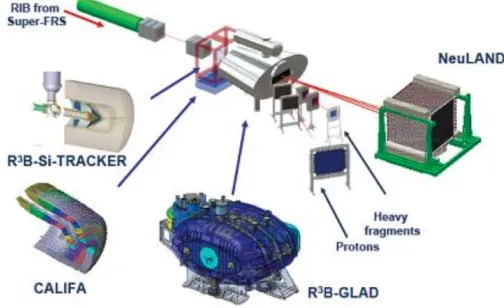
in full kinematics is shown in fig. 1. The new Large-Area Neutron Detector (NeuLAND) will detect stripped neutrons at 0-degree deflection angle. The CALorimeter for In-Flight detection of gamma rays and high energy charged pArticles (CALIFA) will measure protons and gammas around the target area. And the set of tracking detectors, grouped in proton and fragment tracking arms, in combination with the GSI Large Acceptance Dipole (GLAD) will reconstruct properties of protons and heavy fragments. One of the major challenges is
to measure the relative energy which is orders of magnitude smaller than the Lorentz boost in the longitudinal direction. This requires momentum resolution of the heavy fragment tracking arm in the order of 10−3, which means not only extremely precise and fast detectors
but also a dedicated software algorithm which will fit the mass of an ion into a trajectory with measured hits on top of a moderately high background.
Figure 1.Schematic view of the R3B experimental setup.
The R3B experiment will have a large variety of different setups, with significant changes
in detector types and configuration. Energy loss in the detector material significantly changes the velocity and thus the trajectory of a particle. Therefore it has to be taken into account during reconstruction. In addition, there is no position measurement inside of the highly non-homogeneous magnetic field. These challenges have driven the decision to develop the dedicated tracking algorithm, that should fulfill all requirements of the R3B experiment.
2 Tracking algorithm
The tracking algorithm is integrated into the R3BRoot framework [3] - simulation and data analysis tool, based on the FairRoot software project [4].
The core algorithm can be split into the following sequential steps:
• Creating a track candidate
• Setting the initial values
• Mass fit
• Selecting the best candidate
to measure the relative energy which is orders of magnitude smaller than the Lorentz boost in the longitudinal direction. This requires momentum resolution of the heavy fragment tracking arm in the order of 10−3, which means not only extremely precise and fast detectors
but also a dedicated software algorithm which will fit the mass of an ion into a trajectory with measured hits on top of a moderately high background.
Figure 1.Schematic view of the R3B experimental setup.
The R3B experiment will have a large variety of different setups, with significant changes
in detector types and configuration. Energy loss in the detector material significantly changes the velocity and thus the trajectory of a particle. Therefore it has to be taken into account during reconstruction. In addition, there is no position measurement inside of the highly non-homogeneous magnetic field. These challenges have driven the decision to develop the dedicated tracking algorithm, that should fulfill all requirements of the R3B experiment.
2 Tracking algorithm
The tracking algorithm is integrated into the R3BRoot framework [3] - simulation and data analysis tool, based on the FairRoot software project [4].
The core algorithm can be split into the following sequential steps:
• Creating a track candidate
• Setting the initial values
• Mass fit
• Selecting the best candidate
Typically, one expects a single heavy fragment in the outgoing channel of a reaction of a relativistic nucleus with a target. However, due to fake hits in some of the tracking detectors and background hits from the activation of passive material in the cave, several trajectories can be drawn to the hit pattern of the tracking arm. Thus we consider all combinations of hits in each detector layer and create a candidate using combinatorics.
The track candidate contains an array of hits to be fitted and the initial values of start position, start direction, mass and velocity. These start values are very important for the later fit convergence. Depending on the concrete detector setup, namely the number of tracking layers before and after the dipole field, the starting position and the direction of propagation is defined. The starting track direction is defined by a vector, formed from neighboring hits. The mass is chosen to be equal to the mass of the incoming nucleus, which is measured by the spectrometer of Super-FRS. It was tested first, that with such approximation, the fit has the best convergence. The velocity of the track is fixed and is set to the incoming beam velocity. The reconstructed mass has to be calibrated manually with the help of unreacted beam ions.
Having the initial values defined, the candidate is propagated through the setup. During the extrapolation, energy loss is calculated in each step, and the velocity of the candidate is adapted accordingly. This impacts the trajectory of the particle. At each detector layer, a deviation between the expected and measured track position is calculated. From these devia-tions, aχ2function is constructed. The minimization of this function yields the reconstructed
mass value of the current track with the minimum value as a quality factor, which is used in the next step. The minimization is performed by varying only the mass of the track candidate.
In case more than one candidate was successfully fitted, we select the track with the smallest χ2 and store it in the output. These four steps are repeated event by event. It
turned out that the fit converges faster if we include the time-of-flight measurement into the calculation ofχ2. There is also a possibility to store all fitted candidates in the output, this
additional information is required in some special cases of later analysis.
The code of the algorithm is written in four C++classes. The particle and the detector
classes contain corresponding properties and operations with them, the class for the propa-gator and the main class with the algorithm itself. With such implementation, the tracking software package is easy to maintain and can be also exported and applied to other exper-iments with similar physics and configuration. In addition, we have implemented a simple visualization functionality, which helps to debug and to control the fit procedure.
3 Main components
In this section, we would like to highlight some features of the tracking software package.
3.1 Geometry description
The tracking setup, amount, type and sequence of the detectors, is currently fixed in the code. The description of a single tracking layer is specified in the ASCII file using the following parameters: position in the cave, rotation, thickness, A and Z of the material, its density and mean excitation energy. It is implemented using the FairRoot interface for parameter handling. No recompilation of the software is needed when the values in the mentioned ASCII file are changed.
3.2 Propagation in magnetic field
using the simulation with multiple scattering switched off, by comparing the Geant4 track
position and extrapolated prediction. The magnetic field of GLAD is described in the calcu-lated field map, which has a step size of 5 cm. The value of the field in an arbitrary point is interpolated linearly. The field outside the map definition is assumed to be zero.
3.3 Energy loss calculation
Energy loss is calculated using the Bethe-Bloch formula with density effect [5] (eq. 1). As
was mentioned in sec. 3.1, the properties of the material are specified by the user.
− dE
dx
=Kz2Z
A 1
β2
1
2ln
2mec2β2γ2Tmax
I2 −β2−ln
ωp/I
−lnβγ+1/2
, (1)
withωp=28.816eVρZ/AandIbeing mean excitation energy.
3.4 Forward and backward propagation
Depending on the experimental setup, forward or backward propagation is used. If the start-ing position and direction of a candidate is better defined before the GLAD magnet, then the track is extrapolated in the forward direction. If the setup is such, that there are more tracking stations after the magnet - in the backward.
3.5 Mass fit
As mentioned in sec. 2, the mass fit is performed by minimizing theχ2function, where mass is a free parameter. In the current implementation of the algorithm, we make use of the Min-imizer class from the Math package of the ROOT analysis framework [6]. Minuit2 is used as the minimization algorithm, and option "Combined" (which means the combination of SIM-PLEX and MIGRAD) as the method.
Since the ROOT Minimizer is a very general algorithm, we have tested an alternative ap-proach, which is specially tuned for our case and results in less CPU time per track for the fit. It is an iterative procedure, where in each iteration first the correction parameterdm/dχ2
is calculated, by extrapolating two times with slightly different mass. Afterward, the mass is
corrected using the obtaineddm/dχ2andχ2values. First tests show approximately 15
itera-tions needed for the fit to converge without losing the precision. This number of calls to the function is less than performed by the ROOT minimizer and results in approximately 30% faster algorithm.
4 Simulation results
Results presented in this section were obtained using Geant4 as Monte Carlo transport [7] for different Sn isotopes (1 per event) with a momentum of 1.4AGeV. Fig. 2 represents theχ2
distribution of the found ion tracks.
It agrees well with the probability density function with 1 degree of freedom. In the later physics analysis, additional cuts can be applied in order to have a better quality of tracks reconstructed.
As was mentioned in sec. 1 the tracking algorithm should be able to reconstruct the mass of a fragment with a resolution in the order of 10−3. This will be sufficient for clean separation of
using the simulation with multiple scattering switched off, by comparing the Geant4 track
position and extrapolated prediction. The magnetic field of GLAD is described in the calcu-lated field map, which has a step size of 5 cm. The value of the field in an arbitrary point is interpolated linearly. The field outside the map definition is assumed to be zero.
3.3 Energy loss calculation
Energy loss is calculated using the Bethe-Bloch formula with density effect [5] (eq. 1). As
was mentioned in sec. 3.1, the properties of the material are specified by the user.
− dE
dx
=Kz2Z
A 1
β2
1
2ln
2mec2β2γ2Tmax
I2 −β2−ln
ωp/I
−lnβγ+1/2
, (1)
withωp=28.816eVρZ/AandIbeing mean excitation energy.
3.4 Forward and backward propagation
Depending on the experimental setup, forward or backward propagation is used. If the start-ing position and direction of a candidate is better defined before the GLAD magnet, then the track is extrapolated in the forward direction. If the setup is such, that there are more tracking stations after the magnet - in the backward.
3.5 Mass fit
As mentioned in sec. 2, the mass fit is performed by minimizing theχ2function, where mass is a free parameter. In the current implementation of the algorithm, we make use of the Min-imizer class from the Math package of the ROOT analysis framework [6]. Minuit2 is used as the minimization algorithm, and option "Combined" (which means the combination of SIM-PLEX and MIGRAD) as the method.
Since the ROOT Minimizer is a very general algorithm, we have tested an alternative ap-proach, which is specially tuned for our case and results in less CPU time per track for the fit. It is an iterative procedure, where in each iteration first the correction parameterdm/dχ2
is calculated, by extrapolating two times with slightly different mass. Afterward, the mass is
corrected using the obtaineddm/dχ2andχ2values. First tests show approximately 15
itera-tions needed for the fit to converge without losing the precision. This number of calls to the function is less than performed by the ROOT minimizer and results in approximately 30% faster algorithm.
4 Simulation results
Results presented in this section were obtained using Geant4 as Monte Carlo transport [7] for different Sn isotopes (1 per event) with a momentum of 1.4AGeV. Fig. 2 represents theχ2
distribution of the found ion tracks.
It agrees well with the probability density function with 1 degree of freedom. In the later physics analysis, additional cuts can be applied in order to have a better quality of tracks reconstructed.
As was mentioned in sec. 1 the tracking algorithm should be able to reconstruct the mass of a fragment with a resolution in the order of 10−3. This will be sufficient for clean separation of
heavy elements. As illustrated in fig. 3 this goal is achieved and we demonstrate the relative momentum and relative mass resolution of the fit to be 2·10−3.
0 2 4 6 8 10
2 χ 3 − 10 2 − 10 1 − 10 1 ) 2 χ prob(
(1)
2χ
Figure 2.χ2distribution of the tracks in the output - blue points. Red line shows the probability density function forχ2distribution with one degree of freedom.
0.04
− −0.02 0 0.02 0.04 MC ) / p MC (p - p 1 10 2 10 counts Momentum =0.0019 σ 0.04
− −0.02 0 0.02 0.04 MC ) / M MC (M - M 1 10 2 10 counts Mass =0.0019 σ
Figure 3. Relative momentum resolution - left picture. Relative mass resolution - right picture. Red line represents gaussian fit, sigma of which is shown with the numbers.
The distribution of the difference between reconstructed and true momenta follows a
sym-metrical Gaussian distribution with small tails due to energy loss and multiple scattering. The peaks are placed at 0, which indicates a low influence of systematic offsets in the propagation.
The main result, namely distribution of the reconstructed mass of three Sn isotopes128Sn, 129Sn, and130Sn, is shown in fig. 4.
5 Summary
126 127 128 129 130 131 132 A 0
50 100 150
counts
Sn 130 Sn 129 Sn 128
Figure 4. Distribution of the reconstructed mass of heavy fragments. Three peaks have sufficient separation.
comes from the fact that due to combinatorics we have to consider 13 candidates per event on average.
The implementation is modular, algorithm instructions are straight-forward and the size of the software package is approximately 2000 lines of code. An abstract layer in the data classes implementation allows running the algorithm on both simulated and experimental data, which provides the possibility for unique validation.
The R3B experiment is equipped with the software algorithm for the mass reconstruction
of heavy fragments and is ready for data taking end 2018/beginning 2019. We can conclude
that the required resolution of 2·10−3is achieved, which provides clean identification of heavy
ions. Timing aspect is definitely the subject for further improvement, but at the same time is not critical, since this level of analysis in R3B will be performed offline.
References
[1] P. Spilleret al., Nuclear Instruments and Methods in Physics Research Section A: Accel-erators, Spectrometers, Detectors and Associated Equipment5612 305-309 (2006) [2] A next generation experimental setup for studies of Reactions with Relativistic
Radioac-tive Beams. Retrieved October 18, 2018, from http://www.gsi.de/r3b
[3] D. Kresanet al., Journal of Physics: Conference Series523012034 (2014) [4] M. Al-Turanyet al., Journal of Physics: Conference Series396022001 (2012)
[5] Passage of particles through matter. Retrieved Oktober 18, 2018, from http://pdg.lbl.gov/2013/reviews/rpp2012-rev-passage-particles-matter.pdf