Dynamic Proofs of Retrievability via Oblivious RAM
David Cash∗ Alptekin K¨up¸c¨u† Daniel Wichs‡
March 15, 2013
Abstract
Proofs of retrievability allow a client to store her data on a remote server (e.g., “in the cloud”) and periodically execute an efficientaudit protocol to check that all of the data is being maintained correctly and can be recovered from the server. For efficiency, thecomputation and communication of the server and client during an audit protocol should be significantly smaller than reading/transmitting the data in its entirety. Although the server is only asked to access a few locations of its storage during an audit, it mustmaintain full knowledge of all client data to be able to pass.
Starting with the work of Juels and Kaliski (CCS ’07), all prior solutions to this problem crucially assume that the client data isstaticand do not allow it to be efficiently updated. Indeed, they all store a redundant encoding of the data on the server, so that the server must delete a large fraction of its storage to ‘lose’ any actual content. Unfortunately, this means that even a single bit modification to the original data will need to modify a large fraction of the server storage, which makes updates highly inefficient. Overcoming this limitation was left as the main open problem by all prior works.
In this work, we give the first solution providing proofs of retrievability fordynamicstorage, where the client can perform arbitrary reads/writes on any location within her data by running an efficient protocol with the server. At any point in time, the client can execute an efficient audit protocol to ensure that the server maintains thelatest versionof the client data. The computation and communication complexity of the server and client in our protocols is onlypolylogarithmicin the size of the client’s data. The starting point of our solution is to split up the data into small blocks and redundantly encode each block of data individually, so that an update inside any data block only affects a few codeword symbols. The main difficulty is to prevent the server from identifying and deleting too many codeword symbols belonging to any single data block. We do so by hiding where the various codeword symbols for any individual data block are stored on the server and when they are being accessed by the client, using the algorithmic techniques ofoblivious RAM.
∗
IBM Research, T.J. Watson. Hawthorne, NY, [email protected]
†
Ko¸c University. ˙Istanbul, [email protected]
‡
1
Introduction
Cloud storage systems (Amazon S3, Dropbox, Google Drive etc.) are becoming increasingly popular as a means of storing data reliably and making it easily accessible from any location. Unfortunately, even though the remote storage provider may not be trusted, current systems provide few security or integrity guarantees. Guaranteeing the privacy and authenticity of remotely stored data while allowing efficient access and updates is non-trivial, and relates to the study of oblivious RAMs and memory checking, which we will return to later. The main focus of this work, however, is an orthogonal question: How can we efficiently verify that the entire client data is being stored on the remote server in the first place? In other words, what prevents the server from deleting some portion of the data (say, an infrequently accessed sector) to save on storage?
Provable Storage. Motivated by the questions above, there has been much cryptography and security research in creating a provable storage mechanism, where an untrusted server canprove to a client that her data is kept intact. More precisely, the client can run an efficientaudit protocol with the untrusted server, guaranteeing that the server can only pass the audit if it maintains fullknowledge of the entire client data. This is formalized by requiring that the data can be efficiently extracted from the server given its state at the beginning of any successful audit. One may think of this as analogous to the notion of extractors in the definition ofzero-knowledge proofs of knowledge [14, 4].
One trivial audit mechanism, which accomplishes the above, is for the client to simply download all of her data from the server and check its authenticity (e.g., using a MAC). However, for the sake of efficiency, we insist that thecomputation andcommunication of the server and client during an audit protocol is much smaller than the potentially huge size of the client’s data. In particular, the server shouldn’t even have to
read all of the client’s data to run the audit protocol, let alonetransmit it. A scheme that accomplishes the above is called aProof of Retrievability (PoR).
Prior Techniques. The first PoR schemes were defined and constructed by Juels and Kaliski [19], and have since received much attention. We review the prior work and and closely related primitives (e.g.,
sublinear authenticators [23] and provable data possession [1]) in Section 1.2.
On a very high level, all PoR constructions share essentially the same common structure. The client stores some redundant encoding of her data under an erasure code on the server, ensuring that the server must delete a significant fraction of the encoding before losing any actual data. During an audit, the client then checks a few random locations of the encoding, so that a server who deleted a significant fraction will get caught with overwhelming probability.
More precisely, let us model the client’s input data as a string M ∈ Σ` consisting of ` symbols from some small alphabet Σ, and let Enc : Σ` → Σ`0 denote an erasure code that can correct the erasure of up to 12 of its output symbols. The client stores Enc(M) on the server. During an audit, the client selects a small random subset of t out of the `0 locations in the encoding, and challenges the server to respond with the corresponding values, which it then checks for authenticity (e.g., using MAC tags). Intuitively, if the server deletes more than half of the values in the encoding, it will get caught with overwhelming probability >1−2−t during the audit, and otherwise it retains knowledge of the original data because of the redundancy of the encoding. The complexity of the audit protocol is only proportional to t which can be set to thesecurity parameter and is independent of the size of the client data.1
Difficulty of Updates. One of the main limitations of all prior PoR schemes is that they do not support efficient updates to the client data. Under the above template for PoR, if the client wants to modify even a single location ofM, it will end up needing to change the values of at least half of the locations inEnc(M)
1
on the server, requiring a large amount of work (linear in the size of the client data). Constructing a PoR scheme that allows for efficient updates was stated as the main open problem by Juels and Kaliski [19]. We emphasize that, in the setting of updates, the audit protocol must ensure that the server correctly maintains knowledge of the latest version of the client data, which includes all of the changes incurred over time. Before we describe our solution to this problem, let us build some intuition about the challenges involved by examining two natural butflawed proposals.
First Proposal. A natural attempt to overcome the inefficiency of updating a huge redundant encoding is to encode the data “locally” so that a change to one position of the data only affects a small number of codeword symbols. More precisely, instead of using an erasure code that takes all ` data symbols as input, we can use a code Enc : Σk → Σn that works on small blocks of only k ` symbols encoded into
n symbols. The client divides the data M into L = `/k message blocks (m1, . . . ,mL), where each block
mi ∈ Σk consists of k symbols. The client redundantly encodes each message block mi individually into a corresponding codeword block ci = Enc(mi) ∈ Σn using the above code with small inputs. Finally the client concatenates these codeword blocks to form the valueC= (c1, . . . ,cL)∈ΣLn, which it stores on the server. Auditing works as before: The client randomly choosest of theL·n locations inC and challenges the server to respond with the corresponding codeword symbols in these locations, which it then tests for authenticity.2 The client can now read/write to any location within her data by simply reading/writing to thenrelevant codeword symbols on the server.
The above proposal can be made secure when the block-size k (which determines the complexity of reads/updates) and the number of challenged locationst(which determines the complexity of the audit) are both set to Ω(√`) where`is the size of the data (see Appendix A for details). This way, the audit is likely to check sufficiently many values ineach codeword block ci. Unfortunately, if we want a truly efficient scheme and setn, t =o(√`) to be small, then this solution becomes completely insecure. The server can delete a single codeword block ci from C entirely, losing the corresponding message block mi, but still maintain a good chance of passing the above audit as long as none of the t random challenge locations coincides with thendeleted symbols, which happens with good probability.
Second Proposal. The first proposal (with smalln, t) was insecure because a cheating server could easily identify the locations withinC that correspond to a single message block and delete exactly the codeword symbols in these locations. We can prevent such attacks by pseudo-randomly permuting the locations of all of the different codeword-symbols of different codeword blocks together. That is, the client starts with the valueC = (C[1], . . . ,C[Ln]) = (c1, . . . ,cL) ∈ ΣLn computed as in the first proposal. It chooses a pseudo-random permutation π : [Ln] → [Ln] and computes the permuted value C0 := (C[π(1)], . . . ,C[π(Ln)]) which it then stores on the server in an encrypted form (each codeword symbol is encrypted separately). The audit still checkst out of Lnrandom locations of the server storage and verifies authenticity.
It may seem that the server now cannot immediately identify and selectively delete codeword-symbols belonging to a single codeword block, thwarting the attack on the first proposal. Unfortunately, this mod-ification only re-gains security in the static setting, when the client never performs any operations on the data.3 Once the client wants to update some location of M that falls inside some message block mi, she has to reveal to the server where all of the n codeword symbols corresponding to ci = Enc(mi) reside in its storage since she needs to update exactly these values. Therefore, the server can later selectively delete exactly thesencodeword symbols, leading to the same attack as in the first proposal.
Impossibility? Given the above failed attempts, it may even seem that truly efficient updates could be inherently incompatible with efficient audits in PoR. If an update is efficient and only changes a small
2This requires that we can efficiently check theauthenticityof the remotely stored dataC, while supporting efficient updates on it. This problem is solved bymemory checking(see our survey of related work in Section 1.2).
subset of the server’s storage, then the server can always justignore the update, thereby failing to maintain knowledge of the latest version of the client data. All of the prior techniques appear ineffective against such attack. More generally, any audit protocol which just checksa small subset of random locations of the server’s storage is unlikely to hit any of the locations involved in the update, and hence will not detect such cheating, meaning that it cannot be secure.4 However, this does not rule out the possibility of a very efficient solution that relies on a more clever audit protocol, which is likelier to check recently updated areas of the server’s storage and therefore detect such an attack. Indeed, this property will be an important component in our actual solution.
1.1 Our Results and Techniques
Overview of Result. In this work, we give the first solution to dynamic PoR that allows for efficient updates to client data. The client only keeps some short local state, and can execute arbitrary read/write operations on any location within the data by running a corresponding protocol with the server. At any point in time, the client can also initiate an audit protocol, which ensures that a passing server must have complete knowledge of the latest version of the client data. The cost of any read/write/audit execution in terms of server/client work and communication is only polylogarithmic in the size of the client data. The server’s storage remains linear in the size of the client data. Therefore, our scheme is optimal in an asymptotic sense, up to polylogarithmic factors. See Section 7 for a detailed efficiency analysis.
PoR via Oblivious RAM. Our dynamic PoR solution starts with the same idea as the first proposal above, where the client redundantly encodes small blocks of her data individually to form the value C = (c1, . . . ,cL)∈ΣLn, consisting of L codeword blocks and `0 =Ln codeword symbols, as defined previously. The goal is to then store C on the server in some “clever way” so that that the server cannot selectively delete too many symbols within any single codeword blockci, even after observing the client’s read and write executions (which access exactly these symbols). As highlighted by the second proposal, simply permuting the locations of the codeword symbols of C is insufficient. Instead, our main idea it to store all of the individual codeword symbols ofCon the server using an oblivious RAM scheme.
Overview of ORAM. Oblivious RAM (ORAM), initially defined by Goldreich and Ostrovsky [13], allows a client to outsource hermemory to a remote server while allowing the client to perform random-access reads and writes in aprivate way. More precisely, the client has some data D∈Σd, which she stores on the server in some carefully designed privacy-preserving form, while only keeping a short local state. She can later run efficient protocols with the server to read or write to the individual entries ofD. The read/write protocols of the ORAM scheme should be efficient, and the client/server work and communication during each such protocol should be small compared to the size of D (e.g., polylogarithmic). A secure ORAM scheme not only hides thecontent ofD from the server, but also theaccess pattern of whichlocations inD the client is reading or writing in each protocol execution. Thus, the server cannot discern any correlation between the physical locations of its storage that it is asked to access during each read/write protocol execution and the logical location insideD that the client wants to access via this protocol.
We review the literature and efficiency of ORAM schemes in Section 6. In our work, we will also always use ORAM schemes that areauthenticated, which means that the client can detect if the server ever sends an incorrect value. In particular, authenticated ORAM schemes ensure that the most recent version of the data is being retrieved in any accepting read execution, preventing the server from “rolling back” updates.
Construction of Dynamic PoR. A detailed technical description of our construction appears in Sec-tion 5, and below we give a simplified overview. In our PoR construcSec-tion, the client starts with data
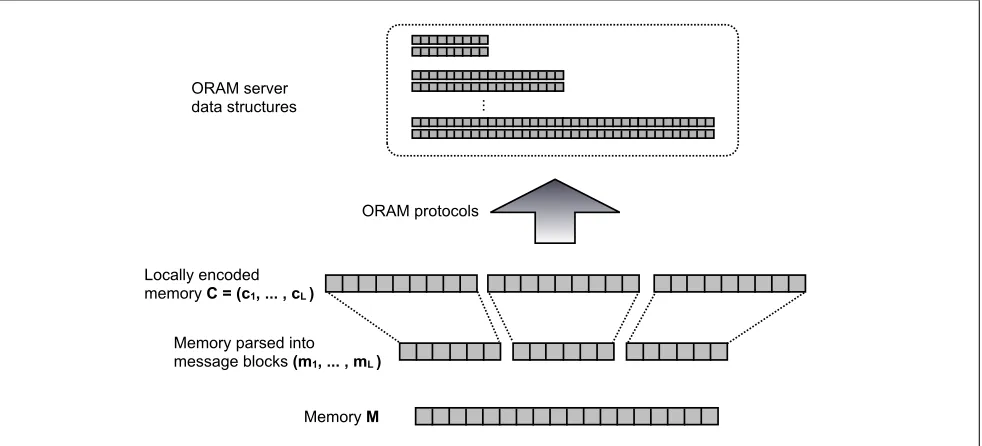
Memory M
Memory parsed into message blocks (m1, ... , mL )
Locally encoded memory C = (c1, ... , cL )
ORAM server
data structures ...
ORAM protocols
Figure 1: Our Construction
M ∈ Σ` which she splits into small message blocks M = (m1, . . . ,mL) with mi ∈ Σk where the block size k ` = Lk is only dependant on the security parameter. She then applies an error correcting code
Enc : Σk→ Σn that can efficiently recover n2 erasures to each message block individually, resulting in the valueC= (c1, . . . ,cL)∈ΣLn whereci =Enc(mi). Finally, she initializes an ORAM scheme with the initial dataD =C, which the ORAM stores on the server in some clever privacy-preserving form, while keeping only a short local state at the client.
Whenever the client wants to read or write to some location within her data, she uses the ORAM scheme to perform the necessary reads/writes on each of the n relevant codeword symbols of C (see details in Section 5). To run an audit, the client chooses t (≈ security parameter) random locations in {1, . . . , Ln} and runs the ORAM read protocol t times to read the corresponding symbols of C that reside in these locations, checking them for authenticity.
Catching Disregarded Updates. First, let us start with a sanity check, to explain how the above con-struction can thwart a specific attack in which the server simply disregards the latest update. In particular, such attack should be caught by a subsequent audit. During the audit, the client runs the ORAM pro-tocol to read t random codeword symbols and these are unlikely to coincide with any of the n codeword symbols modified by the latest update (recall that t and n are both small and independent of the data size `). However, the ORAM scheme stores data on the server in a highly organized data-structure, and ensures that the most recently updated data is accessed during any subsequent “read” execution, even for an unrelated logical location. This is implied by ORAM security since we need to hide whether or not the location of a read was recently updated or not. Therefore, although the audit executes the “ORAM read” protocols on random logical locations insideC, the ORAM scheme will end up scanning recently updated ares of the server’s actual storage and check them for authenticity, ensuring that recent updates have not been disregarded.
Security and “Next-Read Pattern Hiding”. The high-level security intuition for our PoR scheme is quite simple. The ORAM hides from the server where the various locations ofCreside in its storage, even after observing the access pattern of read/write executions. Therefore it is difficult for the server to reach a state where it will fail on read executions for most locations within some single codeword block (lose data) without also failing on too many read executions altogether (lose the ability to pass an audit).
security does not suffice. The main issue is that that the server may be able to somehow delete all (or most) of thencodeword symbols that fall withinsome codeword blockci= (C[j+ 1], . . . ,C[j+n]) without knowingwhich block it deleted. Therefore, although the server will fail on any subsequent read if and only if its location falls within the range {j+ 1, . . . , j+n}, it will not learn anything about the location of the read itself since it does not know the indexj. Indeed, we will give an example of a contrived ORAM scheme where such an attack is possible and our resulting construction of PoR using this ORAM isinsecure.
We show, however, that the intuitive reasoning above can be salvaged if the ORAM scheme achieves a new notion of security that we callnext-read pattern hiding (NRPH), which may be of independent interest. NRPH security considers an adversarial server that first gets to observe many read/write protocol executions performed sequentially with the client, resulting in some final client configurationCfin. The adversarial server then gets to see various possibilities for how the “next read” operation would be executed by the client for various distinct locations, where each such execution starts from the same fixed client configuration Cfin.5 The server should not be able to discern anyrelationship between these executions and the locations they are reading. For example, two such “next-read” executions where the client reads two consecutive locations should be indistinguishable from two executions that read two random and unrelated locations. This notion of NRPH security will be used to show that server cannot reach a state where it canselectively fail to respond on read queries whose location falls within some small range of a single codeword block (lose data), but still respond correctly to most completely random reads (pass an audit).
Proving Security via an Extractor. As mentioned earlier, the security of PoR is formalized via an extractor and we now give a high-level overview of how such an extractor works. In particular, we claim that we can take any adversarial server that has a “good” chance of passing an audit and use the extractor to efficiently recover the latest version of the client data from it. The extractor initializes an “empty array”
C. It then executes random audit protocols with the server, by acting as the honest client. In particular, it chooses t random locations within the array and runs the corresponding ORAM read protocols. If the execution of the audit is successful, the extractor fills in the corresponding values ofCthat it learned during the audit execution. In either case, it then rewinds the server and runs a fresh execution of the audit, repeating this step for several iterations.
Since the server has a good chance of passing a random audit, it is easy to show that the extractor can eventually recover a large fraction, say> 34, of the entries insideCby repeating this process sufficiently many times. Because of theauthenticity of the ORAM, the recovered values are the correct ones, corresponding to the latest version of the client data. Now we need to argue that there is no codeword blockci within Cfor which the extractor recovered fewer than 12 of its codeword symbols, as this would prevent us from applying erasure decoding and recovering the underlying message block. Let FAILURE denote the above bad event. If all the recovered locations (comprising > 34 fraction of the total) were distributed uniformly within C
then FAILURE would occur with negligible probability, as long as the codeword size n is sufficiently large in the security parameter. We can now rely on the NRPH security of the ORAM to ensure that FAILURE also happens with negligible probability in our case. We can think of the FAILURE event as a function of the locations queried by the extractor in each audit execution, and the set of executions on which the server fails. If the malicious server can cause FAILURE to occur, it means that it can distinguish the pattern of locations actually queried by the extractor during the audit executions (for which the FAILURE event occurs) from a randomly permuted pattern of locations (for which the FAILURE event does not occur with overwhelming probability). Note that the use of rewinding between the audit executions of the extractor forces us to rely on NRPH security rather than just standard ORAM security.
The above presents the high-level intuition and is somewhat oversimplified. See Section 4 for the formal definition of NRPH security and Section 5 for the formal description of our dynamic PoR scheme and a rigorous proof of security.
5
Achieving Next-Read Pattern Hiding. We show that standard ORAM security does not generically imply NRPH security, by giving a contrived scheme that satisfies the former but not the latter. Nevertheless, many natural ORAM constructions in the literature do seem to satisfy NRPH security. In particular, we examine the efficient ORAM construction of Goodrich and Mitzenmacher [15] and prove that (with minor modifications) it is NRPH secure.
Contributions. We call our final schemePORAMsince it combines the techniques and security of PoR and ORAM. In particular, other than providing provable dynamic cloud storage as was our main goal, our scheme also satisfies the strong privacy guarantees of ORAM, meaning that it hides all contents of the remotely stored data as well as the access pattern of which locations are accessed when. It also provides strong
authenticity guarantees (same as memory checking; see Section 1.2), ensuring that any “read” execution with a malicious remote server is guaranteed to return the latest version of the data (or detect cheating).
In brief, our contributions can be summarized as follows:
• We give the first asymptotically efficient solution to PoR for outsourced dynamic data, where a suc-cessful audit ensures that the server knows the latest version of the client data. In particular:
– Client storage is small and independent of the data size.
– Server storage is linear in the data size, expanding it by only a small constant factor.
– Communication and computation of client and server during read, write, and audit executions are polylogarithmic in the size of the client data.
• Our scheme also achieves strongprivacyandauthenticityguarantees, matching those ofoblivious RAM
andmemory checking.
• We present a new security notion called “next-read pattern hiding (NRPH)” for ORAM and a con-struction achieving this new notion, which may be of independent interest.
We mention that thePORAMscheme is simple to implement and has low concrete efficiency overheadon top of an underlying ORAM scheme with NRPH security. There is much recent and ongoing research activity in instantiating/implementing truly practical ORAM schemes, which are likely to yield correspondingly practical instantiations of ourPORAM protocol.
1.2 Related Work
Proofs of retrievability for static data were initially defined and constructed by Juels and Kaliski [19], building on a closely related notion called sublinear-authenticators of Naor and Rothblum [23]. Concurrently, Ateniese et al. [1] defined another related primitive calledprovable data possession (PDP). Since then, there has been much ongoing research activity on PoR and PDP schemes.
PoR vs. PDP. The main difference between PoR and PDP is the notion of security that they achieve. A PoR audit guarantees that the server maintains knowledge of all of the client data, while a PDP audit only ensures that the server is storing most of the client data. For example, in a PDP scheme, the server may lose a small portion of client data (say 1 MB out of a 10 GB file) and may maintain an high chance of passing a future audit.6 On a technical level, the main difference in most prior PDP/PoR constructions is that PoR schemes store a redundant encoding of the client data on the server. For a detailed comparison, see K¨up¸c¨u [21, 22].
6
Static Data. PoR and PDP schemes for static data (without updates) have received much research atten-tion [27, 10, 7, 2], with works improving on communicaatten-tion efficiency and exact security, yielding essentially optimal solutions. Another interesting direction has been to extend these works to the multi-server setting [6, 8, 9] where the client can use the audit mechanism to identify faulty machines and recover the data from the others.
Dynamic Data. The works of Ateniese et al. [3], Erway et al. [12] and Wang et al. [30] show how to achieve PDP security fordynamic data, supporting efficient updates. This is closely related to work on memory checking [5, 23, 11], which studies how to authenticate remotely stored dynamic data so as to allow efficient reads/writes, while being able to verify the authenticity of the latest version of the data (preventing the server from “rolling back” updates and using an old version). Unfortunately, these techniques alone cannot be used to achieve the stronger notion of PoR security. Indeed, the main difficulty that we resolve in this work, how to efficiently updateredundantly encoded data, does not come up in the context of PDP.
A recent work of Stefanov et al. [29] considers PoR for dynamic data, but in a more complex setting where an additional trusted “portal” performs some operations on behalf of the client, and can cache updates for an extended period of time. It is not clear if these techniques can be translated to the basic client/server setting, which we consider here. However, even in this modified setting, the complexity of the updates and the audit in that work is proportional tosquare-root of the data size, whereas ours is polylogarithmic.
2
Preliminaries
Notation. Throughout, we use λ to denote the security parameter. We identify efficient algorithms as those running in (probabilistic) polynomial time inλand their input lengths, and identifynegligiblequantities (e.g., acceptable error probabilities) asnegl(λ) = 1/λω(1), meaning that they are asymptotically smaller than 1/λcfor every constantc >0. Forn∈N, we define the set [n]def= {1, . . . , n}. We use the notation (kmod n) to denote the unique integeri∈ {0, . . . , n−1} such thati=k(mod n).
Erasure Codes. We say that (Enc,Dec) is an (n, k, d)Σ-code with efficient erasure decoding over an
al-phabet Σ if the original message can always be recovered from a corrupted codeword with at most d−1 erasures. That is, for everymessage m= (m1, . . . , mk) ∈Σk giving a codeword c= (c1, . . . , cn) =Enc(m), and every corrupted codeword ˜c = (˜c1, . . . ,c˜n) such that ˜ci ∈ {ci,⊥} and the number of erasures is
|{i ∈ [n] : ˜ci = ⊥}| ≤ d−1, we have Dec(˜c) = m. We say that a code is systematic if, for every message m, the codeword c = Enc(m) contains m in the first k positions c1 = m1, . . . , ck = mk. A sys-tematic variant of the Reed-Solomon code achieves the above for any integersn > k and any field Σ of size |Σ| ≥n withd=n−k+ 1.
Virtual Memory. We think of virtual memory M, with word-size w and length `, as an array M∈ Σ` where Σdef= {0,1}w. We assume that, initially, each location M[i] contains the special uninitialized symbol
0 = 0w. Throughout, we will think of ` as some large polynomial in the security parameter, which upper bounds the amount of memory that can be used.
Outsourcing Virtual Memory. In the next two sections, we look at two primitives: dynamic PoR and
(e.g., allowing appends/inserts to data or implementing an entire file-system) can be easily done on top of
this abstract notion of memory and therefore securely outsourced to the remote server.
3
Dynamic P
oR
A Dynamic PoR scheme consists of protocols PInit,PRead,PWrite, Audit between two stateful parties: a clientC and a server S. The server acts as the curator for some virtual memory M, which the client can
read,write andaudit by initiating the corresponding interactive protocols:
• PInit(1λ,1w, `): This protocol corresponds to the client initializing an (empty) virtual memoryMwith word-sizew and length`, which it supplies as inputs.
• PRead(i): This protocol corresponds to the client readingv=M[i], where it supplies the input iand outputs some valuev at the end.
• PWrite(i, v): This protocol corresponds to settingM[i] :=v, where the client supplies the inputsi, v.
• Audit: This protocol is used by the client to verify that the server is maintaining the memory contents correctly so that they remain retrievable. The client outputs a decisionb∈ {accept,reject}.
The client C in the protocols may be randomized, but we assume (w.l.o.g.) that the honest server S is deterministic. At the conclusion of thePInitprotocol, both the client and the server create some long-term local state, which each party will update during the execution of each of the subsequent protocols. The client may also outputrejectduring the execution of thePInit,PRead,PWriteprotocols, to denote that it detected some misbehavior of the server. Note that we assume that the virtual memory is initiallyempty, but if the client has some initial data, she can write it onto the server block-by-block immediately after initialization. For ease of presentation, we may assume that the state of the client and the server always contains the security parameter, and the memory parameters (1λ,1w, `).
We now define the three properties of a dynamic PoR scheme: correctness,authenticity andretrievability. For these definitions, we say that P = (op0, op1, . . . , opq) is a dynamic PoR protocol sequence if op0 =
PInit(1λ,1w, `) and, for j > 0, opj ∈ {PRead(i), PWrite(i, v), Audit} for some index i ∈ [`] and value
v∈ {0,1}w.
Correctness. If the client and the server are bothhonestandP = (op0, . . . , opq) is some protocol sequence, then we require the following to occur with probability 1 over the randomness of the client:
• Each execution of a protocolopj =PRead(i) results in the client outputting the correct valuev=M[i], matching what would happen if the corresponding operations were performed directly on a memoryM. In particular,v is the value contained in the most recent prior write operation with locationi, or, if no such prior operation exists,v=0.
• Each execution of the Auditprotocol results in the decisionb=accept.
Authenticity. We require that the client can alwaysdetect if any protocol message sent by the server de-viates from honest behavior. More precisely, consider the following gameAuthGameS˜(λ) between a malicious
server ˜S and a challenger:
• The malicious server ˜S(1λ) specifies a valid protocol sequenceP = (op
0, . . . , opq).
• The challenger initializes a copy of the honest client C and the (deterministic) honest server S. It sequentially executesop0, . . . , opq betweenC and the malicious server ˜S while, in parallel, also passing a copy of every message fromC to the honest server S.
• If, at any point during the execution of someopj, any protocol message given by ˜S differs from that of
For any efficient adversarial server ˜S, we require Pr[AuthGameS˜(λ) = 1] ≤ negl(λ). Note that authenticity
and correctness together imply that the client will always either read the correct value corresponding to the latest contents of the virtual memory or reject whenever interacting with a malicious server.
Retrievability. Finally we define the main purpose of a dynamic PoR scheme, which is to ensure that the client data remains retrievable. We wish to guarantee that, whenever the malicious server is in a state with a reasonable probabilityδ of successfully passing an audit, he must know the entire content of the client’s virtual memory M. As in “proofs of knowledge”, we formalize knowledge via the existence of an efficient
extractor E which can recover the valueMgiven (black-box) access to the malicious server.
More precisely, we define the game ExtGameS˜,E(λ, p) between a malicious server ˜S, extractor E, and
challenger:
• The malicious server ˜S(1λ) specifies a protocol sequenceP = (op0, . . . , opq). LetM∈Σ` be the correct value of the memory contents at the end of executing P.
• The challenger initializes a copy of the honest clientC and sequentially executesop0, . . . , opq betweenC and ˜S. LetCfinand ˜Sfinbe the final configurations (states) of the client and malicious server at the end of this interaction, including all of the random coins of the malicious server. Define the success-probability
Succ( ˜Sfin)def= PrhS˜fin←→ CAudit fin =accept
i
as the probability that an execution of a subsequent Auditprotocol between ˜Sfin and Cfin results in the latter outputtingaccept. The probability is only over the random coins ofCfin during this execution.
• Run M0 ← ES˜fin(C
fin,1`,1p), where the extractor E gets black-box rewinding access to the malicious server in its final configuration ˜Sfin, and attempts to extract out the memory contents asM0.7
• IfSucc( ˜Sfin)≥1/p andM0 6=M then output 1, else 0.
We require that there exists a probabilistic-poly-time extractor E such that, for every efficient malicious server ˜S and every polynomialp=p(λ) we have Pr[ExtGameS˜,E(λ, p) = 1]≤negl(λ).
The above says that whenever the malicious server reaches some state ˜Sfinin which it maintains aδ ≥1/p
probability of passing thenext audit, the extractorE will be able to extract out the correct memory contents
Mfrom ˜Sfin, meaning that the server must retain fullknowledge ofMin this state. The extractor is efficient, but can run in time polynomial inpand the size of the memory`.
A Note on Adaptivity. We defined the above authenticity and retrievability properties assuming that the sequence of read/write operations is adversarial, but is chosen non-adaptively, before the adversarial server sees any protocol executions. This seems to be sufficient in most realistic scenarios, where the server is unlikely to have any influence on which operations the client wants to perform. It also matches the security notions in prior works on ORAM. Nevertheless, we note that our final results also achieve adaptive security, where the attacker can choose the sequence of operationsopi adaptively after seeing the execution of previous operations, if the underlying ORAM satisfies this notion. Indeed, most prior ORAM solutions seem to do so, but it was never included in their analysis.
4
Oblivious RAM with Next-Read Pattern Hiding
An ORAM consists of protocols (OInit,ORead,OWrite) between a client C and a server S, with the same syntax as the corresponding protocols in PoR. We will also extend the syntax ofOReadandOWriteto allow for reading/writing from/to multiple distinct locations simultaneously. That is, for arbitraryt∈N, we define
7
the protocolORead(i1, . . . , it) fordistinctindicesi1, . . . , it∈[`], in which the client outputs (v1, . . . , vt) corre-sponding to readingv1=M[i1], . . . , vt=M[it]. Similarly, we define the protocolOWrite(it, . . . , it;v1, . . . , vt) fordistinct indices i1, . . . , it∈[`], which corresponds to settingM[i1] :=v1, . . . ,M[it] :=vt.
We say that P = (op0, . . . , opq) is anORAM protocol sequence ifop0 =OInit(1λ,1w, `) and, for j > 0,
opj is a valid (multi-location) read/write operation.
We require that an ORAM construction needs to satisfycorrectness and authenticity, which are defined the same way as in PoR.8 For privacy, we define a new property called next-read pattern hiding. For
completeness, we also define the standard notion of ORAM pattern hiding in Appendix B.
Next-Read Pattern Hiding. Consider an honest-but-curious server A who observes the execution of some protocol sequence P with a client C resulting in the final client configuration Cfin. At the end of this execution, A gets to observe how Cfin would execute the next read operation ORead(i1, . . . , it) for various differentt-tuples (i1, . . . , it) of locations, but always starting in the same client stateCfin. We require thatA cannot observe any correlation between these next-read executions and their locations, up toequality. That is,Ashould not be able to distinguish ifCfin instead executes the next-read operations onpermuted locations
ORead(π(i1), . . . , π(it)) for a permutation π : [`]→[`].
More formally, we defineNextReadGamebA(λ), for b∈ {0,1}, between an adversaryAand a challenger:
• The attacker A(1λ) chooses an ORAM protocol sequence P1 = (op0, . . . , opq1). It also chooses a sequence P2 = (rop1, . . . , ropq2) of valid multi-location read operations, where each operation is of the form ropj = ORead(ij,1, . . . , ij,tj) with tj distinct locations. Lastly, it chooses a permutation
π : [`]→[`]. For eachropj inP2, define a permuted versionropj0 :=ORead(π(ij,1), . . . , π(ij,tj)). The
game now proceeds in two stages.
• Stage I. The challenger initializes the honest client C and the (deterministic) honest server S. It sequentially executes the protocols P = (op0, . . . , opq1) between C and S. Let Cfin,Sfin be the final configuration of the client and server at the end.
• Stage II. For each j ∈ [q2]: challenger either executes the original operation ropj if b = 0, or the permuted operationrop0j if b= 1, between C and S. At the end of each operation execution it resets the configuration of the client and server back toCfin,Sfin respectively, before the next execution.
• The adversaryAis given the transcript of all the protocol executions in stages I and II, and outputs a bit ˜bwhich we define as the output of the game. Note that, since the honest serverS is deterministic, seeing the protocol transcripts betweenS and C is the same as seeing the entire internal state ofS at any point time.
We require that, for every efficientA, we have
Pr[NextReadGame0A(λ) = 1]−Pr[NextReadGame1A(λ) = 1]
≤negl(λ).
5
PORAM: Dynamic PoR via ORAM
We now give our construction of dynamic PoR, using ORAM. Since the ORAM security properties are preserved by the construction as well, we happen to achieve ORAM and dynamic PoR simultaneously. Therefore, we call our constructionPORAM.
8Traditionally, authenticity is not always defined/required for ORAM. However, it is crucial for our use. As noted in several prior works, it can often be added at almost no cost to efficiency. It can also be added generically by running amemory checking
Overview of Construction. Let (Enc, Dec) be an (n, k, d=n−k+ 1)Σ systematic code with efficient
erasure decoding over the alphabet Σ = {0,1}w (e.g., the systematic Reed-Solomon code over F2w). Our
construction of dynamic PoR will interpret the memoryM∈Σ`as consisting ofL=`/kconsecutivemessage blocks, each havingkalphabet symbols (assumek is small and divides`). The construction implicitly maps operation on M to operations on encoded memory C ∈ (Σ)`code=Ln, which consists of L codeword blocks
withnalphabet symbols each. The Lcodeword blocksC= (c1, . . . ,cL) are simply the encoded versions of the corresponding message blocks inM= (m1, . . . ,mL) with cq =Enc(mq) for q ∈[L]. This means that, for each i ∈ [`], the value of the memory location M[i] can only affect the values of the encoded-memory locationsC[j+ 1], . . . ,C[j+n] where j=n· bi/kc. Furthermore, since the encoding issystematic, we have
M[i] =C[j+u] where u= (i mod k) + 1. To read the memory location M[i], the client will use ORAM to read the codeword location C[j+u]. To write to the memory location M[i] := v, the client needs to update the entire corresponding codeword block. She does so by first using ORAM to read the corresponding codeword blockc= (C[j+ 1], . . . ,C[j+n]), and decodes to obtain the original memory blockm=Dec(c).9 She then locally updates the memory block by setting m[u] := v, re-encodes the updated memory block to get c0 = (c1, . . . , cn) := Enc(m) and uses the ORAM to write c0 back into the encoded memory, setting
C[j+ 1] :=c01, . . . ,C[j+n] :=c0n.
The Construction. Our PORAM construction is defined for some parameters n > k, t ∈ N. Let O =
(OInit,ORead,OWrite) be an ORAM. Let (Enc, Dec) be an (n, k, d = n−k+ 1)Σ systematic code with
efficient erasure decoding over the alphabet Σ ={0,1}w (e.g., the systematic Reed-Solomon code overF2w).
• PInit(1λ,1w, `): Assumek divides`and let `code:=n·(`/k). Run theOInit(1λ,1w, `code) protocol.
• PRead(i): Leti0:=n· bi/kc+ (i modk) + 1 and run theORead(i0) protocol.
• PWrite(i, v): Setj:=n· bi/kc andu:= (i mod k) + 1.
– RunORead(j+ 1, . . . , j+n) and get outputc= (c1, . . . , cn).
– Decodem= (m1, . . . , mk) =Dec(c).
– Modify positionu of mby locally settingmu :=v. Re-encode the modified message-blockmby settingc0= (c01, . . . , c0n) :=Enc(m).
– RunOWrite(j+ 1, . . . , j+n;c01, . . . , c0n).
• Audit: Picktdistinct indicesj1, . . . , jt∈[`code] at random. RunORead(j1, . . . , jt) and returnaccept iff the protocol finished without outputtingreject.
If, any ORAM protocol execution in the above scheme outputsreject, the client enters a special rejection state in which it stops responding and automatically outputsrejectfor any subsequent protocol execution. It is easy to see that if the underlying ORAM scheme used in the abovePORAMconstruction is secure in the standard sense of ORAM (see Appendix B) then the above construction preserves this ORAM security, hiding which locations are being accessed in each operation. As our main result, we now prove that if the ORAM scheme satisfies next-read pattern hiding (NRPH) security then the PORAM construction above is also a secure dynamic PoR scheme.
Theorem 1. Assume that O= (OInit,ORead,OWrite)is an ORAM with next-read pattern hiding (NRPH) security, and we choose parameters k = Ω(λ), k/n = (1−Ω(1)), t = Ω(λ). Then the above scheme PORAM= (PInit,PRead,PWrite,Audit) is a dynamic PoR scheme.
9
5.1 Proof of Theorem 1
The correctness and authenticity properties of PORAM follow immediately from those of the underlying ORAM schemeO. The main challenge is to show that the retrievability property holds. As a first step, let us describe the extractor.
The Extractor. The extractorES˜fin(C
fin,1`,1p) works as follows: (1) InitializeC:= (⊥)`code where`
code=n(`/k) to be an empty vector.
(2) Keep rewinding and auditing the server by repeating the following step fors= max(2`code, λ)·p times: Pick t distinct indices j1, . . . , jt ∈ [`code] at random and run the protocol ORead(j1, . . . , jt) with ˜Sfin, acting as Cfin as in the audit protocol. If the protocol is accepting and Cfin outputs (v1, . . . , vt), set
C[j1] :=v1, . . . ,C[jt] :=vt. Rewind ˜Sfin,Cfin to their state prior to this execution for the next iteration.
(3) Letδdef= (1 +nk)/2. If the number of “filled in” values in Cis|{j ∈[`code] : C[j]6=⊥}|< δ·`code then output fail1. Else interpret C as consisting of L = `/k consecutive codeword blocks C = (c1, . . . ,cL) with each blockcj ∈Σn. If there exists some indexj∈[L] such that the number of “filled” in values in codeword block cj is |{i∈[n] : cj[i]6=⊥}|< k then outputfail2. Otherwise, apply erasure decoding
to each codeword block cj, to recovermj =Dec(cj), and output M= (m1, . . . ,mL)∈Σ`.10
Proof by Contradiction. Assume thatPORAMdoesnotsatisfy the retrievability property with the above extractorE. Then there exists some efficient adversarial server ˜S and some polynomialsp=p(λ), p0=p0(λ) such that, for infinitely many valuesλ∈N, we have:
Pr[ExtGameS˜,E(λ, p(λ)) = 1]> 1
p0(λ) (1)
Using the same notation as in the definition of ExtGame, let ˜Sfin,Cfin be the final configurations of the malicious server ˜S and clientC, respectively, after executing the protocol sequenceP chosen by the server at the beginning of the game, and let Mbe the correct value of the memory contents resulting fromP. Then (1) implies
Pr
"
Succ( ˜Sfin)> p(1λ) ∧ES˜fin(C
fin,1`,1p)6=M
#
> 1
p0(λ) (2)
where the probability is over the coins ofC,S˜which determine the final configuration ˜Sfin,Cfin and the coins of the extractor E. We now slowly refine the above inequality until we reach a contradiction, showing that the above cannot hold.
Extractor can only fail with {fail1,fail2}. Firstly, we argue that at the conclusion of ExtGame, the
extractor must either output the correct memory contents M or must fail with one of the error messages {fail1,fail2}. In other words, it can always detectfailure and never outputs an incorrect valueM0 6=M. This
follows from the authenticity of the underlying ORAM scheme which guarantees that the extractor never puts any incorrect value into the arrayC.
Lemma 1. Within the execution of ExtGameS˜,E(λ, p), we have:
Pr[ES˜fin(C
fin,1`,1p)6∈ {M,fail1,fail2}]≤negl(λ).
Proof of Lemma. The only way that the above bad event can occur is if the extractor puts an incorrect value into its arrayCwhich does not match encoded version of the correct memory contentsM. In particular, this
10
means that one of the audit protocol executions (consisting of anOReadwitht random locations) initiated by the extractor E between the malicious server ˜Sfin and the client Cfin causes the client to output some incorrect value which does not match correct memory contentsM, andnot reject. By thecorrectness of the ORAM scheme, this means that the the malicious server must have deviated from honest behavior during that protocol execution, without the client rejecting. Assume the probability of this bad event happening is
ρ. Since the extractor runs s= max(2`code, λ)·p =poly(λ) such protocol executions with rewinding, there is at leastρ/s=ρ/poly(λ) probability that the above bad event occurs on a single random execution of the audit with ˜Sfin. But this means that ˜S can be used to break the authenticity of ORAM with advantage
ρ/poly(λ), by first running the requested protocol sequence P and then deviating from honest behavior during a subsequentOReadprotocol without being detected. Therefore, by the authenticity of ORAM, we must haveρ=negl(λ).
Combining the above with (2) we get:
Pr
"
Succ( ˜Sfin)> p(1λ) ∧ES˜fin(C
fin,1`,1p)∈ {fail1,fail2} #
> 1
p0(λ) −negl(λ) (3)
Extractor can indeed only fail withfail2. Next, we refine equation (3) and claim that the extractor is
unlikely to reach the failure eventfail1 and therefore must fail withfail2.
Pr
"
Succ( ˜Sfin)> p(1λ)
∧ES˜fin(C
fin,1`,1p) =fail2 #
> 1
p0(λ)−negl(λ) (4)
To prove the above, it suffices to prove the following lemma, which intuitively says that if ˜Sfin has a good chance of passing an audit, then the extractor must be able to extract sufficiently many values inside C
and hence cannot outputfail1. Remember thatfail1 occurs if the extractor does not have enough values to
recover the whole memory, and fail2 occurs if the extractor does not have enough values to recover some
message block.
Lemma 2. For any (even inefficient) machine S˜fin and any polynomial p=p(λ) we have:
Pr[ES˜fin(C
fin,1`,1p) =fail1 |Succ( ˜Sfin)≥1/p]≤negl(λ).
Proof of Lemma. Let E be the bad event that fail1 occurs. For each iteration i∈[s] within step (2) of the
execution ofE let us define:
• Xi to be an indicator random variable that takes on the value Xi = 1 iff theORead protocol execution in iterationi does not reject.
• Gi to be a random variable that denotes the subset{j∈[`code] : C[j]6=⊥}of filled-in positions in the current version ofCat the beginning of iterationi.
• Yi to be an indicator random variable that takes on the value Yi = 1 iff |Gi|< δ·`code and all of the locations thatE chooses to read in iterationihappen to satisfy j1, . . . , jt∈Gi.
If Xi = 1 and Yi = 0 in iteration i, then at least one position of C gets filled in so |Gi+1| ≥ |Gi|+ 1. Therefore the bad eventE only occurs if fewer than δ`code of theXi take on a 1or at least oneYi takes on a 1, giving us:
Pr[E] ≤ Pr
" s X
i=1
Xi < δ`code
#
+ s
X
i=1
For eachi, we can bound Pr[Yi= 1]≤ bδ`codet c
/ `code t
≤δt. If we define X= 1
s
Ps
i=1Xi we also get:
Pr
" s X
i=1
Xi < δ`code
#
≤ Pr
X <1/p−(1/p−δ`code
s )
≤ exp(−2s(1/p−δ`code/s)2)
≤ exp(−s/p)≤2−λ
where the second inequality follows by the Chernoff-Hoeffding bound. Therefore Pr[E]≤2−λ+sδt=negl(λ) which proves the lemma.
Use Estimated Success Probability. Instead of looking at the true success probability Succ( ˜Sfin), which we cannot efficiently compute, let us instead consider an estimated probability Succ]( ˜Sfin) which is computed in the context of ExtGame by sampling 2λ(p(λ))2 different “audit protocol executions” between
˜
Sfin and Cfin and seeing on which fraction of them does ˜S succeed (while rewinding ˜Sfin and Cfin after each one). Then, by the Chernoff-Hoeffding bound, we have:
Pr
]
Succ( ˜Sfin)≤ 1 2p(λ)
Succ( ˜Sfin)> 1
p(λ)
≤e−λ =negl(λ)
Combining the above with (4), we get:
Pr
"
]
Succ( ˜Sfin)> 2p1(λ)
∧ES˜fin(C
fin,1`,1p) =fail2 #
> 1
p0(λ)−negl(λ) (5)
Assume Passive Attacker. We now argue that we can replace the active attacker ˜S with an efficient passive attacker ˆS who always acts as the honest server S in each protocol execution within the protocol sequence P and the subsequent audit, but can selectively fail by outputting ⊥at any point. In particular
ˆ
S just runs a copy of ˜S and the honest server S concurrently, and if ˜S deviates from the execution ofS, it just outputs⊥. Then we claim that, within the context ofExtGameSˆ,E, we have:
Pr
"
]
Succ( ˆSfin)> 2p1(λ)
∧ESˆfin(C
fin,1`,1p) =fail2 #
> 1
p0(λ)−negl(λ) (6)
The above probability is equivalent for ˆS and ˜S, up to the latter deviating from the protocol execution with-out being detected by the client, either during the protocol execution ofP or during one of the polynomially many executions of the next read used to compute Succ]( ˜S) and ES˜. The probability that this occurs is negligible, byauthenticity of ORAM.
Permuted Extractor. We now aim to derive a contradiction from (6). Intuitively, if fail2 occurs (but
fail1 does not), it means that there is some codeword block cj such that ˆSfin is significantly likelier to fail on a next-read query for which at least one location falls insidecj, than it is for a “random” read query. This would imply an attack on next-read pattern hiding. We now make this intuition formal. Consider a modified “permuted extractor”Eperm who works just like E with the exception that it permutes the locations used in theORead executions during the extraction process. In particular Eperm makes the following modifications toE:
• At the beginning,Eperm chooses a random permutation π : [`code]→[`code].
Now we claim that an execution ofExtGamethe permuted extractorEpermis still likely to result in the failure eventfail2. This follows from “next-read pattern hiding” which ensures that permuting the locations inside
of theOReadexecutions (with rewinding) is indistinguishable.
Lemma 3. The following holds within ExtGameSˆ,Eperm:
Pr
"
]
Succ( ˆSfin)> 2p1(λ)
∧ESˆfin
perm(Cfin,1`,1p) =fail2 #
> 1
p0(λ) −negl(λ) (7)
Proof of Lemma. Assume that (7) does not hold. Then we claim that there is an adversary A with non-negligible distinguishing advantage inNextReadGamebA(λ) against the ORAM.
The adversary A runs ˆS who chooses a PoR protocol sequence P1 = (op0, . . . , opq2), and A translates this to the appropriate ORAM protocol sequence, as defined by the PORAM scheme. Then A chooses its own sequenceP2= (rop1, . . . , ropq2) of sufficiently many read operationsORead(i1, . . . , it) wherei1, . . . , it∈ [`code] are random distinct indices. It then passes P1, P2 to its challenger and gets back the transcripts of
the protocol executions for stages (I) and (II) of the game.
The adversaryAthen uses the client communication from the stage (I) transcript to run ˆS, getting it into some state ˆSfin. It then uses the stage (II) transcripts, to computeESˆfin(Cfin,1`,1p)
?
=fail2 and to estimate
]
Succ( ˆSfin), without knowing the client stateCfin. It does so just by checking on which executions does ˆSfin abort with⊥and which it runs to completion (here we use that ˆS is semi-honest and never deviates beyond outputting⊥). LastlyAoutputs 1 iff the emulated extractionESˆfin(C
fin,1`,1p) =fail2and Succ]( ˆSfin)≥ 2p1(λ). Let b be the challenger’s bit in the “next-read pattern hiding game”. If b = 0 (not permuted) then A perfectly emulates the distribution of ESˆfin(C
fin,1`,1p) ?
= fail2 and the estimation of Succ]( ˆSfin) so, by inequality (6):
Pr[NextReadGame0A(λ) = 1]≥1/p0(λ)−negl(λ).
Ifb= 1 (permuted) thenAperfectly emulates the distribution of the permuted extractorESˆfin
perm(Cfin,1`,1p) ? =
fail2 and the estimation of Succ]( ˆSfin) since, for the latter, it does not matter whether random reads are permuted or not. Therefore, since (7) is false by assumption, we have
Pr[NextReadGame1A(λ) = 1]≤1/p0(λ)−µ(λ)
where µ(λ) is non-negligible. This means that the distinguishing advantage of the passive attacker A is non-negligible in the next-read pattern hiding game, which proves the lemma.
Contradiction. Finally, we present an information-theoretic argument showing that, when using the permuted extractorEperm, the probability offail2 is negligible over the choice of the permutationπ. Together
with inequality (7), this gives us a contradiction.
Lemma 4. For any (possibly unbounded) S˜, we have
Pr
"
Succ(S˜˜fin)> 2p1(λ)
∧ES˜fin
perm(Cfin,1`,1p) =fail2 #
=negl(λ).
Proof of Lemma. Firstly, note that an equivalent way of thinking aboutEpermis to have it issue random (un-permuted) read queries just likeE to recover C, but then permute the locations ofCvia some permutation
π : [`code]→ [`code] before testing for the event fail2. This is simply because we have the distributional
equivalence (π(random),random) ≡ (random, π(random)), where random represents the randomly chosen locations for the audit andπis a random permutation. Now, with this interpretation ofEperm, the eventfail2
so thatfail1 does not occur, and (II) the permuted version (c1, . . . ,cL) =C[π(1)], . . . ,C[π(`code)] contains some codeword blockcj with fewer thank/n fraction of filled in (non⊥) values.
We now show that, conditioned on (I) the probability of (II) is negligible over the random choice of π. Fix some indexj∈[L] and let us bound the probability thatcj is the“bad” codeword block with fewer than
k filled in values. Let X1, X2, . . . , Xn be random variables where Xi is 1 if cj[i]6=⊥ and 0 otherwise. Let
X def= n1Pn
i=1Xi. Then, over the randomness of π, the random variables X1, . . . , Xn are sampled without
replacement from a population of`code values (location inC), at least δ`code of which are 1 (6=⊥) and the rest are 0 (=⊥). Therefore, by Hoeffding’s bound for sampling from finite populations without replacement (See section 6 of [18]), we have:
Pr[cj is bad ] = Pr[X < k/n] = Pr[X < δ−(δ−k/n)]
≤ exp(−2n(δ−k/n)2) =negl(λ)
By taking a union-bound over all codeword blocks cj, we can bound the probability in equation (7) by
P`/k
j=1Pr[cj is bad ]≤negl(λ).
We have already shown thatfail1only occurs with negligible probability. We now showed thatfail2for the
permuted extractor also occurs with negligible probability, while the adversary succeeds with non-negligible probability.
Combining the above lemma with equation (7), we get a contradiction, showing that the assumption in equation (1) cannot hold. Thus, as long as the adversary succeeds with non-negligible probability dur-ing audits, the extractor will also succeed with non-negligible probability in extractdur-ing the whole memory contents correctly.
6
ORAM Instantiation
The notion of ORAM was introduced by Goldreich and Ostrovsky [13], who also introduced the so-called
hierarchical scheme having the structure seen in Figures 1 and 6.2. Since then several improvements to the hierarchical scheme have been given, including improved rebuild phases and the use of advanced hashing techniques [31, 26, 15].
We examine a particular ORAM scheme of Goodrich and Mitzenmacher [15] and show that (with minor modifications) it satisfiesnext-read pattern hiding security. Therefore, this scheme can be used to instantiate our PORAM construction. We note that most other ORAM schemes from the literature that follow the hierarchical structure also seemingly satisfy next-read pattern hiding, and we only focus on the above example for concreteness. However, in Appendix C, we show that it is not the case that every ORAM scheme satisfies next-read pattern hiding, and in fact give an example of a contrived scheme which does not satisfy this notion and makes our construction of PORAM completely insecure. We also believe that there are natural schemes, such as the ORAM of Shi et al. [28], which do not satisfy this notion. Therefore, next-read pattern hiding is a meaningful property beyond standard ORAM security and must be examined carefully.
Overview. We note that ORAM schemes are generally not described as protocols, but simply as a data structure in which the client’s encrypted data is stored on the server. Each time that a client wants to perform a read or write to some address i of her memory, this operation is translated into a series of read/write operations on this data structure inside the server’s storage. In other words, the (honest) server does not perform any computation at all during these ‘protocols’, but simply allows the client to access arbitrary locations inside this data structure.
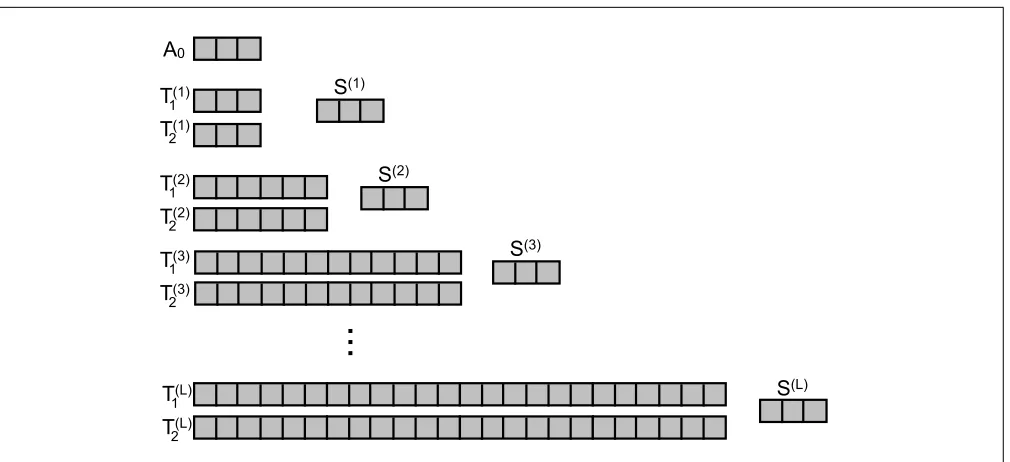
having higher capacity. The tables are managed so that the most recently accessed data is kept in the top tables and the least recently used data is kept in the bottom tables. Over time, infrequently accessed data is moved into lower tables (obliviously).
To write a value to some address, just insert the encrypted address-value pair in the top table. To read the value at some address, one hashes the address and checks the appropriate position in the top table. If it
is found in that table, then one hides this fact by sequentially checking random positions in the remaining tables. If itis not found in the top table, then one hashes the address again and checks the second level table, continuing down the list until it is found, and then accessing random positions in the remaining tables. Once all of the tables have been accessed, the found data is written into the top table. To prevent tables from overflowing (due to too many item insertions), there are additional periodicrebuild phases which obliviously moves data from the smaller tables to larger tables further down.
Security Intuition. The reason that we always write found data into the top table after any read, is to protect the privacy of repeatedly reading the same address, and ensuring that this looks the same as reading various different addresses. In particular, reading the same address twice will not need to access the same locations on the server, since after the first read, the data will already reside in the top table, and the random locations will be read at lower tables.
At any point in time, after the server observes many read/write executions, any subsequent read operation just accesses completely random locations in each table, from the point of view of the server. This is the main observation needed to argue standard pattern hiding. For next-read pattern hiding, we notice that we can extend the above to any set of q distinct executions of a subsequent read operation with distinct addresses (each execution starting in the same client/server state). In particular, each of theq operations just accesses completely random locations in each table, independently of the other operations, from the point of view of the server.
One subtlety comes up when the addresses are not completelydistinct from each other, as is the case in our definition where each address can appear in multiple separate multi-read operations. The issue is that doing a read operation on the same address twice with rewinding will reveal the level at which the data for that address is stored, thus revealing some information about which address is being accessed. One can simply observe at which level do the accesses begin to differ in the two executions. We fix this issue by modifying a scheme so that, instead of accessing freshly chosen random positions in lower tables once the correct value is found, we instead accesspseudorandom positions that are determined by the address being read and the operation count. That way, any two executions which read the same address starting from the same client state are exactly the same and do not reveal anything beyond this. Note that, without state rewinds, this still provides regular pattern hiding.
6.1 Technical Tools
Our construction uses the standard notion of a pseudorandom-function (PRF) where F(K, x) denote the evaluation of the PRFF on inputxwith keyK. We also rely on asymmetric-key encryption scheme secure against chosen-plaintext attacks, and let Enc(K,·),Dec(K,·) denote the encryption/decryption algorithms with keyK.
Encrypted cuckoo table. An encrypted cuckoo table [25, 20] consists of three arrays (T1, T2, S) that hold
ciphertexts of some fixed length. The arraysT1 and T2 are both of size m and serve as cuckoo-hash tables
while S is an array of size s and serves as an auxiliary stash. The data structure uses two hash functions
h1, h2 : [`] → [m]. Initially, all entries of the arrays are populated with independent encryptions of a
special symbol⊥. To retrieve a ciphertext associated with an address i, one decrypts all of the ciphertexts inS, as well as the ciphertexts at T1[h1[i]] andT2[h2[i]] (thus at most s+ 2 decryptions are performed). If
ciphertext ct1 was there before. If the original ciphertext ct1 decrypts to ⊥, then stop. Otherwise, if ct1
decrypts to a pair (j, w), then re-encrypt the pair and write the resulting ciphertext to T2[h2(j)], again
retrieving whatever ciphertextct2 was there before. Ifct2 decrypts to⊥, then stop, and otherwise continue
this process iteratively with ciphertextsct3,ct4, . . .. If this process continues for t=clognsteps, then ‘give
up’ and just put the last evicted ciphertextctt into the first available spot in the stashS. If S is full, then the data structure fails.
We will use the following result sketched in [15]: Ifm= (1 +ε)nfor some constantε >0, andh1, h2 are
random functions, then afternitems are inserted, the probability thatS haskor more items written into it isO(1/nk+2). Thus, ifS has at leastλslots, then the probability of a failure after ninsertions is negligible inλ.
Oblivious table rebuilds. We will assume an oblivious protocol for the following task. At the start of the protocol, the server holds encrypted cuckoo hash tablesC1, . . . , Cr. The client has two hash functionsh1, h2.
After the oblivious interaction, the server holds a new cuckoo hash table Cr0 that results from decrypting the data in C1, . . . , Cr, deleting data for duplicated locations with preference given to the copy of the data in the lowest index table, encrypting each index-value pair again, and then inserting the ciphertexts intoCr0
usingh1, h2.
Implementing this task efficiently and obliviously is an intricate task. See [15] and [26] for different methods, which adapt the usage of oblivious sorting first introduced in [13].
6.2 ORAM Scheme
We can now describe the scheme of Goodrich et al, with our modifications for next-read pattern hiding. As ingredients, this scheme will use a PRF F and an encryption scheme (Enc,Dec). A visualization of the server’s data structures is given in Figure 6.2.
OInit(1λ,1w, `): Let L the smallest integer such that 2L > `. The client chooses 2L random keys K1,1,
K1,2, . . . , KL,1, KL,2 and 2L additional random keys R1,1, R1,2, . . . , RL,1, RL,2 to be used for
pseudo-random functions, and initializes a counterctrto 0. It also selects an encryption key for the IND-CPA secure scheme. It instructs the server to allocate the following data structures:
• An empty array A0 that will change size as it is used.
• L empty cuckoo hash tablesC1, . . . , CL where the parameters in Cj are adjusted to hold 2j data items with a negligible (in λ) probability of overflow when used with random hash functions.
The client state consists of all of the keys (Kj,0, Kj,1)j∈[L], (Rj,0, Rj,1)j∈[L], the encryption key, andctr.
ORead(i1, . . . , it): The client starts by initializing an arrayfound of t flags to false. For each index ij to be read, the client does the following. For each levelk= 1, . . . , L, the client executes
• LetCk= (T1(k), T (k) 2 , S(k))
• Iffound[j] =false, read and decrypt all ofS(k),T(k)
1 [F(Kk,1, ij)] andT2(k)[F(Kk,2, ij)]. If the data is in any of these slots, setfound[j] totrue and remember the value as vj.
• Else, iffound[j] =true, then instead read all ofS(k),T1(k)[F(Rk,1, ijkctr)] and T2(k)[F(Rk,2, ijkctr)] and ignore the results. Note that the counter value is used to create random reads when the state is not reset, while providing the same random values if the state is reset.
Finally, it encrypts and appends (ij, vj) to the end ofA0 and continues to the next indexij+1. We note
that above, when accessing a table using the output ofF, we are interpreting the bit string output by
F as a random index from the appropriate range.
After all the indices have been read and written toA0, the client initiates arebuild phase, the description
OWrite(i1, . . . , it;v1, . . . , vt): The client encrypts and writes (ij, vj) into A0 for each j, then initiates a
rebuild phase, described below.
...
A0
S(1)
S(2)
S(3)
S(L)
T(1) 1
T(1) 2
T(2) 1
T(2) 2
T(3) 1
T(3) 2
T(L) 1
T(L) 2
Figure 2: Server data structures in the ORAM instantiation.
Rebuild phase. We complete the scheme description by describing a rebuild phase, which works as follows. The client repeats the following process untilA0 is empty:
• Incrementctr.
• Remove and decrypt an item from A0, calling the result (j, v).
• Letr ≥0 be the largest integer such that 2r divides (ctr mod 2L).
• Select new keys Kr,1, Kr,2 and use the functions F(Kr,1,·) and F(Kr,2,·) as h1 and h2 to obliviously
build a new cuckoo tableCr0 holding the removed item (j, v) and all of the data items inC1, . . . , Cr−1,
freshly re-encrypted and with duplicates removed.
• Then, forj= 1 to r−1, setKj,1, Kj,2 to fresh random keys and set the cuckoo tables C1, . . . , Cr to be new, empty tables andCr to be Cr0.
Note that the remaining tables Cr+1, . . . , CL are not touched.
We can implement the rebuild phase using the any of the protocols (with small variations) from [15, 16]. The most efficient gives an amortized overhead of log` operations for all rebuilds, assuming that the client cantemporarily locally store `δ memory slots during the protocol (but the client does need to store them between executions of the protocol). If we only allow the client to store a constant number of slots at any one time, then the we incur an overhead of log2`. In either case the worst-case overhead is O(`). Using the de-amortization techniques from [16, 24], we can achieve worst-case complexity of log2`, at the cost of doubling the server storage. This technique was analyzed in the original ORAM security setting, but it is not hard to extend our proof to show that it preserves next-read pattern hiding as well.
6.3 Next-Read Pattern Hiding
Theorem 2. Assuming that F is a secure PRF, and the underlying encryption scheme is chosen-plaintext secure, then the schemeO described above is next-read pattern hiding.