Segmenting the Contour on a Robust Way in
Interactive Image Segmentation Using Region
and Boundary Term
A.Raja Ravi Sekar1,P.Ilanchezhian2
1 M.Tech Student(3rd Sem), Department of IT ,Sona College of Technology,Salem India 2 Associate Professor ,Department of IT ,Sona College of Technology,Salem India
Abstract- Interactive image segmentation algorithms are very much sensitive to the user inputs and often unable to produce an accurate boundary with a small amount of user interaction i.e it assimilate small amount of user interaction to define the needed content to be extracted. The main properties of our proposed method are it exhibits some significant properties of an effective interactive image segmentation algorithm including its robustness to user stated inputs and different initialization .Also ability to produce a smooth and accurate boundary contour and to handle topology changes. So the proposed tool is a highly effective updated method for the interactive image segmentation. The powerful continuous-domain convex active contour with one of the state-of-the-art region-based methods, either Geodesic or RW Geodesic is chosen due to its fast processing speed, where the region-based method is used in the first step to generate an initial contour, and the convex active contour is then applied in the second step to optimize the contour.
Index Terms - Convex active contour,Interactive image segmentation, Region term, Boundary term
I.INTRODUCTION
Interactive image segmentation, which combines a little amount of user interaction to define the needed content to be extracted, has received great attention in recent years . Many interactive image segmentation algorithms have been proposed in the literature.
The main drawback of image segmentation has received a lot of attention since the early days of computer vision research. Automatic image segmentation is a hard problem which requires segments the problem based on domain knowledge. Eventhough the segmentation does
according to the domain, some form of human intervention i.e a sort of user input is required to correct anomalies in the segmentation. Moreover, automatic segmentation methods are not generic.. This report describes the work done on implementing one such interactive segmentation algorithm(Convex active contour method). Eventhough, Convex active contour method is a robust interactive segmentation, it cannot track the transparent or semi-transparent boundaries such as semi lucent hair. Another drawback is that it is difficult to handle sophisticated shapes such as bush branches or hair i.e unable to grab a tree branch clearly.Also interactive Segmentation is done efficiently only for the still images but not so efficient for motion ones. So another limitation is Motion segmentation in which user input aims at breaking down a video in moving objects and background..
The problem of image segmentation has recieved a lot of attention from the beginning of the computer vision research. Before interactive image segmentation, Automatic image segmentation was processing where it is a hard problem which requires modelling. Interactive image segmentation is a process, which imbibe a non sufficient amount of user input to define the needed contents to be extracted. In this paper there are certain important algorithms to solve interactive image segmentation are proposed. Interactive image segmentation can be classified into two types of approaches namely:
Boundary based approach, Region based approach.
II. RELATED WORK
As discussed earlier the active contour model is primarily used to perform local contour adjustment to improve the smoothness. The geodesic active contour model proposed is efficient in evolving the entire boundary contour to snap to geometry edges, but it heavily depends on the edge detection function. The convex active contour model recently introduced is able to find the global minimum solution, and its application on automatic image segmentation. Also then with the use of the Split Bregman Method the convex active contour model can be solved rapidly.
A.Convex Active Contour Method
we propose a powerful continuous domain convex active contour with one of the up to date region based approach ,where the method begins with the first step as region based approach to generate the inital boundary and the second step in the method is to work with our proposed model convex active contour to optimize the contour. Important to be noted is that we use the region based approach to generate the inital contour and also we need to get the pre segmented information of the region based using the existing methods and those information added to the next method we use i.e convex active contour model.In our method we have the comprising of two term namely regional term and boundary term. In addition to make fast processing of our method we have to make use of Split Bregman method.
B. Split bregman is one of the fastest solvers for total-Variation denoising, image reconstruction, convex image segmentation, and many other problems. Our method working style in a brief way is that the first step involves C.Contour Initialization is normally for any active contour method the contour initialization before the contour evolution process.In perfectly with the help of region based
approach’s geodesic method is used for contour initialization as it is of the fast processing speed among the other methods.
D.constrained Convex Active Contour Method
we add the convex active contour model which consists of region term formulation and boundary
III. OVERVIEW OF THE WORKING MODEL
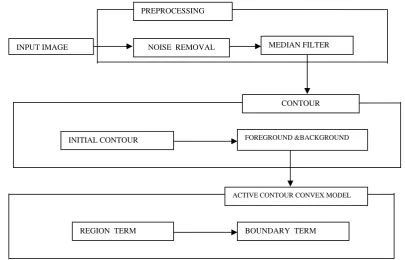
Figure 3 represents the understandable working model of this paper robust interactive image segmentation using convex active contours. First step begins with giving an input image that is to be segmented to produce a accurate boundary and the next step is the preprocessing –here computer supresses noise that can be able to enchance some of the features of the image which helps in better understanding of an image .And the inner work of preprocessing is included of adding salt and pepper noise for the input image. Salt-and-pepper noise is a form of noise sometimes seen on images. It presents itself as sparsely occurring white and black pixels. An effective noise reduction method for this type of noise is a median filter. The median filter is a nonlinear digital filtering technique, often used to remove noise. Such noise reduction is a typical pre-processing step to improve the results of later processing .Median filtering is very widely used in digital image processing because under certain conditions it preserves edges while removing noise . Next part is the boundary initialization here it comprises of segmentation and in which the first step is to separate the foreground and background of the image .Then the final step is our project method adding convex active contour model.In which it consists of two terms namely region term and boundary term.
Figure 3: Working Model Of Robust Interactive segmentation Using Convex Active Contour
REGION TERM BOUNDARY TERM
INITIAL CONTOUR
PREPROCESSING
INPUT IMAGE NOISE REMOVAL MEDIAN FILTER
ACTIVE CONTOUR CONVEX MODEL FOREGROUND &BACKGROUND
. Region Term -It holds the image properties like color,texture.
Boundary Term - Difference between the adjacent pixels are verified
A.Constrained Active Contour Model
In this we describe the continuous domain convex active contour model which extends the convex active contour model.
1) Preprocessing
Preprocessing images commonly involves removing low-frequency background noise, normalizing the intensity of the individual particles images, removing reflections, and masking portions of images. Image preprocessing is the technique of enhancing data images prior to computational processing. The median filter is a nonlinear digital filtering technique, often used to remove noise. Such noise reduction is a typical pre-processing step to improve the results of later processing .Median filtering is very widely used in digital image processing because, under certain conditions, it preserves edges while removing noise. 2) Initialization Of Contour
Initialization of contour is done using the region based method. Based on the initialized contour pre segmented output is obtained. In this using the region based method value similarity and spatial similarity is calculated and pre segmented output is obtained by initializing the contour. 3) Convex Active Contour Model
The convex active contour model consists of two terms: a regional term formulation and boundary term formulation. 1) Regional Term Formulation: The foreground and background seeds give an excellent description about the color distributions of the foreground and background regions. Foreground/background Gaussian mixture models (GMMs) introduced in [20] are estimated from foreground/background seeds, and used to represent the color distributions of the foreground and background regions.
4) Constrained Active Contour Model
Based on the above calculated values the constrained active contour model is constructed, based on the calculated values Compute the alpha channel inside the band, once distance is obtained. Estimate Foreground and Background components in Luv space for each pixel inside the band, after matte alpha is computed. With these components we can paste the object onto a new Background if desired with no noticeable visual artifacts by the simple matting equation. E. Silhouette Reconstruction A silhouette is the image of a person, an object or scene represented as a solid shape of a single color, usually black, its edges matching the outline of the subject. The interior of a silhouette is basically featureless, and the whole is typically presented on a light background, usually white, or none at all. The silhouette differs from an outline which depicts the edge of an object in a linear form, while a silhouette appears as a solid shape. Silhouette images may be created in any visual artistic media. Our algorithm reconstructs the smooth contours of the underlying mesh and then extrudes shadow volumes from the smooth
silhouettes to render the shadows. For this purpose we propose an improved silhouette reconstruction using the vertex normal of the underlying smooth mesh. Then our method subdivides the silhouette loops until the contours are sufficiently smooth and project to smooth shadow boundaries. Here we solve the two problems in a unified framework. Gradient controlled partial differential equation (PDE) surfaces to express terrain surfaces, in which the surface shapes can be globally determined by the contours, their locations, and height and gradient values. The surface generated by this method is accurate in the sense of exactly coinciding with the original contours and smooth with C1 (contour active convex region) continuity everywhere. The method can reveal smooth saddle shapes caused by surface branching of one to more and can make rational interpolated sub-contours between two or more neighbouring contours.
5) Region-Based Method:
The Continuous-domain convex active contour interactive image segmentation.
Continuous-domain convex methods have started to receive attention since they avoid the inherent grid bias in al discrete graph-based methods, and also have fast and global numerical solvers through convex optimization.
However, the convex active contour model so far has mainly been applied for automatic image segmentation, which often results in over-segmentation with trivial solutions for complex images. On the other hand, it is not clear how to apply the convex active contour model for interactive image segmentation.
We propose to marry the powerful continuous-domain convex active contour with one of the state-of-the-art region-based methods, either Geodesic or RW (Geodesic is chosen due to its fast processing speed), where the region-based method is used in the first step to generate an initial contour, and the convex active contour is then applied in the second step to optimize the contour.
Contour to geometry features:
Convex Active Contour Model,
Split Bregman Solver,
Contour Initialization,
Regional Term Formulation,
Boundary Term Formulation
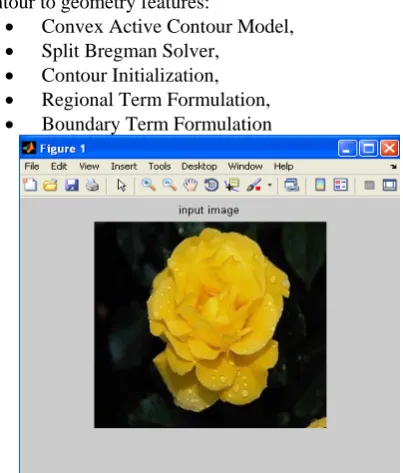
Figure 3.2 Localized Grab Cuts with Markers
Figure 3.3 Contour Mark
Figure 3.4 Saliency Map Chart
Figure 3.5 ROI Selection
Figure 3.6 Binarized ROI
Figure 3.7 Iterations on the Marked Contour
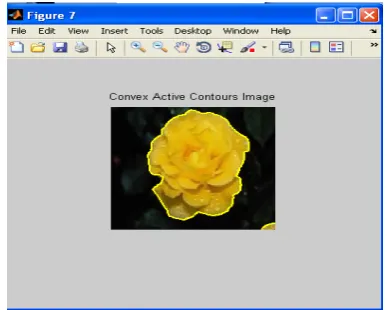
Figure 3.8 Convex Active Contour Image
IV. CONCLUSION
V. FUTURE WORK
Modification the normalized cut criteria for segmenting the graph. Normalized cutis an unbiased measure of disassociation between subgroups of a graph, and it has the nice property that minimizing normalized cut leads directly to maximizing the normalized association which is an unbiased measure for total association within the sub-groups.
REFERENCES
[1] Jianfei cai,Jianmin zheng,Juyoung zhang,Thinhatanh nguyen,senior members of IEEE,August 8 2012,”Robust interactive image segmentation using convex active contours”.in IEEE transaction of image processing of Vol.21
[2] J.Cai,.J.Zhang, J. Zheng ,2010 “A diffusion approach to seeded image segmentation,” in IEEE CVPR,
[3] M. Kass, D. Terzopoulos and A. Witkin ,1988 “Snakes: Active contour models,” IJCV, vol. 1, no. 4, pp. 321–331,
[4] Falcao, F. Miyazawa and J. Udupa, 2002, “An ultra-fast user-steered image segmentation paradigm: live wire on the fly,” Medical Imaging, IEEE Transactions on, vol. 19, no. 1, pp. 55–62,
[5] Blake, V. Kolmogorov and C. Rother, 2004, “Grabcut: Interactive foreground extraction using iterated graph cuts,” in ACM SIGGRAPH,
interactive image segmentation through unified combinatorial user inputs,” IEEE Transactions on Image Processing, vol. 19, no. 9, pp. 2470–2479.
[7] L. Grady and A. Sinop , 2007, “A seeded image segmentation framework unifying graph cuts and random walker which yields a new algorithm,” in IEEE ICCV, , pp. 1–8.
[8] Duchenne, O. et al.2008,, “Segmentation by transduction,” in IEEE CVPR,, pp. 1–8.
[9] O. Duchenne, J.-Y. Audibert, and R. Keriven, “Segmentation by transduction,” in Proc. IEEE Comput. Vis. Pattern Recog., Anchorage, AK, Jun. 2008, pp. 1–8.
[10] K. McGuinness and N. E. O’Connor, “Toward automated evaluation of interactive segmentation,” Comput. Vis. Image Understand., vol. 115, no. 6, pp. 868– 884, 2011.
[11] Y. Wang, W. Yin, and Y. Zhang, “A fast algorithm for image deblurring with total variation regularization,” Dept. Comput. Appl. Math., Rice Univ., Houston, TX, Tech. Rep. TR07-10, 2007. [12] T. Goldstein, X. Bresson, and S. Osher, “Geometric applications of