Parallel authenticated encryption with the
duplex construction
Pawe l Morawiecki1 and Josef Pieprzyk2
1
Section of Informatics, University of Commerce, Kielce, Poland
2
Department of Computing, Macquarie University, Australia
Abstract. The authentication encryption (AE) scheme based on the duplex construction can no be paralellized at the algorithmic level. To be competitive with some block cipher based modes like OCB (Offset CodeBook) or GCM (Galois Counter Mode), a scheme should allow par-allel processing. In this note we show how parpar-allel AE can be realized within the framework provided by the duplex construction. The first vari-ant, pointed by the duplex designers, is a tree-like structure. Then we simplify the scheme replacing the final node by the bitwise xor operation and show that such a scheme has the same security level.
1
Duplex construction
In 2010 Bertoni et al. introduced the duplex construction which provides the framework for an authenticated encryption scheme [3]. In this sec-tion we briefly discuss the construcsec-tion with focus on the authenticated encryption. The duplex construction can be seen as a particular way to use the sponge construction [2], hence it inherits its security properties. The construction is based on the fixed permutation (or transformation) and allows the alternation of input and output blocks at the same rate as the sponge construction. Figure 1 shows the duplex construction. Similarly as in the sponge construction, there are two parameters: r
(bitrate) andc(capacity). The sum of those two parameters makes the state size. Different values for bitrate and capacity give trade-offs between speed and security. A higher bitrate gives a faster construction at the expense of a lower security. Upon initialization all the bits of the state are set to zero. The duplex construction accepts input calls (denoted byin in Figure 1) to the underlying permutationf. The padded input
strings have the size of r bits. After a call to the permutation f, an outputr-bit string is returned (denoted byzn in Figure 1). Please note
that the capacity part of the state is never directly manipulated by an input stringin, nor is included in output stringszn.
Fig. 1.Duplex construction
r
f
c
pad
i0 z0
pad i1
f
z1
pad i2
f
z2
….
duplexing duplexing duplexing
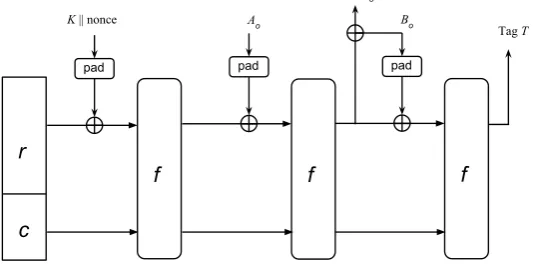
1. The keyK (optionally concatenated with nonce) is absorbed. 2. r-bit block of associated data Ai is absorbed (and remains
unen-crypted). Thenr-bit block of messageBiis absorbed and encrypted
with ther-bit block squeezed from the current internal state. 3. A tag T is returned as the r-bit block squeezed after the last B
block processed. (Empty blocks are processed if more thanrbits are needed for tagT.)
Fig. 2.Authentication encryption scheme based on the duplex construction
r
f
c
pad K || nonce
pad Ao
f
ciphertext Copad Bo
We assume that all blocks are properly padded and frame bits are in-cluded. We refer to Algorithm 3 in [3] for a formal description.
Figure 2 illustrates a simple scenario where a pair of (A0, B0) is processed
and theT is produced.
2
Parallel encryption with the duplex
construction
To be competitive with some block cipher based modes like OCB (Offset CodeBook) or GCM (Galois Counter Mode), the AEAD scheme should allow parallel processing. However, the AEAD based on the duplex con-struction can no be paralellized at the algorithmic level. In [3] the authors just briefly state that tree-like processing (described in detail for hashing, see Section 3.3.2 in [2]) could be used also for the duplex-based AEAD providing parallel streams with some overhead. But no more details are given.
2.1 Parallel encryption with the final duplex node
First variant of parallel duplex-based AEAD is inspired by tree-hashing with the following parameters: tree heightH = 1, node degreeDequals to the number of ‘streams’. It was defined in [2, Section 3.3] in terms of a sponge function as a compression function. Since the duplex construction has been proven equivalent to a cascade of sponge functions it inherits sponge security properties [3]. Consequently, tree-duplexing has the same security properties as a tree-hashing based on sponge functions. What is different though, is that a (parallel) authenticated encryption scheme has to provide confidentiality which is not required in (parallel) hashing. Let us first describe a variant of parallel duplex-based AEAD, where beside a nonce we introduce a counter. Then we explain why a counter (or some equivalent mechanism) is needed to provide full confidentiality and prevent from leaking information about message blocks.
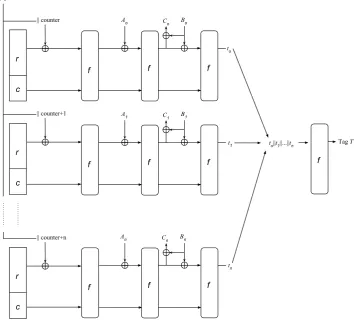
Message blocks (A0, B0),(A1, B1), . . . ,(An, Bn) are processed in separate
duplex streams and they meet in the final node to produce a tag for the whole message. An input to the first duplex (in each stream) is a secret key concatenated with a nonce and a counter. Then for each streamithe associated dataAi is processed followed by the message blockBiwhich
is encrypted. In each stream, after the last call of permutationf,rbits are squeezed. They are concatenated and making an input for the final duplex node which generates the tagT. Figure 3 illustrates the scheme. For clarity we omit padding symbols in Figure 3 but we assume that every input block to the duplex is properly padded. We also assume that intermediate tagst0, t1, . . . , tnhas the same length as the final tagT.
To simplify security analysis we let an attacker know intermediate tags
t0, t1, . . . , tn. This way we can analyze every stream separately. And it
Fig. 3.Parallel authentication encryption scheme based on the duplex construction
f
key || nonce
Ao
f
Co Bo
f r
c
|| counter
r
c
|| counter+1
r
c
|| counter+n
f
A1
f
C1 B1
f
f f f
An Cn Bn
to
t1
tn
Tag T to||t1||...||tn
f
somehow exploited by the attacker. Ast0, t1, . . . , tn are already known,
the key recovery attack (recovery of the state) starting fromT does not make sense, it would only make the task harder. A forgery ofT would mean that the attacker can somehow controlt0, t1, . . . , tn, e.g., can find
two messages giving the samet0. But as a length of each oft0, t1, . . . , tn
is the same asT such a control would contradict the security of a given, single stream. Therefore we state that an addition of the final duplex call does not help the attacker and the whole scheme is secure.
some information on the message structure. For example, letB0 equal
toB1and letA0 equal toA1. Then the attacker having only ciphertexts
C0andC1 would deduce that message blocksB0 andB1 are the same.
2.2 Simpler scheme
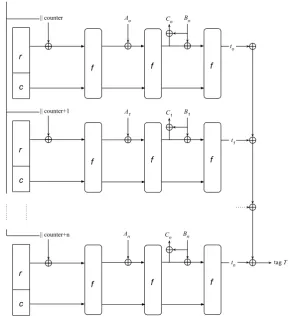
The scheme can be simplified when the final duplex node is replaced by the XOR operation. Figure 4 shows such a scheme.
Fig. 4. Parallel authentication encryption scheme based on the duplex construction without the final duplex node
f
key || nonce
Ao
f
Co Bo
f r
c
|| counter
r
c
|| counter+1
r
c
|| counter+n
f
A1
f
C1 B1
f
f f f
An Cn Bn
to
t1
tn tag T
we give the attacker knowledge oft0, t1, . . . , tnin advance. A tag forgery
would mean that the attacker can control the xor differences between
t0, t1, . . . , tn. This would contradict the security of a single stream. In
par-ticular we assume that the underlyingfpermutation has such differential properties that after the first call (with an input of keyknoncekcounter), the attacker has no control of differences. Please note that exactly the same argument is used in [1] by Keccak designers where they analyze one of the duplex-based construction. They state:
“We rely on the initialization phase and its nonce to make differential attacks infeasible: an attacker has no control whatsoever over state dif-ferences between pairs of monkeyDuplex objects. This limits his attack path to state reconstruction.”
3
Conclusion
We have shown how parallel AEAD can be realized within the framework provided by the duplex construction. We have simplified the tree-like scheme, suggested by the duplex designers, removing the final node and replacing it by the xor operation. In both discussed variants we high-light the importance of the counter (or some equivalent mechanism) for providing confidentiality.
References
1. Bertoni, G., Daemen, J., Peeters, M., Assche, G.V.: Permutation-based encryption, authentication and authenticated encryption (July 2012)
2. Bertoni, G., Daemen, J., Peeters, M., Van Assche, G.: Cryptographic sponges, http://sponge.noekeon.org/CSF-0.1.pdf