594 | P a g e
END-TO-END DELAY MODELING WITH
MARKOVIAN QUEUING BASED OPTIMUM ROUTE
ALLOCATION FOR MANETs
Mrs.V.S.Lavanya
1, Ms.S.Sudha
2 1,2Department of Computer Science, P.K.R Arts college for women, (India)
ABSTRACT
With the recent development in wireless communication technologies, mobile ad hoc networks (MANETs) have become applicable for several critical applications, mainly, rescue emergency, relief measures for disaster, network coverage for cellular networks, and so on. Though large number of work have been investigated to provide commercialization of MANETs, knowing their basic delay performance has been a critical research issue to support different applications with several quality of service (QoS) essentials. This paper focuses on End-to-End delay methoding with Multi Hop Routing using Optimal Route Allocation. In this work we propose an integrated approach that addresses both storage buffer and security for MANET with improved end to end delay analysis. Optimal route allocation is first made by applying dynamic routing protocol. Their cross-section profiles between multiple paths are optimized and processed through Integer Programming method. The cross-section profile for each route path’s buffer constraint is handled by introducing storage of buffer of relay mobile node (i.e. router) using Markovian Queuing method. This is to minimize the link cost between the selected optimal routes. Finally, security between the nodes is ensured through Multiple Unique Hash Chain method. To demonstrate the application of our proposed work, case studies are further provided under different network scenarios to show how the E2E delay can be analytically determined for different network scenarios. Finally, extensive simulation are conducted to illustrate the efficiency of our delay analysis as well as the impacts of network parameters on delay performance, packet delivery ratio and storage buffer with respect to data packet size and data packet generating rate.
Keywords: MOBILE AD HOC NETWORKS, QUALITY OF SERVICE, END-TO-END DELAY, INTEGER PROGRAMMING METHOD, MARKOVIAN QUEUING, HASH CHAIN
I. INTRODUCTION
In a network where certain communicating routes between mobile nodes do not exist, is referred to as the delay
tolerant networks. In these types of delay tolerant networks, the nodes communicate either by the pre-defined
routes or through other nodes. Certain types of issues occurs when the network is said to be distributed and
positioned into different areas because of the high mobility rate or when the network prolongs over several
distances. The conventional method for the queuing system was to provide a method of balance equations to
595 | P a g e
(E2ED-B) [1] mobile ad hoc networks focused on two-hop relay mobile ad hoc networks for end-to-end delayanalysis. The E2ED-B framework combined the theories of fixed-point (FP), quasi-birth-and-death process, and
embedded Markov chain. The framework then methoded limiting distribution of the occupancy states of a relay
buffer. To the occupancy states of relay buffer, the Markov chain theory was then applied to categorize packet
delivery process. This was designed in such a way that an entire theoretical framework for E2E delay analysis
was included. However, the end-to-end delay methoding in buffer limited constraints with 2HR (E2ED-B) did
not take into consideration the security aspects and the constraint on buffer space was not addressed. The
framework did not investigate E2E delay methoding for MANETs with multi-hop routing schemes, therefore
increasing the routing overhead.
As a step towards the methoding of E2E delay for the MANETs, we study the E2E delay methoding for
MANET‟s using Optimal Route Allocation-based Multi Hop Routing. The main contributions of this paper are
summarized as follows.
• To improve end-to-end delay by obtaining optimal route with the aid of Integer Programming method.
• To design a Markovian Queuing method that reduces link cost significantly by improving storage buffer.
• To ensure security with the aid of Multiple Unique Hash Chains, where the keys are distributed to the mobile
nodes on the basis of their hop distances for packet authentication.
The paper is organized as follows. In the next section (Section 2), we discuss some related work in end-to-end
delay analysis in MANET. In Section 3, the proposed framework, E2E delay methoding for MANETs with
Markovian Queuing-based Optimum Route Allocation (MQ-ORA) is presented with the algorithm and block
diagram. In Section 4, experimental setup to conduct the proposed work is provided. In Section 5, a simulation
method for studying the performance of MQ-ORA is presented and detailed discussion is provided with the aid
of table and graph. The simulation results are discussed. The paper concludes with concluding remarks in
Section 6.
II.LITERATURE REVIEW
Given a limited number of route paths, the objective of route allocation is to optimize the route in such a way
that the delay incurred during routing is reduced, ensuring improved throughput rate or packet delivery ratio.
Several research works were conducted by different researchers in the area of end to end delay analysis in
MANET.
Greedy Geographic Routing was provided in [2] where the decision regarding route was made on the basis of
neighboring nodes closest to the destination node. Link estimation and swarm intelligence were applied in [3] to
analyze the routing performance resulting in the improvement of total number of route discovery. Another
multi-path QoS routing method was analyzed in [4].
Many influential variables play a vital role in analyzing end to end delay. Two methods based on Radial Basis
Function (RBF) and Generalized Regression Neural Network (GRNN) was applied in [5] to analyze the end to
end delay. An efficient routing for large scale MANET was discussed in [6] based on hierarchical routing.
Despite efficient routing, energy consumption was less concentrated. To address this issue, an improved hybrid
596 | P a g e
remained unaddressed. Novel Statistical Feature-based Power Control (SFPC) [8] addressed the communicationcost and time via Channel State Information (CSI). This had a great impact on cellular communication.
In this paper, we propose an effective End-to-End delay methoding detector based on the combination of
cooperative network and dynamic routing protocol. We provide an Optimal Route Allocation framework to
select the best combination. An exhaustive quantitative analysis is also given to prove the superiority of our
framework over the state-of-the art works.
III.METHODOLOGY
In this section, an end-to-end delay analysis framework for MANET using Markovian Queuing-based Optimum
Route Allocation (MQ-ORA) is presented. The proposed framework is performed on the network settings
provided in the experimental section. The MQ-ORA framework is divided into Optimum Route
Allocation-based Multi Hop Routing method, Markovian Queuing methodand Secured Multiple Unique Hash Chain
method. Finally, detailed performance analysis is made and compared with the E2ED-B [1]. The details of these
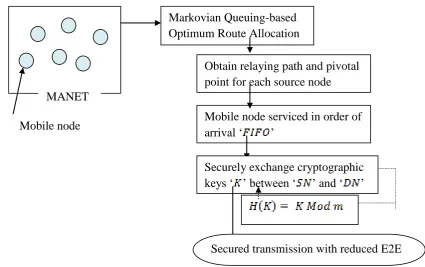
methods are provided in the following sections. Figure 1 shows the block diagram of Markovian Queuing-based
Optimum Route Allocation method.
Figure 1 Block diagram of Markovian Queuing-based Optimum Route Allocation
As shown in figure 1, the Markovian Queuing-based Optimum Route Allocation method provides a way for safe
and secure transmission of data packets between mobile nodes in MANET. In this proposed method, buffer
constraint is reduced via link cost minimization. With the improved buffer cost, end to end delay is said to be
ensured.
MANET
Mobile node
Markovian Queuing-based
Optimum Route Allocation
Obtain relaying path and pivotal
point for each source node
Mobile node serviced in order of
arrival „
‟
Securely exchange cryptographic
keys „ ‟ between „
‟ and „
‟
597 | P a g e
Optimum Route Allocation-Based Multi Hop Routing Method
Given a limited number of routes, the goal of mobile ad hoc network is to obtain the optimum route to increase
the resource utilization and therefore improve packet delivery ratio, with reduced end to end delay. In the
proposed MQ-ORA framework, Multi Hop Routing (MHR) scheme is introduced to provide better connection
between mobile nodes in network. This is said to be achieved via cooperative network. With the aid of
cooperative network, the MQ-ORA framework employs dynamic routing protocol. Here, the route is
represented by a pair and is mathematically denoted as given below.
(1)
From (1), the route „ ‟ is said to be established between the nodes in network with the aid of the relay nodes
„ ‟ at a specific time slot „ ‟. In order to ensure Optimum Route Allocation in the proposed MQ-ORA
framework, process of establishing ORA-based MHR is instigated. In order to perform Route Allocation,
whenever a source node makes a call request, a relaying path is set up to relay signals for the call, where the call
is considered as a session. It is mathematically formulated as given below.
(2)
From (2), for each source node „ ‟, a relay path „ ‟ for each session „ ‟ is established. Each mobile node on
the path is assigned a route for the session. To design a starting point of a session in a source node, a pivotal
point, called source point s is defined, where source node possess several pivotal points „ ‟, each point for
different session. It is mathematically formulated as given below.
(3)
Given a set of relaying paths, the objective of the proposed work is to identify a route that minimizes the total
packet relaying delay using Integer programming method. Let us consider a time-slot and relay node of a route.
Let „ ‟ and „ ‟ denote the maximum time-slot and maximum number of relay nodes in the
network. Now, the route assigned in the proposed framework using integer programming method is done
through two binary variables. The two binary variables are represented by „ ‟.
(4)
(5)
The pseudo code representation of Optimum Route Allocation using Integer Programming, called, Integer
598 | P a g e
Input: Source Node „ ‟, Session „ ‟, maximum time-slot „ ‟, maximum number of relay nodes„ ‟
Output: Optimized route allocated
1. Begin
2. For each Source Node „ ‟
3. Measure relay path using eq. (2)
4. Obtain pivotal point using eq. (3)
5. Measure the route using eq. (4) and eq. (5)
6. End for
7. End
Algorithm 1 – Integer Programming-based Optimum Route Allocation algorithm
The above algorithm using Integer Programming method provides an optimal solution in reducing the delay in
packet transmission between the mobile nodes in network. It also ensures optimal routing through relaying paths
using the pivotal points for each session.
Markovian Queuing Method
Once the optimal route allocation is made, the proposed framework next uses a Markovian Queuing method
with the objective of solving the buffer constraint and therefore improving the issues related to storage. The
buffer of Relay Mobile Node in [1] is limited due to its storage space limitation and computing limitation. This
storage of Buffer of Relay Mobile Node (router) is improved in the proposed framework by solving the buffer
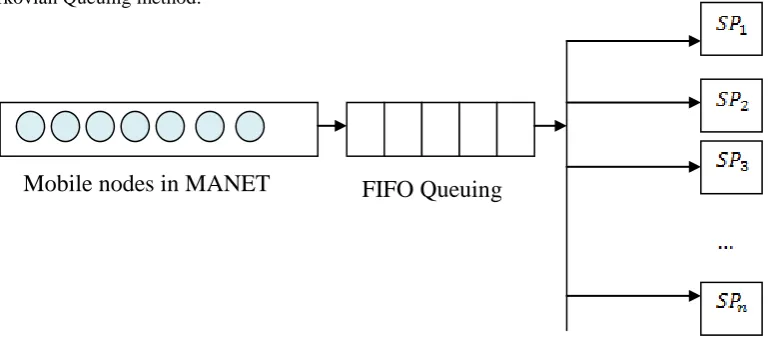
constraint via M/M/1/B queuing method (i.e. Markovian Queuing method) through service providers. This in
turn reduces the link cost subject to Round Trip Time for (aggregated) traffic from source node to destination
node and the propagation delay between the source and destination nodes. Figure 2 shows the flow diagram of
Markovian Queuing method.
Figure 2 Flow diagram of Markovian Queuing method
599 | P a g e
With Markovian Queuing method, the service providers in the proposed framework adopt FIFO where themobile node in MANET is serviced in order of arrival. Being a single lane method, each mobile node arrival
moves to the next cell if empty or waits and moves, when the mobile node ahead, vacates the cell. Thus the
Markovian Queuing method adopted in the proposed work comprises of only two configurations for a particular
mobile node, either the cell ahead is empty or occupied. We say a mobile node is in service when the cell ahead
is „empty‟ and waiting if it is occupied.
(6)
(7)
From (6) and (7), the service providers see to that if the mobile node „ ‟ is in service or waiting. This is
because only two configurations are said to be possible. They are either „ ‟ or „ ‟.
Secured Multiple Unique Hash Chain Method
Finally, with the service providers following a FIFO Markovian Queuing method, the proposed framework
provides security using Multiple Unique Hash Chain method. To achieve security during packet transmission
between source and destination nodes, the proposed framework uses a Diffie-Hellman-Hash algorithm.
The objective of using the Diffie-Hellman-Hash algorithm in the proposed framework is that it possesses a
method of securely exchanging cryptographic keys over a public channel, using multiplicative group of integers
„ ‟ and „ ‟ respectively. The value of „ ‟ is selected in such a way that it is a prime number. On the other hand,
the value of „ ‟, is a primitive root module „ ‟.
(8)
The generated cryptographic keys are used for a particular session. Followed by the generation of cryptographic
keys, the Diffie-Hellman output is hashed using the division remainder method. For each mobile node with
particular session, the initial key is used to encrypt the next key element with the resultant value being the initial
key and the next key element respectively. The size of the number of items in the table is estimated. That
number is then used as a divisor into each original value or key to extract a quotient and a remainder. The
remainder is the resultant key element (i.e. cryptographic keys) is hashed with the data packet. The pseudo code
representation of Diffie- Hellman-Hash algorithm for providing security is provided below.
Input: Source Node „ ‟, Session „ ‟, maximum time-slot „ ‟, multiplicative group of integers „ ‟, „ ‟
Output: Secured data packet transmission
1. Begin
2. For each Source Node „ ‟ with Session „ ‟
600 | P a g e
4. Evaluate the value of „ ‟ using eqn (8)5. End for
6. End
Algorithm 2 – Diffie- Hellman-Hash algorithm
The above algorithm using Division Remainder method enhances the security for the data packets being
delivered and therefore reducing the delay in packet transmission between mobile nodes.
Performance evaluation
This section evaluates the proposed multi hop routing scheme by simulation results by adopting NS2 simulator.
Study presents the performance of Markovian Queuing-based Optimum Route Allocation (MQ-ORA) method
and compares with its traditional End-to-End Delay in Buffer Limited [E2ED-BL] method [1].
To evaluate the performance of MQ-ORA method, we consider a network consisting of 70 nodes within the
1000 * 1000 rectangular area and uses Random Waypoint Methodas the mobile method. The source destination
combination for MQ-ORA method is spread in the network in random form where the data packet generating
rate is set as 10, 20, 30,…, 70 packets / second.
IV.DISCUSSION
In this section the result analysis of MQ-ORA method is made and compared with the existing method,
End-to-End Delay in Buffer Limited [E2ED-BL] [1] in MANET. In this section the scenario with 70 mobile nodes
within the defined area and the number of data packet size in the range of 100KB and 700KB is considered.
Each mobile node moves with the velocity of 0 – 15 m/s and the simulation method were executed 7 times. To
evaluate the efficiency of MQ-ORA method, the following metrics like end-to-end delay, packet delivery ratio,
storage buffer in MANET is measured.
End-to-End Delay
End-to-end delay refers to the time taken for a packet to be transmitted across a network from source to
destination. It is measured in terms of milliseconds (ms) and is mathematically formulated as given below.
(9)
From (9), end-to-end delay is measured using the data packet size „ ‟, with source node and
destination node denoted by „ ‟ and „ ‟ respectively. Lower the end-to-end delay, more efficient the method
601 | P a g e
Table 1 Tabulation for end-to-end delayData Packet size (KB) End-to-end delay (ms)
MQ-ORA E2ED-BL
100 35.42 43.52
200 41.32 49.43
300 52.31 60.41
400 68.76 76.86
500 51.90 59.23
600 63.14 71.23
700 71.85 95.32
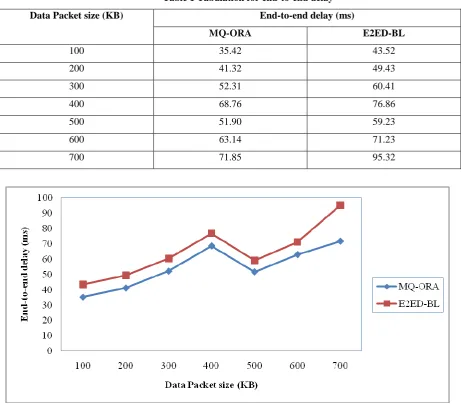
Figure 3 End-to-End delay comparisons of MQ-ORA with E2ED-BL
Figure 3 shows the end-to-end delay comparison of the proposed MQ-ORA method with the existing E2ED-BL
[1] method. To conduct experiments and analyze end-to-end delay, a network scenario with data packet size in
the range of 100KB to 700KB is considered. The size of each data packets ranges from 20KB to 120KB. The
results observed was the end-to-end delay using MQ-ORA method was 35.42ms, 43.52ms when E2ED-BL was
considered. The resulting graph is plotted in figure 3. Its performance increases with the increase in the number
of data packets, though linearity is not said to be observed due to the topological changes
Packet Delivery Ratio
Packet delivery ratio refers to the average rate of successful data packets received at the destination over a
602 | P a g e
(10)From (10), the packet delivery ratio „ ‟ is obtained using the data packets received rate „ ‟ to the
data packets generating rate „ ‟ over a time interval. Higher packet delivery ratio ensures efficiency of the
method. Table 2 shows the tabulation of packet delivery ratio.
Data Packet generating rate Packet Delivery Ratio (pps)
MQ-ORA E2ED-BL
10 8 6
20 15 12
30 25 19
40 35 31
50 43 39
60 56 51
70 65 60
Table 2 Tabulation for Packet Delivery Ratio
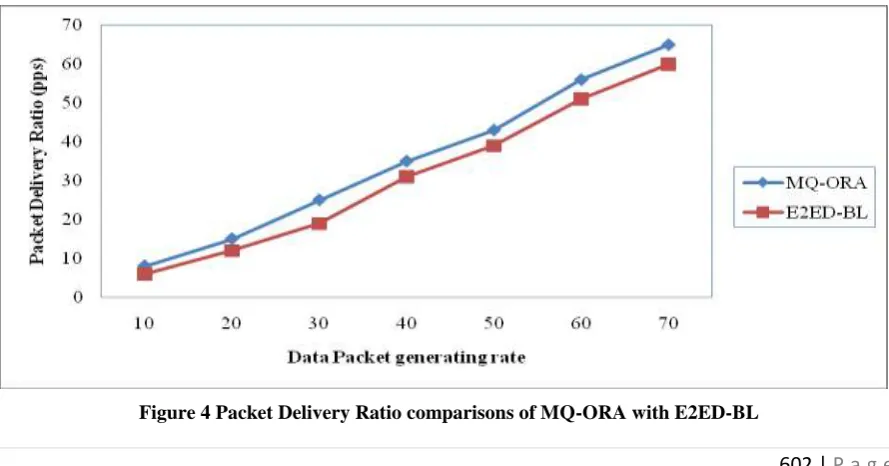
Comparison of E2ED-BL method for solving packet delivery ratio in MANET is performed for the above said
network settings. To measure the packet delivery ratio, data packet generating rate has a great influential factor.
To depict this issue, packet delivery ratio for rendering quality of service is measured. It is the ratio of data
packets received to the data packet generating rate.
Specifically we fix the maximum speed of mobile node to 40 m/s and vary the number of mobile nodes from 10
to 70. Figure shows that the packet delivery ratio with varying mobile nodes increases as the number of mobile
nodes increases by applying all the method. This cause improved packet delivery ratio by applying MQ-ORA
method by 19% compared to E2ED-BL method.
603 | P a g e
Figure 4 shows the quantitative results to compare the packet delivery ratio performance of the two methods. Toinvestigate the impact of packet delivery ratio utilization, we ran a simulation varying the data packet generating
rate in the network.
Storage Buffer
Storage buffer refers to the number of temporary storage of data packets of other nodes, i.e., waiting to be sent
to a device or node. It is measured in terms of kilo bits per second (Kbps). Higher the rate of storage buffer,
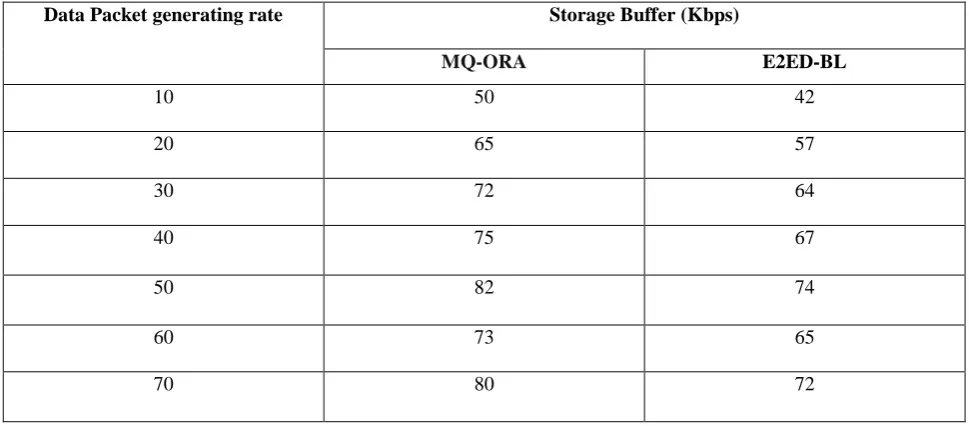
efficient the method is said to be. Table 3 show the tabulation for storage buffer with respect to different data
packet generating rate in the range of 10 to 70 conducted for 7 different simulation runs. Table 3 illustrates the
storage buffer rate for storage of other node‟s packets versus data packet generating rate. As shown in the figure,
the storage buffer is proportional to the data packet generating rate. As the data packet generating rate increase
and the data packet size also increases, the MR-ORA method occupies higher storage buffer compared to
E2ED-BL [1]. At the same time, the storage buffer observed is not linear and varies due to the change in topology
resulting in the node positional changes.
Here the MQ-ORA method ensures optimal storage buffer we are performing Markovian Queuing that obtains
the flow to be serviced in a first in first out basis without having the data packets stored permanently. As a
result, storage buffer is said to be ensured and therefore transmit the total packets to the destination in an
efficient manner.
Data Packet generating rate Storage Buffer (Kbps)
MQ-ORA E2ED-BL
10 50 42
20 65 57
30 72 64
40 75 67
50 82 74
60 73 65
70 80 72
604 | P a g e
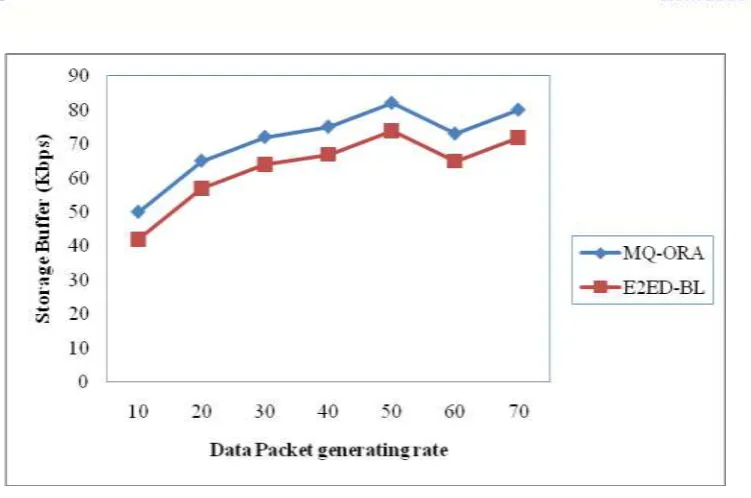
Figure 5 Storage buffer comparisons of MQ-ORA with E2ED-BLFigure 5 illustrates the storage buffer comparison. From the graph and results, we observed that as the data
packet generating rate increases though storage buffer increases, comparatively the performance of MQ-ORA
method is better than that of E2ED-BL by 13%. V.CONCLUSION
This paper represents a significant step towards the end-to-end delay modeling in MANETs. With the help of
the theories of Optimum Route Allocation-based Multi Hop Routing, Markovian Queuing and Secured Multiple
Unique Hash Chain method, a novel theoretical framework has been developed to efficiently depict the highly
dynamics in such networks. Also, it is expected the framework can shed light on the E2E delay modeling for
multi-hop MANETs. The secured integer programming model is formulated as a maximum likelihood routing
problem where optimal routing through relaying paths are identified based on the pivotal point. By measuring
the optimal routing, we propose a Diffie- Hellman-Hash algorithm based on the cryptographic keys to ensures
genuine data packet transmission with the aid of division remainder method. Extensive simulations have been
conducted to validate the efficiency and applicability of our framework, and some interesting theoretical
findings about the impacts of network parameters on delay performance, packet delivery ratio and storage buffer
have been discussed.
REFERENCES
[1] Jia Liu, Min Sheng, Yang Xu, Jiandong Li, and Xiaohong Jiang, “End-to-End Delay Methoding in Buffer-Limited MANETs: A General Theoretical Framework”, IEEE TRANSACTIONS ON WIRELESS
COMMUNICATIONS, VOL. 15, NO. 1, JANUARY 2016
[2] Fraser Cadger, Kevin Curran, Jose Santos and Sandra Moffett, “Mobility and Delay in Greedy Geographic
605 | P a g e
[3] Prabha R. and Ramaraj N., “An improved multipath MANET routing using link estimation and swarmintelligence”, EURASIP Journal on Wireless Communications and Networking, May 2015
[4] Ch. Niranjan Kumara, N.Satyanarayanab, “Multipath QoS Routing for Traffic Splitting in MANETs”,
International Conference on Intelligent Computing, Communication & Convergence, Elsevier, May 2015
[5] Jyoti Prakash Singh, Paramartha Dutta, Arindrajit Pal, “Delay Prediction in Mobile Ad Hoc Network using
Artificial Neural Network, Computer, Communication, Control and Information Technology, Elsevier, May
2012
[6] Seyed Hossein Hosseini Nazhad, Mohammad Shojafar, Shahaboddin Shamshirband, Mauro Conti, “An
efficient routing protocol for the QoS support of large scale MANETs”, Wiley, June 2017
[7] Mustafa Hamid Hassan and Ravie Chandren Muniyandi, “An Improved Hybrid Technique for Energy and
Delay Routing in Mobile Ad-Hoc Networks”, International Journal of Applied Engineering Research ISSN
0973-4562 Volume 12, Number 1 (2017) pp. 134-139
[8] Peng Sun, Kang G. Shin, Hailin Zhang, and Liang He, “Transmit Power Control for D2D-Underlaid Cellular
Networks Based on Statistical Features”, IEEE TRANSACTIONS ON VEHICULAR TECHNOLOGY, VOL.