Automatic Cost Effective Phase Selector
Ashish Kumar Gupta
1, Chandan Singh
2, Gurpreet Singh
3, Arun Kumar
4UG Students, Dept. of EN, Krishna Institute of Engineering and Technology, Ghaziabad, UP, India1,2 &3.
Assistant Professor, Dept. of EN, Krishna Institute of Engineering and Technology, Ghaziabad, UP, India4.
ABSTRACT: Electricity is lifeline of any country and its continuous availability at minimum cost ensure the country’s growth. Reducing the burden over the energy resources leads to the use of alternative sources of energy like Solar, Wind etc. also they are available free of cost. So modern industries and homes, to ensure regular power supply incorporates mainly three sources of energy i.e. Solar, Mains(Utility grid), Diesel generator sets. So an automatic phase selector circuit is required for the switching between these supplies with the Solar having the highest priority followed by Mains for having access of cheapest electricity. The circuit make use of Transformer, Rectifier, Regulator, Comparator and Relays. The switching time is reduced considerably due to the use of high speed electronics devices.
KEYWORDS: Transformer, Bridge Rectifier, Op-amp,Relays, Solar, Mains, Cost.
I.INTRODUCTION
Electricity acts as a backbone of any economy in the world and for the developing nation power instability and high pressure over the natural resources available due to the overpopulation poses a greater threat to their development.So there is necessity for automation of electric power generated along with availability of alternative sources of energy for the purpose of backup to the utility supply [1].The requirement for the renewable sources can be understood from the following data: India is sixth largest energy consumer in the world, holds a share of about 3.7% of global energy usage, having Maharashtra as the top power generator Indian state among others. Because of India’s economic growth, the requirement for power has rise at an average of 3.9% per annum for the last 30 years.
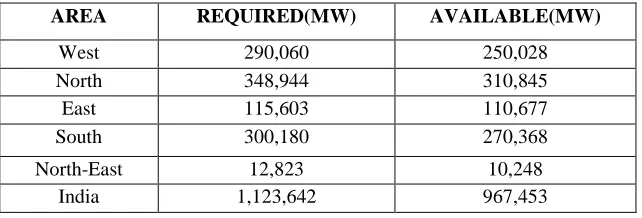
Table 1. Supply and Demand Status
AREA REQUIRED(MW) AVAILABLE(MW)
West 290,060 250,028
North 348,944 310,845
East 115,603 110,677
South 300,180 270,368
North-East 12,823 10,248
India 1,123,642 967,453
In the table 1, the present situation of indian power sector is shown, the difference between the supply and demand can be inferred from it.
at high speed [1]. Here we felt the need of automation industry. More importantly all electrical systems are built upon the three important factors viz. reliability, safety and economy. Safety and reliability is ensured by making use of automation and switching load to efficient phase conforms economy [2]. The switching circuit make use of elementary electronics devices namely transformer (220V/12V), a bridge rectifier(B20), a set of capacitors having capacitance of 1000 microfarad and 1000 microfarad, a voltage regulator (IC7805), an op-amp as a comparator (LM358), a transistor (BC547) and relays.
II. RELATED WORK
The automatic phase selection to drive single phase load from the available three phase supply is already done by making use if microcontroller and opto-coupler ICs where microcontroller senses the incoming voltage levels from the three phases if voltage in any one of the phase namely R, Y and B, a signal is transferred to the relay mechanism through opto-coupler to perform the switching to Y phase if R phase goes down and finally to the B phase if both of the phases (R and Y) falls below the standard voltage of 200 Volts generally. The function of opto-coupler is just to provide the electrical isolation of low voltage circuit from that of the high voltage. The same concept of phase selection can be implemented by making use of the comparator ICs and transistors to connect the load with source whose cost of energy production is least [4]. The equipment used for building the circuit is also less than the circuit employing microcontrollers and opto-couplers.
III.OPERATING TECHNIQUE
The prioritized supply from the solar is delivering the power to the load and the portion of it has been taken to feed the switching circuit through the step down transformer. A reduced voltage output obtained from the secondary of the transformer is delivered to the rectifier and the DC output is smoothened with the help of capacitors. The 12 volt DC when applied to the regulator a voltage of 5 volt is obtained between one of its pin and common. The 5 volt signal is now feed to the comparator, here op-amp acts as the comparator and compare the incoming voltage with a predefined voltage level regulated by the zener diode and if the voltage from the solar remains in the range 200-220V the input at the inverting terminal of the op-amp remains higher than the non-inverting terminal therefore the outcome of the op-amp at pin 6 also remains high making transistor idle and the relay continues the condition of normally connected (NC) and solar is feeding the load directly. In case the input is below the rated value, the load is automatically connected to the Mains if available otherwise the Diesel generator set is asked for the supply [5].
In the Fig.1, the pictorial representation of the process is done and designing the system as per the above flow chart will ensure proper functioning of the installed system and judicial use of the equipment can be ensured to achieve the target of cost effectiveness in the system itself.
IV. PRINCIPLE FUNCTIONAL UNITS
The desired objective can be achieved by connecting elements in logical sequence and proper rating equipment has to be chosen.
A. Transformer
It is one of the most important element of the circuit as it step down the voltageto a level of 12 volts [3]. This voltage is further bring down to a level of 5 volt (the electronics working voltage) and used. The core material and winding ratio is selected precisely so as to have desired output voltage at the secondary.
Vin = Vmsin(wt). (1)
Vout =
𝑉𝑚
𝑛 sin(wt). (2) where n is the turns ratio.
If Vm = 220* 2 = 311.12698 volts then to have 12 volts as peak voltage in the secondary side turns ratio, n = 26. (3)
B.Bridge Rectifier
The output voltage from the transformer is rectified by a bridge rectifier to have a unidirectional voltage, as it is circuit which converts AC to pulsating DC. The rectifier circuit make use of 4 diode forming a bridge such that the 2 of them conduct for the positive cycle while the remaining two for the negative cycle thus a full wave rectifier is obtained [4]. The function of full wave bridge rectifier can be obtained when IC B20 is used after the transformer stage. The centre tap transformer is becoming obsolete because of the following reasons.
The TUF (transformer utilization factor) is more in bridge rectifier as compared with that of the center tap transformer.
Cutting the core in center tap is serious problem. Power loss is more in center tap transformer.
PIV of bridge rectifier is only Vm whereas other type have a PIV of 2Vm.
Hence cost is reduced if bridge rectifier is used.
Fig.2 Output waveform of the rectifier
C.Filter
The output of the rectifier is pulsating DC and it is passed through filter so as to smoothening the output waveform to approximately pure DC. The task of filtering is performed by a set of capacitor. The resulting waveform looks the same as shown below, the ripple present in output waveform is due to non-ideal behaviour of the capacitor as it takes time to charge as well as discharge decided by the time constant of the circuit in which it is connected. The constant is decided by the numerical values of the resistor and the capacitor i.e. T=RC sec. However the ripple waveform looks like triangular wave
withVp
2 as the peak to peak voltage ripple [4].
Fig.3 Voltage variation across capacitor
In the Fig.3 the capacitor output voltage waveform is indicating presence of ripple. The ripple present in waveform can be suitably removed by proper selection of R and C values since time constant purely depends on their numerical values.
D.Design of Filter
V
rms=
𝑉𝑝𝑝
3
(4)
V
dc= V
m-
Vpp
2
(5)
Ripple factor, RF = Vrms Vdc
=
12 3 R f C
(6)
It can be concluded that ripple factor is the function of frequency, resistance, capacitance.To reduce the effect of ripple the capacitance value must be increased but there too is limitation.
E.Voltage Regulator
F.Operational Amplifier
An op-amp here is used as an comparator.It compares the incoming voltage signal from the sources like that of solar, mains
and the diesel generator on the basis of priority as indicated with a voltage kept at a constant level by making use of the zener diode. If the voltage falls below the reference voltage level the load connected to this phase is disconnected and switched over to the mains if solar is not providing thee correct voltage level. Here we have used IC 358. It is a 8 pin IC with pin number 6 as a output pin. LM358 is preffered over the others due to underlying reasons.
It is frequency compensated(internally). It has DC voltage gain of 100 dB. It’s Bandwidth at unity gain is 1 MHz. It hasbias current at input of 20 nA.
G.Transistor
The output whenever goes low on sixth pinof IC 358 the transistor gets activated and starts conducting thereby energizes the relay1 and load is disconnected from source say solar. The load is now transferred to the mains supply and in this case relay2 is providing power to the load through normally connected position. Here the use of IC BC547 as transistor is preferred. It is a NPNepitaxial silicon transistor and exceptional performance at 25 degree centigrade with the maximum ratings of
VCBO= 50.5 V (7)
VCEO = 45.7 V (8)
Ic = 100.0 mA (9)
Operating Junction and Storage temperature = -55to 150o C (10) Power Dissipation foe the temperature
(TA< 26) =500 mW.(11)
Logical and the sequential arrangement of the discussed components is done and some resistors are also used so as to limit the flow of excessive current under fault conditions to protect our equipment. The overall circuit yielded on practical grounds is given below.
V.CIRCUIT DIAGRAM
The circuit diagram which is required to be laid down on the PCB is shown below in the fig.4.
In Fig.4, the overall circuit with all the necessary equipment is laid down. This circuit is implemented by making use of the transformer (220V/12V), Rectifier, Filter, Voltage regulator, Comparator, Transistor and Relays.
The selection of equipment with proper rating is done by calculating their minimum and maximum rating of voltage and current across them under normal as well as abnormal operating conditions and proper care is taken in selection of the transformer as it is acting like interface between the electrical and electronics circuit used. The protection of delicate ICs must be ensured.
Fig.5 Circuit Implementation
In the Fig.5, Complete hardware implementation is shown. The necessary equipment which used after the stepping down the voltage to 12V is depicted here. The simplicity of the design with high performance is what we get from this circuit of automatic cost effective phase selector.
VI. EXPERIMENTAL RESULTS
power during day hours. The finally prepared hardware shown in Fig.5 works in accordance with that of proposed flow chart for the operation as indicated in Fig.1. The output of the Rectifier IC (B20) is in close resemblance with that of waveform drawn in Fig.2 and output of the capacitor filter follows the Fig.3 waveform. The circuit diagram for the operation as indicated by the Fig.4 acts as a prototype for the finally prepared hardware.
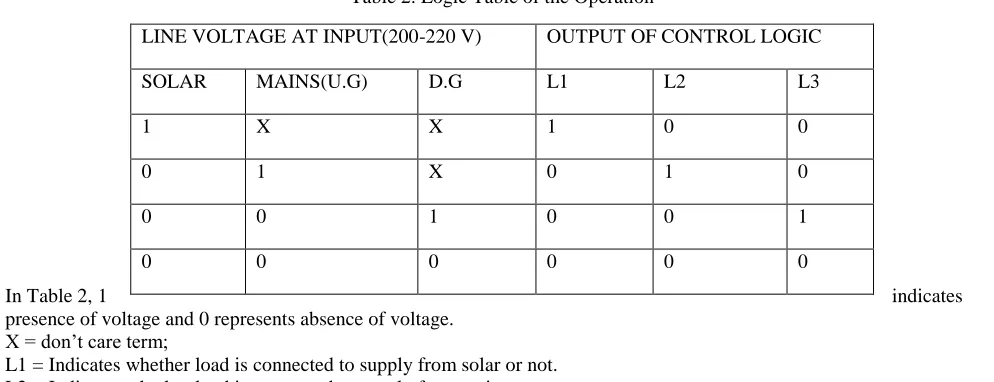
Table 2. Logic Table of the Operation
In Table 2, 1 indicates
presence of voltage and 0 represents absence of voltage. X = don’t care term;
L1 = Indicates whether load is connected to supply from solar or not. L2 = Indicates whether load is connected to supply from mains or not.
L3 = Indicates whether load is connected to supply from diesel generator (DG) or not.
VII. CONCLUSIONS
The cost effective phase selector is not only advanced procedure (technique) for the connection of the load to the phase, costing to the customer the least, automatically, but also helps in increasing the system’s reliability and safety (concept of automation). It is a safe method due to the presence of electronic components whose working voltage levels is considerably low of around 5 volts. The whole setup is static one thereby causing less power loss as compared to the circuits with moving parts and contacts operated manually (mechanical relays). Because of the compact size it is equally suitable for the household purposes along with the small scale industries.
R
EFERENCES[1] Oduobuk, Ettah, E. B., Ekpenyong,”Design and Implementation of Automatic Three Phase Changer Using LM324 Quad Integrated Circuit”,
International Journal of Engineering and Technology Research, Vol.2, pp. 1 – 15, 2014.
[2] Nwafor Chukwubuikem M., Mbonu Ekene S., Uzedhe Godwin,”A Cost Effective Approach to Implementing Change Over System”, Academic
Research International, Vol.2, pp.2-5, 2012.
[3] B. I. & B. Bleaney, ”Electricity & Magnetism”, Oxford at the Clarendon Press, Vol.2, pp.23, 24, & 52, 1959.
[4] Jerry C. Whitaker (nd)., “Electronic Handbook”, Vol.2, pp.1030 –1031, 2005.
[5] Mbaocha Christian, “Smart Phase Change-over system with AT89C52 Microcontroller”, IOSR Journal of Electrical and Electronics Engineering
(IOSRJEEE), Vol.1, pp.31-34, 2012.
LINE VOLTAGE AT INPUT(200-220 V) OUTPUT OF CONTROL LOGIC
SOLAR MAINS(U.G) D.G L1 L2 L3
1 X X 1 0 0
0 1 X 0 1 0
0 0 1 0 0 1