COMPARATIVE STUDY ON DESIGN RESULTS OF
RCC FRAME STRUCTURE USING STAAD PRO AND
ETABS FOR
REGULAR AND IRREGULAR PLAN
Ezna Rafiq
1,Rohit Sharma
2, Hemlata
31
PG Student, Civil Engineering Department, Baddi University, Himachal Pradesh, India
2
Head of Department, Civil Engineering Department, Baddi University, Himachal Pradesh, India
3
Assistant Professor, Civil Engineering Department, CGC Jhanjeri, India
ABSTRACT
ETABS and STAAD. Pro are leading commercial software’s worldwide for structural analysis. STAAD. Pro and ETABS are the present day leading design software’s in the market. Structural Analysis and design are
predominant in finding out significant threats to integrity and stability of a structure. Multi storied structures,
when designed, are made to fulfil basic aspects and serviceability. Since Robustness of structure depends on
loads imposed, it requires attention. All the challenges faced by structural engineers were taken as opportunities
to develop software’s such as STAAD. Pro, ETABS & SAFE, SAP etc., with ease of use. The main purpose of
this study is to carry out a detailed analysis on simulation tools ETABS and STAAD. Pro, which have been used
for analysis and design of rectangular Plan with vertical regular and rectangular Plan with Vertical
geometrically irregular multi-story building. The design results using STAAD. Pro and ETABS of rectangular
RCC building, for both regular and irregular plan configuration, are obtained and compared. It was observed
that STAAD.Pro is more user friendly, accurate, compatible for analyzing design results and many more
advantages to be discussed in this study over ETABS.
Key Words: Staadpro, Etabs, Structural Elements, Frame, Load Combinations
.
1. INTRODUCTION
1.1.1 STAAD PRO
STAAD is powerful design software licensed by Bentley .STAAD stands for Structural Analysis and Design
any object which is stable under a given loading can be considered as structure. So first find the outline of the
structure, whereas analysis is the estimation of what are the type of loads that acts on the beam and calculation
of shear force and bending moment comes under analysis stage. Design phase is designing the type of materials
To calculate shear force diagram and bending moment diagram of a complex loading beam it takes about an
hour. So when it comes into the building with several members it will take a week. STAADPRO is a very
powerful tool which does this job in just an hour. Staad is a best alternative for high rise buildings.
1.1.2ETABS
ETABS is the Acronym of EXTENDED 3D ANALYSIS OF BUILDING SYSTEMS, is software developed by
Computers and Structures, Inc. (CSI); a Berkeley, California based engineering software company founded in
1975. ETABS is an engineering software product that can be used to analyze and design multi-story buildings
using grid-like geometry, various methods of analysis and solution techniques, considering various load
combinations.
ETABS can be effectively used in the analysis and design of building structures which might consists of
structural members like beams, columns, slabs, shear walls etc., With ETABS you can easily apply various
construction materials to your structural members like concrete, structural steel, Reinforced Concrete etc.
ETABS automatically generates the self-weights and the resultant gravity and lateral loads.
ETABS is commonly used to analyze Skyscrapers, parking garages, steel & concrete structures, low rise
buildings, portal frame structures, and high rise buildings.
1.2 OBJECTIVE OF THE STUDY
1) The main purpose of this study-oriented project is to detailed study of simulation tools for analysis and
designing of structures.
2) Comparison of simulation implements STAAD PRO, and ETABS, and analysis of rectangular Plan with
vertical regular and rectangular Plan with Vertical geometrically irregular multi-story building using static
analysis method.
3) To compare the designed structure on the bases of load capacity.
2. LITERATURE REVIEW
B Suresh et.al in (2012),[30] “has concluded that STAAD.Pro software is widely used in analyzing and
designing structures – buildings, bridges, towers, transportation, industrial and utility structures. Designs can
involve building structures including culverts, tunnels, bridges, and piles and building materials like steel,
concrete, timber, aluminum, and cold-formed steel”.
Prashant et.al in (2012), [24] “presented STAAD.Pro and ETABS are the cutting-edge leading design software’s
inside the market. Many design group’s use these software’s for their challenge design purposes. So, this
venture especially deals with the comparative analysis of the outcomes obtained from the design of an everyday
and a plan abnormal (as in line with IS 1893) multi story building shape when designed the use of STAAD.Pro
and ETABS software’s one by one. These effects will also be in comparison with guide calculations of a sample
beam and column of the equal structure designed as in step with IS 456”.
KhushbuJani et.al in (2013), [15] “presented the advancement in product generation, materials, structural
structures and analytical techniques for evaluation and layout facilitated the increase of excessive upward push
or earthquake. Lateral load resistance of structure is provided by using indoors structural machine or exterior
structural system. Analysis and design of 36 store diagrid metal building is presented. A regular ground plan of
36 m × 36 m length is taken into consideration. ETABS software is used for modeling and analysis of structural
contributors. All structural participants aredesigned as in step with IS 800:2007 considering all load
combinations. Dynamic along wind and across wind are considered for analysis and layout of the shape. Load
distribution in diagrid device is also studied for 36 story constructing. Similarly, evaluation and design of 50, 60,
70 and 80 store diagrid systems is performed.”
T.T. ISoonget.al in (2014,) [14] “has concluded that structural engineering is mainly a sub-division of civil
engineering in which structural engineers are trained to understand, predict, and calculate the stability, strength
and rigidity of built structures for buildings and no building structures, to develop designs and integrate their
design with that of other designers, and to supervise construction of projects on site. They can also be involved
in the design of machinery, medical equipment, and vehicles where structural integrity affects functioning and
safety”.
D.Ramya, A.V.S.Sai Kumar (2015): A comparative study on design of G+10 building by staadpro and etabs.
The paper focuses to conclude the effectiveness of use of a structure software between these two. They found
that sometimes staadpro is good for use but many times etabs.
Aman, Manjunath Nalwadgi, Vishal T, Gajendra (2016): aimed an Analysis and design of multistory
building by using STAAD Pro for the G+5 commercial building and shows short term deflection, structure is
safe in shear and flexure, amount steel provided is economic and so on.
3. METHODOLOGY
A research presents the main features and organization of STAAD Pro and ETABS, a computerPrograms that
have been developed for the static and seismic stability evaluations ofdifferent civil engineeringstructures and
concrete gravity dams. Our project involves analysis and design of multistoried building using very popular
designing software STAAD Pro and ETABs against all possible loading conditions. In this chapter a multistory
building has been modeled and analyze with considering all loads like Dead load, Live load, Wind load, Seismic
loads as per as IS standard.
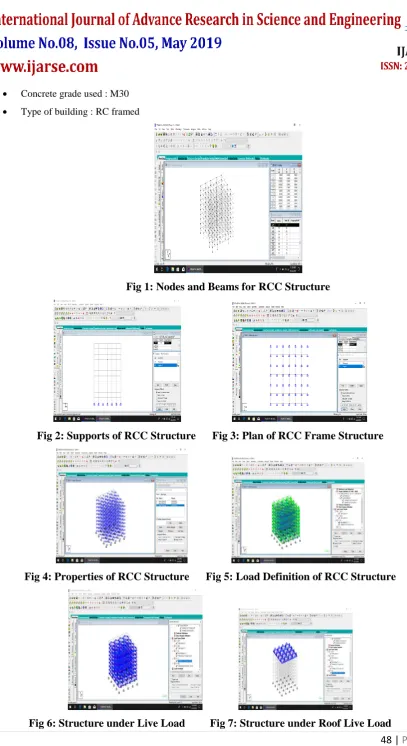
Following data has been used in this design as:
RC moment resisting frame fixed at base.
Seismic Zone: II
No of story’s :10
Density of concrete : 25kN/m2
Live load on floor level : 3kN/m2
Live load on roof level : 1.5kN/m2
Plan (regular) : 25m*25m
Beam dimension : 400mm*400mm
Column dimension :850mm*850mm
Concrete grade used : M30
Type of building : RC framed
Fig 1: Nodes and Beams for RCC Structure
Fig 2: Supports of RCC Structure Fig 3: Plan of RCC Frame Structure
Fig 4: Properties of RCC Structure Fig 5: Load Definition of RCC Structure
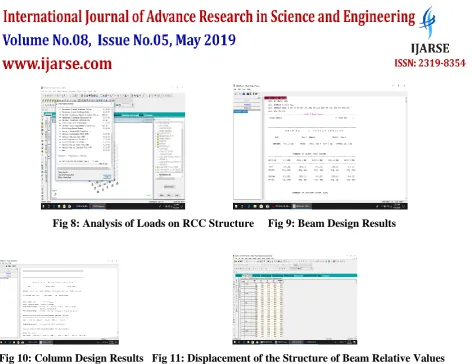
Fig 8: Analysis of Loads on RCC Structure Fig 9: Beam Design Results
Fig 10: Column Design Results Fig 11: Displacement of the Structure of Beam Relative Values
Fig 12: Beam End Forces of RCC Frame Structure
Fig 13: Values of Support Reactions
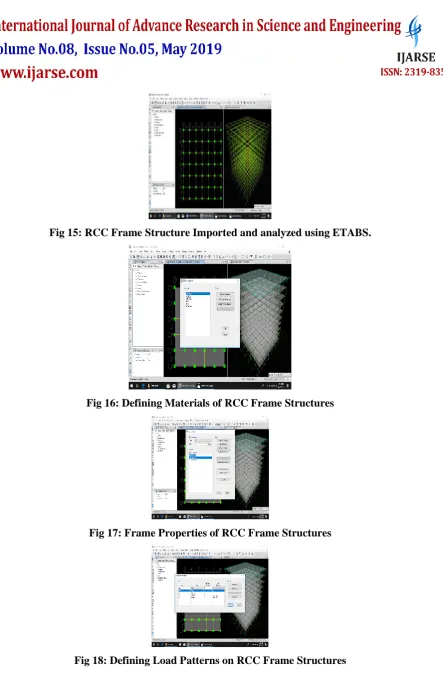
Fig 15: RCC Frame Structure Imported and analyzed using ETABS.
Fig 16: Defining Materials of RCC Frame Structures
Fig 17: Frame Properties of RCC Frame Structures
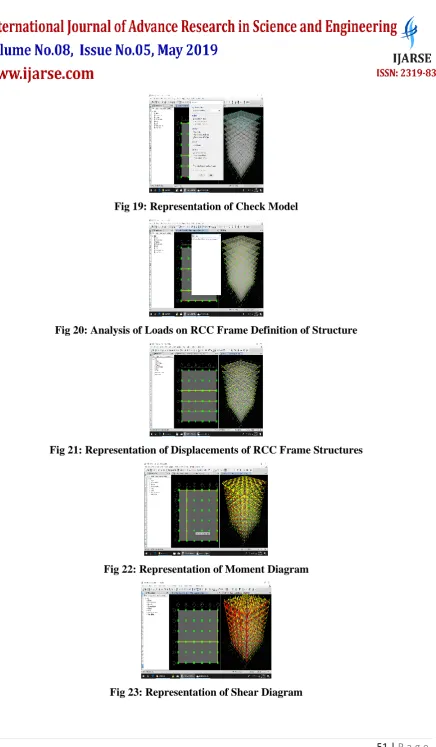
Fig 19: Representation of Check Model
Fig 20: Analysis of Loads on RCC Frame Definition of Structure
Fig 21: Representation of Displacements of RCC Frame Structures
Fig 22: Representation of Moment Diagram
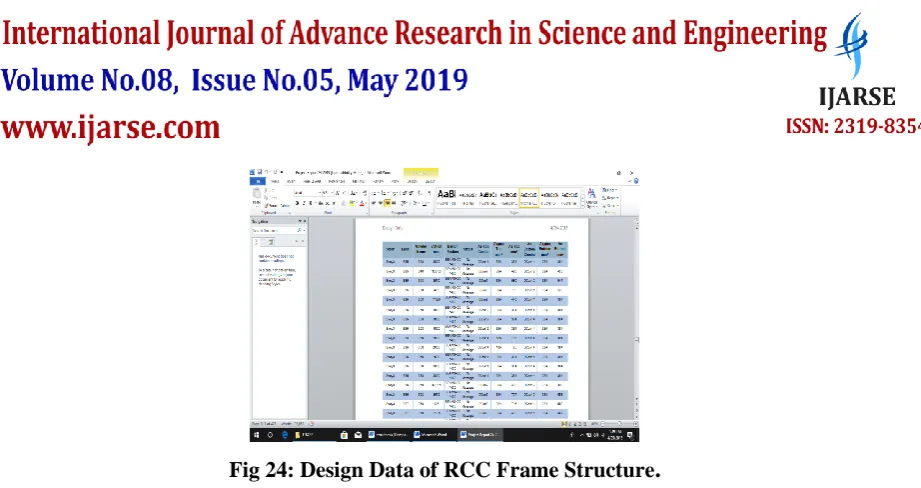
Fig 24: Design Data of RCC Frame Structure
.
4. CONCLUSIONS From the design results of beams, we may conclude that ETABS gave lesser area of
required steel as compared to STAAD PRO.
From dynamic analysis mode shapes are generated and it can be concluded that asymmetrical plans
undergoes more deflection that or deformation then symmetrical plans.
By comparing the results of two structures regular and irregular, the frame elements of regular has
shown maximum bending moments shear forces and axial forces for different loading condition in both
software’s.
The values of force derivative of STAAD PRO are low as Compared to ETABS
ETABS provide detailing of structure while as STAAD PRO does not provide detailing of structure.
By the intensive study of “Comparative study on Analysis and Design of multi-storied building by both STAAD and ETABS software’s” the “economical sections” was developed by ETABS software.
5. FUTURE SCOPE
Any structural designer will use this project as a reference for analysis of RCC Framed Structure.
In Future the analysis can be made with a scope of extension in the design in the building due to
increased need in space and availability if possible.
This project work helps the structure designers to decide which software is better for designing RCC
Framed Structure.
STAAD PRO software is more flexible to work as compared to the ETABS software.
REFRENCES
[1] Ahmed Akil “Dynamic Analysis of Multi-story RCC Building Frames”, ICIDRET 2016.
[2] Anshuman, S., Bhunia, D. and Ramjiyani, B., 2011. Solution of shear wall location in Multi-story
building. International journal of civil and structural engineering, 2(2), p.493.
[3] Babendererde, S., Hoek, E., Marinos, P. and Cardoso, A.S., 2004. Characterization of granite and the
underground construction in metro do Porto, Portugal. Proceedings ISC-2 on geotechnical and
[4] Bagheri, B., Firozabad, E.S. and Yahyaei, M., 2012, November. Comparative study of the static and
Dynamic Analysis of Multi-Story Irregular building. In Proceedings of World Academy of Science,
Engineering and Technology (No. 71, p. 1920). World Academy of Science, Engineering and Technology
(WASET).
[5] Cohen J.L. and Arato, A., 1994. Civil society and political theory. MIT press.
[6] Hoek, E. and Franklin, J.A., 1967. A simple triaxial cell for field or laboratory testing of rock. Imperial
College of Science and Technology, University of London. part 1
[7] Hoek, E. and Franklin, J.A., 1967. A simple triaxial cell for field or laboratory testing of rock. Imperial
College of Science and Technology, University of London. part 2
[8] Hoek, E. and Bieniawski, Z.T., 1984. Brittle fracture propagation in rock under compression.
International Journal of Fracture, 26(4), pp.276-294.
[9] Hoek, E., 1991, January. When is a design in rock engineering acceptable in 7th ISRM Congress
International Society for Rock Mechanics.
[10] Hoek, E., 1999. Support for very weak rock associated with faults and shear zones. Proc. Rock Support &
Reinforcement Practice in Mining, pp.19-32.
[11] Hoek, E., Read, J., Karzulovic, A. and Chen, Z.Y., 2000, November. Rock slopes in civil and mining
engineering. In ISRM International Symposium.
[12] Hoek, E., Read, J., Karzulovic, A. and Chen, Z.Y., 2000, November. Rock slopes in civil and mining
engineering. In ISRM International Symposium. International Society for Rock Mechanics.
[13] Hoek, E., 2001. Rock mass properties for underground mines. Underground mining methods: engineering
fundamentals and international case studies, pp.467-474.
[14] I Soong, T.T. and Constantine, M.C. eds., 2014. Passive and active structural vibration control in civil
engineering (Vol. 345). Springer.
[15] Jani, K. and Patel, P.V., 2013. Analysis and design of diagrid structural system for high rise steel
buildings. Procardia Engineering, 51, pp.92-100.
[16] Jones, B.D., 2002. Peacemaking in Rwanda: the dynamics of failure. Refugee Survey Quarterly, 21(3).
[17] Kakalik, J.S. ed., 1996. An evaluation of mediation and early neutral evaluation under the Civil Justice