Factorization, resummation and sum rules for heavy-to-light
form factors
Yu-Ming Wang1,2
1Fakultät für Physik, Universität Wien, Boltzmanngasse 5, 1090 Vienna, Austria 2School of Physics, Nankai University, 300071 Tianjin, China
Abstract.Precision calculations of heavy-to-light form factors are essential to sharpen our understanding towards the strong interaction dynamics of the heavy-quark system and to shed light on a coherent solution of flavor anomalies. We briefly review factorization properties of heavy-to-light form factors in the framework of QCD factorization in the heavy quark limit and discuss the recent progress on the QCD calculation ofB→πform factors from the light-cone sum rules with theB-meson distribution amplitudes. Demon-stration of QCD factorization for the vacuum-to-B-meson correlation function used in the sum-rule construction and resummation of large logarithms in the short-distance func-tions entering the factorization theorem are presented in detail. Phenomenological impli-cations of the newly derived sum rules forB→πform factors are further addressed with a particular attention to the extraction of the CKM matrix element|Vub|.
1 Introduction
Heavy-to-light form factors serve as fundamental inputs of describing many exclusive heavy hadron decays which are of great phenomenological interest to the ongoing and forthcoming collider exper-iments. Extensive efforts have been devoted to develop systematic theoretical frameworks for the precision calculation of heavy-to-light form factors in QCD (see, for instance[1–7]). In addition to the nonperturbative hadronic distribution amplitudes (DA), the symmetry-conserving “soft" form fac-tors have to be introduced in QCD factorization forB → πform factors due to the emergence of rapidity divergences in the corresponding convolution integrals. An alternative approach to compute
B→ πform factors is QCD light-cone sum rules (LCSR) constructed from the vacuum-to-B-meson correlation functions with the aid of the dispersion relations and parton-hadron duality approxima-tion [8–11]. In the following, we will first establish QCD factorizaapproxima-tion for the vacuum-to-B-meson correlation function at one loop employing the method of regions and perform the resummation of large logarithms in the hard and jet functions with the renormalization-group approach in section 2, where the resummation improved LCSR forB→πform factors and a new determination of the CKM matrix element|Vub|are also presented.
The construction of LCSR for theB→πform factors can be achieved with the following correlation function [12]:
Πμ(n·p,n¯·p) =
d4x eip·x0|Td¯(x)nγ
5u(x),u¯(0)γμb(0)
|B¯(p+q)
= Π(n·p,n¯·p)nμ+Π(n·p,n¯·p) ¯nμ, (1)
wherep+q=mBvand the two light-cone vectors satisfy the relationsn·v=n¯·v=1. To facilitate
the perturbative calculation of short-distance functions in the factorization formula of (1), we need to establish the power counting scheme for the external momentumpμ
n·p m 2
B+m2π−q2
mB =
2Eπ, n¯·p∼ O(ΛQCD). (2)
Applying the light-cone operator-produce-expansion (OPE) at space-likep2yields the tree-level
fac-torization formula
Π(n·p,n¯·p) = f˜B(μ)mB
∞
0
dω φ
−
B(ω)
ω −n¯·p−i0+O(αs),
Π(n·p,n¯·p) = O(αs). (3)
in the heavy quark limit, where theB-meson light-cone DA in the coordinate space is defined as
0|d¯β(τn¯) [τn¯,0]bα(0)|B¯(p+q)=−i
˜
fB(μ)mB
4
1+v
2
2 ˜φ+B(τ)+φ˜−
B(τ)−φ˜+B(τ) n
γ5
αβ. (4)
Applying the standard definitions ofB→πform factors and the pion decay constant
π(p)|u¯γμb|B¯(pB) = fB+π(q2)
⎡
⎢⎢⎢⎢⎣pB+p− m2
B−m2π q2 q
⎤ ⎥⎥⎥⎥⎦
μ
+fB0π(q2)
m2
B−m2π q2 qμ,
π(p)|d¯nγ5u|0 = −i n·p fπ, (5)
it is straightforward to derive the hadronic dispersion relation for the correlator (1)
Πμ(n·p,n¯·p)
= fπn·p mB
2 (m2
π−p2)
¯
nμ
n·p
mB f
+
Bπ(q2)+fB0π(q
2)
+nμ mB
n·p−mB
n·p
mB f
+
Bπ(q2)−fB0π(q
2)
+
+∞
ωs
dω ω − 1
¯
n·p−i0
ρh(ω,n·p)n
μ +ρ˜h(ω,n·p) ¯nμ
, (6)
where the threshold parameterωs in the pion channel scales asΛ2/mb. Matching the hadronic and
OPE representations of the vacuum-to-B-meson correlation function leads to
fB+π(q2) =
˜
fB(μ)mB fπn·p exp
m2
π
n·p ωM ωs
0 d
ω e−ω/ωMφ−
B(ω)+O(αs),
fB0π(q2) = n·p
mB f
+
Bπ(q2)+O(αs). (7)
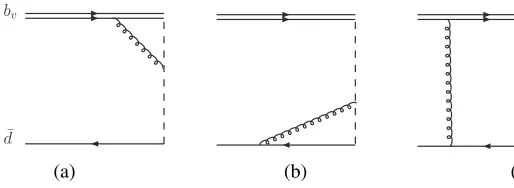
Now we are in a position to demonstrate QCD factorization forΠμ(n·p,n¯·p) at one loop using
d
b
q
p
B
u
(a) (b) (c) (d)
Figure 1.Next-to-leading-order QCD correction to the correlation functionΠμ(n·p,n¯·p).
¯ d bv
(a) (b) (c)
Figure 2.One-loop effective diagrams for the infrared subtraction.
contribution to the one-loop QCD diagrams displayed in Figure 1 and the infrared subtraction shown in Figure 2 in the heavy quark limit and extracting the hard and hard-collinear contributions to the correlation function at leading power inΛ/mb. We will apply the standard strategies to establish the
diagrammatical factorization for QCD Green functions at one-loop accuracy [13, 14]:
• Identify the leading regions of the QCD amplitudes with the power counting scheme (2);
• Evaluate the loop integrals with the method of regions and extract the “bare" perturbative kernels;
• Apply the ultraviolet renormalization and perform the infrared subtraction;
• Substitute the momentum-space light-cone projector of theB-meson.
Taking the weak vertex diagram displayed in Figure 1(a) as an example, the corresponding QCD amplitude can be written as [12]
Π(1)
μ, weak = g2
sCF
2 (¯n·p−ω)
dDl
(2π)D
1 [(p−k+l)2+i0][(m
bv+l)2−mb2+i0][l2+i0]
¯
d(k)nγ5n¯ γρ(p−k+l)γμ(mbv+l+mb)γρb(v). (8)
Employing the power counting scheme (2) one can readily identify that the leading power contribu-tions toΠ(1)μ, weakcome from the hard, hard-collinear and soft regions. Expanding the QCD amplitude Π(1)
μ, weakin terms of the powers ofΛ/mbin the soft region and keeping the leading-order terms yield
Π(1),s μ, weak =
g2
sCF
2 (¯n·p−ω)
dDl
(2π)D
1
[¯n·(p−k+l)+i0][v·l+i0][l2+i0]
¯
Feynman rules
Φαβ ,(1)
bd¯,a (ω, ω) = ig
2
sCF
dDl
(2π)D
1
[¯n·l+i0][v·l+i0][l2+i0]
×[δ(ω −ω−n¯·l)−δ(ω −ω)] [ ¯d(k)]α[b(v)]β , (10)
from which the infrared subtraction term can be deduced asΦ(1)bd¯,a⊗T(0) = Π(1),s
μ, weak, verifying QCD
factorization for the vacuum-to-B-meson correlation function at one loop diagrammatically. By pro-ceeding in a similar way, the hard-colliner contribution from the weak vertex diagram can be extracted as follows:
Π(1),hc μ,weak =
g2
sCF
2(¯n·p−ω)
dDl
(2π)D
2mbn·(p+l)
[n·(p+l) ¯n·(p−k+l)+l2
⊥+i0][mbn·l+i0][l2+i0]
¯
d(k) nγ5 n¯ γμb(pb). (11)
which can be further computed with the loop integrals collected in the Appendix A of [12]. Finally, expanding the QCD amplitude (8) in the hard region gives rise to
Π(1),h μ, weak =
αsCF
4π f˜B(μ)mB
φ−
bd¯(ω)
¯
n·p−ω ¯ nμ 1 2 + 1
2 ln μ
n·p +1
+2 ln2 μ
n·p +2 ln
μ
mb
−ln2r−2 Li2
−r¯
r
+2−r
r−1 lnr+
π2
12+3
+nμ
1
r−1
1+r ¯
r lnr , (12)
withr=n·p/mband ¯r=1−r.
Along the same vein, one can evaluate the leading power contributions to the remaining diagrams in Figure 1 and the resulting factorization formulae for the correlation function are given by
Π = f˜B(μ)mB
k=±
C(k)(n·p, μ)
∞
0
dω
ω−n¯·p J (k)
μ2
n·pω,
ω
¯
n·p
φ(k)
B (ω, μ),
Π = f˜B(μ)mB
k=±
C(k)(n·p, μ)
∞
0
dω
ω−n¯·p J (k)
μ2
n·pω,
ω
¯
n·p
φ(k)
B (ω, μ), (13)
where the hard and hard-collinear functions at one loop read [12]
C(+) = C˜(+) =1, C(−) =αsCF
4π 1 ¯ r r ¯
r lnr+1
,
˜
C(−) = 1−αsCF 4π
2 ln2 μ
n·p+5 ln
μ
mb −
ln2r−2 Li2
−r¯
r
+2−r
r−1 lnr+
π2
12 +5
, (14)
and
J(+) = 1 r J˜
(+)=αsCF
4π
1−n¯·p
ω
ln
1− ω ¯
n·p
, J(−)=1,
˜
J(−) = 1+αsCF
4π
ln2 μ
2
n·p(ω−n¯·p)−2 ln ¯
n·p−ω
¯
n·p ln
μ2 n·p(ω−n¯·p)
−ln2 n¯·p−ω ¯
n·p −
1+2¯nω·p
lnn¯·p−ω ¯
n·p −
π2
6 −1
Figure 3.The momentum-transfer dependence of theB→πform factors f+,0
Bπ(q2) from the NLL resummation
improved LCSR (17) with theB-meson DA (pink curves) and from the NLO QCD sum rules with the pion DA (blue curves).
The hard coefficients presented in (14) are in compatible with the perturbative matching coefficients of the weak current ¯qγμb from QCD to soft-collinear effective theory (SCET) [15], and the hard-collinear functions displayed in (15) coincide with the corresponding jet functions computed with the SCET Feynman rules [11].
It is evident that there is no common value ofμthat can avoid the parametrically large logarithms of order ln(mb/Λ) in the hard functions, the jet functions and the B-meson DA. The summation of
these large logarithms in the hard coefficient functions can be accomplished by solving the following renormalization-group equations
d dlnμC˜
(−)(
n·p, μ) =
−Γcusp(αs) ln μ
n·p +γ(αs)
˜
C(−)(n·p, μ),
d
dlnμ f˜B(μ) = γ˜(αs) ˜fB(μ), (16)
where the three-loop cusp anomalous dimension and the two-loopγ( ˜γ) are needed to achieve the next-to-leading-logarithmic (NLL) resummation. Applying the standard procedure for the construction of QCD sum rules leads to
fπ e−m
2 π/(n·pωM)
n·p
mB f
+
Bπ(q2), fB0π(q2)
=U2(μh2, μ) ˜fB(μh2)
ωs
0 d
ω e−ω/ωM U
1(n·p, μh1, μ)C(−)(n·p, μh1)
φ−
B,eff(ω, μ)
+rφ+B,eff(ω, μ)± n·pm−mB
B
φ+
B,eff(ω, μ)+C(−)(n·p, μ)φ−B(ω, μ)
, (17)
where the explicit expressions ofφ±B,eff(ω, μ) can be found in [12].
Having at our disposal the NLL resummation improved LCSR presented in (17), it is straightfor-ward to plot theq2dependence of theB→ πform factors f+,0
Bπ (q2) in Figure 3 where the theoretical
predictions from the sum rules with the pion DA [4] are also shown for a comparison. The observed discrepancy of theq2shape for the vector form factorf+
Bπ(q2) predicted from the two distinct sum rules
the corresponding correlation functions. Expressing the differential branching fraction ofB→πμνμ
in terms of the form factorfB+π(q2)
dΓ
dq2(B→πμνμ) = G2
F|Vub|2
24π3 |pπ| 3 |
fB+π(q2)|2. (18)
and employing the experimental measurements for the integrated decay rate [16, 17] lead to
|Vub|=
3.05+−00..5438|th.±0.09|exp. ×10−3, (19)
which is consistent with the exclusive determination of|Vub|from the leptonicB→τντdecay [18].
3 Conclusion
To summarize, we demonstrated QCD factorization for the vacuum-to-B-meson correlation function used in the construction of theB→πform factors at one-loop accuracy explicitly with the method of regions and achieved the resummation of large logarithms in the short-distance functions at NLL by solving the renormalization-group equations in the momentum space. Phenomenological applications of the newly derived sum rules with theB-meson DA were also discussed in brief, focusing on the extraction of exclusive|Vub|from the semi-leptonicB→πμνμdecay.
References
[1] M. Beneke and T. Feldmann, Nucl. Phys. B592(2001) 3 [hep-ph/0008255]. [2] P. Ball and R. Zwicky, Phys. Rev. D71, 014015 (2005) [hep-ph/0406232].
[3] G. Duplancic, A. Khodjamirian, T. Mannel, B. Melic and N. Offen, JHEP 0804, 014 (2008) [arXiv:0801.1796 [hep-ph]].
[4] A. Khodjamirian, T. Mannel, N. Offen and Y.-M. Wang, Phys. Rev. D 83, 094031 (2011) [arXiv:1103.2655 [hep-ph]].
[5] Y. M. Wang, Y. Li and C. D. Lü, Eur. Phys. J. C59, 861 (2009) [arXiv:0804.0648 [hep-ph]]. [6] H. n. Li, Y. L. Shen and Y. M. Wang, Phys. Rev. D85, 074004 (2012) [arXiv:1201.5066 [hep-ph]]. [7] C. D. Lü, Y. M. Wang, H. Zou, A. Ali and G. Kramer, Phys. Rev. D 80, 034011 (2009)
[arXiv:0906.1479 [hep-ph]].
[8] A. Khodjamirian, T. Mannel and N. Offen, Phys. Lett. B620, 52 (2005) [hep-ph/0504091]. [9] A. Khodjamirian, T. Mannel and N. Offen, Phys. Rev. D75, 054013 (2007) [hep-ph/0611193]. [10] F. De Fazio, T. Feldmann and T. Hurth, Nucl. Phys. B733, 1 (2006) [hep-ph/0504088]. [11] F. De Fazio, T. Feldmann and T. Hurth, JHEP0802, 031 (2008) [arXiv:0711.3999 [hep-ph]]. [12] Y. M. Wang and Y. L. Shen, Nucl. Phys. B898, 563 (2015) [arXiv:1506.00667 [hep-ph]]. [13] Y. M. Wang and Y. L. Shen, JHEP1602, 179 (2016) [arXiv:1511.09036 [hep-ph]]. [14] Y. M. Wang, arXiv:1606.03080 [hep-ph].
[15] C. W. Bauer, S. Fleming, D. Pirjol and I. W. Stewart, Phys. Rev. D63, 114020 (2001) [hep-ph/0011336].
[16] J. P. Leeset al.[BaBar Collaboration], Phys. Rev. D86, 092004 (2012) [arXiv:1208.1253 [hep-ex]].
[17] A. Sibidanovet al. [Belle Collaboration], Phys. Rev. D88, 032005 (2013) [arXiv:1306.2781 [hep-ex]].