Generic Constructions for Verifiable Signcryption
Laila El Aimani
Technicolor, 1 avenue de Belle Fontaine - CS17616, 35576 Cesson-S´evign´e, France
Abstract. Signcryption is a primitive which simultaneously performs the functions of both signature and encryp-tion in a way that is more efficient than signing and encrypting separately. We study in this paper construcencryp-tions of signcryption schemes from basic cryptographic mechanisms; our study concludes that the known constructions require expensive encryption in order to attain confidentiality, however some adjustments make them rest on cheap encryption without compromising their security. Our constructions further enjoy verifiability which entitles the sender or the receiver to prove the validity of a signcryption with/out revealing the signcrypted message. They also allow the receiver to release some information which allows anyone to publicly verify a signcryption on a given message. Finally, our constructions accept efficient instantiations if the building blocks belong to a wide class of signature/encryption schemes.
Keywords: signcryption, sign-then-encrypt paradigm, commit-then-encrypt-and sign paradigm, encrypt-then-sign paradigm, (public) verifiability, homomorphic encryption.
1
Introduction
Cryptographic mechanisms that proffer both the functionalities of signature and of encryption are becoming nowadays increasingly important. In fact, many real-life applications entail both the confidentiality and the authenticity/integrity of the transmitted data; an illustrative example is electronic elections where the voter wants to encrypt his vote to guarantee privacy, and at the same time, the voting center needs to ensure that the encrypted vote comes from the entity that claims to be its provenance. To respond to this need, Zheng [51] introduced the notion of signcryption which is a primitive that simultaneously performs the functions of both signature and encryption in a way that is more efficient than signing and encrypting separately.
Related work Since the introduction of this primitive, many constructions which achieve different levels of security have been proposed. On a high level, security of a signcryption scheme involves two properties; privacy and authen-ticity. Privacy is analogous to indistinguishability in encryption schemes, and it denotes the infeasibility to infer any information about the signcrypted message. Authenticity is similar to unforgeability in signature schemes and it de-notes the difficulty to impersonate the signcrypter. Defining formally those two properties is a fundamental divergence in signcryption constructions as there are many issues which come into play:
– TWO-USER VERSUS MULTI-USER SETTINGIn the two-user setting, adopted for instance in [1], a single sender (the entity that creates the signcryption) interacts with a single receiver (the entity that recovers the message from the signcryption). Although such a setting is too simplistic to represent the reality, e.g. the case of electronic elections, it provides however an important preliminary step towards modeling and building schemes in the multi-user setting. In fact, many works have proposed simple tweaks in order to derive multi-multi-user security from two-multi-user security [1, 39].
– VERIFIABILITYA further requirement on signcryption is verifiability which consists in the possibility to prove efficiently the validity of a given signcryption, or to prove that a signcryption has indeed been produced on a given message. In fact, if we consider the example of electronic elections, the voting center might require from the voter a proof of validity of the ”signcrypted” vote. Also, the trusted party (the receiver) that decrypts the vote might be compelled, for instance to resolve some later disputes, to prove that the sender has indeed produced the vote in question; therefore, it would be desirable to support the prover with efficient means to provide such a proof without having to disclose his private input. This property is also needed in filtering out spams in a secure email system. Although a number of constructions [3, 46, 17, 38, 45] have tackled the notion of verifiability (this notion is often referred to in the literature as public verifiability, and it denotes the possibility to release (by the receiver) some information which allows to publicly verify a signcryption with/out revealing the message in question), most of these schemes do not allow the sender to prove the validity of the created signcryption, nor allow the receiver to prove without revealing any information, ensuring consequently non-transferability, to a third party, the validity of a signcryption w.r.t. a given message. It is worth noting that the former need, i.e. allowing the sender to prove the validity of a signcryption without revealing the message, already manifests in the IACR electronic voting scheme (The Helios voting scheme) where the sender proves the validity of the encrypted vote to the voting manager. The scheme nonetheless does not respond to the formal security requirements of a signcryption scheme.
Before ending this paragraph, we recall the main generic constructions of signcryption schemes that were pro-posed so far. In fact, building complex mechanisms from basic ones is customary in cryptography as it allows achiev-ing easy-to-analyze schemes, compared to dedicated/monolithic constructions. The first constructions of signcryption were given and analyzed in [1], where the authors study how to derive signcryption schemes, mainly in the two-user setting, using the classical combinations “sign-then-encrypt”, “encrypt-then-sign”, and “commit-then-encrypt-and-sign”. Subsequently, the work [39] presented several optimizations of these combinations that lead to signcryptions with multi-user security. The paper shows also how to use symmetric encryption in order to derive constructions in the outsider multi-user setting. Finally, there are the recent constructions [16] which achieve security in the insider multi-user setting without key registration assumptions (on the receiver’s side). It is worth noting that none of these constructions treat verifiability.
To the best of our knowledge, there are no generic constructions which provide verifiability in a reasonable security model. The main contribution of this paper is to provide such constructions.
Our Contributions We make the following contributions. First, we propose a new model for signcryption schemes which upgrades the existing models by three interactive protocols: 1. a protocol that allows the sender to prove, to a third party, the validity of the created signcryption, 2. and two protocols that allow the receiver to prove, to a third party, the validity of a given signcryption with/out revealing the message. All these protocols do not require the provers to reveal any information.
In Section 3, we show that the “sign-then-encrypt” (StE) and the “commit-then-encrypt-and-sign” (CtEaS) paradigms require expensive assumptions on the underlying encryption in order to derive signcryption with outsider indistin-guishability. We do this by first proving the insufficiency of OW-CCA and NM-CPA secure encryption, then by ex-hibiting a simple attack if the system is instantiated from certain encryption schemes. Next, we propose simple tweaks of the paradigms that make the resulting constructions rest on cheap encryption.
In Section 4, we show that the “encrypt-then-sign” (“TagEncrypt-then-sign”) paradigm provides efficient construc-tions which are proven secure in our adopted model. We demonstrate the efficiency of these schemes by explicitly describing the different verification protocols if the constructions are instantiated from a wide class of encryption (tag-based encryption) schemes.
2
Model and Main Constructions
In this section, we present our model for verifiable signcryption. We refer to Appendix A for the necessary crypto-graphic bricks that will come into play, namely digital signatures, public key encryption schemes, tag-based encryp-tion, KEM/DEM mechanisms, and commitment schemes.
A verifiable signcryption scheme consists of the following algorithms/protocols:
Setup (setup(1κ)). This probabilistic algorithm inputs a security parameterκ, and generates the public parameters
paramof the signcryption scheme.
Key generation (keygenU(1κ,param), U ∈ {S, R}). This probabilistic algorithm inputs the security parameterκ
and the public parametersparam, and outputs a key pair(pkU,skU)for the system userU which is either the
senderSor the receiverR.
Signcryption (signcrypt(m,skS,pkS,pkR)). This probabilistic algorithm inputs a messagem, the key pair(skS,pkS)
of the sender, the public keypkRof the receiver, and outputs the signcryptionµof the messagem.
Proof of validity (proveValidity(µ,pkS,pkR)). This is an interactive protocol between the receiver or the sender who
has just generated a signcryptionµon some message, and any verifier: the sender uses the randomness used to createµ(as private input) and the receiver uses his private keyskRin order to convince the verifier thatµis a valid
signcryption on some message. The common input to both the prover and the verifier comprise the signcryptionµ in question,pkS, andpkR. At the end of the protocol, the verifier either accepts or rejects the proof.
Unsigncryption (unsigncrypt(µ,skR,pkR,pkS)). This is a deterministic algorithm which inputs a putative
signcryp-tionµon some message, the key pair(skR,pkR)of the receiver, and the public keypkS of the sender, and outputs
either the message underlyingµor an error symbol⊥.
Confirmation/Denial ({confirm,deny}(µ, m,pkR,pkS)). These are interactive protocols between the receiver and
any verifier; the receiver uses his private keyskR(as private input) to convince any verifier that a signcryptionµon
some messagemis/is not valid. The common input comprises the signcryptionµand the messagemin question, in addition topkRandpkS. At the end of the protocol, the verifier is either convinced of the validity/invalidity of µw.r.t.mor not.
Public verification (publicVerify(µ, m,skR,pkR,pkS)). This is an algorithm which inputs a signcryptionµ, a
mes-sagem, the key pair(skR,pkR)of the receiver, and the public keypkS of the sender, and outputs either an error
symbol⊥ifµis not a valid signcryption onm, or a string which allows to publicly verify the validity ofµonm otherwise.
Remark 1. – The proveValidity protocol allows the sender to prove the validity of the signcryption he has just created (need for the randomness used to produce the signcryption). Although this situation is plausible in secure email or in electronic elections, it would be however nice to have a stateless system. This would require in our constructions involved non-interactive proofs which are in general difficult to obtain in the standard model.
– The{confirm,deny}protocols can also be run by the sender who has just generated the signcryption in question. Furthermore, they are interactive in order to ensure non-transferability, i.e. the possibility of the verifier to transfer to a third party his conviction about the validity/invalidity of a signcryption w.r.t. a given message. It has been proven in [37] that interactivity guarantees only offline non-transferability, i.e., non-transferability is not preserved if the verifier interacts concurrently with the receiver and an unexpected verifier. One way to remediate to this problem was proposed in [18] using non-interactive designated verifier proofs. Again, the proposed solution rests on heavy non-interactive proofs using the [30] proof system, and is hard to be generalized.
It is natural to require the correctness of a signcryption scheme, i.e. for any messagem:
unsigncrypt(signcrypt(m,skS,pkS,pkR),skR,pkR,pkS) =m.
and
publicVerify(m,signcrypt(m,skS,pkS,pkR),skR,pkR,pkS)6=⊥.
2.1 Unforgeability
This notion protects the sender’s authenticity from malicious insider adversaries, i.e. the receiver. It is defined through a game between a challengerCand an adversaryAwhere the latter gets the public keypkS of the sender, generates
the key pair(pkR,skR)of the receiver, and handspkRto the challenger. During the game,Ais allowed to ask
adap-tively signcryption queries w.r.t.pkRandpkS on messages of his choice toC. The scheme is said to be Existentially Unforgeable against Chosen Message Attacks (EUF-CMA) if the adversary is unable to produce a valid signcryption µ⋆on a messagem⋆that he did not ask to the signcryption oracle.
Definition 1 (Unforgeability). We consider a signcryption schemescgiven by the algorithms/protocols defined ear-lier in this section. LetAbe a PPTM. We consider the following random experiment:
ExperimentExpeufsc,A-cma(1κ)
param←sc.setup(1κ)
(pkS,skS)←sc.keygenS(1κ,param)
pkR← A(pkS) µ⋆← AS(
pkS,pkR,skR)
S:m7−→sc.signcrypt{skS,pkS,pkR}(m)
return1if and only if the following properties are satisfied: -sc.unsigncrypt{skR,pkR,pkS}[µ
⋆] =m⋆
-m⋆was not queried toS
We define the success ofAvia:
Succeuf-cmasc,A (1κ) = PrhExpeuf-cma
sc,A (1κ) = 1
i
.
Given(t, qs) ∈N2andε ∈[0,1],Ais called a(t, ε, qs)-EUF-CMAadversary againstscif, running in timetand
issuingqsqueries to thesc.signcryptoracle,AhasSucceuf-cmasc,A (1κ)≥ε. The schemescis said to be(t, ε, qs)-
EUF-CMAsecure if no(t, ε, qs)-EUF-CMAadversary against it exists.
Remark 2. Note thatAin the above definition is not given the oraclessc.proveValidity,sc.unsigncrypt,sc.publicVerify, andsc.{confirm,deny}. In fact, these oracles are useless for him as he has the receiver’s private keyskRat his disposal.
2.2 Indistinguishability
This notion protects the sender’s privacy from outsider adversaries. It is defined through a game between a chal-lengerC and an adversary A; C generates the key pairs (skS,pkS) and(skR,pkR) for the sender and for the
re-ceiver respectively, and hands(pkS,pkR)toA. During the first phase of the game,Aqueries adaptivelysigncrypt and proveValidity (actually proveValidity is only invoked on inputs just obtained from the signcryption oracle), unsigncrypt,{confirm,deny}, andpublicVerify for any input. OnceAdecides that this phase is over, he generates two messagesm⋆
0, m⋆1 and hands them to C who generates a signcryptionµ⋆ onm⋆b forb R
←− {0,1} and gives it (µ⋆) toA. The latter resumes querying the previous oracles adaptively on any input with the exception of not querying
unsigncryptonµ⋆, and{confirm,deny}andpublicVerifyon the pair(µ⋆, m⋆
i)fori∈ {0,1}. At the end, the adversary
outputs his guessb′for the message underlying the signcryptionµ⋆. He is considered successful ifb=b′.
ExperimentExpind-ccasc,A -b(1κ) param←sc.setup(1κ)
(skS,pkS)←sc.keygenS(1κ,param)
(skR,pkR)←sc.keygen(1
κ,param)
(m⋆0, m⋆1,I)← A S,V,U,C
(find,pkS,pkR)
S:m7−→sc.signcrypt{skS,pkS,pkR}(m) V:µ7−→sc.proveValidity(µ,pkS,pkR)
U:µ7−→sc.unsigncryptsk
R,pkR,pkS(µ)
C: (µ, m)7−→sc.{confirm,deny}(µ, m,pkR,pkS)
P: (µ, m)7−→sc.publicVerify(µ, m,pkR,pkS)
µ⋆←sc.signcrypt
{skS,pkS,pkR}(m
⋆ b)
d← AS,V,U,C
(guess,I, µ⋆,pk S,pkC)
S:m7−→sc.signcrypt{skS,pkS,pkR}(m) V:µ7−→sc.proveValidity(µ,pkS,pkR)
U:µ(6=µ⋆)7−→sc.unsigncrypt
skR,pkR,pkS(µ) C: (µ, m)(6= (µ⋆, m⋆
i), i= 0,1)7−→sc.{confirm,deny}(µ, m,pkR,pkS)
P: (µ, m)(6= (µ⋆, m⋆
i), i= 0,1)7−→sc.publicVerify(µ, m,pkR,pkS)
Returnd
We define the advantage ofAvia:
Advind-ccasc,A (1κ) =
PrhExpscind,A−cca−b(1κ) =bi−1
2 .
Given(t, qs, qv, qu, qcd, qpv)∈N6andε∈[0,1],Ais called a(t, ε, qs, qv, qu, qcd, qpv)-IND-CCAadversary against
scif, running in timetand issuingqsqueries to thesc.signcryptoracle,qv queries to thesc.proveValidityoracle,
qu queries to the sc.unsigncrypt oracle,qcd queries to the sc.{confirm,deny} oracle, andqpv to the publicVerify
oracle,A hasAdvscind,A−cca(1κ) ≥ ε. The scheme sc is said to be(t, ε, q
s, qv, qu, qcd, qpv)-IND-CCA secure if no
(t, ε, qs, qv, qu, qcd, qpv)-IND-CCAadversary against it exists.
In Appendix B, we provide the above properties in the multi-user setting, namely the dM-EUF-CMA and the fM-IND-CCA security properties, where the adversary is further given all the private keys except those of the target sender and of the target receiver.
2.3 Main Constructions
Let Σ be a digital signature scheme given by Σ.keygen which generates a key pair (Σ.sk, Σ.pk), Σ.sign, and Σ.proveValidity. Let furthermoreΓ denote a public key encryption scheme described byΓ.keygen that generates the key pair (Γ.sk,Γ.pk),Γ.encrypt, andΓ.decrypt. Finally, letΩbe a commitment scheme given by the algorithms Ω.commitandΩ.open. The most popular paradigms used to devise signcryption schemes from basic primitives are:
– The “sign-then-encrypt” (StE) paradigm. Given a messagem,signcryptfirst produces a signatureσon the mes-sage usingΣ.sk, then encryptsmkσunderΓ.pk. The result forms the signcryption onm. Tounsigncrypt, one first decrypts the signcryption usingΓ.skinmkσ, then checks the validity ofσ, usingΣ.pk, onm. Finally,publicVerify of a valid signcryptionµ=Γ.encrypt(mkσ)onmoutputsσ.
– The “encrypt-then-sign” (EtS) paradigm. Given a messagem,signcryptproduces an encryptioneonmusing Γ.pk, then produces a signatureσon eusing Σ.sk; the signcryption is the pair(e, σ). To unsigncryptsuch a signcryption, one first checks the validity ofσw.r.t.eusingΣ.pk, then decryptseusingΓ.skto getm. Finally, publicVerifyoutputs a zero knowledge non-interactive (NIZK) proof thatmis the decryption ofe; such a proof is possible since the statement in question is in NP ([28] and [6]).
– The “commit-then-encrypt-and-sign” (CtEaS) paradigm. This construction has the advantage of performing the
a signatureσoncusingΣ.sk. The signcryption is the triple(e, c, σ). Tounsigncryptsuch a signcryption, one first checks the validity ofσw.r.t.c, then decryptseto getmkr, and finally checks the validity of the commitmentc w.r.t(m, r).publicVerifyis achieved by releasing the decryption ofe, namelymkr.
The proofs of well (mal) formed-ness, namelyproveValidityand{confirm,deny}can be carried out since the languages in question are in NP (co-NP) and thus accept zero knowledge proof systems [28]. Finally, it is possible to require a proof in thepublicVerifyalgorithms of StE and CtEaS, that the revealed information is indeed a correct decryption of the encryption in question; such a proof is again possible to issue since the corresponding statement is in NP.
3
Analysis of the StE and CtEaS Paradigms
3.1 Insufficiency of OW-CCA and NM-CPA secure encryption
We proceed in this subsection as in [23] where the author shows the impossibility to derive secure confirmer signa-tures, using the StE and the CtEaS paradigms, from both OW-CCA and NM-CPA secure encryption; we first show the impossibility result for the so-called key-preserving reductions, i.e. reductions which launch the adversary on its challenge public key in addition to some freely chosen parameters, then we generalize the result to arbitrary reductions assuming new assumptions on the underlying encryption scheme.
Lemma 1. Assume there exists a key-preserving reductionRthat converts an IND-CCA adversaryAagainst sign-cryptions from the StE (CtEaS) paradigm to a OW-CCA adversary against the underlying encryption scheme. Then, there exists a meta-reductionMthat OW-CCA breaks the encryption scheme in question.
This lemma claims that under the OW-CCA security assumption of the underlying encryption, there is no key-preserving reduction that reduces OW-CCA breaking the encryption scheme in question to IND-CCA breaking the signcryption construction (from StE or CtEaS), or if there exists such an algorithm, then the underlying encryption scheme is not OW-CCA secure, thus rendering such a reduction useless.
Proof. LetRbe the key-preserving reduction that reduces OW-CCA breaking the encryption scheme underlying the construction to IND-CCA breaking the construction (from StE or CtEaS) itself. We will construct an algorithmM
that usesRto OW-CCA break the same encryption scheme by simulating an execution of the IND-CCA adversaryA
against the construction.
LetΓ be the encryption schemeMis trying to attack.Mgets his challengecand is equipped with a decryption oracle that he can query on all ciphertexts of his choice except of course on the challenge.MlaunchesRoverΓ with the same public keyΓ.pkand the same challengec. Obviously, all decryption queries made byR, which are by definition different from the challengec, can be forwarded toM’s own challenger.Mneeds now to simulate an IND-CCA adversaryAtoR(ΣandΩdenote respectively the signature and the commitment schemes in use):
– StE paradigm.Areceives as a challenge signcryption a certainµb =Γ.encrypt(Σ.sign(mb)), whereb∈ {0,1}
(m0, m1 being the challenge messages output byA, simulated byM, toR). With overwhelming probability,
c6=µb(we refer to Remark 3 in caseRmisbehaves and submitscas a challenge signcryption) since the challenge
cis not encryption of a valid digital signature on the messagem0or the messagem1. ThusMcan queryµbto
his own challenger for decryption. The answer of such a query is sufficient forA(simulated byM) to answer his indistinguishability challenge.
– CtEaS paradigm.Areceives as a challenge signcryptionµb = [Γ.encrypt(mbkr), c=Ω.commit(mb, r), Σ.sign(c)]
withb∈ {0,1}(alwaysm0, m1denote the challenge messages output byAtoR). Similarly,c6=Γ.encrypt(mbkr)
(we refer again to Remark 3 in caseRmisbehaves and submitscas the first field of the challenge signcryption) with overwhelming probability sincec is not encryption of a message whose prefix is the messagem0 orm1.
Thus,Mcan query his challenger for the decryption of the first field ofµb. The result of such a query is sufficient
To sum up,Mis able to perfectly answer the decryption queries made byR(that are by definition different from c).Mis further capable of successfully simulating the IND-CCA challenge against the construction (from the StE or the CtEaS paradigms). ThusRis expected to return the answer to the OW-CCA challenge, namely the decryption of
c. Upon receipt of this answer,Mwill forward it to his own challenger. ⊓⊔
Remark 3. In the above proof, ifRsubmitsc in the challenge signcryption toA, then this latter cannot solve the IND-CCA challenge as he (M) cannot invoke his decryption oracle onc. In this case, as it is very unlikely that the resulting signcryption is a valid signcryption on the challenge messagesm0 orm1, then whatever is the answer of A(actually in this case,A, simulated byMwho launchedRoverc, can abort the indistinguishability game) to the challenge signcryption, this answer will not helpRsolving his OW-CCA challenge since he already knows that c cannot be (with overwhelming probability) a valid signcryption on either messagesm0 orm1. In other words, in
this case, whateverRlearns fromA, he can also learn it withoutA, which corresponds to a reductionRsolving a OW-CCA challenge in polynomial time without the help ofA, i.e.Ris useless as it is solving an easy problem.
We further have this lemma (which we prove in Appendix C.1) on the insufficiency of NM-CPA secure encryption.
Lemma 2. Assume there exists a key-preserving reductionRthat converts an IND-CCA adversaryAagainst sign-cryptions from the StE (CtEaS) paradigm to a NM-CPA adversary against the underlying encryption scheme. Then, there exists a meta-reductionMthat NM-CPA breaks the encryption scheme in question.
We generalize in Appendix C.2 the previous results to arbitrary reductions if the encryption scheme has a non-malleable key generator, which informally means that OW-CCA (NM-CPA) breaking the encryption, w.r.t. a public keypk, is no easier when given access to a decryption oracle w.r.t. any keypk′different frompk.
Moreover, we can rule out the OW-CPA, OW-PCA, and IND-CPA notions1by remarking that ElGamal’s encryp-tion meets all those noencryp-tions (under different assumpencryp-tions), but cannot be employed in StE and CtEaS as it is malleable. In fact, the indistinguishability adversary can create a new signcryption (by re-encrypting the ElGamal encryption) on the challenge message, and query it for unsigncryption. The answer of such a query is sufficient to conclude. We refer to Appendix C.3 for the detail of this attack using a much larger class of encryption schemes.
In consequence of the above analysis, the used encrypted scheme has to satisfy at least IND-PCA security in order to lead to secure signcryption from StE or CtEaS. Since there are no known encryption schemes in the literature which separate the notions IND-PCA and IND-CCA, our result practically means that the encryption scheme underlying the previous constructions has to satisfy the highest security level (IND-CCA) in order to lead to secure signcryption. This translates in expensive operations, especially if verifiability is further required for the resulting signcryption.
3.2 Positive results
Constructions from StE or CtEaS suffer the strong forgeability: given a signcryption on some message, one can create another valid signcryption on the same message without the sender’s help. To circumvent this problem, we propose the following techniques which bind the digital signature to the resulting signcryption.
The new “sign-then-encrypt”(StE) paradigm. LetΣbe a digital signature scheme given byΣ.keygen, which gen-erates a key pair (Σ.sk,Σ.pk),Σ.sign, andΣ.proveValidity. Let furthermoreKbe a KEM given byK.keygen, which generates a key pair (K.pk,K.sk),K.encap, andK.decap. Finally, we consider a DEMDgiven byD.encryptand
D.decrypt. We assume that the message space ofDincludes the concatenation of elements from the message space of Σ, and of signatures produced byΣ, and that the encapsulations generated byKare exactlyκ-bit long, whereκis a security parameter.
1The step of ruling out OW-CPA, OW-PCA, and IND-CPA is necessary although we have proved the insufficiency of stronger
notions, namely OW-CCA and NM-CPA. In fact, suppose there is an efficient key-preserving reductionRwhich reduces OW-PCA breaking a cryptosystemΓunderlying a StE or CtEaS construction to IND-CCA breaking the construction itself. Then there exists an efficient key-preserving reduction sayR′that reduces OW-CCA breakingΓ to IND-CCA breaking the construction (since OW-CCA is stronger than OW-PCA). According to the previous Lemmata, such a reduction (R′) may exist ifΓ is not
A signcryption schemescis defined as follows:sc.setupinvokes the setup algorithms ofΣ,K, andD.sc.keygenS andsc.keygenR consist ofΣ.keygenandK.keygen respectively. Tosc.signcrypt a messagem, one first generates a key k with its encapsulation c using K.encap, then produces a signature σ on ckm, and finally outputsµ = (c,D.encryptk(mkσ))as a signcryption ofm. Unsigncryption of some(µ1, µ2)is done by first recovering the keyk
fromµ1usingK.decap, then usingD.decryptandkto decryptµ2, and finally checking that the result is a valid digital
signature onµ1kmwheremis the retrieved message. The rest is similar to the original StE.
Theorem 1 Given(t, qs)∈N2andε∈[0,1], the above construction is (t, ǫ, qs)-EUF-CMA secure if the underlying
digital signature scheme is (t, ǫ, qs)-EUF-CMA secure.
The proof is given in Appendix C.4.
Theorem 2 Given(t, qs, qv, qu, qcd, qpv)∈N6and(ε, ǫ′)∈[0,1]2, the above construction is (t, ǫ, qs, qv, qu, qcd, qpv
)-IND-CCA secure if it uses a(t, ǫ′, q
s)-EUF-CMA secure digital signature, an IND-OT secure DEM and an (t+qs(qu+
qcd+qpv), ǫ·(1−ǫ′)qu+qcd+qpv)-IND-CPA secure KEM.
The proof is provided in Appendix C.5. We note that the above theorem holds true also when the used DEM is only computationally secure. Details are given in Remark 9.
The new “commit-then-encrypt-and-sign” (CtEaS) paradigm The new “commit-then-encrypt-and-sign” (CtEaS)
paradigm. The construction is similar to the basic one described earlier, with the exception of producing the digital signature on both the commitmentcand the encryptione. The new construction looses the parallelism of the original one, i.e. encryption and signature can longer be carried out in parallel, however it has the advantage of resting on cheap encryption compared to the early one.
Theorem 3 Given(t, qs)∈N2and(ε, ǫb)∈[0,1]2, the above construction is (t, ǫ, qs)-EUF-CMA secure if it uses a
uses a(t, ǫb)binding commitment scheme and a(t, ǫ(1−ǫb)qs, qs)-EUF-CMA secure digital signature scheme.
Theorem 4 Given(t, qs, qv, qu, qcd, qpv)∈N6and(ε, ǫ′, ǫh)∈[0,1]3, the new CtEaS construction is(t, ǫ, qs, qv, qu, qcd, qpv)
-IND-CCA secure if it uses a(t, ǫ′, q
s)-SEUF-CMA secure digital signature, a statistically binding, and (t, ǫh)-hiding
commitment, and a(t+qs(qu+qcd+qpv),12(ǫ+ǫh)(1−ǫ′)qu+qcd+qpv)-IND-CPA secure encryption scheme.
The proofs are given in Appendix C.6 and Appendix C.7 resp.
4
Efficient Verifiable Signcryption from the EtS Paradigm
The Encrypt-then-Sign paradigm, described in Subsection 2.3, turns out to provide efficient signcryptions schemes that are proven secure in the model we adhere to.
Theorem 5 Given(t, qs)∈ N2andε ∈[0,1], signcryption schemes from EtS are (t, ǫ, qs)-EUF-CMA secure if the
underlying digital signature scheme is (t, ǫ, qs)-EUF-CMA secure.
Theorem 6 Given(t, qs, qv, qu, qcd, qpv)∈N6and(ε, ǫ′)∈[0,1]2, signcryptions from EtS are(t, ǫ, qs, qv, qu, qcd, qpv)
-IND-CCA secure if they use a(t, ǫ′, q
s)-SEUF-CMA secure digital signature and a(t+qs(qu+qcd+qpv), ǫ(1−
ǫ′)qu+qcd+qpv)-IND-CPA secure encryption scheme
We flesh out the details of both proofs in Appendix D.1 and Appendix D.2 respectively. In fact, the proofs that were given so far correspond to security models different from the one we consider.
4.1 Efficient instantiations
To allow efficientproveValidity,{confirm,deny}, andpublicVerifyprotocols/algorithms, we propose to instantiate the encryption scheme from the following class:
Definition 3 (The classEof encryption schemes).Eis the set of public key encryption schemesΓ that have the following properties:
1. The scheme operates in a message spaceMwhich is a groupM = (G,∗), and produces encryptions which
belong to a group spaceC= (H,◦e), i.e.Γ.encrypt: (G,∗)→(H,◦e).
2. Letm∈ Mbe a message andcits encryption (usingΓ.encrypt) w.r.t. a keypk. On the common inputpk,m, and c, there exists an efficient zero knowledge proofPoKofmbeing the decryption ofcw.r.t.pk. The private input of the prover is either the private key corresponding topkor the randomness used to produce the encryptionc. 3. ∀m, m′ ∈ M,∀pk: Γ.encryptpk(m∗m′) =Γ.encryptpk(m)◦eΓ.encryptpk(m′). Moreover, given the
random-ness used to encryptminΓ.encryptpk(m)andm′ inΓ.encryptpk(m′), one can deduce (using only the public
parameters) the randomness used to encryptm∗m′inΓ.encryptpk(m)◦eΓ.encryptpk(m′).
Examples of encryption schemes in the above class include ElGamal’s encryption [24], the encryption scheme defined in [8], or Paillier’s [40] encryption scheme. In fact, these schemes are homomorphic and possess efficient protocols for proving that a ciphertext decrypts to a given message: the proof of equality of two discrete logarithms [15], in case of [24, 8], or the proof of knowledge of anN-th root in case of [40].
We describe in the rest of this subsection theproveValidity,{confirm,deny}, andpublicVerifyprotocols/algorithms if the used encryption belongs to the classE.
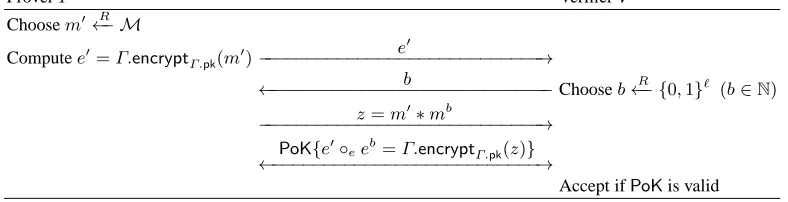
Proof of Validity We depict theproveValidityprotocol in Figure 1.
ProverP VerifierV
Choosem′ R ←− M
Computee′=Γ.encrypt
Γ.pk(m′)
e′
−−−−−−−−−−−−−−−−−−−−−−−−−−−−→
b
←−−−−−−−−−−−−−−−−−−−−−−−−−−−−Chooseb←R− {0,1}ℓ (b∈N)
z=m′∗mb
−−−−−−−−−−−−−−−−−−−−−−−−−−−−→
PoK{e′◦eeb=Γ.encrypt Γ.pk(z)} ←−−−−−−−−−−−−−−−−−−−−−−−−−−→
Accept ifPoKis valid
Fig. 1. Proof system for membership to the language {m : e = Γ.encryptΓ.pk(m)} Common input:(e, Γ.pk) and Private input:mandΓ.skor randomness used to producee.
Theorem 7 LetΓ be a one-way encryption scheme from the classE. The protocol depicted in Figure 1 is a zero
knowledge proof of knowledge of the decryption ofe. ⊓⊔
Confirmation/denial protocols Theconfirmprotocol is nothing but the proofPoKwhich is in case of [24, 8] a proof of equality of two discrete logarithms, and in case of [40] a proof of knowledge of anN-th root. We depict thedeny protocol in Figure 2, wherefdenotes an arbitrary homomorphic injective one way function:
∀m, m′: f(m ⋆ m′) =f(m)◦sf(m′)
ProverP VerifierV
Choosem′←− MR
Computee′
1=f(m
′
)
Computee′
2=Γ.encryptΓ.pk(m
′
) e
′
1, e′
2
−−−−−−−−−−−−−−−−−−−−−−−−−−−−−−−−→
b
←−−−−−−−−−−−−−−−−−−−−−−−−−−−−−−−−Chooseb←− {R 0,1}ℓ (b∈N) z=m′∗m˜b
−−−−−−−−−−−−−−−−−−−−−−−−−−−−−−−−→
PoK{e′2◦eeb=Γ.encryptΓ.pk(z)}
←−−−−−−−−−−−−−−−−−−−−−−−−−−−−−−−→
Accept ifPoKis valid and iff(z)6=e′1◦sf(m)b.
Fig. 2. Proof system for membership to the language{(m, e) :∃m˜ :e=Γ.encrypt( ˜m)∧m˜ 6=m}Common input:(m, e, Γ.pk)andPrivate input:Γ.skor randomness encryptingm˜ine
Public verification thepublicVerifyalgorithm outputs a ZK non-interactive proof of the correctness of a decryption. We note the following three solutions according to the used encryption:
1. The case of Paillier’s encryption [40]: this scheme belongs to fully decryptable encryption schemes, i.e. encryption schemes where decryption leads to the randomness used to produce the ciphertext. Thus,publicVerifywill simply release the randomness used to generate the ciphertext.
2. The case of [8]’s encryption: Groth and Sahai [30] presented an efficient ZK non-interactive proof that a given encryption using this scheme encrypts a given message under a given public key.
3. The case of DL-based encryption schemes, e.g. [24, 8, 20]: the interactive proof of correctness of most such schemes reduces to a proof of equality of two discrete logarithms. The work [21] presented an efficient method to remove interaction using additively homomorphic encryption, e.g. Paillier [40].
4.2 Extension to Multi-user security
The construction is the same provided in [39], namely the TagEncrypt-then-Sign paradigm (TEtS), which deviates from the standard EtS paradigm as follows:
1. It considers a tag-based encryption scheme where the tag is set to the public key of the senderpkS.
2. The digital signature is produced on the resulting ciphertext and on the public key of the receiver.
Theorem 9 Given(t, qs)∈N2andε∈[0,1], signcryption schemes from the TEtS paradigm are (t, ǫ, qs
)-dM-EUF-CMA secure if the underlying digital signature scheme is (t, ǫ, qs)-EUF-CMA secure.
Theorem 10 Given (t, qs, qv, qu, qcd, qpv) ∈ N6 and (ε, ǫ′) ∈ [0,1]2, signcryption constructions from the TEtS
paradigm are(t, ǫ, qs, qv, qu, qcd, qpv)-IND-CCA secure if they use a(t, ǫ′, qs)-SEUF-CMA secure digital signature
and a(t+qs(qu+qcd+qpv), ǫ(1−ǫ′)qu+qcd+qpv, qu+qcd+qpv)-IND-sTag-CCA secure tag-based encryption scheme.
We provide again the proofs of both theorems in Appendix D.3 and Appendix D.3 resp. as we consider a model different from that adopted in [39]. Finally, we provide in Appendix D.5 an efficient instantiation of the paradigm using Kiltz’encryption [35].
5
Efficient Verifiable Signcryption from the EtStE Paradigm
does not satisfy this requirement, to create a new signcryption on any message given one signcryption on it (just generate a new digital signature on the encryption e), which entitles the indistinguishability adversary to retrieve the message in the game described in Definition 6.
The new StE paradigm, described in Subsection 3.2, does not suffer the recourse to stronger assumptions on the underlying signature. It further provides anonymity of the sender; the signcryption on a message m is a ciphertext, whereas in the EtS paradigm, everyone can check whether the sender was involved in a signcryption(e, s)by checking the validity of the digital signature (using the sender’s public key) on the ciphertexte. However, verifiability turns out to be a hurdle; StE applies the signing algorithm (of the used signature scheme) to the message to be signcrypted concatenated with the used encapsulation. It further produces an encryption of the resulting signature concatenated with the message in question. As we are interested in proving the validity of the produced signcryption, we will need to exploit the homomorphic properties of the signature and of the encryption schemes in order to provide proofs of knowledge of the encrypted signature and message. As a consequence, the used encryption and signature schemes need to operate on elements from a set with a known algebraic structure rather than on bit-strings.
To sum-up, EtS provides efficient verifiability but at the expense of the sender’s anonymity, and of the secu-rity requirements on the building blocks. StE achieves better privacy using cheap constituents but at the expense of verifiability. It would be nice to have a technique that combines the merits of both paradigms while avoiding their drawbacks. This is the main contribution in this section; the core of the idea consists in first encrypting the message to be signcrypted using a public key encryption scheme, then applying the StE paradigm to the produced encryption. The result of this operation in addition to the encrypted message form the new signcryption of the message in question. In other terms, this technique can be seen as a merge between the EtS and the StE paradigms; thus we can term it the ”encrypt-then-sign-then-encrypt” paradigm (EtStE).
5.1 The construction
Setup. Consider a signature schemeΣ, an encryption schemeΓ, and another encryption scheme(K,D)derived from the KEM/DEM paradigm. Next, on input the security parameterκ= (κ1, κ2, κ3), generate the parameters
paramof these schemes. We assume that signatures issued withΣ can be written as(r, s), whererreveals no information about the signed message nor about the public signing key, andsrepresents the “significant” part of the signature.
Key generation. On input the security parameterκand the public parameters param, invoke the key generation algorithms of the building blocks and set the sender’s key pair to(Σ.pk, Σ.sk), and the receiver’s key pair to ({Γ.pk,K.pk},{Γ.sk,K.sk}).
Signcrypt. On a messagem, produce an encryption e = Γ.encryptΓ.pk(m) ofm. Then fix a key kalong with its encapsulationc using K.encryptK.pk, produce a signature(r, s)on cke, and finally encryptswithk using
D.encrypt. The signcryption ofmis the tuple(e, c,D.encryptk(s), r).
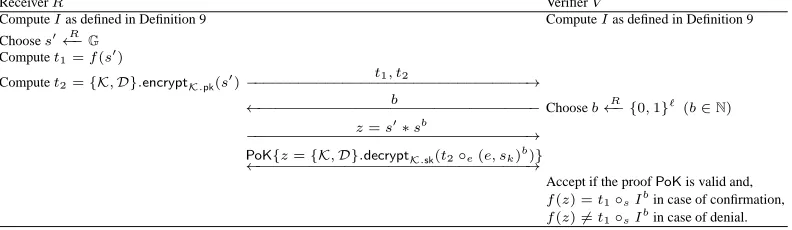
Prove Validity. Given a signcryptionµ = (µ1, µ2, µ3, µ4)on a messagem, the prover proves knowledge of the
decryption ofµ1, and of the decryption of(µ2, µ3), which together with µ4 forms a valid digital signature on
µ2kµ1. The private input is either the randomness used to createµor{Γ.sk,K.sk}.
Unsigncrypt. On a signcryption a(µ1, µ2, µ3, µ4), computem = Γ.decryptΓ.sk(µ1)andk = K.K.sk(µ2). Check
whether(D.decryptk(µ3), µ4)is valid signature onµ2kµ1; if yes then outputm, otherwise output⊥.
Confirm/Deny. On input a putative signcryptionµ= (µ1, µ2, µ3, µ4)on a messagem, use the receiver’s private key
to prove thatmis/isn’t the decryption ofµ1, and prove knowledge of the decryption of(µ2, µ3), which together
withµ4forms a valid/invalid digital signature onµ2kµ1.
Public Verify. On a valid signcryptionµ= (µ1, µ2, µ3, µ4)on a messagem, output a ZK non-interactive proof that
µ1encryptsm, in addition to(D.decryptK.decap(µ2)(µ3), µ4).
5.2 Analysis
Theorem 11 Given(t, qs)∈N2andε∈[0,1], the above construction is (t, ǫ, qs)-EUF-CMA secure if the underlying
Theorem 12 Given(t, qs, qv, qu, qcd, qpv)∈N6and(ε, ǫ′)∈[0,1]2, the construction proposed above is (t, ǫ, qs, qv, qu, qcd, qpv
)-IND-CCA secure if it uses a(t, ǫ′, q
s)-EUF-CMA secure digital signature, an IND-CPA secure encryption, an IND-OT
secure DEM, and a (t+qs(qu+qcd+qpv),ǫ(1−ǫ
′
)qcd+qu+qpv
2 )-IND-CPA secure KEM.
We provide both proofs in Appendix E.1 and Appendix E.2 respectively.
Our aim in the rest of this paragraph consists in identifying suitable classes of encryption/signature schemes that renders theproveValidityand{confirm,deny}efficient. These protocols comprise the following sub-protocols:
1. Proving knowledge of the decryption of a ciphertext produced using the encryption schemeΓ. 2. Proving that a message is/isn’t the decryption of a certain ciphertext produced usingΓ.
3. Proving knowledge of the decryption of a ciphertext produced using(K,D), and that this decryption forms a valid/invalid digital signature, issued usingΣ, on some known string.
It is natural to instantiate the encryption schemeΓ from the classEdefined in Definition 3. The first two sub-protocols can be efficiently carried out using the proofs depicted in Figure 1 and Figure 2. For the last sub-protocol, one can consider encryption schemes from the classEthat are derived from the KEM/DEM paradigm, in addition to signature schemes that accept efficient proofs of knowledge. We provide in Appendix E.3 the class of used signatures as well as the proof underlying the third sub-protocol.
5.3 Extension to Multi-user security
The above EtStE technique can be extended to achieve security in the multi-user setting, as defined in Subsection B, by applying the standard techniques [1, 39]. More specifically, one considers a tag-based encryption schemeΓ, a tag-based KEMK, a DEMD, an a signature scheme. The sender’s key pair is the signature scheme key pair, whereas the receiver’s key pair comprise both key pairs ofΓandK. Signcryption on a messagemw.r.t. a sender’s public keyΣ.pk and a receiver’s public key(Γ.pk,K.pk)is generated as follows. First compute an encryptioneonm(withΓ) w.r.t. the tagΣ.pk, then generate a keykand its encapsulationcw.r.t. the same tag (withK), then compute a digital signature onckek{Γ.pk,K.pk}, and finally sign the “significant” part of this signature usingk. The signcryption consists of the result of this encryption, the remaining part of the signature, and(e, c). The rest is similar to the paradigm in the two-user setting.
Theorem 13 Given (t, qs) ∈ N2 and ε ∈ [0,1], the above construction is (t, ǫ, qs)-dM-EUF-CMA secure if the
underlying digital signature scheme is (t, ǫ, qs)-EUF-CMA secure.
The proof is similar to that of Theorem 9 and of Theorem 11. ⊓⊔
Theorem 14 Given(t, qs, qv, qu, qcd, qpv)∈N6and(ε, ǫ′)∈[0,1]2, the above construction is(t, ǫ, qs, qv, qu, qcd, qpv)
-fM-IND-CCA secure if it uses a(t, ǫ′, q
s)-EUF-CMA secure digital signature, an IND-sTag-CCA secure encryption,
an IND-OT secure DEM, and a (t+qs(qu+qcd+qpv),ǫ(1−ǫ
′
)qcd+qu+qpv
2 , qcd+qu+qpv)-IND-sTag-CCA secure
KEM.
The proof is similar to that of Theorem 9 and of Theorem 12.
⊓ ⊔
6
Conclusion
References
1. J. H. An, Y. Dodis, and T. Rabin, On the Security of Joint Signature and Encryption., Advances in Cryptology - EUROCRYPT
2002 (L. R. Knudsen, ed.), LNCS, vol. 2332, Springer, 2002, pp. 83–107.
2. J. Baek, R. Steinfeld, and Y. Zheng, Formal Proofs for the Security of Signcryption, J. Cryptology 20 (2007), no. 2, 203–235. 3. F. Bao and R. H. Deng, A Signcryption Scheme with Signature Directly Verifiable by Public Key, Public Key Cryptography
(H. Imai and Y. Zheng, eds.), LNCS, vol. 1431, Springer, 1998, pp. 55–59.
4. M. Bellare, A. Desai, D. Pointcheval, and P. Rogaway, Relations Among Notions of Security for Public-Key Encryption Schemes., Advances in Cryptology - CRYPTO’98 (H. Krawczyk, ed.), LNCS, vol. 1462, Springer, 1998, pp. 26–45.
5. M. Bellare and P. Rogaway, The Exact Security of Digital Signatures: How to Sign with RSA and Rabin., Advances in Cryp-tology - EUROCRYPT’96 (U. M. Maurer, ed.), LNCS, vol. 1070, Springer, 1996, pp. 399–416.
6. M. Blum, P. Feldman, and S. Micali, Non-Interactive Zero-Knowledge and Its Applications (Extended Abstract), STOC (J. Si-mon, ed.), ACM Press, 1988, pp. 103–112.
7. D. Boneh and X. Boyen, Short Signatures Without Random Oracles., Advances in Cryptology - EUROCRYPT2004 (C. Cachin and J. Camenisch, eds.), LNCS, vol. 3027, Springer, 2004, pp. 56–73.
8. D. Boneh, X. Boyen, and H. Shacham, Short Group Signatures., in Franklin [25], pp. 41–55.
9. D. Boneh, B. Lynn, and H. Shacham, Short Signatures from the Weil Pairing., J. Cryptology 17 (2004), no. 4, 297–319. 10. G. Brassard, D. Chaum, and C. Cr´epeau, Minimum disclosure proofs of knowledge., J. Comput. Syst. Sci. 37 (1988), no. 2,
156–189.
11. E. Bresson and J. Stern, Proofs of Knowledge for Non-Monotone Discrete-Log Formulae and Applications., Information Secu-rity, ISC 2002 (A. H. Chan and V. D. Gligor, eds.), LNCS, vol. 2433, Springer, 2002, pp. 272–288.
12. J. Camenisch and A. Lysyanskaya, Dynamic Accumulators and Application to Efficient Revocation of Anonymous Credentials, CRYPTO (M. Yung, ed.), LNCS, vol. 2442, Springer, 2002, pp. 61–76.
13. , Signature Schemes and Anonymous Credentials from Bilinear Maps, in Franklin [25], pp. 56–72.
14. J. Camenisch and V. Shoup, Practical Verifiable Encryption and Decryption of Discrete Logarithms., Advances in Cryptology - CRYPTO2003 (D. Boneh, ed.), LNCS, vol. 2729, Springer, 2003, pp. 126–144.
15. D. Chaum and T. P. Pedersen, Wallet Databases with Observers., Advances in Cryptology - CRYPTO’92 (E. F. Brickell, ed.), LNCS, vol. 740, Springer, 1993, pp. 89–105.
16. D. Chiba, T. Matsuda, J. C. N. Schuldt, and K. Matsuura, Efficient Generic Constructions of Signcryption with Insider Security in the Multi-user Setting, ACNS (J. Lopez and G. Tsudik, eds.), LNCS, vol. 6715, 2011, pp. 220–237.
17. S. M. Chow, S-M. Yiu, L. Hui, and K. P. Chow, Efficient Forward and Provably Secure ID-Based Signcryption Scheme with Public Verifiability and Public Ciphertext Authenticity, ICISC (J. I. Lim and D. H. Lee, eds.), LNCS, vol. 2971, Springer, 2003, pp. 352–369.
18. S. S. M. Chow and K. Haralambiev, Non-interactive Confirmer Signatures, CT-RSA (A. Kiayias, ed.), LNCS, vol. 6558, Springer, 2011, pp. 49–64.
19. R. Cramer and V. Shoup, Signature schemes based on the strong RSA assumption., ACM Trans. Inf. Syst. Secur. 3 (2000), no. 3, 161–185.
20. , Design and Analysis of Practical Public-Key Encryption Schemes Secure Against Adaptive Chosen Ciphertext Attack., SIAM J. Comput. 33 (2003), no. 1, 167–226.
21. I. Damg˚ard, N. Fazio, and A. Nicolosi, Non-interactive zero-knowledge from homomorphic encryption, in Halevi and Rabin [31], pp. 41–59.
22. A. W. Dent, Hybrid Signcryption Schemes with Outsider Security, ISC (J. Zhou, J. Lopez, R. H. Deng, and F. Bao, eds.), LNCS, vol. 3650, Springer, 2005, pp. 203–217.
23. L. El Aimani, On Generic Constructions of Designated Confirmer Signatures, in Roy and Sendrier [43], Full version available at the Cryptology ePrint Archive, Report 2009/403, pp. 343–362.
24. T. El Gamal, A Public Key Cryptosystem and a Signature Scheme based on Discrete Logarithms., IEEE Trans. Inf. Theory 31 (1985), 469–472.
25. M. K. Franklin (ed.), Advances in Cryptology - CRYPTO 2004, 24th Annual International Cryptology Conference, Santa Barbara, California, USA, August 15-19, 2004, Proceedings, LNCS, vol. 3152, Springer, 2004.
26. R. Gennaro, S. Halevi, and T. Rabin, Secure Hash-and-Sign Signatures Without the Random Oracle., in Stern [48], pp. 397–416. 27. O. Goldreich, Foundations of cryptography. Basic Tools., Cambridge University Press., 2001.
28. Oded Goldreich, Silvio Micali, and Avi Wigderson, How to Prove all NP-Statements in Zero-Knowledge, and a Methodology of Cryptographic Protocol Design, CRYPTO (A. M. Odlyzko, ed.), LNCS, vol. 263, Springer, 1986, pp. 171–185.
29. S. Goldwasser, S. Micali, and R. L. Rivest, A Digital Signature Scheme Secure Against Adaptive Chosen-Message Attacks., SIAM J. Comput. 17 (1988), no. 2, 281–308.
31. Shai Halevi and Tal Rabin (eds.), Theory of cryptography, third theory of cryptography conference, tcc 2006, new york, ny, usa, march 4-7, 2006, proceedings, LNCS, vol. 3876, Springer, 2006.
32. S-H. Heng and K. Kurosawa (eds.), The fourth international conference on provable security, LNCS, vol. 6402, Springer, 2010. 33. J. Herranz, D. Hofheinz, and E. Kiltz, KEM/DEM: Necessary and Sufficient Conditions for secure Hybrid Encryption, Available
at http://eprint.iacr.org/2006/265.pdf, August 2006.
34. I. Jeong, H. Jeong, H. Rhee, D. Lee, and J. Lim, Provably Secure Encrypt-then-Sign Composition in Hybrid Signcryption, in Lee and Lim [36], pp. 16–34.
35. E. Kiltz, Chosen-Ciphertext Security from Tag-Based Encryption, in Halevi and Rabin [31], pp. 581–600.
36. P. J. Lee and C. H. Lim (eds.), Information security and cryptology - ICISC 2002, 5th international conference seoul, korea, november 28-29, 2002, revised papers, LNCS, vol. 2587, Springer, 2003.
37. M. Liskov and S. Micali, Online-Untransferable Signatures, Public Key Cryptography (R. Cramer, ed.), LNCS, vol. 4939, Springer, 2008, pp. 248–267.
38. C. Ma, Efficient Short Signcryption Scheme with Public Verifiability, Inscrypt (H. Lipmaa, M. Yung, and D. Lin, eds.), LNCS, vol. 4318, Springer, 2006, pp. 118–129.
39. T. Matsuda, K. Matsuura, and J. Schuldt, Efficient Constructions of Signcryption Schemes and Signcryption Composability, in Roy and Sendrier [43], pp. 321–342.
40. P. Paillier, Public-Key Cryptosystems Based on Composite Degree Residuosity Classes, in Stern [48], pp. 223–238.
41. P. Paillier and J. Villar, Trading One-Wayness Against Chosen-Ciphertext Security in Factoring-Based Encryption, ASI-ACRYPT (X. Lai and K. Chen, eds.), LNCS, vol. 4284, Springer, 2006, pp. 252–266.
42. D. Pointcheval and J. Stern, Security Arguments for Digital Signatures and Blind Signatures., J. Cryptology 13 (2000), no. 3, 361–396.
43. B. Roy and N. Sendrier (eds.), Progress in cryptology - INDOCRYPT2009, vol. 5922, Berlin, Heidelberg, 2009. 44. C. P. Schnorr, Efficient signature generation by smart cards., J. Cryptology 4 (1991), no. 3, 161–174.
45. S. Selvi, S. Vivek, and P. Pandu Rangan, Identity Based Public Verifiable Signcryption Scheme, in Heng and Kurosawa [32], pp. 244–260.
46. J-B Shin, K. Lee, and K. Shim, New DSA-Verifiable Signcryption Schemes, in Lee and Lim [36], pp. 35–47.
47. V. Shoup and R. Gennaro, Securing Threshold Cryptosystems against Chosen Ciphertext Attack, J. Cryptology 15 (2002), no. 2, 75–96.
48. J. Stern (ed.), Advances in Cryptology - EUROCRYPT’99, International Conference on the Theory and Application of Crypto-graphic Techniques, Prague, Czech Republic, May 2-6, 1999, Proceeding, LNCS, vol. 1592, Springer, 1999.
49. B. Waters, Efficient Identity-Based Encryption Without Random Oracles., Advances in Cryptology - EUROCRYPT 2005 (R. Cramer, ed.), LNCS, vol. 3494, Springer, 2005, pp. 114–127.
50. F. Zhang, R. Safavi-Naini, and W. Susilo, An Efficient Signature Scheme from Bilinear Pairings and Its Applications., 7th International Workshop on Practice and Theory in Public Key Cryptography, PKC 2004 (F. Bao, R. H. Deng, and J. Zhou, eds.), LNCS, vol. 2947, Springer, 2004, pp. 277–290.
51. Y. Zheng, Digital Signcryption or How to Achieve Cost(Signature & Encryption)≪Cost(Signature) + Cost(Encryption)., Advances in Cryptology - CRYPTO’97 (B. S. Kaliski Jr., ed.), LNCS, vol. 1294, Springer, 1997, pp. 165–179.
A
Preliminaries
A.1 Digital signatures
A signature schemeΣcomprises three algorithms, namely the key generation algorithmkeygen, the signing algorithm sign, and the verification algorithmproveValidity. The standard security notion for a signature scheme is existential unforgeability under chosen message attacks (EUF-CMA), which was introduced in [29]. Informally, this notion refers to the hardness of, given a signing oracle, producing a valid pair of message and corresponding signature such that message has not been queried to the signing oracle. There exists also the stronger notion, SEUF-CMA (strong exis-tential unforgeability under chosen message attack), which allows the adversary to produce a forgery on a previously queried message, however the corresponding signature must not be obtained from the signing oracle.
A.2 Public key encryption schemes
non-Malleability (NM) which corresponds to the hardness of deriving from a given ciphertext another ciphertext such that the underlying plaintexts are meaningfully related. Conversely, the typical attack models an adversary against an encryption scheme is allowed to are: Chosen Plaintext Attack (CPA) where the adversary can encrypt any mes-sage of his choice. This is inevitable in public key settings, Plaintext Checking Attack (PCA) in which the adver-sary is allowed to query an oracle on pairs (m, c) and gets answers whethermis really encrypted incor not, and finally Chosen Ciphertext Attack (CCA) where the adversary is allowed to query a decryption oracle. Pairing the men-tioned goals with these attack models yields nine security notions: GOAL-ATK for GOAL ∈ {OW,IND,NM}and ATK∈ {CPA,PCA,CCA}. We refer to [4] for the formal definitions of these notions as well as for the relations they satisfy.
A.3 Tag-based encryption
Tag-based encryption, also referred to as encryption with labels, was first introduced in [47]. In these schemes, the encryption algorithm takes as input, in addition to the public keypkand the messagemintended to be encrypted, a tag twhich specifies information related to the message mand its encryption context. Similarly, the decryption algorithm takes additionally to the ciphertext and the private key the tag under which the ciphertext was created. Security notions are then defined as usual except that the adversary specifies to his challenger the tag to be used in the challenge ciphertext, and in case he (the adversary) is allowed to query oracles, then he cannot query them on the pair formed by the challenge ciphertext and the tag used to form it. There are also weakened security models for this type of encryption where the adversary specifies the challenge tag before getting the parameters of the scheme, and during the game, he (the adversary) is not allowed to query the allowed oracles w.r.t. the challenge tag; we talk in this case about selective tag security. We specify in the following the formal definition of IND-sTag-CCA security for tag-based encryption:
Definition 4 (IND-sTag-CCA indistinguishability). LetΓ be a tag-based encryption scheme scheme. Let furtherA
denote a PPTM. We consider the following random experiment:
ExperimentExpind-sTag-CCAΓ,A −b(1κ)
(t⋆,I0)← A(1κ,init)
(pk,sk)←Γ.keygen(1κ),
(m⋆
0, m⋆1,I)← A O
(find,pk,I0)
O: (c, t)[t6=t⋆]7−→Γ.decryptsk(c, t)
c⋆←Γ.encryptpk(m⋆b, t⋆)
d← AO(guess,I
, c⋆, t⋆)
Returnd
We define the advantage ofAvia:
Advind-sTag-CCAΓ,A (1κ) =
PrhExpind-sTag-CCAΓ,A −b(1κ) =bi−1
2
.
Given(t, qd)∈N2andε∈[0,1],Ais called a(t, ε, qd)-ind-sTag-CCAadversary againstΓ if, running in timetand
issuingqddecryption queries,AhasAdvΓ,indA−sTag−CCA(1κ)≥ε. The schemeΓ is said to be(t, ε, qd)-ind-sTag-CCA
secure if no(t, ε, qd)-ind-sTag-CCAadversary against it exists.
A.4 Key/Data encapsulation mechanisms (KEM/DEMs)
DEM is simply a secret key encryption scheme given by the same algorithms forming a cryptosystem (PKE). KEMs could be efficiently combined with DEMs to build secure encryption schemes. This paradigm is called the Hybrid encryption paradigm and we refer to [33] for the necessary and sufficient conditions on the KEMs and the DEMs in order to obtain a certain level of security for the resulting hybrid encryption scheme. For instance, to obtain an IND-CPA secure cryptosystem, it suffices to combine an IND-IND-CPA secure KEM and an indistinguishable under a one time attack (IND-OT) DEM.
A.5 Commitment schemes
A commitment scheme [10] consists of the following algorithms:
– setup: the setup algorithm that generates the public parameters of the system.
– keygen: generates probabilistically a public commitment keypk.
– commit: a probabilistic algorithm that, on input a public keypkand a messagem, produces a pair(c, r):cserves as the commitment value (locked box), andras the opening value.
– open: this is a deterministic algorithm that given a commitment(c, r), w.r.t. a public keypk, on a alleged message
m, checks whetherc=? commitpk(m, r).
The algorithmopenmust succeed if the commitment was correctly formed (correctness). Moreover, we require the following security properties:
1. Hiding. It is hard for an adversary A to generate two messagesm0, m1such that he can distinguish between their
corresponding locked boxesco, c1. That is,creveals no information aboutm.
A commitment scheme is(t, ǫ)-hiding if no adversary A, operating in timet, can succeed in the above game with probability greater thanǫ, where the probability is taken over the random coins of both A and his challenger. 2. Binding. It is hard for an adversary A to come up with a collision(c, d, d′)such that(c, d)and(c, d′)are valid
commitments formandm′resp andm6=m′.
B
Multi-User Security
Definition 5 (Multi-user Unforgeability). We consider a signcryption schemescgiven by the algorithms/protocols defined earlier in this document. LetAbe a PPTM. We consider the following random experiment:
ExperimentExpdm-euf-cmasc,A (1κ)
param←sc.setup(1κ)
(sk⋆S,pk⋆S)←sc.keygenS(1κ,param)
(sk⋆R,pk⋆R, µ⋆)← AS
(pk⋆S)
S: (m,skR,pkR)7−→sc.signcrypt{sk⋆S,pkS,pkR}(m)
return1if and only if the following properties are satisfied: -sc.unsigncrypt{sk⋆
R,pk⋆R,pk⋆S}[µ ⋆] =m⋆
-m⋆was not queried toSw.r.t.pk⋆ R.
We define the success ofAvia:
Succdm-euf-cmasc,A (1κ) = PrhExpdm-euf-cma
sc,A (1κ) = 1
i
.
Given(t, qs) ∈ N2 andε ∈ [0,1], Ais called a (t, ε, qs)-dM-EUF-CMA (dynamic Multi-user Existentially
Un-forgeable against Chosen Message Attacks) adversary againstscif, running in timetand issuingqsqueries to the
sc.signcryptoracle,AhasSuccdm-euf-cmasc,A (1κ)≥ε. The schemescis said to be(t, ε, q
s)-dM-EUF-CMAsecure if no
Remark 5. A tangible difference between unforgeability in the multi-user setting and unforgeability in the two-user setting lies in the possibility of the adversary in the former to return a forgery on a messagem⋆that may have been
queried before but w.r.t. a receiver’s key different from the returned receiver’s keypk⋆R.
Definition 6 (Multi-user Indistinguishability). Letscbe a signcryption scheme, and letAbe a PPTM. We consider the following random experiment forb←R− {0,1}:
ExperimentExpfM-ind-ccasc,A -b(1κ)
param←sc.setup(1κ)
(sk⋆S,pk⋆S)←sc.keygenS(1κ,param) (sk⋆R,pk⋆R)←sc.keygen(1κ,param)
(m⋆
0, m⋆1,I)← A S,V,U,C
(find,pk⋆S,pk⋆R)
S:m7−→sc.signcrypt{sk⋆
S,pk⋆S,pk⋆R}(m) V:µ7−→sc.proveValidity(µ,pk⋆S,pk⋆R)
U:µ7−→sc.unsigncryptsk⋆
R,pk⋆R,pk⋆S(µ)
C: (µ, m)7−→sc.{confirm,deny}(µ, m,pk⋆R,pk⋆S)
P: (µ, m)7−→sc.publicVerify(µ, m,pk⋆R,pk⋆S)
µ⋆←sc.signcrypt{sk⋆
S,pk⋆S,pk⋆R}(m
⋆ b)
d← AS,V,U,C
(guess,I, µ⋆,pk⋆ S,pk⋆R)
S:m7−→sc.signcrypt{sk⋆
S,pk⋆S,pk⋆R}(m) V:µ7−→sc.proveValidity(µ,pk⋆S,pk⋆R)
U:µ(6=µ⋆)7−→sc.unsigncrypt sk⋆
R,pk⋆R,pk⋆S(µ) V: (µ, m)(6= (µ⋆, m⋆
i), i= 0,1)7−→sc.{confirm,deny}(µ, m,pk⋆R,pk⋆S)
P: (µ, m)(6= (µ⋆, m⋆i), i= 0,1)7−→sc.publicVerify(µ, m,pk⋆R,pk⋆S)
Returnd
We define the advantage ofAvia:
Advfm-ind-ccasc,A (1κ) =
PrhExpfm-ind-cca-bsc,A (1κ) =bi−1
2 .
Given(t, qs, qv, qu, qcd, qpv)∈N6andε∈[0,1],Ais called a(t, ε, qs, qv, qu, qcd, qpv)-fM-IND-CCA(fixed challenge
Multi-user Indistinguishable under Chosen Ciphertext Attacks) adversary againstscif, running in timetand issuingqs
queries to thesc.signcryptoracle,qvqueries to thesc.proveValidityoracle,ququeries to thesc.unsigncryptoracle,qcd
queries to thesc.{confirm,deny}oracle , andqpv queries to thesc.oracle,AhasAdvindsc,A−cca(1κ)≥ε. The scheme
scis said to be(t, ε, qs, qv, qu, qcd, qpv)-fM-IND-CCAsecure if no(t, ε, qs, qv, qu, qcd, qpv)-fM-IND-CCAadversary
against it exists.
Remark 6. Note that in the Multi-user setting, the indistinguishability adversary is allowed to ask the unsigncryption of the challenge w.r.t. any receiver’s key except that of the target receiver.
C
Analysis of the StE and the CtEaS Paradigms
C.1 Proof of Lemma 2
Proof. LetRbe the key-preserving reduction that reduces NM-CPA breaking the encryption scheme underlying the construction to IND-CCA breaking the construction (from the StE or EtS) itself. We will construct an algorithmM
that usesRto NM-CPA break the same encryption scheme by simulating an execution of the IND-CCA adversaryA
against the construction.
– StE paradigm.M(behaving asA) will queryRon two messagesm0, m1(m06=m1) for signcryption. Letµ0, µ1
be the corresponding signcryptions respectively.Mwill query again(µi, mi),i∈ {0,1}, for public verification.
Letσ0, σ1be the corresponding answers respectively. At that point,MoutputsD = {m0kσ0, m1kσ1}, to his
NM-CPA challenger, as a distribution probability from which the messages will be drawn. He gets in response a challenge encryptionµ⋆, of eitherm0kσ
0 orm1kσ1underΓ.pk, and is asked to produce a ciphertextµ′ whose
corresponding plaintext is meaningfully related to the decryption of µ⋆. To solve his task, Mqueries µ⋆ for
unsigncryption. Letmbbe the result of such a query withb ∈ {0,1}.Mwill outputΓ.encryptΓ.pk(mbkσb)(m
refers to the bit-complement of the elementm) and the relationR:R(m, m′) = (m′ =m). FinallyMaborts the
game (stops simulating an IND-CCA attacker against the generic construction).
– CtEaS paradigm. Similarly, Mqueries Ronm0, m1(m0 6= m1) for signcryption. Letµ0 = (e0, c0, σ0)and
µ1 = (e1, c1, σ1)be the corresponding signcryptions.Mwill then queryµ0, µ1, along with the corresponding
messages, for public verification. Let m0kr0 andm1kr1 be the corresponding answers.M will outputD = {m0kr0, m1kr1}, to his NM-CPA challenger, as a distribution probability from which the messages will be drawn.
He will receive a challenge encryptione⋆, of eitherm0kr0orm1kr1.Mwill then query the unsigncryption of
(e⋆, c
b, σb)for someb ←R− {0,1}. If the answer is different from⊥, thene⋆ is indeed an encryption ofmbkrb,
and thus Mwill output Γ.encryptΓ.pk(mbkrb)and the relationR (defined above). Otherwise, Mwill output
Γ.encryptΓ.pk(m1−bkr1−b)and the same relationR. FinallyMaborts the game (stops simulating an IND-CCA
attacker against the generic construction).
⊓ ⊔
C.2 Generalization to Arbitrary Reductions
Non malleable key generators We define the non malleability of a cryptosystem key generator through the following
two games:
1. In Game 0, we consider an algorithmRtrying to break a cryptosystemΓ, w.r.t. a public keyΓ.pk, in the sense of NM-CPA (or OW-CCA) using an adversaryA which solves a problem A, perfectly reducible to OW-CPA breaking the cryptosystem Γ (w.r.t.Γ.pk). In this game,R lunchesA over his own challenge key Γ.pkand some other parameters chosen freely byR. We will denote byadv0(RA)the success probability ofRin such a
game, where the probability is taken over the random tapes of bothRandA. We further definesuccGame0
Γ (A) =
maxRadv0(RA)to be the success in Game 0 of the best reductionRmaking the best possible use of the adversary A. Note that the goal of Game 0 is to include all key-preserving reductionsRfrom NM-CPA (or OW-CCA) breaking the cryptosystem in question to solving a problem A, which is reducible to OW-CPA breaking the same cryptosystem.
2. In Game 1, we consider the same entities as in Game 0, with the exception of providingRwith, in addition to A, a OW-CPA oracle (i.e. a decryption oracle corresponding to Γ) that he can query w.r.t. any public key Γ.pk′ 6=Γ.pk, whereΓ.pkis the challenge public key ofR. Similarly, we defineadv1(RA)to be the success of Rin such a game, andsuccGame1
Γ (A) = maxRadv0(RA)the success in Game 1 of the reductionRmaking the
best possible use of the adversaryAand of the OW-CPA oracle.
Definition 7. A cryptosystemΓ is said to have a non malleable key generator if ∆=maxA|succGame1Γ (A)-succGame0Γ (A)|is negligible in the security parameter.
This definition informally means that a cryptosystem has a non malleable key generator if NM-CPA (or OW-CCA) breaking it w.r.t. a key pkis no easier when given access to a decryption (OW-CPA) oracle w.r.t. any public key pk′6=pk.
To generalize the impossibility results in Subsection 3.1, we first need the following Lemma (similar to Lemma 6 of [41])
Lemma 3. LetAbe an adversary solving a problem A, reducible to OW-CPA breaking a cryptosystemΓ, and letR
be an arbitrary reductionRthat NM-CPA (OW-CCA) breaks a cryptosystemΓ, given access toA. We haveadv(R)≤