A CRITICAL AND EVALUATIVE STUDY OF EDUCATIONAL PROVISION IN JAMAICA
, 1938 —
1973.
By B.S. Palmer.
Presented as a thesis
for the Degree of Ph.D.
University Of London Institute of Education.
University of London.
ABSTRACT
As a precursor to the study of school—age educational provision in Jamaica, there is a review of the historical, social, cultural and economic factors which have comprised the demographic background in which the schools
function. Attention is paid to the considerable body of research, official reports, comment and opinion which avers that Jamaican society is both vulnerable to and influenced by elitism, based upon models borrowed from metropolitan cultures.
The chapters which deal with successive age ranges in the school population offer an objective study of qualitative and quantitative differences between the age sectors and also between schools within each sector. Major
influences in educational practice, such as selection for secondary schooling, curriculum choice and the examination process are subjected to scrutiny,
though acknowledgements are made to the developmental stage through which the society has been moving throughout the period under review.
While recognition is given to the place of further and higher education as an outcome of the educational system, it has not been possible to offer more than a cursory examination of these sectors.
Thera is an attempt to examine the educational process as a causal or adaptive feature of a society in a state of rapid change from Colonial to Independent status. There is ready acknowledgement also that the state of
affairs observed in the course of an academic year of field study, in 1972 —
1
973, was influenced by the political tradition which had ensured a decade of administration by the Jamaica tabour Party.CONTENTS
Page.
Introduction, Methodology.
4.
Chapter One. Demographic Background. 13.
Chapter Two. Society, the Economy and Education.
41.
Chapter Three. Function and Dysfunction in
73.
educational opportunity.Chapter Four. Early Childhood Education.
66.
Chapter Five. Primary Education. 106,
Chapter Six. Junior Secondary Education.
142.
Chapter Seven. Secondary Education. 173,
Chapter Eight. Further, Vocationd and Higher Education.
Chapter Nine. The Teaching Profession. 225.
Chapter Ten. Educational ixitoonieS i4 Jamaican: Schools. 256.
Appendix One. Research design for field study inquiry 288. — Jamaican schools.
Appendix. Two. Table to show site accommodation,by type 289. of school.
Appendix Three. Net paid circulation figures-IChildrens' Own.' 290. (The Gleaner Company
Appendi Four. Facts Sheet:The Jamaica Schools Library 291. Service.
1973.
Tables. 292.
Li-
INTRODUCTIO N
Major influences in the instigation of this research have stemmed from my own work in the training of sub-literate adults, the teaching of English as a second language to foreign students, and teaching in a multi-racial school as well as recent work in teacher education. This has involved the addition to the Trent Park College curriculum of study ar,pas on the multi-racial society, wherein a high priority has been given to developing student awareness of the range of educational backgrounds of pupils born overseas, or of parents of foreign origin. Within the literature generally available for student use, the sources which conveyed information on cultural background: fell short of desired standards where the minutiae of educational provision was concerned.
Studies on the West Indian region, it must be acknowledged, had not
been constructed on this basis. For example, Black (1965), and Sherlock (1966) emphasized historical perspectives, including the social and economic effects of a slave society. Simey (1946), Henriques (1953 and 1968), Clarke (1957 and 1966), Smith (1960, 1961, 1962), produced major studies of an
anthropological/sociological nature, examining family structures and community and social class relationships. The examination of political and economic transformation in a developing society which these provided was reinforced by more specific studies, such as Evans (1953, 1962), Cohen (1961), Francis (1963) and Rubin (1967), on the Jamaican rural community and the adolescent,
on teacher education or on the Ministerial system in education, and on popu-lation studies or in an investigation into the outcomes of deprivation,
wherein a number of deficits in educational opportunity were stressed, albeit in general terms.
the Committee Reports headed by Kandell and Easter, on the system of secondary education in the island, gave insights into the goals and values of Jamaican society in the colonial en l. Also of value were the Annual Reports of the Jamaican Department of Education.
Within the period of self-government and Independence, National Plans, and Five Year Development Plans of the National Planning Agency gave attention to the place of education in the island economy. More specifically for the purposes of this research, were Education Acts and Government White Papers, the most notable in the period being the 1966 New Deal for Education in Independent Jamaica. However, sources were sparse for the early years of independent administration, School Directories in particular being refurbished intermittently, with a greater abundance of official publications arising out of the expansion in educational provision which the New Deal promised. The part played in vocational training by ministries other than that of Education seemed inevitable in the developing situation. Contributions from the
Ministries of Health, Development and Welfare, Finance, Labour, and Youth and Community Development proved useful in gaining insights into community
needs in the island. Data from the Department of Statistics, relating the work 0 Francis to subsequent information from the 1970 census, and from the West Indian Medical Journal and the Caribbean Conference for Mental Health provided further study in depth of varying degrees of well-being in the population at the end of the 1960's and the early 1970's. A range of reports, researches and theses of the University of the West Indies and articles in journals, such as The
outcome of education, was the topic of work b:' Ebanks (1968), Evans (1967), Lowenthal (1972)and Kuper (1976).
Socio-economic factors affecting the aspiration of working-class Jamaicans were studied by Smith (1960), Brooks (1962), Cumper (1962), Strumpel (1965) and Miller (1971), and the influence of environment upon mental ability was examined by Manley (1963), Reid (1964), Evans (1964) and Williams (1951 and 1968). The question of employment, in particular the case for youth employment, was studied in papers by Harewood (1960), Campbell (1965), and at the Commonwealth Caribbean Regional Youth Seminar held in Port of Spain (1970). Employment and unemployment
were also the object of attention for a mission, requested by the Government of Jamaica, from the International Labour Organisation (1972), when the issues of educability, of attainment, under-attainment and the acquisition of basic skills were of keen interest to members of the enquiry.
Despite the sentiments implicit in the island people" cultural identity and division of interests
motto, "Out of many, one promoted by social class hierarchies were still apparent, though one should hasten to comment that this is not to suggest that Jamaica was unique in this. Many of the tensions which resulted were of a multi-ethnic basis and the seeming perpetuation of
'deprivation and disadvantage' appeared to provide ammunition for the politics both of envy and expectation. These topics were the object of many studies, especially during the first decade of Independence: Smith, Augier and Nettleford (1960), Rubin (1967), Pilau (1968), Miller (1969), Nettleford (1970), Lowenthal (1970, 1972), and Milner (1975).
The theme of educational provision was a consistent source of discussion, thou .11 usually at a somewhat generalised level, with the stuffy of inequalities, and conflicting views as to the efficacy of education as a social service, forming the threads of many of the commentaries. The study by Figueroa (1971), devoted to an examination of schools and society in the Caribbean region, while giving an intellectual and philosophical gloss to the picture, failed to
In the second half of the field study year a proliferation of papers on developmental aspects of the educational philosophy of the new administration indicated clearly new emphases in education. A salient feature of most of the material which cane to hand was the recognition of a social class hierarchy based partly, if not largely, onethnic differences, yet no study attempted specifically to indicate the influence of the educational process as a causal or adaptive feature of the society. There is little point, it seems, in assessing the implications of an educational system unless the ramifications of educational provision are set out clearly. This, then, appeared to justify a study of the facets of the educational system which could explore variations in the availability of opportunity at successive age ranges, as well as
inquiring into the disposition of resources made accessible to teacher, pupil or school.
In the designing of the research plan these appeared to be matters of vital concern. The practicalities of the teaching situation are bound up with questions of who shall be educated and to what level, of what funding or
materials should be disbursed for the educational process, and whether education is an equal right or not. It is apparent that questions of such a fundamental nature plague many societies. The case for Jamaica as a study area was bound up with its size as a relatively small community, with the fact that it offered the possibility of a practical analysis of the whole spectrum of state and state-aided school provision, and also that it had been a major contributor to the process of migration, significantly to the United Kingdom, in the 1950's and 1960's.
excellence. It was also necessary to recognise degrees of progress in planning and administration for education in a developing economy and to acknowledge the countervailing influences which acted as brakes upon progress.
The thesis is seen, therefore, as an investigation into the nature of the teaching situation and the implications of teacher/pupil, teacher/teacher,
parent/teacher relationships as they impinge upon the development of age-cohorts of Jamaican pupils. It also incorporates a study of school mechanisms, such as selective or streaming processes, the evaluation of pupil progress and the inter• relationships between the developing educational structure and the complexities of a society striving to establish its identity.
Methodology
It was with these objectives in mind that the preparation for the field study was carried out. A review of the available sources; publications, reports and articles accessible in the United Kingdom was begun, as was the establishment of links with institutions and individuals concerned with the development and practice of education in the island. Once the field study was under way, the cooperation and hospitality of the Jamaican community was remarkable, in suggesting or unearthing relevant material in support of the research. Many times the donation of scarce documents, surveys, or considerably dated reports was an invaluable adjunct to the helpful attitudes found.
There was a hiatus in the field work through what can be carefully termed 'bureaucratic intransigence'. It was recognised that a form of official saLotion for a first-hand inquiry into school conditions was essential. The request was passed along, or 'up' the line, but then refused. The official in question was shown letters from his own colleagus expresAn interest and approval for the intention and scope of the proposed study, but insisted warily that things may well not be as they seemed. The only safeguard which he would accept, giving credence both to research and researcher, would be direct approval of the project from London to himself. Even a subsequent interview, at Ministerial level,
•
inquiry was produced. However, the objectives of the study were not as a result affected adversely. In circles other than the Ministry the story of the hold-up seemed to tell in favour of the interests of the research, individuals appearing to go out of their way to contribute material or advice. In another direction, the delay proved fruitful. Since the major objective of touring a range of schools was thwarted by the absence of a letter of credence, much of the time was put to gaining first hand experience in teaching alongside the system. This occurred when, upon visiting the Priory school, the major private school in the island, an invitation was given to join the staff on a temporary basis. By helping out in an emergency, created by a staffing crisis in the science department, many insights were gained into pupil/teacher relationships, albeit at a privileged level in pupil terms, during the last ten weeks of the autumn term.
The collection of material proceeded at the sane time, the most fruitful sources being the Faculty of Education and the Institute for Social and
Economic Research at the University of the West Indies. The interest and con-structive guidance of the librarians there was, as always, of the utmost value. As a source of material the Ministry appeared to be much less effective, though it was apparent that the change in political administration, taking place only six months prior to the field study, had contributed to this state of affairs. It was also plain that the new Ministry Planning Unit was in its infancy, though significant improvements were seen by the end of the study year.
to.
'remote rural' as well as urban schools. Within the university campus little first-hand knowledge was forthcoming on the remote regions - the predilection for urban life-style apparently extending to mental attitudes of some indifference to the state of distant rural affairs. The joint difficulties of choice and
access to a range of schools in different parts of the island were finally resolved by the intervention of friends whose business carried them into most of the island parishes, and the ready assistance of the Jamaica Schools Library Service. Forty-nine schools were seen in eleven of the fourteen parishes of the island, though only four of these could be termed 'remote rural', despite the valuable assistance given.
The theses of in-service teacher/students at the School of Education gave many insights into the feasibility of constructing a profile of schools. One such, (Gascoigne - 1970), provided a ready-made research design to inquire into the availability of fifteen teaching or equipment resources, considered relevant to Jamaican schools. Apart from these guide lines, a check list (App'x I) was devised to ascertain a range of vw'iables in school provision. The items ranged from accommodation and attendance to staff provision and qualification. They also included types of room allocation for teaching or ancillary purposes and the range and tylie of subjects offered, as well as listing the examinations used by the schools. School space was assessed, and assembly or playing areas were itemised, as were the existence of school clubs or societies and 'other facilities'. For example, at one school there existed one 'Minist7' piano, while "tuck-shop" funds provided for a percussion band, a film strip projector, a typewriter and a school intercommunication system.
Most notable among the many pleasurable aspects of field study was the readiness of teachers, principals and other interested individuals to assist in the work. However time-consuming the inquiry, help was never withheld and it seems proper to note that records which involved the scrutiny of class or stream sizes, and two year-old attendance records were almost always produced with a
which had adverse effects upon the school population. It was fortunate that the Jamaica Teachers' Association had conducted their own survey into conditions in primary and all-age schools as late as 1969, as this gave several indications of critical areas.
Where source materials relevant to particular facets of the study were difficult to unearth on the Mona campus, alternative sources such as the Jamaica Institute were utilised, or summaries of evidence were taken from the media, notably the island newspaper, The Daily Gleaner. Towards the end of the field study, the Ministry of Education.Planning Unit was more forthcoming, and the compilation of material from their inquiries into the state of affairs in the educational system, either by copying, or by their offer of official papers, enabled the assembly of a more comprehensive body of background sources.
This routine development of the collection of substantive or supporting material paid high dividends in the collating phase of the research, providing much data for the many hypotheses subsumed under the broad research perspective, such as differentials affecting educability based upon social class, family
patterns, occupational status, urban or rural location, ethnic consciousness, and the practice of schools in determining, or following, choice in subject areas
within the school curricula.
The individual nature of the research project imposed its own limitations. It was not feasible to attempt more than a study of the school-age population and its disposition within the school educational system. .Thus, certain areas were deliberately excluded from the field study, such as the infrastructure of the youth camps, the work of the Ministry of Youth and Comunity Development, and also the specific area of teacher education in the island teachers' colleges. The area of higher education, embodied in the University of the West Indies, the College of Arts, Science and Technology and the Jamaica School of Agriculture, was also impossible to pursue at a level of some rigour.
.f2.
tion's "Curriculum Development Thrust", not to mention the conference on
"Vocational Training in Jamaica - 1972" appeared to confirm this beyond dispute. By the same token, there was an avoidance of research into language patterns, based upon the interference factor of the island patois in pupil learning. In any case it was felt that a considerable body of research had already been built up on this basis - possibly to the detriment of the attention due to the social and cultural factors with which this research is primarily concerned.
It is recognised that, in maintaining a research plan which aims to
embrace all sectors of school-age educational proviSion, study in depth must be sacrificed, relatively, in favour of a wide perspective. At a number of points in the study, several areas appear to offer themselves as worthwhile issues for further investigation: inquiry into differentials in school provision and facilities as between regions, or between urban and rural locations, or inquiry into subject choice, or subject groupings. It seems feasible to suggest that high potential may be developed as effectively through practical and technical subjects as by the traditional short-list of preferred academic study areas. Data on high attainment levels disclosed in the research would surely assist in the formulation of policy decisions based on curriculum change. Attention to the larger sectors of primary and all-age schools, hitherto the 'Cinderellas' of the system, would allow the administration to develop closer recognition of the qualitative and quantitative results which still emerge from schools working
I 3
giungPNE
DEMOGRAPHIC AND SOCIAL BACKGROUND.
Population, urban - rural.
The 1943 Census showed that out greater part, 1.013,000 were resident thirty per cent increase between 1943
of a total population of 1,237,063, the (1)
in tural Jamaica. Together with the (2)
and 1960, to a population of 1,609,814 persons there was an accompanying pattern of considerable urban drift. This
(3)
confirmed the evidence from the regional survey of
1955
which disclosed a town population of 400,000 out of an estimated island total of 1.55 million. Francis, basing his assessment of urban status as any built up locality of more than 2,000 persons, or having social amenities such as chirch, post office and police station, recorded urban population figures of 520,496.(4) The 1970Cenaus figure of1.861,000 represented an increase of 15.6 per cent over the corresponding census (5)
count of 1960, but these figures were clouded by a non-response rate of 1.9 per cent. Urban estimates,for main Parish capitals only, were shown in the prelim-
(6)
inary report but in the subsequent analysis urban population was given as 750,951 out of a revised island total of 1,813,598. The 'Corporate Area' along (Kingston and urban St. Andrew parish) accounted for 475,548 oilhis number.
Age and Sex.
The age distribution of the population gives rise to concern in terms of (7)
"minor dependents". Francis stated that
"while in 1943, children under 10 years of age comprised 25 per cent of the total population, in 1960, children under 10 accounted for 30 per cent of the population. The age group 'under
5
years' has shown the highest percentage increase with 71 per cent more children than at the time of the 1943 Census.And,
(1) Mather who fathered me.
1957.
Foreword p. 12.(2) FrancisIO.C. The People of Modern Jamaica. 1963. Chap 1. 1 - 4. (3) Smith,M.G. West Indian Family Structure. 1962. Chap
5.
p 125. (4) Francis,O.C. Op.cit. Tab. 1.4."The comparatively small increase of the middle age groups, 20 - 44, could probably be associated with the fact that it is these age groups which supply the bulk of Migrants."
For the purpose of a study of the educational system a more appropriate (1)
analysis is that of the 1970 Preliminary Report wherein the proportion of
population under 14 years of age is given as 44.6 per cent. A detailed age break- down was not available at that time but the Statistical Abstract of
1973
gave the2) following data,
TABLE I
Population by Age Groups to Age 14.
Under 2 years 2 - 4 'ears 7.__LYPars 10 - 14 ears 102,059 185,047 300,893 244,111
while a graphic representation of this age distribution in the island total is shown for the period under review in Figure I.
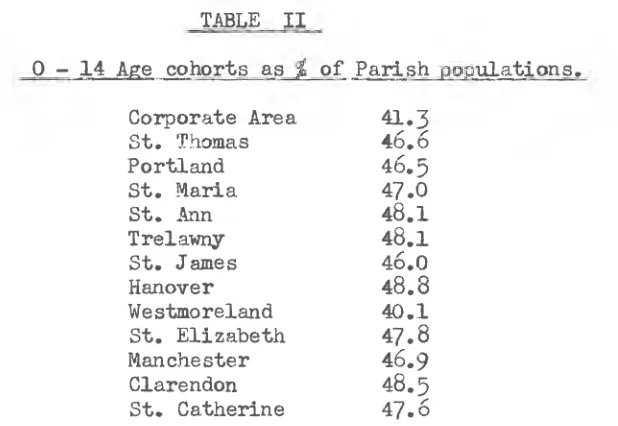
On a regional basis, differentiating only on the basis of corporate area and extra-metropolitan parishes, the following variations in the proportion of pre-school plus school-age cohorts were observable.
TABLE II
0 --14 Age cohorts as % of Parish populations. Corporate Area 41.3
St. Thomas 46.6
Portland 46.5
St. Maria 47.0
St. Ann 48.1
Trelawny 48.1
St. James 46.0
Hanover 48.8
Westmoreland 40.1 St. Elizabeth 47.8 Manchester 46.9
Clarendon 48.5
St. Catherine 47.6
(1) Preliminary Report, Op.cit. p. 4.
5 -
19 age cohorts. A•••
al/ •••
School attendance/enrolment.
1
FIGURE Population growth;
5 -
19 age cohorts and school attendance."L
K
Total population.
1:16m-
1-5M —
•IM.
.15M—
• 5s4.
.
2Sx.
(1
) The variable disposition of these age groups is commented upon by Smith in his chapter on Kingston;"low incidence of children under 14 may be due to many women sending some of their children to kinfolk in the country, or leaving them there when they come to town themselves."
(2)
Sex differentials are shown by abstracting material from Francis and the
( 3 )
Statistical Abstract.
TABLE III
Population Classified by5ystIrlat groups and Sex — to Age 19.
5 Year 1943. 1960. 2E2t___
Female Total Age Male Fimple Total Male Female , Total Male
Groups--
0 — 4 78,300 78,065156,365 134,954 132,937. 267,891 144,679 142,427 287106 5 — 9 78,225 7708 4 156,079 110,922 109,774 220,696 151,092 149,801 300,893 10 — 14 70,340 69,502 139,842 86,740 87,181 173,921 122,755 121,356 244,111 15 — 19 55,060 60,968 116,028 68,372 76,436 .144,808 81,176 84,692 165,868
The broad—based pyramid effect is normal given the expected mortality rates in years succeeding birth, although it may be inferred that the differential between the sexes which is reversed between the first age cohort and the last is effected by migratory trends. In the age range 0 — 4 the percentage of females in the total is 49.9, 49.6 and 49.6 respectively, while in the 15 — 19 age range it is 52.5, 53.4 and 51.0 respectively. The closing of this gap over the last decade may be due to obstacles placed in the path of intending migrants. With the 1960 figures in mind contributory evidence to support the theory of migratory influences is
(4)
found in Smith. Comparison between his 1955 rural/urban sample population showed
( 5 )
that the proportion of females varied from 49.9 to 57.7 per cent.
"Probably the movement of country women into town is of greater significance, despite considerable maleemigrat— ion to Britain since 1953."
(1) Smith,M.G. Op.cit.p. 164. (2) FrancisIO.C. 0o.cit. Tab. 1.6.
(3) Statistical Abstract. Op.cit. Tab. 5. Smith,M.G. 0 .cit. p. 126
As
Icily i
to the accommodation in which those fzmilie3 exist the most co.aprehensive
(1)
obtia
by ex(mination of the fitatistical Ab4tr-ct
ox;;;
'TABL:; TT
Clas-ifid by Numbr of 3013
-
Colus 1970
Number of rooms
Total
7 and
Not
P:Jr1F1-1
dwell-
ings.
_.
2
3
4 ,
5
6
over
stated
Allyarishe . 42
,l59137512 10,365 67,614 :35,627 22,385 11,740 10,764 24,152
Kingston
31,198 17,822 6,037 2,625 1,322
667
358
345 2,022
St.Andrew
99,263 37,731 18,600 12,216 8,540 7,000 4,128 4,077 6,971
St.Thomas
18,670
5,966 6,325
2,999 1,274
580
270
171 1,065
POrtland
.16,407
4,044
5,497
2,978 1,433
842
391
290
932
St. Mary
23,690
7,149
6,994
4,464 1,889 1,146
491
416 1,141
St.Ann
24,321
5,284
6,574 4,915
2,661
1,585
847 1,018 1,437
Trelawny.
14,006 4,165 4,044 2,616 1,110
605
320
279
867
'
St:James
23,858 7,758
6,004
4,454
2,258 1,200
632
620
932
Han.3,ver
12,983 2,092 4,728
2,555 1,511
739
354
262. 742
Westmoreland
25,498
4,880
9,183 4,674
2,911 1,484
. 647
406 1,313
St-Elizabeth
25,280
5,365
7,887 5,404
2,746 1,430
629
507 1,312
Manchester
24,766 5,268
6,760
4,738
2,674. 1,843 1,122 1,079 1,282
Clarendon
38,286 13,704 11,024 6,024 '2,465 1,621
835
615 2,000
St.Catherine, 41,931 16,264 10,708 6,952 2,833 1,643
716
679 2,136
total the construction(
.?)of houses varied
frpmwood or concrete
o wattle or "other", which, in areas such as "shluity towns" in mEny urban z,reaai
ozprised cartons, sheets
ofiron or car bodies. Wood and concrete- comprise 3V, and
5:fe of all housl.nc while wattle/adobe conprise 4 and "other" under one per cent. This
P,Avol.r.bly with 1945 -ad 1950 durin;s Wiich 2ariod
rot 49.)
to 44.4 whi2e concrete structures incrensed from
eclined from 13.7 to 12.0:4 md "other" from 26.3 to 15.0;;.
tatistical Abstract. Op. cit. Tab. 89.
(A)
(2r:mcis)
..cad claclined
3.3 to 23.6. wattle
18
Services, such as water supply showed similar patterns pf progression from 1943 onwards. Piped supply into dwelling or yard increased from 26.1% to 37% and 41% respectively. Supply by catchment area, notably in rural parished St. Ann, St. Elizabeth and Manchester declined from 6.3% in 1943 and 7.2% in 1960 'bib 1.2% in 1970, although In the parishes noted the 1970 supply so obtained was still of the order of over 30% in St. Ann and St. Elizabeth and close to 38% in Manchester.
Land.
Stress was laid on the low proportion of cultivable land in the region. Only Barbados had a potential of agricultural land of the order of
77
per cent, comparing(1)
favourably with 70 per cent in the Netherlands and 80 per cent in Italy. Jamaica's varied topography meant that only about 35 per cent of its land was suitable for agriculture which, together with historical and economic patterns of land useage resulted in the 1955 calculation that
"the average area of agricultural land per head of population was 0.7 acres for Jamaica.... as compared with 0.9 in the United Kingdom which has so high a proportion of its labour force in non-agricultural occupations; 6.7 acres per head in the U.S.A., and 1 in India." (2)
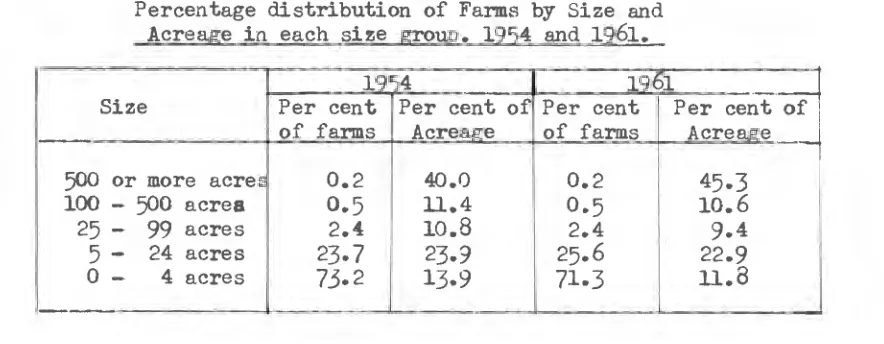
This feature merited comparison in the well recognised practice of showing distrib-
(3)
ution of land by farms and farm size. One such table is drawn from Mau using figures given in the Government's Five Year Independence Plan 1963 - 1968.
TABLE V
Percentage distribution of Farms by Size and Acreage in each size group. 1954 and 1961.
Size
1954
1
261:______Per cent of Acrea:e ....i Per cent
of farms
Per cent of Acreage
Per cent of farms
500 or more acres 0.2 40.0 0.2 45.3 100 - 500 acres 0.5 11.4 0.5 10.6 25 -
99
acres 2.4 10.8 2.4 9.45 -
24 acres 23.7 23.9 25.6 22.9 0 - 4 acres 73.2 13.9 71.3n.8
(1) Harewood,J.'Overpopulation and Underemployment in the West Indies.' in -International Labour Review. Vol 82 No 2 August 1960. p 106 (2) Ibid.
19
A later inquiry showed in more detail how much change had taken place since (1)
this situation was drawn by Clarke from 1943 Census figures:
"The total number of farms, ranging from 1 — 1000 acres and over was 66,173. Over
97
per cent of them were under 50 acres, the largest number being between 4 and 10 acres. In addition there were 146,515 holdings of under one acre." Mauls conclusion based on the 1954 — 1961 comparison was that of an increasing amalgamation of farm holdings. The analysis made in the 1968 Survey of Agriculture(2) seemed to confirm this trend.
TABLE VI
Number and size of farms — 1968.
Size Group
— in acres Number
Per cent
of all farms Acres
Per cent of all acres
Average size of farms
acres Under
5
144,604 78.0 223,818 14.91.5
5 - 25
36,881 19.9
333,548
22.1 9.025 — 100 3,004 1.6 125,104 8.3 4.6 100 — 500 699 0.4
148,501
9.9
212.4 Over 500 295 0.2 676,426 44.9 2,293.0185,483 100.0 1
,507,397 100.0
8.1
(Totals do not equal sum of parts because of rounding.)
Crops.
The rural Jamaican still measures his land in roods as often as acres and is vulnerable to the market forces of the cash crop economy. Major crops, sugar, sttrus, coconut and bananas are grown as a plantation crop mostly in the coastal= plateaux or in the coastal hills of eastern and north central Jamaica. Mixed farming areas occupy most of the central uplands where soil and climate permit:
"Virtually all the mixed farming activity takes place on small individually owned farms. Mixed farming refers mostly to cultivation of a great variety of food crops including yams, sweet potatoes, irish potatoes, corn, pumpkin, peas, cassava and other vegetables, tree crops such as ackees, avocadoes, mangoes, guavas and pawpaws, as well as small fields of export crops such as sugar cane and bananas." (3)
(1) Clarke,E. 0a.cit. Foreword, pp 12-13.
2,0
A significant feature of this analysis is that the small farmer relies on the local market for his cash return.
Socio—economic factors G.D.P., income and occupation.
Some basic information on the economics of Jamaican families seems approp— (1)
riate both in local and comparative terms. Harewood compared Gross Domestic Product at factor cost per head of population as,
"low in the West Indies as compared with the United Kingdom... and North America... The figure for
Jamaica was $ 490, compared with $ 3,430 in the U.S.A., $ 2,800 in Canada and $ 1,680 in the United Kingdom."
Acknowledging that information was not available for classifying thw whole of the Jamaican labour force into high and low—earning sectors, Harewood also utilised figures from the
1953
Survey:"18.6 per cent of wage earners had,an income of under $ 124 per year; 27.2 per cent had an income of between $ 124 and $ 237 per year and 26.3 per cent had an income
of between $ 237 and $ 487 per year. Thus neaftrthree— quarters of all wage earners received less than $ 41 per month." (2)
(3)
Smith and Evans work contributed to a paper based on research among school pupils in rural, sugar plantation and 'open country' districts, i.e., a sample of
'peasant' population comprising 2,050 boys and 2,850 girls, aged 10-16. In a summary of hours worked and pay expectations it was disclosed that
70
per cent of the young men (15-39) were willing to work for 38 — 54 hours at wages of less than £3 (us X
8.40) per week."Such levels of demand may seem depressingly low yet many employers in these rural areas would consider requests for 40/— outrageous and would scoff at a work week of less than
50
hours."Of the women in the same research, two thirds would accept wages of less than 30/— (US $ 4.20) per week.
(4)
Cumper estimated that
57
per cent of all households in Jamaica, in 1958, had incomes of less than £ 300 per annum.(1) Harewood0J. Op.cit. p. 104. (2) Ibid. p. 118
(3) Smith,M.G.'Education and Occupational Choice in Jamaica' in Social and Economic Studies. Vol
9.
No3. 1960.
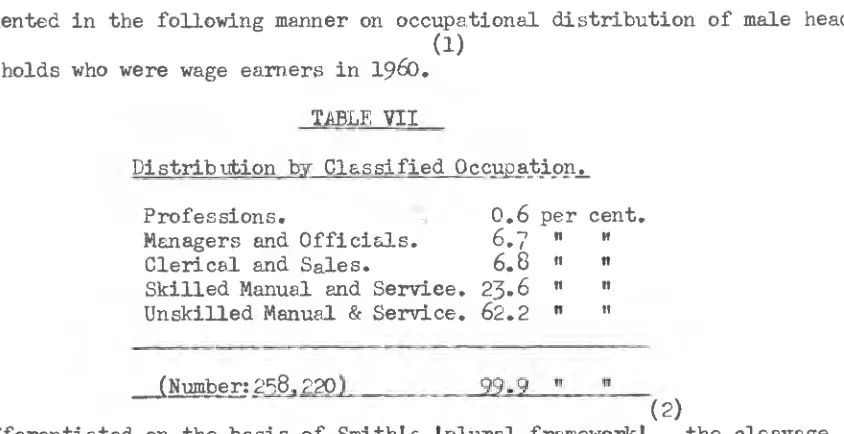
Few alternatives to traditional patterns existed as regards employment. Mau commented in the following manner on occupational distribution of male heads
(1) of households who were wage earners in 1960.
TABLE VII
Distribution by Classified Occupation. Professions. 0.6 per cent. Managers and Officials.
6.7 u
I,
Clerical and Sales.6.8 " ft
Skilled Manual and Service. 23.6 " " Unskilled Manual & Service. 62.2 " "
(2)
When differentiated on the basis of Smith's 'plural framework' the cleavage between the white upper class and the black lower classes was shown as material
(3) "re—computed from the 1943 Census"
TgB~E VIII
Colour distribution of Male Wage
Earners by Occupational Classification.
Black Brown White No. of
Occupational cases
Classification
Managers and Officials 12.9% 46.9% 40.2% 1,265
Professions 45.8% 38.1% 16.1% 2,131
Clerical and Sales
38.5% 53.5%
8.0%
8,852 Skilled: manual and service73.7% 24.8%
1.5% 34,386
Unskilled: manual and service
88.6% 11.1%
0.3% 149,640
"One of the striking 'features in the foregoing table is the relatively high proportion of professionals who are blank. This is perhaps most clearly interpreted as a commentary on the importaice of education instrutturing opportunities for social mobility in Jamaica."
A feature equally compelling is that the figures related to under 200,000 of the (4)
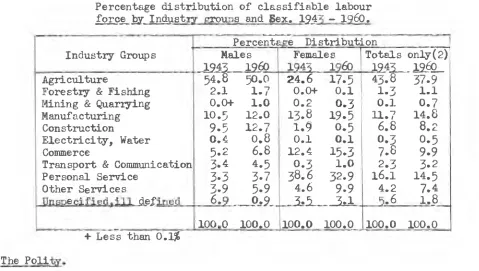
male labour force of 321,637 in the 1943 Census and offered no information at all on the 183,455 members of the female labour force. Male classifiable labour rose, between 1943 and 1960, by 60,01. an increase of 19%, whereas female labour rose in number by 41,710, an increase of 23 %. Main features of change in labour
(1) Mau,J.A. Op.cit. p 27.
(2) Smith,M.G. 'The Plural Framework of Jamaican Society.' in the British Journal of Sociology. Vol XII. 1961. pp. 249-262.
(3) Ibid.
(4) Francis,O.C. Op.cit. Tab. 7.1.
22
force participation in the period were:
(a) decline in the relative importance of agriculture.
(b) gains made by mining, manufacturing, construction and commerce, and (c) a percentage decline in the contribution of personal service.
How this affected the relative positions of industrial groups and male/female (1)
labour was shown by Francis and the National Atlas. TABLE IX
Percentage distribution of classifiable labour force by Industry groups and Sex. 1943 - 1960. Percentage Distribution
Industry Groups Males Females Totals only(2) 1960
_1943
1•43 160 19_43_ 1960Agriculture 54.8 50.0 24.6 17.5 43.8
37.9
Forestry & Fishing 2.1 1.7 0.0+ 0.1 1.3 1.1 Mining & Quarrying 0.0+ 1.0 0.2 0.3 0.1 0.7 Manufacturing 10.5 12.0 13.8 19.5 11.7 14.8 Construction9.5 12.7
1.9
0.5
6.8
8.2 Electricity, Water 0.4 0.8 0.1 0.1 0.3 0.5Commerce
5.2
6.8
12.4 15.37.8
9.9
Transport & Communication 3.4 4.5 0.3 1.0 2.3 3.2 Personal Service
3.3
3.7 38.6 32.9 16.1 14.5
Other Services3.9
5.9
4.6
9.9
4.2 7.4 .-se API' n 4 6.9 0.93,2 3.1
5.6
1.8
100 0 100.0
100.0 100.0 100.0 100.0+ Less than 0.1% The Polity.
A further issue which has bedevilled the lot of the rural Jamaican began with thoughts of mass participation in the early throes of self government and, subsequently Independence.
"The active plan to release Jamaica from the yoke of colonial bondage into a world of freedom and creative potential" (3)
sounded fine on the hustings and did in fact lead to the establishment of lecal political influence and administration, yet the true nature of both• factors should not be allowed to appear solely as signals of responsibility and patriotism.
Characteristics of this nature, essential though they may be to the interests of emergent societies, were obscured before, during and after Independence by the chiaroscuro of the Jamaican Political scene. As Nettleford points out "rhetoric
(1) Ibid.. Tab. 7.2 (Abstract)
(2) National Atlas. Op.cit. p 28, Abstract from Tab.
5.
23
is a commonplace among the traditions of the Jamaican people" but without attempt— ing an extensive study, the political implications of the island two party 4stem deserve comment on the ground that it is the masses who stand subject to manipulation from above. As this is not intended as a political treatise two names will suffice
to illustrate the points which are to be made, and in terms of Jamaican history what names they are ! The native politics of the island grew out of labour movements in the trade unions which in turn were nurtured on the discontent of the labouring classes. From the ambivalences of the old Assembly which, in the last quarter of the Nineteenth Century, was instrumental in the retrogression to Crown Colony govern—
(1)
ment, to the Legislative Council of the Twentieth Century which was dominated, still, by the 'plantocracy' the lot of the Black masses was consistent in its degrees of wretchedness. The 'alleged' riots in Frome, in 1938, brought Alexander Bustamente to the fore as the champion of the oppressed. His speedy incarceration by Governor Richards in 1940 resulted in the entry of Norman Washington Manley onto the politic— al stage.
A brief comment needs to be made on the nature of the island political parties. Both leaders had organised labour as their springboard. During the period just
discussed Bustamente was the founder of the Trade Union bearing his name — the Bustamente Industrial Trade Union (B.I.T.U.).
"Manley, a member of the Trade Union Congress, and an important mediator in the many crises of that period had recently launched the People's National Party (P.N.P.)." (2)
Bustamente, on his release from detention, split with Manley and the P.N.P., and prior to the 1944 elections founded the Jamaica Labour Party (J.L.P.). The P.N.P. organised a labour wing, following electoral defeats both in 1944 and 1949, in the form of the National Workers Union (N.W.U.). Thus both parties owed their popular support to the allegiance of workers in one or other trade union, but in such an economy as existed this did not ensure financial backing from the mass of their supporters. Both sought, and were given this by influential land—owning, commercial and industrial sections of the community. It is also worthy of note that the current (1973) leaders of the two parties have served their time with organised labour.
2Li-
This relationship between party goals and the aspirations of the masses
accounts in large measure for ensuing rivalries and also for the continuing problems which have acted as brakes upon progress toward economic as well as political
Independence. The rivalries were between the claim on allegiance of Statesmen or Charismat. Manley,
"was never expected or allowed to be flippant. Many demanded from him consistency in excellence of performance." (1)
Nettleford also stresses his gifts to the young nation of ideals and purpose as well as example of practical politics, of his belief that political activity depends on knowledge and understanding. Bustamentels opportunism is seen in the eye
witness account, given to the author, of his scramble atop a freight wagon at Myers Wharf, Kingston, to declaim in his shrill voice to crowds of unemployed labourers and striking dock workers "You need a leader. I will lead you."
Personalities apart, the process of gaining popular support was doomed to a life of expediency. The politics of expectation and aspiration have clouded the issue for more than the cohorts of workers. As subsequent sections will attempt to show, the ambitions of adolescents are subject to the politics of excitation.
Not only politicians offer exhortations and promises in return for votes. The rival trade unions are engaged in incessant combat too. During the period of field work the author's attention was drawn to union elections which comprised the presentation of competings and escalatingl demands upon the economy. This under— lines the invidious position which is the lot of either political party. To
engineer the downfall of the reigning party the trade union with opposition align— ment has onlyip effect industrial discord sufficient to make stable government unlikely, while at the same time the labour wing of the ruling party must engage in the same tactic to maintain viable support, thus creating an identical effect upon its own political figureheads.
25
Family patterns.
As to the familial groups upon which these demographic factors reacted, much has been written in which the consistent factor to emerge has been a degree of instability in Western European terms. Many accounts give as the reason for this feature the legacy of slavery during the early centuries of island populations.
(1)
Francis classifies family unions under the headings "conjugal condition",1943, and "Union status", 1960. Since these st4tistics are more relevant to the condition of present family patterns than are the details to be found in the Abstract from the 1970 Census they are to form the basis of assessment of the status of parents of todays's school-age population. Proportionate figures from The 'People of Modern
(2)
Jamaica' erre as follows:TABLE X
Percentage distribution of Females 15 and over by Conjugal Condition and Union Status, 1943 - 1960.
1943
1160
Single (Never lived with partner)56.3 53.1
Widowed or no longer living withDivorced husband or Common-law partner.
Married (Living with husband) 26.3 26.3 Common Law(Living with common-law spouse) 17.4
18.8
Not specified.
1.
8
The first group is too heterogeneous to discuss with any hope of precision, while the second shows regional variations in that marital status dropped as low, in 1960, as 20.5, 21.8 and 21.9 in Kingston, St. Thomas and St. Catherine and Lose to values of 32.6 and 31.4 per cent in St. Ann and Manchester.
(3)
Smith comments on 'the preponderance of the illegitimate issue of kinswomen among (rural Jamaican) residential collateral s', giving further analysis in the terms
"Men have many illegitimate children of their consensual or extra-residential unions living with them in their homes. They are not as willing to accommodate their sons' children as their daughters'; they freely accommodate their daughter's illegitimate offspring, only rarely thtir daughter's lawful
children.
(1) Francis,0.C. Op.cit. p 5-2. (2) Ibid. Tab.
5.5
Also
"in rural Jamaica... and Kingston... the system of mating relations include three alternative forms, namely marriage, extra—residential mating and consensual cohabitation." (1) No facile generalisation can be applied in order to characterise family patterns over the whole Jamaican society but mating would appear to fall into two main styles, not necessarily exclusive of each other. One is the pattern character-ised partly by male irresponsibility and partly by female vulnerability to fear of not having a man or even, as was recounted on a number of occasions in the survey, of not being 'complete' unless proven to be fertile. This type of union is class— ified variously as extra—residential cohabitation, or 'denuded family'. The second is the style of relationship most closely linked to the formal union. Thus 'faith—
(2) (3)
ful concubinage', 'companionate union' or 'keeper family', and common law unions may stabilise, especially once the period of sexual experimentation has passed, and the partners may then either live in the style of marriage or achieve this status
(4)
formally. In either set of events, Smith maintains that monogamous relationships are nearer to the norm and the tendency appears to be strengthened by the growth
(5) of the 'emerging middle' class.
Social Class.
Miller recognises "plural" society but argues that in addition to Smith's White, Brown and Black sections there is an emerging Brown strbtum,(the "Brown" middle class owe their place to tradition). Its history goes back into the 19th century, its behavioural characteristics are based more on the group above than the group below, it has become more heterogeneous, more multi—ethnic than any other stratum, partly as a result of the upward social mobility of the Chinese minority since the 19th century, and partly by similar achievements on the part of Indian and some Black entrepreneurs.
The "emerging middle" stratum, as Miller puts it, is recent history: "It is the stratum of the truck driver, tractor driver,
mechanic, taxi operator, the welder, the electrician, the ex—farm worker and the Chinese own—account operator of a (1) Ibid.
(2) Ibid.
(3) Henriques,F. Family and Colour in Jamaica. McGibbon & Kee. 1968. (4) Smith,M.G. .cit. p 198-201
Urban — White Rural — Black Wealthy
Profession, proprietor Educated
'Standard English' speaking Reputable Church
Patriarchal family Aquatic sport/Golf Moralistic values
Poor
Unskilled, unemployed, casual labour Illiterate
Creole speaking dialect Revivalist cult
Matriarchal family
'Dominoes/draughts
Pragmatic values
2-1
"small establishment. To a large extent this is the artisan class which has emerged because of
(1) migration of Black Jamaicans for economic reasons and their subsequent return and re—settlement, (2) industrialisation with its attendant creation of
new niches in the labour force,
(3) urbanisation, where this has been synonymous with modernisation." (1)
In terms of income this stratum overlaps a great deal with the traditional middle, as is common with developed us well as developing economies, but two signif— icant features should be added from Miller's analysis. One is that the new stratum is almost completely urban, and the tendency to urban drift noted earlier reinforces the economic and social implications of this factor. Secondly, the characteristics associated with a life—style tending to move away from that of the lowest stratum
(2)
are suggested by a model construct:
"Social Continuums in Jamaican Society.
The argument is that the inconsistencies within Smith's relatively fixed groupings may well be considered under a "speculative idea" of continuums along which individuals may be differentiated.
The terms of reference of Miller's earlier study did not allow him to estab— (3)
lish this empirically but in Savacou he posits "three fairly plausible alternatives" to show movement between strata, or inter—relationships:
(1) Ibid.
(2) Miller,E.L. A study of self—concept and its relationships to certain physical social. cognitive and adjustment variables in a selected group of Jamaican school girls. Ph.D.Thesis. Kingston, 1969. p 87.
"1. The Society could be conceived as still being plural with the Upper and Traditional Middle being two classes of one section and the Emergent Middle and Lower classes of the second.
2. The Society could be conceived as still being plural with the Upper, Traditional Middle and Emergent Middle forming three classes of one section while the Lower stratum remains a section by itself.
3. The Society could be conceived as being heterogeneous. That is, all four strata constituting four social classes in the society. Although each class practises a peculiar set of institutional systems all share a sufficient number of common institutions to be regarded as being integrally related to each other." (1)
At the same time the point is established, it needs no elaboration, that the Lower stratum, mainly rural and practising a material culture "that appears to be a product of African ancestry and Caribbean slavery" is the largest single stratum — larger than all the others combined. This has inescapable consequences upon the issue of educational aspiration and equality, or inequality, of opportunity.
The adolescent in Jamaican society.
The social and cultural contexts within which the Jamaican adolescent develops are worthy of comment before a more detailed assessment of educational opportunity and provision is attempted.
(2)
Cohen differentiates between adolescence as a biological and physiological stage of maturation and adolescence as a sociological and cultural phenomenon. In his paper he discusses the assimilation of role by Rocky Roads adolescents in Jamaican hill farming regions as a result of study in the early 1950's. Extrapol— ation of his material for the purpose of this survey must be based upon the follow— ing assumptions:
1.The onset of adolescence is assumed to coincide with school leaving at the age of 14. 'In truth and in fact' many rural youngsters leave school earlier as a result of the disincentives within the educational system, and in any case the process of maturation noted above commences at an age commensurate with the usual norms for adolescence.
(1) Ibid.
(2) Cohen,Y.A.IAdolescent conflict in a Jamaican community' Chap.
6
in Social Structure and Personality — a Casebook. Molt Rinehart29
2. Predominant among the values examined is the notion of a land based ethos,
'relinquishing a parcel of land.... is something no Rocky Roeder will ever do'. This value seems contentious in the light of subsequent acceleration of urban drift. Retention of land, even the acquisition of more land if this is feasible, is certainly the ethos of adult rural Jamaicans. What is being suggested here is that the young are being weaned away from the land and that the produce of the rural hill farms is being won by an ageing labour force.
However, the general characteristics of ehild rearing and social training appear to have validity in the regions in question where tradition exists hardily
(1) in face of the alternative goals of urban life.
"The most significant learning which takes place during adolescence is of an economic nature.... a Rocky Roader learns that practically everything occupies a position
subordinate to food and money."
The Jamaican boy spends time before and after school hours helping to cultivate his father's or the family land. Indeed this responsibility obtrudes for all youngsters into school attendance as will be shown later. Every son must give some of his
time to the land. When given a portion of family land he must contribute towards his keep.
For girls the position is slightly different:
"The first important variation shows up in the cultural rule that while boys need not be supported after the age of fourteen, girls must be supported as long as they live at home.
The second important distinction is that the girl must seek permission for everything she wants to do.
The third difference is that girls do not have to contribute to their maintenance while living at home." (2)
"Not contribute" is used loosely here as the rural Jamaican girl is not, as Cohen goes on to point out, able to engage in a life of leisure, as may be the case for her urban, Middle class counterpart. She is trained since early childhood in
household labour and child-minding. She is under the absolute control of her mother, or grandmother as the syndrome has it, and despite the equally pressing necessity for the adolescent of either sex to make an economic offering to the family budget
30
she is obliged to account both for her time spent away from home and the activities she pursues. She may utilise the household skills she has learnt to gain employ— ment in domestic service, or acquire skill in dress—making which is more prestigious than another country ommans° trade — that of Ihiggleringl or trading at the local or urban market places where farm produce is commonly sold.
Even in the instances where she engages in the urban drift noted elseThere, she is liable to instant recall should her services be seen to be of more use at home, say to care for younger siblings, and is under a stronger cultural obligation to heed the call than is the young Jamaican male.
'The adolescent in the changing Caribbean'
One of the most firmly internalised values of the rural Black Jamaican is the association of class and status with wealth. They are fully aware of the plural system of social class but with the advent of the 'emergent middle class' together with the all pervasive impact of the sets of Values characteristically portrayed by the advertising media traditional attitudes are put under stress. Cohen argued that the Rocky Roaders were not particularly pre—occupied with social class and its Jamaican concommitants, colour and occupation_ During the period of Independ— ence, indeed for the greater part of the time which has elapsed since his study, diversification of opportunity has been brandished for political, economic and social reasons, not to mention cultural or other purposes bound up with the notion of national identity. To say that this opportunity exists as a set of alternative goals is by no means the same thing as suggesting that these goals are generally attainable.
This is recognised by many sources, one variety being drawn together in the Third Caribbean Conference for Mental Health, held in 1961 at the University
(1) College of the West Indies in Jamaica.
(2)
In an opening address Braithwaite commented on an increase in the expectation of the masses, stemming from many causes:
"The experience of many people travelling abroad, of students, of persons in the armed forces, of farm labourers;
Another the influence of cinemas, radio, the modern means of communication;
Third is the rise of trade unionism, the aid and encouragement given to the unions — sometimes
Government sponsored international trade unions — establishing standards in wages."
In the rural areas of Jamaica adolescents are concerned with the lack of (3) opportunity which is further enhanced by their limited education. Royston, in the source noted stated that
"there was no social interaction between the parent, (guardian) or young person and there was no—one with whom the adolescent could discuss his future.
The relationship in the home is still one where the adolescent is treated as a child, although at 15 ( or less ) he or she was not being told to go out and earn a living — which they were ill—equipped to do both emotionally and at times physically."
(4) Regional and social class variables were touched upon by Smith.
"the adolescent in the middle class has a different pattern of behaviour from the adolescent in the lower class, the ages of adolescence and the phases
of adolescence, the problems and conditions which bear on this condition are completely different — a definit— ion drawn from New York has no relevance here
you have to distinguish different types of society in the Caribbean.... the adolescent in Puerto Rico and the adolescent in Kingston represent adjustments to complete— ly different socio—historical circumstances."
(1)1 The adolescent in the Changing Caribbean' the proceedings of the Third Caribbean Conference for Mental Health.Kingston. April 1961.
(2) Ibid. 'The changing social scene.' p..18
Sexual was accorded adolescent —
behaviour, which has already been characterised as irresponsible, (1)
a different connotation. Levy adduced a stress syndrome for the not confined to the Caribbean.
"Among the causative factors are frustration of the creative instinct, consequent increase of sexual urges and thirdly bewilderment at the changes of values around him... This frustration causes the sexual urges to dominate and lead on to the various forms of anti—social behaviour which have become associated with the wordlteen—agerl. Bewilderment at social changes frequently arises from racial antagonism, or rampant nationalism which is really nationwide
selfishness. The issues have been clouded for these youngsters at every turn."
Further_RAysiological and socio—economic features of adolescence in Jamaica. While the youth of the advantaged cohorts in Jamaican society appeared to have benefitted in the same way as British adolescents, in increased body weight
(2)
and height, the situation for lower—class black Jamaicans was markedly different. Subsequent sections on deprivation and disadvantage will seek to show that for both urban and rural lower classes, educational potential was retarded by low living standards, induced by poor nutrition and adverse conditions.
Living standards.
The effects of differences in living standards appeared to be perpetuated by differences in attitudes towards life—style, morality and employment. The middle and upper classes affected unreservedly the goals and norms of behaviour of advanced industrial societies, enjoying the material rewards of consumer— oriented metropolitan cultures. As Miller's (1971) dodel of Social Continuums sought to show, they were characterised by a pattriarchal family system based on moralistic values and were likely to be members of 'reputable' churches. The lot of the poor rural, or urban, black Jamaicans was subject to the vagaries of the employment situtation at the unskilled or casual level, or the effects of sustained unemployment, together with the effects of shanty, or low—cost housing accommoda—
(1) Ibid.'The Doctor looks at the Adolescent.' P. 43.
33
tion. It was apparent At the time of the field study, that while the religion of the established churches was seen as being socially desirable, spiritual solace for rural and poor urban classes was still sought from revivalist cults, influenced as these were by the same messianic and charismatic qualities as had obtained in the political arena for over two generations. It should also be recognised that, with the great bulk of the age cohorts comprised not only of black Jamaicans, but of potential voters, the aspirations of adolescent youth were the object of assiduous attention from the island political parties. On an analysis of moral and family structure for the lower black strata, the evidence suggested long—standing influences of slave heritage.(Black 1965; Clarke 1966; Cohen 1961; Evans 1958,1964; Francis 1963; Henriques 1968; Lowenthal 1970;
Milner
1975;
Miller 1969, 1971; Rubin 1967; Simey 1946; and Smith 1960,1961,1962.) These induced inhibiting attitudes towards the notion of stable marriage, creat— ing problems for male and female adolescents in the culture.Social Class and Occupational Choice.
For adolescents of both sexes in the upper and middle classes education and opportunity were synonymous, being effected either through the acquisition of administrative or professional status after full—time higher education, or through the self—recruiting tendencies by which the elites have maintained their positions. Miller's (1971) assertions rested on the assumption that the acquired values and aspirations of black adolescents and the emergent Middle classes were based on shared institutions common to the society. Here High school education was, and is, seen serving
"as a broker institution for the Black segments of the society in the same manner inwhich it
did for the Brown segment in the nineteenth uentury."(1) (2)
Plurality of the discontinuous pattern posited by Smith may be suggested by the homogeneity of the population in Government schools of the primary
(1) Miller,E.L.(1971). Q.cit. p. 56
bt+
and all-age sector though levels of public awareness appeared to have changed considerably by the 1970'e. Levels of aspiration heightened by the politicisa-tion of educ-politicisa-tion as a mobilising factor at both macro and micro levels, by media influences conveying images of alternative life-styles across the island, and by the adoption of Black Power as a political rallying cry, have instilled in the rural and urban masses an urgent desire on the part of many to utilise the educational experience to practical advantage.
Educational provision and th_mth of opportunity.
Despite the expansion of school places, government funded or with the assist-ance of international loans, during the first decade of Independence, a gap, albeit narrowing, still remained between the size of the appropriate year groups in the population and the size of school cohorts at these age-ranges. As the Ministry Committee for In-depth study of Primary Education preliminary report disclosed, the goal of Universal Primary Education had not been attained by 1973, nor had the effects of selectivity in the secondary sectors been ameliorated significantly:
"Enrolment in Government owned or aided schools
out of year groups in population.
Age groups In school Out of school Total
6 - 11
319,200
35,600
354,80012 - 15 143,600 35,900 179,500 16 - 18 27,900 Y 92,100 120.000
Totals 490,700 163,600 654,300." (1)
While recognising that part of the short-fall in school places was taken up by the preparatory schools, the Ministry Planning Unit had acknowledged for some time that further extensions of compulsory attendance in the Primary Grades 1 -
6
and the All-age Grades
7 - 9
could only be met by a more intensive use of school plant, such as shift systems or extension classes. A demographic feature com-pounding the problems of the Ministry was a heavy population growth, common in developing countries, demonstrated by the age pyramid (Figure YI ) and with which the P.R.E.A.L.C. Report on employment and unemployment in Jamaica concurred:(1) In-depth study of Primary Education.Ministry Of Education Planning Unit.
F
r- f*. t fI
I
I 1 I I I 1 I 1 I ;4 2 0 • 0 2 4 6 8 10 12 14 IS
PERCENTAGE SCALE
FIGUP3
AGE PYRAMID - JAMAICA 1943 a 1960,1970.
0 -4
-4.4...imatt.ivreti4whismorlibriotoz4atiaro$04
tYEARS' *--1 80 & :-....
over k
75-797?_A
70 -74,71':
—1
65-69; .
60-64 ■
55-59;.
I
tj3
`"- 19GO.
11970.
''Pli&4■••no...a.:a441eif
50-54
45.49 r--2"."-"-`-;--_ °
40-44
35-39 l' ,.e,-st-grelaics
25-29
20-247r4-If"''
r.
15
0Ageig 5-9
I
•iti i2 10 8 6
Vt. ;*
Devised from: The National Atlas of Jamaica , p 23,
"Estimates show that in 1970, 46 percent of the population were under fifteen years of age, and 64 per cent under twenty—five. This means that the population was even younger than it had been in 1960, when persons under fourteen amounted to 41.7 per cent,
and those under twenty—five, 56.3 per cent of the total." (1) In common with most countries in the Caribbean region, indeed, with many of the 'developing' nations, the provision of school places at secondary level was limited. Even with the institution of technical and comprehensive educ— ation, opportunity for post primary education was restricted, relative to the population bulge working its way through attrained system. Miller's Savacou paper clearly enunciated a relationship between education and society in Jamaica;
"the manner and the measure in which the educational system enhances the life chances of some groups of individuals and inhibits those of other groups are
consistent with the social stratification of the society." (2)
He further offered a qualitative examination of relationships between the (3)
Private and Government agencies providing education, with the additional distinction within the first category of "Posh" and "Poor" private schools (namely, those charging high fees and catering for the higher social strata and
those catering, generally through a Midsionary influence, for the lower social strata), to cite only two of the latter, such as Catholic schools run by American nuns in Molynes Road, and in Gordonstown.
(1) Employment and unemployment in Jamaica.P.R.E.A.L.C., Pt II. p. 52. (2) Miller,E.L. Op.cit. p. 51.
gOCIAL STRATIFICATION AND Ti-IE EDUCATIONAL cYSTEM (i4iller-1971)-
(I)
/5,tirr.1
Ey.sti=
SOCIAL STRATA
upper e ideliz Loa4er
Emly Cnildhocd Posh Private
' Preparatory 1. Po-a' Private Preparstory It Govt. Tilt=
1. Govt !ant 2. Basic 3. Pcsh Prisate
Prt- ;..mi!ory
I. Basic 2. GOT': Infant
Pr:rr,ary I. Pet.5 Private
Preparetary 1. Posh Private Preparatory 2. Govt. Prira.-iry
I. Gov!. Primary 2_ Posh PTiv:ito
Preparatory
Gov._ Prima ry.
roth. Private Prep: rztoty 2. Govt .kiderf . High
1. Govt. Atdc-d 1-112.11 2. Posh Pri,..ate
High 3. Priiate High 4. Jr. SecencFary 5. Ali Agc
1. Junior Sec. 2. All Age. 3. Govt. High 4. Private High 5. Vecaticttal
A.L! A
2. Jr. Secondary 3. Vocational 4. Govt. 1-::zh
Fuilh-er 1. College or University
2.
1.
2. College or Univ. abroad 3. CAST 4. lsA 5. MSC here
College 6. Theoloe.kal
CoUrge
1. U.W.I.
2. CAST 1. U.W.1. 3. JSA. 2. CAST 4. Teachers' 3. JSA
College 4 Teachers' 5. ;:-:rol,ael:31 Co:lege • Colie,re 5. Thecla:s:J1 6. L'atv. abroad Colk-se.
2 It must that 13!,c) "P3Q-." cIncs rt ft r muzb to tha quaiity of the rhysicel fa..nt:4-s c: thc14-• s,:a.,ols as to the (Act :not they ch.orze It.gh fees ard cite F to the hie:cr
Douglas Manley, at the time of transition to Independence, conducted an inquiry into mental ability, which revealed some of the outcomes of social. class environment as they affected the results of the entrance examination, and also
some of the ways in which privilege within the society was reinforced - even
a. through the use of an instrument designed to bring about equc,lity of opportunity. Some of his observations were starkly simple:
"It is estimated that approximately twenty- five per cent of those who ar9 eligible, by age, to sit, actually do so."0'
Others indicated, in a detailed manner, the positive advantages which high status conferred on candidates, as well as regional differences.
Ibid. p
55.
Manley, D.R. 'Mental ability in Jamaica" in Social and Economic Studies. Vol 12 No. 1., March 1963.
Ibid. p 52.