Mesons in NA61/SHINE
Antoni Marcinek1,∗for the NA61/SHINE Collaboration
1Institute of Nuclear Physics, Polish Academy of Sciences, PL-31342 Kraków, Poland
Abstract. This contribution presents a selection of recent results on meson production from the NA61/SHINE experiment. The results include spectra ofφmesons in p+pcollisions at 40, 80 and 158 GeV/cbeam momenta, as well asπ±, K±,ρ0,ωandK∗0mesons inπ−+C collisions at 158 GeV/cand
350 GeV/c. They are compared with predictions of several models. A spec-tacular failure of considered models is observed forφ,ρ0andK∗0production.
Also a very peculiar system size dependence of the longitudinal evolution ofφ production, contrasting with all other measured hadrons, is shown. Finally, pre-liminary results on spectator-induced electromagnetic effects inπ±production in Ar+Sc at 150AGeV/care presented, bringing information on space-time evolution of the hot and dense matter created in the collision.
1 Introduction
The NA61/SHINE experiment at the CERN SPS [1] pursues a two-fold physics programme: (1) measurements of hadron spectra in hadron-nucleus collisions for neutrino and cosmic rays experiments; and (2) study of strongly interacting matter via a two-dimensional beam momentum and system size scan, including correlations, fluctuations and hadron spectra. Reactions measured within both parts of the programme are sketched in Fig.1. This article discusses only a selection of recent results from this rich collection. The important results on pion and kaon production obtained from the 2D scan as well as future measurements of open charm mesons are tackled in separate contributions [2,3].
2
φ
(1020) meson in
p
+
p
collisions
Motivation for the measurement ofφ(1020) meson production inp+pcollisions is twofold. On one hand, it may serve to constrain hadron production models. On the other hand, it may be used as reference for Pb+Pb measurements at the same energies to conclude about strangeness-related phenomena in heavy ion collisions.
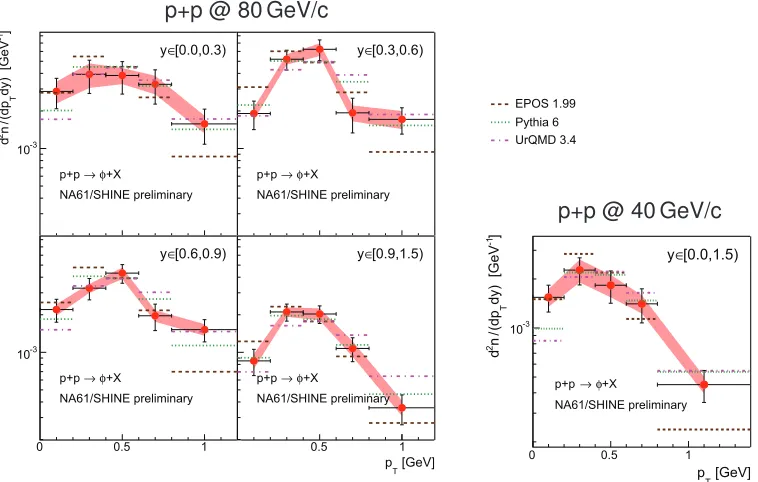
In Fig.2transverse momentum spectra ofφmesons inp+pcollisions at 80 GeV/cand 40 GeV/cbeam momenta, in rapidity bins, are compared to three models: Epos1.99 [4,5], Pythia 6.4.28 [6] and UrQMD 3.4 [7,8]. These models are normalized to the integral of the data in each rapidity bin, so that the shape of the spectrum can be compared. It is visible that Pythiadescribes well the pT spectrum shape, while the spectra from UrQMD are too hard and those from Epostoo soft. These are the first ever differential measurements ofφ production at these energies.
!
"
"#$%
"
&'"
(
()*&*
)"* *+
'
,, -+#.% .,
++
-,-/
.0.
++-,-/.0.
Figure 1: Reactions collected by NA61/SHINE and proposed after CERN Long Shutdown 2
within both parts of the physics programme. Size of squares visualizes amount of data with typical sample size of few million events. Worth noting are measurements with meson beams.
]
-1
dy) [GeVT
(dp/
n
2d
-3
10
[0.0,0.3) ∈ y
NA61/SHINE preliminary +X
φ →
p+p
0 0.5 1
-3
10
[0.6,0.9) ∈ y
NA61/SHINE preliminary +X
φ →
p+p
[0.3,0.6) ∈ y
NA61/SHINE preliminary +X
φ →
p+p
[GeV]
T
p
0 0.5 1
[0.9,1.5) ∈ y
NA61/SHINE preliminary +X
φ →
p+p
EPOS 1.99 Pythia 6 UrQMD 3.4
p+p @ 80 GeV/c
[GeV]
T
p
0 0.5 1
]
-1
dy) [GeV T
(dp/
n
2
d
-3
10
[0.0,1.5) ∈ y
NA61/SHINE preliminary +X
φ →
p+p
p+p @ 40 GeV/c
Figure 2: Transverse momentum spectra ofφmesons in p+pcollisions at 80 GeV/cand
40 GeV/c beam momenta in rapidity bins with statistical (vertical lines) and systematic
beam
y
2 2.5 3
0.6 0.8 1 1.2
p+p → full + K
-K
Λ Λ φ Λ φ
beam
y
2 2.5 3
0.6 0.8 1 1.2
coalescence
-K + K
p+p Pb+Pb Pythia 6 UrQMD 3.4
Figure 3: Left: Widths of rapidity distributions of various particles in p+p (full symbols)
and central Pb+Pb (open symbols) collisions as a function of beam rapidity, with statistical
(vertical lines) and systematic (bands) uncertainties. Full red circles are results of this
analy-sis, the blue star is the NA49p+pmeasurement [10], other p+ppoints come from NA61/
SHINE [11,12]. Pb+Pb data are from NA49 [13–16]. Lines are fitted to points to guide
the eye.Right:Comparison of widths of rapidity distributions ofφmesons with expectations
from kaon coalescence and models (see text).
[GeV]
NN
s
10 20 30 40 50
〉φ〈
0 0.01 0.02 0.03 0.04
NA61/SHINE preliminary world data
+X φ → p+p
EPOS 1.99 Pythia 6 UrQMD 3.4 HRG
Figure 4.Energy dependence of total yields ofφmesons
inp+pcollisions. World data come from
Refs. [10,17–20]. Total uncertainties are shown; for
preliminary NA61/SHINE results total uncertainties are
smaller than markers. Red dashed line is fitted to guide the eye. Regarding models see text.
Fig. 3 presents widths σy of rapidity distributions of φ mesons [9] and various other
particles inp+pand central Pb+Pb collisions [10–16] as a function of beam rapidity ybeam
in the centre-of-mass frame. It is apparent that all particles in both colliding systems,except
φin Pb+Pb follow the same trend. This non-trivial system size dependence forφmesons,
contrasting with other hadrons, calls for investigation in other systems measured within the
2D scan of NA61/SHINE (Fig.1,left).
The widths are also compared to predictions of models, showing that Pythiaproduces too
narrowφrapidity spectra, while both Eposand UrQMD provide widths comparable to
exper-imental data. Moreover, Fig.3demonstrates that the experimental results are not compatible
with the simple picture ofφproduction throughK+K−coalescence [13].
The energy dependence of totalφyields inp+pinteractions is displayed in Fig.4. It is
evident that NA61/SHINE results are consistent with the world data [10,17–20], but provide
superior accuracy. Comparing to models, it is visible that only Eposdescribes the data
rea-sonably well, while others fail with UrQMD underestimating and HRG [21] overestimating
F
dx
dn
F
x
0 0.02 0.04 0.06 0.08 0.1 0.12 0.14 0.16 0.18 0.2
EPOS1.99 DPMJet3.06 Sibyll2.1 Sibyll2.3 QGSJetII-04 EPOSLHC
+C at 158 GeV/c
-π
in
0
ρ
NA61/SHINE
F
dx
dn
F
x
0 0.02 0.04 0.06 0.08 0.1 0.12 0.14 0.16 0.18 0.2
EPOS1.99 DPMJet3.06 Sibyll2.1 Sibyll2.3 QGSJetII-04 EPOSLHC
+C at 350 GeV/c
-π
in
0
ρ
NA61/SHINE
F x
0 0.2 0.4 0.6 0.8 1
F
dx
dn
F
x
0 0.02 0.04 0.06 0.08 0.1
0.12 EPOS1.99
DPMJet3.06 Sibyll2.1 Sibyll2.3 EPOSLHC
+C at 158 GeV/c
-π
in
0*
K NA61/SHINE
F x
0 0.2 0.4 0.6 0.8 1
F
dx
dn
F
x
0 0.02 0.04 0.06 0.08 0.1 0.12 0.14
0.16 DPMJet3.06
Sibyll2.1 Sibyll2.3 EPOSLHC EPOS1.99
+C at 158 GeV/c
-π
in
ω
NA61/SHINE
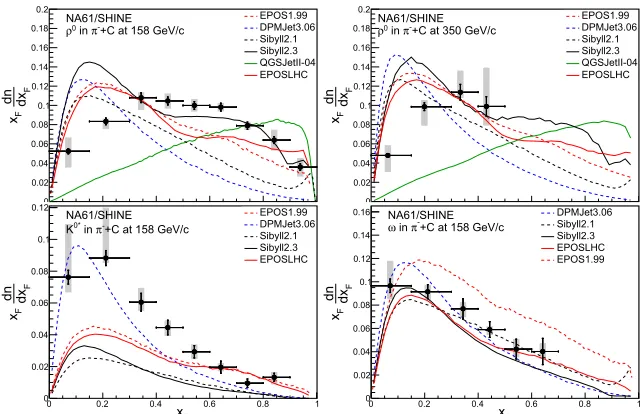
Figure 5: Spectra of ρ0, ω and K∗0 mesons in π−+C collisions at beam momenta of 158 GeV/cand 350 GeV/cas a function ofxF. The statistical uncertainties are represented by bars and the systematic ones by grey bands [22]. Regarding models see text.
3 Production of mesons in
π
−+
C collisions
Indirect measurements of high energy cosmic rays through Extensive Air Showers (EAS) require air shower simulations to be interpreted. These simulations rely to a large extent on a correct modelling of hadron-air interactions that occur during the shower development [23]. Especially the pion-nucleus collisions data are important for models tuning, as these are the most abundant hadronic interactions occurring in EAS.
Spectra ofρ0,ωandK∗0[22], as well asπ±andK±mesons inπ−+C collisions at beam momenta of 158 GeV/cand 350 GeV/care presented in Fig.5 and Fig. 6. These results are compared to predictions of several models used in EAS simulations: QGSJetII-04 [24], Epos1.99 [25], DPMJet3.06 [26], Sibyll2.1 [27], Sibyll2.3 [28] and EposLHC [29]. It is apparent that while at least some of these models are able to describeωandπ±production, all fail forρ0and kaons. This shows that the new data constitute an important input to tune hadron production models necessary to understand cosmic-ray air showers.
4 Spectator-induced EM effects
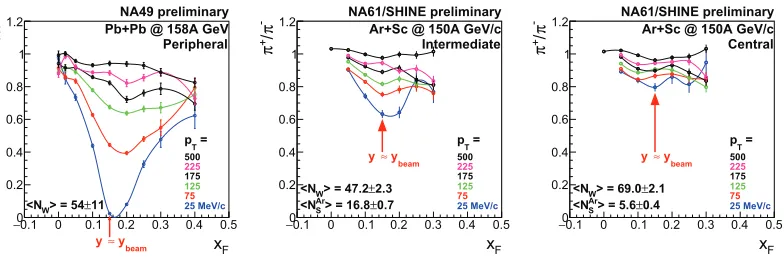
The spectator-induced electromagnetic distortion of charged pion ratio was first observed in peripheral Pb+Pb collisions at 158AGeV/cbeam momentum [30] (Fig.7,left). This charge asymmetry is caused by the final state electromagnetic repulsion (attraction) of positive (neg-ative) pions by the spectator system. It is the largest for pions moving at spectator rapidity.
dp dn p 0 0.2 0.4 0.6 0.8 + X + π → + C -π
at 158 GeV/c
dp dn p 0 0.2 0.4 0.6 0.8 1 + X -π → + C -π
at 158 GeV/c
p [GeV/c]
1 10 2
10 dp dn p 0 0.02 0.04 0.06 0.08 0.1 0.12 0.14 + X + K → + C -π
at 350 GeV/c
p [GeV/c]
1 10 2
10 dp dn p 0 0.02 0.04 0.06 0.08 0.1 0.12 0.14 + X K → + C -π
at 350 GeV/c
Figure 6: Spectra ofπ±andK±mesons inπ−+C collisions at beam momenta of 158 GeV/c
and 350 GeV/cas a function of momentump. The statistical uncertainties are represented by
bars and the systematic ones by grey bands. Regarding models see text.
F
x 0.1
− 0 0.1 0.2 0.3 0.4 0.5
- π / +π 0 0.2 0.4 0.6 0.8 1 1.2 11 ±
> = 54 W <N beam y ≈ y = T p 500 225 175 125 75 25 MeV/c NA49 preliminary Pb+Pb @ 158A GeV Peripheral
F
x 0.1
− 0 0.1 0.2 0.3 0.4 0.5
- π / +π 0 0.2 0.4 0.6 0.8 1 1.2 2.3 ±
> = 47.2 W <N
0.7
±
> = 16.8 Ar S <N beam y ≈ y = T p 500 225 175 125 75 25 MeV/c NA61/SHINE preliminary Ar+Sc @ 150A GeV/c Intermediate
F
x 0.1
− 0 0.1 0.2 0.3 0.4 0.5
- π / +π 0 0.2 0.4 0.6 0.8 1 1.2 2.1 ±
> = 69.0 W <N
0.4
±
> = 5.6 Ar S <N beam y ≈ y = T p 500 225 175 125 75 25 MeV/c NA61/SHINE preliminary Ar+Sc @ 150A GeV/c Central
Figure 7: Theπ+/π−ratio as a function ofxFfor several values of transverse momentum in
peripheral Pb+Pb [30], intermediate centrality Ar+Sc and central Ar+Sc collisions at the
top CERN SPS beam momentum. Only statistical uncertainties are shown.
lowering of the ratio at beam rapidity can still be observed, suggesting a shadow of the EM
distortion even for such a low spectator charge (about 3 e.u.).
It is known that the spectator-induced EM effect brings information on the space-time
evolution of the reaction [31]. The new results allow to obtain such information for Ar+Sc
collisions along with an insight into energy transfers in the spectator system [32].
5 Summary
A selection of recent results on meson production measured by the NA61/SHINE experiment
has been presented. The first results on differential multiplicities ofφmesons inp+p
production inp+pcollisions and emphasize the peculiarity of the system size dependence of the width of rapidity distributions ofφmesons. The spectra ofπ±,K±,ρ0,ωandK∗0mesons inπ−+C provide important input to tune hadron production models necessary to understand cosmic-ray air showers. The spectator-induced EM effects in charged pion production give insight to space-time properties of the system created in heavy ion collisions.
This work was supported by the National Science Centre, Poland (grant numbers:
2014/14/E/ST2/00018, 2015/18/M/ST2/00125) and the Foundation for Polish Science — MPD program, co-financed by the European Union within the European Regional Development Fund.
Bibliography
[1] N. Abgrall et al. (NA61/SHINE), JINST9, P06005 (2014)
[2] D. Larsen,The onsets of deconfinement and fireball of NA61/SHINE, this proceedings [3] A. Merzlaya,Open charm measurements at CERN SPS energies with the new Vertex
Detector of the NA61/SHINE experiment, this proceedings [4] K. Werner, F. Liu, T. Pierog, Phys. Rev. C74, 044902 (2006) [5] T. Pierog, K. Werner, Nucl. Phys. B (Proc. Suppl.)196, 102 (2009) [6] T. Sjöstrand, S. Mrenna, P. Skands, J. High Energy Phys.05, 026 (2006) [7] S. Bass et al., Prog. Part. Nucl. Phys.41, 255 (1998)
[8] M. Bleicher et al., J. Phys. G25, 1859 (1999) [9] A. Marcinek, EPJ Web Conf.182, 02082 (2018) [10] S. Afanasiev et al. (NA49), Phys. Lett. B491, 59 (2000)
[11] N. Abgrall et al. (NA61/SHINE), Eur. Phys. J. C74, 2794 (2014) [12] A. Aduszkiewicz et al. (NA61/SHINE), Eur. Phys. J. C77, 671 (2017) [13] C. Alt et al. (NA49), Phys. Rev. C78, 044907 (2008)
[14] S.V. Afanasiev et al. (NA49), Phys. Rev. C66, 054902 (2002) [15] C. Alt et al. (NA49), Phys. Rev. C77, 024903 (2008)
[16] T. Anticic et al. (NA49), Phys. Rev. Lett.93, 022302 (2004) [17] V. Blobel et al., Phys. Lett. B59, 88 (1975)
[18] C. Daum et al. (ACCMOR), Nucl. Phys. B186, 205 (1981) [19] D. Drijard et al., Z. Phys. C9, 293 (1981)
[20] M. Aguilar-Benitez et al. (LEBC-EHS), Z. Phys. C50, 405 (1991)
[21] V. Vovchenko, V.V. Begun, M.I. Gorenstein, Phys. Rev. C93, 064906 (2016) [22] A. Aduszkiewicz et al. (NA61/SHINE), Eur. Phys. J.C77, 626 (2017) [23] R. Engel, D. Heck, T. Pierog, Ann. Rev. Nucl. Part. Sci.61, 467 (2011) [24] S. Ostapchenko, Phys.Rev.D83, 014018 (2011)
[25] T. Pierog, K. Werner, Phys. Rev. Lett.101, 171101 (2008)
[26] S. Roesler, R. Engel, J. Ranft, inProc. MC2000(2000), pp. 1033–1038 [27] E.J. Ahn et al., Phys.Rev.D80, 094003 (2009)
[28] F. Riehn et al., PoS(ICRC2015), 558 (2015) [29] T. Pierog et al., Phys. Rev.C92, 034906 (2015) [30] A. Rybicki, Acta Phys. Polon.B42, 867 (2011)