A LOAD BALANCING FRAMEWORK IN CLOUD
USING SMARTPHONE WITH CWC ARCHITECTURE
Anantkumar V. Salame
1, Prof. Pradnya V. Kulkarni
2 1Department of Computer Engineering Maharashtra Institute of Technology, Pune (India)
2
Department of Computer Engineering Maharashtra Institute of Technology, Pune (India)
ABSTRACT
The main objective of this paper was to propose cloud supporter framework to support cloud for processing
multiple tasks. Because of multiple tasks on cloud server, it works slower and sometimes gets failed. In this
situation distributing or scheduling of tasks on the distributed computing system is the only solution to reduce
workload on server. Computing capability of smart phones CPU can compete with the CPU of the computers.
Smart phones are energy-efficient and cost-effective alternative to running certain tasks of traditional servers.
Distributing tasks for computations must utilize all the resources equally, no resource should be under or over
utilize this problem leads to focus on the load balancing technique to support the cloud for processing tasks.
Our approach is to form a load balancing frame work as cloud supporter for processing tasks on smart phones
when they are plugged into the power sources
Keywords: Android volunteer, Cloud supporter, CWC, Distributed computing, Load balancing
I. INTRODUCTION
Every enterprise in the world has the basic need of fast server to work efficiently as well as rapidly. But day by
day computational workloads on server in the form of multiple task requests are also increasing. Because of
these multiple tasks on cloud server, it works slower and sometimes gets failed. In this present situation
distributing or scheduling of tasks on the distributed computing system is the only solution to reduce workload
on server. To form the best distributed computing system we are using smart phones as volunteer or android
clients, there are many other options to form distributed system such as vehicular cloud [5] or virtual machines
[8] but computing capability of smart phones CPU can compete with the CPU of the computers [6]. Smart
phones are energy-efficient and cost-effective alternative to running certain tasks of traditional servers. When
these smart phones are plugged into power source for charging battery then this idle phones provides the
increasing computing capabilities and sizable computing infrastructure. So we are using CWC (computing while
charging) architecture for distributed computing infrastructure. Distributing tasks for computations must utilize
all the resources equally, no resource should be under or over utilize this problem leads to focus on the load
balancing technique to support the cloud for processing tasks. In this paper we are proposing the load balancing
frame work as cloud supporter for processing tasks on smart phones when they are plugged into the power
sources. We name our framework Cloud supporter, this framework is supporting cloud server to handle multiple
phone which will accept the task and process it, after completing the task processing result will get back to the
cloud server and server will send this result to the task submitter. About CWC architecture, CWC stands for
computing while charging as the biggest problem of using smart phones for computing are battery life and
bandwidth. If these smart phones are using for the heavy computation during in use by its owner then battery of
phone may drains very fast and it will be unusable after some time. To overcome this problem the solution is
using smart phones when they are being charged at night, when active use by phone owners is not likely. CWC
uses a single server connected to the Internet, for scheduling jobs on the smart phones and collecting the outputs
from the computations [1].
II. LITERATURE REVIEW
CWC: A Distributed Computing Infrastructure Using Smart phones [1] - According to the author of this paper
many organizations supply smartphones to their employee to manage organization data and to have real time
access to key product information. This smartphone can distributed computing infrastructure. Smartphones has
CPU’s can compete with desktop CPU’s. When smartphones are plugged into charge gives increasing
computing capabilities. In this paper, they implemented and evaluated prototype of CWC that employs a novel
scheduling algorithm to minimize the makes pan of set of computing tasks. Computing while charging (CWC)-
Uses single server connected to the internet, scheduling jobs on the smartphones and collecting output from
computations.Towards Vehicle-Assisted Cloud Computing for Smartphones [2] - In this paper, they combine
vehicular cloud with infrastructure based cloud to expand the current available resources for task request from
smartphones. Vehicular cloud acts as cloud service provider for smartphone also proposed flexible offloading
strategy (FOS) to carry out task migration. In vehicle, the unutilized resources are available, so vehicular cloud
able to discover and utilize that resource to accomplish application offloading for smartphone. CANDIS:
Heterogeneous Mobile Cloud Framework And Energy Cost- Scheduling [3] - This paper present CANDIS, A
framework that can distribute computing task to a computing cloud consisting of mobile devices running
android as well as computers. Integrating mobile device into an IT infrastructure makes ecologic sense while
saving cost at the same time. If applied on larger scale helps to stabilize electricity grids. CANDIS framework
can partitioned tasks based on the computation power of the participating clients. Its architecture allows it to be
use on mobile devices using android as well as common server hardware. Use of mobile devices makes
economic and ecologic sense. As they are already available only the additional energy used for computation
considered as cost factor. Replacing servers with mobile devices results into real cost saving for
business.Optimal Load Balancing in Cloud Computing by Efficient Utilization of Virtual Machine [4] - Load
balancing is the major concern in the cloud computing environment. The performance is analyzed using clouds
simulator and compared with existing active VM load balancing algorithm. Algorithm used- VM assign load
balancing algorithm. Algorithm focuses on efficient utilization of resources. Proposed algorithm optimally
distribute load and hence under/over utilization situations will not arise. A Linear Programming Approach for
Optimizing Workload Distribution in a Cloud [5] - Cloud computing usage-based pricing model creates an
candidate blocks and then composes an optimal partition by solving an integer programming problem. The
second approach solves the set partitioning problem with column generation technique [5].
III. COMPARISON WITH SIMILLAR SYSTEMS
While use of smart phones for computing has been proposed many times in various contexts, there are very few
studies that share our vision of using the computing power of smart phones for executing enterprise-grade
computations. In that follows, we compare the similarities and differences between our work and these previous
proposals. The system that is nearly similar to our work is CANDIS; In CANDIS framework authors proposed
use of employee smart phones for executing enterprise applications [2]. They enforced an execution setting for
automaton that permits for running desktop Java applications on smart phones in an automatic fashion [1]. Also
created similar observations about scheduling tasks based on processing capabilities of smart phones. While we
envision similar applications and system implementation, we provide an algorithm that helps to minimize the
completion time of the job based on both CPU capabilities of smart phones, which has not been addressed in
CANDIS. The well-known problem of scheduling jobs on a set of processors in a cluster for the make span
objective or we can say the completion time of the last job, this drawback has been shown to be NP-Hard and
several heuristics have already been planned to reduce the execution time. For that we introduce an approach
based on linear programming algorithm, The idea is to relax an integer number linear program and use p norm
based [3] operators to force the solver to search out almost integer solutions which will be assimilated to number
solution. We have a tendency to think about the case wherever jobs are either rigid or moldable. A rigid parallel
job is performed with a predefined number of processors while a moldable job will outline the quantity of
processors that it is using just before it starts its execution. We tend to compare the scheduling approach with
the classic Largest Task 1st list based algorithm and we will show that our approach provides sensible results for
little instances of the problem. Distributed load balancing is a very important system operates destined to
distribute workload among accessible processors to boost throughput and/or execution times of parallel pc in
Cluster Computing [4]. Rather than balancing the load in cluster by process migration or by moving a whole
process to a less loaded pc, we tend to build an effort to balance load by making partition of processes into
separate jobs then balance them to android volunteers of cluster and to form cluster fuzzy c-means (FCM)
algorithm is the novel approach than the clustering algorithm such as k-means algorithm [4].
III. SYSTEM ARCHITECTURE / SYSTEM OVERVIEW
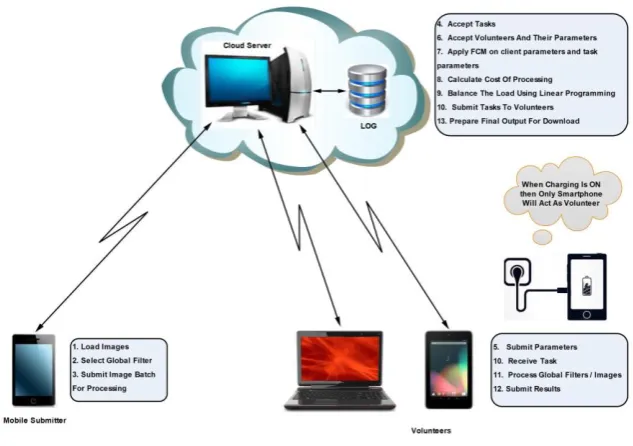
The proposed system will have three components like Job Submitter, Cloud Server and Volunteers.
Fig. 1- Cloud Supporter System Overview
1) Job Submitter
•The Job Submitter will submit the task to server.
•The task can be any time consuming which actually takes time to execute such as file enc/dec , image
processing etc.
2) Cloud Server
•After receiving of the task, server will distribute the task to volunteers.
•The load balancing algorithm like Linear programming can be used at the server side. Based on current load the
task will be submitted to volunteers.
3) Volunteers
•Volunteers will complete the task processing and then send the response to server. •Server will integrate the result and send the reply back to Submitter application.
In our proposed of cloud supporter framework there will be a submitter who will submit the task to the cloud
server for processing. Before submitting the task submitter has to register itself to the cloud server with proper
credential details. After logging in submitter can submit the different tasks such image processing or file
encryption/decryption etc. We are using the image processing task for easily understanding the concept and
efficiency of our work. Cloud server will accept the task and distribute it to the available volunteers for
processing. If there is unavailability of volunteers then server will send the toast massage for plugging smart
phone on charge and being ready to process the task on registered android volunteer as because we are using the
CWC architecture. Smart phones needs to submit their parameters to work as volunteer and all the log details of
volunteers are separately saved in the database connected to the cloud server. Cloud server will accept the
parameters of task and clients and apply the FCM algorithm to form the cluster of volunteers according to their
algorithm and tasks will schedule to the volunteers. Volunteers process these tasks completely and result is send
back to the cloud server, finally server will prepare the final output to download by the submitter of the task
IV. ALGORITHM FOR PROPOSED SYSTEM
The proposed system will use Linear programming algorithm/technique which will be used to obtain fine
optimized results and system accuracy. The system will not refer or use any readymade data set. The user logs
and submitted task data will be maintained at server side based on which the load balancing will be done. The
variables assumed in algorithm are as discussed below. Let Set Of Images I1,I2,...In As Inputs To proceed
with FCM only if there is at least a single mobile and a single computer available as a volunteer Else all images
to be processed by available devices only.
FCM Steps
Apply FCM On Image Sizes
Divide Into Three Categories → Small, Medium and Large
All small images will be targeted to mobile devices only
All large images will be targeted to computers only
All medium images will be targeted using linear programming
Fixed Constants
PixCostM → Cost Per Pixel For Mobile Devices PixCostC → Cost Per Pixel For Computers
PixTimeM → Time Per Pixel (In CPU Cycles and Not In Seconds) For Mobile Devices PixTimeC → Time Per Pixel (In CPU Cycles and Not In Seconds) For Computers TotalPix → Total number of pixels of all images in medium image set
Linear Programming Technique:
Aim:- To Find PixM And PixC PixM → Total pixels to be processed by mobile devices PixC → Total pixels to be processed by computers Equations
1) PixM + PixC = TotalPix
2) Minimize Total Cost (TC) Min(TC) TC = (PixM * PixCostM) + (PixC * PixCostC)
3) Minimize Total Time (TT) Min(TT) TT = (PixM * PixTimeM) + (PixC * PixTimeC)
V. RESULT
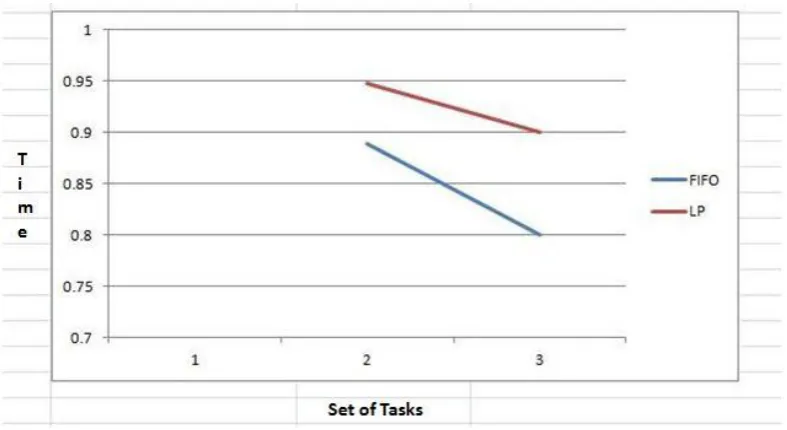
The sample graph based on the precision and recall method indicates accuracy of the project. The task assigned
by the server using FIFO, varies with task assigned with Linear Programming. In FIFO the task assigned by
server is on First In First Out Basis which does not care about small and large tasks. The tasks are executed on
the priority basis which may take long time for execution as they are in queue. It may happen that small tasks
are assigned to fast processor and large tasks may assigned to slow processor which affects overall throughput
rate of system. The proposed system will be implemented on Linear Programming Platform which smartly
gives fast processing speed and obtain optimized results. The final results of the proposed system can be
expected as given below.
Fig 2- Project Accuracy
VI. CONCLUSION
Our vision is to build load balancing framework as cloud supporter for enterprises. We can conclude that to
improve the distribution of workload and complete utilization of resources load balancing framework is
necessary. The Proposed system will reduce the workload on cloud server by load balancing technique and
improve the resource utilization such that no resource should be under or over utilized also proposed work will
helps to find the exact cost of processing.
REFERENCES
[1] M.Y. Arslan, I. Singh, S. Singh, H.V. Madhyastha, K. Sundaresan and S.V. Krishnamurthy CWC: A
Distributed Computing Infrastructure Using Smartphones In Proc. IEEE Transaction on mobile
computing, vol. 14, no. 8, august 2015
[2] H. Zhang, Q. Zhang, and X. Du Toward Vehicle-Assisted Cloud Computing for Smartphones In Proc.
IEEE Transactions on Vehicular Technology 2015
[3] S. Schildt, F. Bsching, E. Jrns, and L Wolf CANDIS: Heterogenous Mobile Cloud Framework and Energy
Cost-Aware Scheduling In Proc. IEEE International Conference on Green Computing and
Communications and IEEE Internet of Things and IEEE Cyber, Physical and Social Computing 2013
[4] S. G.Damanal and G. R. M. Reddy Optimal Load Balancing in Cloud Computing By Efficient Utilization
of Virtual Machines In IEEE 978-14799-3635-9/14 2014
[5] Vadym Borovskiy, Johannes Wust, Christian Schwarz, Alexander Zeier,Wolfgang Koch “A Linear
Programming Approach for Optimizing Workload Distribution in a Cloud” In Proc. CLOUD
[6] N. Nehra, R.B. Patel, V.K. Bhat A Framework for Distributed Dynamic Load Balancing in Heterogeneous
Cluster In Proc. Journal of Computer Science 3 (1): 14-24, 2007
[7] S. Ray and A. De Sarkar Execution Analysis Of Load Balancing Algorithms In Cloud Computing
Environment In Proc. International Journal on Cloud Computing: Services and Architecture
(IJCCSA),Vol.2, No.5, October 2012
[8] S. Sethi, A. Sahu, and S. K. Jena Efficient load Balancing in Cloud Computing using Fuzzy Logic In Proc.
IOSR Journal of Engineering (IOSRJEN) ISSN: 2250-3021 Volume 2, Issue 7(July 2012), PP 65-71
[9] M. Katyal and A. Mishra A Comparative Study of Load Balancing Algorithms in Cloud Computing
Environment In Proc. International Journal of Distributed and Cloud Computing Volume 1 Issue 2
December 2013
[10] K.Al Nuaimi, N. Mohamed, M. Al Nuaimi and J. Al-Jaroodi A Survey of Load Balancing in Cloud