534 | P a g e
A STUDY ON FACTORS AFFECTING THE
CONSTRUCTION PROJECTS SCHEDULING
S.Revathy
1, Dr. S. Kamal
2Post Graduate
1, Assistant Professor
2Department of Structural Engineering, Annamalai University, TamilNadu, (India)
ABSTRACT
Scheduling is very important in construction industry for reducing and controlling the delay of the project.
However, most of the construction projects delays in India were characterized by schedule overrun (Time). Withthis growing volume, the schedule overrun of the Indian construction projects is certainly a significant topic for
investigation. In spite of that, the initial planning of construction schedule is often revised due to many critical
activities. This study conducts an attempt to identify the critical activities responsible for schedule overrun.
Data was collected through Secondary data method such as scheduling of the project and project information to
assess the extent of schedule overruns. The result of the study revealed the main critical activities causing
schedule overrun such as (i) pump and motor fixing design, (ii) pollution control approval, (iii) Filling for
basement with quarry dust, (iv)PCC, (v) Staircase shuttering, (vi) Concreting for flooring, (vii) Lift wall
shuttering, (viii) Wall shuttering and concreting, (ix) Excavation for sump, (x) Parapet wall masonry, (xi) Water
proofing, (xii) supply and fixing of doors and windows, (xiii) Ground water (bore wells) and also presented a
possible suggestions to get the optimum result to avoid rescheduling and to complete the project within planned
duration.
Keywords:
Critical activities, Delay, Duration of projects, Rescheduling, Scheduling, Schedule
Overrun,.
I. INTRODUCTION
Construction industry contributes towards 40 to 50 % of India’s capital expenditure on projects in various
sectors such as Highways, Railways, and Buildings etc. Construction industry is the second largest industry in
India and it is the main motivating force in Indian national economy (Mulla et al 2015). One of the major
problems facing by the construction industry is schedule overrun. In India, most of the projects were ended with
extra involvement of time, money and resources. It is a rare scene in construction industry, that a project is
completed within planned duration. Construction schedule overrun are widespread in most projects all over the
world. Some overrun may happen in the preconstruction phase which is defined as the period beginning of the
project to signing of the contract between the owner and contractor. However, some of them may happen in the
construction phase or when construction is under way. Nowadays the planned duration is one of the main
535 | P a g e
The main reason behind is, most of them treats task duration as deterministic but in reality the task duration aresubject to considerable uncertainty and it is influenced by many critical activities. Hence, those critical activities
are main reason for the time overrun of individual activity. The overrun of critical activity will extend the
overall duration of the project. As consequences the time will stretch, cost will increase and similarly the quality
of the project will degrade. The ability to anticipate such problem is very important because the problem can be
controlled or even corrected to get the project back on track. The main objective of this paper to identify which
phase of the projects where getting affected in construction project scheduling. Later study would suggest to
framework the rescheduling methods of the project.
II. BACKGROUND OF THIS STUDY
Many researchers have done research on causes of delay and the identification of factors responsible for that
delay in the construction projects. Such literatures were collected from the various sources such as construction
management books, journals, articles, web sources etc. The relevant research was studied in detail and reviewed
for identify the reasons for rescheduling in the projects. The following topic defines the various issue occurred
in scheduling and causes for rescheduling and the factors that affect the planned duration and uses of its
application in construction industry. Every individual paper has given the intense information about the schedule
overrun of the projects in construction industry.
Chester and Hendrickson, (2005) stated thatconstruction mismanagement results in multiple problems that can
cascade throughout the work force chain, affecting the schedule and leading to damages to multiple parties. A
case study is presented with seven different mismanagement scenarios. A description of each scenario is
provided as well as a quantification of the damages that result from the problem and a construction claims
section is also included that addresses many of the issues that could result from a claim for each of the seven
scenarios.
Dayi, (2010) made an analysis to identify the impacts of construction delays on project completion duration and
to allocate responsibility among the project participants for such delays. The “Time Impact Analysis Method”
(TIA) was applied to the case study project using PRIMAVERA software. It was observed that the delays in the
critical activities extended the project duration by 57 days in total i.e. by 15.4 % of the estimated construction
period. These delays were caused due to organizational deficiencies of the owner, the bureaucracy of the
provincial municipality, the lack of detailed drawings during the municipality application, the lack of experience
of the contractor, problems in material procurement; unforeseeable weather conditions and shortages of
qualified employees of the subcontractors and finally some recommendations are presented to minimize the
construction delays.
Marzouk and Rasas, (2012) stated that the causes of construction delays in Egypt project by questionnaire
survey and was distributed to owners, consultants, and contractor’s of the organizations. Based on response the
following Frequency Index, Severity Index, Importance Index and top ten delay causes of construction projects
in Egypt are determined. A case study is analyzed and the test results reveal that the most important delay
536 | P a g e
external and it is prioritized according to very high, high, medium, low and very low. And finally somerecommendations have been made to minimize the delay.
Sweis, (2013) conducted a research to identify major factors for such overruns in the typical developing
environment of Jordan. The top ten factors causing time overruns in construction projects were identified and
treated using Principal Component and Factor Analysis (PCFA). After conducting the analysis on both the
secondary and primary data, results showed agreement only on one cause, weather conditions.
Indhu and Ajai, (2014) stated that the delay factors and the effect of factors on the project completion by a case
study. The planned and actual schedule was collected from the site office and to calculate the delay period of
each activity. The test result reveals that the most important causes were delays in contractor's payments,
shortage of material in construction, change in material, the weather condition, shortage of manpower (skilled,
semi-skilled and unskilled labour), frequent change of staffs, poor site management and improper management
of the engineers, submission of drawings, space constraints, and delay in payment by client, delay in material
supply and local problems like strikes. The major effects of delay are cost impact, reduced labour productivity,
postponement in work, change in labour allocation etc. And finally recommend the suggestions to minimize the
delay.
Lishitha and Subramani, (2014) stated that to optimally allocate the resources among individual tasks, Resource
tracking, Minimize the time over run and Cost Effectiveness in a case study project by using Primavera project
planner enterprise. The results reveals that general re sequencing model had been proposed to overcome the
delay factor from the critical area, changes in drawings, shortage of skilled labours, conflict between
participants etc. And finally compares the cost variation due to the delay of the project.
Mulla and Wagmare, (2015) stated that the factors responsible for time and cost overruns of the construction
project and suggest the suitable remedial solutions through case study and questionnaires. The result reveals
that poor planning, implementation and management are the main reasons for time and cost overruns in the case
study project.
Wale et al, (2015) observed that the difference between the Microsoft Project (MSP) and the Traditional
Planning Techniques which speeds up Construction and also make the Project Cost Effective with Proper
Planning with the help of the case study. Data collected in two part viz. Primary data and secondary. The Result
reveals that efficient planning & proper execution of the project, disparate Methodologies is the remedial
measures for the problem.
Bhatia and Apte, (2016) stated that the factors and reasons causing project schedule and cost overruns, in Pune
Province of India by comparing the planned and achieved schedule and cost of the project. The actual and
planned schedule of the project was compared to find the factors. The results revealed the main factors and
reasons causing schedule and cost overruns in construction of residential projects are Delays in decision making;
Poorly performed time estimation of the project tasks and activities; Unforeseen circumstances; Internal
conflicts within the project team; Poor work organization and planning; inaccuracy of cost estimates; changes in
scope, design, drawings
Multashi and Salgude, (2016) stated that the main reasons for the delay of Alkut Olympic stadium in Waist state
537 | P a g e
get the reasons for the delay of the project. The reasons are changes in the design of foundation, cancelling ofsome important activities to decrease the construction cost, poor decision making from the client side.
The following can be concluded from the results published in the reviewed literature: Researchers found the
causes for the delay, types of delay and their impact of delay in overall project duration and the responsibility of
the participants of the projects to avoid the delay. The methods like MS project, Primavera, Time impact
analysis method, ANOVA, and various schedule delay analysis are mostly adopted to found the construction
schedule overrun. Most of the researchers were found that overall project duration increases due to the time
overrun of every single activity of the projects. The most of the researchers recommended some suggestions to
minimize the schedule overrun like avoid rescheduling, complete the project in planned duration, within the
budget, quality and economical by both owner and contractors.
III. METHODOLOGY
The research methodology of this study was done based on case studies. There were around 30 projects was
considered to identify the most critical milestones and activity prolonging to schedule overrun in the project.
However the data collected only for building projects in which the limitations of projects were only small
construction projects (cost of the project lies between 1-200 crores, activities of the projects should be less than
100, duration of the project lies between 1- 10 years) considered. Samples (secondary data) were collected from
the esteemed organization such as Construction Company, Project Management Company, etc. Sample
Collection contains collection of project information and scheduling of the project for particular project. Initially
scheduling of the project (either in MS project/ Primavera), projects information and other necessary data that
used to carry out this study was collected. The secondary data was collected and generate necessary inputs from
MS project and Primavera to find the schedule overrun of individual activity by comparing the planned and
achieved schedule for 30 projects. There were 224 activities in overall 30 projects. Among that each project has
different numbers of activity. Data were compiled to develop the milestones of each project. There are about 12
milestones fixed to compile the activities for 30 projects. The lists of milestones are 1. Preconstruction Phase
has 15 activities, 2. Approval has 19 activities, 3. Site Preparation holds 21 activities, 4. Sub Structure consists
of 27 activities, 5. Super Structure has sub divided in to two sub milestone (i) Formwork and Reinforcement has
comprise 18 activities, (ii) Concreting has 24 activities, 6. Lift works has 5 activities, 7. Retaining Wall works
has 10 activities, 8. Sump/ Septic tank works contains 14 activities, 9. Brick works has 13 activities, 16.
Finishing works comprise 27 activities, 11. Service works has 19 activities, 12. Other Miscellaneous works
consists of 12 activities. The frequency analysis was used to identify the critical milestones and activity with the
help of MS Excel application. As outcome of this data collection indicate the delay percentage for critical
activity and milestone and its effect in project planned duration of the projects.
IV. RESULTS AND DISCUSSION
4.1. Project Parameters (Information) of Case Studies
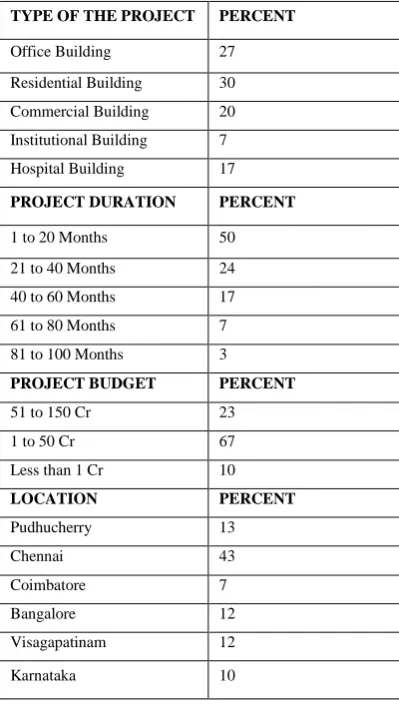
The project parameters details of all projects are shown in TABLE 1. It is found that 30% of the projects were
538 | P a g e
Hospital buildings, 7% were Institutional Buildings in different states like Pudhucherry, Chennai, Coimbatore,Bangalore, Karnataka, Visagapatinam. It was found that 50% of projects are in between 1 – 20 months, 24% of
projects are in between 21 – 40 months, 17% of projects are in between 41 – 60 months, 7% of projects are in
between 61 – 80 months, 3% of projects are in between 81 – 100 months. On the whole 23 % of projects come
under 51 to 150 Cr, 67% of projects come under 1 to 50 Cr, and 10% of projects come under 1 Cr are also
shown in TABLE1.
Table 1 Project information of case studies
4.2. Occurrence of Activity Delay
From the case study of 30 projects, the schedule overrun of each activity was identified by comparing planned
and achieved schedule of all projects. There are 224 different activities found from 30 projects. Later, the 224
activities are compiled together to develop a 12 numbers of milestones. The activities were ranked to arrive the
top ten activities which contributing delay in project and allows schedule overrun.
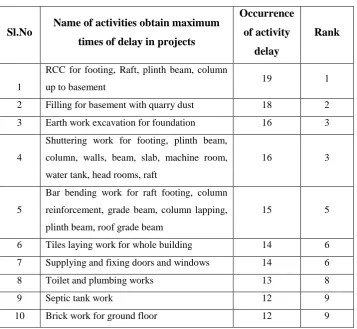
TABLE 2 shows, which activity obtained higher number of delay occurrence in all 30 projects. From Table 2,
shows that concreting for RCC for Plinth beam, Column, Raft up to basement under sub structure milestone
marks its higher number of occurrence (19 projects out of 30 projects). Follow by filling for basement with
quarry dust under site preparation milestone marks its second higher number of occurrence (18 out of 30).
TYPE OF THE PROJECT PERCENT
Office Building 27
Residential Building 30
Commercial Building 20
Institutional Building 7
Hospital Building 17
PROJECT DURATION PERCENT
1 to 20 Months 50
21 to 40 Months 24
40 to 60 Months 17
61 to 80 Months 7
81 to 100 Months 3
PROJECT BUDGET PERCENT
51 to 150 Cr 23
1 to 50 Cr 67
Less than 1 Cr 10
LOCATION PERCENT
Pudhucherry 13
Chennai 43
Coimbatore 7
Bangalore 12
Visagapatinam 12
539 | P a g e
Follow by brick work for ground floor under brick work milestone marks its lower number of occurrence (12out of 30).
Table 2 Occurrence of Activity Delay
4.3. Delay of Milestones
There are about 12 milestones fixed to compile the activities for 30 projects. To find the percentage delay of
each milestone, the comparison made between planned and achieved schedule to find the schedule overrun of
each activity under milestone of all 30 projects. The delay of particular activity under each milestone of
individual project is added to get the delay of the each milestone of individual project. Then the delay of each
milestone of individual project is added to get the overall delay of milestone of all 30 projects. Likewise planned
duration of each milestone for individual project was calculated by adding planned duration of each activity
under milestone for individual project.
Sl.No
Name of activities obtain maximum
times of delay in projects
Occurrence
of activity
delay
Rank
1
RCC for footing, Raft, plinth beam, column
up to basement 19 1
2 Filling for basement with quarry dust 18 2
3 Earth work excavation for foundation 16 3
4
Shuttering work for footing, plinth beam,
column, walls, beam, slab, machine room,
water tank, head rooms, raft
16 3
5
Bar bending work for raft footing, column
reinforcement, grade beam, column lapping,
plinth beam, roof grade beam
15 5
6 Tiles laying work for whole building 14 6
7 Supplying and fixing doors and windows 14 6
8 Toilet and plumbing works 13 8
9 Septic tank work 12 9
540 | P a g e
Table.3. Delay of Milestones
The percentage delay of each milestone for individual project was calculated before to find the overall
percentage delay of each milestone for all 30 projects. Finally, the average percentage delay of milestone was
calculated by using the following formula.
Where Equation 2 represents the 3rd column of this table and “Equation 3 represents the 5th column of this table.
(1)
Sl.No
Milestones
Overall
%delay of
milestones
Times of
occurrence of
milestone
Average %
delay of
milestones
R
ank
1 Pre construction phase 100 12 8
12
2 Approval 814 23 35
10
3 Site preparation 3510 30 117
2
4 Sub structure 1377 28 49
7
5
Super structure
(I) Formwork and
reinforcement
898 24 37 9
(II) concreting 2469 29 85
5
6 Lift works 95 2 48
8
7 Retaining wall works 19 4 5
13
8 Sump/ septic tank works 3039 20 152
1
9 Brick work 2765 26 106 3
10 Finishing works 2647 30 88 4
11 Service works 1656 27 61 6
12 Other miscellaneous
541 | P a g e
The delay of milestones was ranked on the basis of average percentage delay. The top milestones were rankedto arrive the top delayed milestone contributing to major schedule overrun of all 30 projects. TABLE 3 shows
that, the Sump/ Septic tank works marks its highest range of delay of about 152% for an individual project.
Followed by Brick works marks its second highest range of about 106 % for an individual project consequently,
Retaining wall works marks its lowest range of about 5%.
4.4. Delay of Activities
There are different activities involve under each milestone. Both planned and achieved schedule are compared
to calculate the delay period of each activity and also helps to understand the causes and implications of
schedule overrun. The percentage delay of each activity for individual project was calculated before to find the
overall percentage delay of each activity for all 30 projects. Finally, the average percentage delay of activity was
calculated by using the following formula. There are 224 activities involved in 30 projects. Among them 97
were critical activities (75 activities have more than 25% of delay occurrence, 22 activities have less than 25%
of delay occurrence) and 73 were non critical activities (completed before planned duration) and 54 activities
doesn’t attains delay. Maximum delay of activity was considered those having more than 25% delay of
occurrence. The following equations are used to derive the average percentage delay of activities.
Where Equation 5 represents the 3rd column of this table and “Equation 6" represents the 5th column of this table
TABLE 4 shows that list of activity have more than 25% chances of delay. From TABLE 4 shows that list of
activities obtaining delay in projects such as (i) filling for basement with quarry dust marks its higher number of
delay occurrence of about 419% (extended four times of planned duration), (ii) Stair case shuttering marks its
second higher number of delay occurrence of about 382% (extended three and half times of planned duration),
(iii) Concrete for flooring marks its third higher number of delay occurrence of about 379% (extended three and
half times of planned duration), (iv) PCC marks its fourth higher number of delay occurrence of about 350%
(extended three and half times of planned duration), (v) Parapet wall masonry work marks it fifth higher
number of delay occurrence of about 241% ( extended two and half times of planned duration), (vi) Water
proofing marks its sixth higher number of delay occurrence of about 230% (extended two and half times of
planned duration), (vii) Earth work excavation for foundation marks its seventh higher number of delay
occurrence of about 220%( nearly extended two times of planned duration), (viii) Supplying and fixing doors
542 | P a g e
planned duration), (ix) Excavation for STP Sump marks its ninth higher number of delay occurrence of about200% (extended two times of planned duration), (x) block work marks its tenth higher number of delay
occurrence of about 195% (extended one and half times of planned duration). Additionally internal and
external painting marks its lower percentage of delay occurrence of about 25%.
Table.4. Delay of Activities
S.no Activities
Overall
percentage delay
of activity of all 30
projects
Times of
occurrence of
activity of all
30 projects
Average
percentage of
delay of
activities
1 Filling for basement with quarry dust 7543 18 419
2 Stair case shuttering 2293 6 382
3 Concrete for flooring 2273 6 379
4 PCC 2803 8 350
5 Parapet wall masonry work 2656 11 241
6 Water proofing 1378 6 230
7 Earth work excavation for foundation 5723 26 220
8 Supplying and fixing doors and windows 3177 15 212
9 Excavation for STP Sump 400 2 200
10 Block work 2343 12 195
11 PCC for column footing 383 2 191
12 Septic tank work 3119 17 183
13 Concrete work for sunshade and lintel 2479 14 177
14 Pollution control approval 354 2 177
15 PT slab works 333 2 167
16 Wall shuttering and concrete 313 2 157
17 PCC for Drain 309 2 155
18 Raft concrete 463 3 154
19
RCC for footing, Raft, plinth beam,
column up to basement 3381 23 147
20
Bar bending work for raft footing,
column reinforcement, grade beam,
column lapping, plinth beam, roof grade
beam
2538 18 141
21 Ground water (bore wells) 265 2 132
22
Ceiling and wall plastering for whole
543 | P a g e
23 Starter marking 247 2 123
24 Environmental clearance 244 2 122
25 Toilet and plumbing works 1468 13 113
26 Carpentry work for whole building 1032 10 103
27 Electrical panel works 100 1 100
28 Drawing approval 199 2 99
29 pump and motors fixing drawing 91 1 91
30 Pipe laying work 91 1 91
31 Service works 176 2 88
32 Brick work in steps 667 9 74
33 Electrical conduit laying 148 2 74
34
Handing Over of Site after excavation
and dressing 220 3 73
35 Tiles laying work for whole building 1313 18 73
36 Reinforcement laying 351 5 70
37 Levelling coarse 70 1 70
38 External sanitary and water supply works 406 6 68
39 Design and drawing 130 2 65
40 Tie beam shuttering 65 1 65
41 HDPE sheet laying 64 1 64
42 Planning authority approval 127 2 64
43 Brick work for ground floor 802 13 62
44 Marking of column and footing 1125 19 59
45
Masonry work with fly ash brick for
foundation 58 1 58
46
Foundation, Pedestals and retaining walls
works till Grade slab PCC 57 1 57
47 statutory approval 513 9 57
48 Pressed tiles laying work for terrains 391 7 56
49
Terrace water proof and heat resistant
terrace tiles laying 381 7 54
50 Temporary meter box 700 13 54
51 Brick laying for grade beam 683 13 53
52 RCC work up to podium slab 52 1 52
53 Electrical works 561 11 51
54 Concrete laying 50 1 50
544 | P a g e
56 NOC from fire 99 2 50
57 Lime concreting 188 4 47
58 Earth Filling Up to Drain Bottom Level 46 1 46
59 Shuttering for Lift 91 2 45
60 Partition wall 89 2 45
61
Cover block laying and levelling work
for ground floor roof 400 9 44
62 Lift reinforcement 85 2 43
63 Joinery works 378 9 42
64 Ceiling plastering 41 1 41
65 Tie beam concrete 119 3 40
66
Shuttering work for footing, plinth beam,
column, walls, beam, slab, machine
room, rooms, raft
903 24 38
67 Painting works 488 13 38
68 Temporary power supply 73 2 36
69 Stair case concrete 500 14 36
70 Road and pavement works 33 1 33
Aluminium doors, windows, partitions
and cladding 63 2 31
70 Crusher powder for filling on basement 250 8 31
71 Consolidation work in all column footing 400 13 31
72 RCC for Corbel 29 1 29
73 Motor and pump line fixings 26 1 26
74 Parapet wall 129 11 25
75 Internal / External plastering works 148 6 25
V. CONCLUSION
The study was carried out to identify the activities affecting construction project scheduling in the construction
industry. This study was carried around 30 samples of data. The retrieved data were analyzed and found the top
critical factor (activity) responsible for time overrun of construction schedule. There are around 224 activities in
all 30 projects. The study concluded that following points.
(i) The delay of milestones was ranked on the basis of average percentage delay
(ii) The result obtained in this study mainly focussed on building projects.
(iii)The maximum 50% projects are in 1to 20 months. Hence the result of the more applicable for the project
duration lies in 1to 20 months.
(iv)The maximum 67% projects are in 1to 50 Cr. Hence the result of the more applicable for the project budget
545 | P a g e
(v) The maximum 44% projects are located in Chennai.
(vi) The maximum times of delay of activity obtained in overall project such as (i) RCC for footing, plinth
beam, column, raft up to basement, (ii) filling for basement with quarry dust, (iii) earth work excavation for
foundation. The remaining is shown in the Table2.
(vii) The maximum delay occurrence in the milestone is (i) sump/ septic tank works, (ii) site preparation, (iii)
Brick works. The remaining milestones are shown in the Table3
(viii) The maximum delay of activity was considered those having more than 25% of delay. Table 4 shows the
list of activities having more than 25% chances of occurring delay such as (i) Filling for basement with quarry
dust, (ii) Stair case shuttering, (iii) Concrete for flooring, (iv) PCC, (v) Parapet wall masonry work.
VI. SUGGESTIONS & RECOMMENDATIONS
The following recommendations are only for the top most delay activity under each milestone. The
identification of critical activities is to enhance the projects to achieve in planned duration and also avoid the
rescheduling in construction industry.
The recommendation of this paper suggests the influencing information for the project participants to focus on
critical factors to avoid the rescheduling. The suggestions to overcome schedule overrun of corresponding top
most activity are given below.
(i) Pump and motors fixing design - It will be avoided by providing complete data and complete drawing in
contract formation.
(ii) Pollution control approval – Most of the projects were get time overrun for getting approval. Hence this
time overrun will be overcome through the clients should check all necessary approvals for the project from the
relevant authority before the execution of building works. The process of approval should be started early as
soon as possible.
(iii) Filling for basement with quarry dust -The time overrun of this activity will be control by early
prediction of scarcity of filling material by site engineer during their site visit. To increase the productivity
machines are used instead of labours. It will be avoided by better monitoring and controlling, proper
communication among top management and labours.
(iv) Plain cement concreting (PCC) – The time overrun of this activity will be control by while planning
consideration of labours social and cultural factors and equipment selection should be done as per its
productivity and need of the project.
(v) Staircase shuttering – The time overrun of this activity will be control by a skilled labour because he can
ensure the formwork will be in the correct place or position before the concrete is poured. If we are failing in
doing all the above process, it will insist the rework. Hence the rework will insist the schedule overrun of
activity.
(vi) Concreting for flooring – The time overrun of this activity will be control by giving reasonable planned
duration (ii) Ensure that the concrete is pour it is completed as soon as possible. It should not be allowed to dry
546 | P a g e
(vii) Lift wall shuttering – the time overrun of this activity should be controlled by delivery schedule ofmaterials should be adhered with proper planning like having material in place before execution and making
advance payments for booking materials to avoid scarcity.
(viii)Wall shuttering and concreting – The time overrun of this activity will be control by al the previous
works should be properly corrected prior to start of shuttering and concreting work to avoid rework and to finish
with in planned duration.
(ix) Excavation for sump - The time overrun of this activity will be control byto employ an earthmover to
level the ground and giving reasonable planned duration for site preparation. Soil investigation should be
properly done prior to start of excavation work to avoid rework and handling the site on time as planned.
(x) Parapet wall masonry work –The time overrun of this activity will be control by material should be
procured as per planned and need of the project. To avoid the scarcity it should be booked in advance. Activities
should be planned by considering the impact of weather conditions due to seasonal changes. Festival holidays
must be taken in to consideration while scheduling to avoid the absenteeism of labours.
(xi) Water proofing –It will be corrected by cost control system is performed in projects to avoid the
unwanted increase of cost during rate escalation. Due to absence of skilled labour, training should be given to
unskilled labour to avoid the rework, time overrun of activity.
(xii) Supply and fixing doors and windows - It will corrected by taking fast decision and having back up plan
(vendors list) would avoid delay in supply of materials. Fixing of Window frames and door frames should be
placed correctly and checked to avoid the rework.
(xiii)Ground water (bore wells) –The schedule overrun of this activity will be overcome by giving reasonable
planned duration for excavation works and also using equipments for excavation, skilled labour will be needed
to install all the pipes, pump and motors which will be under the flooring of the house or in critical areas.
REFERENCES
[1] Chester. and Hendrickson, Cost Impacts, Scheduling Impacts And The Claim Process During
Construction, Journal Of Construction Engineering And Management, Vol 131(8), 2005, 102-107.
[2] Dayi, Schedule Delay Analysis In Construction Projects: A Case Study Using Time Impact Analysis
Method, The Graduate School Of Natural And Applied Sciences Of Middle East Technical University,
2010, 1-105.
[3] Marzouk, M. and Rasas, I, Analysis Delay Causes in Egyptian Construction Projects, Journal Of
Advanced Research, Vol.3, 2012), 49-55.
[4] Sweis, J, Factors Affecting Time Overrun In Public Construction Projects: The Case Of Jordan,
International Journal Of Business And Management, Vol. 8 (23), 2013, 120-129.
[5] Indhu,B. and Ajai,P, Study Of Delay Management In A Construction Project- Acase Study, International
Journal Of Emerging Technology And Advanced Engineering, Vol. 4(5), 2014, 108-113.
[6] Subramani, T., Lishitha,P.T., and Kavitha,M, Time Overrun And Cost Effectiveness In The Construction
547 | P a g e
[7] Mulla, S. and Waghmaree, P, A Study Of Factors Caused For Time And Cost Overrun In Construction
Projects And Their Remedial Measures, International Journal Of Engineering Research And
Applications, Vol. 5(1), 2015, 48-53.
[8] Wale, P.M., Jain, N.D., and Godhani, N.R., Planning and Scheduling of Project Using Microsoft Project
Case Study of Building in India,Journal Of Mechanical And Civil Engineering, Vol. 12 (3), 2015, 57-63.
[9] Bhatia. and Apte, M.R, Schedule Overrun And Cost Overrun In The Construction Of Private Residential
Construction Project: Case Study Of Pune India, International Journal Of Technical Research And
Applications, Vol. 4(2), 2016, 174-177.
[10] Multashi. and Salgude,R, Delay Analysis In Construction Project A Case Study- Alkut Olympic Stadium,