Hydro and Jets in Relativistic Heavy-Ion Collisions
L.V. Bravina1,3,4,a, B.H. Brusheim Johansson1, J. Crkovská5,6, G.Kh. Eyyubova2,7, V.L. Korotkikh2, I.P. Lokhtin2, L.V. Malinina2,7, E.N. Nazarova2, S.V. Petrushanko2, A.M. Snigirev2, and E.E. Zabrodin1,2,3,4
1Department of Physics, University of Oslo, PB 1048 Blindern, N-0316 Oslo, Norway
2Skobeltsyn Institute of Nuclear Physics, Moscow State University, RU-119991 Moscow, Russia 3Frankfurt Institute for Advanced Studies, Ruth-Moufang-Str. 1, D-60438 Frankfurt a.M., Germany
4National Research Nuclear University "MEPhI" (Moscow Engineering Physics Institute), RU-115409
Mo-scow, Russia
5Czech Technical University in Prague, FNSPE, CR-11519 Prague, Czech Republic
6Institut de Physique Nucléaire, CNRS-IN2P3, Univ. Paris-Sud, Université Paris-Saclay, F-91406 Orsay
Ce-dex, France
7Joint Institute for Nuclear Researches, Dubna, Russia
Abstract. We apply HYDJET++model, which contains the treatment of both soft and hard processes, to study the heavy-ion collisions at LHC energies. The interplay of para-metrised hydrodynamics and jets describes many features of the development of particle anisotropic flow including the break-up of mass hierarchy of elliptic and triangular flow, the falloffof the flow at certain transverse momentum and violation of the number-of-constituent-quark (NCQ) scaling at LHC energies compared to the lower ones. Other signals, such as long-range dihadron correlations (ridge) and event-by-event (EbyE) fluc-tuations of the flow are also discussed. Model calculations demonstrate a good agreement with the available experimental data.
1 Introduction
The main difficulties emerging in analysis of data on relativistic heavy-ion collisions (HIC’s) are (i) absence of the unified theory for the description of these collisions, (ii) that perturbative quantum chro-modynamics (QCD) does not apply for “soft" interactions with small transverse momentum transfer, which play an essential role in physics of HIC’s, and (iii) that the final state of HIC’s is very com-plicated to extract easily the signatures of the new state of matter, the quark-gluon plasma (QGP). Therefore, models are indispensable for evaluating the current experiments and for planing the new ones. These models can be subdivided into macroscopic, i.e. thermal [1–3] and hydrodynamic mod-els [4–6], and microscopic Monte Carlo modmod-els [7–10], incorporating partonic and hadronic degrees of freedom in a consistent fashion. Note that for better description of data, hydrodynamic models nowadays are employing the microscopic transport models as afterburner.
In contrast to microscopic transport models, macroscopic models usually deal with soft processes with particle transverse momentum up to pT ≈ 1.5−2 GeV/conly, and do not include jets. HY-DJET++model [11] was, probably, the first attempt to combine a hydro-like state and hard processes within a single event generator. This idea appears to be very promising. After the discussion of basic principles of the model in Sec. 2, the most interesting results obtained by the HYDJET++are listed in Sec. 3. Finally, conclusions are drawn in Sec. 4.
2 HYDrodynamics with JETs (HYDJET++)
In HYDJET++the soft state is represented by a hydro-like system [12, 13]. It is coupled to a hard multiparton state, where the hard partons are suffering the collisional and gluon radiation losses [14] when propagating the dense and hot medium. For the sake of simplicity, both states are treated inde-pendently. In the soft sector sector HYDJET++employs the popular Bjorken or Hubble expansion scenarios for the overlapping zone of heavy-ion collisions. At certain temperatureT = Tch and chemical potentialsμi, wherei= B,S,Qrepresents baryon charge, strangeness and electric charge, respectively, the thermalised fireball breaks into individual hadrons in a sudden chemical freeze-out process. The particle number densityρeqi (T, μi) is given by the well-known series expansion [4]
ρeq
i (T, μi)= gi 2π2m
2 iT
∞
k=1 (∓)k+1
k exp
kμi
T
K2
kmi T
, (1)
wheregiis the spin degeneracy factor,miis the particle mass, andK2is the modified Bessel function of a second kind. To calculate the particle yields one has to know the fireball volume. It is proportional to the mean number of wounded nucleons at a given impact parameterb, see [11–13] for details. After the chemical freeze-out, the system of hadrons continues to expand until the thermal contact between the particles is lost. This is the stage of thermal freeze-out. The only final-state interactions taken into account in the model are two- and three-body decays of resonances. HYDJET++benefits from the extensive table of particles which contains more than 360 meson and baryon states including the charmed ones. The mass distribution of the resonances is given by a non-relativistic Breit-Wigner formula
P(m)dm∝ 1
(m−m0)2+ Δm2/4
dm, (2)
wherem0andΔmare the resonance nominal mass and width, respectively.
The hard multiparton stage emerges in the model as a superposition of individual hard nucleon-nucleon (NN) collisions. For each collision, the PYQUEN routine [14] generates the initial parton spectra (by means of the tune Pro-Q20 of PYTHIA [15]) and the production vertexes. The parton res-cattering stage is accompanied by collisional energy loss and radiation of gluons. In high-momentum transfer limit, the collisional loss reads
dE dl
col = 1
4Tλσ tmax
μ2 D
dtdσ
dtt, (3)
with the dominant contribution to the differential scattering cross section
dσ
dt C
2πα2 s(t) t2
E2 E2−m2
p
Hereλ = 1/(σρ) is the mean free path of a parton in a medium with densityρand integral cross section of parton-medium interactionσ. In the last equationEandmp are energy and mass of the parton,αs is the QCD running coupling constant, andC = 4/9,1,9/4 forqq, gq andgg interac-tion, respectively. Then, the energy spectrum of coherent medium-induced gluon radiation and the corresponding dominant part of radiative energy loss of massless parton in the framework of BDMS formalism [16, 17] become
dE dl
rad
=2αs(μ2D)CR πL E ωmin dω
1−y+y 2
2
ln|cos (ω1τ1)|, (5)
ω1=
i 1−y+CR 3 y
2
¯ κln16
¯
κ with κ¯= μ2
Dλg
ω(1−y), (6)
containingτ1 = L/(2λg),λg is the gluon mean free path, andy =ω/Eis the parton energy fraction carried away by the gluon. Partons produced in initial hard scatterings with the transverse momentum transfer lower than a certain limitpmin
T are excluded from the hard component. Their hadronization products are added to the thermalised component of particle spectrum.
Let us discuss generation of the anisotropic flow in non-central heavy ion collisions in the model. Recall, that the flow harmonics are the Fourier coefficients of series expansion of the invariant cross section in azimuthal plane [18]
Ed 3N
d3p =
1 π
d2N d p2
Tdy ⎧⎪⎪ ⎨ ⎪⎪⎩1+2
∞
n=1
vncosn(φ−Ψn) ⎫⎪⎪ ⎬
⎪⎪⎭ , (7)
vn = cos
(n(φ−Ψn). (8)
Hereyis the particle rapidity,φis the azimuthal angle between the particle transverse momentum pT and the participant plane, andΨn is the azimuth of the participant plane ofn-th order. The flow harmonic coefficients are called directed,v1, elliptic,v2, triangular,v3, quadrangular,v4, pentagonal, v5, hexagonal,v6, flow and so forth. The transverse radius of the fireball for non-central heavy ion collision depends on impact parameterb, azimuthal angleφ and spatial eccentricity(b) = (R2
y −
R2
x)/(R2y+R2x) as [13]
Rell(b, φ)=Rf r.−out(b)
1−2(b)
1+(b) cos 2φ. (9)
The parameterRf r.−out(b) is linked to the freeze-out radius of the fireball in a central collision,R0, as Rf r.−out(b) =R0
√
1−(b). The momentum anisotropy arises from the pressure gradients, which are stronger in the direction of short axis of the ellipsoid. Another free parameter,δ(b), connects the flow azimuthal angleφf lwith the azimuthal angleφ. Namely,
δ(b)=1−C 2
1+C2 , C= tanφf l
tanφ . (10)
Triangular flow needs further modification of the transverse radius [20], which is controlled by new free parameter3(b)
Rtriang(b, φ)=Rell(b, φ){1+3(b) cos3(φ−Ψ3)}. (11)
(GeV/c) T p
0 1 2 3 4 5
2
v
0 0.05 0.1 0.15 0.2 0.25 0.3
25-30%
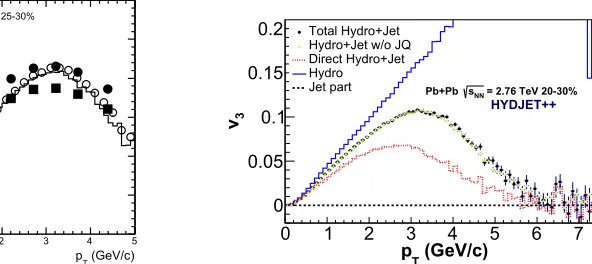
Figure 1. Thev2(pT) distributions in the HYDJET++
model for 25-30% centrality collisions (histogram) compared to event-plane flow restoration method (open circles) and CMS data (full symbols). See text for de-tails.
(GeV/c) T
p
0 1 2 3 4 5 6 7
3
v
0 0.05 0.1 0.15 0.2
= 2.76 TeV 20-30%
NN
s Pb+Pb
HYDJET++ Total Hydro+Jet
Hydro+Jet w/o JQ Direct Hydro+Jet Hydro Jet part
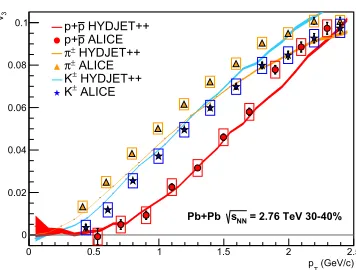
Figure 2.Thev3(pT) distributions for charged hadrons
from (i) all processes (solid circles), (ii) soft+hard pro-cesses w/o jet quenching (open triangles), (iii) directly frozen hadrons (dash-dotted line), (iv) soft processes (solid histogram), (v) jets (dashed line) in Pb+Pb at 2.76 TeV with centrality 20-30%.
3 Interplay of soft processes and jets
For our further analysis Pb+Pb collisions at √s = 2.76 TeV are chosen. Figure 1 displays elliptic flow of charged hadrons produced in collisions with centrality 25-30%. Experimental data by the CMS Collaboration [19] obtained by the 2-cumulant and Lee-Yang zeroes (LYZ) methods are plotted also. To estimate possible distortion of the flow spectra caused by the reconstruction procedure, the generated particle spectra were used as an input for the flow determination. The event-plane (EP) method was employed. The restored spectrum is very close to the original one. Model calculations agree well with the data. The good agreement with the experiment is obtained for the triangular flow and higher flow harmonics as well, see [20].
Note that falloffof the differential flowv2(pT) at pT ≥3 GeV/cis a common feature of all flow harmonics. Since we apply ideal parameterised hydrodynamics which has no such peculiarity, the most plausible explanation of the drop ofvn(pT) is the jet influence. One can see this in Fig. 2, which shows the partial contributions of different subprocesses to the triangular flowv3(pT) in collisions with centrality 20-30%. In addition to the totalv3, this figure presents also the flow in case of absence of jet-medium interaction, flow of particles produced merely in soft processes, flow of particles without the resonance feed-down, and flow of hadrons decoupled from jets. The latter is essentially zero, whereas its hydrodynamic counterpart increases with risingpT. After certain transverse momentum, however, the total spectrum of hadrons is dominated by particles produced in hard processes which can carry very weak flow because of the jet quenching [21]. Since these particles prevail in the hadron spectrum, the total flow drops.
(GeV/c) T p
0 0.5 1 1.5 2 2.5
3 v 0 0.02 0.04 0.06 0.08 0.1
= 2.76 TeV 30-40% NN s Pb+Pb HYDJET++ p p+ ALICE p p+ HYDJET++ ± π ALICE ± π HYDJET++ ± K ALICE ± K
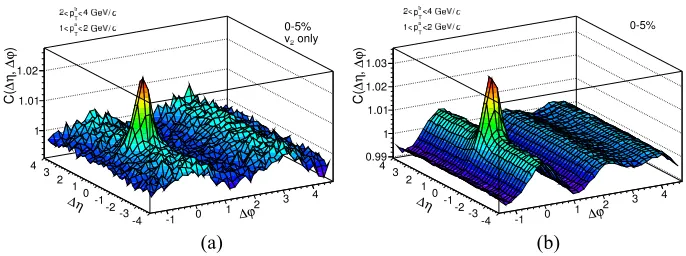
Figure 3. pT-differential triangular flow of charged pions, kaons, and protons plus antiprotons in Pb+Pb
colli-sions at 2.76 TeV with centrality 20-30%. solid curves indicate HYDJET++calculations, symbols show ALICE data from [22].
q /n2 v 0 0.05 0.1 0.15
0.2 Hydro, s=2.76 TeV
20-30% π p K Λ (a) (GeV) q /n t KE
0 0.5 1 1.5
(p)2 /v2 v 0 1 2 Hydro (c) All Hadrons (b) (GeV) q /n t KE
0.5 1 1.5
All Hadrons
(d)
Figure 4.Upper row: TheKET/nqdependence of elliptic flow for (a) hadrons produced in soft processes only,
and (b) all hadrons calculated in HYDJET++model for Pb+Pb collisions at 2.76 TeV with centrality 20-30%. Bottom row: The distributions from the upper row are normalised to the elliptic flow ofp+p.¯
abundant. Therefore, the pT-differential flow of mesons experiences the saturation and subsequent drop at smallerpT compared to heavier baryons. This effect is called violation of the mass ordering of the flow.
(a) (b)
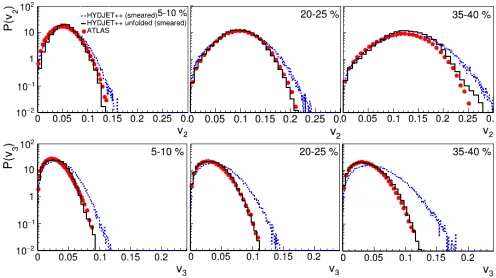
Figure 5.2D correlation function in HYDJET++in Pb+Pb collisions at √sNN=2.76 TeV for 2<ptrT<4 GeV/c and 1< pa
T <2 GeV/cfor centrality 0-5% with (a) only elliptic flow and (b) with both elliptic and triangular flow.
elliptic flow from the quark coalescence at the partonic stage, most presumably, quark-gluon plasma (QGP). The violation of NCQ scaling was predicted by HYDJET++[25, 26] before its experimental observation by the ALICE Collaboration [27].
The reduced functionsv2(KET/nq)/nqofπ±,K±,pandΛcalculated in HYDJET++for 20-30% central Pb+Pb collisions at 2.76 TeV are shown in Fig. 4. Left upper panel displays the results for the soft sector. As one can see, all distributions are indeed on the top of each other up to 1.5 GeV. To see the degree of the scaling fulfillment explicitly all particle flows in the bottom row are normalized to the flow of protons,vh2/nq :v2p/nq. Hadrons from jets make the scaling performance significantly worse, as seen im right panels of Fig. 4. The NCQ scaling at LHC holds only approximately within the range 0.4≤KET/nq≤0.8 GeV despite the fact that in pure hydrodynamic sector with final state interactions the scaling fulfillment is very good. The detailed study of consequences of the interplay between the soft processes and jets on the development of elliptic and triangular flow and higher order harmonics within the HYDJET++can be found in [20, 25, 26, 28–31].
Finally, we would like to discuss the issue of correlations and fluctuations presented in the model. Among the sources of particle correlations in HYDJET++are decays of resonances, jets, femtoscopic correlations, correlations imposed by energy-momentum conservation and so forth. However, as was shown in [32], the long-range correlations arise in the model merely because of the collective flow. The di-hadron correlation functionC(Δη,Δϕ), whereΔη=ηtr−ηaandΔϕ=ϕtr−ϕais presented in Fig. 5(a,b) for the calculations of Pb+Pb collisions with centrality 0-5%. - The indices “tr" and “a" indicate the so-called “trigger" and “associated" particle, respectively. - Two cases are considered: (a) without and (b) with the triangular flow in addition to the elliptic one. We see that the long-range azimuthal correlations appear both at near-side (Δϕ ≈ 0) and at away-side (Δϕ ≈ π) in both figures. But the experimentally observed [33, 34] double-hump structure at the away-side emerges in the model only in the presence of elliptic and triangular flow simultaneously.
Figure 6.The probability density distributions of elliptic flowV2(upper row) and triangular flowV3(bottom row) in three centrality intervals: 5−10% (left), 20−25% (middle) and 35−40% (right). Dashed and solid histograms present the results for simulated HYDJET++events before and after the unfolding procedure, respectively. The full circles are the ATLAS data from [35].
procedure makes it narrower. Obtained results strongly support the idea of dynamical origin of the EbyE flow fluctuations in the model.
4 Conclusions
We show the importance of hard processes for the correct treatment of anisotropic flow harmonics in heavy-ion collisions at ultrarelativistic energies within the ideal hydrodynamic model. Jets account for (i) falloffof the flow harmonics in the range of intermediate transverse momenta, (ii) changing of the mass ordering of the hadron elliptic and triangular flow, and (iii) the violation of the number-of-constituent-quark scaling at energies of LHC and higher.
The interplay betweenv2 andv3is able to describe both qualitatively and quantitatively the di-hadron long-range correlations, i.e. ridge at near-side and double-hump structure at the away-side. The unfolding procedure was employed to study event-by-event flow fluctuations in the model and compare the obtained results with the experimental data. The comparison revealed dynamical origin of the flow fluctuations, originating primarily from the correlation between the momenta and coordinates of final particles and the velocities of hadronic fluid elements.
Acknowledgments
This work was supported in parts by the Grant INGO II LG15001 of the Ministry of Education, Youth and Sports of the Czech Republic and the Grant Agency of Czech Republic No.13-20841S, and the Grant of the President of Russian Federation for Scientific Schools Supporting No. 7989.2016.2. L.B. acknowledges financial support of the Alexander von Humboldt Foundation.
References
[2] G. Torrieriet al., Comput. Phys. Commun.167, 229 (2005)
[3] A. Kisiel, T. Taluc, W. Broniowski, and W. Florkowski, Comput. Phys. Commun.174, 669 (2006) [4] L. D. Landau, Izv. Akad. Nauk Ser. Fiz.17, 51 (1953);
S. Z. Belenkij and L. D. Landau, Nuovo Cim. Suppl.3S10, 15 (1956) [5] H. Song, S. A. Bass, and U. Heinz, Phys. Rev. C83, 024912 (2011) [6] B. Schenke, S. Jeon, and C. Gale, Phys. Rev. C82, 014903 (2010)
[7] A. Capella, U. Sukhatme, C.-I. Tan, and J. Tran Thanh Van, Phys. Rep.236, 225 (1994) [8] S. A. Basset al., Prog. Part. Nucl. Phys.41, 255 (1998);
M. Bleicheret al., J. Phys. G25, 1859 (1999)
[9] N. S. Amelin and L. V. Bravina, Sov. J. Nucl. Phys.51, 133 (1990);
E. E. Zabrodin, C. Fuchs, L. V. Bravina, and Amand Faessler, Phys. Lett. B508, 184 (2001); J. Bleibel, L. V. Bravina, and E. E. Zabrodin, Phys. Rev. D93, 114012 (2016)
[10] Z.-W. Lin,et al., Phys. Rev. C72, 064901 (2005)
[11] I. P. Lokhtinet al., Comput. Phys. Commun.180, 779 (2009) [12] N. S. Amelinet al., Phys. Rev. C74, 064901 (2006)
[13] N. S. Amelinet al., Phys. Rev. C77, 014903 (2008)
[14] I. P. Lokhtin and A. M. Snigirev, Eur. Phys. J. C46, 211 (2006) [15] T. Sjostrand, S. Mrenna, and P. Skands, JHEP0605, 026 (2006)
[16] R. Baier, Yu. L. Dokshitzer, A. H. Mueller, and D. Schiff, Phys. Rev. C60, 064902 (1999) [17] R. Baier, Yu. L. Dokshitzer, A. H. Mueller, and D. Schiff, Phys. Rev. C64, 057902 (2001) [18] S. A. Voloshin and Y. Zhang, Z. Phys. C70, 665 (1996)
[19] S. Chatrchyanet al.(CMS Collaboration), Phys. Rev. C87, 014902 (2013) [20] L. V. Bravinaet al., Eur. Phys. J. C74, 2807 (2014)
[21] X.-N. Wang and M. Gyulassy, Phys. Rev. Lett.68, 1480 (1992) [22] J. Adamet al., (ALICE Collaboration), arXiv:1606.06057 [nucl-ex] [23] J. Adamset al.(STAR Collaboration), Phys. Rev. Lett.92, 052302 (2004) [24] S. S. Adleret al.(PHENIX Collaboration), Phys. Rev. Lett.91, 182301 (2003) [25] G. Eyyubovaet al., Phys. Rev. C80, 064907 (2009)
[26] E. Zabrodinet al., J. Phys. G.37, 094060 (2010)
[27] F. Noferiniet al.(ALICE Collaboration), Nucl. Phys. A904-905, 438c (2013) [28] I. P. Lokhtinet al., Eur. Phys. J. C72, 2045 (2012)
[29] L. Bravina, B. H. Brusheim Johansson, G. Eyyubova, and E. Zabrodin, Phys. Rev. C87, 034901 (2013)
[30] L. V. Bravinaet al., Phys. Rev. C89, 024909 (2014) [31] J. Crkovskáet al., arxiv:1606.03250 [hep-ph] [32] G. Eyyubovaet al., Phys. Rev. C91, 064907 (2015)
[33] K. Aamodtet al.(ALICE Collaboration), Phys. Rev. Lett.107, 032301 (2011) [34] S. Chatrchyanet al.(CMS Collaboration), Eur. Phys. J.C72, 2012 (2012) [35] G. Aadet al.(ATLAS Collaboration), JHEP11, 183 (2013)