Adaptation and Risk Management
Roger N. Jones
1and Benjamin L. Preston
21. Centre for Strategic Economic Studies, Victoria University, Melbourne Victoria Australia 2. Oak Ridge National Laboratories, Knoxville Tennessee USA
Climate Change Working Paper No. 15 Centre for Strategic Economic Studies Victoria University
Melbourne
Citation
Jones, R.N. and Preston, B.L. (2010) Adaptation and risk management. Climate Change Working Paper No. 15, Centre for Strategic Economic Studies, Victoria University, Melbourne, 18 pp.
© Copyright CSES 2010
PO Box 14428
Melbourne, Victoria 8001, Australia Telephone +613 9919 1340 Fax +613 9919 1350
Website: http://www.cfses.com
Email: [email protected]
Roger N. Jones and Benjamin L. Preston
1Abstract
Assessment methods for adaptation to climate change are very compatible with environmental risk assessment frameworks. Risk assessment approaches are increasingly being recommended for assessments at both national and local levels. Two orientations to assessments can commonly be identified: top-down and bottom-up, and prescriptive and diagnostic. Combinations of these orientations favor different types of assessments that can be related to uncertainties in both prediction and taking action, and in the type of adaptation and degree of system stress. Taking multiple viewpoints is to be encouraged, especially in complex situations. The bulk of current guidance material is consistent with top-down and predictive approaches, thus is most suitable for risk scoping and identification. A broad range of material from within and beyond the climate change literature can be used to select subsequent methods. The framing of risk, correct formulation of the questions being investigated and assessment methodology are critical aspects the scoping phase. Only when these issues have been addressed should be issue of specific methods and tools be addressed. The re-orientation of adaptation from an assessment focused solely on anthropogenic climate change to broader issues of vulnerability/resilience, development and managing disaster risk, especially through a risk management framework can draw from existing policy and management understanding in communities, professions, and agencies, and to their existing agendas, knowledge, risks, and issues they already face.
Keywords
Climate change, Risk management, Adaptation, Methodologies, Mainstreaming
1
A version of this working paper has been submitted to WIREs Climate Change. The authors wish
Introduction
Risk management involves exploring, making and acting on decisions under conditions of uncertainty. Formally, risk management is defined as the culture, processes and structures that are directed towards realizing potential opportunities whilst managing adverse affects (Standards Australia and Standards New Zealand, 2004). Risk itself is defined as the combination of the probability of an event and its consequences; there may be more than one event, consequences can be both positive and negative and likelihoods can be measured qualitatively or quantitatively (ISO, 2009). These definitions are also appropriate for assessing climate risks and planning adaptation. Our thesis is that risk management frameworks should be the major vehicle used for climate change assessments, including those for adaptation.
Assessment of climate change impacts, adaptation and vulnerability (CCIAV) and risk management have many elements in common including the need to manage uncertainty, the linking of hazards and consequences, communication between technical experts and stakeholders, the mitigation of risk by reducing both the hazard and consequences of those hazards and formal processes to link all of these activities (Carter et al., 2007).
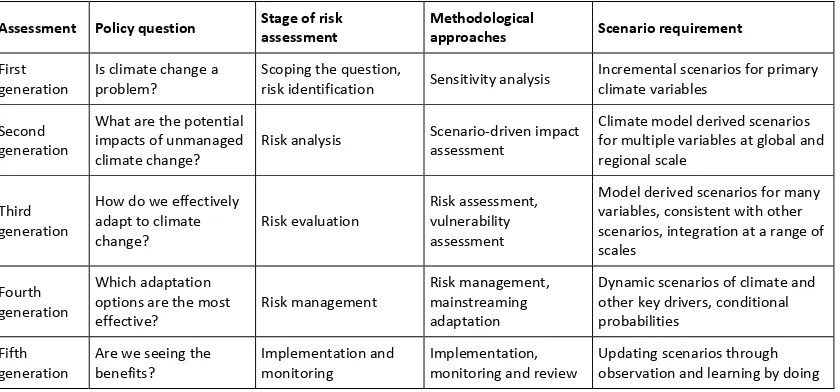
Risk management has been linked with adaptation for a decade and with anthropogenic climate change for almost two decades. In that time, the understanding of both has evolved considerably (Table 1). The enhanced greenhouse effect was linked to risk management in the 1990s (Shlyakhter et al., 1995; Beer, 1997; Downing et al., 1999), and adaptation to climate change was framed as risk management more recently (Jones, 2001; Willows and Connell, 2003; UNDP, 2005). Adaptation has also been linked to natural hazard management and disaster risk reduction (Handmer, 2003; Moench, 2007). This is an area of significant development in risk management techniques that is increasingly being linked to climate change (O’Brien et al., 2008).
Table 1. Generations of risk assessment as they apply to climate change, particularly adaptation.
Assessment Policy question Stage of risk
assessment
Methodological
approaches Scenario requirement
First
generation
Is climate change a
problem?
Scoping the question,
risk identification Sensitivity analysis
Incremental scenarios for primary
climate variables
Second
generation
What are the potential
impacts of unmanaged
climate change?
Risk analysis Scenario‐driven impact
assessment
Climate model derived scenarios
for multiple variables at global and
regional scale
Third
generation
How do we effectively
adapt to climate
change?
Risk evaluation
Risk assessment,
vulnerability
assessment
Model derived scenarios for many
variables, consistent with other
scenarios, integration at a range of
scales
Fourth
generation
Which adaptation
options are the most
effective?
Risk management
Risk management, mainstreaming
adaptation
Dynamic scenarios of climate and
other key drivers, conditional
probabilities
Fifth
generation
Are we seeing the
benefits?
Implementation and
monitoring
Implementation,
monitoring and review
Updating scenarios through
observation and learning by doing
Linking adaptation and risk
Risk management is an iterative process, and the different stages of risk can be seen in the evolution of assessment methods for climate change. Four generations of risk management can be identified from successive assessments carried out by the Intergovernmental Panel on Climate Change (IPCC). The first and second generations involve scoping the nature of the climate change issue, and identifying and analysing climate risks, mainly climate impacts. The third generation began to explore the nature of adaptation itself and the fourth to applying it by adopting the techniques of evaluation and risk management. The third and fourth generation literature is reviewed by (Schipper and Burton, 2008). In addition, we suggest a nascent fifth stage as researchers and stakeholders begin to assess the benefits of adaptation and develop methods for measuring such benefits.
Standard elements within the risk management process that can be linked to parallel methods in assessing climate vulnerability, impacts, and adaptation are:
A scoping exercise where the context of the assessment is established. This
identifies the overall method to be used and establishes relationships between stakeholders and researchers.
Risk identification. This step also identifies scenario development needs.
Risk analysis, where the consequences and their likelihood are analysed. This
is a highly developed area with a wide range of available methods to undertake impact analysis.
Risk evaluation, where adaptation ±mitigation methods are prioritised.
Risk management or treatment, where selected adaptation ±mitigation
measures are applied.
Monitoring and review, where measures are assessed and the decision made to
reinforce, re-evaluate or repeat the risk assessment process.
Two overarching activities are researcher–stakeholder interaction and communication with stakeholders and the wider community. In CCIAV assessments, these are largely concerned with uncertainty management and clarity and transparency surrounding the assumptions and concepts being used. However, the recent proliferation of post-normal, participatory approaches to climate risk management has seen the emergence of more deliberative, two-way methods for incorporating stakeholder knowledge and values (Saloranta, 2001; Lorenzoni et al., 2005). Such participation helps to ensure the risk management process is appropriately framed. It also enables the direction of the assessment to change as researchers and stakeholders learn by doing (Cohen et al., 1998).
The evolution of different methodological approaches to understanding vulnerability and risk has produced a diverse lexicon due to the many disciplines currently engaged in adaptation science (O'Brien et al., 2004a; Haque and Burton, 2005). While this creates the potential for confusion, particularly among stakeholders, the basic elements of risk management transcend nomenclature, and an over-arching paradigm is often visible among different frameworks.
The benefits of a risk management approach
required to reduce harm or to take advantage of any benefits associated with that impact. This climate scenario-driven, or ‘standard approach’, dominated assessments through to those summarized in the IPCC Fourth Assessment Report (Carter et al., 2007).
The limitations of the standard approach have been raised in a series of critiques that can be summarized as follows:
Adaptation is a social process, the understanding of which is independent of
the ability to predict climate change and climate impacts (Cohen et al., 1998; Pielke, 1998; Kelly and Adger, 2000a, b).
Because vulnerability to climate change is a broader component of social and
environmental vulnerability, reducing the latter can lessen vulnerability to climate change (Kelly and Adger, 2000b).
The standard approach dislocates adaptation to climate change from
adaptation to historical climate change and other changes in associated human-environmental systems (Cohen et al., 1998; Kelly and Adger, 2000b; Pielke and Sarewitz, 2005).
The presence of ‘deep uncertainty’ associated with future socio-economic
states and the uncertainty inherent in complex systems contributing to the understanding of climatic change (Lempert and Schlesinger, 2000; Kandlikar et al., 2005).
Over the past two decades, a range of methods have been developed to manage these uncertainties and limitations (Carter et al., 2007). We would argue that while each has benefits, they are better employed as methods within a risk management approach which has the flexibility to utilize a range of methods. The challenge is to select which methods best suits a particular context and set of needs. Several are briefly described.
One strategy for managing uncertainty is improved scientific prediction, particularly of climate hazards and their resulting impacts. For example, disaster mitigation, and the design and location of infrastructure hinge upon estimated return intervals for specific hazards, such as the 1 in 100 year flood or storm event. Such benchmarks are based upon statistical estimates of event frequency and magnitude, assuming a stationary climate. Planning for climate change is often perceived as a process of adjusting those benchmarks to reflect future conditions. Significant investments have been made in improving the ability of global climate models to predict future climate and thus constrain uncertainty about those conditions. Most recently, investigations of model performance and the use of selective weighting of models have been used to tighten probability distributions of future states (Tebaldi et al., 2004; Tebaldi and Knutti, 2007). Such approaches can be carried through to impacts.
These efforts effectively represent an attempt to build greater consensus around “best guess” estimates of future climatic change and its consequences. However, such reductionist approaches to uncertainty management are not without their critics (Dessai et al., 2009). Oppenheimer et al. (2007, p. 1506) argue,
Hence, prediction/optimization approaches to managing uncertainty may mask plausible outcomes, particularly those that have severe consequences but appear unlikely.
Scenarios can be developed to provide a discrete set of plausible assumptions about future states, without being dependent on likelihoods. The general argument in their favor is that they free research from being tied to a particular model or normative representation of future states, or by mixing such states inappropriately (Grubler and Nakicenovic, 2001). Instead, any future can be considered, although Morgan et al. (2001) note that even with such freedom experts tend to underestimate the true range of uncertainty associated with complex systems. The drawback of scenarios is that researchers have consistently avoided assigning likelihoods to climate model scenarios, preferring that they be treated as “if. . .then” constructs (Jones, 2004; Risbey, 2004). This lack of guidance regarding the possible likelihood of different scenarios, however, has been identified as a potential problem for decision-making (Pittock et al., 2001; Webster et al., 2003). While scenarios represent uncertainty; they can fail to make that uncertainty explicit.
A further strategy is to assess which adaptations are robust across a broad range of plausible climate change (Dessai and Hulme, 2007; Groves and Lempert, 2007), given that uncertainties are not fully understood, will carry some level of subjectivity and that climate change may well occur outside the range of the projected range provided by climate modelling. In some cases, directly reducing social vulnerability may reduce climate-related vulnerabilities, especially if the determinants of vulnerability are more closely relate to social and economic rather than biophysical criteria (Nelson et al., 2009). However, the emphasis of the full range of uncertainty with low predictability can also have its downside. Stakeholders have used large uncertainties to justify the continuation of business as usual (Jones, 2001) or to argue that business as usual is adaptation because human-environment systems are always changing.
As a tool for coping with uncertainty in decision-making, risk management offers a number of distinct benefits over other approaches. Risk management also aims to manage uncertainty, but does so within a framework for weighing likelihood and consequence. As such it is very flexible; while capturing a broad array of future states or consequences, stakeholders can expand their options by tailoring the above strategies to best suit their particular circumstances.
Under conditions of deep uncertainty, decision-making around risk will invariably necessitate deliberation over values and preferences, which should be explicit attributes of the risk management process (Anand, 2002). This opens up the decision-making process to hedging in the face of uncertainty and the preferential weighting of different lines of evidence or values, such as trade-offs between economic and environmental goals.
Directional approaches
This simplified view defined adaptation as a property of climate change, and overlooked the rich development and social adaptation literature, but was in one sense necessary. The scientific capacity to model climate change and to use the results in a meaningful way first needed to be developed. The resulting risks were analyzed to determine whether an adaptive response was needed. The global to local downscaling involved has often led this approach to be labelled as top-down (Dessai and Hulme, 2004).
Top-down assessments tend to focus on direct cause-and-effect relationships within systems of interest. Such relationships are convenient in that they represent the perceived critical linkages between climate and society and may often be amenable to direct quantitative analysis. However, as a consequence, they tend to neglect the complexity inherently associated with human–environment systems. Many nodes within these systems may be poorly defined, unappreciated or even unrecognized. Some relationships between components can perhaps only be described qualitatively. For example, the determinants of social vulnerability to climate change, and thus of many climate change risks, are a function of social, cultural, political and institutional characteristics (Adger and Kelly, 1999), perceptions of risk among the public and governing institutions, and time preferences. Many of these issues only become apparent at regional-to-local scales of investigation.
Recognition of the importance of more nuanced perspectives on adaptation has focused greater attention on bottom-up approaches to risk management, in which the process begins at the local scale, assessing current and emerging risks, the social and environmental factors that underpin risk and the capacity for risk management (Dessai and Hulme, 2004). Only then, are change processes, including planning horizons and scenario generation, used to assess future adaptation needs. The integration of adaptation into this setting includes the recognition of adaptation as a social process rather than a set of adjustments, taking a more dynamic view of adaptation based on past and present experience of climate variability and change, and combining climate with other drivers of change, an activity known as “mainstreaming” (Huq et al., 2003).
How an assessment deals with time is also important, with approaches looking both forward and backwards in time, influencing how likelihood is combined with hazard and consequence. They have been labelled as event and outcome risk (Sarewitz et al., 2003), natural hazard and vulnerability approaches to risk (UNDP, 2005) and prescriptive/predictive and diagnostic approaches:
1) Predictive – event risk, natural hazard or prescriptive approach. Drivers are projected through a cause and effect process to determine vulnerability to those drivers. The likelihood of occurrence of hazards such as sea-level rise, storm surge, or extreme rainfall events. Vulnerability is measured as the likelihood of an event multiplied by the cost. This is method is generally, though not always, identified with top-down methods.
2) Diagnostic – also known as an inverse, outcome, goal-oriented or critical threshold approach. Risks associated with a valued outcome of climatic change such as species extinctions, loss of agricultural productivity or heat-related human mortality. Consequences are expressed as the risk of exceeding a pre-defined standard. This method is generally, though not always, identified with bottom-up methods.
while limited in scope, are generally more amenable to quantitative analysis. Results can be more readily compared across space and time. However, simplicity can lead to risk being inappropriately framed; e.g., by focusing on biophysical rather than socio-economic drivers of risk (Nelson et al., 2009). Although bottom-up approaches may better suit the context of the system in question, risk management processes often need to be tailor-made for each context, so are less amenable to generalization. Furthermore, rigorous investigation of social, economic, political and institutional processes associated with climate risk management can be labor-intensive and simple conclusions about causes and implications of risk may be difficult to achieve.
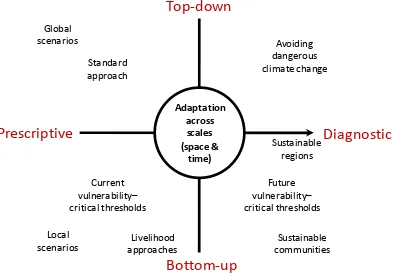
Two-way approaches can deliberately manage these trade-offs, managing multiple perspectives to a fuller advantage. A range of selected origins of assessments are mapped on top-down/bottom-up and predictive/diagnostic axes in Figure 1. For example, combining the standard approach from the top-left corner of Figure 1 with a bottom-up survey of current vulnerability and adaptive capacity can link projected impacts with current risks and the capacity of local actors to manage existing and emerging risks.
Figure 1. Selected reference points for assessments mapped on top-down/bottom-up and prescriptive/diagnostic axes. Top-down bottom-up relates to scale approaches that can be geographic or institutional and prescriptive/diagnostic describe whether an assessment looks forward or backwards in time from a given reference.
Top
‐
down
Bottom
‐
up
Diagnostic
Prescriptive
Standard approach
Avoiding dangerous climate change
Current vulnerability– critical thresholds
Livelihood approaches
Sustainable communities Adaptation
across
scales
(space &
time)
Future vulnerability– critical thresholds
Sustainable regions Global
scenarios
Development of risk management guidance
Most of the guidance for adaptation assessment released during the 1990s outlines the standard approach. It did not explicitly reference risk assessment but is consistent with hazard-driven assessment. More recently, risk assessment frameworks that focus on adaptation and include diagnostic methods have been developed (Jones, 2001; Willows and Connell, 2003; UNDP, 2005).
Jones (2001) expanded the seven-step method developed by the IPCC (Carter et al., 1994) by adding methods for assessing likelihood of both event and outcome based risk, specifically critical thresholds of vulnerability. Stakeholders are involved in risk identification, setting critical thresholds and prioritization of adaptations. Willows and Connell (2003) developed a risk assessment framework for the UK that describes a process for decision-makers to recognize and evaluate risks posed by climate change and to identify adaptive responses. The tools accompanying the guide draw from both risk management methods and climate impact analysis. It is now being applied in the UK and other countries. Australia has also developed a related approach based on the Australian/New Zealand risk management standard (AGO, 2006).
The UNDP developed Adaptation Policy Frameworks for Climate Change (UNDP, 2005) assesses current climate risks and vulnerabilities before addressing the potential for both social and physical change. Three main templates are discussed: a natural hazards approach, a vulnerability-based approach and a policy-based or normative approach, where current or future policies are investigated to determine whether their aims are achieved under a changing climate. The APF exercise tried to link up many of the potential approaches, so became very complex. Despite producing simplified procedures for undertaking risk in a User’s Guide, the APF did not totally overcome the complexity it was trying to manage in its approach.
The most recent developments involve mainstreaming adaptation to climate change with other drivers of change encompassing global change processes and disaster management, and with development processes that focus on vulnerability, resilience and adaptive capacity.
Multi-level approaches are being developed to integrate adaptation across different scales (as in Figure 1) and also to integrate adaptation and mitigation. Risk can be quantified as a function of mean global warming, in order to aggregate the sum of local risks and thus distribute the benefits of mitigation across a range of impacts and locations (Corfee-Morlot and Agrawala, 2004; Jones, 2004). Assessing the limits to adaptation for specific systems can also identify the need for mitigation. Other approaches combine top-down methods to examine the regional distribution of climate risks with bottom-up methods to elucidate the local context in which those risks can be managed. For example, O’Brien et al. (2004b) mapped vulnerability to adverse agricultural outcomes across India, then conducted village-level interviews in a number of vulnerable regions to understand how risk manifests at ground-level. Similarly, a project in metropolitan Sydney mapped regional vulnerability to different climate hazards (Preston et al., 2009a). This information was subsequently used to engage with stakeholders through workshops and interviews to understand barriers to adaptation within local government.
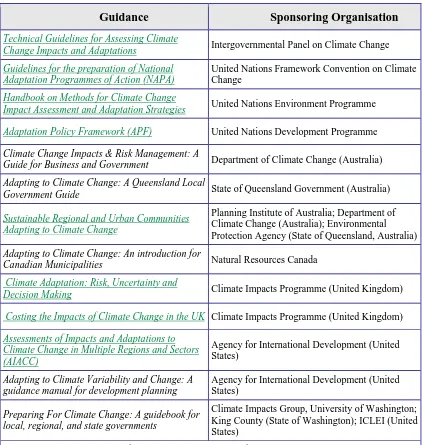
Table 2. Guidance documents for climate change risk management
Selecting a risk management approach
Given the large amount of risk management guidance now available, we believe the most important task in applying risk assessment is in the choice of the approach used. The range of approaches, and of methods that can be used within those approaches, is expanding rapidly. Approaches that have been developed solely to deal with climate change are being combined with those developed for other purposes. The following factors can influence the choice of approach:
1. The overall exposure of the activity or location of concern to climate risks.
This is a scoping phase that investigates how climate may change and follows through in analysing the most likely risks, those of high consequence and how risks are currently managed. This area is the best catered for in terms of guidance materials.
Guidance Sponsoring Organisation
Technical Guidelines for Assessing Climate
Change Impacts and Adaptations Intergovernmental Panel on Climate Change
Guidelines for the preparation of National Adaptation Programmes of Action (NAPA)
United Nations Framework Convention on Climate Change
Handbook on Methods for Climate Change
Impact Assessment and Adaptation Strategies United Nations Environment Programme
Adaptation Policy Framework (APF) United Nations Development Programme
Climate Change Impacts & Risk Management: A
Guide for Business and Government Department of Climate Change (Australia)
Adapting to Climate Change: A Queensland Local
Government Guide State of Queensland Government (Australia)
Sustainable Regional and Urban Communities Adapting to Climate Change
Planning Institute of Australia; Department of Climate Change (Australia); Environmental Protection Agency (State of Queensland, Australia)
Adapting to Climate Change: An introduction for
Canadian Municipalities Natural Resources Canada
Climate Adaptation: Risk, Uncertainty and
Decision Making Climate Impacts Programme (United Kingdom)
Costing the Impacts of Climate Change in the UK Climate Impacts Programme (United Kingdom)
Assessments of Impacts and Adaptations to Climate Change in Multiple Regions and Sectors (AIACC)
Agency for International Development (United States)
Adapting to Climate Variability and Change: A guidance manual for development planning
Agency for International Development (United States)
Preparing For Climate Change: A guidebook for local, regional, and state governments
Climate Impacts Group, University of Washington; King County (State of Washington); ICLEI (United States)
2. How well the relationship between the drivers of risk (climate and other relevant factors) and the outcomes are known and whether they can be quantified.
3. How well the consequences are known, including the identification of critical
thresholds.
4. The status of the system in question; whether it is considered to be in a
normal, marginal or critical state will influence the choice of risk management. Potential future status also becomes important when evaluating management options.
5. The types of knowledge and understanding of stakeholders, taking account of
cultural, educational and institutional background. This is an important component of adaptive capacity.
6. When considering mainstreaming, questions that need to be considered
include:
a. Knowledge of how climate interacts with other factors in contributing
to risk,
b. Whether there is an existing risk management standard or approach
that can be modified to incorporate climate change,
c. Whether there is an established institutional framework for effective
risk management.
The following topics cover new or growing areas of risk management and are a selective rather than comprehensive collection.
Risk scoping and identification
Risk identification is now becoming routine under established risk assessment methodologies such as Willows and Connell (2003) and AGO (2006), the national frameworks for the UK and Australia (Table 2). These are being carried out by local and regional governments, statutory authorities, industry and non-profit organizations. They have at their core a climate scenario-based approach that has been built into a wide risk management framework. Risk scoping and identification can be run as a stand-alone exercise or as part of a larger process. However, approaches focusing on climate scenarios face the risk that the assessment becomes restricted to climate and/or gets locked into a top-down, predictive approach.
Probabilistic risk analysis
Despite limited probabilistic risk analyses being available for over a decade, only a limited number of assessments that explicitly treat a wide range of climate uncertainty have been undertaken in the literature (Hulme and Mearns, 2001; Jones, 2001; Dessai and Hulme, 2004; New et al., 2007). More commonly, existing measures of risk are being updated using climate scenarios that encompass a range of climate futures. When combined with an institutional framework for managing those risks and an engaged coalition of stakeholders, such approaches are more likely to be successful than risk analyses undertaken on their own.
Bottom-up approaches – community-based methods
themselves be adapted to incorporate climate change. Relevant approaches are being developed from the foci of community-based adaptation (Reid and Huq, 2007), community-based vulnerability (Adger, 2003) and community risk assessment (van Aalst et al., 2008) and are being merged with disaster risk reduction through the auspices of the United Nations International Strategy for Disaster Reduction (UN ISDR; O'Brien et al., 2006) and the IPCC. The common elements within these approaches involve community participation, social vulnerability/adaptive capacity and development pathways (O'Brien et al., 2006). Community risk assessment (CRA) uses participatory methods to assess hazards vulnerabilities and capacities in support of community-based risk reduction (Smit and Wandel, 2006).
Community-based methods need to be easy to understand, procedurally simple and culturally appropriate. This does not always sit well with the complexity of managing climate change uncertainties, although in some instances this may be quite straightforward. Specific needs include the broad dissemination of locally relevant projections for scoping studies and risk identification; and the development of a better understanding of how to integrate natural climate variability and human-induced climate change in a whole of climate approach. This approach is consistent with observations of trends in climate adaptation (Smit and Wandel, 2006), although the challenge is to aggregate those lessons for broader transfer. Exposure to climate risk at the community scale may also require top-down management, such as improved governance or regional planning initiatives.
Institutional capacity for risk management
Adaptive capacity influences not only the ability of institutions to undertake risk assessments, but also to implement management responses to address identified risks (e.g., Smit and Wandel, 2006). The specific capacities required to successfully carry out risk assessments and implement management have different relevance at successive stages (e.g., to identify, evaluate, manage risk and monitor and review risks). The capacities required to carry out the early stages of an assessment are largely technical, while those required later on become dominated by institutional and governance issues.
As evidence regarding the accelerating pace of climate change increases along with stakeholder awareness of potential consequences, the demand for risk assessment and adaptation has grown rapidly. The number of adaptation strategies and action plans is doubling approximately every two years (Preston and Westaway, in press). Nevertheless, stakeholders still identify knowledge deficit as a major concern, often nominating research, risk assessment and other forms of capacity building high on the list of adaptation actions. This suggests that institutions are still struggling to frame the adaptation challenges they are likely to experience and are constrained in their attempts to address knowledge gaps. In response, governments are increasingly allocating support to institutions to facilitate risk assessment and adaptation.
Implementation and monitoring
evaluation. Much of the work on evaluating adaptation has been to support adaptation funding programs and projects by institutions such as the Global Environment Facility and World Bank (Preston et al., 2009b) as well as traditional development assistance (UNDP, 2007; Hedger et al., 2008). Decision-makers currently focus on what can be described as substantive risk management (c.f., Simon, 1976), which emphasizes the identification and quantification of risk, and the identification of risk treatment options. However, without first defining system boundaries, selecting appropriate stakeholders, and asking the appropriate questions in the initial stages, an assessment is more likely to fail. The failure to articulate a process by which adaptation outcomes will be realized can result in viable plans sitting idle or being rejected by interest groups not involved in the risk management process.
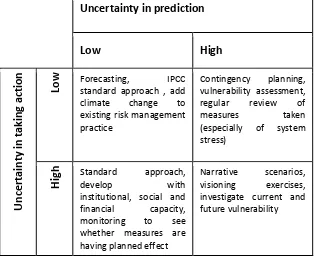
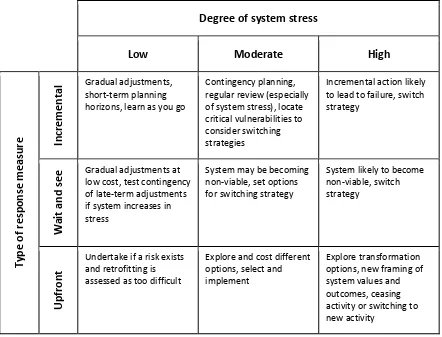
Table 3 nominates a range of assessment methods framed according to a matrix of uncertainties in prediction and taking action. The ability to judge the likely success in specific actions should influence the choice of approach. Complex systems may warrant several approaches being applied within an integrated assessment. Table 4 addresses the most appropriate response to type of adaptation (incremental, wait and see, and up-front response) and system stress. Such stress can be current stress or perceived future stress relating to the level of future vulnerability, relating to one or more planning horizons. Incremental adaptations are suitable for systems where there is little penalty for adjusting the rate of adaptation in response to new information. In a system approaching a critical threshold however, incremental adaptation is no longer viable. Encountering such a situation would suggest that forecasts were wrong, the system was misdiagnosed or a surprise has occurred. Wait and see approaches are most viable for systems facing low levels of stress and where the penalty for encountering unanticipated risks is low. Up front responses are best for situations where retrofitting is too costly, or irreversible outcomes are considered intolerable. System transformations such as shift, cease or transform the activity under investigation need to be considered.
Table 3. Methodological approaches contrasted with uncertainties in prediction and in taking action.
Uncertainty in prediction
Low High
Uncertainty
in
taki
ng
action Low
Forecasting, IPCC
standard approach , add
climate change to
existing risk management practice
Contingency planning,
vulnerability assessment,
regular review of
measures taken
(especially of system
stress)
High
Standard approach,
develop with
institutional, social and
financial capacity,
monitoring to see
whether measures are
having planned effect
Narrative scenarios,
visioning exercises,
investigate current and future vulnerability
Table 4. Appropriate adaptation responses according to type of adaptation (incremental, wait and see, and up-front response) and system stress.
Degree of system stress
Low Moderate High
Type of response measu re Incremental Gradual adjustments, short‐term planning horizons, learn as you go Contingency planning, regular review (especially of system stress), locate critical vulnerabilities to consider switching strategies Incremental action likely to lead to failure, switch strategy Wait and see Gradual adjustments at low cost, test contingency of late‐term adjustments if system increases in stress System may be becoming non‐viable, set options for switching strategy System likely to become non‐viable, switch strategy Upfront
Undertake if a risk exists and retrofitting is assessed as too difficult Explore and cost different options, select and implement Explore transformation options, new framing of system values and outcomes, ceasing activity or switching to new activity
Conclusion
Many of the existing tensions about the application of risk management are between simplicity and complexity, and between certainty and uncertainty. Users undertaking adaptation assessments want access to simple and clear methods. However, simple methods are criticized as being unable to manage the range of situations in which they may be used. On the other hand, risk management guidance that tries to be flexible and comprehensive can become too complex. This is because adaptation assessments themselves can range from being simple to encompassing the general class of wicked problems (Rittel and Webber, 1973), characterized by multiple drivers of stress, significant uncertainties and contested values that cannot easily be resolved.
settle on a simple answer even though they realize it will not solve the problem that has been defined as part of the assessment process (which may be different to the initial problem).
As yet there is no orientation map guiding as to which approaches – top-down, bottom-up, prescriptive, diagnostic, other and multiple configurations – are best for particular purposes. This was an issue for the IPCC Fourth Assessment (Carter et al., 2007). Despite a great deal of activity since then, the direction is clearer but the detail remains obscure. Adaptation research is an action-oriented undertaking, where the entry point should be relatively simple and where mutual learning between researchers and stakeholders develops a more sophisticated process over time (and where stakeholders can also become the researchers). Multiple orientations may be desirable to shed different perspectives on an assessment and two-way approaches that combine top-down and bottom-up approaches should be considered.
In conclusion, we would like to make to following points:
Risk management stands as the most appropriate overarching framework for
assessing climate change adaptation. Other methodological approaches often proposed as alternatives can sit comfortably within a broad risk assessment framework.
The bulk of the guidance material that has been made available is most
suitable for risk scoping and identification. A broad range of material from within and beyond the climate change literature can be used to select subsequent methods.
The framing of risk, correct formulation of the questions being investigated
and assessment methodology are critical aspects of risk management. Only when these issues have been addressed should be issue of specific methods and tools be addressed.
The re-orientation of adaptation from an assessment focused solely on
anthropogenic climate change to broader issues of vulnerability/resilience, development and managing disaster risk, especially through a risk management framework can draw from existing policy and management understanding in communities, professions, and agencies, and to their existing agendas, knowledge, risks, and issues they already face.
References
Adger, W., Agrawala, S., Mirza, M., Conde, C., O’Brien, K., Pulhin, J., Pulwarty, R., Smit, B. and Takahashi, K. (2007) Assessment of adaptation practices, options, constraints and capacity. In Climate Change 2007: Impacts, Adaptation and Vulnerability. Contribution of Working Group II to the Fourth Assessment Report of the Intergovernmental Panel on Climate Change (eds Parry, M.L., Canziani, O.F., Palutikof, J.P., van der Linden, P.J. and Hanson, C.E.). Cambridge University Press, Cambridge, UK, pp. 717-743.
Adger, W.N. and Kelly, P.M. (1999) Social Vulnerability to Climate Change and the Architecture of Entitlements. Mitigation and Adaptation Strategies for Global Change, 4, 253-266.
Adger, W.N. (2003) Social capital, collective action, and adaptation to climate change.
Economic Geography, 79, 387-404.
Anand, P. (2002) Decision-Making When Science Is Ambiguous. Science, 295, 1839.
Beer, T. (1997) Strategic risk management: a case study of climate change. World Resources Review, 9, 113-126.
Carter, T.R., Parry, M.L., Harasawa, H. and Nishioka, S. (1994) IPCC technical guidelines
for assessing climate change impacts and adaptations. Center for Global
Environmental Research and National Institute for Environmental Studies, London and Japan.
Carter, T.R., Jones, R.N., Lu, X., Bhadwal, S., Conde, C., Mearns, L.O., O’Neill, B.C., Rounsevell, M.D.A. and Zurek, M.B. (2007) New Assessment Methods and the Characterisation of Future Conditions. In Climate Change 2007: Impacts, Adaptation and Vulnerability. Contribution of Working Group II to the Fourth Assessment
Report of the Intergovernmental Panel on Climate Change (eds Parry, M.L.,
Canziani, O.F., Palutikof, J.P., van der Linden, P.J. and Hanson, C.E.). Cambridge University Press, Cambridge, UK, pp. 133-171.
Cohen, S., Demeritt, D., Robinson, J. and Rothman, D. (1998) Climate change and sustainable development: towards dialogue. Global Environmental Change, 8, 341-371.
Corfee-Morlot, J. and Agrawala, S. (2004) The benefits of climate policy. Global Environmental Change Part A, 14, 197-199.
Dessai, S. and Hulme, M. (2004) Does climate adaptation policy need probabilities? Climate Policy, 4, 107-128.
Dessai, S. and Hulme, M. (2007) Assessing the robustness of adaptation decisions to climate change uncertainties: A case study on water resources management in the East of England. Global Environmental Change, 17, 59-72.
Dessai, S., Hulme, M., Lempert, R.J. and Pielke, R.J. (2009) Climate prediction: a limit to adaptation? In Living with climate change: are there limits to adaptation? (eds Adger, N., Goulden, M. and Lorenzoni, I.). Cambridge University Press, Cambridge. Dovers, S. (2009) Normalizing adaptation. Global Environmental Change, 19, 4-6.
Downing, T.E., Olsthoorn, A.A. and Tol, R.S.J. (1999) Climate, change and risk. Routledge, London and New York.
Granger Morgan, M., Pitelka, L. and Shevliakova, E. (2001) Elicitation of Expert Judgments of Climate Change Impacts on Forest Ecosystems. Climatic Change, 49, 279-307. Groves, D.G. and Lempert, R.J. (2007) A new analytic method for finding policy-relevant
scenarios. Global Environmental Change, 17, 73-85.
Grubler, A. and Nakicenovic, N. (2001) Identifying dangers in an uncertain climate. Nature,
412, 15-15.
Handmer, J. (2003) Adaptive capacity: what does it mean in the context of natural hazards? In
Climate Change, Adaptive Capacity and Development (eds Smith, J.B., Klein, R.J.T. and Huq, S.). Imperial College Press, London, pp. 51-70.
Haque, C. and Burton, I. (2005) Adaptation Options Strategies for Hazards and Vulnerability Mitigation: An International Perspective. Mitigation and Adaptation Strategies for Global Change, 10, 335-353.
Hedger, M., Mitchell, T., Leavy, J., Greeley, M., Downie, A. and Horrocks, A. (2008) Evaluation of Adaptation to Climate Change from a Development Perspective. Institute of Development Studies, Brighton, UK.
Huq, S., Rahman, A., Konate, M., Sokona, Y. and Reid, H. (2003) Mainstreaming Adaptation to Climate Change in Least Developed Countries (LDCS). International Institute for Environment and Development, London.
ISO (2009) ISO Guide 73:2009 International Standards Organisation, Geneva.
Jones, R. (2004) Incorporating agency into climate change risk assessments - An editorial comment. Climatic Change, 67, 13-36.
Jones, R.N. (2001) An environmental risk assessment/management framework for climate change impact assessments. Natural Hazards, 23, 197-230.
Kandlikar, M., Risbey, J. and Dessai, S. (2005) Representing and communicating deep uncertainty in climate-change assessments. Comptes Rendus Geosciences, 337, 443-455.
Kelly, P.M. and Adger, W.N. (2000b) Theory and practice in assessing vulnerability to climate change and facilitating adaptation. Climatic Change, 47, 325-352.
Lempert, R.J. and Schlesinger, M.E. (2000) Robust Strategies for Abating Climate Change.
Climatic Change, 45, 387-401.
Lorenzoni, I., Pidgeon, N.F. and O'Connor, R.E. (2005) Dangerous climate change: The role for risk research. Risk Analysis, 25, 1387-1398.
Moench, M. (2007) Adapting to climate change and the risks associated with other natural hazards: Methods for moving from concepts to actions. In Working with Winds of Change (eds Moench, M. and Dixit, A.). Provention Consortium, Institute for Social and Environmental Transition, ISET-International and ISET-Nepal, Nepal, pp. 13-48. Nelson, R., Kokic, P., Crimp, S., Meinke, H. and Howden, S.M. (2009) The vulnerability of
Australian rural communities to climate variability and change: Part I--Conceptualising and measuring vulnerability. Environmental Science & Policy, 13, 8-17.
New, M., Lopez, A., Dessai, S. and Wilby, R. (2007) Challenges in using probabilistic climate change information for impact assessments: an example from the water sector. Philosophical Transactions of the Royal Society A, 365, 2117-2131.
O'Brien, G., O'Keefe, P., Rose, J. and Wisner, B. (2006) Climate change and disaster management, pp. 64-80.
O'Brien, K., Eriksen, S., Schjolden, A. and Nygaard, L. (2004a) What’s in a word? Conflicting interpretations of vulnerability in climate change research, CICERO, Oslo.
O'Brien, K., Leichenko, R., Kelkar, U., Venema, H., Aandahl, G., Tompkins, H., Javed, A., Bhadwal, S., Barg, S., Nygaard, L. and West, J. (2004b) Mapping vulnerability to multiple stressors: climate change and globalization in India. Global Environmental Change Part A, 14, 303-313.
O’Brien, K., Sygna, L., Leichenko, R., Adger, W., Barnett, J., Mitchell, T., Schipper, L., Tanner, T., Vogel, C. and Mortreux, C. (2008) Disaster Risk Reduction, Climate Change Adaptation and Human Security, Global Environmental Change and Human Security (GECHS) Project, Oslo.
Oppenheimer, M., O'Neill, B.C., Webster, M. and Agrawala, S. (2007) Climate Change: The Limits of Consensus. Science, 317, 1505-1506.
Pielke, R.A. (1998) Rethinking the role of adaptation in climate policy. Global Environmental Change, 8, 159-170.
Pielke, R.A. and Sarewitz, D. (2005) Bringing Society Back into the Climate Debate.
Pittock, A., Jones, R. and Mitchell, C. (2001) Probabilities will help us plan for climate change - Without estimates, engineers and planners will have to delay decisions or take a gamble. Nature, 413, 249.
Preston, B., Brooke, C., Measham, T., Smith, T. and Gorddard, R. (2009a) Igniting change in local government: lessons learned from a bushfire vulnerability assessment.
Mitigation and Adaptation Strategies for Global Change, 14, 251-283.
Preston, B., Westaway, R., Dessai, S. and Smith, T. (2009b) Are we adapting to climate change? Research and methods for evaluating progress. In Fourth Symposium on Policy and Socio-Economic Research, AMS Annual Meeting, Phoenix, AZ.
Preston, B. and Westaway, R. (in press) A critical look at the state of adaptation planning. In
Greenhouse 2009: Climate Change and Resources. Springer, New York.
Reid, H. and Huq, S. (2007) Community-based adaptation: A vital approach to the threat climate change poses to the poor, International Institute for Environment and Development, London.
Risbey, J.S. (2004) Agency and the Assignment of Probabilities to Greenhouse Emissions Scenarios. Climatic Change, 67, 37-42.
Rittel, H. and Webber, M. (1973) Dilemmas in a General Theory of Planning. Policy Sciences, 4, 155-169.
Saloranta, T. (2001) Post-Normal Science and the Global Climate Change Issue. Climatic Change, 50, 395-404.
Sarewitz, D., Pielke, R. and Keykhah, M. (2003) Vulnerability and Risk: Some Thoughts from a Political and Policy Perspective. Risk Analysis, 23, 805-810.
Schipper, E.L.F. and Burton, I., eds. (2008) The Earthscan Reader on Adaptation to Climate Change. Earthscan, London (UK) and Sterling (USA), pp 459.
Shlyakhter, A., James, L., Valverde, A. and Wilson, R. (1995) Integrated risk analysis of global climate change. Chemosphere, 30, 1585-1618.
Simon, H. (1976) From substantive to procedural rationality. In Method and Appraisal in Economics (ed. Latsis, S.). Cambridge University Press, Cambridge and New York, pp. 129-148.
Smit, B. and Wandel, J. (2006) Adaptation, adaptive capacity and vulnerability. Global Environmental Change, 16, 282-292.
Standards Australia and Standards New Zealand (2004) AS/NZS Australian/New Zealand Standard for Risk Management: AS/NZS 4360 2004. Standards Australia and Standards New Zealand, pp. 38.
Tebaldi, C., Mearns, L.O., Nychka, D. and Smith, R.L. (2004) Regional probabilities of precipitation change: A Bayesian analysis of multimodel simulations. Geophysical Research Letters, 31, L24213.
Tebaldi, C. and Knutti, R. (2007) The use of the multi-model ensemble in probabilistic climate projections. Philosophical Transactions of the Royal Society A: Mathematical, Physical and Engineering Sciences, 365, 2053-2075.
UNDP (2005) Adaptation Policy Frameworks for Climate Change: Developing Strategies, Policies and Measures Cambridge University Press, Cambridge and New York. UNDP (2007) Draft Monitoring and Evaluation Framework for Adaptation to Climate
Change. United Nations Development Programme, New York.
Webster, M., Forest, C., Reilly, J., Babiker, M., Kicklighter, D., Mayer, M., Prinn, R., Sarofim, M., Sokolov, A., Stone, P. and Wang, C. (2003) Uncertainty Analysis of Climate Change and Policy Response. Climatic Change, 61, 295-320.