THE EFFECTS OF HYPNOSIS ON FLOW AND PUTTING PERFORMANCE IN GOLFERS
TIEN DUNG DAO Student ID: S3923132
THESIS SUBMITTED IN PARTIAL FULFILLMENT OF THE REQUIREMENTS FOR THE DOCTOR OF PHILOSOPHY
March 2019
DOCTOR OF PHILOSOPHY PROFORMA
“I, Tien Dung Dao, declare that the PhD thesis entitled “The Effects of Hypnosis on Flow and Putting Performance in Golfers” is no more than 100,000 words in length, exclusive of tables, figures, appendices, references and footnotes. This thesis contains no material that has been submitted previously, in whole or in part for the award of any other academic degree or diploma. Except where otherwise indicated, this thesis is my own work.”
ABSTRACT
Csikszentmihalyi (1975) introduced the flow concept, involving total absorption in the task, confidence, and control, with effortless, automatic movement. Flow has nine dimensions that Stavrou and Zervas (2004) divided into five antecedents (challenge-skill balance, clear goals, unambiguous feedback, total concentration on the task, sense of control) and four concomitant dimensions (action-awareness merging, loss of self-consciousness, time
transformation, and autotelic experience). Loss of self-consciousness and time transformation have similarities to phenomena often reported in hypnotic trance states. To examine whether the experience of these phenomena in hypnosis enhanced flow state, I performed three studies. In Study 1, I evaluated whether a hypnotic state facilitates flow and enhances performance via its concomitant dimensions and whether the trancework component of traditional hypnosis (TH), compared with neutral hypnosis (NH), is crucial, with 20 golfers, who performed putting under controlled conditions. In Study 2, I examined the effect of two hypnosis techniques, regression (RE) and future progression (FP) on golf putting
performance and flow state with 25 golfers. Both studies had the same structure. I used the Waterloo-Stanford Group C Scale of Hypnotic Susceptibility (WSGC) to match participants into conditions. Golfers performed 56 4m test putts at pre-test and post-test. I measured radial error of each putt and number of putts holed. Then they completed the Flow State Scale-2 (FSS-2) at pre- and post-test. All participants undertook a 60-minute, face-to-face session, then listened to a recording of that session for seven days with different hypnotic suggestions in the RE and FP conditions. In Study 1, two-way mixed-design ANOVA revealed that TH reduced radial error and two dimensions of flow, sense of control and loss of
Study 3, I investigated the effect of FP on flow and putting performance in competitions. Three male golfers participated in a single-case design (SCD) study, comprising six
ACKNOWLEDGEMENTS
This journey of finishing the Ph.D. is long and challenging for me in many ways, and I would not be able to finish it without so much love, support and guidance from so many wonderful people.
First and foremost, I particularly want to thank my principal supervisor, Emeritus Professor Tony Morris for his unconditional support, professional guidance, constructive feedback and encouragement, attention to detail, and excellent communication. Your invaluable guidance in all aspects of the completion of this manuscript, together with your excellent level of standard in academics shaped me into a better researcher. I would like to thank my associate supervisor, Dr. Daryl Marchant for his unwavering support and belief in me. You trusted me and allowed me to teach your course in sports psychology over the years, which ignited my love for this field and made my journey at Victoria University so much more fun and memorable.
I want to express my immense gratitude to Golf Victoria, Golf Australia, and various golf clubs who facilitated contact with the participants and offered their facilities for me to conduct the studies. I greatly appreciate all participants in my research for their time, effort, willingness, and cooperation to make the studies the best possible.
To my parents, who have always been in my heart despite the distance we were apart. Thank you for raising me to who I am today, and allowing me to grow in foreign countries, knowing that I am your only son. I hope you are proud of who I have become.
I made 2 international conference presentations on studies from this thesis: - The first study was presented at the World Congress of Sport and Exercise Psychology in Seville, Spain in July 2017.
TABLE OF CONTENTS
DOCTOR OF PHILOSOPHY PROFORMA ... i
ABSTRACT ... ii
ACKNOWLEDGEMENTS ... iv
TABLE OF CONTENTS ... v
LIST OF TABLES ... xv
LIST OF FIGURES ... xvi
LIST OF APPENDICES ... xx
CHAPTER 1: INTRODUCTION ... 1
The Role of Sport Psychology in Successful Performance ... 1
How Flow Affects Performance and Description of Flow ... 1
Flow and Its Nine Dimensions ... 1
Similarity Between Flow and Hypnosis ... 3
Definition of Hypnosis ... 3
Research on Hypnosis in Sport ... 4
Aims of This Thesis ... 5
CHAPTER 2: LITERATURE REVIEW ... 7
Flow ... 7
Definition ... 7
Peak Experience, Peak Performance, and Flow ... 8
Csikszentmihalyi’s Flow Theory ... 11
Csikszentmihalyi’s Nine Dimensions of Flow ... 14
Challenge-skill Balance ... 15
Action-awareness Merging ... 15
Clear Goals ... 15
Total Concentration on the Task ... 17
Sense of Control ... 18
Loss of Self-consciousness ... 19
Transformation of Time ... 20
Autotelic Experience ... 21
Measurement of Flow ... 23
The Experience Sampling Method (ESM) ... 23
Qualitative In-depth Interview ... 23
Quantitative Measures ... 24
Research Examining Flow in Sport ... 27
Flow Antecedent Dimensions and Concomitant Dimensions ... 27
Personal and Situational Factors that Affect Flow ... 28
Factors that Improve or Decrease Flow ... 30
Facilitators of Flow ... 30
Factors that Prevent Flow from Occurring ... 32
Factors that Disrupt Flow ... 32
Recent Research on Flow and Sport Performance ... 33
Hypnosis ... 37
Definition ... 37
Hypnosis versus Placebo Effect ... 46
Types of Suggestion ... 47
Neutral Hypnosis ... 49
Hypnosis with Suggestion ... 49
Regression Hypnosis ... 51
Future Progression Hypnosis... 53
Theories of Hypnosis ... 55
Altered States of Consciousness Theories ... 56
Neodissociation Theories ... 56
Ego-psychological Theory ... 62
Conditioning and Inhibition Theory ... 65
Non-state Theories ... 65
Measurement of Hypnotisability ... 74
Research on Hypnosis in Sport ... 81
Inner Mental Training ... 81
Hypnosis, Flow, and Performance in Sport ... 83
Similarity between Flow and Hypnosis ... 92
The Present Thesis ... 94
CHAPTER 3: COMPARISON OF THE EFFECTS OF TRADITIONAL AND NEUTRAL HYPNOSIS ON FLOW STATE AND GOLF PUTTING PERFORMANCE ... 97
Introduction ... 97
Method ... 98
Participants ... 98
Study Design ... 99
Measures ... 99
Demographic Information Form ... 99
Waterloo-Stanford Group C Scale of Hypnotic Susceptibility (WSGC) ... 99
Golf Putting Performance ... 101
Flow State Scale-2 (FSS-2) ... 102
Diary of Self-managed Hypnosis ... 103
Brief Social Validation Assessment ... 103
Research Conditions ... 103
Neutral Hypnosis Condition ... 103
Traditional Hypnosis Condition ... 104
Procedure ... 105
Analysis ... 107
Results ... 107
Demographic Information ... 107
Waterloo-Stanford Group C Scale of Hypnotic Susceptibility (WSGC) ... 109
Radial Error ... 111
Number of Putts Holed ... 112
Global Flow State and Flow State Dimensions ... 113
Discussion ... 117
Conclusions ... 117
Performance Results ... 117
Global Flow and Flow State Dimension Results ... 118
Change in the Loss of Self-Consciousness Dimension... 120
Change in the Time Transformation Dimension ... 121
Change in the Other Flow Dimensions ... 122
Change in the Sense of Control Dimension ... 125
Methodological Considerations ... 127
Sample Size ... 127
Characteristics of the Sample ... 128
Self-managed Hypnosis Sessions ... 128
Benefit of Using Neutral Hypnosis as a Comparison Condition ... 129
Timing of the Pre-test and Post-test Putting ... 129
Difference between PSS and PRP ... 130
Further Research ... 131
Effect of Trancework Suggestions on Flow and Performance ... 131
Hypnotist-led Sessions and Self-managed Hypnosis Sessions ... 133
Effect of Neutral Hypnosis in Other Sports ... 134
Research with Golfers at Different Skill Levels ... 134
Causal Relationship between Flow and Performance ... 135
Conclusion ... 136
CHAPTER 4: COMPARISON OF THE EFFECTS OF FUTURE PROGRESSION SUGGESTIONS AND REGRESSION SUGGESTIONS ON FLOW STATE AND GOLF PUTTING PERFORMANCE ... 137
Introduction ... 137
Study Design ... 138
Measures ... 138
Demographic Information Form ... 138
Waterloo-Stanford Group C Scale of Hypnotic Susceptibility (WGSC) ... 139
Golf Putting Performance ... 139
Flow State Scale-2 (FSS-2) ... 139
Diary of Self-managed Hypnosis ... 139
Brief Social Validation Assessment ... 139
Research Conditions ... 139
Future Progression Suggestions Condition ... 139
Regression Suggestions Condition ... 140
Procedure ... . 141
Analysis ... 143
Results ... 143
Demographic Information ... 143
Waterloo-Stanford Group C Scale of Hypnotic Susceptibility (WSGC) ... 145
Diary of Self-managed Hypnosis ... 146
Golf Putting Performance ... 146
Radial Error ... 147
Number of Putts Holed ... 148
Global Flow State and Flow State Dimensions ... 148
Discussion ... 152
Conclusions ... 153
Performance Results ... 153
Global Flow and Flow State Dimension Results ... 154
Difference between FP and RE Scripts ... 154
Change in the Action-awareness Merging Dimension ... 156
Change in the Time Transformation Dimension ... 157
Change in Other Dimensions ... 159
Methodological Considerations ... 161
Sample Size …. ... 162
Absence of a Control Condition ... 162
Characteristics of the Sample ... 162
Difference between PSS and PRP ... 163
Depth of Trance ... 163
Further Research ... 164
Research on RE and FP ... 165
Depth of Trance ... 165
Hypnotist-led Sessions and Self-managed Hypnosis Sessions ... 166
Ideal Time of the Day for Listening to the Hypnosis Audio File ... 167
The Long-lasting Effect of Post-hypnotic Suggestion ... 167
Research with Golfers at Different Skill Levels ... 168
Causal Relationship between Flow and Performance ... 168
Conclusion ... 169
CHAPTER 5: THE EFFECTS OF FUTURE PROGRESSION HYPNOSIS TRAINING ON FLOW STATE AND PUTTING PERFORMANCE WITH HIGHLY-SKILLED GOLFERS IN COMPETITION ...170
Introduction ... 170
Method ... 172
Participants . ... 172
Study Design ... 173
Measures ... 176
Demographic Information Form ... 176
Waterloo-Stanford Group C Scale of Hypnotic Susceptibility (WGSC) ... 177
Golf Putting Performance ... 177
Flow State Scale-2 (FSS-2) ... 180
Diary of Self-managed Hypnosis ... 180
Social Validation Interview ... 181
Analysis ... 183
Results ... 187
Participant Thomas ... 188
Golfer’s Profile ... 188
Number of Putts Per Round ... 188
Percentage Distance Error ... 190
Strokes Gained Putting ... 191
Global Flow ... 191
Challenge-Skill Balance ... 192
Action-Awareness Merging ... 193
Clear Goals ... 194
Unambiguous Feedback ... 195
Total Concentration ... 196
Sense of Control ... 197
Loss of Self-consciousness ... 198
Transformation of Time ... 199
Autotelic Experience ... 200
Social Validation Interview ... 202
Participant Igor ... 203
Golfer’s Profile ... 203
Number of Putts Per Round ... 203
Percentage Distance Error ... 204
Strokes Gained Putting ... 205
Global Flow ... 206
Challenge-Skill Balance ... 207
Action-Awareness Merging ... 208
Clear Goals ... 209
Unambiguous Feedback ... 210
Total Concentration ... 211
Loss of Self-consciousness ... 213
Transformation of Time ... 214
Autotelic Experience ... 215
Social Validation Interview ... 217
Participant Lee ... 219
Golfer’s Profile ... 219
Number of Putts Per Round ... 219
Percentage Distance Error ... 220
Strokes Gained Putting ... 221
Global Flow ... 222
Challenge-Skill Balance ... 223
Action-Awareness Merging ... 224
Clear Goals ... 225
Unambiguous Feedback ... 226
Total Concentration ... 227
Sense of Control ... 228
Loss of Self-consciousness ... 229
Transformation of Time ... 230
Autotelic Experience ... 231
Social Validation Interview ... 233
Discussion ... 236
External Factors ... 236
Course Conditions ... 236
Golf Partners ... 238
Conclusions from the Results ... 238
Performance ... 239
Global Flow and Flow Dimensions ... 240
Relation to Theory and Previous Research ... 247
Using Neodissociation Theory to Explain the Results ... 247
Methodological Issues ... 250
Single-case Design ... 250
Sample Size ... 252
Timing and Frequency of Hypnosis Sessions ... 252
Measurement of Performance ... 253
Measurement of Flow with FSS-2 ... 255
Social Validation Technique ... 257
Presence of the Researcher ... 259
Further Research ... 261
Customizing Hypnosis Induction Technique and Trancework Suggestion Scripts ... 261
Hypnosis Scripts Targeting Specific Flow Dimensions ... 264
Hypnosis Scripts on Performance and on Flow State ... 265
Research in Other Sports ... 265
Summary ... 266
CHAPTER 6: GENERAL DISCUSSION ... 268
Introduction ... 268
Conclusions ... 268
Result Summary ... 268
General Pattern of the Three Studies ... 273
Factors that Affected the Three Studies Differently ... 274
Causal Relationship between Flow and Performance ... 276
Number of Flow Dimensions Required to be in Flow State ... 277
Is It Possible to Target a Specific Flow Dimension? ... 278
Use of Hypnosis to Enhance Flow and Improve Performance through Confidence and Self-Efficacy ... 281
Methodological Considerations ... 284
Hypnotisability Test ... 284
Using a Laser Range Finder ... 287
Optimal Dose of Hypnosis Training ... 288
Test of Retention of Hypnosis Effect ... 291
Further Research ... 291
Participants’ Skill Level ... 292
Combining Regression with Future Progression Hypnosis ... 293
Difference in Performance between Individuals in Hypnotic Trance and Individuals who Receive Post-Hypnotic Suggestions ... 295
An Isomorphic Model of Hypnosis Training ... 296
Optimal Dose of Hypnosis Training ... 297
Using Hypnosis with Past Personal Experience of Flow ... 298
Research on Other Golf Skills ... 300
Self-paced and Externally-paced Sports ... 301
Implications for Practice ... 302
Concluding Remarks ... 306
REFERENCES ... 308
LIST OF TABLES
Table 2.1: A Chronological Listing of Hypnosis Scales ... 77 Table 3.1: Demographic Information of Participants in Traditional Hypnosis Condition
and Neutral Hypnosis Condition ... 109 Table 3.2: Means, Standard Deviations, and 2-way Mixed-design ANOVA Scores for
Each Flow Dimension from Pre-test to Post-test ... 116 Table 3.3: Changes in Flow Score for Nine Dimensions from Pre-test to Post-test between
the Traditional Hypnosis and Neutral Hypnosis Condition ... 124 Table 4.1: Demographic Information of Participants in Regression Condition and Future
Progression Condition ... 145 Table 4.2: Means, Standard Deviations and 2-way Mixed-design ANOVA Scores for
Each Flow Dimension from Pre-test to Post-test ... 150 Table 4.3: Changes in Flow Score for Nine Dimensions from Pre-test to Post-test between
LIST OF FIGURES
Figure 2.1: Csikszentmihalyi’s (1975) Model of the Flow State ... 12
Figure 2.2: Csikszentmihalyi and Lefevre’s (1989) Quadrant Flow Model ... 13
Figure 2.3: The Experience Fluctuation Model of Flow... 14
Figure 2.4:Hilgard’s Hierarchical Model of Cognitive Control ... 57
Figure 2.5: The Explanation of Non-volitional Responding of Neodissociation Theory ... 59
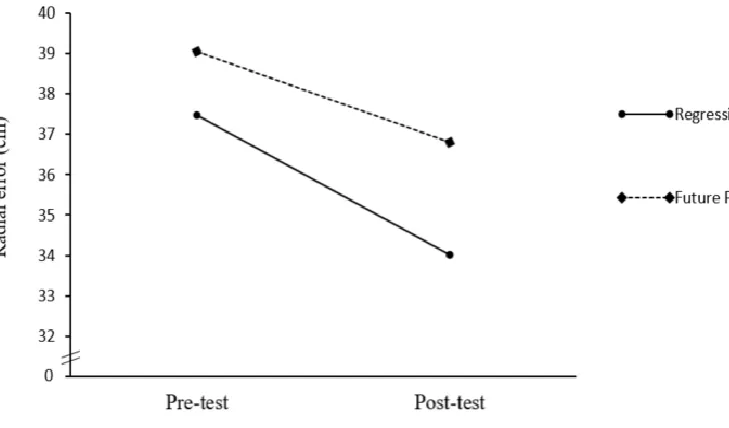
Figure 3.1: Change in Radial Error from Pre-test to Post-test …... 112
Figure 3.2: Change in Number of Putts Holed from Pre-test to Post-test ... 113
Figure 3.3: Change in the Sense of Control Dimension from Pre-test to Post-test ... 115
Figure 3.4: Change in the Loss of Self-consciousness Dimension from Pre-test to Post- test ... 115
Figure 4.1: Change in Radial Error from Pre-test to Post-test ... 147
Figure 4.2: Change in Number of Putts Holed from Pre-test to Post-test ... 148
Figure 4.3: Change in Flow State Scores for the Action-awareness Merging Dimension from Pre- to Post-test ... 151
Figure 4.4: Change in Flow State Scores for the Time Transformation Dimension from Pre- to Post-test ... 152
Figure 5.1: Number of Putts per Round across Phases for Thomas ... 189
Figure 5.2: Percentage Distance Error per Round across Phases for Thomas ... 190
Figure 5.3: Strokes Gained Putting per Round across Phases for Thomas ... 191
Figure 5.4: Global Flow Scores per Round across Phases for Thomas ... 192
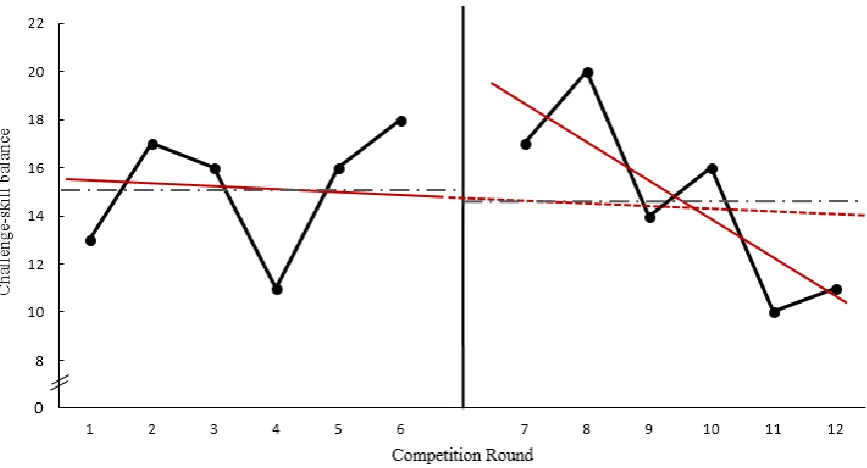
Figure 5.5: Flow Scores for the Challenge-skill Balance per Round across Phases for Thomas ... 193
Figure 5.7: Flow Scores for the Clear Goals Dimension per Round across Phases for
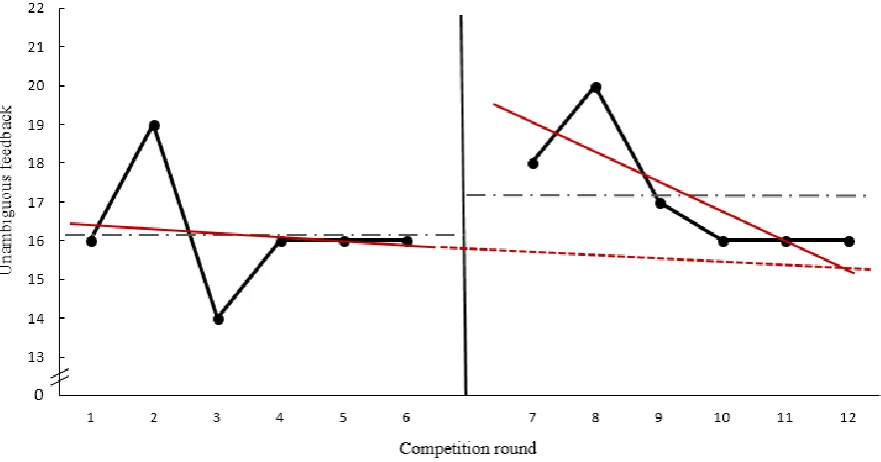
Thomas ... 195 Figure 5.8: Flow Scores for the Unambiguous Feedback Dimension per Round across
Phases for Thomas ... 196 Figure 5.9: Flow Scores for the Total Concentration Dimension per Round across Phases
for Thomas ... 197 Figure 5.10: Flow Scores for the Sense of Control Dimension per Round across Phases
for Thomas ... 198 Figure 5.11: Flow Scores for the Loss of Self-consciousness Dimension per Round across
Phases for Thomas ... 199 Figure 5.12: Flow Scores for the Transformation of Time Dimension per Round across
Phases for Thomas ... 200 Figure 5.13: Flow Scores for the Autotelic Experience Dimension per Round across Phases
for Thomas ... 201 Figure 5.14: Number of Putts per Round across Phases for Igor after Removing Round 11
as Outlier ... 204 Figure 5.15: Percentage Distance Error per Round across Phases for Igor after Removing
Round 11 as Outlier ... 205 Figure 5.16: Strokes Gained Putting per Round across Phases for Igor after Removing
Round 11 as Outlier ... 206 Figure 5.17: Global Flow Scores per Round across Phases for Igor after Removing Round
11 as Outlier ... 207 Figure 5.18: Flow Scores for the Challenge-skill Balance per Round across Phases for
Figure 5.19: Flow Scores for the Action-awareness Merging Dimension per Round across
Phases for Igor after Removing Round 11 as Outlier ... 209
Figure 5.20: Flow Scores for the Clear Goals Dimension per Round across Phases for Igor after Removing Round 11 as Outlier ... 210
Figure 5.21: Flow Scores for the Unambiguous Feedback Dimension per Round across Phases for Igor after Removing Round 11 as Outlier ... 211
Figure 5.22: Flow Scores for the Total Concentration Dimension per Round across Phases for Igor after Removing Round 11 as Outlier ... 212
Figure 5.23: Flow Scores for the Sense of Control Dimension per Round across Phases for Igor after Removing Round 11 as Outlier ... 213
Figure 5.24: Flow Scores for the Loss of Self-Consciousness Dimension per Round across Phases for Igor after Removing Round 11 as Outlier ... 214
Figure 5.25: Flow Scores for the Transformation of Time Dimension per Round across Phases for Igor after Removing Round 11 as Outlier ... 215
Figure 5.26: Flow Scores for the Autotelic Experience Dimension per Round across Phases for Igor after Removing Round 11 as Outlier ... 216
Figure 5.27: Number of Putts per Round across Phases for Lee …... 220
Figure 5.28: Percentage Distance Error per Round across Phases for Lee ... 221
Figure 5.29: Strokes Gained Putting per Round across Phases for Lee ... 222
Figure 5.30: Global Flow Scores per Round across Phases for Lee after Removing Round 8 as Outlier ... 223
Figure 5.31: Flow Scores for the Challenge-skill Balance per Round across Phases for Lee after Removing Round 8 as Outlier ... 224
Figure 5.33: Flow Scores for the Clear Goals Dimension per Round across Phases for Lee after Removing Round 8 as Outlier ... 226 Figure 5.34: Flow Scores for the Unambiguous Feedback Dimension per Round across
Phases for Lee after Removing Round 8 as Outlier ... 227 Figure 5.35: Flow Scores for the Total Concentration Dimension per Round across
Phases for Lee after Removing Round 8 as Outlier ... 228 Figure 5.36: Flow Scores for the Sense of Control Dimension per Round across Phases
for Lee after Removing Round 8 as Outlier ... 229 Figure 5.37: Flow Scores for the Loss of Self-Consciousness Dimension per Round across
Phases for Lee after Removing Round 8 as Outlier ... 230 Figure 5.38: Flow Scores for the Transformation of Time Dimension per Round across
Phases for Lee after Removing Round 8 as Outlier ... 231 Figure 5.39: Flow Scores for the Autotelic Experience Dimension per Round across
LIST OF APPENDICES
CHAPTER 1: INTRODUCTION
The Role of Sport Psychology in Successful Performance
In the modern sporting world, the margin between success and error is tiny, and the physical and technical difference in standard between a medallist and a qualifier are often small. Hence, the difference very often depends on athletes who have stronger mental characteristics, which can allow them to endure the competition pressure. Time and again, athletes are observed who, faced with an unfavorable situation during competition physically or mentally, are able to switch on their focus, stay in the moment and perform at their
personal best.
How Flow Affects Performance and Description of Flow
Top athletes frequently mention that, during their best performance, they experience a heightened state of awareness with total absorption in the event. They often also find that they can be very focused while performing at ease. Csikszentmihalyi (1975) described this psychological state as flow. Flow can potentially facilitate athletes who seek peak experience because it is associated with enjoyment and intrinsic motivation. Jackson (2011) described flow as “an internal, conscious process that lifts experience from the ordinary to the optimal” (p. 331). Athletes who are in flow tend to exert more effort, and they are fully involved and absorbed in what they are doing to the extent that they exclude other thoughts and emotions. They can also experience a harmonious sense of enjoyment because the mind and body work together as a whole (Jackson & Csikszentmihalyi, 1999). Hence, it is useful for athletes, coaches, and applied sport psychologists to understand the factors that may create flow.
Flow and Its Nine Dimensions
action - awareness merging. When athletes are wholly immersed in the activity, they feel at one with the movements they make. When the mind and body merge into one, intention and action become automatic, so individuals do not need to go through a conscious decision-making process. The third dimension is clear goals, which help athletes stay focused and avoid distraction. The fourth dimension is unambiguous feedback, which gives athletes a clear understanding of the result of their performance. The fifth dimension is concentration on the task. In flow state, athletes have total concentration on the moment and what they are doing, a critical component of optimal performance. The sixth dimension is sense of control, where athletes feel in control, confident, and calm. The seventh dimension is loss of self-consciousness. Athletes stop concerning themselves with how other people think about their performance and appearance and just focus on their sports activity. The eighth dimension is transformation of time. Time dependence can prevent people from immersing in what they are doing. In flow, time can seem to either slow down or speed up. The transformation of time is a by-product of total concentration. The final dimension is autotelic experience, which means the experience is performed for its own sake. Athletes genuinely enjoy the activities as a result of the first eight components.
Stavrou and Zevras (2004) proposed separating those nine dimensions of flow into two categories. The first category includes five dimensions, namely challenge-skill balance, clear goals, unambiguous feedback, concentration on the task at hand, and sense of control. These factors are proposed to be antecedents of flow because they help to induce flow (Stavrou & Zevras, 2004). The second category, which includes action-awareness merging, loss of self-consciousness, transformation of time, and autotelic experience, are considered as concomitants because they only happen once individuals are experiencing flow. Some
researchers have argued that the antecedents can be manipulated, using psychological
whereas the concomitants arise automatically when people are in flow and cannot be manipulated. Researchers have explored various approaches ranging from goal-setting
(Kingston & Hardy, 1994), relaxation (Jones, 1993), self-talk (Weinberg & Jackson, 1990), to imagery (Koehn, Morris, & Watt, 2013) to improve the antecedent dimensions. The
advantage of these approaches is that they are simple, easy to use, cognitive behavior therapy techniques. Koehn et al. (2013) and Jeong (2012) proposed that there is no compelling evidence that the concomitant dimensions enhance flow.
Similarity Between Flow and Hypnosis
Uneståhl (1981) proposed the concept of “ideal performing state” which is a state in which athletes perform at their best, being in a high-functioning mental state. This mental state is similar to Hanin’s (1978) “zone of optimum function.” According to Morgan (2013), the main difference between these two states is whether athletes can recall it. While Hanin suggested that athletes can recall, Uneståhl argued that there is selective or total amnesia in athletes’ minds, which prevents athletes from describing or analyzing the mental state after the event. Hence, Uneståhl used hypnosis to define this “ideal performance state” as well as to apply it to several thousand Swedish athletes whose experiences he researched (Railo & Uneståhl, 1979).
during hypnosis in highly susceptible participants (highs) as compared with low susceptible participants (lows). Other investigators supported the concept of hemispheric shift, as measured by the EEG ((Edmonston & Moskovitz, 1990; MacLeod-Morgan & Lack, 1982; Gruzelier et al., 1984; Crawford, Crawford & Koperski, 1983). Despite this similarity, very little research has been conducted to explore the possibility of using hypnosis to facilitate or control flow. The use of hypnosis as a possible intervention to enhance flow may offer a viable and effective method to access and enhance flow state, which would be beneficial to athletes, coaches, and sport psychologists, as well as informative to researchers.
Definition of Hypnosis
The official definition of hypnosis, according to Division 30 (Society of
Psychological Hypnosis) of the American Psychological Association (2014), is, “a state of consciousness involving focused attention and reduced peripheral awareness characterized by an enhanced capacity for response to suggestion” (Society of Psychological Hypnosis, para 2, p.1).
A hypnotic intervention comprises four parts: induction, deepening, trancework, and awakening. Suggestion is a significant component of trancework because it can be used to treat a presenting problem. Because of the strong connection between hypnosis and suggestion, many people have proposed that suggestion is an essential part of hypnosis. Depending on how a person responds to suggestion, such as arm catalepsy, auditory
hallucination, their hypnotisability can be measured (for example, using the Harvard Group Scale of Hypnotic Susceptibility, Form A (HGSHS:A) or Stanford Hypnotic Susceptibility Scale, Form C (SHSS:C)) (Kihlstrom, 2008).
Research on Hypnosis in Sport
stated, “hypnosis is a valuable, powerful, and possibly dangerous tool for professionals in applied sport psychology. The potential benefits may be significant and, at the same time, the potential harm may be profound” (p. 73). Pates, Oliver and Maynard (2001) identified several challenges for research on hypnosis, such as a lack of adequately controlled research studies that focus only on sport, lack of qualified training and supervision for hypnotists, and confusion of different hypnotic techniques.
Since the late 1990s, two researchers, Pates and Barker have examined the use of hypnosis in sport. While Barker and colleagues focused on the effect of hypnosis on self-efficacy (Barker & Jones, 2005, 2006, 2008, 2010), Pates and colleagues (Pates, 2013; Pates & Cowen, 2013; Pates, Cummings, & Maynard, 2002; Pates & Maynard, 2000; Pates, Maynard, & Westbury, 2001; Pates, Oliver et al., 2001; Pates & Palmi, 2002) focused on the effect of hypnosis on flow state and performance. Barker and Jones found hypnosis improved self-efficacy in footballers, cricketers, and martial artists. Pates and colleagues found
hypnosis promoted flow in badminton players (Pates & Palmi, 2002), basketball players (Pates et al., 2002), and golfers (Pates, 2013; Pates & Maynard, 2000; Pates, Oliver et al., 2001). Whereas research by Pates and colleagues clearly showed an increase in flow state using hypnosis, research by Lindsay, Maynard, and Thomas (2005) with cyclists and Vasquez (2005) with basketball players showed no significant effect of hypnosis on flow, although there was a significant improvement in performance in Vasquez’s (2005) basketball study. Although these researchers set the first steps in examining hypnosis and flow, no research has specifically explored the role of hypnosis in interacting with each dimension of flow.
Aims of This Thesis
CHAPTER 2: LITERATURE REVIEW
In this literature review, I first evaluate the literature on flow, focusing on theory and research that is relevant to the present thesis, to provide knowledge of what researchers understand about flow in general, and more particularly in the context of sport. Next, I
discuss the current literature and research about hypnosis that is relevant to the present thesis. From this understanding of flow and hypnosis, I discuss the aspects of flow that are related to the hypnotic trance state and present an argument why hypnosis is a promising way to
promote and stimulate flow, especially in sports and examine research that has been conducted on hypnosis and flow in sport. Finally, I present the primary focus of this thesis and what I aim to achieve through three linked studies.
Flow
Definition
Researchers have found that when athletes performed at their best, they often reported experiencing a state of being completely focused, feeling in control and confident, while executing tasks automatically and effortlessly (Jackson, 1995, 1996; Jackson &
Csikszentmihalyi, 1999). Csikszentmihalyi (1975, 1988) called this state of optimal
experience “flow.” Flow was defined by Jackson and Csikszentmihalyi (1999) as a “state of consciousness where one becomes totally absorbed in what one is doing, to the exclusion of all other thoughts and emotions.” (p. 5). Jackson (1992) emphasized the internal reward aspect by considering flow as a “psychological process involving a state of total absorption in an activity with experiential characteristics that make the experience so intrinsically
The flow state of total immersion is often associated with high quality of experience (Csikszentmiahlyi, 1994), intrinsic motivation, enjoyment of the subject (Privette, 1983), and high quality of performance (Jackson, 2011; Jackson & Kimiecik, 2008), which increase participation rates, effort, and perseverance (Csikszentmihalyi, 1988, 2000b). According to Kimiecik and Harris (1996), enjoyment is closely related to flow experience because flow is associated with positive feelings and doing an activity purely for its own sake.
Csikszentmihalyi (1975, 2000b) identified positive effects of flow in work, sport, and
recreation contexts, while Jackson (1995) and Russell (2001) confirmed these positive effects in sports competition and training environments.
Peak Experience, Peak Performance, and Flow
Flow overlaps with two other constructs from the humanistic psychology literature, namely peak experience and peak performance. All three concepts describe intense, positive experience at the optimal level for individuals. While flow is similar to the success aspect of peak performance and the enjoyment element of peak experience, it does not always involve peak performance or optimal joy as Privette (1983) and Privette and Bundrick (1991) have pointed out. Researchers have defined peak experience slightly differently. Maslow (1962) defined it as “moments of highest happiness and fulfillment” (p.69), whereas Privette (1983) talked about an “intense and highly valued moment” (p. 1361). Laksi (1962) suggested that peak experience is “characterized by being joyful, transitory, unexpected, rare, valued, and extraordinary to the point of often seeming as if derived from a preternatural source” (p. 5). McInman and Grove (1991) conceptualized peak experience as involving feelings of bliss, great joy, and illumination.
within a specific competition” (p. 503). Peak performance is considered the “prototype of superior use of human potential”, which involves both physical and mental aspects (Jackson & Roberts, 1992, p. 156). One aspect that remains unclear from these definitions is whether peak performance refers only to objective outcomes or whether it also includes subjective experiences (Swann, Crust, Jackman, Vella, Allen, & Keegan, 2017). For example, golfers may produce an excellent performance for only part of the round and not necessarily perform consistently throughout the whole round or tournament, resulting in them not achieving the peak objective outcome (i.e., winning).
There are similarities and differences among these three constructs depending on intensity level, active versus passive modes, relational modes, sense of self, and motivation (Privette, 1983). While flow experience may range from a moderate to high intensity of joy or performance, peak experience and peak performance are both at the high end of intensity in joy or performance respectively. Privette argued that peak performance and flow may stimulate the person to actively participate in a task or interact with another person or the environment, whereas peak experience tends to be passive, receptive, and may not involve behavior at all, for example, listening to music or watching television.
Csikszentmihalyi (1975) suggested that there is intrinsic motivation and internal enjoyment within flow. Kimiecik and Harris (1996) concurred by suggesting that flow state leads to intrinsic motivation to do something without effort. Privette (1965) found strong motivation concerning effort in peak performance.
Jackson and Wrigley (2004) made a distinction between optimal experience as “an inner psychological state while engaged in an effortful and challenging activity” (p. 426) and peak performance “the outcome or accomplishment as a consequence of that person’s effort and sustained concentration” (p. 426). According to Kimiecik and Stein (1992), flow and peak experience are subjective, while peak performance is primarily about objective outcomes. Privette (1983) proposed the following factors: absorption, joy, involvement, spontaneity, awareness, loss of time, and temporality as similar aspects of peak performance and flow. Jackson (2000) also listed several factors that are similar between flow and peak performance. She found that athletes in a peak performance state experienced a sense of confidence and highly energetic characteristics, heightened awareness and immersion in their activity, a narrow focus, and feeling in control. The similar or parallel factors in flow for these attributes were challenge-skill balance, action-awareness merging, concentration on the task, and sense of control, respectively. Despite this similarity, the main difference between peak performance and flow is whether the objective is focused on the outcome performance, in the case of peak performance, or the internal experience, in the case of flow.
functioning and their performance outcomes” (p. 234). Stavrou, Jackson, Zervas, and Karteroliotis (2007) agreed that people could be in flow without having reached their peak performance outcome. Because of the many overlapping characteristics between peak performance and flow (as mentioned above), flow might be an underlying psychological process of peak performance (Jackson & Roberts, 1992), but flow is focused on the
subjective, internal experience. Athletes can experience flow during a competition break, at the end of the game, or during practice sessions, which is not possible for peak performance. Flow may not always lead to high performance in all sports. Schuler and Brunner (2009) found that flow was positively linked with higher training motivation, but was not associated with higher performance itself. They argued that marathon athletes might need to force the body to run through certain physical discomfort, especially after the 30km mark, and flow would hinder this conscious effort (Schuler & Langens, 2007).
Csikszentmihalyi’s Flow Theory
control. In this dissertation, I will focus on Csikszentmihalyi’s theory because it has clearly been the most popular and well-researched framework in the study of flow, especially in sport contexts.
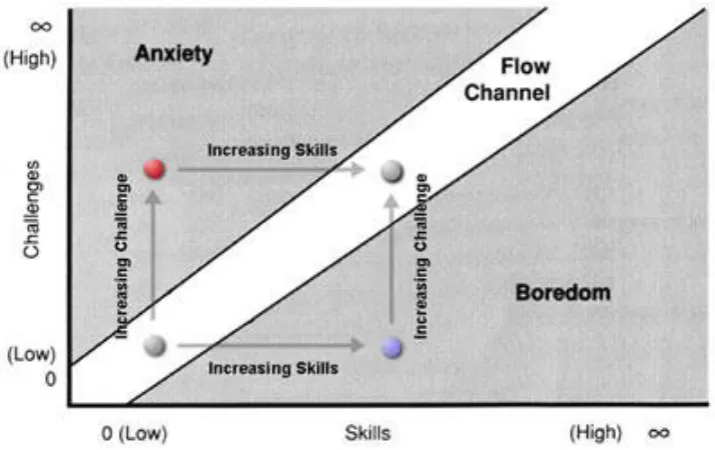
Csikszentmihalyi (1975) proposed the first flow model, which he focused mainly on the balance between challenge and skill (Figure 2.1). In Figure 2.1, the horizontal axis represents skill level from low on the left to high on the right. The vertical axis represents perceived challenge level going from low at the bottom to high at the top. If challenge is high, but skill level is low, the task is difficult, which leads to anxiety. If challenge is low, but skill level is high, the task is too easy, which leads to boredom. According to this early
model, flow happens when there is a balance between the level of perceived challenge and skill level (regardless of whether these two factors are low, medium, or high).
Csikszentmihalyi (1987) later clarified that when both challenge and skill level are equal and high, flow state is more intense, ordered, and complex as compared with when both challenge and skill are equal and low.
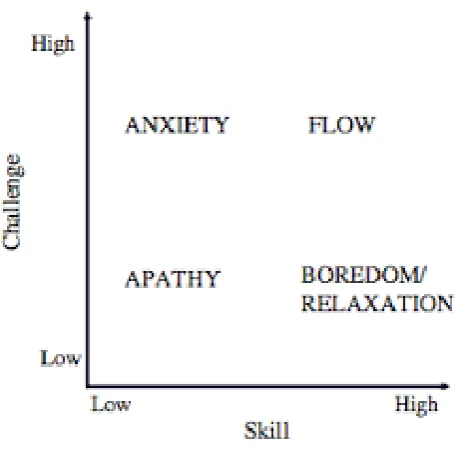
Proposing an improvement to the first model, Csikszentmihalyi and LeFevre (1989) introduced the quadrant model. Similar to the first model, in the quadrant model depicted in Figure 2.2, the horizontal axis represents skill level ranging from low to high (0 value represents the weekly mean). The vertical axis represents perceived challenge level ranging from low to high (0 value represents the weekly mean). There are four mental states that are formed as quadrants depicted in Figure 2.2, anxiety, flow, boredom, and apathy. Compared with the first flow model, the quadrant model introduced an apathy state, when both
challenge and skill level are equal and at a low level. Flow only occurs when both the perceived challenge and skill level are high and are in relative balance.
Figure. 2.2. Csikszentmihalyi and Lefevre’s (1989) quadrant flow model
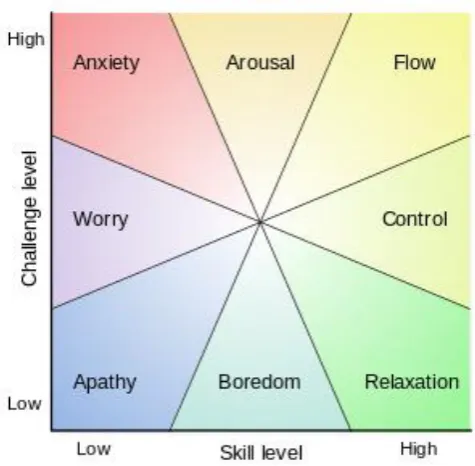
skills and challenges are in the centre where all the lines cut each other, whereas the further away from the centre, the higher is the intensity of that state. Participants are in a flow state when their perceived challenge and skill level are both higher than the weekly average and are equal with each other.
Figure 2.3. The Experience Fluctuation Model of flow (Massimini, Csikszentmihalyi, & Carli, 1987)
Csikszentmihalyi’s Nine Dimensions of Flow
Challenge-skill balance. As mentioned in the Experience Fluctuation Model, it is necessary to have a balance between challenge and skills to achieve flow; however, both challenge and skill need to be higher than average. When perceived challenge is high and perceived skill is medium or low, this creates arousal or anxiety. When perceived challenge is medium or low, and skill is high, this leads to control or relaxation. Csikszentmihalyi (1975) stated that the essential principle of flow is having a balance between challenge and skill. In sports terms, for example, this equates to a match between the expectation about the result of performance and actual skill. What matters is not the objective level of challenge and skill, but the perceived level, which can be entirely different. Challenge can be the situational demand from an event, whereas skill is the perceived level of confidence and belief individuals possess about their skill in the task (Jackson & Csikszentmihalyi, 1999).
Action-awareness merging. When in flow, there is a sense of unity between action (be it physical or mental) and awareness. Athletes become fully absorbed in the activity, so that their action will likely feel effortless and automatic (Jackson & Wrigley, 2004). This immersion helps athletes to be mentally and physically at one with their action and performance (Jackson & Csikszentmihalyi, 1999). Csikszentmihalyi (1990) observed that people in day-to-day life tend to “keep interrupting what we do with doubts and questions…. We question the necessity of our actions and evaluate critically the reasons for carrying them out.” (p. 54). Csikszentmihalyi (1988) argued that action-awareness merging is likely caused by concentration on the task. Because of a high level of concentration, there is no space for dysfunctional thoughts (doubt, distraction) in the conscious mind, which frees athletes to perform at their best. This dimension is one of the most frequently mentioned characteristics of flow by athletes during previous studies (Jackson, 2000).
Csikszentmihalyi (1990) found people in flow have a clear sense of what they are aiming to do, and what is expected of them both in the short- and long-term. According to
Csikszentmihalyi (2002) goals need to be set to a challenging, yet attainable, level in order for flow to occur. In a similar manner to the challenge-skill balance dimension, goals that are too easily achieved will rarely lead to enjoyment or flow.
Unambiguous feedback. Athletes receive feedback about their performance through two different channels, internal and external feedback (Jackson & Wrigley, 2004). The internal feedback channel is through body movement, tactile, and kinesthetic senses. The external feedback channel can come from visual or auditory sensing of environmental cues by athletes or coaches, teammates, and audiences. For example, golfers rely on their tactile, and kinesthetic senses of how smoothly their body moves during the swing as a key source of internal feedback. They also rely on their visual sense to know where the ball ends its
trajectory (external feedback) for each shot. Both these feedback channels offer critical information about the quality of golfers’ performance, which will potentially affect their flow state.
Depending on the type of sports, feedback can be immediate (e.g., a golfer sees whether a putt goes into the hole) or feedback can be delayed for a while (e.g., figure skaters perform on ice and finish the routine before knowing their scores).
Total concentration on the task. Concentration is among the most frequently examined characteristics of flow, because the experience of total concentration is at the core of the flow experience. Athletes perceived concentration as the most reliable indication of being in flow state as mentioned many times in research, for example, by Jackson (2000) and Kimiecik and Jackson (2002). Vernacchia (2003) defined concentration simply as “the ability to perform with a clear and present focus.” (p. 144). Sometimes concentration is used
interchangeably with focus and attention. To put these different terms in relation to each other, an individual who is concentrating is said to have their attention focused clearly and presently on the task at hand. While individuals are in the concentration state, distraction is kept to the minimum level, whereas other dimensions (challenge-skill balance, clear goals, and unambiguous feedback) are also heightened and balanced (Csikszentmihalyi, 1997). Attention is considered a limited resource (Csikszentmihalyi, 1993) and may involve cues that provide either relevant or irrelevant information for performance. Moran (1996)
target. Further, it may be easier to focus on a short duration activity like sprinting for 10 seconds, but the challenge to stay focused throughout a round of golf for nearly five hours is considerable.
Nideffer (1993) categorised attention focus along two dimensions: width (broad or narrow) and direction (external or internal). This produces four attentional styles, namely broad external, broad internal, narrow external, and narrow internal. In different sporting situations, athletes may shift their attention from one type (e.g., broad external to assess the environment situation) to another (e.g., narrow internal to focus on a single thought of what to do right now) continuously during performance.
Uneståhl (1979) suggested hypnosis can increase concentration. During the hypnotic process, clients’ focus is narrowed down to only a few stimuli, such as a feeling in the body or the hypnotist’s voice (Shor, 1959). Research by Robazza and Bortoli (1994) and Schreiber (1991) indicated that during hypnosis, athletes could increase their focus and prevent
irrelevant stimuli from producing electrophysiological responses, thanks to the increase in focusing ability.
outcome in their favour, this leads athletes to experience a feeling of being in control (Csikszentmihalyi, 2002).
Loss of self-consciousness. Athletes in flow focus entirely on what they need to do to the extent that they discard irrelevant thought about how they look, or how others are
perceiving their performance or looks (Kimieceik & Jackson, 2002). Jackson and
Csikszentmihalyi (1999) stated that when they are in flow, athletes focus on their skill, but not the evaluation. Csikszentmihalyi (2002) further elaborated,
Loss of self-consciousness does not involve a loss of self, and certainly not a loss of consciousness, rather, only a loss of consciousness of the self. What slips below the threshold of awareness is the concept of self, the information we use to represent to ourselves who we are. Moreover, being able to forget temporarily who we are seems to be very enjoyable. (p. 64).
Because athletes can be free from the consciousness of self, which frequently contains negative self-concern or self-doubt, they can deeply concentrate on the task at hand, which helps them experience oneness and unity with their activity (Jackson, 1996). Justin Leonard, 12 times PGA tour winner, stated,
The times when I have gotten into it [flow], I forget how many under par I am, or where I am in the tournament… And you are not thinking about those outside things that can be detractors. Your focus goes from the size of a basketball to a pin needle and nothing that goes on around you matters. You do not hear things that go on. Your focus gets so narrow on what you are trying to do… You are not fighting through thoughts like “what if I hit it here or there?” You do not fight through any of that. It all just disappears. (Valiante, 2013, pp. 41-42).
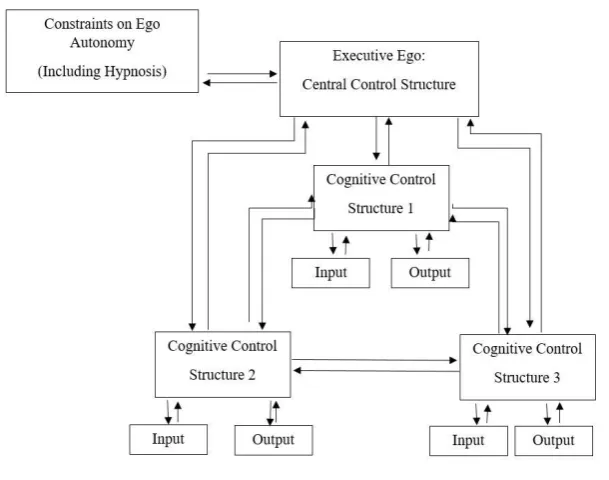
supported its influence on flow state as much as other dimensions. The Neodissociation theory of hypnosis (Hilgard, 1977, 1991, 1992), may offer a possible explanation for the process of loss of self-consciousness. There are many co-existing cognitive control subsystems in the body, each of which is associated with a habitual action sequence with limited or no involvement of the Executive Ego. Once a cognitive control system is activated, the task is indirectly self-monitored. Hilgard proposed that lapses in consciousness because of the activation of well-learned habits is a type of dissociation. He defined dissociation as, “the splitting off of certain mental processes from the main body of consciousness, with various degree of autonomy (Hilgard, 1992, p. 45). This activation of habitual cognitions and movements is essential for sports performers and is the basis for “muscle memory” of movements. Uneståhl (1973) argued that any conscious thoughts that enter the mind will disturb and decrease results.
Transformation of time. Time seems to alter as athletes focus intensely and become absorbed in their activity. When in flow, they may experience time slow down or speed up more than usual. Bryce Molder, 2011 PGA tour winner, 4 -time NCAA All-American, stated,
The zone is both fast and slow. While you are there, it seems slow and effortless. When I look back to that last round I was in the zone; it seemed like it took 45
minutes. In fact, everything moved really slowly; I was never rushed (Valiante, 2013, p. 9).
People who experience flow do not always report this transformation of time dimension (Jackson, 1996). One factor that needs to be considered is the type of sport. Jackson proposed that certain sports require athletes to pay full attention to how long it takes to finish a
both qualitative (Jackson, 1996) and quantitative research (Jackson, Thomas, Marsh, & Smethurst, 2001). Time transformation also did not relate well to other flow dimensions as indicated by Brewer, Van Raalte and Linder (1991) and Vlachopoulos et al. (2000).
Csikszentmihalyi (1988) argued that time transformation only happens during an intense flow state, which means time transformation might not be experienced as frequently as other flow dimensions.
Research on both loss of self-consciousness and time transformation dimensions has shown equivocal results. However, this does not mean these dimensions are irrelevant, or that Csikszentmihalyi’s (1975) nine dimensions of flow are not important. Jackson and Marsh (1996) argued that these research results on loss of self-consciousness and time
transformation may merely indicate that these two dimensions are not as crucial to some sports as are other dimensions. Vasquez (2005) suggested this could be due to the specific characteristic of the sport that requires athletes to manage their time (running, swimming) or be self-conscious of one’s body and its position (figure skating, gymnastics). Hence, it is essential for researchers to conduct more studies that focus specifically on these two dimensions to draw clear conclusions.
Another mental state that can create similar alteration to the sense of time is hypnosis. Many people have reported a perception of time passing away quickly under hypnosis. In Neodissociation theory, Hilgard (1994) explained this phenomenon by proposing that the information about time is being recorded in the memory system, but it is blocked from the conscious part of the executive ego. It is worth considering the possibility of using hypnosis to create a time transformation sensation similar to flow state.
from the Greek language, auto means the “self” and telos means the “goal”. When put together, autotelic means doing the activity for its own sake (Csikszentmihalyi, 1990). This seems very similar to the meaning of the term intrinsic motivation, which is closely related to flow. When flow involves an autotelic experience, people find the activity that they are involved in to be motivating, intrinsically-rewarding, and it gives them a broad sense of enjoyment (Jackson, 1996). Even if there are external rewards, such as money or fame, athletes with a high level of autotelic experience can ignore or compartmentalise those extrinsic motives and be entirely focused on the satisfaction of doing the task itself.
Csikszentmihalyi (1975, 1990) also proposed the concept of autotelic personality, which refers to people’s dispositional tendency to engage in an activity for its own sake. Csikszentmihalyi (1990) suggested that people who have an autotelic personality are more likely to experience flow, that is, they have a propensity to experience the flow state (Asakawa, 2004).
The nine dimensions of flow are interdependent and interconnected of each other. Csikszentmihalyi (1993) suggested that when the other eight dimensions of flow are
available, the activity of people becomes self-contained and a goal in itself, which will lead the experience to become an autotelic experience. Jackson and Csikszentmihalyi (1999) argued that autotelic experience could be considered a consequence of the other eight dimensions.
Measurement of Flow
Due to its ephemeral characteristics, flow is difficult to measure objectively. Also, flow state is usually measured immediately or soon after performance, so it is possible that the subjective judgment of flow state will be affected by the performance result. With all the methods of measurement that have been developed to date, what is measured is the
psychological experience indicative of flow. There are three main types of measurement available, namely the Experience Sampling Method (ESM), qualitative, in-depth interviews, and quantitative methods, using self-report questionnaires.
The Experience Sampling Method (ESM). Csikszentmihalyi and Larson (1987) introduced the ESM as a new way to measure flow, using both interviews and questionnaires. Participants carry a beeper, which rings eight times throughout the day to remind participants to fill in a brief questionnaire. This questionnaire consists of a Likert scale to measure
participants’ mood, concentration, sense of control, and self-consciousness level. There are also open-ended questions about the location and the activity that participants are doing. Csikszentmihalyi and Larson (1987) concluded that ESM is a valuable tool to understand the flow experience not only at the individual level, but also at the group level. There are,
however, drawbacks to using ESM, especially in sport. One of the requirements for ESM is to have participants complete the questionnaire whenever the beeper sounds. There is a high potential that athletes will be in the middle of a training/competing activity, which they cannot stop. Furthermore, even if participants can stop to record, it is possible that the beeper/questionnaire disrupts their flow experience. Hence, there is a need for less intrusive methods.
broadly. Knapik (2006) argued that the interview method gives access to a large pool of experiences that are not accessible by other measures, such as paper and pencil questionnaire assessment. Interview techniques are helpful for research to explore the flow experience in a group (Mugford, 2006; Sutton, 2005) or new aspects of antecedents and consequences of flow at work (Wright, Sadlo, & Stew, 2007). However, interviews are sometimes conducted a long time after individuals experienced flow, which can lead to either poor recall (Yarrow, Campbell, & Burton, 1970), or biased or distorted recall about the flow experience (Brewer et al., 1991). Jackson (1992, 1995) further explored the factors that may facilitate or disrupt flow, using in-depth interviews. A wide range of athletes in athletics, rowing, swimming, and cycling joined the studies, which make Jackson’s work more valuable in generalizing her results for many sports. The in-depth interview allows researchers to have a richer
understanding of the perception of participants.
Quantitative measures. Jackson and Marsh (1996) developed a questionnaire called the Flow State Scale (FSS), which measures the state component of flow. Flow state is the intensity of flow at any moment. A flow state can change from moment to moment. The FSS is based on Csikszentmihalyi’s (1975, 1990) model of flow and comprises 36 questions, covering the nine dimensions of flow. There are four questions for each dimension, to help to evaluate flow intensity of athletes at one moment in time. Each question has a statement followed by a Likert response scale ranging from 1 (strongly disagree) to 5 (strongly agree). The FSS questionnaire has internal reliability in the range from .80 to .86 (with the lowest dimension being challenge-skill balance at .80, and the highest dimensions being
unambiguous feedback at .85 and sense of control at .86)
nine dimensions, but it measures flow experience in general over a number of occasions. The FTS is administered away from the influences of specific, high-pressure competition
situations, so it is less likely to be influenced by experiences during a particular performance. There are some questions that were designed to measure time transformation and loss of self-consciousness on the FSS and FTS that did not have strong relationships with global flow, that is, the sum of scores for all the nine subscales. Jackson and Eklund (2002) developed the Flow State Scale-2 (FSS-2) as a refined version of the FSS to measure state flow more sensitively. This involved changing the wording of some items. Jackson and Eklund (2002) also introduced the Dispositional Flow Scale-2 (DFS-2) to replace the Flow Trait Scale, to measure the frequency of flow that athletes experienced across sporting events in general. Both the FSS-2 and DFS-2 scales were designed to measure the experience of flow in
physical activities, but they have also been used to measure flow in other areas. The amended version of the flow state scale, the FSS-2, has an internal consistency reliability range from .80 to .90 (Jackson & Eklund, 2002). The amended version of the dispositional flow scale, the DFS-2, has an internal consistency reliability range from .81 to .90. The nine dimension subscales of the revised scales have stronger relationships with the global flow score derived by summing all the subscales than the previous scales (Jackson & Eklund, 2002).
In addition to the scales mentioned above, researchers have proposed the need for a shorter version of the flow questionnaire for practical reasons (Jackson, Martin, & Eklund (2008). For example, short forms are more suitable for large-scale projects involving many measures, or when there is a time constraint. In order to convince athletes to fill in a
scales that can be administered in less than two minutes: the SHORT Flow Scales and the CORE Flow Scale. Based on the FSS-2 and DFS-2, Jackson and colleagues developed the SHORT Flow State Scale-2 and the SHORT Dispositional Flow Scale-2. Each of these scales has nine items which represent the nine flow dimensions. There were two criteria for
selection. First, these items were identified to best measure the intended construct, based on the size of their standardized factor loadings in previous confirmatory factor analysis. Second, where items representing the same dimension had equal or very close factor loading, ones deemed to have better face validity were chosen. Both of these short Flow Scales showed good reliability with internal consistency ranging from .73 to .84 (in work, sport, and music environments) (Jackson et al., 2008; Martin & Jackson, 2008). However, more
research should be done to examine their measurement properties (Jackson, 2001). While the SHORT Flow Scales were based on the existing quantitative FSS-2 and DFS-2, the CORE Flow Scales derived from qualitative research with elite athletes. Based on the work by Jackson (1992, 1995, 1996), Martin and Jackson (2008) came up with 10
descriptive statements about what it feels like to be in flow. The CORE Flow Scale uses a rating scale similar to other flow scales. The reliability score ranges from .91 to .93 in school and sports environments.
Despite all the best efforts to measure flow by the methods mentioned above, it is crucial to remember Csikszentmihalyi’s reluctance to operationalize the flow state. He suggested that any measure of flow cannot fully reflect the human experience
subjective, ephemeral characteristics of flow, which are highly susceptible to the challenges of the measurement methods, as well as Csikszentmihalyi’s (1992) suggestion, it is essential to acknowledge that no one measurement method to date can give a full assessment of flow state. In fact, some researchers have proposed to combine qualitative and quantitative methods to produce a more detailed understanding of flow (Jackson, Kimiecik, Ford, & Marsh, 1998; Jackson & Marsh, 1996; Kimiecik & Stein, 1992).
Research Examining Flow in Sport
Flow antecedent dimensions and concomitant dimensions. The role of each dimension in global flow may not be of the same importance. Nakamura and
Csikszentmihalyi (2002) proposed two concepts: flow conditions and flow characteristics. Flow conditions are dimensions that are crucial to getting into flow, including challenge-skill balance, clear goals, and unambiguous feedback. Flow characteristics are dimensions that reflect the phenomenological experience of flow, including action-awareness merging, concentration on the task at hand, sense of control, loss of self-consciousness, transformation of time, and autotelic experience. Based on this argument, interventions to induce flow state should target only the three flow condition dimensions: challenge-skill balance, clear goals, and unambiguous feedback.
Stavrou and Zevras (2004) proposed a different distinction between two categories of Csikszentmihalyi's nine flow dimensions with five flow dimensions (challenge-skill balance, clear goals, unambiguous feedback, concentration on the task at hand, and sense of control) proposed to be antecedents, which essentially means they promote flow. Stavrou and Zervas proposed that the other four dimensions (action-awareness merging, loss of
analyses of previous studies, the four most influential dimensions underlying flow were identified as challenge-skill balance, clear goals, concentration on the task, and sense of control (Koehn et al., 2013). Similarly, Jackson et al. (1998) found that challenge-skill balance, concentration on the task at hand, sense of control, and unambiguous feedback were the predominant dimensions of flow. In a follow-up study, Jackson et al. (2001) found challenge-skill balance, concentration on the task at hand, sense of control, and clear goals had the strongest correlation with other psychological variables, that is, goals were important, rather than feedback. Jeong (2012) found a stronger relationship between imagery and some characteristics of flow, including challenge-skill balance, clear goals, concentration, sense of control, and autotelic experience, rather than other dimensions. She proposed that to develop an effective and efficient intervention to enhance flow, researchers should focus on
antecedent dimensions of flow, rather than concomitant dimensions that appear to emerge with or from flow. From the research by Koehn et al. (2013) and Jeong (2012), there is no compelling evidence that the concomitant dimensions enhance flow.
Personal and situational factors that affect flow. Kimiecik and Stein (1992) proposed that researchers should go beyond the point of describing various elements of the flow experience. Instead, they should focus more on the interaction between personal and situational variables (Jackson, 2011). Sorrentino, Walker, Hodson, and Roney (2001) shared this view about the importance of situational and personal characteristics of flow. They argued that without a match between situational and personal factors, there is likely to be a lack of perceived importance to athletes, which affects their motivation and information processing. For flow to appear, a match between these two factors is crucial.
self-efficacy, goals and concentration). Situational variables include environmental factors such as the type of sport, opponent ability, coach behavior, competition importance, competitive flow structure, teammate interaction and behavior. Jackson (1992) supported this interaction model by confirming personal factors (positive affect, self-confidence and physical readiness) were linked to flow-like states. At the same time, situational factors (behavior of the crowd and other athletes) also contributed to the attainment of flow (Jackson, 1992). Many studies have found no significant difference in how gender affects flow state (e.g., Jackson et al., 2001; Jackson & Marsh, 1996; Russell, 2001; Vlachoplolous et al., 2000). A study by Grove and Lewis (1996) showed that gym circuit trainers with higher hypnotisability and prior experience were more likely to experience flow during training. Koehn, Langenkamp, and Morris (2004) examined the effect of action orientation and state orientation on flow in junior tennis players. They found action orientation was more strongly related to flow than state orientation, with strong effect sizes on global flow, concentration on the task at hand, and autotelic experience. Koehn (2007) further demonstrated that dispositional personality variables, action control, imagery use, and trait sport confidence have a moderate relationship with flow. Koehn also found significant and near-significant main and interaction effects between personal variables (trait sport confidence and action control) and situational variables (self-paced service task and externally-paced groundstroke task) on flow state. Among the personality variables, motivation and anxiety are two factors that have received the most research attention. This trend followed work by Csikszentmihalyi (1975, 1988), which suggested that intrinsic motivation is one of the main factors to facilitate flow (Jackson et al., 1998), while anxiety is a crucial factor that prevents flow from happening (Jackson et al., 1998; Stavrou & Zervas, 2004).
tennis players. Their results did not show a significant difference in flow states across performance contexts. The results seemed to contradict Kimiecik and Stein (1992), who argued that self-paced tasks, like the tennis service, should facilitate flow more than externally-paced tasks, like groundstrokes. While the findings lead to the hypothesis being rejected, they actually opened up a new area to consider, that being whether the difference between discreet and continuous performance has an impact on flow state. While the research on personal and dispositional interaction showed some encouraging results, Koehn (2007) suggested that the current measurement method of global flow may not be sensitive enough to detect the interaction effects between personal and situational factors. Koehn suggested closer consideration of participants and task characteristics to better understand the person x situation interaction effect.
Factors that improve or decrease flow. To further understand the effect of various personal and situational factors on flow, it is crucial to identify factors that may facilitate, prevent, disrupt, or control flow.
Facilitators of flow. Researchers have identified some factors that may facilitate flow.
Having a better understanding of these factors and how to use them in practical settings is important for increasing the possibility of flow occuring for athletes. Jackson (1992) interviewed 16 elite figure-skating athletes and found that these athletes could enter a flow state more easily with the following factors present: positive mental attitude, positive pre-competitive and pre-competitive affect, maintaining appropriate focus, feeling physically ready, and having unity with their dance partner. All these factors were similar to the flow
characteristics suggested by Csikszentmihalyi (1990). All but one (partner unity) were
were mentioned by Jackson (1992), Jackson (1995) proposed motivation to perform, achieving optimal arousal, competitive plans and preparation, physical preparation and readiness, feeling good while performing, confidence, positive team play and interaction, experience, and optimal environmental and situational conditions as factors that facilitate flow. Among these factors, two factors were cited by the highest percentage of athletes. These were competitive plans and preparation, and confidence and positive attitude, to which 64% of the athletes referred. Two factors, optimal physical preparation and readiness, and optimal level of arousal were cited by 57% of the participants. The athletes in Jackson’s qualitative studies claimed that flow could be attained by managing those controllable factors that facilitate flow. Young (2000) and Young and Pain (2005) explored the flow experience in professional tennis players. Similar to other research they found physical and mental preparation, positive mood, control of arousal, environmental conditions, motivation, positive feedback, and focus were factors that promoted flow. Russell (2001) researched both
qualitative and quantitative factors that affect flow in 42 athletes from five team sports and four individual sports. He found nine factors that may facilitate flow. Some of the most common factors included optimal pre-competitive plans, optimal physical preparation, confidence, and positive thinking. Russell’s sample emphasized being confident and being prepared for competition as essential factors that facilitate flow. This conclusion is similar to Jackson’s (1995) conclusions. Furthermore, Jackson (1995) suggested that confidence and positive mental attitude are two key factors that facilitate flow in sport. Finally, Sugiyama and Inomata (2005) found a similar result in Japanese elite athletes, in which feeling relaxed, self-confident, highly motivated, entirely focused, lacking negative thoughts and feelings, and being extremely positive were factors that promoted flow.