DOES PRICING DEVIATION OF EXCHANGE-TRADED FUNDS PREDICT ETF RETURNS?
Jung-Chu Lin1 1Associate Professor, Department of Banking and Finance, Takming
University of Science and Technology, Taipei, Taiwan
ABSTRACT
Article History Received: 13 April 2017 Revised: 10 May 2017 Accepted: 5 June 2017 Published: 19 June 2017
Keywords Exchange-traded fund Pricing deviation ETF return ETF pricing efficiency Creation-redemption process Arbitrage strategy JEL Classification G11, G12, G14
This paper investigates whether the pricing deviation of inactive exchange-traded funds (ETFs) differs from that of active ETFs and can predict future ETF returns better and longer. The results show that, compared to active ETFs, inactive ETFs trade at a substantial, more volatile, mostly negative and more skewed-to-the-right pricing deviation. Inactive ETFs’ pricing deviation relates significantly and negatively to longer-day future ETF returns, indicating that the deviation may predict ETF returns better and longer. However, if an inactive ETF has corresponding futures for its underlying index, its pricing deviation may shrink and pricing efficiency may increase.
Contribution/ Originality: This study contributes the first logical analysis which classifies ETFs into four types to investigate whether inactive ETFs’ pricing deviation can predict future ETF returns better than active ETFs’. The results demonstrate that inactive ETFs’ pricing deviation does predict future ETF returns better and longer.
1. INTRODUCTION
Even though exchange traded funds (ETFs) resemble closed-end funds (CEFs) in many facets, ETFs have a unique feature that additional shares can be created and redeemed by investors through authorized dealers (Engle
and Sarkar, 2006). The creation–redemption process allows investors to engage in an arbitrage strategy that
adjusts the supply of ETF shares on the market, and thus helps ETF shares to trade at prices approximating the calculated net asset value (NAV) of the underlying portfolio (the underlying value). However, because the creation– redemption mechanism requires a minimum shares for each creation or redemption order (i.e., a creation and redemption unit), the arbitrage trading on ETFs with poor marketability may not be able to be executed smoothly and instantaneously. The deviation (pricing error) between the NAVs and market prices of these less marketable
Asian Economic and Financial Review
ISSN(e): 2222-6737 ISSN(p): 2305-2147
DOI: 10.18488/journal.aefr.2017.78.748.759 Vol. 7, No. 8, 748-759
ETFs may be therefore much larger and mostly negative when compared with that of actively traded ETFs. Using actively traded ETFs as a benchmark, this article investigates the extent and properties of the less marketable ETFs’ pricing errors (premiums or discounts), how their NAVs and market prices lead each other, and whether their pricing errors can predict near-term returns better.
Taiwan currently has 13 domestic-component-security ETFs trading on the Taiwan Stock Exchange Corporation (TWSE), since the 2003 launch of the first ETF. While nine of the 13 ETFs have correspondent futures trading on the Taiwan Futures Exchange for their underlying indexes, only three of them have average daily share turnover that are greater than their corresponding creation and redemption unit during the data period August 31, 2006 to June 30, 2016. This study defines those ETFs with an average daily share turnover greater than their creation and redemption unit as active ETFs and the opposites as inactive ETFs. Further considering the existence of corresponding futures for the underlying indexes may affect the ETF pricing efficiency, this study divides the 13 ETFs into four types: (1) active ETFs that have futures markets for the underlying indexes; (2) active ETFs that do not have corresponding futures for the underlying indexes; (3) inactive ETFs that have corresponding index futures; and (4) inactive ETFs that do not have corresponding index futures. This paper compares the four different types of ETFs in terms of pricing errors, lead-lag relationship between NAVs and market prices and the ability of the pricing deviation to predict ETF near-term returns.
2. LITERATURE AND HYPOTHESES
A vast literature shows that CEF share prices generally trade at a substantial and long-lasting discount to the NAV. Explanations for the CEF discount include unrealized capital gains tax (Malkiel, 1977) portfolio illiquidity
(Deli and Varma, 2002; Cherkes et al., 2009) managerial performance (Chay and Trzcinka, 1999; Berk and Stanton,
2007) agency costs (Barclay et al., 1993; Coles et al., 2000) and distribution policies (Johnson et al., 2006; Wang and
Nanda, 2011). Investors who notice any discrepancy between the NAV and the fair market value have the
opportunity to make a profit by buying at a discount and selling at a premium (Chalmers et al., 2001; Goetzmann et
al., 2001; Boudoukh et al., 2002). Yet not until the development of the ETF creation and redemption mechanism are
the arbitrage opportunities really exploited profitably. The creation and redemption process for ETFs allows arbitrage strategies to be executed effectively whenever the share prices deviate from the underlying value. If the creation–redemption process works efficiently, ETF shares should not trade at significant deviation from the fair value of the portfolio (Engle and Sarkar, 2006). The lower marketability in those inactive ETFs on the TWSE may block the efficient work of the creation–redemption process, making inactive ETF shares trade at significant deviation from the underlying value. For inactive ETFs, the bi-directional lead-lag relationship between NAVs and market prices of active ETFs, found in Lin (2011) may become a one-way lead-lag relationship that only NAVs lead market prices. However, having corresponding futures markets for the underlying indexes may improve the pricing efficiency and the connection between NAVs and market prices of inactive ETFs. Therefore, this paper develops three hypotheses to test as follows:
(1) This paper expects inactive ETFs, like CEFs, trade at a substantial and mostly-negative pricing error to the NAV. The distribution of their pricing errors is expected to be more skewed to the right and have a higher proportion for the negative than active ETFs. However, if an inactive ETF has corresponding futures for its underlying index, the deviation and the skewness to the right may shrink.
(3) Since the arbitrage on the pricing deviation of inactive ETFs needs more time (days) to accumulate enough shares for satisfying the requirement of the creation and redemption unit, the pricing errors of inactive ETFs may predict ETFs’ near-term returns better and longer.
3. DATA AND DESCRIPTIVE STATISTICS
All the 13 ETFs, composed of the listed shares on TWSE, are included in the sample of this study. To identify the type of each ETF, I collect relevant information of the 13 ETFs summarized in Table 1, and categorize all these ETFs to one of the four types of ETFs as shown in Table 2.
Table-1. The 13 ETFs with domestic component securities on the TWSE
ETF name Stock code Listing date Creation/redemption unit
(lot)
Average daily share
turnover (lot) With correspondi ng index futures Yuanta/P-shares Taiwan Top
50 ETF 0050 June 30, 2003 500 12,581 Y
Yuanta/P-shares Taiwan
Mid-Cap 100 ETF 0051 August 31, 2006 1,000 296 N
Fubon Taiwan Technology
Tracker Fund 0052 September. 12, 2006 500 118 N
Yuanta/P-shares Taiwan
Electronics Tech ETF 0053 July 16, 2007 1,000 158 Y
Yuanta/P-shares S&P Custom
China Play 50 ETF 0054 July 16, 2007 1,000 148 N
Yuanta/P-shares MSCI Taiwan
Financials ETF 0055 July 16, 2007 1,000 2,723 Y
Yuanta/P-shares Taiwan
Dividend Plus ETF 0056 December 26, 2007 500 1,045 N
Fubon MSCI® Taiwan ETF 0057 February 27, 2008 500 375 Y
Fubon Taiwan Eight Industries
ETF 0058 February 27, 2008 500 26 Y
Fubon Taiwan Finance ETF 0059 February 27, 2008 500 48 Y
Yuanta/ P-shares MSCI
Taiwan ETF 006203 May 12, 2011 500 336 Y
Sinopac TAIEX ETF 006204 September 28, 2011 1,000 296 Y
Fubon FTSE TWSE Taiwan 50
ETF 006208 July 17, 2012 500 104 Y
Note: One lot equals 1,000 shares. Average daily share turnovers are computed using daily data between August 31, 2006 and June 30, 2016. “Y” indicates the ETF has corresponding index futures on the market, while “N” means the ETF does not have corresponding index futures.
Source: the TWSE.
Table-2. Classification of the 13 ETFs
Type Active ETFs with
corresponding index futures
Active ETFs without
corresponding index
futures
Inactive ETFs with
corresponding index
futures
Inactive ETFs without
corresponding index
futures ETF code 0050
0055 0056 0053 0057 0058 0059 006203 006204 006208
0051 0052 0054
Let
mp
it andnav
it be the market price and the NAV of ETF i at time t, respectively. The pricing error rate, aproxy for pricing deviation, is the percentage difference between the market price and the NAV. The pricing error
rate of ETF i at time t (
per
it) is thus computed as follows:%
100
it it it
it
nav
nav
mp
per
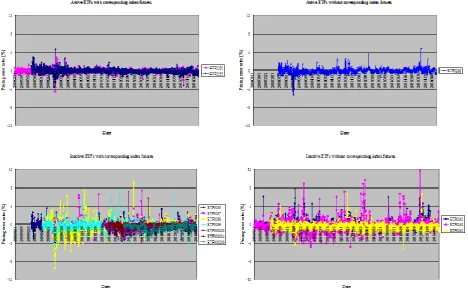
(1)This study gathers daily data of the market price and the NAV of the 13 ETFs between August 31, 2006 and June 30, 2016 from the Taiwan Economic Journal (TEJ) database to compute the pricing error rates of the 13 ETFs of this data period. The movements of the pricing error rates for the four types of ETFs during this data period are plotted in Fig. 1 and the descriptive statistics of each ETF by types are presented in Table 3. For comparison purposes, the vertical axes of the four panels in Fig. 1 have the same maximum, minimum and spacing for the scale.
Fig. 1 shows that inactive ETFs do have a larger-extent and more volatile pricing error than active ETFs. In particular, the inactive ETFs without corresponding index futures seem to have the largest-magnitude pricing error, and the volatility of their pricing errors seems the greatest. In addition to supporting the findings in Fig. 1, Table 3 shows that the distribution of pricing error rates of inactive ETFs are more skewed to the right and that their proportions of the negative pricing error are higher than those of active ETFs. All these results support the expectations of hypotheses (1) that inactive ETFs trade at a substantial and mostly-negative deviation to the NAV and that the existence of corresponding index futures does mitigate the deviation.
Fig-1. Pricing error rates of the four types of ETFs, August 31, 2006 to June 30, 2016.
Table-3. Descriptive statistics of the four types, 13 ETFs’ pricing error rates, August 31, 2006 to June 30, 2016
ETFs Mean (%) Median (%) Maximum (%) Minimum (%) Dev.(%) Std. Skewness Kurtosis Obs.ervations % negative of
Ⅰ. Active ETFs with corresponding index futures
0050 -0.0603 -0.0676 2.8743 -4.5656 0.3415 -0.5174 23.2761 2436 58.50
0055 -0.0814 -0.0884 4.6225 -3.5714 0.4782 0.6620 12.8551 2222 56.84
Ⅱ. Active ETFs without corresponding index futures
0056 -0.1033 -0.1676 4.7794 -5.2830 0.5703 -0.1114 14.4013 2108 61.10
Ⅲ. Inactive ETFs with corresponding index futures
0053 -0.3994 -0.4041 3.5384 -3.9683 0.6266 0.6175 7.8262 2222 79.30
0057 -0.1761 -0.1664 7.3892 -4.6623 0.6516 2.2883 30.3901 2070 65.31
0058 -0.3393 -0.2895 9.3393 -9.3105 1.2081 -0.1068 12.7568 2070 63.77
0059 -0.2535 -0.2616 7.2385 -5.7845 0.9045 0.4912 12.6330 2070 64.93
006203 -0.4577 -0.3834 7.1981 -3.8040 0.7560 0.2594 12.2817 1270 72.05
006204 -0.1575 -0.1121 5.7460 -1.8966 0.3873 2.4887 50.8604 1173 64.79
006208 -0.6883 -0.6036 2.5050 -3.4108 0.6761 -0.3038 4.6213 974 89.73
Ⅳ. Inactive ETFs without corresponding index futures
0051 -0.0364 -0.1551 7.7717 -3.6124 0.8747 2.0637 13.4916 2436 58.62
0052 -0.2652 -0.3321 11.7188 -4.9327 1.1941 2.1981 18.4974 2428 65.98
0054 -0.4891 -0.5239 6.7214 -5.3526 0.7168 1.3014 17.1590 2222 81.59
Source: The TEJ database and this study.
4. METHODOLOGY AND EMPIRICAL RESULTS
I first use the vector autoregression (VAR) to model the dynamic relationship between the NAV and the market price of each ETF. Through this model specification, I use Schwarz information criterion to decide the optimum lag length for each ETF’s NAV and market price relationship. Then I use the decided optimum lag length to execute the Granger Causality test to examining the causation between the NAV and the market price of each ETF. The results, presented in Table 4, show that the longest optimum lag length is 4 and that the length seems independent of ETF type. For all the 13 ETFs, the NAV does Granger cause the market price, yet only the active ETFs with corresponding index futures and some of the inactive ETFs with corresponding index futures display the reverse lead-lag relationship, i.e. the market price Granger causes the NAV. These results support the expectations of hypotheses (2) that inactive ETFs mostly have a one-way lead-lag relationship, compared to active ETFs. However, if an inactive ETF has corresponding futures for its underlying indexes, this one-way lead-lag relationship may evolve into a bi-directional one that the market price also leads the NAV.
Since all the NAV and market price series are non-stationary, I further test the presence of cointegrating relationship between each ETF’s NAV and market price. The results show that each ETF’s NAV and market price do have a cointegrating relationship between them. The properties of each cointegration equation (CE) are presented in Table 4. To investigate the ability of ETF pricing deviation to predict subsequent ETF returns, this paper constructs three testing equations as follows:
t i t i j
t t
i
c
a
D
ret
ETF
_
,,
,1
, (2)t i it j
t t
i
c
b
per
ret
ETF
_
,,
, (3)t i it t
i it
t i j
t t
i
c
a
D
b
per
D
per
ret
ETF
_
,,
,1
,1
, (4)Table-4. The causality and cointegration relationship between NAVs and market prices of the 13 ETFs
ETFs Optimum lag length Null: Market price does not Granger Cause NAV Null: NAV does not Granger Cause market price Cointegration relationship
Ⅰ. Active ETFs with corresponding index futures
0050
2 7.6493 (0.0005)***
15.6358 (0.0000)***
A CE with intercept and trend; linear deterministic trend in data
0055
4 7.74165 (0.0000)***
3.19969 (0.0125)**
A CE with intercept and trend; linear deterministic trend in data
Ⅱ. Active ETFs without corresponding index futures
0056
2 1.4372
(0.2378) 77.1551 (0.0000)***
A CE without intercept and trend; no deterministic trend in data
Ⅲ. Inactive ETFs with corresponding index futures
0053
3 1.0120
(0.3863) 53.6837 (0.0000)*** A CE with intercept and trend; linear deterministic trend in data
0057
1 9.1918 (0.0025)***
183.9010 (0.0000)***
A CE with intercept but without trend; no deterministic trend in data
0058
2 3.0569 (0.0472)**
206.3550 (0.0000)***
A CE with intercept but without trend; no deterministic trend in data
0059
2 3.8528 (0.0214)**
142.7930 (0.0000)***
A CE without intercept and trend; no deterministic trend in data
006203
1 5.7821
(0.0163)** 174.3890 (0.0000)*** A CE with intercept but without trend; no deterministic trend in data
006204
2 0.7657
(0.4653) 40.7755 (0.0000)*** A CE with intercept and trend; linear deterministic trend in data
006208
4 0.87610
(0.4776) 25.3851 (0.0000)***
A CE without intercept and trend; no deterministic trend in data
Ⅳ. Inactive ETFs without corresponding index futures
0051
2 1.7569
(0.1728) 133.3340 (0.0000)***
A CE without intercept and trend; no deterministic trend in data
0052
3 0.3753
(0.7708) 135.7700 (0.0000)***
A CE without intercept and trend; no deterministic trend in data
0054
2 0.0475
(0.9536) 132.4450 (0.0000)***
A CE without intercept and trend; no deterministic trend in data
The dependent variable is the subsequent ETF return for ETF i from day t close to (t+j) close, j=1, 2, 3, 4. The
two independent variables,
D
i,t1 andper
it, are sequentially incorporated to form the above three regressionequations.
D
i,t1 is a dummy variable for ETF i on trading day t-1 that equals one for its positive weekly NAVreturns and zero for its non-positive weekly NAV returns. Intercept
c
, coefficients a, b, and
are parameters of the regressions. The equation (4) is specified to distinguish the connections between future returns and pricing deviation in rising or non-rising market conditions as measured by the slope estimates b for the non-rising and
b
for the rising market condition, respectively. The significance of coefficient b indicates that the current pricing error rates do have a connection with the future ETF returns, i.e. the current pricing error rates may predict the future ETF returns. The significance of coefficient
indicates that the connection between future ETF market-price returns and current pricing deviation in a rising market is different from that in a non-rising market. The regression results, presented in Table 5, show that all the four-type ETFs’ pricing deviation is significantly and negatively related to one-day future ETF returns, indicating that a discount in ETF pricing predicts one-day future positive returns and vice versa. However, only inactive ETFs have pricing deviation significantly and negatively related to two- to four-day future ETF returns, supporting the hypothesis (3) that the pricing errors of inactive ETFs may predict ETF returns better and longer. In a few cases, the connection between future ETF market price returns and current pricing deviation in a rising market is stronger than that in a non-rising market.Table-5. Regression results based on various-period future ETF returns against the market condition dummy and the pricing errors rates
t i t i j
t t
i
c
a
D
ret
ETF
_
,,
,1
,t i it j
t t
i
c
b
per
ret
ETF
_
,,
,t i it t
i it
t i j
t t
i
c
a
D
b
per
D
per
ret
ETF
_
,,
,1
,1
,
Panel A: one-day future ETF return
ETFs c a b γ Adj. (%) R2
Ⅰ. Active ETFs with corresponding index futures
0050 0.0644 (0.1749) -0.0142 (0.6283) 0.0669 (0.1610)
-0.1037 (0.0709)*
-0.1783 (0.0042)*** -0.3640 (0.0278) **
-0.2756 (0.3026) -0.3351 (0.2839)
0.1003 0.7788 1.1667
0055 -0.0070 (0.9024) -0.0294 (0.4522) -0.0160 (0.7835)
-0.0091 (0.9027)
-0.0301 (0.6990) -0.2233 (0.0451)
**
-0.2018 (0.2300) -0.0549 (0.8046)
-0.0444 0.3234 0.2512
Ⅱ. Active ETFs without corresponding index futures
0056 0.0052 (0.9090) -0.0478 (0.0689)*
0.0200 (0.6935)
-0.0203 (0.7126)
-0.1990 (0.0017)*** -0.4145 (0.0001) ***
-0.3346 (0.0317)** -0.3661 (0.0379)**
-0.0409 3.5651 4.3345
Ⅲ. Inactive ETFs with corresponding index futures
0053 0.0566 (0.2765) -0.2045 (0.0000)***
-0.0990 (0.1132)
-0.1110 (0.0802)*
-0.2206 (0.0087)*** -0.5048 (0.0000) ***
-0.5141 (0.0000)*** -0.0349 (0.7774)
0.0988 4.6559 5.0775
0057 0.0565 (0.2644) -0.0920 (0.0042)***
-0.0281 (0.6037)
-0.0843 (0.1779)
-0.1265 (0.0550)* -0.5877 (0.0000) ***
-0.5602 (0.0000)*** -0.0868 (0.5098)
-0.0407 (0.3952) -0.2433 (0.0001)*** -0.4082 (0.0000)*** -0.1556 (0.0441)** 15.3688
0059 0.0055 (0.9271) -0.1638 (0.0001)***
-0.1538 (0.0090)***
-0.0157 (0.8379)
-0.0217 (0.7869) -0.6372 (0.0000)
***
-0.6156 (0.0000)*** -0.0541 (0.6830)
-0.0466 9.5441 9.4792
006203 0.0574 (0.2792) -0.2354 (0.0000)***
-0.1749 (0.0020)***
-0.1057 (0.1048)
-0.1108 (0.1415) -0.5168 (0.0000)
***
-0.5559 (0.0000)*** 0.0735 (0.3937)
0.1363 11.7472 12.0689
006204 0.0812 (0.0875)
*
-0.0757 (0.0103)**
-0.0228 (0.6579)
-0.1206 (0.0369)**
-0.0916 (0.1490) -0.5856 (0.0000)
***
-0.6820 (0.0000)*** 0.2151 (0.1854)
0.3052 5.4732 5.9241
006208 0.0767 (0.1243) -0.1808 (0.0002)***
-0.1059 (0.1139)
-0.0909 (0.1415)
-0.1396 (0.1073) -0.2985 (0.0000)
***
-0.2880 (0.0000)*** -0.0287 (0.7437)
0.1454 4.8653 5.1123
Ⅳ. Inactive ETFs without corresponding index futures
0051 0.0196 (0.6959) -0.0190 (0.5378) 0.0825 (0.0867)*
-0.0412 (0.5145)
-0.2035 (0.0010)*** -0.4434 (0.0000) ***
-0.4186 (0.0000)*** -0.1125 (0.2813)
0.0234 6.3298 6.7447
0052 0.0771 (0.1537) -0.1283 (0.0005)***
0.0196 (0.7227)
-0.1297 (0.0655)*
-0.2910 (0.0001)*** -0.5067 (0.0000) ***
-0.4768 (0.0000)*** -0.0926 (0.2534)
0.0947 1.9085 12.5039
0054 0.0265 (0.6025) -0.3028 (0.0000)***
-0.1958 (0.0019)***
-0.0679 (0.2824)
-0.2623 (0.0009)*** -0.6005 (0.0000) ***
-0.5557 (0.0000)*** -0.1738 (0.1650)
0.0036 7.8012 8.1855 Note: The panel reports estimates from the OLS regressions of one-day future ETF returns on the dummy variable for market condition and the pricing error rate. Robust p-values following White or Newey and West (1987) corrected t-statistics with optimum lag length are reported in parentheses. *, ** and *** indicate
significance at the 10%, 5% and 1% levels, respectively. The sample period is from August 31, 2006 through June 30, 2016.
Panel B: two-day future ETF return
ETFs c a b γ Adj. R2 (%)
Ⅰ. Active ETFs with corresponding index futures
0050 0.0812 (0.3465) 0.0029 (0.9551) 0.0801 (0.3545)
-0.1222 (0.2354)
-0.2167 (0.0494)** -0.1993 (0.3562) 0.1204 (0.6889) -0.9304 (0.0153)**
0.0572 0.0819 0.7706
0055 0.0179 (0.8686) -0.0324 (0.6730) 0.0149 (0.8946)
-0.0824 (0.5238)
-0.1024 (0.4398) -0.1171 (0.5387) -0.0688 (0.8196) -0.1279 (0.7114)
-0.0176 0.0056 0.0317
Ⅱ. Active ETFs without corresponding index futures
0056 -0.0324 (0.7092) -0.0541 (0.2961) -0.0177 (0.8440)
0.0391 (0.6928)
-0.1381 (0.1723) -0.4202 (0.0077)
***
-0.3259 (0.1519) -0.3690 (0.1637)
-0.0355 1.7669 1.9914
Ⅲ. Inactive ETFs with corresponding index futures
0053 0.0585 (0.5294) -0.2212 (0.0026)***
-0.0907 (0.3904)
-0.1210 (0.2791)
-0.2870 (0.0329)**
-0.5373 (0.0000)***
-0.4936 (0.0003)*** -0.1590 (0.3659)
0.0428 2.6931 2.9559
0057 0.0847 (0.3798) -0.0892 (0.1153) -0.0074 (0.9385)
-0.1130 (0.3182)
-0.1591 (0.1639) -0.6351 (0.0000)
***
-0.6080 (0.0000)*** -0.0981 (0.5981)
0.0286 4.1028 4.2028
0058 0.0398 (0.6468) -0.1747 (0.0008)***
-0.0569 (0.4988)
-0.0469 (0.6502)
-0.2555 (0.0090)*** -0.5576 (0.0000) ***
-0.5023 (0.0000)*** -0.1491 (0.2467)
-0.0343 11.6961 12.0796
0059 0.0525 (0.6415) -0.1865 (0.0102)**
-0.1336 (0.2098)
-0.1112 (0.3998)
-0.1006 (0.4305) -0.7174 (0.0000)
***
-0.7223 (0.0001)*** 0.0104 (0.9580)
-0.0020 6.2660 6.2371
006203 0.0618 (0.4864) -0.2747 (0.0000)***
-0.2081 (0.0386)**
-0.1134 (0.3000)
-0.1197 (0.3391) -0.6023 (0.0000)
***
-0.6488 (0.0000)*** 0.0878 (0.5035)
0.0470 8.0834 8.2332
006204 0.0668 (0.4357) -0.0600 (0.2849) -0.0410 (0.6439)
-0.0686 (0.4954)
-0.0263 (0.7976) -0.5801 (0.0000)
***
-0.7211 (0.0000)*** 0.3128 (0.1564)
006208 0.0803 (0.2441) -0.1770 (0.0437)**
-0.1192 (0.3246)
-0.0587 (0.4974)
-0.1118 (0.4427) -0.3282 (0.0001)
***
-0.3161 (0.0024)*** -0.0299 (0.8245)
-0.0538 2.7645 2.6952
Ⅳ. Inactive ETFs without corresponding index futures
0051 0.0146 (0.8742) -0.0260 (0.6499) 0.0847 (0.3321)
-0.0389 (0.7264)
-0.2450 (0.0229)** -0.5480 (0.0000) ***
-0.4660 (0.0014)*** -0.2606 (0.1041)
-0.0332 4.8247 5.2776
0052 0.1172 (0.2347) -0.1491 (0.0143)**
0.0468 (0.6365)
-0.1933 (0.1068)
-0.3771 (0.0024)***
-0.6045 (0.0000)***
-0.5865 (0.0000)*** -0.0754 (0.5191)
0.1229 9.2099 9.7251
0054 0.0250 (0.7943) -0.3209 (0.0001)***
-0.2169 (0.0517)*
-0.0831 (0.4640)
-0.2363 (0.0896)* -0.3184 (0.0000) ***
-0.6053 (0.0005)*** -0.0865 (0.6590)
0.0073 4.2716 4.4080 Note: The panel reports estimates from the OLS regressions of two-day future ETF returns on the dummy variable for market condition and the pricing error rate. Robust p-values following White or Newey and West (1987) corrected t-statistics with optimum lag length are reported in parentheses. *, ** and *** indicate significance at the 10%, 5% and 1% levels, respectively. The sample period is from August 31, 2006 through June 30, 2016.
Panel C: three-day future ETF return
ETFs c a b γ Adj. R2 (%)
Ⅰ. Active ETFs with corresponding index futures
0050 0.0966 (0.4189) 0.0003 (0.9966) 0.0972 (0.4181)
-0.1392 (0.3184)
-0.2484 (0.0943)* -0.3444 (0.1260) -0.0655 (0.8395) -0.8541 (0.0454)**
0.0432 0.2020 0.6218
0055 0.0300 (0.8463) -0.0424 (0.7017) 0.0317 (0.8432)
-0.1291 (0.4820)
-0.1605 (0.3898) -0.0869 (0.7170) 0.0399 (0.9221) -0.2931 (0.5320)
-0.0017 -0.0271 0.0183
Ⅱ. Active ETFs without corresponding index futures
0056 -0.0709 (0.5598) -0.0688 (0.3662) -0.0538 (0.6688)
0.0978 (0.4735)
-0.1099 (0.4319) -0.5009 (0.0167)
**
-0.3758 (0.2124) -0.4396 (0.2276)
0.0005 1.5967 1.7491
Ⅲ. Inactive ETFs with corresponding index futures
0053 0.0699 (0.5849) -0.2364 (0.0234)**
-0.0974 (0.5021)
-0.1497 (0.3231)
-0.2958 (0.0831)* -0.5656 (0.0000) ***
-0.5544 (0.0038)*** -0.0946 (0.6780)
0.0436 1.9588 2.1438
0057 0.1113 (0.3977) -0.0999 (0.2149) 0.0070 (0.9562)
-0.1425 (0.3450)
-0.2179 (0.1403) -0.7637 (0.0000)
***
-0.6877 (0.0000)*** -0.2302 (0.3043)
0.0326 3.9298 4.0469
0058 -0.0020 (0.9870) -0.1707 (0.0191)**
-0.1043 (0.3631)
0.0423 (0.7624)
-0.1477 (0.2395) -0.5667 (0.0000)
***
-0.5324 (0.0009)*** -0.0914 (0.6313)
-0.0404 8.4444 8.4703
0059 0.0932 (0.5684) -0.2077 (0.0468)**
-0.1278 (0.3999)
-0.1956 (0.3049)
-0.1482 (0.4058) -0.7958 (0.0000)
***
-0.8579 (0.0002)*** 0.1543 (0.5382)
0.0450 5.0144 5.0601
006203 0.0406 (0.7309) -0.2779 (0.0037)***
-0.2369 (0.0755)*
-0.0739 (0.5961)
-0.0674 (0.6670) -0.6095 (0.0000)
***
-0.6693 (0.0000)*** 0.1188 (0.4614)
-0.0414 5.8068 5.8167
006204 0.0622 (0.5973) -0.0499 (0.5331) -0.0312 (0.7998)
-0.0307 (0.8182)
-0.0288 (0.8350) -0.6048 (0.0003)
***
-0.6344 (0.0097)*** 0.0652 (0.8290)
-0.0769 1.9151 1.7661
006208 0.0635 (0.6084) -0.1569 (0.2242) -0.1508 (0.3872)
0.0100 (0.9427)
-0.0141 (0.9426) -0.3307 (0.0039)
***
-0.3397 (0.0172)** 0.0131 (0.9399)
-0.1023 1.8630 1.6692
Ⅳ. Inactive ETFs without corresponding index futures
0051 0.0060 (0.9623) -0.0332 (0.6905) 0.0819 (0.4917)
-0.0307 (0.8355)
-0.2728 (0.0550)* -0.6340 (0.0000) ***
-0.5030 (0.0054)*** -0.3850 (0.0802)*
-0.0379 4.2813 4.7924
0052 0.1451 (0.2866) -0.1449 (0.0880)*
0.0736 (0.5840)
-0.2365 (0.1418)
-0.4174 -0.6067 (0.0000)
***
-0.5985 (0.0000)*** -0.0588 (0.6190)
(0.0085)***
0054 0.0047 (0.9714) -0.3894 (0.0007)***
-0.2698 (0.0703)*
-0.0634 (0.6762)
-0.2924 (0.0963)* -0.7384 (0.0000) ***
-0.6883 (0.0030)*** -0.1932 (0.4432)
0.0308 3.9606 4.0666 Note: The panel reports estimates from the OLS regressions of three-day future ETF returns on the dummy variable for market condition and the pricing error rate. Robust p-values following White or Newey and West (1987) corrected t-statistics with optimum lag length are reported in parentheses. *, ** and *** indicate significance at the 10%, 5% and 1% levels, respectively. The sample period is from August 31, 2006 through June 30, 2016.
Panel D: four-day future ETF return
ETFs c a b γ Adj. R2 (%)
Ⅰ. Active ETFs with corresponding index futures
0050 0.1008 (0.5004) -0.0073 (0.9400) 0.1038 (0.4901)
-0.1354 (0.4304)
-0.2673 (0.1393) -0.5693 (0.0652)
*
-0.3328 (0.4218) -0.7591 (0.1255)
0.0190 0.4598 0.7342
0055 0.0369 (0.8513) -0.0488 (0.7308) 0.0473 (0.8167)
-0.1666 (0.4625)
-0.2163 (0.3467) -0.0196 (0.9449) 0.2354 (0.6085) -0.5721 (0.2821)
0.0096 -0.0444 0.0672
Ⅱ. Active ETFs without corresponding index futures
0056 -0.1034 (0.4995) -0.0802 (0.4223) -0.0846 (0.5916)
0.1455 (0.3838)
-0.0687 (0.6918) -0.5375 (0.0353)
**
-0.4086 (0.2545) -0.4272 (0.3279)
0.0320 1.3707 1.4461
Ⅲ. Inactive ETFs with corresponding index futures
0053 0.0825 (0.5980) -0.2429 (0.0618)*
-0.0539 (0.7528)
-0.1497 (0.3231)
-0.2958 (0.0831)* -0.5656 (0.0000) ***
-0.5544 (0.0038)*** -0.0946 (0.6780)
0.0436 1.9588 2.1438
0057 0.1210 (0.4538) -0.0938 (0.3628) 0.0177 (0.9103)
-0.1434 (0.4312)
-0.2311 (0.2020) -0.7864 (0.0000)
***
-0.6904 (0.0006)*** -0.2850 (0.2962)
0.0150 3.2002 3.3023
0058 -0.0243 (0.8719) -0.1711 (0.0675)*
-0.1244 (0.3833)
0.0929 (0.5863)
-0.1210 (0.4307) -0.5838 (0.0000)
***
-0.5229 (0.0056)*** -0.1471 (0.5229)
-0.0180 7.0023 7.0406
0059 0.1356 (0.5183) -0.2034 (0.1286) -0.0691 (0.7237)
-0.2828 (0.2375)
-0.2593 (0.2529) -0.7693 (0.0000)
***
-0.7923 (0.0025)*** 0.0581 (0.8387)
0.1023 3.6039 3.6619
006203 0.0252 (0.8661) -0.2844 (0.0187)**
-0.2423 (0.1478)
-0.0462 (0.7815)
-0.0766 (0.6837) -0.6235 (0.0000)
***
-0.6458 (0.0000)*** 0.0407 (0.8306)
-0.0678 4.6821 4.5842
006204 0.0805 (0.5883) -0.0447 (0.6552) -0.0199 (0.8954)
-0.0367 (0.8217)
-0.0433 (0.7937) -0.6776 (0.0002)
***
-0.6887 (0.0061)*** 0.0226 (0.9449)
-0.0765 1.7806 1.6264
006208 0.0860 (0.5869) -0.1378 (0.4171) -0.1252 (0.5858)
0.0123 (0.9422)
-0.0218 (0.9292) -0.3342 (0.0232)
**
-0.3339 (0.0669)* -0.0020 (0.9923)
-0.1023 1.3995 1.1964
Ⅳ. Inactive ETFs without corresponding index futures
0051 -0.0280 (0.8592) -0.0411 (0.7041) 0.0587 (0.6942)
0.0238 (0.8955)
-0.2562 (0.1435) -0.7367 (0.0000)
***
-0.5728 (0.0017)*** -0.4595 (0.0758)*
-0.0397 4.3625 4.8223
0052 0.1679 (0.3212) -0.1488 (0.1725) 0.0854 (0.6063)
-0.2365 (0.1418) -0.4174
(0.0085)*** -0.6067 (0.0000)
***
-0.5985 (0.0000)*** -0.0588 (0.6190)
0.1289 6.4173 6.8439
0054 -0.0112 (0.9448) -0.4119 (0.0043)***
-0.2837 (0.1113)*
-0.0634 (0.6762)
-0.2924 (0.0963)*
-0.7384 (0.0000)***
-0.6883 (0.0030)*** -0.1932 (0.4432)
0.0308 3.9606 4.0666
5. CONCLUSION
This study examines whether the poor marketability of inactive ETFs block the efficient work of the creation-redemption process, making their pricing deviation, lead-lag relationship between the NAVs and market prices and ability to predict future ETF returns distinct from those of active ETFs. The empirical results show that inactive ETFs do trade at a substantial, more volatile and mostly negative pricing deviation to the NAV and that the existence of corresponding index futures trading may mitigate the deviation and improve the pricing efficiency. While active ETFs display a bi-directional lead-lag relationship between NAVs and market prices, most of the inactive ETFs only display a one-way lead-lag relationship, i.e. only NAVs Granger cause market prices. However, if an inactive ETF has corresponding futures market for its underlying index, the pricing deviation may shrink and the one-way lead-lag relationship may evolve into a bi-directional one that market prices also lead NAVs. Finally, the regression results show that both active and inactive ETFs’ pricing deviation relates significantly and negatively to one-day future ETF returns, indicating that a discount in ETF may predict a positive one-day future return and a premium predict a negative return. However, only inactive ETFs’ pricing deviation relates significantly and negatively to longer-day future ETF returns, indicating that since the arbitrage on the pricing deviation of inactive ETFs needs more days to accumulate enough shares for satisfying the requirement of the creation and redemption unit, their deviation may predict ETF returns better and longer.
Funding: This study received no specific financial support.
Competing Interests: The author declares that there are no conflicts of interests regarding the publication of this paper.
REFERENCES
Barclay, M., C. Holderness and J. Pontiff, 1993. Private benefits from block ownership and discounts on closed-end funds. Journal of Financial Economics, 33(3): 263–291.View at Google Scholar | View at Publisher
Berk, J.B. and R. Stanton, 2007. Managerial ability, compensation, and the closed-end fund discount. Journal of Finance, 62(2): 529–556.View at Google Scholar | View at Publisher
Boudoukh, J., M. Richardson, M. Subrahmanyam and R. Whitelaw, 2002. Stale prices and strategies for trading mutual funds. Financial Analysts Journal, 58(4): 53–71.View at Google Scholar | View at Publisher
Chalmers, J., R. Edelen and G. Kadlec, 2001. On the perils of financial intermediaries setting security prices: The mutual fund wild card option. Journal of Finance, 56(6): 2209–2236.View at Google Scholar | View at Publisher
Chay, J.B. and C. Trzcinka, 1999. Managerial performance and the cross-sectional pricing of closed-end funds. Journal of Financial Economics, 52(3): 379–408.View at Google Scholar | View at Publisher
Cherkes, M., J. Sagi and R. Stanton, 2009. A liquidity-based theory of closed-end funds. Review of Financial Studies, 22(1): 257– 297.View at Google Scholar | View at Publisher
Coles, J., J. Suay and D. Woodbury, 2000. Fund advisor compensation and closed-end funds. Journal of Finance, 55(3): 1385– 1414.View at Google Scholar | View at Publisher
Deli, D. and R. Varma, 2002. Closed-end versus open-end: The choice of organizational form. Journal of Corporate, 8(1): 1–27.
View at Google Scholar | View at Publisher
Engle, R. and D. Sarkar, 2006. Premiums-discounts and exchange traded funds. Journal of Derivatives, 13(4): 27–45.View at Google
Scholar
Goetzmann, W., Z. Ivkovic and G. Rouwenhorst, 2001. Day trading international mutual funds: Evidence and policy solutions. Journal of Financial and Quantitative Analysis, 36(3): 287–309.View at Google Scholar | View at Publisher
Johnson, S., J. Lin and K. Song, 2006. Dividend policy, signaling, and discounts on closed-end funds. Journal of Financial Economics, 81(3): 539–562.View at Google Scholar | View at Publisher
Malkiel, B.G., 1977. The valuation of closed-end investment company shares. Journal of Finance, 32(3): 847–859. View at Google
Scholar | View at Publisher
Newey, W.K. and K.D. West, 1987. A simple, positive semi-definite, heteroskedasticity and autocorrelation consistent covariance matrix. Econometrica, 55(3): 703-708.View at Google Scholar | View at Publisher
Wang, Z.J. and V. Nanda, 2011. Payout policies and closed-end fund discounts: Signaling, agency costs, and the role of institutional investors. Journal of Financial Intermediation 20(4): 589-619.View at Google Scholar | View at Publisher