Hermes8 : A Low-Complexity Low-Power Stream Cipher
Ulrich Kaiser
Texas Instruments Deutschland GmbH, 85350 Freising, Germany
Abstract. Since stream ciphers have the reputation to be inefficient in software
applications the new stream cipher Hermes8 has been developed. It is based on a 8-bit-architecture and an algorithm with low complexity. The two versions presented here are Hermes8-80 with 23 byte state and 10 byte key and furthermore Hermes8-128 with 37 byte state and 16 byte key. Both are suited to run efficiently on 8-bit micro computers and dedicated hardware (e.g. for embedded systems). The estimated performance is up to one encrypted byte per 118 CPU cycles and one encrypted byte per nine cycles in hardware. The clarity and low complexity of the design supports cryptanalytic methods. The 8x8 sized S-BOX provides the non-linear function needed for proper confusion. Hermes8 uses the well-established AES BOX, but works also excellent with well-designed random S-BOXes. Hermes8 withstands so far several ‘attacks’ by means of statistical tests, e.g. the Strict Avalanche Criterion and FIPS 140-2 are met successfully.
1 Introduction
Stream ciphers of today have the reputation to be very efficient in hardware, but slow and costly in software. Often Linear Feedback Shift Registers (LFSRs) are taken as building blocks, because their hardware efficiency and their statistical properties are well known [1,2,3]. The cryptographic community is well served by a variety of efficient and trusted block ciphers. However, the same doesn’t seem to hold for stream ciphers.
In 2004 the ECRYPT Network of Excellence (NoE) initiated a multi-year effort to identify new stream ciphers suitable for widespread adoption. Algorithm designers were invited to submit new stream cipher proposals (http://www.ecrypt.eu.org/stream). Following public discussions at the State of the Art of Stream Ciphers (SASC) Workshop in Bruegge (October 2004) the ECRYPT NoE proposed to develop new stream ciphers with respect to two profiles :
Profile-1: Stream ciphers for software applications with high throughput needs.
Profile-2: Stream ciphers for hardware applications with restricted resources. Main criteria are long-term security, efficiency (performance), flexibility, and market requirements. Hermes8 has been designed to serve both profiles and these main criteria, concentrating on clarity of design, efficiency, flexibility, and security.
efficiency in software and hardware, implementation items to avoid weaknesses, and early hardware evaluations. After the conclusions, also an outlook is given.
2 Specification of Hermes8
2.1 Description
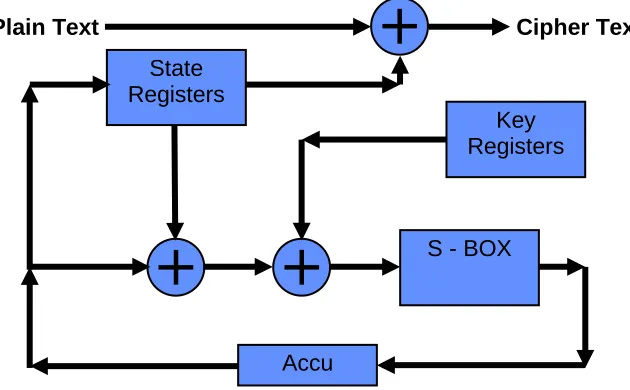
Hermes8 is based on the Substitution-Permutation-Network (SPN) principle [1,2,3,10]. The substitution (confusion) is performed by means of an S-BOX. The permutation and diffusion is performed by means of addressing the different state bytes, the different key bytes, and most importantly by the chaining with help of the Accu (Figure 1).
Figure 1. Principle of Hermes8 core operation round
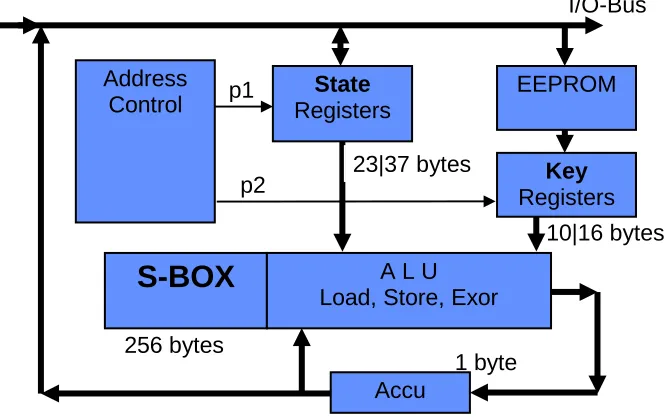
80 is based on 10 key bytes and 23 state bytes, whereas the larger Hermes8-128 contains 16 key bytes and 37 state bytes. There are two pointers involved: p1 addresses one of the state bytes, p2 addresses one of the key bytes (Figure 2). The pointers obey modulo addition operation in order to assure that they always address valid register space.
The core operation (sub-round) consists of
1. Select a certain state byte and EXOR it with Accu,
2. Select a certain key byte and EXOR it with the previous result, 3. Take the previous result and apply the S-BOX function, 4. Store the previous result in Accu,
5. Copy Accu into the same state byte selected in step1.
The S-BOX is 8-bit wide in order to provide the non-linear Boolean function needed for substitution, i.e. confusion [8,9]. One choice is the known SBOX of AES [4,5] which is strong w.r.t. Differential Cryptanalysis. – But random number based S-BOXes are also
S - BOX
Accu
Key
Registers
State
Registers
suitable, if their differential distribution table (ddt) demonstrates good quality [15, 23] with respect to DC attacks. Such random S-BOXes are especially interesting when algebraic attacks are successfully applied to AES in the future [24]…
Figure 2. Byte-Architecture of Hermes8 with registers, ALU, and S-BOX
Figure 3. Key Modification and Scheduling Method of Hermes8
The key bytes are modified every KEY_STEP3, i.e. seven steps, during the sub-round loops depending on the position of p2. The details are shown in Figure 3 : Two temporary pointers p3 and p4 are addressing the key bytes that following the byte
S - BOX
k[]
k[p2] k[p3]
k[p4]
k[]
k[]
k[]
S - BOX
1 byte
p1
p2
256 bytes
S-BOX
Accu
Key
Registers
State
Registers
I/O-Bus
A L U
Load, Store, Exor
EEPROM
Address
Control
addresses selected by p2. The byte k[p2] is not modified because it has to be used in the following sub-round. But the bytes k[p3] and k[p4] are ‘rather old’ and are therefore candidates for modification; they are replaced by SBOX[ k[p3] exor k[p2] ] and SBOX[ k[p4] exor k[p2] ] respectively. The exor’ing with k[p2] is advantageous over the direct application of the SBOX, because the inverse function of the SBOX does exist. Therefore, backtracking is hampered by means of this method. The dashed pointer in Figure 3 represents the next p2 position (because KEY_STEP1=3) when addressing the next key byte needed for the next sub-round.
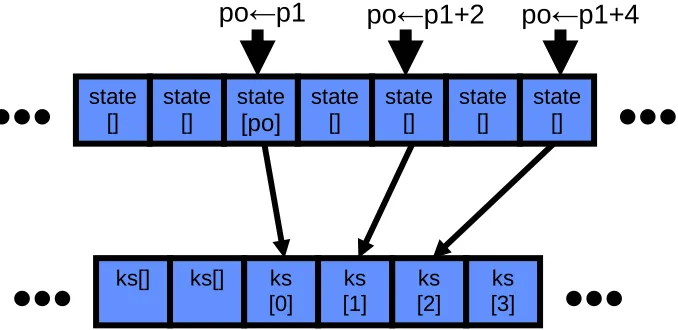
Figure 4 describes how the output bytes for the key stream ks[] are derived from the state bytes state[]. Since the pointer p1 has been incremented after the last sub-round, it points to the ‘oldest’ available state byte. This is the first byte to be packed into the key stream block of e.g. eight bytes for Hermes8-80 or sixteen bytes for Hermes8-128. Then further bytes follow by means of output pointer po, that is incremented by two in order to separate consecutive sub-round results from each other.
Since a new output block of key stream bytes does not follow earlier than the next STREAM_ROUNDS=3 are completed, the state byte contents corresponding to the same address are separated by 3 x 23 sub-rounds respectively 3 x 37 sub-rounds.
Figure 4. Output Function of Hermes8
During the 69 Hermes8-80 sub-rounds there are nearly ten occurrences of key modi-fication, i.e. about 20 key bytes are modified per output block in relation to ten key byte registers. --- During the 111 Hermes8-128 sub-rounds there are nearly 16 occurrences of key modification, i.e. about 32 key bytes are modified per output block in relation to 16 key byte registers.
A related mechanical model consists of two wheels. One has 23 teeth and needs 23 steps per round, the second one has only ten teeth, but rotates with a three-fold speed. When the first one has performed three rounds with 69 steps, the smaller one has rotated for 207 steps, i.e. nearly 21 turns.
state
[]
state
[po]
state
[]
state
[]
state
[]
state
[]
state
[]
ks[]
ks
[0]
ks
[1]
ks
[2]
ks[]
ks
[3]
2.2 Pseudo-Code of Hermes8-80
1 nx 23
2 nk 10
3 OUTPUTBYTES 8
4
5 INIT_ROUNDS 10
6 STREAM_ROUNDS 3
7 KEY_STEP1 3
8 KEY_STEP2 5
9 KEY_STEP3 7
10
11 k[] load( nk key bytes) 12 state[] load( nx IV bytes ) 13
14 p1 ( k[0] exor k[1] exor k[2] ) mod nx 15 p2 ( k[3] exor k[4] exor k[5] ) mod nk 16 accu k[6] exor k[7] exor k[8]
17 src ( k[9] exor k[0] exor k[3] ) mod KEY_STEP3
18 round 0
19
20 for INIT_ROUNDS do
21 begin
22 round round + 1
23 /* begin of core */ 24 for nx subrounds do
25 begin
26 accu accu exor state[p1] exor k[p2]
27 accu SBOX[ accu ]
28 state[p1] accu
29 p1 ( p1 + 1 ) mod nx
30 p2 ( p2 + KEY_STEP1 ) mod nk
31 src src + 1
32 if( src KEY_STEP3 )
33 then
34 begin /* two key modifications */
35 src src – KEY_STEP3
36 p3 ( p2 + 1 ) mod nk
37 p4 ( p3 + 1 ) mod nk
38 k[p3] SBOX[ k[p3] exor k[p2] ]
39 k[p4] SBOX[ k[p4] exor k[p2] ]
40 endif
41 endfor
42 if ( round mod KEY_STEP2 equal 0) then p2 ( p2 + 1 ) mod nk 43 /* end of core */
44 45
47 /* initialization completed */ 48
49 pc 0
50 for MAX_ROUNDS do
51 begin
52 for STREAM_ROUNDS do // corrected 14.Jul.2006
53 round round + 1 // corrected 14.Jul.2006 54 /* begin of core */
55 for nx subrounds do
56 begin
57 accu accu exor state[p1] exor k[p2]
58 accu SBOX[ accu ]
59 state[p1] accu
60 p1 ( p1 + 1 ) mod nx
61 p2 ( p2 + KEY_STEP1 ) mod nk
62 src src + 1
63 if( src KEY_STEP3 )
64 then
65 begin /* two key modifications */
66 src src – KEY_STEP3
67 p3 ( p2 + 1 ) mod nk
68 p4 ( p3 + 1 ) mod nk
69 k[p3] SBOX[ k[p3] exor k[p2] ]
70 k[p4] SBOX[ k[p4] exor k[p2] ]
71 endif
72 endfor
73 if ( round mod KEY_STEP2 equal 0) then p2 (p2+1) mod nk
74 /* end of core */
75 endfor
76 /* key stream round completed */ 77
78 po p1
79 for 1 to OUTPUTBYTES do
80 begin
81 ciphertext[pc] plaintext[pc] exor state[po] /* encrypt */
82 pc pc + 1
83 po (po + 2) mod nx
84 endfor
85 endfor
For Hermes8-128 only the three lines 1 - 3 are changed to nx 37, nk 16, and
OUTPUTBYTES 16.
MAX_ROUNDS (line 50) specifies how many multiples of OUTPUTBYTES bytes shall be encrypted. It is assumed that the plaintext is also a multiple of OUTPUTBYTES bytes, i.e. has been padded accordingly.
The encryption by means of the key stream bytes in the state register is shown in lines 53-84.
During ‘key streaming’ the inner core of the algorithm (54-74) is the same as described for the initialization phase (23-43). The number of rounds between the output of two blocks of key-stream bytes is defined by STREAM_ROUNDS.
The complete C-code of Hermes8 and some test environment C-code for SAC tests and FIPS 140-2 tests can be found in [21].
3 Security properties, security levels, attacks
3.1 Strict Avalanche Criterion
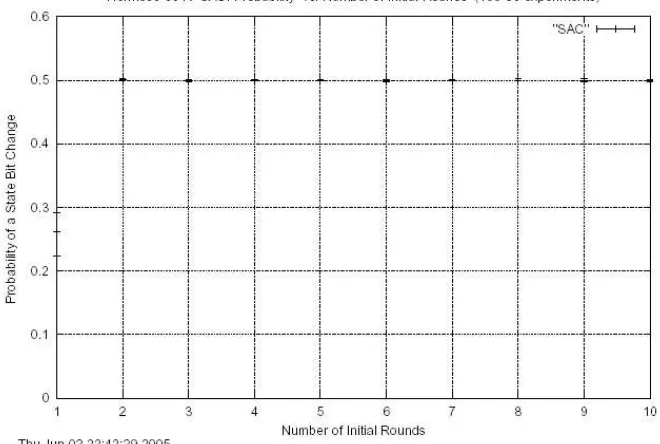
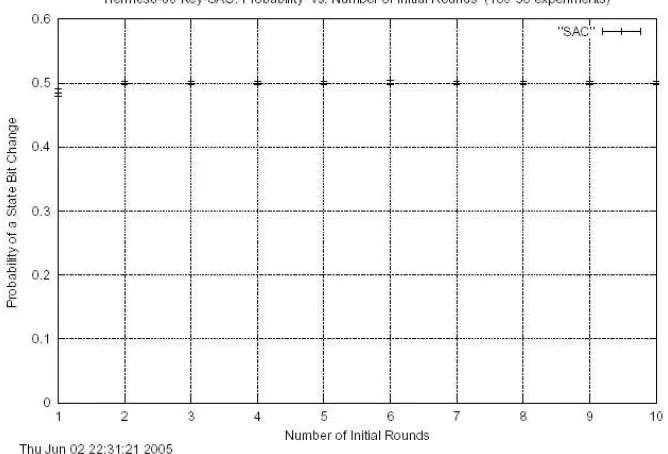
The initialization phase has been evaluated with respect to the Strict Avalanche Criterion (SAC) [1,10]. This has been done not only for the key sensitivity but also for the IV sensitivity. Only two rounds are needed to get very close to the 50% goal (see appendix A for the related SAC plots). If ten rounds are performed during the initialization, the security level is assumed to be so high, that only exhaustive search can find the correct key or IV value from known plaintext / cipher text pairs.
3.2 Differential and Linear Cryptanalysis
The algorithm has been tested for DC and LC weakness (sensitivity, affinity, correlation) with respect to the initialization phase of ten rounds. No problems were found.
Several parts of the output stream (e.g.192 bits) were applied to the Berlekamp-Massey algorithm. There was no exponential found below X^93 .
3.3 Random Number Quality tests
The algorithm has been tested for FIPS 140-2; no problems were found. The algorithm was also tested by means of the Diehard test suite; no problems could be discovered.
3.4 Some Attack Scenarios
In [22] some attacks on pseudorandom number generators (PRNG) are described: a) direct cryptanalytic attack, b) input-based attacks, c) state compromise extension attack. Since PRNGs are very similar to stream ciphers, the same attacks shall be considered here.
3.4.1 Direct Cryptanalytic Attack
3.4.2 Input-Based Attacks
An adversary might use the initialization phase and the IV value for known-input, replayed-input or chosen-input attacks. However, there is a stream cipher application rule that the first IV has to be chosen as a good random number; sub-sequent IVs might be derived from that, and no (IV, key)-pair must be used twice. – In Hermes8 the IV is not used to derive any initial pointer value or similar variable. -- Since the SAC properties are strong, it is assumed that input-based attacks are not more efficient than exhaustive search.
3.4.3 State Compromise Extension Attacks
The key stream consists of consecutive blocks of 8 bytes (Hermes8-80) or 16 bytes (Hermes8-128). Two consecutive blocks are separated by 69 sub-rounds respectively 111 sub-rounds. And during these 69 (111) steps the key bytes are modified 20 (32) times. This leads to a certain number of unknown bits, i.e. a certain complexity:
| b y t e s | b y t e s | | state state | state key | bits Version | nx nk output distance |unknown unknown | unknown Hermes8-80 | 23 10 8 69 | 61 20 | 648 Hermes8-128 | 37 16 16 111 | 95 32 | 1016
If the number of unknown bits is not enough, the algorithm can be made harder by extending the number of STREAM_ROUNDS to more than three.
3.5 Weak Keys
Due to the method of the key scheduling all keys with equal byte pattern are weaker than randomly generated keys.
Example: If the initial key is all zero we obtain for Hermes8-80 after the 10 initial rounds:
Key: 0x 4b 4b b0 4d ba 44 02 a0 f3 25
and for Hermes8-128 the related result is
Key: 0x a3 c2 ee bf 3a a3 b2 45 e0 70 1b a3 c2 ee bf 3a
The repetition of bytes here is also caused by the application of KEY_STEP3 = 5, i.e. the pointer p2 is only one time during initialization increased additionally. – Of course, one could change KEY_STEP3 from 5 to 1 for the initialization phase only, but generally the key bytes have to be produced by means of a good random number generator.
4 Design Choices, Strength and Advantages
The strength and advantages listed below are the result of the following design choices, options, and alternatives:
- Substitution Permutation Network (SPN), - Clarity of design, low complexity [20],
- Use of only registers, three pointers, EXORs, one S-BOX [8,9], small control logic, - Constants KEY_STEP1, 2, and 3 are chosen as primes not being factors of nx or nk, - Prevention against related key attacks [4] due to key modification/scheduling,
- Prevention against backtracking attacks [22] due to special key modification/scheduling, - No bit-shifting, no LFSRs in order to avoid slowdown of software implementations, - No additions, subtractions, multiplications, divisions in the core data flow,
- No constraint on IV length, beside nx as maximum, - Low-power architecture [16],
- Scalable architecture concept (StateSize > 37 bytes, KeySize > 16 bytes).
Strength:
- one 8x8 S-BOX (e.g. AES S-BOX), - the S-BOX is used in every sub-round [10], - the S-BOX is used for a specialized key scheduling, - every sub-round involves one state-byte and one key-byte, - no conditional branch is dependent directly on key content, - learned from AES [4,5,11,12].
Advantages:
- number crunching of bytes ( => fast on 8-bit micros), - no bit-shifting ! ( => high efficiency in software), - low complexity [20].
5 Computational efficiency
5.1 Computational efficiency in software
The following estimations are based on a an 8-bit microcomputer with two-operand instruction set and RISC architecture. The S-BOX access is assumed to be a one cycle operation, i.e. table look-up. The mod operation is performed by means of conditional subtraction; this is an important software speed-up compared to full modular division. The Key setup takes 1 cycle per byte. The setup of the primitive including the loading of the IV is described in details in appendix B1 and results in equation (1), i.e. N1, the number of cycles for the setup, is dependent on the state size and the number of initial rounds.
N1 = nx + 13 + INIT_ROUNDS • ( 3 + nx •14 + 1/7• nx • 13 + 2 ) (1)
The streaming part (see appendix B2) results in the number N2 of cycles needed to produce one block of key stream bytes and the related block of cipher text output bytes. Equation (2) shows the dependence of N2 on the state size and OUTPUTBYTES.
N2 = 3 • ( 3 + 2 + nx •14 + 1/7• nx • 13 + 2 ) + OUTPUTBYTES • 7 (2)
loop performance. Some savings can be obtained by means of loop un-rolling, e.g. reducing the cycle count by OUTPUTBYTES• 2 for the encryption loop.
cycles/byte vs. bytes processed for nx=23
0.00 100.00 200.00 300.00 400.00 500.00 600.00 700.00
0 50 100 150 200 250 300
bytes processed
c
y
c
le
s
/
b
y
te
cycles/byte
Figure 5. Cycles/byte versus bytes processed for Hermes8-80
cycles/byte vs. bytes processed for nx=37
0.00 100.00 200.00 300.00 400.00 500.00 600.00
0 50 100 150 200 250 300
bytes processed
c
y
c
le
s
/
b
y
te
cycles/byte
Figure 6. Cycles/byte versus bytes processed for Hermes8-128
5.2 Computational efficiency in hardware
the correct timing of the operations, especially the conditional modification of the key byte replacement by means of S-BOX application (line 63-71). This is described in detail in appendix C.
The resulting efficiency depends on the degree of parallelism reached and the amount of pipeline registers that are spent additionally. A performance of 16 bytes per 143 clock cycles seems reasonable, therefore (based on equation 3 and nx=37).
N3 = 3 • ( nx + 1/7• nx • 2 ) for OUTPUTBYTES (3)
6 Implementation items to avoid weaknesses
Compared to other ciphers, the literature about side-channel attacks on stream ciphers is rare; an overview is given in [18]. For Hermes8-80 and Hermes8-128 the following countermeasures are proposed:
a) When the key is loaded from non-volatile memory into the key byte array, the related bus should have bus-scrambling, or 2x8 wire differential drivers, or similar DPA [13,14] protection. b) The S-BOX should be implemented as ROM with pre-charge technique. This is favorable over the algebraic S-BOX [11,12] in GF(16) with three internal multipliers that are sensitive to products of zero. c) The Accu should be built with 16 DFFs, so that the inverted output of the S-BOX is stored as well and DPA attacks are hampered. d) All DFFs in the registers and Accu should be built in CSEM style [16] in order to avoid hazards and minimize DPA susceptibility.
e) The first IV must be generated by means of a TRNG, later IVs can be built by continuously incrementing the first IV [19].
7 Early Hardware Evaluations
An electrical Spice3 simulation was performed in an early design stage. The following hardware parts were connected for the simulation schematic:
- SBOX ROM 8 x 8 with pre-charged N-channel MOS transistor array - Accu ( 8 D-FlipFlops (DFFs) )
- State: one S-Register ( 8 DFFs)
- Eight capacitors ( as replacement for the other nx-1 state registers) - Key: one K-Register (instead of 8 multiplexers with nk inputs) - 16 EXOR gates
- One clock driver
Based on the models of a 0.35 CMOS DLP TLM process, a current consumption of only 5uA was obtained when simulating with f=500kHz, VCC=2V, models=typical, tempe-rature=27°C. -- However, the technology allows decreasing the VCC to the sum of one N-channel transistor threshold voltage and one P-channel transistor threshold voltage. This is especially advantageous because the power dissipation is proportional to the supply voltage squared, but only proportional to the clock frequency.
| 0.35 CMOS | process in [17] | _
Hermes8-80 | 1711 | 4026 | gates
Hermes8-128 | 2400 | 5946 | gates
The higher numbers regarding [17] are caused by the much higher gate count for the DFF compared to the 0.35 m CSEM DFF [16], i.e. 12 instead of 4.3 !
8 Conclusions
A new Stream Cipher module, Hermes8, is presented. Following the eSTREAM competition profile rules it comes in two designs: An 80 bit key version, and a 128 bit key version. Both versions fulfill the main criteria of security, efficiency, flexibility and clarity of design. The Hermes8 design is based on a byte-architecture of low complexity and serves low-power applications such as RFID and other embedded systems. Therefore, it is suited to run efficiently on 8-bit micro computers and dedicated hardware; and a comparison with other 32-bit algorithms seems to be difficult.
9 Outlook on Hermes16 and Hermes32
The algorithm principle is not only extendable w.r.t. the number of bytes for state and key, but also w.r.t. the word length of the registers. For example, an architecture with 16 bit words and two S-BOXes (resp. S-BOX calls) could be build with the same property of low complexity [15]. Especially interesting is the low-power processor MSP430 [25] in this case. - The same holds for an architecture with four S-BOXes (resp. S-BOX calls) on a 32-bit digital signal processor (DSP) such as the TMS320C2xxx or the TMS320C5xxx [26] where circular addressing is well supported. – A dedicated hardware can lead to a nearly four-fold throughput, then.
10 Acknowledgments
The author wants to thank for the kind support received from John Gordon, Vincent Rijmen, Christof Paar, Sean Murphy, and Matt Robshaw. Special thanks go to the three anonymous reviewers of the first Hermes8 version, the organizers of the SKEW 2005 workshop, Joan Daemen for the encouraging talk about Simplistic Stream Cipher Design [20], Christophe De Canniere for great C-code support, and Matt Henricksen for pointing to the pseudo code error (lines 52,53). -- Also special thanks go to the ECRYPT NoE for providing this interesting challenge.
References
[1] A. Menezes, P. van Oorschot, S. Vanstone, Handbook of Applied Cryptography, CRC Press, 1997
[2] D. Stinson, Cryptography - Theory and Practice, CRC Press, 1995 [3] B. Schneier, Applied Cryptography, Wiley, 1994
[4] J. Daemen, V. Rijmen, AES Proposal: Rijndael, Version 2, 03/09/99, 45 pages and related Reference Code in C
[5] NIST FIPS 197, Advanced Encryption Standard (AES), Nov. 26, 2001, 47 pages [6] NIST FIPS 140-2, Security Requirements for Cryptographic Modules, May 25, 2001, http://csrc.nist.gov/cryptval,
http://csrc.nist.gov/publications/fips/fips140-2/fips1402.pdf
[7] National Institute of Standards and Technology, FIPS PUB 140-2 Annex A: Approved Security Functions, www.nist.gov/cmvp.
[8] J. Seberry, X. Zhang, Y. Zheng, Pitfalls in Designing Substitution Boxes, Crypto'94, Aug. 1994, pp 383ff
[9] J. Gordon, A. Retkin, Are Big S-Boxes Best ?, IEEE Workshop on Communication Security, Santa Barbara, Cal. 1981, pp. 1-6
[10] H. Heys, S. Tavares, Substitution-Permutation Network Resistant to Differential and Linear Cryptanalysis, Journal of Cryptology, Vol. 9, No. 1, pp.1-19, 1996 [11] J. Rejeb, V. Ramaswamy, K. Ghadiri, Hardware Implementation of the Rijndael Algorithm for High-Speed Networks, ISPC 2003, March 2003, Dallas, 6 pages [12] H. Kuo, I. Verbauwhede, Architectural Optimization for a 1.82Gbits/sec VLSI Implementation of the AES Rijndael Algorithm, CHES 2001, LNCS 2162, pp. 51-64, Springer 2001
[13] Kocher, Jaffe, Jun, Differential Power Analysis, Advances in Cryptology, CRYPTO'99, LNCS 1666, Springer 1999, 10 pages
[14] Kocher, Evaluating Cryptosystems, 31 slides, Cryptography Research 2002, http://www.cryptography.com/resources/whitepapers/HackingCryptosystems.pdf [15] U. Kaiser, Universal Immobilizer Crypto Engine, “UICE, the little brother of AES”, http://www.aes4.org/english/events/aes4/downloads/AES_UICE_slides.pdf
[16] C. Piguet, Design of Low-Power Libraries, ICECS 1998
[17] L. Batina, J. Lano, N. Mentens, S. B. Oers, B. Preenel, I. Verbauwhede, Energy, performance, area versus security trade-offs for stream ciphers, ECRYPT workshop, SASC – The State of the Art of Stream Ciphers, Bruegge, 14.Oct.2004, 9 pages [18] S. Kumar, K. Lemke, C. Paar, Some Thoughts about Implementation Properties of Stream Ciphers, ECRYPT Workshop, SASC – The State of the Art of Stream Ciphers, Bruegge, 14.Oct.2004, 9 pages
[19] C. DeCanniere, J. Lano, B. Preneel, Comments on the Rediscovery of the Time Memory Data Tradeoffs, KUL, April 2005, 5 pages,
http://www.ecrypt.eu.org/stream/TMD.pdf
[20] J. Daemen, Simplistic Stream Cipher Design, Workshop on Symmetric Key Encryption, SKEW 2005, 26.+27.May.2005, Aarhus, Denmark
[21] U. Kaiser, Hermes8, eSTREAM, ECRYPT Stream Cipher Project, Report 2005/012, 2005, http://www.ecrypt.eu.org/stream
[22] J. Kelsey et al., Cryptanalytic Attacks on Pseudorandom Number Generators, Fast Software Encryption, FSE 1998, March 1998, pp.168-188
[23] U. Kaiser, UICE: A Low-Power High-Speed Cryptographic Module for RFID and Embedded Systems, Proceedings of European Conference on Circuit Theory and Design, ECCTD’05, Cork, Ireland, Aug.29-Sep.02, 2005
[24] N. Courtois, General principles of Algebraic Attacks and new Design Criteria for Cipher Components, Proceedings of AES 4, Bonn, Germany, May 2004, LNCS 3373
[25] MSP430 Data Sheets, http://www.ti.com -> Microcontrollers -> MSP430
Appendix
A Strict Avalanche Criterion (SAC) Plots with Min-Mean-Max
Figure A1. Strict Avalanche Criterion Test regarding IV variation for Hermes8-128
Figure A3. Strict Avalanche Criterion Test regarding key variation for Hermes8-128
B Computational efficiency in software
B1 Primitive Setup Part
1 cycle per byte loading the IV, padding with constant 12 cycles initialize pointers, counters, accu
1 cycle reset round counter
2 cycles loop control for INIT_ROUNDS
1 cycle increment round counter
2 cycles loop control for nx sub-rounds 2 cycles 2 times EXOR
1 cycle S-BOX accecss 1 cycle new state byte 3 cycles update p1
3 cycles update p2
1 cycle increment src 1 cycle conditional key
modification
1 cycle decrement src
3 cycles calculate p3
3 cycles calculate p4
3 cycles new k[p3]
3 cycles new k[p4]
2 cycles average conditional increment p2
B2 Streaming Part
2 cycles loop control for MAX_ROUNDS 1 cycle increment round counter 2 cycles loop control for
STREAM_ROUNDS
2 cycles loop control for nx sub-rounds 2 cycles 2 times EXOR
1 cycle S-BOX accecss 1 cycle new state byte 3 cycles update p1
3 cycles update p2
1 cycle increment src 1 cycle conditional key
modification
1 cycle decrement src
3 cycles calculate p3
3 cycles calculate p4
3 cycles new k[p3]
3 cycles new k[p4]
2 cycles average conditional increment p2
2 cycles loop control for encryption
1 cycle increment P/C pointer 3 cycle increment po pointer
C Computational efficiency in hardware
CLK rising edge operations:
52 round round + 1
/* the following three lines, if output is required */ 81 ciphertext[pc] plaintext[pc] exor state[po] /* enc. */
82 pc pc + 1
83 po (po + 2) mod nx
58a accu sbox_out
59 state[p1] sbox_out
57 address accu exor state[p1] exor k[p2]
CLK falling edge operations:
58b sbox_out S-BOX-TABLE[ address ]
60 p1 ( p1 + 1 ) mod nx
61 p2 ( p2 + KEY_STEP1 ) mod nk
82 src src + 1
73 if ( round mod KEY_STEP2 equal 0) then p2 ( p2 + 1 ) mod nk
The operations above are executed 7 times (KEY_STEP3); then the following has to be inserted :
66 src src – KEY_STEP3
67 p3 ( p2 + 1 ) mod nk
68 p4 ( p3 + 1 ) mod nk
69 k[p3] SBOX[ k[p3] exor k[p2] ]
70 k[p4] SBOX[ k[p4] exor k[p2] ]
that means
CLK rising edge operations:
/* p3 and p4 are always calculated in parallel to p2, line 61 */
69a address k[p2] exor k[p3]
CLK falling edge operations:
69b sbox_out S-BOX-TABLE[ address ]
50 src src - 7
CLK rising edge operations:
69c k[p3] sbox_out
70a address k[p2] exor k[p4]
CLK falling edge operations:
70b sbox_out S-BOX-TABLE[ address ]
CLK rising edge operations:
70c k[p4] sbox_out