PERSPECTIVES
Genetics of Sexual Development: An Evolutionary
Playground for Fish
Corina Heule, Walter Salzburger, and Astrid Böhne1 Zoological Institute, University of Basel, 4051 Basel, Switzerland
ABSTRACTTeleost fishes are the most species-rich clade of vertebrates and feature an overwhelming diversity of sex-determining mechanisms, classically grouped into environmental and genetic systems. Here, we review the recent findings in the field of sex determination infish. In the past few years, several new master regulators of sex determination and other factors involved in sexual development have been discovered in teleosts. These data point toward a greater genetic plasticity in generating the male and female sex than previously appreciated and implicate novel gene pathways in the initial regulation of the sexual fate. Overall, it seems that sex determination in fish does not resort to a single genetic cascade but is rather regulated along a continuum of environmental and heritable factors.
I
N contrast to mammals and birds, cold-bloodedverte-brates, and among them teleostfishes in particular, show
a variety of strategies for sexual reproduction (Figure 1), ranging from unisexuality (all-female species) to hermaph-roditism (sequential, serial, and simultaneous, including
outcrossing and selfing species) to gonochorism (two
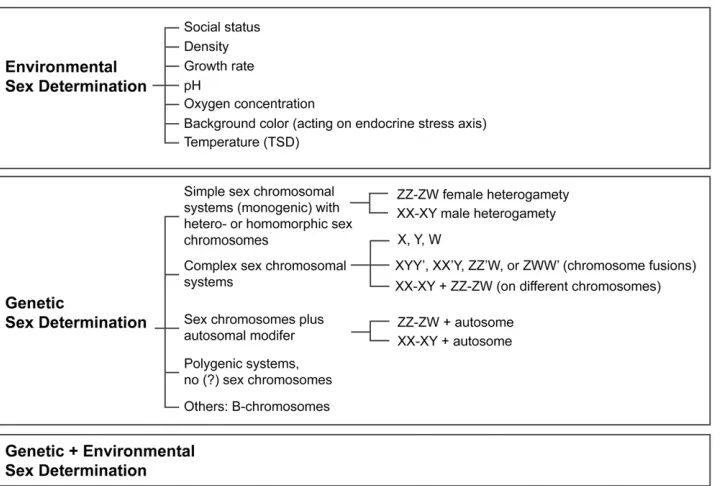
sep-arate sexes at all life stages). The underlying phenotypes are regulated by a variety of sex determination (SD) mechanisms that have classically been divided into two main categories: genetic sex determination (GSD) and environmental sex de-termination (ESD) (Figure 2).
Environmental factors impacting sex determination infish are water pH, oxygen concentration, growth rate, density, social state, and, most commonly, temperature (for a detailed review on ESD see,e.g., Baroilleret al.2009b and Stelkens and Wedekind 2010). As indicated in Figure 2, GSD systems
infish compose a variety of different mechanisms and have
been reviewed in detail elsewhere (e.g., Devlin and Nagahama 2002; Volffet al.2007).
The GSD systems that have received the most scientific
attention so far are those involving sex chromosomes, which either may be distinguishable cytologically (heteromorphic) or appear identical (homomorphic). In both cases, one sex is heterogametic (possessing two different sex chromosomes and hence producing two types of gametes) and the other
one homogametic (a genotype with two copies of the same sex chromosome, producing only one type of gamete). A male-heterogametic system is called an XX-XY system, and female-heterogametic systems are denoted as ZZ-ZW. Both types of heterogamety exist in teleosts and are even found side by side in closely related species [e.g., tilapias (Cnaani et al. 2008), ricefishes (Takehana et al. 2008), or
stickle-backs (Ross et al.2009)]; for more details on the
phyloge-netic distribution of GSD mechanisms in teleost fish, see
Manket al.(2006). Note that sex chromosomes infish are mostly homomorphic and not differentiated (Ohno 1974), which is in contrast to the degenerated Y and W chromo-somes in mammals (Graves 2006) and birds (Takagi and Sasaki 1974), respectively. This is one possible explanation for the viable combination of different sex chromosomal systems within a single species or population offish (Parnell and Streelman 2013) and could be a mechanistic reason why sex chromosome turnovers occur easily and frequently
in this group (Mank and Avise 2009). Additionally, fish can
have more complex sex chromosomal systems involving more than one chromosome pair (see Figure 2). Even within
a singlefish species, more than two sex chromosomes may
occur at the same time, or more than two types of sex
chro-mosomes may co-exist in the same species (Schultheiset al.
2006; Cioffi et al. 2013), which can sometimes be due to
chromosome fusions (Kitano and Peichel 2012).
Detailed insights on the gene level for GSD/sex chromo-somal systems are currently available for only a limited number offish species, and all but one of these cases involve
Copyright © 2014 by the Genetics Society of America doi: 10.1534/genetics.114.161158
a rather simple genetic system with male heterogamety and one major sex determiner (see below). The only exception is the widely used model species zebrafish (Danio rerio), which has a polyfactorial SD system implicating four dif-ferent chromosomes (chromosomes 3, 4, 5, and 16) (Bradley et al.2011; Andersonet al.2012) and also environmental cues (Shanget al.2006).
In this review, we focus on newly described genetic sex-determining systems and possible mechanisms allowing their
emergence infishes, which are the most successful group of
vertebrates with30,000 species.
Genetic Basis of Sex Determination
Classic view on sexual development
The conventional definition of GSD states that the sex of an
individual is fixed upon fertilization by inherited genetic
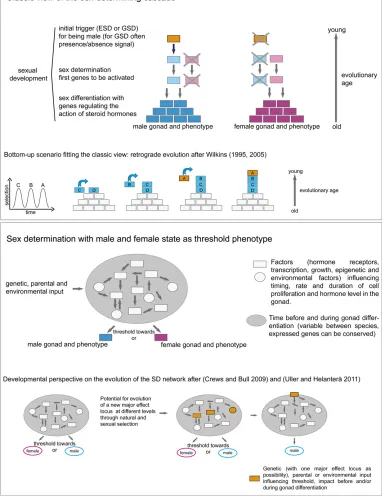
factors. The establishment of the corresponding sexual phe-notype is subsequently achieved through sexual development. The process of sexual development has classically been divided into sex determination and sex differentiation. Determination is understood as the “master” switch (initial inherited factor) that causes thefirst steps of the SD cascade, which then activate further downstream genes of sexual dif-ferentiation, which themselves regulate steroid hormone pro-duction, eventually leading to one functional gonad type with the corresponding sexual phenotype (Figure 3, top). In this scenario, the master switch functions as a presence–absence signal, in which the presence initiates the cascade to actively produce one sex, whereas the absence causes the other sexual differentiation program, which has long been considered as the default sex. However, this view has recently been chal-lenged in, for example, mammals, where female development also needs active gene regulation and feedback loops (Munger and Capel 2012).
In the classic view, the SD cascade is considered to have evolved stepwise, in a retrograde fashion, with the
down-stream genetic network evolving first (and remaining
con-served over time and between species), and new genes subsequently and independently added to the top of the hierarchy in different species/lineages (bottom-up theory) (Wilkins 1995, 2005) (Figure 3, top). That major changes occur frequently at the top of the cascade are substantiated by the observation that even closely relatedfish species (e.g., of the same genus/family) do not share the same master SD gene (e.g., the ricefishes, genusOryzias) (Kondoet al.2004). However, the hypothesis of the existence of a conserved genetic cascade of SD common to all vertebrates governed
by different lineage or species-specific genes [“masters
change, slaves remain (Grahamet al.2003)] is largely based on sequence conservation in the downstream genes and conserved expression patterns for a handful of genes such as the testis-specificdmrt1(Smithet al.1999).
Sex as a threshold phenotype based on a sex-determining network
More and more data reveal that, especially in teleostfishes, sex seems to be a rather plastic phenotype with natural and inducible sex reversal even after the geneticfixation of one sex at fertilization (Paul-Prasanthet al.2013). These results thus question the scenario of a stepwise, hierarchical
cas-cade with a fixed outcome. Instead, it has been suggested
that sex should be interpreted as a threshold trait with Figure 1 Reproductive strategies infish. Fish can be grouped according
triggers (genetic, parental, or environmental) acting on a“parliament of interacting gene networks”(Crews and Bull 2009) and hormones (Uller and Helanterä 2011; Schwanz et al.2013), resulting in a rather complex interplay between different signals (Figure 3, bottom). Importantly, gene net-works are not necessarily hierarchical but rather modular (for review and further extension of this idea, see Salazar-Ciudad 2009 and Barabasi and Oltvai 2004). Assuming an interconnected network of genes and other factors impact-ing sex, the emergence of new sex determiners should be viewed from a developmental perspective (Figure 3, bottom), which allows for the emergence of major effect loci at dif-ferent levels/nodes of the network.
In the next section, we present the current models for the evolution of such major-effect loci and our extension of these to a network concept of sex determination.
Suggested Mechanisms for the Emergence of New Master Sex Determination Genes
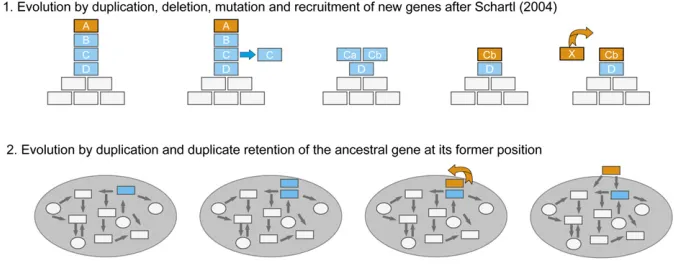
Based on the view of sex determination as a hierarchical cascade, the model of Schartl (2004) suggests that a new master SD gene can arise via a combination of gene dupli-cation, sequence change (coding or regulatory), and (up-) recruitment [Figure 4, scenario 1 after (Schartl 2004)]. However, similar mechanisms of genetic changes, based mainly on duplication and subsequent mutation and espe-cially without the loss of one of the duplicates, could also work with sex determination relying on a network of genes and must not necessarily occur only at the top of a cascade (Figure 4, scenario 2). These two ideas are rather mecha-nistic. More generally, the observation that similar/related genes, which are implicated in sexual development in several
species, are recruited as master regulators (mainly dm-domain and HMG-domain transcription factors) led Marshall Graves
and Peichel (2010) to put forward the “limited options”
hypothesis. They suggested that a pool of genes/chromo-somes “good at doing the job”might exist and be preferen-tially reused repeatedly in the vertebrate lineage (although in different combinations) rather than that“any”gene could be recruited as a master SD gene. As indicated in Figure 2, teleostfish are a particularly attractive system to study these models for the evolution of SD networks and their master genes.
Currently, detailed genetic information on male SD genes is available for six teleost species that we will discuss in detail in the next paragraph.
New master sex-determining genes in teleosts: dmY and gsdf in the Oryzias genus:
The best-studied SD gene in fish is the second vertebrate
master SD gene that was described after the discovery of the
mammalianSrygene, namelydmrt1by/dmy,DM-domain gene
on the Y chromosome, which acts as the master sex determiner
in two species of the genus Oryzias [the medaka, Oryzias
latipes, and the Malabar ricefish, O. curvinotus (Matsuda et al. 2002; Nandaet al. 2002)].Dmyis not present in any otherfish species studied so far, not even in the closely related Oryzias species (Kondoet al.2003). Dmyarose in the com-mon ancestor ofO. latipesand its sister speciesO. curvinotus andO. luzonensisbetween 1062 and 1862 million years ago through a segmental duplication of a small autosomal
region containing its precursor gene dmrt1 [a gene with
followed by the insertion of the duplicated region on the proto-Y chromosome, directly creating a region of suppressed recombination. Outside of the relatively small sex-determining
region (258 kb), in whichdmyremained the only functional
gene, recombination is not suppressed between the medaka
X and Y chromosomes (Brunner et al. 2001; Kondoet al.
2006). Dmy is often cited as a typical example of an
up-recruited SD gene, as is DM-W in the frog Xenopus laevis
and possibly dmrt1 in birds. It is derived from a gene that
has already been implicated in testis formation and male de-velopment,dmrt1, agreeing with the idea of limited options
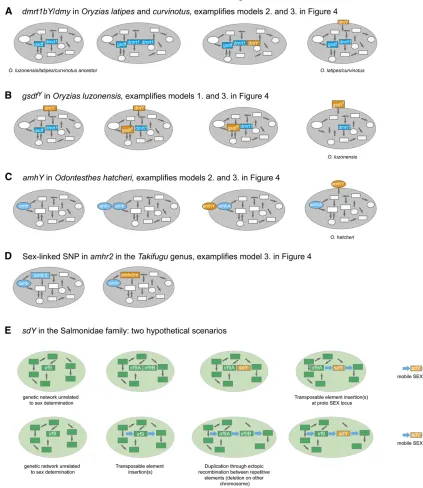
for controlling sex determination. The mechanism of its evo-lution as a master SD gene likely followed the one described in Figure 4B.
In a closely related Oryziasspecies, O. luzonensis, which
has lost dmY, Myosho et al. (2012) identified a derived
version of the gonadal soma derived growth factor (gsdf) as the male master sex determiner. The gene has a Y- and X-chromosome-specific allele, called gsdfY and gsdfX. Gene
expression experiments revealed an overexpression of gsdfY
gsdfYandgsdfXvary by 12 nucleotide substitutions, but all
are silent. The male expression is thus likely caused by a mutation in a cis-regulatory region of gsdfY. Myosho et al.
(2012) speculate that this mutation could involve a change in a putative binding site for steroidogenic factor 1 (Sf1), causing a loss of the binding site ingsdfYbut not ingsdfX.
This change could lead to the observed higher expression during an earlier stage of sexual development compared to its ancestral counterpart. Transgenic transformation with gsdfY
constructs led to XX males in O. luzonenis(as well as in its sister speciesO. latipeswith a different SD gene), confirming a master sex-determining role for this gene. InO. luzonensis,
gsdfY thus seems to have functionally replaced dmY. Note
that theO. luzonensisgenome harbors a pseudogenized copy
of dmrt1 called Oludmrt1p, in addition to the autosomal dmrt1 gene (Oludmrt1). However, this pseudogene is lo-cated on a chromosome that is not syntenic to the Y chro-mosome ofO. latipes. It is therefore likely thatO. luzonensis
has lost dmY from its genome and that Oludmrt1p is an
independent pseudogene copy of dmrt1 (Kondoet al. 2004;
Tanakaet al.2007).
In contrast to dmY, gsdfis not a transcription factor but a member of the TGF-bsuperfamily and specific tofish [it is present in all available teleost genomes and in the
sarcop-terygian Latimeria but not in tetrapods (Forconi et al.
2013)]. InO. latipesmales,gsdfis transcribed at 6 days post fertilization in the primodial gonad and colocalized with
dmy in the somatic cells (Sertoli cells) of the adult male
gonad (Shibata et al. 2010). This suggests that gsdf acts
rather early [indeed, it is expressed earlier than dmrt1]
(Kobayashi et al. 2004)], which possibly facilitated its
re-cruitment as a master SD gene. Functional data for gsdf
are still limited, but it has been implicated with the prolif-eration of primordial germ cells (PGCs) and spermatogonia
in the rainbow trout (Sawatari et al.2007) and it possibly
acts during female-to-male sex change, promoting prolifer-ation of spermatogonia and spermatogenesis in the wrasse Halichoeres trimaculatus (Horiguchi et al. 2013).
Further-more, gsdf turns out to be a good candidate for the
sex-determining locus in a member of another fish genus, the
sablefish Anoplopoma fimbria (Rondeau et al. 2013),
why a gene that is not a transcription factor has been
recruited as a master SD gene and could, at least in fish,
represent support for the limited options hypothesis.
amhY and amhr2: Two other newly described sex
deter-miners, amhy andamhr2, also belong to the TGF-b
super-family. amhy is a gene duplicate of amh (anti-Müllerian
hormone) found on the Y chromosome of the Patagonian pejerrey,Odontesthes hatcheri. This gene has a 557-bp long
insertion in the third intron and 92.2% sequence identity on
the amino acid level compared to the autosomal copy (amha
for amh autosomal) (Hattori et al. 2012). Hattori et al.
(2012) showed that amhyis expressed during gonadal
for-mation starting at 6 days after fertilization whereasamhais
expressed later (12 weeks after fertilization). amhy
tran-scripts are located in somatic cells (likely Sertoli cells) sur-rounding germ cells in the developing male gonad, a typical
expression pattern for SD genes. Knockdown ofamhyin XY
embryos led to an up-regulation of female factors and, con-sequently, to the development of ovaries (Hattoriet al.2012). Theamhr2(amh receptor 2) gene has been identified as possible third nontranscription factor master SD gene in the
tiger pufferfish, Takifugu rubripes (Kamiya et al. 2012).
Here, a single nucleotide polymorphism (SNP) in the kinase
domain ofamhr2has been associated with sex, with males
being heterozygous and females homozygous. This sex-specific SNP, which changes an amino acid (His384 to Asp384), is also associated with sex in two otherTakifuguspecies (T. pardalis andT. poecilonotus), which diverged around 5 million years ago fromT. rubripes. The authors suggest that sex in the tiger
pufferfish is determined by a combination of the twoamhr2
alleles, with the Y allele being dominant.
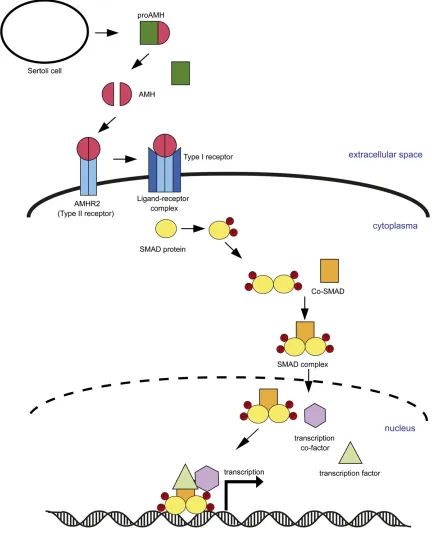
AMH is a secreted glycoprotein of the TGF-bsuperfamily
best studied in tetrapods, where it is produced by the Sertoli cells and causes regression of Müllerian ducts during male sexual development (Jossoet al.2001; Reyet al.2003; Johnson et al. 2008). AMH signaling functions through its primary receptor, AMHR2, which, upon AMH-binding, induces the as-sembly of a receptor complex eventually, activating expression of target genes (Jossoet al.2001) (see Figure 6 for details).
Althoughfish possess amhandamhr2, they lack
Mülle-rian ducts. In fish, the AMH-signaling pathway has been
implicated in PGC proliferation and spermatogenesis, simi-lar to the function proposed for Gsdf (Morinagaet al.2007).
In general, AMH signaling infish could decrease the number
of germ cells (Morinagaet al.2007; Leeet al.2009), which
in some species, such as the medaka or zebrafish, are
crucial for gonadal fate determination (Kurokawa et al.
2007; Siegfried and Nüsslein-Volhard 2008) with more germ cells leading to a female gonad. However, this seems not to be a general mechanism infish (Fujimotoet al.2010; Gotoet al.2012). Another proposed mechanism of action for
AMH/AMHR2 in fish is through the activation of the
aroma-tase enzyme that synthesizes estrogens from androgens as has
been described in mammals (Di Clementeet al.1992). Higher
estrogen levels result in ovary differentiation in fish (Devlin and Nagahama 2002). A suppression of the estrogen produc-tion by AMH/AMHR2 signaling on the aromatase could thus decrease estrogen levels and so promote testis formation.
amhy, likedmY, exemplifies the mechanism of gene du-plication for the formation of new master SD genes. Based
on the limited data available, members of the TGF-b
super-family (gsdf,amh, andamhr2) could be part of the limited
options for master SD genes, at least in fish. However, the
options for the evolution of new SD genes in fish could be
less limited as the next example suggests.
sdY in the salmonid family:The fourth newly discovered sex regulator infish issdY(sexually dimorphic on the Y chromosome) in the rainbow trout,Oncorhynchus myskiss(Yanoet al.2012). This gene is thefirst example of a SD gene not related to a gene that was already implicated with sexual development and,
hence, could be an example for functional de novo evolution
(Yano et al.2012).sdYshows sequence similarity toirf9 (
in-terferon regulatory factor 9), a transcription factor that acts in the immune system (Yanoet al.2012). The presence ofsdYwas
confirmed in 15 salmonid species, and male sex linkage was
found for 13 of these (Yano et al. 2013). Interestingly, the Y chromosomes in the investigated salmonid species are not syntenic, and hence the SD locus is located on different chro-mosomes. Before the discovery ofsdY, the idea of a (likely small) conserved but mobile SD locus had been put forward for the salmonid family as a possible explanation for the fact that dif-ferent chromosomes showed sex linkage in difdif-ferent species
(Davidson et al. 2009) and even within species (Moghadam
et al.2007; Küttneret al.2011; Eisbrenneret al.2013). To conclude this section, support for the limited-options
theory comes certainly from dmy [duplication ofdmrt1, a
gene involved in development of testis in vertebrates and
retention of dmrt1 at its ancestral position (Kondo et al.
2006)], and possibly alsoamhy[duplication ofamh, a gene
that is responsible for the degeneration of the Müllerian ducts in male mammals (Klattig and Englert 2007) and re-tention of its ancestor amha], gsdfY [derived from gsdf, a
gene involved in the proliferation and differentiation of germ cells in fish (Gautieret al.2011a)], andamhr2[a re-ceptor involved in the AMH pathway in vertebrates (Klattig and Englert 2007)]. By contrast,irf9, the next most closely
related gene to the salmonid SD gene sdY, has not been
implicated in SD before and so could have been added on top of a conserved genetic network at a later stage.
Further Flexibility in the Network: Variation in Downstream Gene Usage
Until recently, the steps following the initiation of sex determination were thought to follow a rather well-orchestrated and conserved cascade of genes (some of them candidates for the limited options) controlling sexual development
mainly via the action of steroid hormones (Lange et al.
2002; Nakamura 2010; Angelopoulouet al.2012;
Moroha-shi et al. 2013). Among the most prominent examples of apparently conserved genes of sexual development are dmrt1 (Matson and Zarkower 2012) and sox9 (Morrish
and Sinclair 2002; Kobayashi et al.2005) for testis
forma-tion and wnt4 (Smith et al. 2008) and the aromatase
cyp19a1 (Valenzuela et al. 2003; Diotel et al. 2010) for
ovary development. However, recent data from variousfish
species suggest that, in addition to theflexibility at the top of the cascade, even these key elements are not as conserved as previously assumed. This is evidenced by varying and
species-specific expression patterns between sexes and
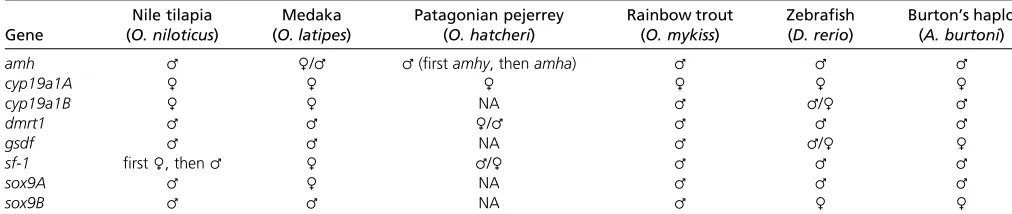
throughout development (see,e.g., Vizzianoet al.2007; Ijiri et al.2008; Haleet al.2011; Herpinet al.2013; and Table 1).
For example, sox9and the aromatasecyp19a1show
expres-sion patterns in East African cichlidfishes that are not con-sistent with conserved testis and ovary functions, respectively (Böhneet al.2013).
into estrogens and was thought to control the female and male pathway by its presence or absence in expression, re-spectively (Guiguen et al. 2010). After the teleost-specific genome duplication, teleost fish retained two copies of this
gene (cyp19a1A andcyp19a1B), which are active in ovary
and brain tissue, respectively. Some derived East African
cichlid species express the otherwise ovary-specific gene
cyp19a1A in testis (Böhne et al. 2013). This finding asks for a critical revision of the hormonal control of sexual differentiation.
Interlinking GSD and ESD
Interestingly, steroid hormones, or the regulation of their production, are a putative link between ESD and GSD
(Nakamura 2010; Angelopoulouet al.2012), withcyp19a1
being a prime candidate (Valenzuelaet al.2013).
Navarro-Martín et al.(2011) have recently investigated the
methyl-ation levels of the aromatase (cyp19a1A) promoter in the
European sea bass, Dicentrarchus labrax, a species with
a polygenic SD system influenced by temperature (Vandeputte et al.2007). They found that thecyp19a1Apromoter in males features twice as many methylated sites compared to females, leading to an under-expression of this gene in males. The methylation rate is positively correlated with water tempera-ture, and temperature-masculinizedfish (i.e., sex-reversed ge-netic females) have a higher methylation rate and lower levels ofcyp19a1Aexpression.
In some species thought to have GSD, temperature has been shown to impact sex ratios (e.g., the Nile tilapia) (Baroiller et al.2009a). Furthermore, some species previously thought to have ESD were later found to have genetic mechanisms of sex determination (Ospina-Álvarez and Piferrer 2008). This has led to a controversial discussion about the occurrence of true or obligate temperature-dependent sex determination (TSD) in fish. A critical evaluation of the available data on the prevalence
of TSD in fish (Ospina-Álvarez and Piferrer 2008) suggested
two prerequisites to a true TSD system: (1) there must be the absence of sex chromosomes and (2) the temperature shifts influencing sex ratios must occur during decisive developmental steps. Based on these assumptions, TSD in fish appears to be much less widespread than previously thought with many ob-served cases involving (extreme) temperatures that lie outside the naturally occurring range (Ospina-Álvarez and Piferrer 2008). However, the two assumptions seem rather strict, given the fact that sex infish is often not stable but can change
even after juvenile stages. Baroiller et al. (2009b)
sug-gested, in a less strict way, the classification of TSD fish species into three categories: (1) species with strong GSD and an absence of, or weak sensitivity to, temperature; (2) species that are highly sensitive to temperature or other environmental factors; and (3) species that are sensitive
to several environmental cues. This definition seems to
better reflect the empirical data and offers another part
of the framework toward a new understanding of the mechanisms driving sex determination systems and their evolution.
Conclusion
Considering the recentfindings of a substantialflexibility in expression and timing in the downstream network of sexual differentiation, the diversity of master SD genes found in
fish and the co-influence of genetic and environmental
factors, we think that it is time to redefine our understand-ing of the SD cascade. An attempt into this direction has recently been made by proposing that one should not strictly distinguish between sex determination and sex differentia-tion (Uller and Helanterä 2011). Instead, the entire process should be seen as a continuum in which all factors (genetic, maternal, and environmental) work together in a nonhierar-chical network to ultimately form a male or female pheno-type. This process would be canalized toward the male or female fate above a certain sex-specific threshold of genetic and environmental interactions influencing cell proliferation and hormonal levels (Figure 3, top). An extreme canaliza-tion of this process can result in the evolucanaliza-tion of one or more major-effect locus/loci, such as the master SD genes de-scribed earlier. However, this does not have to happen, as reflected by the polygenic SD system in the zebrafish.
Interestingly, this view also offers a developmental expla-nation for how factors that, at thefirst glance, seemed unlikely
master regulators, such as the members of the TGF-bfamily
gsdf,amh, and amhr2, could become important in sex
de-termination. The evolution of the TGF-bfamily members as
master SD genes, although not acting as transcription fac-tors, might simply reflect their previous involvement in the regulation of timing, rate, and duration of cell proliferation (in the developing gonad) and interaction with steroidogen-esis, as described for their ancestral genes (Teixeira et al.
1999; Yamamotoet al.2002; Sawatariet al.2007; Shiraishi
et al.2008). For example,amhaandamhyare spatially
colo-calized but not temporally (Hattori et al. 2012), providing
Table 1 Variation in gene expression profiles of sexual development genes in major teleost model species
Gene
Nile tilapia (O. niloticus)
Medaka (O. latipes)
Patagonian pejerrey (O. hatcheri)
Rainbow trout (O. mykiss)
Zebrafish (D. rerio)
Burton’s haplo (A. burtoni)
amh ♂ ♀/♂ ♂(firstamhy, thenamha) ♂ ♂ ♂
cyp19a1A ♀ ♀ ♀ ♀ ♀ ♀
cyp19a1B ♀ ♀ NA ♂ ♂/♀ ♂
dmrt1 ♂ ♂ ♀/♂ ♂ ♂ ♂
gsdf ♂ ♂ NA ♂ ♂/♀ ♀
sf-1 first♀, then♂ ♀ ♂/♀ ♂ ♂ ♂
sox9A ♂ ♀ NA ♂ ♂ ♂
sox9B ♂ ♂ NA ♂ ♀ ♀
Data:Oreochromis niloticus(Kobayashiet al.2008; Ijiriet al.2008; Baroilleret al.2009a; Poonlaphdechaet al.2011, 2013; Taoet al.2013;http://www.uniprot.org/uniprot/ E9RGV7),Oryzias latipes(Suzukiet al.2004; Klüveret al.2005; Nakamotoet al.2007; Shibataet al.2010; Siegfried 2010; Okuboet al.2011; Nakamuraet al.2012),
Odontesthes hatcheri(Hattoriet al.2013),Oncorhynchus mykiss(Baronet al.2005; Sawatariet al.2007; Gohinet al.2011; Vizziano-Cantonnetet al.2011),D. rerio(Chiang
et al.2001; Guoet al.2005; Von Hofsten and Olsson 2005; Kallivretakiet al.2007; Siegfried 2010; Gautieret al.2011b; Nakamuraet al.2012),Astatotilapia burtoni(Böhne
one example of how a change in timing of expression could lead to the up-recruitment of a seemingly downstream factor. To understand the evolution of sex-determining networks— and possibly there is not only one cascade of SD but rather several network modules that are slightly rewired to
ever-new combinations—we have to understand the different
steps of sexual development and their interconnections (see Table 1 for a first approach to understanding shifts in gene
expression in fish). In this context, the network modules
could also be considered as limited options; however, we are far away from understanding where the limits really are, especially infish.
We suggest a critical rethinking of the current models for the evolution of sex-determining genes with a stronger focus on the interactions further downstream in the network. All currently proposed models aim to explain switches in the master control genes without considering the dynamics of the subsequent networks. Hence, much effort has been put toward the identification of new“masters,”especially infish. Why SD systems are so extremely divergent and why turnovers of sex-determining systems are so seemingly frequent infish remains to be answered. We propose regarding the SD pathway as a whole and not considering only its master switches as an isolated phenomenon when investigating these systems.
Acknowledgments
The authors thank Catherine Peichel for discussion and valuable comments on the manuscript. WS was supported by the University of Basel, the Swiss National Science Foundation (SNF) and the European Research Council (ERC), AB was supported by the Forschungsfonds of the University of Basel and the VolkswagenStiftung.
Literature Cited
Anderson, J. L., A. Rodríguez Marí, I. Braasch, A. Amores, P. Hohenlohe
et al., 2012 Multiple sex-associated regions and a putative sex chromosome in zebrafish revealed by RAD mapping and popu-lation genomics. PLoS ONE 7: e40701.
Angelopoulou, R., G. Lavranos, and P. Manolakou, 2012 Sex de-termination strategies in 2012: Towards a common regulatory model? Reprod. Biol. Endocrinol. 10: 13.
Barabasi, A.-L., and Z. N. Oltvai, 2004 Network biology: under-standing the cell’s functional organization. Nat. Rev. Genet. 5: 101–113.
Baroiller, J. F., H. D’Cotta, E. Bezault, S. Wessels, and G.
Hoerstgen-Schwark, 2009a Tilapia sex determination: where
tempera-ture and genetics meet. Comp. Biochem. Physiol. A Mol. Integr. Physiol. 153: 30–38.
Baroiller, J. F., H. D’Cotta, and E. Saillant, 2009b Environmental effects onfish sex determination and differentiation. Sex Dev. 3: 118–135.
Baron, D., R. Houlgatte, A. Fostier, and Y. Guiguen, 2005 Large-scale temporal gene expression profiling during gonadal differen-tiation and early gametogenesis in rainbow trout. Biol. Reprod. 73: 959–966.
Böhne, A., C. Heule, N. Boileau, and W. Salzburger, 2013
Ex-pression and sequence evolution of aromatase cyp19a1 and
other sexual development genes in East African cichlid fishes. Mol. Biol. Evol. 30: 2268–2285.
Bradley, K. M., J. P. Breyer, D. B. Melville, K. W. Broman, E. W. Knapik et al., 2011 An SNP-based linkage map for zebrafish reveals sex determination loci. G3 (Bethesda) 1: 3–9.
Brunner, B., U. Hornung, Z. Shan, I. Nanda, M. Kondo et al., 2001 Genomic organization and expression of the doublesex-related gene cluster in vertebrates and detection of putative regulatory regions for DMRT1. Genomics 77: 8–17.
Chiang, E. F.-L., Y.-L. Yan, Y. Guiguen, J. Postlethwait, and B.-c.
Chung, 2001 Two Cyp19 (P450 aromatase) genes on
dupli-cated zebrafish chromosomes are expressed in ovary or brain. Mol. Biol. Evol. 18: 542–550.
Cioffi, M. B., T. Liehr, V. Trifonov, W. F. Molina, and L. A. Bertollo, 2013 Independent sex chromosome evolution in lower verte-brates: a molecular cytogenetic overview in the Erythrinidaefish family. Cytogenet. Genome Res. 141: 186–194.
Cnaani, A., B. Y. Lee, N. Zilberman, C. Ozouf-Costaz, G. Hulata
et al., 2008 Genetics of sex determination in tilapiine species. Sex Dev. 2: 43–54.
Crews, D., and J. J. Bull, 2009 Mode and tempo in environmental sex determination in vertebrates. Semin. Cell Dev. Biol. 20: 251– 255.
Davidson, W. S., T. K. Huang, K. Fujiki, K. R. von Schalburg, and B. F. Koop, 2009 The sex determining loci and sex chromo-somes in the family Salmonidae. Sex Dev. 3: 78–87.
Devlin, R. H., and Y. Nagahama, 2002 Sex determination and sex differentiation infish: an overview of genetic, physiological, and environmental influences. Aquaculture 208: 191–364.
di Clemente, N., S. Ghaffari, R. B. Pepinsky, C. Pieau, N. Jossoet al., 1992 A quantitative and interspecific test for biological activity of anti-Mullerian hormone: the fetal ovary aromatase assay. De-velopment 114: 721–727.
Diotel, N., Y. L. Page, K. Mouriec, S.-K. Tong, E. Pellegrini et al., 2010 Aromatase in the brain of teleostfish: expression, regula-tion and putative funcregula-tions. Front. Neuroendocrinol. 31: 172–192. Eisbrenner, W. D., N. Botwright, M. Cook, E. A. Davidson, S. Dominik
et al., 2013 Evidence for multiple sex-determining loci in Tas-manian Atlantic salmon (Salmo salar) Heredity (Edinb.). DOI: 10.1038/hdy.2013.55.
Fan, Y.-S., Y.-J. Hu, and W.-X. Yang, 2012 TGF-b superfamily: how does it regulate testis development. Mol. Biol. Rep. 39: 4727–4741.
Forconi, M., A. Canapa, M. Barucca, M. A. Biscotti, T. Capriglione
et al., 2013 Characterization of sex determination and sex dif-ferentiation genes inLatimeria. PLoS ONE 8: e56006.
Fujimoto, T., T. Nishimura, R. Goto-Kazeto, Y. Kawakami, E. Yamaha
et al., 2010 Sexual dimorphism of gonadal structure and gene expression in germ cell-deficient loach, a teleostfish. Proc. Natl. Acad. Sci. USA 107: 17211–17216.
Gautier, A., F. Le Gac, and J.-J. Lareyre, 2011a Thegsdfgene locus harbors evolutionary conserved and clustered genes pref-erentially expressed infish previtellogenic oocytes. Gene 472: 7–17.
Gautier, A., F. Sohm, J.-S. Joly, F. Le Gac, and J.-J. Lareyre, 2011b The proximal promoter region of the zebrafish gsdf
gene is sufficient to mimic the spatio-temporal expression pat-tern of the endogenous gene in Sertoli and granulosa cells. Biol. Reprod. 85: 1240–1251.
Gohin, M., P. Bodinier, A. Fostier, F. Chesnel, and J. Bobe, 2011 Aro-matase is expressed and active in the rainbow trout oocyte during
final oocyte maturation. Mol. Reprod. Dev. 78: 510–518. Goto, R., T. Saito, T. Takeda, T. Fujimoto, M. Takagiet al., 2012 Germ
cells are not the primary factor for sexual fate determination in goldfish. Dev. Biol. 370: 98–109.
Graves, J. A. M., 2006 Sex chromosome specialization and degen-eration in mammals. Cell 124: 901–914.
Guiguen, Y., A. Fostier, F. Piferrer, and C.-F. Chang, 2010 Ovarian aromatase and estrogens: a pivotal role for gonadal sex differ-entiation and sex change infish. Gen. Comp. Endocrinol. 165: 352–366.
Guo, Y., H. Cheng, X. Huang, S. Gao, H. Yuet al., 2005 Gene structure, multiple alternative splicing, and expression in go-nads of zebrafish Dmrt1. Biochem. Biophys. Res. Commun. 330: 950–957.
Hale, M., P. Xu, J. Scardina, P. Wheeler, G. Thorgaard et al., 2011 Differential gene expression in male and female rainbow trout embryos prior to the onset of gross morphological differ-entiation of the gonads. BMC Genomics 12: 404.
Hattori, R. S., Y. Murai, M. Oura, S. Masuda, S. K. Majhi et al.,
2012 A Y-linked anti-Müllerian hormone duplication takes
over a critical role in sex determination. Proc. Natl. Acad. Sci. USA 109: 2955–2959.
Hattori, R. S., C. A. Strussmann, J. I. Fernandino, and G. M. Somoza, 2013 Genotypic sex determination in teleosts: insights from the testis-determiningamhygene. Gen. Comp. Endocrinol. 192: 55– 59.
Herpin, A., M. C. Adolfi, B. Nicol, M. Hinzmann, C. Schmidtet al., 2013 Divergent expression regulation of gonad development genes in medaka shows incomplete conservation of the down-stream regulatory network of vertebrate sex determination. Mol. Biol. Evol. 30: 2328–2346.
Horiguchi, R., R. Nozu, T. Hirai, Y. Kobayashi, Y. Nagahamaet al., 2013 Characterization of gonadal soma-derived factor expres-sion during sex change in the protogynous wrasse,Halichoeres trimaculatus. Dev. Dyn. 242: 388–399.
Ijiri, S., H. Kaneko, T. Kobayashi, D.-S. Wang, F. Sakai et al., 2008 Sexual dimorphic expression of genes in gonads during early differentiation of a teleostfish, the Nile tilapiaOreochromis niloticus. Biol. Reprod. 78: 333–341.
Johnson, P. A., T. R. Kent, M. E. Urick, and J. R. Giles,
2008 Expression and regulation of anti-Mullerian hormone
in an oviparous species, the hen. Biol. Reprod. 78: 13–19. Josso, N., N. di Clemente, and L. Gouédard, 2001 Anti-Müllerian
hormone and its receptors. Mol. Cell. Endocrinol. 179: 25–32. Kallivretaki, E., R. I. L. Eggen, S. C. F. Neuhauss, O. Kah, and H.
Segner, 2007 The zebrafish, brain-specific, aromatasecyp19a2
is neither expressed nor distributed in a sexually dimorphic man-ner during sexual differentiation. Dev. Dyn. 236: 3155–3166. Kamiya, T., W. Kai, S. Tasumi, A. Oka, T. Matsunaga et al.,
2012 A trans-species missense SNP inamhr2is associated with sex determination in the tiger pufferfish, Takifugu rubripes
(Fugu). PLoS Genet. 8: e1002798.
Kikuchi, K., and S. Hamaguchi, 2013 Novel sex-determining
genes in fish and sex chromosome evolution. Dev. Dyn. 242: 339–353.
Kitano, J., and C. Peichel, 2012 Turnover of sex chromosomes and speciation infishes. Environ. Biol. Fishes 94: 549–558. Klattig, J., and C. Englert, 2007 The Müllerian duct: recent
in-sights into its development and regression. Sex Dev. 1: 271–278. Klüver, N., M. Kondo, A. Herpin, H. Mitani, and M. Schartl, 2005 Divergent expression patterns ofSox9duplicates in tele-osts indicate a lineage specific subfunctionalization. Dev. Genes Evol. 215: 297–305.
Kobayashi, A., H. A. O. Chang, M.-C. Chaboissier, A. Schedl, and R. R. Behringer, 2005 Sox9 in testis determination. Ann. N. Y. Acad. Sci. 1061: 9–17.
Kobayashi, T., M. Matsuda, H. Kajiura-Kobayashi, A. Suzuki, N.
Saitoet al., 2004 Two DM domain genes,DMYandDMRT1,
involved in testicular differentiation and development in the medaka,Oryzias latipes. Dev. Dyn. 231: 518–526.
Kobayashi, T., H. Kajiura-Kobayashi, G. Guan, and Y. Nagahama,
2008 Sexual dimorphic expression ofDMRT1andSox9a
dur-ing gonadal differentiation and hormone-induced sex reversal in the teleost fish Nile tilapia (Oreochromis niloticus). Dev. Dyn. 237: 297–306.
Kondo, M., I. Nanda, U. Hornung, S. Asakawa, N. Shimizu et al.,
2003 Absence of the candidate male sex-determining gene
dmrt1b(Y) of medaka from other fish species. Curr. Biol. 13: 416–420.
Kondo, M., I. Nanda, U. Hornung, M. Schmid, and M. Schartl, 2004 Evolutionary origin of the medaka Y chromosome. Curr. Biol. 14: 1664–1669.
Kondo, M., U. Hornung, I. Nanda, S. Imai, T. Sasaki et al., 2006 Genomic organization of the sex-determining and adjacent regions of the sex chromosomes of medaka. Genome Res. 16: 815–826.
Kurokawa, H., D. Saito, S. Nakamura, Y. Katoh-Fukui, K. Ohtaet al., 2007 Germ cells are essential for sexual dimorphism in the medaka gonad. Proc. Natl. Acad. Sci. USA 104: 16958–16963. Küttner, E., J. Nilsson, S. Skúlason, S. Gunnarsson, M. M. Ferguson
et al., 2011 Sex chromosome polymorphisms in Arctic charr and their evolutionary origins. Genome 54: 852–861.
Kuwamura, T., and Y. Nakashima, 1998 New aspects of sex
change among reeffishes: recent studies in Japan. Environ. Biol. Fishes 52: 125–135.
Lange, I. G., A. Hartel, and H. H. D. Meyer, 2002 Evolution of oestrogen functions in vertebrates. J. Steroid Biochem. Mol. Biol. 83: 219–226.
Lee, K. H., A. Yamaguchi, H. Rashid, K. Kadomura, S. Yasumoto
et al., 2009 Germ cell degeneration in high-temperature treated pufferfish,Takifugu rubripes. Sex Dev. 3: 225–232.
Mank, J. E., and J. C. Avise, 2009 Evolutionary diversity and turn-over of sex determination in teleostfishes. Sex Dev. 3: 60–67. Mank, J. E., D. E. L. Promislow, and J. C. Avise, 2006 Evolution of
alternative sex-determining mechanisms in teleostfishes. Biol. J. Linn. Soc. Lond. 87: 83–93.
Marshall Graves, J. A., and C. L. Peichel, 2010 Are homologies in vertebrate sex determination due to shared ancestry or to lim-ited options? Genome Biol. 11: 205.
Matson, C. K., and D. Zarkower, 2012 Sex and the singular DM domain: insights into sexual regulation, evolution and plasticity. Nat. Rev. Genet. 13: 163–174.
Matsuda, M., Y. Nagahama, A. Shinomiya, T. Sato, C. Matsuda
et al., 2002 DMY is a Y-specific DM-domain gene required for male development in the medakafish. Nature 417: 559–563. Moghadam, H. K., M. M. Ferguson, and R. G. Danzmann, 2007 Linkage variation at the sex-determining locus within Fraser strain Arctic charr Salvelinus alpinus. J. Fish Biol. 71: 294–301.
Morinaga, C., D. Saito, S. Nakamura, T. Sasaki, S. Asakawaet al., 2007 The hotei mutation of medaka in the anti-Müllerian hor-mone receptor causes the dysregulation of germ cell and sexual development. Proc. Natl. Acad. Sci. USA 104: 9691–9696. Morohashi, K., T. Baba, and M. Tanaka, 2013 Steroid hormones
and the development of reproductive organs. Sex Dev. 7: 61–79. Morrish, B., and A. Sinclair, 2002 Vertebrate sex determination:
many means to an end. Reproduction 124: 447–457.
Munger, S. C., and B. Capel, 2012 Sex and the circuitry: progress toward a systems-level understanding of vertebrate sex deter-mination. Wiley Interdiscip. Rev. Syst. Biol. Med. 4: 401–412. Myosho, T., H. Otake, H. Masuyama, M. Matsuda, Y. Kurokiet al.,
2012 Tracing the emergence of a novel sex-determining gene in medaka,Oryzias luzonensis. Genetics 191: 163–170. Nakamoto, M., D.-S. Wang, A. Suzuki, M. Matsuda, Y. Nagahama
Nakamura, M., 2010 The mechanism of sex determination in ver-tebrates: Are sex steroids the key-factor? J. Exp. Zool. A Ecol. Genet. Physiol. 313: 381–398.
Nakamura, S., I. Watakabe, T. Nishimura, A. Toyoda, Y. Taniguchi
et al., 2012 Analysis of medakasox9orthologue reveals a con-served role in germ cell maintenance. PLoS ONE 7: e29982. Nanda, I., M. Kondo, U. Hornung, S. Asakawa, C. Winkler et al.,
2002 A duplicated copy ofDMRT1in the sex-determining re-gion of the Y chromosome of the medaka,Oryzias latipes. Proc. Natl. Acad. Sci. USA 99: 11778–11783.
Navarro-Martín, L., J. Viñas, L. Ribas, N. Díaz, A. Gutiérrezet al., 2011 DNA methylation of the gonadal aromatase cyp19a pro-moter is involved in temperature-dependent sex ratio shifts in the European sea bass. PLoS Genet. 7: e1002447.
Ohno, S., 1974 Animal Cytogenetics. Borntraeger, Berlin. Okubo, K., A. Takeuchi, R. Chaube, B. Paul-Prasanth, S. Kanda
et al., 2011 Sex differences in aromatase gene expression in the medaka brain. J. Neuroendocrinol. 23: 412–423.
Ospina-Álvarez, N., and F. Piferrer, 2008 Temperature-dependent sex determination infish revisited: prevalence, a single sex ratio response pattern, and possible effects of climate change. PLoS ONE 3: e2837.
Parnell, N. F., and J. T. Streelman, 2013 Genetic interactions controlling sex and color establish the potential for sexual
con-flict in Lake Malawi cichlidfishes. Heredity (Edinb.) 110: 239– 246.
Paul-Prasanth, B., R. K. Bhandari, T. Kobayashi, R. Horiguchi, Y. Kobayashiet al., 2013 Estrogen oversees the maintenance of the female genetic program in terminally differentiated gono-chorists. Sci. Rep.3:2862.
Poonlaphdecha, S., E. Pepey, S. H. Huang, M. Canonne, L. Soler
et al., 2011 Elevatedamhgene expression in the brain of male tilapia (Oreochromis niloticus) during testis differentiation. Sex Dev. 5: 33–47.
Poonlaphdecha, S., E. Pepey, M. Canonne, H. de Verdal, J. F. Baroiller et al., 2013 Temperature induced-masculinisation in the Nile tilapia causes rapid up-regulation of both dmrt1
andamhexpressions. Gen. Comp. Endocrinol.
Rey, R., C. Lukas-Croisier, C. Lasala, and P. Bedecarrás, 2003 AMH/ MIS: what we know already about the gene, the protein and its regulation. Mol. Cell. Endocrinol. 211: 21–31.
Rondeau, E., A. Messmer, D. Sanderson, S. Jantzen, K. von Schalburg
et al., 2013 Genomics of sablefish (Anoplopoma fimbria): ex-pressed genes, mitochondrial phylogeny, linkage map and
identi-fication of a putative sex gene. BMC Genomics 14: 452. Ross, J. A., J. R. Urton, J. Boland, M. D. Shapiro, and C. L. Peichel,
2009 Turnover of sex chromosomes in the sticklebackfishes (Gasterosteidae). PLoS Genet. 5: e1000391.
Sakurai, M., S. Nakakoji, H. Manabe, S.-i. Dewa, A. Shinomiya
et al., 2009 Bi-directional sex change and gonad structure in the gobiidfishTrimma yanagitai. Ichthyol. Res. 56: 82–86. Salazar-Ciudad, I., 2009 Looking at the origin of phenotypic
var-iation from pattern formation gene networks. J. Biosci. 34: 573– 587.
Sawatari, E., S. Shikina, T. Takeuchi, and G. Yoshizaki, 2007 A novel transforming growth factor-b superfamily member ex-pressed in gonadal somatic cells enhances primordial germ cell and spermatogonial proliferation in rainbow trout ( Oncorhyn-chus mykiss). Dev. Biol. 301: 266–275.
Schartl, M., 2004 Sex chromosome evolution in non-mammalian
vertebrates. Curr. Opin. Genet. Dev. 14: 634–641.
Schultheis, C., Q. Zhou, A. Froschauer, I. Nanda, Y. Selz et al., 2006 Molecular analysis of the sex-determining region of the platyfishXiphophorus maculatus. Zebrafish 3: 299–309. Schwanz, L. E., T. Ezaz, B. Gruber, and A. Georges, 2013 Novel
evolutionary pathways of sex-determining mechanisms. J. Evol. Biol. 26: 2544–2557.
Shang, E. H. H., R. M. K. Yu, and R. S. S. Wu, 2006 Hypoxia
affects sex differentiation and development, leading to a male-dominated population in zebrafish (Danio rerio). Environ. Sci. Technol. 40: 3118–3122.
Shibata, Y., B. Paul-Prasanth, A. Suzuki, T. Usami, M. Nakamoto
et al., 2010 Expression of gonadal soma derived factor (GSDF) is spatially and temporally correlated with early testicular dif-ferentiation in medaka. Gene Expr. Patterns 10: 283–289. Shiraishi, E., N. Yoshinaga, T. Miura, H. Yokoi, Y. Wakamatsuet al.,
2008 Müllerian inhibiting substance is required for germ cell proliferation during early gonadal differentiation in medaka (Oryzias latipes). Endocrinology 149: 1813–1819.
Siegfried, K. R., 2010 In search of determinants: gene expression during gonadal sex differentiation. J. Fish Biol. 76: 1879–1902. Siegfried, K. R., and C. Nüsslein-Volhard, 2008 Germ line control of female sex determination in zebrafish. Dev. Biol. 324: 277–287. Smith, C. A., P. J. McClive, P. S. Western, K. J. Reed, and A. H.
Sinclair, 1999 Evolution: conservation of a sex-determining gene. Nature 402: 601–602.
Smith, C., C. Shoemaker, K. Roeszler, J. Queen, D. Crews et al., 2008 Cloning and expression ofR-Spondin1in different verte-brates suggests a conserved role in ovarian development. BMC Dev. Biol. 8: 72.
Stelkens, R. B., and C. Wedekind, 2010 Environmental sex rever-sal, Trojan sex genes, and sex ratio adjustment: conditions and population consequences. Mol. Ecol. 19: 627–646.
Suzuki, A., M. Tanaka, and N. Shibata, 2004 Expression of aro-matase mRNA and effects of aroaro-matase inhibitor during ovarian development in the medaka, Oryzias latipes. J. Exp. Zool. A Comp. Exp. Biol. 301A: 266–273.
Takagi, N., and M. Sasaki, 1974 A phylogenetic study of bird karyotypes. Chromosoma 46: 91–120.
Takehana, Y., S. Hamaguchi, and M. Sakaizumi, 2008 Different ori-gins of ZZ/ZW sex chromosomes in closely related medakafishes,
Oryzias javanicusandO. hubbsi. Chromosome Res. 16: 801–811. Tanaka, K., Y. Takehana, K. Naruse, S. Hamaguchi, and M. Sakaizumi,
2007 Evidence for different origins of sex chromosomes in closely relatedOryziasfishes: substitution of the master sex-determining gene. Genetics 177: 2075–2081.
Tao, W., J. Yuan, L. Zhou, L. Sun, Y. Sun et al., 2013 Char-acterization of gonadal transcriptomes from Nile tilapia ( Oreo-chromis niloticus) reveals differentially expressed genes. PLoS ONE 8: e63604.
Teixeira, J., E. Fynn-Thompson, A. H. Payne, and P. K. Donahoe, 1999 Müllerian-inhibiting substance regulates androgen synthe-sis at the transcriptional level. Endocrinology 140: 4732–4738. Uller, T., and H. Helanterä, 2011 From the origin of sex-determining
factors to the evolution of sex-determining systems. Q. Rev. Biol. 86: 163–180.
Valenzuela, N., D. C. Adams, and F. J. Janzen, 2003 Pattern does not equal process: Exactly when is sex environmentally deter-mined? Am. Nat. 161: 676–683.
Valenzuela, N., J. Neuwald, and R. Literman, 2013
Tran-scriptional evolution underlying vertebrate sexual development. Dev. Dyn. 242: 307–319.
Vandeputte, M., M. Dupont-Nivet, H. Chavanne, and B. Chatain,
2007 A polygenic hypothesis for sex determination in the
European sea bassDicentrarchus labrax. Genetics 176: 1049– 1057.
Vizziano, D., G. Randuineau, D. Baron, C. Cauty, and Y. Guiguen, 2007 Characterization of early molecular sex differentiation in rainbow trout,Oncorhynchus mykiss. Dev. Dyn. 236: 2198– 2206.
in monosex rainbow trout populations. Gen. Comp. Endocrinol. 170: 346–355.
Volff, J. N., I. Nanda, and M. Schartl, 2007 Governing sex deter-mination infish: regulatory putsches and ephemeral dictators. Sex Dev. 1: 85–99.
von Hofsten, J., and P.-E. Olsson, 2005 Zebrafish sex determina-tion and differentiadetermina-tion: involvement of FTZ-F1 genes. Reprod. Biol. Endocrinol. 3: 63.
Wilkins, A., 1995 Moving up the hierarchy: A hypothesis on the evolution of a genetic sex determination pathway. Bioessays 17: 71–77.
Wilkins, A. S., 2005 Recasting developmental evolution in terms of genetic pathway and network evolution. . .and the implica-tions for comparative biology. Brain Res. Bull. 66: 495–509.
Yamamoto, N., L. K. Christenson, J. M. McAllister, and J. F. Strauss, 2002 Growth differentiation factor-9 inhibits 3959-adenosine monophosphate-stimulated steroidogenesis in human granulosa and theca cells. J. Clin. Endocrinol. Metab. 87: 2849–2856. Yano, A., R. Guyomard, B. Nicol, E. Jouanno, E. Quillet et al.,
2012 An immune-related gene evolved into the master
sex-determining gene in rainbow trout,Oncorhynchus mykiss. Curr. Biol. 22: 1423–1428.
Yano, A., B. Nicol, E. Jouanno, E. Quillet, A. Fostier et al.,
2013 The sexually dimorphic on the Y-chromosome gene
(sdY) is a conserved male-specific Y-chromosome sequence in many salmonids. Evol. Appl. 6: 486–496.