ABSTRACT
ZHANG, QIANG. The Smart Agent-based Model in Urban Growth Problems. (Under the direction of Dr. Raju Vatsavai).
As per United Nations (UN) projections, it is expected that another 2.5 billion will be
added to the urban populations by 2050. Urban growth models were widely employed to
study urban expansion. In this study, we present a framework for the integration of an
agent-based model (ABM) with the popular cellular automata (CA) based FUTure
Urban-Regional Environment (FUTURES) model. This thesis addresses one of the key challenges
in urban growth modeling, which is to capture the communication and behavior of agents
in order to infer the agent’s intent to develop a land parcel. With the interaction between
agent-based model and urban growth model, we simulated the decision-making process
of landowners when dealing with the urban development.
Many existing agent-based model frameworks were implemented using traditional
shared and distributed memory programming models. On the other hand, recent Apache
Spark is becoming a popular platform for distributed big data in-memory analytic. This
thesis presents an implementation of agent-based sub-model in Apache Spark framework.
With the in-memory computation, Spark implementation outperforms the traditional
distributed memory implementation using MPI. This report provides (i) an overview of
our framework capable of running urban growth simulations at a fine resolution of
30-meter grid cells, (ii) a scalable approach using Apache Spark to implement an agent-based
model for simulating human decisions, and (iii) the comparative analysis of performance
© Copyright 2019 by Qiang Zhang
The Smart Agent-based Model in Urban Growth Problems
by Qiang Zhang
A thesis submitted to the Graduate Faculty of North Carolina State University
in partial fulfillment of the requirements for the Degree of
Master of Science
Computer Science
Raleigh, North Carolina
2019
APPROVED BY:
Dr. Munindar P. Singh Dr. Steffen Heber
DEDICATION
This is dedicated to my grandparents, Shuxiang Jiang and Jinyi Kang, who believe in me
and inspire me, who love me and have supported me every step of the way.
"Cross the Bridge when you get to it, in the end things will mend." Without their comfort, I
BIOGRAPHY
Qiang Zhang received his bachelor’s degree in telecom engineering in University of Science
and Technology Beijing. After graduation, he joined a mobile security company and had
been working as malware analyst for 3 years. He attended North Carolina State University
in 2013, joining STAC Lab under the advice and Dr. Raju.
His thesis projects were focused on Agent-based model and high performance
ACKNOWLEDGEMENTS
I would like to express my sincere, heartfelt thanks to my supervisor, Dr. Raju Vatsavai, for
introducing me to the fantastic world of Geospatial Sciences, continually guiding me and
giving me his invaluable advice, constant encouragement and precise modification on this
road.
Besides my advisor, I would like to thank Center of Geospatial Analytics, for their
in-sightful help and guidance of this work.
And also, my sincere appreciation to all of my friends, especially Ziqi Diao, M.J Mu and
Binyuan Wu whom friendly encourage me in writing the thesis. When time gets tough, I
TABLE OF CONTENTS
LIST OF TABLES . . . vii
LIST OF FIGURES. . . viii
Chapter 1 INTRODUCTION. . . 1
Chapter 2 Samrt Agents in Urban Growth Simulation . . . 5
2.1 Related Work . . . 5
2.2 Methods . . . 9
2.2.1 Study Area . . . 9
2.2.2 Data Description . . . 11
2.2.3 Framework Structure . . . 12
2.3 FUTURES . . . 13
2.4 Model Drivers . . . 17
2.4.1 Demographic Data . . . 17
2.4.2 Land Market . . . 18
2.4.3 GIS Data . . . 20
2.5 Agent-based Model . . . 21
2.5.1 Agents Conceptualization . . . 21
2.5.2 Agents Decision Rules . . . 22
2.5.3 Agents Neighbor Influence . . . 24
2.5.4 Agent’s Bargain Process . . . 24
2.6 Experiments . . . 25
2.6.1 Validate Metrics . . . 25
2.6.2 Train the Model . . . 27
2.6.3 Simulation . . . 29
2.7 Results and Analysis . . . 32
Chapter 3 Build ABM on Apache SPARK. . . 34
3.1 Problem Statement . . . 34
3.2 Methodology . . . 37
3.2.1 Formulas . . . 38
3.2.2 Agent-based Model . . . 42
3.3 Model Overview . . . 44
3.3.1 Model Design Concepts . . . 44
3.3.2 Model Details . . . 44
3.3.3 FUTURES . . . 48
3.3.4 the FLAME . . . 48
3.4 Experiment . . . 52
3.4.1 System Description . . . 52
3.4.2 Data Description . . . 53
3.4.3 Experiment Results . . . 53
3.5 Discussion . . . 54
3.5.1 Result Analysis . . . 56
3.5.2 Limitations of the FLAME . . . 57
Chapter 4 Conclusion . . . 60
LIST OF TABLES
Table 2.1 Model Comparison . . . 7
Table 2.2 Comparison of median value of land (per sqrt feet) value distribution before and after the interpolation . . . 19
Table 2.3 Neighborhood Influence for multi-label approach . . . 24
Table 2.4 Logistic Regression result . . . 28
Table 2.5 CART result . . . 28
Table 2.6 SVM result . . . 29
Table 2.7 Bayesian Network result . . . 29
Table 2.8 Random Forest result . . . 30
Table 2.9 Simulation Result without Neighborhood Influence . . . 31
Table 2.10 Simulation Result with Neighborhood Influence . . . 31
Table 2.11 Simulation Result with Neighborhood Influence and Bargain . . . 32
Table 3.1 Computation Time for Different Core Number with the FLAME Frame-work . . . 54
LIST OF FIGURES
Figure 2.1 Cabarrus County, NC, USA . . . 10
Figure 2.2 The communication between ABM and CA in each time step . . . 12
Figure 2.3 The FUTURES land change modeling framework[Mee13] . . . 14
Figure 2.4 Cabarrus land value trend for zip code (2004-2006) . . . 19
Figure 2.5 Agent-based model conceptualization . . . 22
Figure 2.6 Allocation agreement illustration . . . 26
Figure 2.7 Willingness agreement illustration . . . 27
Figure 2.8 Prediction accuracy with land value increase rate change . . . 30
Figure 2.9 Error propagation observation . . . 33
Figure 3.1 Example of landscape cell, landscape parcel and parcel neighborhood 36 Figure 3.2 Communication between Urban Growth Simulator and Human In-volvement Simulator for Rounds . . . 37
Figure 3.3 Human involvement module communicates with urban growth model 38 Figure 3.4 Working flow of urban growth model and human involvement simu-lating module for one-time step . . . 40
Figure 3.5 The logic flow of the FLAME . . . 49
Figure 3.6 Flow illustration when implementing with the FLAME . . . 50
CHAPTER
1
INTRODUCTION
In recent years, some UGMs have simulated the urban growth tendency. However, some of
the work focuses on only one driver of urbanization[PF08] [Rom99] [KC03]. We believe that a realistic model of urban growth needs multiple driving factors and a means of modeling
interactions between individual stakeholders in order to address the social factors involved
in urbanization.
To achieve this goal of simulating urban growth to predict the area of urban
develop-ment, agent-based models (ABM) could provide such advantages to present and model the
urbanization growth with the multiple factors as economic status, individual
bottom up where all the individual computational elements are designated as an agent.
The behavior of the system can be integrated from micro-level interactions of the agents.
ABMs are widely used in various application domains, including but not limited to, biology,
economy, psychology and crowd behavior studies. Simulations with ABM can obtain not
only the result of the whole simulating system but also the snapshot of each agent in the
system, which could help us understand the underlying relationships of the system further.
An agent-based model seeks to simulate the complex global behaviors via the most
atomic units: individual, autonomous decision makers known as agents. The micro-level
decisions involved in modeling agents manifest themselves globally in the aggregate
be-havior of the individual agents. We view this perspective as a natural way of modeling both
the individual development decisions and the social factors involved. Besides, simulations
involving ABMs allow aggregate behavior to be understood at any level of granularity since
the underlying drivers are happening at the lowest level and not from the "top down."
However, with the explosive growth of data involved in the simulation, more and more
computational resources are required, especially in the geospatial application domain. In
this paper, we build an ABM to simulate the decision-making procedure of the landowners
in urban growth problems.
Our central goal in this work is to develop a discrete time-stepped intelligent agent model
that couples urban growth with individual stakeholder decisions and takes demographic,
economic and geographic information into account as driving factors. In addition, we
also seek to demonstrate the application of machine learning algorithms in the modeling
process. In our ABM design, we fully consider and conceptualize the possible principal
elements that may affect the landowners’ decisions in urban development. For a more
accurate simulation, we use not merely the landowner’s properties as computation input,
into account as well. All the core characters are shaped into heterogeneous agents. In order
to compare the computation performance, our module is built with both Apache Spark and
a generic agent-based modeling platform, the FLAME, which supports message passing
interface (MPI) and can be executed on multiple hardware and software platforms.
We make the following specific contributions:
• We implemented an ABM based on Apache Spark, which dramatically accelerates
the simulation speed compared to the prevailing ABM framework the FLAME.
• We couple an ABM with a cellular automata (CA) model (FUTURES). The interaction
between the two modules facilitates the ability of stakeholders to detect and analyze
the change of the conditions. By doing this, we reduce the error propagation with
better initial predictions.
• We implement an ABM to simulate the decision-making process in the urban growth
process. Also, each agent in the system is given the ability to make an intelligent and
more accurate decision by analyzing and understanding the historical urban growth
patterns from the data over time.
• We specify a multi-level decision hierarchy instead of outputting yes/no decision for the stakeholders. Such design enhances the ability of stakeholders to make more
flexible and intelligent decisions.
• We add a bargaining process in the urban development process between
landown-ers and developlandown-ers. Our results indicate that this strategy could better capture the
stakeholders’ behavior and conduct a more realistic simulation.
This thesis is mainly divided into two parts. In the first parts, we integrate the smart
improve the model with more accurate prediction. And the second part covers an approach
to make the urban growth simulation model execute faster by implementing Agent-based
CHAPTER
2
SAMRT AGENTS IN URBAN GROWTH
SIMULATION
2.1
Related Work
CA models are used to represent the urban and regional growth along with many other
technologies.[Ars13]proposed a hybrid model consisting logistic regression model, Markov chain (MC) and Cellular automaton (CA) to enhance the performance of traditional urban
urban growth trend of various land use classes. And[Fen16]also came up with a refined CA model which integrated partial least square regression (PLS-CA) and geographical
informa-tion systems (GIS). The introducinforma-tion of new algorithms and technologies could improve the
accuracy of the urban growth prediction, but in some circumstances, people would like to
understand the process of urbanization in a micro-level simulation. The urban growth and
neighborhood influence were estimated through calibrated parameters, which reflect only
the landscape features implicitly[CG98] [Cla97] [Cou97] [Bat07]. As a bottom-up model, CA cannot represent well macro-scale political, economic and cultural driving forces that
influence urban growth[War00] [MS00]and[CH89]argued that the local economy has a significant impact on the urban growth, specifically mentioned the house price and land
market.
Some existing CA models could be used to predict urban growth. While there are many
similarities among the models, each still differs in its modeling framework and assumptions,
as well as specific algorithms used to determine urban growth. So broadly these models
can be categorized into deterministic and stochastic. GEOMOD[Hal95] [PJ01]is a relatively simple deterministic model, it needs the input as spatial data representing observed land
cover, a site suitability surface, and an estimation of the quantity of cells to be developed.
Here the site suitability is calculated through a regression function with the parameter
of a pile of different layers of data. GEOMOD uses the optimization algorithm to select
the most suitable location. SLEUTH[Cla97]is a much more complex deterministic model, and it is widely used through the United States, the input it requires are historical urban
growth, road construction and slope along with an exclusion layer that acclaims what
cells cannot be developed. LCM (Land Change Modeler)[Eas09]is a stochastic model, it has three modules: change analysis module to determine the quantity of cells to be
site suitability surface for new development, and change predictions that allocate new cells
based on the site suitability surface. And FUTURES (FUTure Urban-Regional Environment
Simulation) has three core components as Site Suitability, Per capita demand and Patch
growth algorithm (PGA), And we use FUTURES as our CA model in our study, we will
introduce more in later sections.
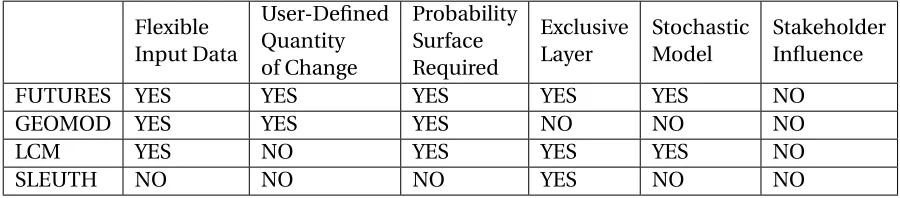
We did a comparison with these four models in Table 2.1.
Table 2.1Model Comparison
Flexible Input Data User-Defined Quantity of Change Probability Surface Required Exclusive Layer Stochastic Model Stakeholder Influence
FUTURES YES YES YES YES YES NO
GEOMOD YES YES YES NO NO NO
LCM YES NO YES YES YES NO
SLEUTH NO NO NO YES NO NO
We can see that the common limitation is that the ignorance of stakeholder activity in
the urbanization process.
Some researchers concern that human is the major determinant controlling factor. The
work of [Ars13]and[LL07], they conceptualized three types of agents as the residence, developer, and governor. Each role of the agent has a corresponding social responsibility in
the decision-making. Residence and developers and their interactions are the main force
in the creation of a new urban area, and governors are the final decision maker. Similarly,
[PF08]) and[Fil09]also conceptualized agents in LUCC problems, mostly from a perspective of economy. These researches addressed the interactions between supply and demand sides
can be converted into the urban growth process when dealing with farmlands. In such cases,
the representation of the economy in urban growth is crucial, and we can also decompose
the problem with the analogue demand and supply measurements. Some CA models take
account of the effect of the economy on the urban growth problem, but primarily focusing
on the demand side of the process[Wat08] [SC02].
Applications of ABMs to study urban dynamics have increased steadily over the last
twenty years, and researchers have studied the different models with different applied
scenarios. Human decision-making procedure has also been taken into consideration with
the agent-based model. The main advantage is an agent-based model can represent and
observe the decision-making procedure from a bottom-up approach[Hua14]. Most of the study only comes with a study with the prediction precision[Mag11] [Mat07] [dâ ˘A02], however, with the increasing number of data and requirement of computation speed, the
computational performance should be taken into consideration.
With the advent of Big Data, more and more application domains are trying to exploit
and extract knowledge from this big data, ranging from global economy to society
adminis-tration, and from scientific researches to national security[CZ14]. Some research shows the work of creating intelligent agents for making smart decisions in various application fields.
2.2
Methods
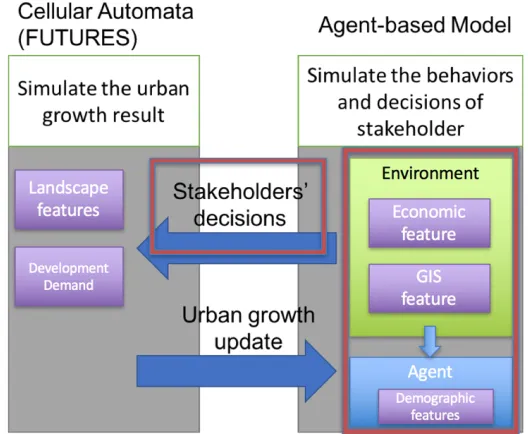
We use a loosely-coupling framework to integrate the CA and ABM modules. Briefly, CA
and ABM have its corresponding functions in the simulation, and they also communicate
with each other to fulfill the goal.
ABM simulates stakeholders’ behaviors and passes the final decisions of the stakeholders
to FUTURES. Then FUTURES synthesizes the decisions along with landscape features to
generate the urban growth simulation results and pass the growth update back to ABM. In
our work, we define the interface between FUTURES and ABM in each time step and the
logic flow of discrete time-stepped simulation.
In this section, we first introduce our study area and explain the data we collected. And
then we present the methodology of the framework implementation.
2.2.1
Study Area
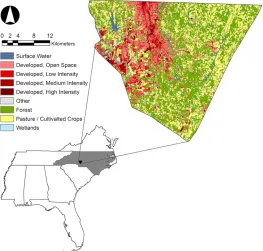
Cabarrus County is a region located in the north-east of Charlotte, North Carolina, USA,
as shown in Figure 2.1. Since the late 19th century, Cabarrus has been an area of cotton
cultivation and industrialization through cotton mills. Due to the economic development
of the Charlotte metropolitan area, Cabarrus County has significant urban growth in recent
decades. Despite the competitive advantage as being close to Charlotte, Cabarrus County
has a limited size of large-scale manufacturing and agriculture is still leading a dominant
role in its economy.
With the fact of mixed land use of agriculture and urban, Cabarrus County is an ideal
2.2.2
Data Description
To build an empirical model to simulate the urban growth in Cabarrus County, we collected
the demographic data, GIS data, and land market transaction data for the ABM module.
We use the census age and salary data of the residence to represent the social and
biologic status of the landowners. From the census data, we obtain the age and salary
distribution of Cabarrus County and interpolate the data for each landowner from the
distribution. Besides the census data, we also retrieved the land market transaction data of
Cabarrus County from 2004 to 2016. The transaction data contains the land transaction
history of the residential land use, farm land use, and commercial land use. We mainly
focus on the residential and farm land use in the data.
Besides the demographic and economic parameters, we use GIS measurement to
calcu-late the distance between each parcel to its closest green area and the highway. Distance to
park could reflect the living comfort degree, the closer the green area is, the more leisure the
residence could have, the fresher the air is. And the distance to the highway could present
the travel convenience levels. Since there’s no subway or many public transportation
op-tions in Cabarrus, the highway is the main transportation alternative. Therefore, we take
but not limited to the distance to green area (Dist2GA) and distance to highway (Dist2HW)
as the measurements of living comfort index.
We also collected the school rating scores of the primary, middle and high schools in
Cabarrus County. According to the school district division, we assign each household a
2.2.3
Framework Structure
We design an urban growth simulation framework that integrates an agent-based model to
simulate the stakeholder involvement. In addition to the cellular automata urban growth
simulation model, ABM plays an important role to simulate the behavior of stakeholders in
the urbanization problem.
Figure 2.2The communication between ABM and CA in each time step
As shown in the structure diagram in Figure 2.2, The framework is composed of CA and
ABM, we use FUTURES as our CA model. As the initialization requirement of FUTURES, we
initialize it with development demand and landscape features, such as slope, the distance
to city center, and etc. Once acquiring all the initializing data, FUTURES generates the
development potential DevPt of each landscape cell. Later FUTURES will use development
On the other side, ABM has two separate parts, they are environment and agent
sub-modules. Environment sub-module is responsible for collecting the data of the environment
where all the agents live in. In our design, we collect two kinds of data in the environment
sub-module, one is economic data such as land value, and the other one is GIS data such
as the distance to green area. And agent sub-module is the main reactor of ABM, it has the
ability to acquire the data from environment module and synthesizes its own demographic
data, also it could respond to the development request with landowner’s decision. All the
data we collected in our simulation can be considered as the drivers to the urbanization
process.
This design enhances the power of the framework to simulate a more empirical
simula-tion. The selection of the drivers reflects the understanding of the problem modeling, and
the implementation of each driver has a significant influence on the ultimate result of the
simulation. In our study, we have age and salary drivers to assign age and salary for each
landowner on the study area. And we also implement a land price estimator for each land
parcel in the study area. We apply GIS tools to calculate the distance between each parcel
to the nearest green area and highway.
Next, I will introduce more about the CA model in our framework, FUTURES.
2.3
FUTURES
FUTURES is a multilevel modeling framework for simulating changing regional urban-rural
divide based on observed land change patterns[Mee13]. It is a useful tool for researchers of urban systems to study the effect of changing landscape patterns with urbanization.
FUTURES considers a variety of environmental, infrastructural, socioeconomic and
Figure 2.3The FUTURES land change modeling framework[Mee13]
land growth patterns. These inputs are non-stationary drivers of land change influencing
the spatial structure of new growth regions and known to vary with time. Also, FUTURES
also considers simulated land conversion events in a feedback loop to predict new land
change patterns. To incorporate the different drivers of land change, the spatial structure
of land change events and their influence on further conversions, the FUTURES framework
couples three interacting components: a DEMAND sub-model that projects the estimated
demand for land in a region, a POTENTIAL sub-model that quantifies the site suitability of
land in a region and, a patch growing algorithm (PGA) that produces projections of regional
landscape patterns based on outputs from the DEMAND and POTENTIAL sub-models.
Figure 2.3 provides an overview of the FUTURES simulation framework and its
interact-ing components, namely, (i) DEMAND sub-model, (ii) POTENTIAL sub-model and, (iii)
Patch Growing algorithm (PGA)[Sha16].
The POTENTIAL sub-model implements a site suitability modeling technique that
infrastruc-tural, and socioeconomic changes over time in a region. The model considers a number
of predictor variables as input to a multilevel logistic regression model. Each predictor
variable accounts for a spatial or temporal aspect of land cover change and is used to define
a suitability score for a site in a region. Finally, the output from the POTENTIAL model is
normalized to produce a map of development probability values for all sites in a region.
The probability that an undeveloped cell becomes developed is defined as:
pi=
esi
1+esi
whereSi is the composite development potential for a celli. The development potentialSi
is defined as a function of environmental, infrastructural, and socioeconomic predictor
variables of site suitability as following:
Si=aj i+ n
X
h=1
βj i h∗xi j+βj i h∗pi0
where, for theithundeveloped cell and varying acrossj groups (i.e., the level),a
j iis the
intercept,βj i is the regression coefficient,h is a predictor variable representing conditions
at the start of a chosen simulation year,n is the number of predictor variables,xi h is the
value ofh ati, andp0is the dynamic development pressure variable due to neighboring
developed sites.
pi0=
ni
X
k=1
S t a t ek
di kγ
whereS t a t ek is the current state (0/1) of thekthneighbor of celli,dis its distance from
thekth neighbor in its list of n neighbors andγis a coefficient that controls the influence
The DEMAND sub-model establishes the relationship between historical land
con-sumption and population growth under different development scenarios. This relationship
is established using an ordinary least squares regression technique. The regression model
considers two parameters in estimating future land use for urbanization: (i) population
growth and (ii) land consumption over time. The generated per capita demand projections
from the model drive the PGA in the FUTURES UGM.
The Patch Growing Algorithm implements the mechanism to simulate historically
observed urbanization patterns based on the above two sub-models. Patch growth is
de-fined as a 3-step process: (i) Monte Carlo based seed selection using the site development
probability, (ii) patch size selection from a library of patch sizes, a weighted distribution
of historically observed patch sizes, and (iii) patch growth through a neighbor discovery
process.
A neighborhood configuration specified at the start of the simulation defines the
neigh-bor discovery process. Further, a site suitability metric for newly discovered cells determines
the most suitable cells that go towards patch growth.
si=si0∗d
−α
wheres0is the underlying development potential of celli,d is the distance of celli
to seed andαis a patch compactness factor. The PGA continues the neighbor discovery
process by using the newly added neighbors as potential seed cells. Thus, the patch growing
algorithm continues till the value of patch size is met or else terminates when no more
2.4
Model Drivers
The initialization of the framework requires empirical input, this section introduces the
data preparation.
2.4.1
Demographic Data
For this study, we collected the Cabarrus County demographic data like age and income of
the household. According to the census data, we built distribution samplers for age and
salary. We use a normal distribution for each age group of the landowners. The census data
provides the number of people in each age group within each street block. We assume the
age of people falls into the normal distribution. Based on the age range and percentage
of each age group, we assign the landowner an age, and the age increased by one with the
simulation continues over years. We also simulate the death of a landowner. We assume
that after the age of 79 (US average Life expectancy), the landowner has a chance to survive,
otherwise, we replace a new landowner based on the age and salary distribution.
And we use a skewed distribution, chi-square distribution, to describe the salary
distri-bution over the landowners. As the feature of chi-square distridistri-bution, we use the median
value of the salary of each age group within each street block to obtain the degree freedom,
as the equation below.
m e d i a n=k(1− 2 9∗k)
3
Here,k is the degree freedom of the distribution, and according to the survey conducted
by Society for Human Resource Management, the average annual salary raise is about 3.1%
increase by a fixed rate every year.
The landowner could be replaced as a result of two reasons, one is the death of a
landowner, and the other is the land trade transaction. Either of the above occurs, a new
landowner will replace the old one. And a new landowner will occur when a new parcel is
developed.
2.4.2
Land Market
The land market is a crucial factor in our study, the prediction of the land price could affect
the demand and decision-making of the stakeholders. We built a land price estimator based
on the historical land price to estimate the land value over years for every parcel on the
map.
While some researches have focused on factors that may affect the land value of a region,
such as the human density and the distance to central business district; however, the data
we obtained is too scarce to implemented any existing complex land value prediction model
[McM96]. Therefore, we selected a straightforward method to estimate the land value based on the available data, and test the approach with the statistics data, which compare the
median value of the predicted land values with the actual land values distribution.
Obviously, not all the parcels were sold in the past years, limited to the scope of the
transaction data of the land trade, we need to interpolate the data for every parcel. We use
the K-nearest-neighbor algorithm to interpolate the land price for each year. For example, if
we want to know the land value of a parcel for a certain year, we locate the nearest neighbors
(geographical distance) which had been sold in the same year and calculate the average
value of its neighbors for the demand parcel. With this method, we calculated the land
Table 2.2Comparison of median value of land (per sqrt feet) value distribution before and after the interpolation
zipcode County 2013BM 2013AM 2014BM 2014AM 2015BM 2015AM 2016BM 2016AM
28027 Concord 86.41 82.32 90.67 89.77 95 92.23 100.67 96.7
28025 Concord 81.83 80.78 85.25 83.78 89.17 89.67 94.58 92.3
28081 Kannapolis 73.42 70.45 76.17 76.23 79.83 80.89 85 82.67
28083 Kannapolis 70.5 71.67 72.5 70.73 75.25 72.23 80.42 76.8
28075 Harrisburg 93.5 87.23 97.5 98.67 101.75 103.5 106.92 110.21
28107 Midland 99.33 95.45 102.3 98.98 106.17 104.56 112.08 105.4
28124 Mount Pleasant 93.41 93.56 97.75 94.4 100.17 100.4 104.33 102.7
BM is the median value of the land value distribution before interpolation, and AM
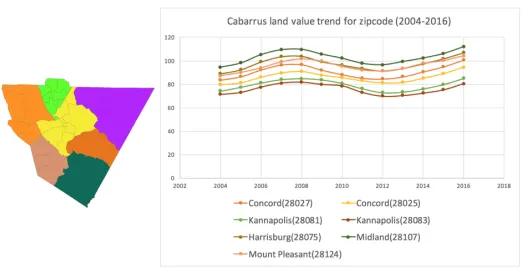
is the median value of the land value distribution after interpolation. From Table 2.2, we
can see the tendency of the land value for each zip-code in Cabarrus County. With the
development of economy and urbanization, the land value is increasing by years. And
we can also observe that the land value declines with the distance to Charlotte (in the
South-western of Cabarrus County).
Figure 2.4Cabarrus land value trend for zip code (2004-2006)
From Figure 2.4, we can clearly observe the tendency of the land value on Cabarrus
County, and the tendency of different zip-code area follow almost the same pattern. In
predict the land value based on the historical values. By interpolation and prediction of
the land value, we considered both spatial and temporal change of the land value, and the
historical land value could be well interpolated across the map.
2.4.3
GIS Data
GIS data is also widely used in the urbanization problem[CG98] [Bat07] [LY00] [Sud04], and the application of GIS in urban growth prediction propel the implementation of the models.
We use multi-layer data, GIS is applied as a data integrator. Although the data is already
existing, we created new maps to fit the grid resolutions and projections.
And the other purpose of using GIS is visualization. This is the weak component for
urban growth, GIS can just enhance the model. The role of GIS in for visualization is taking
the intermediate result and generate the visible map for the comparison of different maps.
The model we built requires the DIST2GA and DIST2HW as inputs to ABM, we projected
the shapefile of Cabarrus County transportation and Cabarrus County green land onto the
Cabarrus County land parcel, generating the raster file of the distance from each parcel to
its nearest highway and green area. With the same method, we also mapped each parcel
to corresponding schools (primary, middle and high schools), and calculate the average
school rating score for each parcel.
Up to this point, we prepared the initial data to train and test ABM, as listed as (i)
landowner age, (ii) landowner salary, (ii) land parcel distance to green area, (iii) land parcel
distance to highway, (iv) land parcel value, (v) land parcel school rating. With the above
data, we designed our discrete-time agent-based model to simulate the decision-making
2.5
Agent-based Model
To interact with urban growth model, the human involvement simulation should be
capa-ble of responding with the landowners’ decisions while retrieving sufficient information
for both the internal(landowner) and the external(environment) properties. With more
information considered, a simulating module could always generate better predictions. In
our design of the agent-based model, we fully considered the heterogeneity of the model,
each agent on the map is an autonomous individual[Zha16]. The system level behaviors emerge from the micro-level interactions of the agents. Therefore, it could depict the whole
simulation procedure with the details of different levels, specifically reasoning how and
when a decision is made by the landowners. Also, ABM aggregates all the information of its
constituent elements and measure the outcomes in the system level over time.
2.5.1
Agents Conceptualization
We conceptualize the model obeying ODD protocol[Gri10]. The ODD protocol is a standard format proposed to describe the individual and agent-based model.
The ABM is designed with two-layers, one is landowner layer, and the other is
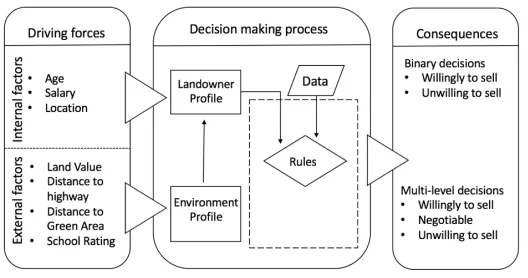
environ-ment layer. As illustrated in Figure 2.5, available parcels (Not all the parcels are legitimate
for developing, such as roads) and all the landowners on the layers are conceptualized
as agents, which maintains the information passed by the model drivers. With the model
driver updating the values, the agents update its memory.
When the simulation starts, the landowner retrieves the land parcel information where
data. In our experiment, we tried various kinds of machine learning algorithms to test their
performance in this framework.
The key outcome of the model is the decision map, indicating if the landowner is willing
to sell some certain landscape cell to develop. And the FUTURES is seeking the objective
that the landowner is willing to sell this parcel based on the decision map generated by
ABM, and in return, the newly developed parcels trigger ABM generate new landowner
agents.
Figure 2.5Agent-based model conceptualization
The outcome of ABM synthesizes not only the landowners’ condition but also their
neighbors’ impact on them. Besides the agents internal updating, we also modeled the
influence of external agents of the experiments. In the experiment, we also tried different
mechanisms for different scenarios.
2.5.2
Agents Decision Rules
Traditionally, the decision of the landowner is simply yes or no, such implementation
make a decision based on the decision rules, and there’s also a development demand for
each year, this problem happens when the number of the willing landowner is less than the
demand. To solve this problem, we proposed a new decision hierarchy to replace the binary
yes/no. In our design, the decision is 3 categories as willingly, negotiable and unwillingly. When there are not enough â ˘AIJwillinglyâ ˘A˙I landowners, we will convert some negotiable
landowners into â ˘AIJwillinglyâ ˘A˙I ones by the process of bargaining. And the simulation
could continue with enough cells to develop.
We conclude the decision rules with some machine learning algorithms. For binary
de-cisions, we use the historical land transaction data to train our model. From the transaction
record, we can tell which cell is sold in which year, combining with other features which we
have initialized for each year, we can try to find the decision-making pattern. With logistic
regression algorithm, we can obtain the function with the parameter of age, salary, distance
to green area, distance to highway, land value and development potential.
When it comes to multi-level decisions, we cannot get such label from the historical
transaction record directly. We use the time interval between two transactions of the same
cell to determine the decision labels. When a piece of land is sold within a certain threshold,
we can infer that when a person with certain characteristics owns a piece of land, he is more
likely to sell it. The threshold we use is the average moving time of US residence, it is 5 years.
So we define that when the interval is less than 4 years, the stakeholder is more willing to
move, and longer than 6 years is unwilling to move. Any other time between 4 and 6 years,
which contains 5 is negotiable to move. We test different classification algorithms to train
2.5.3
Agents Neighbor Influence
We consider the neighborhood influence among agents. And For a different decision setting,
we have different influence calculation methods. For binary decision, since we are using
logistic regression, we find a way to aggregate itself value and its neighbors. For multi-level
decisions, we define a cross-reference table for neighborhood influence as shown in Table
2.3. In the neighborhood, we apply majority voting, selecting the most popular decision
and consider both the local and neighbor decision, according to the table, we have the final
decision.
Table 2.3Neighborhood Influence for multi-label approach
Willingly Negotiable Unwillingly Willingly Willingly Willingly Negotiable Negotiable Willingly Negotiable Unwillingly Unwillingly Negotiable Unwillingly Unwillingly
2.5.4
Agent’s Bargain Process
We implement multi-level decision because of insufficient cells to develop in the
urban-ization process. And in an empirical study, developers would like to negotiate with the
landowners or providing them a higher bid[PF08]. When adopting the multi-level deci-sion, we need to consider converting negotiable landowners into willingly ones, and in the
meantime, the land value should increase by a certain percentage. The increasing rate is
2.6
Experiments
We split the experiment into four parts, the first part is to train the model to generate the
decision-making rules for the landowners, to test under what circumstances that they
would sell their land. The rest of the experiments are all conducted in the form as the
comparison of 3 platforms as the plain FUTURES, the FUTURES with binary decision ABM
and the FUTURES with the multi-level decision. And the second experimental part is to
simulate without neighborhood influence, and the third experimental part is to simulate
with neighborhood influence. The fourth experimental part is to simulate with
neighbor-hood influence and the bargaining process. Additionally, before the fourth experiment, we
need to determine the land value increase rate.
All the experiments were initialized with different scenarios of different landowner age
and salary assignment. For each scenario, we repeated the experiment 10 times, and we
summarize all the result to get an average value for validation. The simulation year is from
2014 to 2016.
2.6.1
Validate Metrics
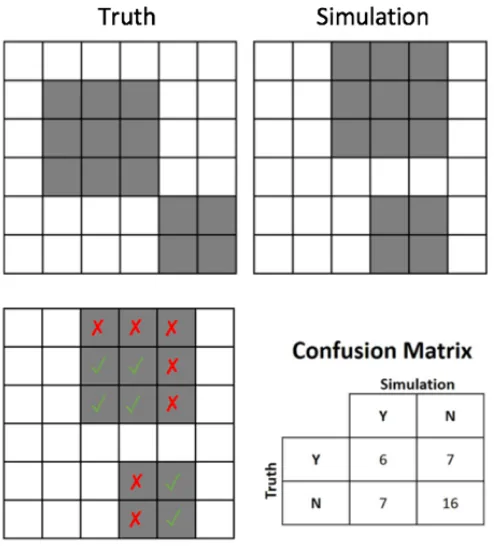
We used two validation metrics in the result analysis of our experiment, they are allocation
agreement and willingness agreement. Allocation agreement indicates the precision of the
urban growth simulation prediction, representing the ratio of correctly predicted developed
cell status.
As illustrated in Figure 2.6, the allocation agreement is the ratio of the overlapping
Figure 2.6Allocation agreement illustration
Al l o c a t i o n Ag r e e m e n t = N u m(T P)
N u m(T P) +N u m(F P) +N u m(T N) +N u m(F N)
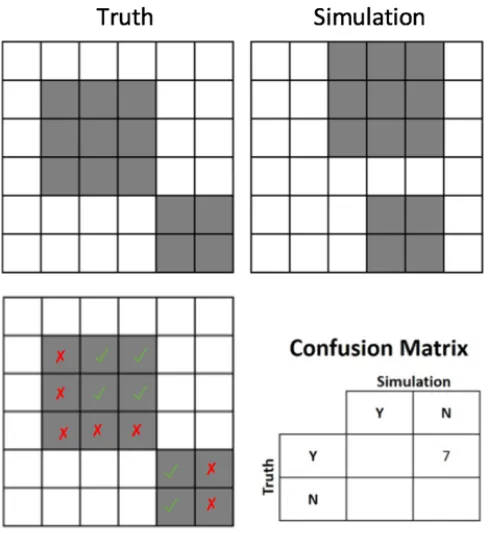
And the other metric is willingness agreement. Willingness agreement is the
measure-ment for the performance of the agent-based model, representing the ratio of correctly
pre-dicted decisions. Since we don’t know the actual decisions of the landowners, we could only
imply that via the actual development map. We compare the predicted decision-making
result with the actual development map. As shown in Figure 2.7, we can only retrieve the
false negative in the confusion matrix, and we are not sure about others. So, we defined the
Figure 2.7Willingness agreement illustration
W i l l i n g n e s s Ag r e e m e n t = N u m(F N)
N u m(T P) +N u m(F P) +N u m(T N) +N u m(F N)
2.6.2
Train the Model
We obtained the historical transaction data for each parcel, we use this dataset to train and
test the performance of different machine learning algorithms. Along with this dataset, we
assign an age and salary to the landowners based on the model drivers, the DIST2GA and
DIST2HW to each, and the sold price (per sqrt feet) from the record, and also generate the
item in the transaction record, we have the landowner age, landowner salary, DIST2GA,
DIST2HW, land value, development potential and the sold status, which is the decision of
the landowners. We regard the other parcels which are not listed in the record as unsold.
For this raw and extended dataset, we have 59136 sold records and 1350740 unsold
records, and we use the data record from 2004 to 2013 as training data, and the rest as
testing data.
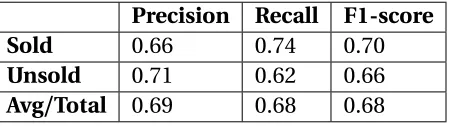
We use logistic regression[KZ01] [BH03]to generate binary output as the decision of the landowners. Table 2.4 is the result of the test:
Table 2.4Logistic Regression result
Precision Recall F1-score
Sold 0.66 0.74 0.70
Unsold 0.71 0.62 0.66
Avg/Total 0.69 0.68 0.68
We calculated the intervals of transactions of each parcel, retrieving the multi-label
decision of the landowners.
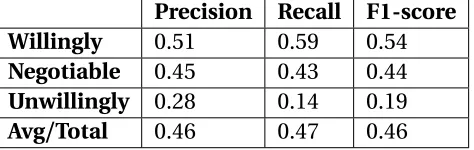
Table 2.5, Table 2.6, Table 2.7, Table 2.8 are the results of different algorithms:
Table 2.5CART result
Precision Recall F1-score
Willingly 0.74 0.73 0.74
Negotiable 0.70 0.70 0.70
Table 2.6SVM result
Precision Recall F1-score
Willingly 0.54 1.00 0.70
Negotiable 0.99 0.23 0.37
Unwillingly 1.00 0.27 0.42 Avg/Total 0.60 0.60 0.53
Table 2.7Bayesian Network result
Precision Recall F1-score
Willingly 0.51 0.59 0.54
Negotiable 0.45 0.43 0.44
Unwillingly 0.28 0.14 0.19 Avg/Total 0.46 0.47 0.46
2.6.3
Simulation
We chose random forest as the multi-label algorithm to compare with binary output result
since it has the moderate but steady performance among the competitors.
we took 2013 as a starting year and test the development status of 2014, 2015 and
2016. We did three simulations with different conditions, we tested the framework with the
plain frameworks, FUTURES model alone, FUTURES model with binary decision ABM and
FUTURE model with multi-level decision ABM. Firstly, we assume that the landowners are
not affected by its neighbors (adjacent parcels) and no bargaining process involves. And
Table 2.8Random Forest result
Precision Recall F1-score
Willingly 0.74 0.76 0.75
Negotiable 0.70 0.71 0.70
Unwillingly 0.66 0.59 0.62 Avg/Total 0.78 0.72 0.72
last, we added the bargaining process when dealing with multi-level decision ABM model.
Before the simulation, we need to determine the optimal land value increase rate of the
bargaining process. As shown in Figure 2.8, we increase the rate from 5% to 15% by the
interval of 0.5%. And the result shows that with the rate of 8%, it gives the best simulation
result.
Figure 2.8Prediction accuracy with land value increase rate change
Table 2.9Simulation Result without Neighborhood Influence
Year Framework Demand Successfully Developed Allocation Agreement Willingness Agreement 2014 Plain Futures
9773 9773 17%
-2015 9773 9773 15%
-2016 9773 9773 14%
-2014
Binary Decision
9773 9773 18% 35%
2015 9773 8750 17% 46%
2016 9773 - -
-2014
Multilevel Decision
9773 9773 24% 44%
2015 9773 6164 20% 60%
2016 9773 - -
-Table 2.10Simulation Result with Neighborhood Influence
Year Framework Demand Successfully Developed Allocation Agreement Willingness Agreement 2014 Plain Futures
9773 9773 16%
-2015 9773 9773 16%
-2016 9773 9773 14%
-2014
Binary Decision
9773 9773 20% 40%
2015 9773 7896 19% 45%
2016 9773 - -
-2014
Multilevel Decision
9773 9773 29% 60%
2015 9773 6164 22% 62%
-Table 2.11Simulation Result with Neighborhood Influence and Bargain
Year Framework Demand Successfully Developed Allocation Agreement Willingness Agreement 2014 Plain Futures
9773 9773 17%
-2015 9773 9773 16%
-2016 9773 9773 15%
-2014
Binary Decision
9773 9773 22% 48%
2015 9773 7654 19% 45%
2016 9773 - -
-2014
Multilevel Decision
9773 9773 32% 60%
2015 9773 9773 24% 62%
2016 9773 9773 26% 68%
2.7
Results and Analysis
From the results of the experiment, on average, the binary and multi-level framework
out-perform the plain model of FUTURES alone for both the overlapping rate and disagreement
rate. And in the comparison with binary and multi-level decision framework, multi-level
decision framework performs better. In the first and second experiment, multi-level
ap-proach failed in development enough parcels, so the land growth model quit in developing.
The reason for that is there are not sufficient landowners agree to sell their land, and the
developers do not negotiate with these landowners. The overlapping rate of the multi-level
approach is lower than the third experiment, one of the reasons is that the fewer number
of the cells were developed. However, the disagreement rate is lower than the other two
approaches in the first experiment.
When adding neighborhood influence, we noticed that the performance of all has been
That indicates that when the interaction between landowners occurs, the landowner learns
more of the environment through his/her neighbors, which helps the landowner make the correct and wise decision.
In Table 2.10, Multi-level approach met the demand of development with moderate
per-formance. When the bargaining process involved, we can see that the allocation agreement
rate is raised, which verifies our assumption that neighborhood influence and bargain
process could improve the landowner agents’ ability to make more intelligent decisions.
And the land value increase rate indicates the commercial pattern in land trade. When the
value of the land is low, fewer landowners would like to sell their land; and when the land
value is too high, the allocation agreement rate drops because of fewer developers would
like to buy and develop a new site.
Besides the spatial error estimation, temporal error estimation is also important. Error
propagation exists in the simulation. We did another experiment to test the impact of error
propagation that small initial error in geo-simulation will lead to larger errors in the end.
We manually inserted incorrect data into our initial landscape file. We randomly selected
10%, 15%, and 20% cells on the map, transposing their development status. With such
preparation, we intentionally aggrandized the initial error in order to observe the impact of
error propagation.
CHAPTER
3
BUILD ABM ON APACHE SPARK
3.1
Problem Statement
Urbanization is a process that accumulates for a long time. Therefore, a significant change of
the land use could take place after years. In the prediction of the urban growth, researchers
usually measure the land use status of the past years and simulate the following land use
status of the next decades.
Many factors would affect the urban growth and development, including the properties
of the landscape and landowners. For a better illustration of the algorithm and model, we
Landscape cell: We grid segment the landscape, and each grid of the landscape is called
a cell.
In many spatial problems, satellite images are used for further analysis. We can
re-gard each pixel of the image as a cell. And in some actual landscape maps, we use such
representation to convert continuous data into discrete data.
Landscape parcel: A group of adjacent cells which belong to the same landowner is call
a parcel.
A landowner may have more than one parcel on the landscape, and all of the parcels
from the same landowner may sparsely locate.
We also define one spatial relationship of the landscape parcels.
Parcel neighborhood: A group of parcels which are adjacent to a parcel, is called this
parcel’s neighborhoods.
For instance, we assume there is one piece of the landscape taken into consideration,
as shown in Figure 3.1. Each color area indicates a landscape parcel, and each parcel is
composed of multiple cells, as represented by dotted squares. For better illustration, we
mark each parcel a name alphabetically. As defined above, only the adjacent parcels are
considered as the neighborhood of a particular parcel. In this example, parcel A’s neighbors
are C, D, E, F, G, H.
Hence, we have an overview of the landscape units and the relationships between them,
and we would specify the problem we are facing. Human involvement is inevitably in
urbanization, and people have the ownership of the land and the willingness to trade. Also,
one person’s decision could be affected by others, like peers or neighborhood. We need a
module simulating and monitoring human involvement and conduct further qualitative
and quantitative analysis.
Figure 3.1Example of landscape cell, landscape parcel and parcel neighborhood
information as input, including the landscape cells’ position, landscape parcel composition,
landscape parcel ownership, the profiles of landowners and other landscape information
whichever used in the decision-making algorithms. With the information of landscape and
landowners, this module could calculate the probability of how likely the landowner is
willing to sell a certain parcel and make the ultimate decision of the landowner. Since this
module is working with the urban growth simulation model, it could respond to the urban
growth model when it’s requested to provide the final decision if any parcel is going to be
sold or not.
Since the urban growth simulation is usually done for decades in the future, researchers
usually simulate not for a single year, but a series of continuous years. In our study, we
multiple-year simulation as working with both an urban growth simulator (UGS)and a human
involvement simulator (HIS). UGS waits for the feedback from HIS, the response time of
HIS is the gap of the overall performance; we aim to reduce the response time of HIS to
improve the performance of the simulation.
Figure 3.2Communication between Urban Growth Simulator and Human Involvement Simula-tor for Rounds
Building a stable and scalable human involvement simulating module can assist the
urban growth model to make a more accurate prediction, and help people analyze how
human affect the urbanization procedure.
3.2
Methodology
To interact with urban growth model, the human involvement simulating module should be
capable of responding with the landowners’ decisions while retrieving sufficient
Figure 3.3Human involvement module communicates with urban growth model
module could always generate better predictions. In our study, we pass the landowners’
profile and landscape geographic information as an initial input to the human
involve-ment simulating module; some decision-making algorithms could convert the data into
landowner’s decisions.
3.2.1
Formulas
We consider landowner’s the probability of the landowners’ willingness to trade their land
is based on the parcel, which means we assume that all the land trades are in the unit of a
parcel. However, all the landscape information we gathered is based on landscape cells,
we need algorithms to transfer the landscape information from cell level to parcel level.
Before introducing the algorithms, we need to define some critical parameters we used in
the algorithms.
Development potential: Development potential is a value indicating how likely a cell
would be developed into an urban area without human involvement.
While urban growth model is working in a standalone mode, development potential is
with the innate and acquired conditions of the landscape cells, as well as the adjacent cells’
information. Development potential synthetically considers the interior and the exterior of
the landscape conditions.
Willingness to sell: Willingness to sell (WTS) is a value indicating how willing a landowner
would be to sell the landscape cell or parcel.
When human involvements occur, the intention of the landowners becomes crucial. In
the trade of one piece of land, landowners always synthesize multiple factors and make the
final decision if the land could be sold or not. And during the decision-making procedure, a
landowner could also be influenced by other landowners. Due to the different personalities
of the landowner, their behavior can be varied in pondering the decision. Overall possible
influencing factors, we use WTS to represent the possibility a landowner could sell a certain
cell or parcel.
As shown in Figure 3.4, a cell’s WTS should be calculated based on the landowner
information and its development potential, the algorithm we use to calculate cell’s WTS is
illustrated as below.
LetW T Sc e l l to be the willingness to sell value of a landscape cell, and potential to be
the development potential value of this landscape cell. If a landowner owns this landscape
cell, we assume that
W T Sc e l l =i n t e r s e c t i o n+α∗a g e+β∗i n c o m e+γ∗p o t e n t i a l
wherei n t e r s e c t i o nis a value that varies among different types of landowners,a g e
is the age of the landowner, andi n c o m e is the annual income of a landowner.α,β,γare
the coefficients of the parameters. In our study, we useαas 0.0032,β as 0.00000486, andγ
Figure 3.4Working flow of urban growth model and human involvement simulating module for one-time step
Since our study is based on landscape parcels, we should obtain the intention of the
landowner about the whole parcel. We also use the value willingness to sell to represent the
intention of the landowner.
letW T Sp a r c e l to be the willingness to sell value of a landscape parcel andW T Sc e l l to
be the willingness to sell value of a landscape cell. We have
W T Sp a r c e l =
P
c e l l∈p a r c e lW T Sc e l l
P
We use the averageW T Sc e l l in a parcel to signify the willingness to sell a parcel.
Not only the internal factor influencing the decision of the landowners, but they could
also be affected by their peers, such as their neighborhood, workmates or some financial
agents. We usep e e r i n f l u e n c e to measure the outside influence on the landowners. In
our study, we only consider the situation when the landowners are influenced by their
neighborhood, specifically the other landowners who own the adjacent parcels.
LetP to be the peer influence value of one certain parcel, and we can calculateP with
its adjacent parcels’W T S.
P =
P
p a r c e l∈n e i g h b o r h o o dW T Sp a r c e l
P
p a r c e l∈n e i g h b o r h o o d1
The averageW T S value of the neighborhood is regarded as the peer influence on a
certain parcel, which can be interpreted as the more willingly the neighborhood to sell their
land, the more likely a landowner would be to sell the land.
We have obtained theW T Sof the landscape parcel and the peer influence to it, however,
they have different dominants, we need to normalize the values before conducting more
operations on them. The normalization method we use is as below.
LetN o r m a l i z e d be the normalized variable, and x to be the original value.
N o r m a l i z e d= e
x
1+ex
Hence, we have the normalized parcel W T S and peer influence; we plan to test how
the urbanization differentials when given different proportions of parcelW T S and peer
influence.
LetDVp a r c e l to be the determinative value for the landowner,W T Sp a r c e l to be
peer influence.
DV =α∗W T Sp a r c e l+β∗P
αandβ are the coefficients we would give to the function when testing, indicating
the proportion of the parcel’sW T S and peer influence. For keeping the consistency of
normalization, we simply should have the equationα+β=1.
With the normalized determinative value of the decision, we can set an arbitrary
thresh-old for the landowners to make the ultimate decision.
LetR AN D be the random threshold we set for the landowner to make a decision,DV
to be the determinative value of the decision andD T S to be the decision to sell.
D T S=1,w h e n DV ≥R AN D
D T S=0,o t h e r w i s e
Human involvement simulating module passes the decision of the landowner to the
urban growth model, assisting urban growth model to accomplish the urbanization
simu-lation.
3.2.2
Agent-based Model
Agent-based modeling (ABM) is widely applied in the domain of dynamic simulation of
the geographical system in the last decade. A definition is provided by Axtell: "An ABM
consists of individual agents with states and rules of behavior. Running such a model is
simply creating a population of such agents and letting agents interact, and monitoring
through the simulation of human involvement during the urbanization.
Agent-based modeling is a technique for modeling dynamic systems from the bottom
up. Individual elements of the system are represented computationally as agents. The
system level behaviors emerge from the micro-level interactions of the agents. Therefore, it
could depict the whole simulation procedure with the details of different levels, specifically
reasoning how and when a decision is made by the landowners. Also, ABM aggregates all
the information of its constituent elements and measure the outcomes in the system level
over time.
There are several features of the agents in most of the agent-based models, which are
briefly illustrated below[CH12]:
• Autonomy: all of the agents are autonomous entities, their functionalities are not
affected by the system or other agents. The agents should have the ability to process
the data internally and communicate with the environment and other agents through
messages.
• Heterogeneity: the agents can be in different shapes of entities. Various agents
main-tain different sets of attributes and functions. Also, a group of the same kind agent is
allowed as long as they have a similar set of attributes and functions.
• Active: all the agents contribute to the simulation outcomes.
All the agents together amalgamate the agent-based model, and different types of agents
have different jobs in the simulation. The human involvement simulating module could be
shaped into an agent-based model. And in this way, we can better interpret the relationships
among different types of agents and observe the state change of agents.
three principal components to be documented about a model: Overview, Design
3.3
Model Overview
3.3.1
Model Design Concepts
The key outcome of the model is the decision raster file, indicating if the landowner is
willing to develop some certain landscape cell. The outcome synthesizes not only the
landowners’ condition but also their neighbors’ impact on them. All of the landscape
cells, parcel and landowner have adaptive behavior, as landscape updates development
potential and landowner updates age after each time step, and landscape parcel updates
its willingness to sell value once it senses the landscape cell holds a new willingness to sell
value. And the landscape parcel is seeking the objective that the landowner is willing to
sell this parcel. Stochasticity is used to determine the threshold to make the final decision.
Also, a set of collective jobs is presented in the model, as the landscape cells within the
same landscape parcel working as a group, their average value of willingness to sell is one
of the landscape parcels, and they share the same DTS value; and the landscape parcel
neighbors work in the shape of a group as well. Moreover, the agents interact with each
other via messages.
3.3.2
Model Details
• Initialization
Since all the raw landscape data is in the format of raster and the landowner profile is
in the format of tables, we need to reassign all the data to corresponding agents.
• Input data
sim-ulation model, and the input data for each time step is passed in by urban growth
simulating model as the updated development potential value of every landscape
cell.
• Output data
After each time step, the human involvement simulating module generates a raster
of the landowner’s decision on every landscape cell. The raster file indicates if the
landscape cell in the corresponding position of the landscape earns the permission
from its landowner to be traded for development into the urban area.
• Purpose
The purpose of this model is to simulate the human involvement in urban growth
procedure, especially the decision making of landowners in the land trade.
• Entities, state variables, and scales
We briefly categorize the agents into three types: landowners, landscape cells and
landscape parcels. And the state variables of each type of agents are listed below
correspondingly:
– Landowner
Landowner ID: the unique identification of a landowner.
Landowner Type: There are four types of landowners, we assume they would
hold different attitudes when the land trade is happening. The main
differ-ence among the four types of landowner in computation is embodied in
landscape cell’s willingness to sell (WTS) value. The more conservative the
Landowner Age: the age of the landowner.
Landowner Income: the annual income of the landowner.
– Landscape Cell
Landscape Cell ID: the unique identification of a landscape cell.
Landscape Parcel ID: the id of the landscape parcel that this landscape cell
locates in.
Landowner ID: the id of the landowner who owns this landscape cell.
Development Potential: the development potential value of this cell, this
variable is estimated by urban growth model and passed in.
WTS: value of willingness to sell by the landowner on this landscape cell.
DTS: value of the decision to sell by the landowner on this landscape cell.
– Landscape Parcel
Landscape Parcel ID: the unique identification of a landscape parcel.
Landowner ID: the id of the landowner who owns this landscape parcel.
Landscape Cell List: the ID list of the landscape cells which locates in this
landscape parcel.
Neighborhood Parcel List: the ID list of the landscape parcels which locates
adjacent to this landscape parcel.
Peer Influence: the value of the peer influence to this landscape parcel.
WTS: value of willingness to sell by the landowner on this landscape parcel.
DTS: value of decision to sell by the landowner on this landscape parcel.
The communication among agents to agents or agents to the environment occurs
via messages. Before introducing the functions of different agents, we define some
messages in the communication.
– Message of Landowner Information
sender: landowner
receiver: landscape cells under the landowner’s property
content: the landowner’s profile, including the landowner’s ID, typology,
age and income
– Message of Landscape Cell’s WTS
sender: landscape cell
receiver: the landscape parcel which the sender in
content: the landscape cell’s ID and WTS
– Message of Landscape Parcel WTS
sender: landscape parcel
receiver: the landscape parcels which locates adjacent to the sender
content: the landscape parcel ID and WTS
– Message of Landscape Parcel DTS
sender: landscape parcel
receiver: the landscape cells which locates into the sender
![Figure 2.3 The FUTURES land change modeling framework [Mee13]](https://thumb-us.123doks.com/thumbv2/123dok_us/1756783.1225658/24.612.191.445.74.272/figure-futures-land-change-modeling-framework-mee.webp)