Comparative Investigation of Diverse
Controller for a Nonlinear Level Control
Process
Trini Xavier.X1, Deepika.V2, Iswarya.C3, Gnana Bringle.M4, Kala.H5
UG Student [ICE], Dept. of ICE, Saranathan College of Engineering, Trichy, Tamilnadu, India1,2,3,4
Assistant Professor, Dept. of ICE, Saranathan College of Engineering, Trichy, Tamilnadu, India5
ABSTRACT: In this paper we proposed a method of conventional Proportional Integral Derivative Controller (PID) to execute optimum controller for a spherical tank. The aim of the controller is to sustain the level inside the process tank in a preferred value. Here, we have identified the process model in real time and the controller is designed using MATLAB simulink using data acquisition module. The model is the first order plus delay time (FOPDT) process. These controllers are tuned by Tyreus-Luben (TL) method, Skogestad (SK) method, Model Predictive Control (MPC) method and Chien Hrones Reswick (CHR) method. These tuning methods are compared and the controller settings have been obtained out of which the best controller is highlighted with the aid of their performance criteria and time
domain specifications.Of the four control algorithms MPC settles faster and have lower value of peak overshoot.
KEYWORDS:Process model, Data acquisition system, PID controller, FOPDT, Spherical tank, MPC
I. INTRODUCTION
The nonlinear process cannot be controlled easily in the industrial environment. It is a complex task as it has a varying cross sectional area with the height of the tank. Sphere is a well-built structure as the stresses are distributed evenly on the sphere's surfaces. Additionally, they have a smaller surface area per unit volume than any other shape of vessel. Thus the quantity of heat transferred from warmer surroundings to the liquid in the sphere, will be less than that for cylindrical or rectangular storage vessels. PID controllers are widely used in many control applications. Its wide popularity lies in the simplicity of design and good performance which includes low percent over shoot and small settling time. The proportional gain (Kp), derivative gain (Kd) and the integral gain (Ki) of the controller is determined accurately. Different methods are developed to determine the controller parameters. Among them, TL method, SK method, MPC method and CHR method are used in this controller design. The control is based on the performance a criterion of the various tuning methods of which outperforms faster settling point.
From the paper titled ‘Model based Controller Design for a Spherical Tank’ they concluded SIMC based PI controller as the best method with lesser values of IAE and ISE, among all other methods like ZN, IMC, Cohen- Coon and Chien. From the paper titled ‘Design of Fuzzy Logic Controller for a Spherical tank system and its Real time implementation’ it is concluded that fuzzy logic controller is the best with lesser values of Integral Square Error (ISE) and faster settling point. From the paper titled ‘Design and Implementation of Skogestad PID Controller for Interacting Spherical Tank System’ they concluded Skogested method as the best method of tuning. From the paper titled ‘Design and Implementation Of IMC Based PID Controller’ they found that the standard IMC filter has a better set point and at the end of simulation they concluded that IMC based controller is better compared to other conventional methods as it has minimum settling time.
This paper is structured as follows:
domain specifications of the various tuning methods. The discussion has been made on this and the results are given in Section 6. The conclusions arrived, based on the results in section 7.
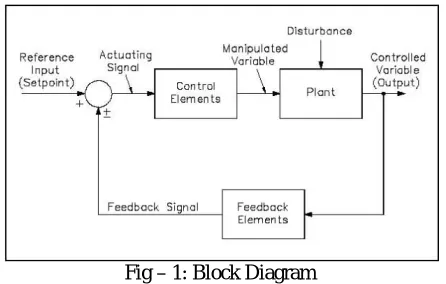
II. BLOCK DIAGRAM
Fig – 1: Block Diagram
Though it is a closed loop response, the controlling of the non linear system is a complex process. It is a complex task as it has a varying cross sectional area with the height of the tank. Sphere is a well-built structure as the stresses are distributed evenly on the sphere's surfaces. Here it is controlled by various tuning techniques.
III.MATHEMATICAL MODELLING OF SPHERICAL TANK
Any system, if has to be analyzed, must be mathematically modeled, i.e. the mathematical equations describing the system must be derived so as to aid in studying the system, its features, predicting the dynamic behavior & for many other purposes. The mathematical modeling the system is as follows:
Consider a spherical tank, as shown in figure 2, of radius R. The water flows in at a rate Fin& flows out at a rate Fout.
Fig – 2: Mathematical model of a spherical tank
Volume of a sphere is given by, V = πh
Fi – Flow rate at inlet of the tank Fo– Flow rate at outlet of the tank h – Height of the liquid in the tank R – Resistance to flow
F =
A – Area of cross-sectional area of tank
A = F −F =F −
AR +h = RF
At steady state
h =RF′,
In terms of deviation variables from (1) and (2)
AR ′+h’=RF′
Where h′
=h−h and F′
=F −F
τ
K =R=steady state gain of the process
Transfer function is
G(s) = ′( ) ′( )=τ
G(s) = ( )
( )=τ
R =
Where h height of the tank at steady state,
τ= 4πh R
Time constant=Storage capacity×resistance to flow
IV. PID CONTROLLER DESIGN
Once the transfer function model has been derived, the controller is designed and the optimal set point is made to maintain the system. Thus, the Kp parameters are selected and tuned properly.
The following methods are used for the controller design:
Controllers
Tyreus-Luben (TL) method K
3.2
2.2P P
6.3
Chien Hrones Reswick (CHR): Load rejection:
0%
0.95 K
τ
d
2.4d 0.42d
Chien Hrones Reswick (CHR): Load rejection:
20%
1.2 K
τ
d
2d 0.42d
Chien Hrones Reswick (CHR): Set point tracking:
0%
0.6 K
τ
d
τ 0.5d
Chien Hrones Reswick (CHR):
0.95 K
τ
d
20%
Skogestad (SK) method: Time constant + Delay
T K(T +τ)
min [T, C (τ +τ)] 0
Skogestad (SK) method: Time constant + Delay +
Integral
1 K(T +τ)
C [τ +τ] T
Table 1: Comparative formula for different controllers
Thus the above table tabulates the comparative formula for the controllers such as T-L method, CHR method and SK method.
4. Model Predictive Control (MPC) method:
MPC is a widely used means to deal with large multivariable constrained control issues in industry. The main aim of MPC is to minimize a performance criterion in the future that would possibly be subject to constraints on the manipulated inputs and outputs, where the future performance is computed according to a model of the plant. The model predictive controller uses the models and current plant measurements to calculate future moves in the independent variables that will result in operation that honors all independent and dependent variable constraints. The MPC then sends this set of independent variable moves to the corresponding regulatory controller set-points to be implemented in the process.
V. TUNING OF PID
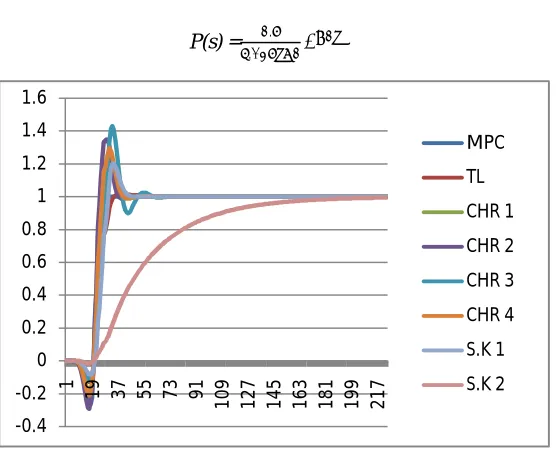
P(s) = . .
Fig – 3: Response of all tunings CHR 1- Load rejection 0%
CHR 2- Load rejection 20% CHR 3- Set point tracking 0% CHR 4- Set point tracking 20% S.K 1- Time constant + delay
S.K 2- Time constant + delay + integral
The above fig – 3 shows the response of all the tuning methods. Thus by calculating the time domain specifications of these plots the we will be able to find the best controller for the spherical tank.
-0.4 -0.2 0 0.2 0.4 0.6 0.8 1 1.2 1.4 1.6
1 19 37 55 73 91
1
0
9
1
2
7
1
4
5
1
6
3
1
8
1
1
9
9
2
1
7
MPC
TL
CHR 1
CHR 2
CHR 3
CHR 4
S.K 1
VI. RESULTS
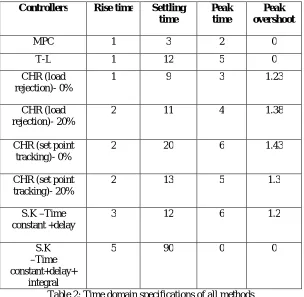
Thus, the different methods for the tuning of PID have been designed and the time domain specifications of the various methods are listed below:
Table 2: Time domain specifications of all methods
The above table 2 infers that MPC has zero value of peak over shoot and low value of settling point. Thus, it is the most appropriate method for the control of spherical tank, while compared to the other controllers.
VII. CONCLUSION
Thus, by the above table 2, comparing the time domain specifications of the four controllers we conclude that MPC is the best controller for the spherical tank. Of the four control algorithms, MPC settles faster and have lower value of peak overshoot.
REFERENCES
[1] Cheng Ching Yu, Auto tuning of PID controllers. A Relay feedback approach, Second Edition, Springer, 2006.
[2] Carls A. Smith & Armando B.Corripio, Principles & Practice of Automatic Process Control., John Wiley & sons, New York,1985 [3] Donald R Coughnowr. PID Controllers: Process System Analysis & Control. Second Edition, MC-Graw Hill, 1991.
[4] George Stephanopoulos, Chemical Process Control, Prentice Hall publication, 1983.
[5] Luyben W.L, Process Modeling, Simulation & Control for chemical engineers, Mc-Graw Hill, 1990. [6] O'Dwyer, A., Handbook of PI and PID Controller Tuning Rules. World Scientific Pub Co, London, 2003.
[7] Skogestad. S, Simple analytic rules for model reduction and PID controller tuning. Journal of Process Control, Vol 25, Pgno.85-120, 2004. [8] Skogestad&ChrissGrimholt, The SIMC method for smooth PID controller tuning, Sep 7, 2011.
[9] M.Bharathi, C.Selvakumar, A.Kalpana, Model based Controller Design for a Spherical Tank. IOSR Journal of Electrical and Electronics Engineering (IOSR-JEEE), Volume 9, Issue 2 Ver. VI (Mar – Apr. 2014).
Controllers Rise time Settling time
Peak time
Peak overshoot
MPC 1 3 2 0
T-L 1 12 5 0
CHR (load rejection)- 0%
1 9 3 1.23
CHR (load rejection)- 20%
2 11 4 1.38
CHR (set point tracking)- 0%
2 20 6 1.43
CHR (set point tracking)- 20%
2 13 5 1.3
S.K –Time constant +delay
3 12 6 1.2
S.K –Time constant+delay+
integral