An Attribute-Based Anonymous Broadcast
Encryption Scheme with Adaptive Security in
the Standard Model
Reyhaneh Rabaninejad, Mohammmad Hassan Ameri, Mahshid Delavar, Javad Mohajeri
Abstract
In broadcast encryption schemes, a distribution center broadcasts an encrypted message to a subsetSchosen from a universe of receivers and only the intended users are able to decrypt the message. Most broadcast encryption schemes do not provide anonymity and the identities of target receivers are sent in plaintext. However, in several applications, the authorized users’ identities has the same sensitivity as the message itself. YRL, is an anonymous attribute-based broadcast encryption scheme with linear computation, communication and storage overheads in the number of attributes. In this paper, we first propose an attack on the YRL scheme and show that unfortunately the unauthorized receivers can also decrypt the broadcasted message. Next, we propose the Improved-YRL scheme and prove that it achieves anonymity and semantic security under adaptive corruptions in the chosen ciphertext setting. The proof is provided using the dual system encryption technique and is based on three complexity assumptions in composite order bilinear maps. The Improved-YRL scheme is a step forward in solving the long-standing problem of secure and low overhead anonymous broadcast encryption.
Index Terms
Broadcast Encryption, Ciphertext-Policy Attribute-Based Encryption (CP-ABE), Access Structure, Anonymity, Prov-able Security, Attack.
F
1 Introduction
The concept of Broadcast Encryption (BE) is used when a sender wants to send a message to an arbitrary subset chosen from a universe of receivers via an insecure broadcast channel. In this scenario, the distribution center chooses an arbitrary subgroup of receivers,S, encrypts the message due to the setSand broadcasts the ciphertext through the
• R. Rabaninejad is with the with the Department of Electrical Engineering, K. N. Toosi University of Technology, Tehran. Iran. E-mail:
• M. H. Ameri is with the Electronics Research Institute of Sharif University of Technology, Tehran, Iran. E-mail: [email protected]
• M. Delavar is with the Department of Electrical Engineering, Iran University of Science and Technology, Tehran, Iran. E-mail:[email protected]
channel. In a secure broadcast encryption scheme, only the legitimate receivers which belong to the setS, can decrypt the received message; while the unauthorized users obtain no information about the message even if they collude. BE schemes are helpful in several applications including TV subscription services, access control in encrypted file systems, copyrighted content protection and group key distribution.
Since the introduction of BE in 1993 by Fiat and Naor [1], lots of schemes have been proposed (see e.g., [2]–[8]). In these schemes, the broadcaster specifies the legitimate receivers individually; while in real applications, broadcasters often address groups of receivers with the same characteristics. In these scenarios, especially when the number of receivers is large, identifying each individual receiver is impractical. Using attribute-based broadcast encryption (ABBE), a broadcaster can encrypt a massage under a specified attribute policy, and only the receivers who own the intended attributes can decrypt the message. In other words, in an ABBE scheme, the target set of receivers,S, is specified by the attributes of its members stated as an access policy. Therefore, the broadcaster has the flexibility to encrypt the message, either with or without the identity information of each individual receiver. Several ABBE schemes have been proposed in the literature, which among them we can refer to [9]–[12].
In the traditional BE schemes, the authorized receiver, in order to decrypt the ciphertext correctly, needs information about the intended set of receivers,S. Therefore, the set S must be transmitted as part of the ciphertext. Hence, all users including the authorized and unauthorized ones, will be aware of the authorized set of receivers. This causes important privacy issues; for example in group key distribution, everyone will know which users and how many of them are involved in a task. Also, in applications like television broadcasting, the user who has paid a subscription to a certain channel, will know who else has paid for that subscription and the user’s privacy is violated. To solve this issue, Barth et al. [13], proposed the first anonymous BE scheme. Their scheme protect receivers’ identities but number of receivers is leaked by the ciphertext length. Also, the computation and communication overheads are linear in the number of users. Libert et al. [14] suggested another anonymous BE scheme in the standard model with overhead linear in the number of receivers. Schemes [13] and [14] provide full anonymity; which means that any user, whether he is in the setS or not, is unable to obtain information about intended receivers. Outsider anonymity [15], is another
definition which only guarantees the anonymity of intended receivers from the view of users outside of the setS. But,
users inS, can still learn the identities of other legal receivers. Fazio et al. in [15], proposed an outsider-anonymous BE with sublinear overheads. Attribute-based anonymous multicast scheme presented by Yu et al. [10], which we call it YRL scheme in this paper, suggests stronger definition of full anonymity; the scheme not only hides the identities of receivers, but also it protects the number of intended users. Also, communication and computation overheads are linear in the number of attributes and independent of the number of receivers; so the scheme provides a high efficiency thank to its attribute-based structure. The scheme relies on Ciphertext-Policy Attribute-Based Encryption (CP-ABE) and aims solving the group key distribution problem. So instead of broadcasting a messageM, a group keyGK is emitted.
Our contributions.In this paper, we have the following three main contributions:
• We propose an attack on the YRL scheme. This attack shows that all the users including the authorized and
• We develop an enhanced scheme in composite order bilinear groups, called Improved-YRL, which is secure
against the proposed attack. We also prove the security of Improved-YRL in the standard model using dual system encryption technique [17]. Our proof is based on the security model for adaptive CCA adversaries proposed in [14] which considers anonymity and indistinguishability in one security game, simultaneously.
• We demonstrate that the new scheme retains low performance overhead property of the basic YRL scheme;
which means computation and communication overheads are linear in the number of attributes and independent of the number of receivers.
Boneh et al. have stated in [8] that “it is a long-standing open problem to build a low-overhead anonymous broadcast encryption system”; so presenting Improved-YRL as an anonymous BE scheme with adaptive security and overhead proportional to the number of attributes is an effort toward solving this open problem.
The paper is organized as follows. In Section2, we give background on bilinear groups and state the access policy used in the YRL scheme. In Section3, we present the YRL scheme. Section4proposes the attack on the YRL. In Sections
5and 6we describe our Improved-YRL scheme and prove its security, respectively. Section 7gives the performance evaluation, and finally Section8concludes the paper.
2 Preliminaries
2.1 Bilinear Maps
The YRL scheme is based on bilinear maps. LetGandGT be two multiplicative cyclic groups of prime orderp. Letg
be a generator ofGandebe a bilinear map,e:G× G→ GT. The bilinear mapeis a function with the following
properties:
1) Bilinearity: for allu, v∈Ganda, b∈Zp,e(ua, vb) =e(u, v)ab.
2) Non-degeneracy:e(g, g)6= 1, where1denotes the identity element ofGT.
3) Computability: There is an efficient algorithm to computee(u, v)foru, v∈G. 2.2 Composite Order Bilinear Maps
The notion of composite order maps was first introduced in [18]. LetGbe an algorithm called group generator. It takes as input a security parameter,λ, and outputs a tuple,(N = p1p2p3, G, GT, e), where p1, p2, p3 are distinct prime numbers,Gand GT are multiplicative cyclic groups of composite orderN = p1p2p3 and e : G× G→ GT is a
composite order bilinear map. For eachpi, i∈ {1,2,3}, letGpi, be a subgroup ofGof orderpiwith a generator named
asgi. Each T ∈ Gcan be represented asT = X1X2X3 whereXi ∈ Gpi is referred to as the “Gpi component of G”. Also, for allx, y, z ∈ {1, p1, p2, p3},Gxyzdenotes a subgroup of orderxyz inG. To generate a random element
r∈Gpi, one can setr=g
α
i whereαis a random element inZpi.
The main property of composite order bilinear maps is that the subgroupsGp1, Gp2, Gp3 areorthogonalunder the
bilinear mape, meaning that ifh∈Gpiandu∈Gpj fori6=j, thene(h, u) = 1. The other properties of composite
2.3 Access Policy
Here we review the access policy used in the YRL scheme to specify the intended group of receivers [10]. Letndenote the total number of attributes. Each user is assigned ann-element string,{Atti,b | ∀i ∈ Zn, b = 0or 1}, such that
Atti,0 and Atti,1 show the negative and positive incident of i-th attribute, respectively. In other words, the binary
sequenceXn−1Xn−2...X0can be used to demonstrate the attribute set of each user. In this sequence, the bit000imply that the user does not have the corresponding attribute and the bit010show that the user owns that attribute.
The access policy is demonstrated using AND logic. For example,(Att3,1∧Att1,0)orX3X¯1is used for showing the access policy for the users which have the3rd attribute and do not possess the1st attribute. Here,X2is don’t-care, i.e., for this access policy, it is not important what the value ofX2is.
3 The YRL Scheme
YRL [10] which aims solving the group key distribution problem is a Ciphertext-Policy Attribute-Based Encryption (CP-ABE) scheme in which the intended subset of users,S, is specified with the access policy,T. YRL, also provides anonymity, i.e., unlike some CP-ABE schemes, in which the access policy T is clearly broadcasted along with the ciphertext, in the YRL scheme, the access policy T is not sent and the authorized users can decrypt the received messages without knowing the access structure. The scheme consists of four algorithms: Setup, KeyGen, Encryption and Decryption. In the following, we will describe in detail how the scheme works.
Setup.This algorithm chooses a groupGof orderpwith generatorg. Each attribute is mapped to one of the members ofG. Considerhi,bas the member ofGwhich the attributeAtti,bis mapped to. The Setup algorithm randomly selects
(ai, bi)∈Zpand sets the values ofhi,0andhi,1equal togai andgbi, respectively and setsγi=ai+bi. Finally, this
algorithm outputs the Master KeyM K= (α, β,{ai, bi}∀i∈Zn)whereα, β∈RZN.M Kis only held by the broadcaster.
KeyGen.This algorithm takes the master keyM Kand the attribute set of each user,Xn−1Xn−2...X0, as input and outputs the secret key of the user through Relation1.
SK= (D=g(α+r)/β,ˆD=gr,˘D=gβr,{Di=hri,X¯i}∀i∈Zn) (1)
Wherer∈RZp.
Encryption.In order to distribute the group key,GK, the broadcaster first encryptsGK using this algorithm. It takes
GK, the access policy,T, andM K and generates a ciphertext CT = (˜C,˘C,{Cˆj}j=0,1,{Ci}∀i∈Zn). The first term
ofCT is of the form ˜C = (GK k M AC).X, where X is a blinding factor to hide the value of(GK k M AC).
The other three terms in the ciphertext are used to constructX and obtainGK. In the last term, eachCiis generated
corresponding to thei-th bit of the attribute set,Xn−1Xn−2...X0through the following procedure:
1) The random values,s0, s1,…, sn−1, k0, k1 ∈R Zp are chosen andδis set equal to
Pn−1
i=0 γisi; whereγiwas
2) Ciis equal to the tuple(gsi, Ci,0, Ci,1)whereCi,0andCi,1are the members ofG. IfXi∈T, thei-th attribute
is an intended attribute in the access policy. Then a random valueti ∈RZpis chosen andCi,Xi =h
si+ti
i,Xi and Ci,1−Xi=h
si
i,1−Xiare computed. Otherwise,Ci,0andCi,1are set equal toh
si
i,0andh
si
i,1, respectively.
3) The broadcaster sets gs0 = Qn−1
i=0 Ci,0Ci,1 = gδ+xwhere δwas defined in step 1 and x∈ Zp satisfies the
equation gx = Q
∀j,Xj∈Th tj
j,Xj. Then the second term of the ciphertext is calculated as
˘
C = gβs0 and the
values ofCi,0andCi,1are updated as follows:
Ci,0=gk0Ci,0, Ci,1=gk1Ci,1 (2) 4) Finally, the ciphertext is generated through Relation3.
CT = (˜C= (GKkM AC)e(g, g)αs0,˘C=gβs0,{Cˆj =gkj/β}j=0,1,{Ci}∀i∈Zn) (3)
WhereM AC=H(GK)(H(.)is a cryptographic hash function).
Decryption.Each authorized group member, GM, runs this algorithm to obtain the group keyGK. The inputs of this algorithm are the ciphertext, the attribute set,Xn−1Xn−2...X0, and the secret key of the GM. The output isGK or⊥ depending on whether the attribute set of the GM satisfies the access structure or not. The Decryption procedure is as follows:
1) Forj = 0,1, Bj =e( ˆCj,˘D) = e(gkj/β, gβr) =e(g, g)rkj is calculated. Then, for each bitXi of the user’s
attribute set, Xn−1Xn−2...X0, Fi corresponding to Xi is computed using Ci = (gsi, Ci,0, Ci,1) through Equation4.
Fi = e(Di, gsi)e(Ci,Xi,ˆD)/BXi
= e(hri,X¯
i, g
si)e(gkXihsi+ti
i,Xi , g
r)/B Xi
= e(g, g)rγisie(g, h
i,Xi)
rti (4)
In (4), IfXi∈T,ti6= 0; and otherwise,ti= 0.
2) F is computed by multiplying the values ofFi:
F =
n−1
Y
i=0
Fi= n−1
Y
i=0
e(g, g)rγisie(g, h
i,Xi)
rti =e(g, g)rδe(g, g)rx0 (5)
wherex0∈Zpis defined in Equation6:
gx0 =
n−1
Y
i=0
hti
i,Xi,(ti= 0if Xi∈/ T) (6)
Therefore, according to properties of bilinear maps, we will have:
n−1
Y
i=0
e(g, hi,Xi)
rti=e(g, g)rx0 (7)
Equation7is used in calculatingFin (5).
If the GM’s attributes satisfies the access policy,x0 will be equal tox. Otherwise, the probability ofx0 being
equal toxwill be negligible (note thatxwas defined in encryption algorithm asgx=Q
∀j,Xj∈Th
tj
3) Finally, each GM computesM0and recovers the group key,GK using (8).
M0 = ˜
C
e(˘C, D)/F =
(GK kM AC)e(g, g)αs0
e(g, g)αs0+rs0
/e(g, g)r(δ+x0) = (GK kM AC)e(g, g)
r(x0−x) (8)
Then the user checks whether the hash value of the first part of M0 is equal to its second part or not. If the user is a member of the target subset,x0will be equal tox, and as a result the hash value of the first part will be equal to the second part. Thus, the user obtains the correctGK. Otherwise, the user is unauthorized and cannot obtainGK.
As can be seen, in the YRL scheme, the access structureT is not sent along with the ciphertext and the authorized users are able to decrypt the received message without knowing the access structure. As a result, the authorized user, after decryption, does not know which attributes or how many of them make the message accessible to him. Also, he is not aware of the membership of other users in the subset or even the number of authorized users. So, not only the unauthorized users, but also the authorized ones are not able to obtain any information about the access structure and the YRL scheme provides the anonymity property.
Yu et. al. [10] also claim that the scheme is secure, meaning that a user can obtain the correctGK iff his attributes satisfy the access policy. But, no proof is provided for neither anonymity nor security in their paper. In the next section, we propose an attack which violates the security of the YRL scheme.
4 Attack on the YRL Scheme
Here, we demonstrate that the claim that a user can obtainGK iff he holds all the attributes required by the access
policy, is not true and all of the users (including authorized and unauthorized ones) can decrypt the received message. Assume a useruwith secret keySKuhas received a broadcasted ciphertextCT. As mentioned in Section3, the secret
keySKuand the ciphertextCT are as follows:
SKu = (D=g(α+r)/β,ˆD=gr,˘D=gβr,{Di=hri,X¯i}∀i∈Zn) (9) CT = (˜C= (GKkM AC)e(g, g)αs0,˘C=gβs0,{Cˆj =gkj/β}j=0,1,{Ci}∀i∈Zn) (10)
Now, userucan decrypt the ciphertext using his secret key through the following procedure:
1) Computese(D,˘C) =e(g(α+r)/β, gβs0) =e(g, g)(α+r)s0.
2) Calculatese(g, g)rs0:
As mentioned in the Decryption algorithm,s0 satisfies the equation,gs0 =Qn−1
i=0 Ci,0Ci,1; but after thatCi,0 andCi,1were updated to new values,Ci,0=gk0Ci,0, Ci,1=gk1Ci,1. SinceCi= (gsi, Ci,0, Ci,1), userucan computeQn−1
i=0 Ci,0Ci,1by usingCis:
Ci,0=gk0Ci,0, Ci,1=gk1Ci,1
n−1
Y
i=0
Ci,0Ci,1=
n−1
Y
i=0
gk0Ci,0.gk1Ci,1=gn(k0+k1)gs
0
(11)
So,
Furthermore, we have:
Bj=e( ˆCj,˘D) =e(gkj/β, gβr) =e(g, g)rkj, j= 0,1→B0.B1=e(g, g)r(k0+k1) (13) Thus, using Equations12and13, userucan obtaine(g, g)rs0as follows:
(12) (13)n =
e(g, g)rs0e(g, g)rn(k0+k1)
(e(g, g)r(k0+k1))n =e(g, g)
rs0 (14)
3) Computes e(g, g)αs0 by dividing the result of the first step of the attack,e(g, g)(α+r)s0, by the result of the
second step,e(g, g)rs0.
e(g, g)(α+r)s0
e(g, g)rs0 =e(g, g)
αs0 (15)
4) Finally, userucan obtainGKas follows:
˜
C e(g, g)αs0 =
(GK kM AC)e(g, g)αs0
e(g, g)αs0 = (GK kM AC) (16)
So this user, regardless of what his attributes set is, can obtainGK. This shows that the YRL scheme is not secure and
does not provide the main requirement of a broadcast encryption scheme that only the intended users should be able to decrypt the broadcasted message.
5 Improved-YRL Scheme
In this section we improve the YRL scheme in order to remove its weakness and make it secure against the proposed attack in Section4. The update procedure ofCi,0andCi,1is the vulnerability point of YRL. As mentioned before, for alli∈Zn, the broadcaster uses fixed valuesk0, k1for updatingCi,0andCi,1to new valuesCi,0=gk0Ci,0, Ci,1=
gk1C
i,1. Soe(Qin=0−1Ci,0Ci,1,Dˆ )has a fixed term e(g, g)rn(k0+k1) which can be omitted using the termCˆj in the
ciphertext. As a result,e(g, g)rs0 ande(g, g)αs0 are obtained which helps the attacker to obtainGK. Hence, in order
to fix this weakness, we randomize the update process and eliminate the third term in both ciphertext and secret key. Also, in order to propose a security proof, Improved-YRL is based on composite order bilinear maps. In what follows, we describe the Improved-YRL scheme in detail:
Setup. This algorithm selects a cyclic group G of composite order N = p1p2p3. Let Gp1, Gp2 and Gp3 be three
subgroups of Gwith orders p1, p2, p3 and generators g1, g2, g3 respectively. Then, the same as before, each of the attributesAtti,bis mapped tohi,b.hi,0andhi,1are set equal toga1iR3,0andg1biR3,1, respectively whereaiandbiare
randomly selected formZp1 andγi =ai+bi. The only difference here is thathi,0andhi,1have an additional factor
R3,0andR3,1which are randomly chosen fromGp3. Hencehi,bis an element of the subgroupGp1p3. The algorithm
outputs the master keyM K = (α, β,{ai, bi}∀i∈Zn), whereα, β∈RZN andM K is only held by the broadcaster as
before.
KeyGen. This algorithm takes the master key M K, the attribute set of a user,Xn−1Xn−2. . . X0, chooses random
r∈RZp1 and outputs the user’s private key using Equation17:
So it is the same as the YRL’s KeyGen algorithm except that the third term˘D=gβris omitted andD
is are members of
Gp1p3.
Encryption.As before, The inputs are the group keyGK, the access policyT, and the master keyM Kand the output is the ciphertextCT. But, this algorithm has some differences with the YRL’s Encryption algorithm; The first difference is the procedure of updating the values ofCi,0andCi,1and the second one is omitting the term{Cˆj =gkj/β}j=0,1 from the ciphertext because the decryption successfully works without it. Alsogis turned intog1, so the first term in
Ciisgs1i∈Gp1and becausehi,Xiis an element ofGp1p3as stated in the setup algorithm,Ci,0andCi,1are elements
ofGp1p3, too.
So the ciphertextCT = (˜C,˘C,{Ci}∀i∈Zn)is generated as below:
1) The values,s0, s1,…, sn−1∈RZp1are randomly selected andδis set equal to
Pn−1
i=0 γisi.
2) ∀i∈Zn:Ci= (gs1i, Ci,0, Ci,1), whereCi,0andCi,1belong to the groupGp1p3. IfXi∈T (thei-th attribute
is an intended attribute in the access policy), then a random valueti∈RZp1is selected and the values ofCi,Xi
andCi,1−Xiare set equal toh
si+ti
i,Xi andh
si
i,1−Xi, respectively. Otherwise,Ci,0=h
si
i,0andCi,1=hsi,i1. 3) The termgs0
1 is computed through Equation18:
n−1
Y
i=0
Ci,0Ci,1=gs
0
1R3=g1δ+xR3 (18)
WhereR3is the product of all elements inGp3. Also,x∈Zp1 is such thatg x
1 =
Q
∀j,Xj∈Th
tj
j,Xj, where only Gp1 part ofhj,Xj is considered. Then the value of˘C is set equal to(g
s0
1R3)β = gβs
0
1 R03 ∈ Gp1p3. In other
words,˘Chas an extraR0
3term in comparison to the basic YRL.
4) Ci,0 and Ci,1 are updated as follows: If Xi ∈ T, the random value ki ∈ Zp1 is selected and Ci,Xi = Ci,Xi, Ci,1−Xi=g
ki
1 Ci,1−Xi. In this way, onlyCi,1−Xi, which is not intended in the access policy is updated
andCi,Xi, which is intended in the access policy does not change. Otherwise, ifXi ∈/ T or Xiis don’t-care, Ci,0andCi,1remain unchanged. For example, if we have an access policy withn= 4andT = ¯X3X2X0, only the values ofC0,0,C2,0andC3,1are updated and the other values do not change.
5) Finally, the ciphertext is computed asCT = (˜C = (GK k M AC)e(g1, g1)αs
0
,˘C = g1βs0R03,{Ci}∀i∈Zn),
where e(g1, g1)αs
0
is computed ase(Qn−1
i=0 Ci,0Ci,1, gα1) = e(gs
0
1R3, g1α) = e(g1, g1)αs
0
. The last equality holds due to the orthogonality property of composite order bilinear maps.
Decryption.The inputs of this algorithm are the ciphertext, the attribute setXn−1Xn−2...X0, and the private key of a GM and its output isGKor⊥depending on whether the GM’s attribute set satisfies the access structure or not. In this algorithm, the first step of the basic YRL’s Decryption algorithm for calculatingBj is omitted. Also,Fis are
computed in a simpler way:
1) For each bitXiof the GM’s attribute setXn−1Xn−2...X0,Fiis computed through Equation19:
Fi = e(Di, g1si)e(Ci,Xi,ˆD)
= e(hri,X¯i, g
si
1)e(g
ki
1 h
si+ti
i,Xi , g
r
1) (19)
= e(g1, g1)rγisie(g1, hi,Xi)
rtie(g
It can be easily verified that the elements ofGp3 are omitted due to the orthogonality property of composite
order bilinear maps. Also, values of the parameterstiandkichange due to the following conditions:
• Xi∈T, ti6= 0andki= 0
• X¯i∈T, ti= 0andki6= 0
• Xi∈/T, ti= 0andki= 0
2) The GM calculatesF by multiplying the values ofFis obtained in the previous step:
F =
n−1
Y
i=0
Fi= n−1
Y
i=0
e(g1, g1)rγisie(g1, hi,Xi)
rtie(g
1, g1)kir=e(g1, g1)rδe(g1, g1)rx
0
e(g1, g1)kr (20)
x0satisfies the Equation21where onlyGp1part ofhj,Xj is considered:
g1x0 =
n−1
Y
i=0
hti
i,Xi,(ti= 0if Xi∈/ T) (21)
If the GM’s attributes satisfies the access policy, then we will have:
• x0=x
• ∀i, ki= 0→k= 0
Otherwise, the probability ofx0=xork= 0will be negligible.
3) Each user calculatesM0corresponding to his attributes through Equation22to obtainGK:
M0 = ˜
C
e(˘C, D)/F =
(GK kM AC)e(g1, g1)αs
0
e(g1, g1)αs
0+rs0
/e(g1, g1)r(δ+x
0+k) = (GK kM AC)e(g1, g1)r(k+x
0
−x) (22)
Then, each user verifies whether the hash value of the first part ofM0 is equal to its second part or not. If the
user is a member of the target group, this equality will be obtained becausex=x0andk= 0. Otherwise, the
user is unauthorized and cannot obtain the correct value ofGK.
In the next section we will analyze security of the proposed scheme and prove that it achieves both inditiguishability and anonymity in the standard model.
6 Security Analysis
We begin by explaining why the proposed attack in Section4would not succeed on the Improved-YRL construction. Then, in order to prove the security of the proposed scheme, we will formally define the exact security definition in Subsection6.1. Next, we state the complexity assumptions in composite order bilinear groups and present the proof in Subsections6.2and6.3, respectively.
Lemma.The Improved-YRL scheme is secure against the proposed attack in Section4.
Proof.The attack process involves computing the equation Qn−1
i=0 Ci,0Ci,1 = gk1r.g
s0
1R3, wherekr is sum of allki
values that is used for updating Ci,0 and Ci,1 in the update phase of the Improved-YRL scheme. kr is completely
random and unpredictable because there is no term in the ciphertext containing information about it. Therefore, the attacker will not be able to obtaine(g1, g1)rs
0
and the blinding factore(g1, g1)αs
0
6.1 Security Definition
Here we define a model for anonymous broadcast encryption with CCA security against adaptive adversaries. This model is a modification of the security model defined in [14].
Definition 1.ANO-IND-CCA security game for a broadcast encryption scheme, BE, is as follows. Setup.The challengerCruns Setup algorithm to generate the master keyM K.
Phase1. Adversary A issues queries for secret keys corresponding to the set of attributes Att1, Att2, . . . , Attq0.
ChallengerC runs KeyGen algorithm and returns the corresponding sectret keysSK1, SK2, . . . , SKq0 toA.A can
also make decryption queries(CT, Atti), which means decryption of the ciphertextCT for useriwith attribute set
Atti, and the challengerCwill return the decrypted message or⊥using Decryption algorithm.
Challenge.Asubmits two equal length group keysGK0andGK1and two access policiesT0∗andT1∗. The submitted access policiesT0∗andT1∗should be such that none of the queried attribute setsAtt1, Att2, . . . , Attq0in Phase 1 satisfy
them. Then the challenger chooses a random bitb ∈ {0,1} and encryptsGKbunderTb∗using Encryption algorithm
and returnsCT∗toA.
Phase2. A continues querying secret keys corresponding to the set of attributes Attq0+1, Attq0+2, . . . , Attq which
none of them satisfiesT0∗orT1∗and receives corresponding sectret keysSKq0+1, SKq0+2, . . . , SKq.Aalso continues
making decryption queries(CT, Atti)with the restriction that ifCT =CT∗, thenAtti should not satisfy any ofT0∗ orT1∗.
Guess. Aoutputs b0 as its guess forb and wins the game ifb = b0. The advantage of Ain this game is defined as
AdvAAN O,BE−IN D−CCA(λ) =|P r[b=b0]−1/2|.
Definition 2.A broadcast encryption scheme, BE, is said to be anonymous and indistinguishable against CCA adver-saries or is ANO-IND-CCA secure, if any PPT adaptive CCA adversary, has at most a negligible advantage in the above security game.
6.2 Complexity Assumptions
In what follows, we state three complexity assumptions in composite order bilinear groups which we will rely on to prove security of the Improved-YRL scheme. Rao et al. in [19] closely followed [20] to show that Assumptions 1, 2, 3 hold in the generic group model under the assumption that finding a non-trivial factor ofN, where N =p1p2p3, is hard.
Assumption 1.LetGbe a group generator and~y= (N =p1p2p3, G, GT, e)← G(λ). Chooseg1, g3randomly from
Gp1andGp3respectively. Then for each PPT adversaryAwhich is givenD= (~y, g1, g3),A’s advantage to distinguish
T0∈GfromT1∈Gp1p3, is negligible; whereT0andT1are randomly chosen from the corresponding groups. In other
words, for any PPT algorithmA, we have:
Adv1A=|P r[A(D, T0) = 1]−P r[A(D, T1) = 1]| ≤negl(λ) (23) Wherenegl(.)is a negligible function.
Assumption 2. Let G be a group generator and ~y = (N = p1p2p3, G, GT, e) ← G(λ). Choose random
D = (~y, g1, g3, X1X2X3, Y1Y2), A’s advantage to distinguish T0 ∈ Gp1 from T1 ∈ Gp1p2, is negligible; where
T0andT1are randomly chosen from the corresponding groups. In other words, for any PPT algorithmA, we have:
Adv2A=|P r[A(D, T0) = 1]−P r[A(D, T1) = 1]| ≤negl(λ) (24) Wherenegl(.)is a negligible function.
Assumption 3. Let G be a group generator and ~y = (N = p1p2p3, G, GT, e) ← G(λ). Choose random
el-ements α, ς ∈ ZN, g1 ∈ Gp1, X2, Y2 ∈ Gp2, X3, Y3 ∈ Gp3. Then for each PPT adversary A which is given
D= (~y, g1, g1αX2, X3, gς1Y2Y3),A’s advantage to distinguishT0=e(g1, g1)ας fromT1which is a random element in
GT, is negligible. In other words, for any PPT algorithmA, we have:
Adv3A=|P r[A(D, T0) = 1]−P r[A(D, T1) = 1]| ≤negl(λ) (25) Wherenegl(.)is a negligible function.
6.3 Security Proof
Here we use a technique called dual system encryption [17] to prove security of Improved-YRL scheme in the ANO-IND-CCA security game described in Subsection6.1. In a dual system, ciphertexts and secret keys can be either normal or semi-functional. Semi-functional terms are not part of the real system, but they are only used in the security proof. A normal secret key, can decrypt both normal and semi-functional ciphertexts, but a semi-functional secret key can only decrypt normal ciphertexts. In other words, one would fail to decrypt a functional ciphertext using a semi-functional secret key. The semi-semi-functional ciphertexts and secret keys for Improved-YRL are defined as below:
Semi-functional ciphertext. To obtain a semi-functional ciphertext, we first run Encryption algorithm to obtain a normal ciphertextCT = (˜C,˘C,{Ci}∀i∈Zn), whereCi = (g
si, C
i,0, Ci,1)for alli ∈ Zn. Then the semi-functional
ciphertextCT0= (˜C0,˘C0,{Ci0}∀i∈Zn)is computed as below
˜
C0 = ˜C,˘C0= ˘C×g2δβ, Ci0=Ci×g2δ/n (26) whereδis chosen randomly fromZN and inCi0=Ci×g2δ/nonly the termsCi,0, Ci,1are multiplied byg2δ/n. Also,
nis the number of attributes andβis a part of master key as stated before.
Semi-functional secret key.To compute a semi-functional secret key for a user with the attribute setXn−1Xn−2...X0, we first run the algorithm KeyGen to obtain a normal secret keySK= (D,ˆD,{Di}∀i∈Zn), whereDi=h
r
i,x¯i for all i∈Zn. The semi-functional secret keySK0= (D0,ˆD0,{Di0}∀i∈Zn)is computed as below
D0=D×g2γ/β,ˆD0 = ˆD×g2γ, Di0=Di×g2γei (27) Whereγis a random element inZN andei=aiifhi,x¯i =g
ai
1 X3andei=biifhi,x¯i =g
bi
1X3.
Security is proved using a sequence of games which are proven to be indistinguishable under assumptions given in Section6.2. Consideringqas the maximum number of secret key queries an adversary can make, the sequence of games
GameAN O−IN D−CCA: In this game which was described in Section6.1, all ciphertexts and secret keys are normal.
Game0: Here the challenge ciphertext is semi-functional, but all secret keys are normal.
Gamek(1 ≤ k ≤q): In this game, in addition to the challenge ciphertext, the first k queried secret keys are
semi-functional and the rest of them are normal. So inGameq, all the secret keys would be semi-functional.
Gamef inal: This game is the same asGameq except that the ciphertext is randomized. So the challenge ciphertext is
independent of the group keys and access policies given by the adversary in the challenge step. The sequence of hybrid games in the proof are related as follows:
GameAN O−IN D−CCA⇔Game0⇔Game1...⇔Gameq−1⇔Gameq⇔Gamef inal.
Where the notation “ ⇔ “ means that the two games are computationally indistinguishable. Now, we will show the above relations through the following lemmas.
Lemma 1.Suppose that there exists a polynomial time algorithmAsuch thatAdvGameAN O−IN D−CCA
A −Adv
Game0
A =
ε. Then we can build a PPT algorithmBwith advantageεin breaking Assumption 1.
Proof.Bis given(~y, g1, g3, T). It will simulateGameAN O−IN D−CCAorGame0forAdepending on whetherT is an element ofGor it is an element ofGp1p3. We now describe howBinteracts withAto break Assumption 1.
Setup.Bchooses random elementsα, β∈ZN, and for each element of the attribute set, it choosesai, birandomly from
Zp1and keeps the master keyM K = (α, β,{ai, bi}∀i∈Zn).
Phase1 and Phase2.Bgenerates normal secret keysSK= (D,ˆD,{Di}∀i∈Zn)in response toA’s secret key queries
using the KeyGen algorithm. This is possible sinceBpossess the master keyM K andg1, g3. As we mentioned in the ANO-IND-CCA security game, non of the attribute sets queried in secret key requests, should satisfy the access policies given byAin the challenge phase. Also, in response toA’s decryption requests(CT, Atti),Bgenerates the secret key
corresponding toAtti, and decryptsCT using Decryption algorithm.
Challenge.AsendsBtwo equal length group keysGK0andGK1and two access policiesT0∗and T1∗.Bchooses a random bitb and performs the normal encryption of GKb under Tb∗ to obtainCTb = (˜C,˘C,{Ci}∀i∈Zn). Next, in
order to generate the challenge ciphertextCT∗= (˜C0,˘C0,{Ci0}∀i∈Zn),Bperforms the following calculations:
˜
C0= ˜C×e(gα1, T) ˘
C0= ˘C×Tβ (28)
Ci00,1 =Ci0,1×T
1/n
Guess. Aoutputs a bitb0 as its guess ofb and wins ifb = b0. It can be seen that if T ∈ Gp1p3,CT
∗ is a properly
distributednormal ciphertextand GameAN O−IN D−CCAis simulated. Else, ifT ∈ G,CT∗ is a properly distributed
semi-functional ciphertext and we have Game0. So, if is a non-negligible function, B can use the output of Ato distinguish between two values ofT and break Assumption 1.
Lemma 2.Suppose that there exists a polynomial time algorithmAsuch thatAdvGamek−1
A −Adv
Gamek
A =ε, where
1≤k≤qandqis the maximum secret key queries thatAcan make. Then we can build a PPT algorithmBthat has advantageεin breaking Assumption 2.
Proof.Bis given(~y, g1, g3, X1X2X3, Y1Y2, T). It will simulateGamek−1orGamek depending on whetherT is an
Setup.Bchooses random elementsα, β∈ZN, and for each element of the attribute set, it choosesai, birandomly from
Zp1and keeps the master keyM K = (α, β,{ai, bi}∀i∈Zn).
Phase1 and Phase2.HereBresponds to secret keys queries fromAin three ways depending on the query number. For the firstk−1queries,Bgenerates semi-functional secret keys. For this purpose,Bfirst computes a normal secret key
(D,ˆD,{Di}∀i∈Zn)using the KeyGen algorithm. ThenSKj= (D
0,ˆD0,{D
i0}∀i∈Zn)for1≤j ≤k−1is computed
as below:
rj∈RZN
D0=D×(Y1Y2)
rj/β
ˆ
D0= ˆD×(Y1Y2)rj (29)
Di0=Di×(Y1Y2)
rjei
Whereeican take two values;ei=aiifhi,x¯i=g
ai
1 X3andei=biifhi,x¯i=g
bi
1X3.
For the queryk,Bfirst generates normal secret key(D,ˆD,{Di}∀i∈Zn)and setsSKk as below: D0 =D×T1/β
ˆ
D0 = ˆD×T (30)
Di0=Di×Tei
Whereeiis as defined above. It can be seen that ifT ∈Gp1, theSKkis a normal secret key and ifT ∈Gp1p2,SKk is
a semi-functional secret key.
Finally, forSKj, k+ 1≤j ≤q,Bsimply generates a normal secret key.
Also, in response toA’s decryption requests(CT, Atti),Bgenerates the normal secret key corresponding toAtti, and
decryptsCT using Decryption algorithm.
Challenge.AsendsBtwo equal length group keys and two access policiesT0∗andT1∗.Bchooses a random bitband performs the normal encryption ofGKbunderTb∗to obtainCTb = (˜C,˘C,{Ci}∀i∈Zn). Next, in order to generate the
semi-functional ciphertextCT∗= (˜C0,˘C0,{Ci0}∀i∈Zn),Bperforms the following calculations:
˜
C0= ˜C×e(g1α,(X1X2X3))
˘
C0= ˘C×(X1X2X3)
β
(31)
Ci00,1=Ci0,1×(X1X2X3)
1/n
CT∗is sent back toA.
Guess.Aoutputs a bitb0as its guess ofband wins ifb=b0. It can be seen that ifT ∈Gp1,Bhas interacted withAin
Gamek−1. Else ifT ∈Gp1p2,Gamekis simulated. SoBcan use the output ofAto distinguish between two values of
T and break Assumption 2.
Lemma 3.Suppose that there exists a polynomial time algorithmAsuch thatAdvGameq A −Adv
Gamef inal
A =ε. Then
we can build a PPT algorithmBthat has advantageεin breaking Assumption 3.
e(g1, g1)αςor it is a random element ofGT. We now describe howBinteracts withAto break Assumption 3.
Setup. B chooses randomβ ∈ ZN, and for each element of the attribute set, it chooses ai, bi randomly from Zp1
and keeps the master keyM K = (β,{ai, bi}∀i∈Zn). Here,Bcan not choose the parameterαhimself, because this
parameter is given to him via the termgα
1X2. But it can be easily shown that normal ciphertext and secret keys can be generated using the termgα
1X2, without havingαdirectly.
Phase1 and Phase2. Here all the queried secret keys are semi-functional. In response to A’s secret key queries,
B first generates normal secret key(D,ˆD,{Di}∀i∈Zn)using the KeyGen algorithm, g1, X3, g
α
1X2 and M K. Then semi-functional secret keySKj= (D0,ˆD0,{Di0}∀i∈Zn)for1≤j≤qis computed as below:
rj∈RZN
D0 =D×(g1αX2)
rj/β
ˆ
D0 = ˆD×(g1αX2)
rj (32)
Di0=Di×(g1αX2)
rjei
Whereeiis as defined in Lemma 2.
Also, in response toA’s decryption requests(CT, Atti),Bgenerates the normal secret key corresponding toAtti,
and decryptsCT using the Decryption algorithm.
Challenge.AsendsBtwo equal length group keys and two access policiesT0∗andT1∗.Bchooses a random bitband performs the normal encryption ofGKbunderTb∗to obtainCTb= (˜C,˘C,{Ci}∀i∈Zn). Next, the challenge ciphertext CT∗= (˜C0,˘C0,{Ci0}∀i∈Zn)is generated as below:
˜
C0= ˜C×T
˘
C0= ˘C×(g1ςY2Y3)
β
(33)
Ci0,1
0=C
i0,1×(g ς
1Y2Y3)1/n
CT∗is sent back toA.
Guess.Aoutputs a bitb0 as its guess ofband wins ifb =b0. It can be seen that ifT =e(g1, g1)ας,Bhas interacted withAinGameq. Else ifT ∈RGT, the challenge ciphertext is randomized andGamef inalis simulated. SoBcan use
the output ofAto distinguish between two values ofTand break Assumption 3.
Theorem 1. If Assumptions 1, 2 and 3 hold, then Improved-YRL is an anonymous adaptive CCA secure broadcast encryption scheme.
Proof.We have shown in previous lemmas that theGameAN O−IN D−CCAis indistinguishable fromGamef inal. In
Gamef inal, the adversary receives no information aboutbinformation theoretically and the chance of any adversary
in guessing the truebis exactly1/2. So this is true inGameAN O−IN D−CCAand the adversary can not guess which
GK is encrypted and also can not obtain any information about access structure from the ciphertext with a probablity
7 Performance Evaluation
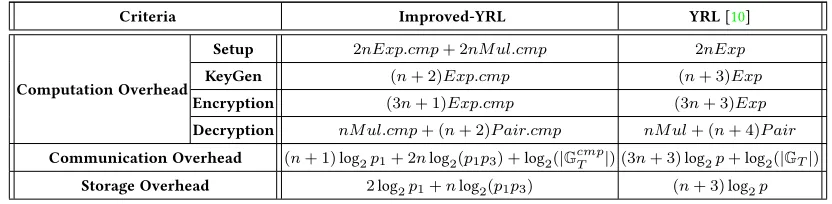
This section analyzes the performance of the proposed scheme. For this aim, we compute the computation, communica-tion and storage overheads in terms of the total number of attributes in the network which is denoted byn. These results are achieved due to the YRL scheme’s overheads presented in [10]. We denote modular multiplications, exponentiations and pairings over prime and composite orders byM ul,M ul.cmp,Exp,Exp.cmp,P airandP air.cmprespectively.
7.1 Computation Overhead
Here we investigate the computation load of the Setup, KeyGen and Encryption algorithms of Improved-YRL executed by the broadcaster and Decryption algorithm executed by the receivers.
Similar to the YRL’s setup overhead [10], Improved-YRL’s setup has a term2nExp.cmp; also as in the Improved-YRL’s setup, some elements of subgroup G1 are multiplied with some elements of subgroup G3, the extra term
2nM ul.cmpis added. So the total overhead of the Improved-YRL’s setup is2nExp.cmp+ 2nM ul.cmp.
In the KeyGen algorithm, there is no need to computegrβin comparison with KeyGen algorithm of YRL. Therefore,
the computation overhead of the KeyGen algorithm is(n+ 2)Exp.cmp.
In the Encryption algorithm, the terms gkβ0 andg k1
β are eliminated. Therefore, in comparison with the Encryption
algorithm of YRL, two Expcomputations are omitted and the resulting computation overhead is reduced to (3n+ 1)Exp.cmp.
In the Decryption algorithm, there is no need to compute{Bj =e(g
kj β, grβ)}j
∈{0,1}and consequently, the total
number of pairing computations is reduced by two units. Therefore, the total computation overhead of Decryption algorithm becomesnM ul.cmp+ (n+ 2)P air.cmp.
These results are summarized in Table1.
7.2 Communication Overhead
The total communication overhead of the proposed scheme is(n+1)log2p1+2nlog2(p1p3)+log2|G
cmp
T |as presented
in Table1
7.3 Storage Overhead
The main storage load for users comes from the secret keySK. The storage load of the YRL scheme is(n+ 3)log2p
[10], and as in the Improve-YRL scheme,gβris omitted from the secret key, each user needs2log2p1+nlog2(p1p3) bits to store his secret key. These results are illustrated in Table1.
8 Conclusion
In this paper, we investigated an anonymous broadcast encryption scheme called YRL and showed its vulnerability. Our investigation demonstrated that all of the users in this scheme, including authorized and unauthorized ones, can decrypt the received message. Thus, it does not provide the main requirement of the broadcast encryption schemes.
TABLE 1
Comparison between the proposed scheme and the basic YRL scheme [10]. Note that, according to [21], to achieve192-bit security level we should selectlog2pi=log2p= 192.
Criteria Improved-YRL YRL[10]
Computation Overhead
Setup 2nExp.cmp+ 2nM ul.cmp 2nExp
KeyGen (n+ 2)Exp.cmp (n+ 3)Exp
Encryption (3n+ 1)Exp.cmp (3n+ 3)Exp
Decryption nM ul.cmp+ (n+ 2)P air.cmp nM ul+ (n+ 4)P air
Communication Overhead (n+ 1)log2p1+ 2nlog2(p1p3) +log2(|GcmpT |) (3n+ 3)log2p+log2(|GT|) Storage Overhead 2log2p1+nlog2(p1p3) (n+ 3)log2p
secure against the proposed attack. We also proved anonymity and semantic security of the Improved-YRL scheme under adaptive corruptions in the chosen ciphertext setting.
The same as the basic YRL, the computation and communication overheads of the Improved-YRL scheme, as illustrated in Table 1, are O(n), where n is the number of attributes and independent of the number of receivers.
Since the attributes are usually shared by unlimited number of group members, the scheme is more efficient than the anonymous BE schemes with overheads related to the number of receivers.
References
[1] A. Fiat and M. Naor, “Broadcast encryption,” inAnnual International Cryptology Conference. Springer, 1993, pp. 480–491.
[2] J. A. Garay, J. Staddon, and A. Wool, “Long-lived broadcast encryption,” inAnnual International Cryptology Conference. Springer, 2000, pp. 333–352.
[3] D. Naor, M. Naor, and J. Lotspiech, “Revocation and tracing schemes for stateless receivers,” inAnnual International Cryptology Conference. Springer, 2001, pp. 41–62.
[4] D. Halevy and A. Shamir, “The lsd broadcast encryption scheme,” inAnnual International Cryptology Conference. Springer, 2002, pp. 47–60.
[5] D. Boneh, C. Gentry, and B. Waters, “Collusion resistant broadcast encryption with short ciphertexts and private keys,” in Annual International Cryptology Conference. Springer, 2005, pp. 258–275.
[6] D. Boneh and B. Waters, “A fully collusion resistant broadcast, trace, and revoke system,” inProceedings of the 13th ACM conference on Computer and communications security. ACM, 2006, pp. 211–220.
[7] C. Delerablée, P. Paillier, and D. Pointcheval, “Fully collusion secure dynamic broadcast encryption with constant-size ciphertexts or decryption keys,” inInternational Conference on Pairing-Based Cryptography. Springer, 2007, pp. 39–59.
[8] D. Boneh, B. Waters, and M. Zhandry, “Low overhead broadcast encryption from multilinear maps,” inInternational Cryptology Conference. Springer, 2014, pp. 206–223.
[9] D. Lubicz and T. Sirvent, “Attribute-based broadcast encryption scheme made efficient,” inInternational Conference on Cryptology in Africa. Springer, 2008, pp. 325–342.
[10] S. Yu, K. Ren, and W. Lou, “Attribute-based on-demand multicast group setup with membership anonymity,”Computer Networks, vol. 54, no. 3, pp. 377–386, 2010.
[11] Z. Zhou and D. Huang, “On efficient ciphertext-policy attribute based encryption and broadcast encryption,” inProceedings of the 17th ACM conference on Computer and communications security. ACM, 2010, pp. 753–755.
[13] A. Barth, D. Boneh, and B. Waters, “Privacy in encrypted content distribution using private broadcast encryption,” inInternational Conference on Financial Cryptography and Data Security. Springer, 2006, pp. 52–64.
[14] B. Libert, K. G. Paterson, and E. A. Quaglia, “Anonymous broadcast encryption: Adaptive security and efficient constructions in the standard model,” inPublic Key Cryptography–PKC 2012. Springer, 2012, pp. 206–224.
[15] N. Fazio and I. M. Perera, “Outsider-anonymous broadcast encryption with sublinear ciphertexts,” inInternational Workshop on Public Key Cryptography. Springer, 2012, pp. 225–242.
[16] R. Rabaninejad, M. Delavar, M. H. Ameri, and J. Mohajeri, “On the security of yrl, an anonymous broadcast encryption scheme,” in
Telecommunications, IST 2016, International Symposium on. IEEE, 2016.
[17] B. Waters, “Dual system encryption: Realizing fully secure ibe and hibe under simple assumptions,” inAdvances in Cryptology-CRYPTO 2009. Springer, 2009, pp. 619–636.
[18] D. Boneh, E.-J. Goh, and K. Nissim, “Evaluating 2-dnf formulas on ciphertexts,” inTheory of Cryptography Conference. Springer, 2005, pp. 325–341.
[19] Y. Sreenivasa Rao and R. Dutta, “Fully secure bandwidth-efficient anonymous ciphertext-policy attribute-based encryption,”Security and Communication Networks, vol. 8, no. 18, pp. 4157–4176, 2015.
[20] A. Lewko, T. Okamoto, A. Sahai, K. Takashima, and B. Waters, “Fully secure functional encryption: Attribute-based encryption and (hierarchical) inner product encryption,” inAdvances in Cryptology–EUROCRYPT 2010. Springer, 2010, pp. 62–91.
[21] C. Hu, R. Yang, P. Liu, Z. Yu, Y. Zhou, and Q. Xu, “Public-key encryption with keyword search secure against continual memory attacks,”