Image Edge Detection by Using Rule Based Fuzzy
Classifier
Er.Mandeep Singh Sandhu1 ,Er.Vikram Mutneja2 ,Er.Nishi#
#
Department of Computer Science and Engineering B.M.S College of Engineering
Sri Muktsar Sahib, India.
*
Department of E.C.E M.I.M.I.T Malout, India.
Abstract─ Fuzzy logic is a key concept of artificial intelligence helps to implement the rule based algorithms that helps to find and highlight the properties of an image by checking the relative pixel values. Image processing is any form of information processing for which both the input and output are images where the images are treated as two-dimensional arrays (i.e. matrices), in which each element of the matrix corresponds to a single pixel in the displayed image. Edge detection is a terminology in image processing and computer vision, particularly in the areas of feature detection and feature extraction, to refer to algorithms which aim at identifying points in a digital image at which the image brightness changes sharply or more forma lly has discontinuities. In this research work Fuzzy image processing is used for edge detection, which is a collection of fuzzy logic and image processing that understand, represent and process the images as fuzzy sets. The proposed approach is begins by padding the input image and exhaustive scanning of image is done by using the sliding window of 5x5 mask, then pixel values of window are subjected to fuzzy rules designed for horizontal, vertical and diagonal direction, for comparison of pixel values with the adjacent pixels to check, whether the pixel belongs to edge region or non-edge region, an intermediate image is generated as output of fuzzy logic system. First derivative is calculated to fetch the edges from the intermediate image. At the last thinning algorithm is applied to get thin and refined edges.
Keywords─ Image processing, Fuzzy logic, Fuzzy image processing, MATLAB, Edge detection, padding, fuzzy rules, fuzzification, de-fuzzification
I. INTRODUCTION
Over the past few decades fuzzy logic has been used a wide range of problem domains .Although the fuzzy logic is relatively young theory, the area of applications are wide: process control, management and decision making, operation research economic and for this paper the most important pattern recognition and classification .Dealing with simple black and white answerer is no longer satisfactory enough, a degree of membership became a new of solving problems[ 2, 4, 5, 8].Edge detection is a terminology in electronic vision, particularly in the areas of feature extraction, to refer to algorithms which aim at identifying points in a digital image at which image intensity changes sharply or more formally has discontinuities .The goal of the edge detection is to locate the pixels in the image that corresponds to edges of the objects seen in the image. An idea to solve the problem of edge detection by using fuzzy image processing [1, 12, 20,
and 25] as well as the comparisons of the results with traditional methods of edge detection is the main motivation of this work.
Earlier edge detection methods, such as Sobel, Prewitt and Robert are based on the calculation of the intensity gradient magnitude at each image pixel. In these algorithms, the gradient value is compared to the threshold value and a pixel location is classified as an edge if the value of the gradient is higher than a threshold. Gradient-based edge detectors have a major drawback of being very sensitive to noise[10, 14].In order to counter noise problems Canny proposed an approach to edge detection in which the image is convolved with the first order derivatives of Gaussian filter for smoothing in the local gradient direction followed by edge detection and thresholding [26]. Edge detection represents an extremely important step facilitating higher-level image analysis and therefore remains an area of active research, with new approaches continually being developed. Comparison of edge detection approaches and an assessment of their performance may be found in [10, 21, and 24].
In this paper, to fetch input pixels from an image, a sliding neighborhood operation is used. A pixel's neighborhood is some set of pixels, defined by their locations relative to that pixel, which is called the center pixel. The neighborhood is a rectangular block, and as you move from one element to the next in an image matrix, the neighborhood block slides in the same direction [6] .Fuzzy Sets is a set without a crisp, clearly defined boundary. It can contain elements with only a partial degree of membership .Membership Functions (MF) is a curve that defines how each point in the input space is mapped to a membership value (or degree of membership) between 0 and 255 i.e. black and white for input and edge and nonedge for output [2,4,5,8]. If-Then Rules are statements used to formulate the conditional statements that comprise fuzzy logic for edge detection [7, 12, 23] Possible direction of edges can be horizontal, vertical and diagonal [6, 9].Fuzzy Inference Systems is the process of formulating the mapping from a given input to an output using fuzzy logic edge detection. The mapping then provides a basis from which decisions can be made [4, 12, and 22].
processing such as image quality assessment, edge detection, image segmentation, etc. Many techniques have been suggested by researchers in the past for fuzzy logic-based edge detection. Devesh D. Nawgaje, et al presented a Fuzzy Inference System (FIS) approach to detect edge within color bone marrow microscopic images, which is robust with regard to variable illuminant level conditions, and takes into account color components stability degrees. They proposed a fuzzy technique which is based on the subjection of set of three pixels, part of a 2x2 window of an image to a set of fuzzy rules which help to highlight all the edges that are associated with an image[4]. Devesh D. Nawgaje, et al aimed at developing the edge detection techniques for breast cancer using Fuzzy Logic and DSP so that the disease may be detected in its early stage and proper and sooner steps may be taken thereafter. Edge detection is one of the important factors in the diagnosis of cancer [2]. Isha Jain, et al have been taken the images of moving and still vehicles and an algorithm is used for vehicle detection which is based on image processing techniques and classification of vehicles in the form of natural description( in linguistic terms) based on fuzzy logic[5].
B. Fuzzy Image Processing
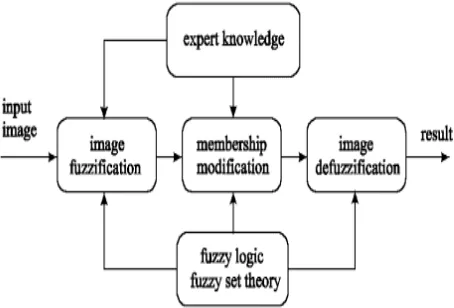
Fuzzy image processing is the collection of all approaches that understand, represent and process the images, their segments and features as fuzzy sets. The representation and processing depend on the selected fuzzy technique and on the problem to be solved. Fuzzy image processing has three main stages:
Image fuzzification,
Modification of membership values, and, if necessary,
Image defuzzification
The fuzzification and defuzzification steps do not possess fuzzy hardware. Therefore, the coding of image data (fuzzification) and decoding of the results (defuzzification) are steps that make possible to process images with fuzzy techniques.
Fig. 1 The general structure of fuzzy image processing
C. Advantages of Fuzzy Image Processing
Fuzzy image processing is important to represent uncertainty in data. Some of the main benefits of fuzzy image processing are listed as below:
Fuzzy techniques are powerful tools for knowledge representation and processing
Fuzzy techniques can manage the vagueness and ambiguity efficiently
Fuzzy logic is tolerant of imprecise data.
Fuzzy logic is conceptually easy to understand. The mathematical concepts behind fuzzy reasoning are very simple. What makes fuzzy nice is the “naturalness” of its approach and not its far-reaching complexity.
In many image processing applications, expert knowledge is used to overcome the difficulties (e.g. object recognition, scene analysis). Fuzzy set theory and fuzzy logic offer powerful tools to represent and process human knowledge in form of fuzzy if-then rules. On the other side, many difficulties in image processing arise because the data/tasks/results are uncertain. This uncertainty, however, is not always due to the randomness but to the ambiguity and vagueness. Beside randomness which can be managed by probability theory, imperfection in the image processing can be distinguished into three types as follows:
Grayness ambiguity Geometrical fuzziness
Vague (complex/ill-defined) knowledge
These problems are fuzzy in the nature. The question whether a pixel should become darker or brighter than it already is, the question where is the boundary between two image segments, and the question what is a tree in a scene analysis problem, all of these and other similar questions are examples for situations that a fuzzy approach can be the more suitable way to manage the imperfection.
II. PROPOSED METHOD
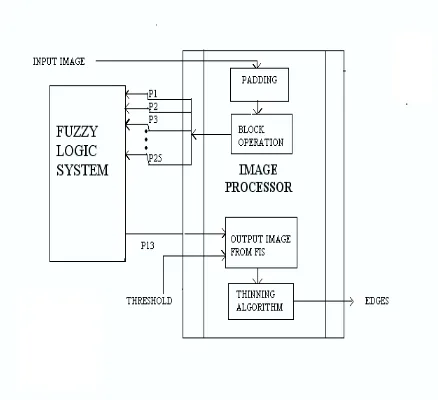
To accomplish the task of edge detection using fuzzy logic, the step by step methodology is followed as described under
1) To get the output at first pixel of an input image pad image firstly. So that output at each and every pixel of input image can be acquired.
2) Fuzzification is done for P1 to P25 inputs into various FS, having two membership functions i.e. Black and White by using 5x5 mask of sliding window.
3) Fuzzy rules are applied on each input.
4) For all the fired rules output FS is calculated by using MAX operator.
5) Centroid Method is used for de-fuzzification.
6) The P13 pixel having output value of image i.e. containing the Edge and Nonedge regions.
7) For the output image of FIS, the first derivative is calculated to fetch the edges from the image.
Fig. 2 Basic Building Blocks of proposed system
A. Fuzzy sets and fuzzy membership functions
The system implementation is carried out considering that the input image and the output image obtained after defuzzification are both 8-bit quantized; this way, their gray levels are always between 0 and 255. The fuzzy sets are created to represent each variable’s intensities; these sets are associated to the linguistic variables “black” and “white” for input and “edge” and “nonedge” for output. The adopted membership functions for the fuzzy sets associated to the input and output are triangular, as shown in figures 3 and 4.
Fig. 3 Membership functions of the fuzzy sets associated to the input
Fig. 4 Membership functions of the fuzzy sets associated to the output
TABLE I
FUZZY SETS FOR INPUT AND OUTPUT
Two fuzzy sets used for input
Name Range MF type
Black [0 0 255] Triangular
White [0 255 255] Triangular
Two fuzzy sets used for output
Name Range MF type
Edge [0 0 80] Triangular
Nonedge [81 255 255] Triangular
The functions adopted to implement the “and” and “or” operations are the minimum and maximum functions, respectively. The Mamdani method is chosen as the defuzzification procedure, which means that the fuzzy sets obtained by applying each inference rule to the input data are joined through the add function; the output of the system is then computed using weighted average method of the resulting membership function. The values of the two membership functions of the output are designed to separate the values of the edges regions and nonedges regions of the image.
B. Inference Rules definitions
. The basic rules for fuzzy logic in edge detection depends on the weights of the eight neighbors gray level pixels, if the neighbors’ weights are degree of blacks or degree of whites. The powerful of these rules is the ability of extract all edges in the processed image directly. This study is assaying all the pixels of the processed image by studying the situation of each neighbor of each pixel. The condition of each pixel is decided by using the 5x5 mask which can be scanning the allgrays. The designed rules are dealing with adjacent pixels of the desired checked or center pixel of the mask, in the vertical, horizontal and diagonal direction as shown in the following figure 5.
The introduced group of rules is detecting the edges, the nonedge pixels. The result images contribute for edge and nonedge areas. From the side of the fuzzy construction, the input grays is ranged from 0-255 gray intensity, and according to the desired rules the gray level is converted to the values of the membership functions. The output of the FIS according to the defuzzification is presented again to the values from 0-255 and then the edge and nonedge are detected. From the experience of the tested images in this study, it is found that the best result to be achieved at the range black from zero to 80 gray values and from 80 to 255 meaning that the weight is white. The rules designed for the proposed system shown in the following figure 6.
Fig.6 Rule Base Design
III. EXPERIMENTAL RESULTS
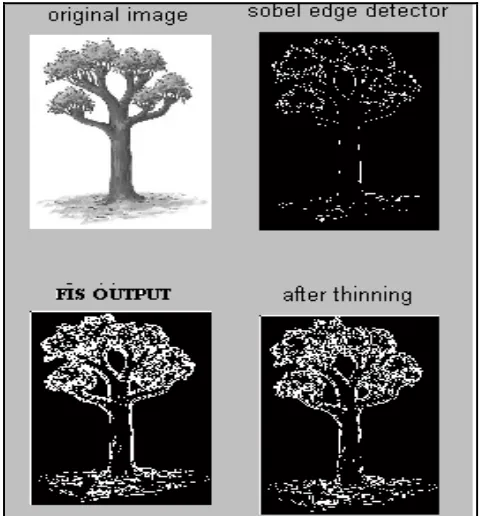
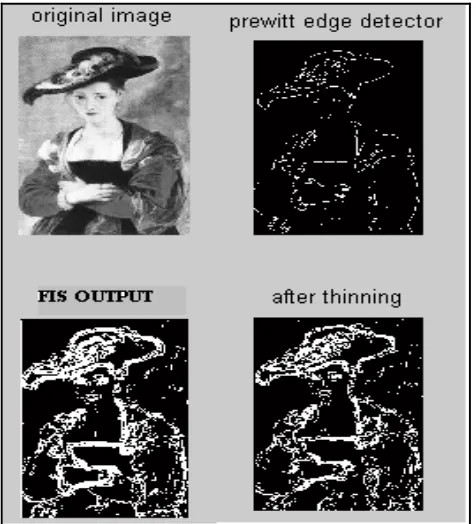
The fuzzy relative pixel value algorithm for image edge detection was tested for various images and the outputs were compared to the existing edge detection algorithms and it was observed that the outputs of this algorithm provide much more distinct marked edges and thus have better visual appearance than the ones that are being used. The sample output shown below in Fig. 7 (a-d) compares the traditional Edge detection algorithms and the fuzzy
relative pixel value algorithm. It can be observed that the output that has been generated by the fuzzy method has found out the edges of the image more distinctly as compared to the ones that have been found out by the “sobel”,”canny”,”prewitt” and “Roberts” edge detection algorithms. Thus the Fuzzy relative pixel value algorithm provides better edge detection and has an exhaustive set of fuzzy conditions which helps to extract the edges with a very high efficiency.
Fig. 7(a) Comparison of FIS output with “Sobel” edge detector.
Fig. 7(c) Comparison of FIS output with “Canny” edge detector.
Fig. 7(d) Comparison of FIS output with “Prewitt” edge detector.
IV. CONCLUSION
In this paper, the algorithm to find the edges associated with an image had been introduced which has been instrumental to abridge the concepts of artificial intelligence and digital image processing. Comparisons were made amongst the various other edges detection algorithms that have already been developed and displayed the accuracy of the edge detection using the fuzzy relative pixel value algorithm over the other algorithms which has
tremendous scope of application in various areas of digital image processing. The image edge detection using fuzzy relative pixel value algorithm has been successful in obtaining the edges that are present in an image after the implementation and execution of the algorithms with various sets of images. Sample outputs have been shown to make the readers understand the accuracy of the algorithm and the display that the algorithm can find image edges even in case of minor pixel value gradients.
V. FUTURE SCOPE
To optimize the FLS, it can be integrated with soft computing techniques. The soul of SC is to make computers as soft as the human brain, and is capable of carrying out both quantitative information that takes the form of precise numerical and qualitative information that assumes qualitative statements of knowledge and experience represented by natural languages. SC techniques include Fuzzy Sets, Artificial Neural Networks (ANN), Genetic Algorithm (GA), Ant Colony Optimization (ACO) and Gravitational Search Algorithm (GSA). To increase the speed of developed process, in future it can introduce a parallelization of fuzzy logic based image processing using Graphics Processor Units (GPUs). The low price of GPUs and the ease of learning and using the CUDA API make this type of parallel programming a legitimate possibility for a large portion of the programming community
REFERENCES
[1] Shahana Bano, Dr. M.S. Prasad Babu and E D Nagendra Prasad T [March 2011], “A new approach for edge detection using first order techniques.” International Journal of Computer Science and Technology IJCST Vol. 2, Issue 1, March 2011
[2] Devesh D. Nawgaje, Dr. Rajendra and D.Kanphade [Feb 2011],
“Implementation of fuzzy inference system for white blood cell cancer detection using dsp tms320c6711.”International Journal of Engineering Science and Technology (IJEST) ISSN: 0975-5462 NCICT Special Issue Feb 2011
[3] Punam Thakare [Feb 2011], “A study of image segmentation and edge detection techniques” International Journal on Computer Science and Engineering (IJCSE)ISSN: 0975-3397 Vol. 3 No. 2 Feb 2011 900
[4] Devesh D. Nawgaje, Dr. Rajendra and D.Kanphade [Jan 2011], “Implementation of Fuzzy Logic for Detection of Suspicious Masses in Mammograms using DSP TMS320C6711” Published in International Journal of Advanced Engineering & Application, Jan 2011 Issue.
[5] Isha Jain and Babita Rani [Dec. 2010], “Vehicle detection using image processing and fuzzy logic.” International Journal of Computer Science & Communication. 1, No. 2, July-December 2010, pp. 255-257
[6] Neha Agrawal, Rishabh Agrawal and Sushil Kumar [Dec. 2010],”Fuzzy edge filter-edge detection and feature extraction technique for any jpeg image.” International Journal of Computer Science & CommunicationVol. 1, No. 2, July-December 2010, pp. 387-390
[7] Aborisade and D.O [2010], “Fuzzy logic based digital image edge detection” Global Journal of Computer Science and Technology Vol. 10 Issue 14 (Ver. 1.0) November 2010 P a g e | 78
[8] Singh Gill [2010], “Fuzzy logic based image edge detection algorithm in matlab” ©2010 International Journal of Computer Applications (0975 - 8887) Volume 1 – No. 22
[9] Manisha Kaushal, Arjan Singh and Baljit Singh [2010], “Adaptive thresholding for edge detection in gray scale images” International Journal of Engineering Science and Technology Vol. 2(6) and 2010and 2077-2082
domain” International Journal of Computer Theory and Engineering and Vol. 1 and No. 5 and December and 20091793-820
[11] Sasi Gopalan, Madhu S Nair and Souriar [2009], “An approximation studies on image enhancement using fuzzy technique” Sebastian Cochin University of Science and Technology (CUSAT) and International Journal of Advanced Science and Technology Vol. 10 and September and 2009
[12] Ayman A. Alyand and Abdallah A. Alshnnaway [2009], “An edge detection and filtering mechanism of two dimensional digital objects based on fuzzy inference” World Academy of Science and Engineering and Technology 53 2009
[13] R. H. Luke, D. T. Anderson and J. M. Keller [2009] “Fuzzy logic-based image processing using graphics processor units” IFSA-EUSFLAT ISBN: 978-989-95079-6-8
[14] O. R.Vincentand and O. Folorunso [2009] “A descriptive algorithm for sobel image edge detection” Proceedings of Informing Science & IT Education Conference (InSITE) 2009
[15] Yasar Becerikli , Tayfun M. Karan and Ali Okatan[2009] “A new fuzzy edge detector for noisy images using modified wfm filter” and International Journal of Innovative Computing and Information and Control Volume 5and Number 6and ICIC International °c 2009 ISSN 1349-4198 pp 1725-1733
[16] Zhang Junrua and Jiang Xuezhonga [2008], “Research on edge extraction with level set method.” The International Archives of the Photogrammetry, Remote Sensing and Spatial Information Sciences. Vol. XXXVII. Part B4. Beijing 2008
[17] Shashank Mathur and Anil Ahlawat [July 2008], “Application of fuzzy logic on image edge detection”, Intelligent Technologies and Applications International Book Series "Information Science and Computing"
[18] Hu L., Cheng H. D. and Zang M. [2007], “Ahigh performance edge detector based on fuzzy inference rules.” An International Journal on Information Sciences, vol. 177, Nov 2007, no. 21, pp. 4768-4784 [19] alpher PASHA [2006] “Morphological image processing with fuzzy
logic” Havacilick Ve Ujay Teknolojileri Dergisi Ocak Cilt 2 Sayi 3 (27-34)
[20] Raman Maini and Dr. Himanshu Aggarwal “Study and comparison of various image edge detection techniques” International Journal of Image Processing (IJIP) and Volume (3) : Issue (1)
[21] I.Nedeljkovic “IMAGE CLASSIFICATION BASED ON FUZZY LOGIC” and
MapSoft Ltd and Zahumska 26 11000 Belgrade and Serbia and Montenegro and The International Archives of the Photogrammetry and Remote Sensing and Spatial Information Sciences and Vol. 34and Part XXX
[22] Wafa barkhoda, Fardin Akhlaqian Tab and Om-Kolsoom Shahryari
“fuzzy edge detection based on pixel's gradient and standard deviation values” Proceedings of the International Multi conference on Computer Science and Information Technology, ISBN 978-83-60810-22-4 pp. 7 – 10 ISSN 1896-7094
[23] Mohamed Roushdy [2006], “Comparative study of edge detection algorithms applying on the grayscale noisy image using morphological filter” GVIP Journal and Volume 6 and Issue 4 and December and 2006
[24] Becerikli T. and Anf Karan Y. [2005], “A new fuzzy approach for edge detection”. In J. Cabestany, A. Prieto, and D. Sandoval,editors,
Lecture Notes in ComputerScience, volume 3512, Springer-Verlag Berlin Heidelberg, 2005, pp. 943–951
[25] Tizhoosh [1997], “Fuzzy Image Processing.” Springer and 1997. [26] John Canny. [Nov. 1986], “A computational approach to edge