ISSN(Online): 2320-9801 ISSN (Print): 2320-9798
I
nternational
J
ournal of
I
nnovative
R
esearch in
C
omputer
and
C
ommunication
E
ngineering
(An ISO 3297: 2007 Certified Organization)
Vol. 3, Issue 5, May 2015
A Comparison between Bat Algorithm and
Cuckoo Search for Path Planning
Yogita Gigras
1,
Kusum Gupta
2, Vandana
3, Kavita Choudhary
4 Assistant Professor, Dept. of CSE, ITM University, Gurgoan, Haryana, India1Assistant Professor, Dept. of CSE/IT, Banasthali University, Banasthali, Rajasthan, India2
M.Tech Scholar, Dept. of CSE/IT, Banasthali University, Banasthali, Rajasthan, India3
Assistant Professor, Dept. of CSE, ITM University, Gurgoan, Haryana, India4
ABSTRACT: Here, metaheuristic search techniques are applied for robotic path planning. Robot has to move from its starting point called source point to final point called as destination point with minimum number of moves and iteration. Here both cuckoo search and bat algorithms are applied for the proposed problem and simulation results are compared. The techniques are applied for different number of population and bat algorithm provide better results as compared to cuckoo search.
KEYWORDS: Metaheuristic, cuckoo search, levy flight, bat algorithm.
I. INTRODUCTION
To solve any particular problem heuristic techniques were used. As these techniques do not provide any optimal solution so they were categorized into problem dependent techniques. Heuristic techniques were greedy in nature, that‟s why they were trapped into local optima and unable to provide global optimum solution. Metaheuristic approach is opposite to heuristic because of its problem independent nature. Metaheuristic algorithms provide current and global best solution in search space. It provides a good balance between local and global solution and also improve the convergence of algorithm.
For robotic path planning metaheuristic search algorithm is better technique because it is problem independent. It uses random solutions to achieve the goal. It uses hit and trial method to reach the goal.
There are many metaheuristic search techniques and classified with their properties i.e. based on swarm intelligence: Firefly algorithm, Ant colony optimization, particle swarm optimization, and on the basis of solitary intelligence: bat algorithm and cuckoo search etc. Solitary intelligence based techniques are used for robotic path planning.
Robots have to reach their destination with minimum moves and with avoiding obstacles. Path for robots can be static or dynamic. If it is static (fix), the path is known to robots. And if path is dynamic (not fixed), the robot have to choose its own path from source to destination. As path can be static or dynamic, the obstacles can be static or dynamic. If the obstacles are static means they are fixed or they remain fixed during the whole path. If the obstacles are dynamic then every time they will be at different position and robot has to identify to avoid during choosing the required path.
ISSN(Online): 2320-9801 ISSN (Print): 2320-9798
I
nternational
J
ournal of
I
nnovative
R
esearch in
C
omputer
and
C
ommunication
E
ngineering
(An ISO 3297: 2007 Certified Organization)
Vol. 3, Issue 5, May 2015
II. RELATED WORK
Srhan et al.[3] proposed cuckoo search for” Traveling Salesman problem” for 20 to 442 cities and found optimal path that reduce the cost and time both. Mohanna et al. [4] applied improved cuckoo search for their problem of feed forward neural network training and found overall better performance in all criteria. Moe Zaw et al. [5] also applied improved cuckoo search with levy flight for a text based web document clustering system and got better performance.
Shukla et al.[6] implemented “ Adaptive & Discrete Real Bat Algorithms for Routing Search Optimization of Graph Based Road Network”. For their purpose they implement the three variable dependent Weibull Cumulative Distribution Function as Weibull Coded Binary Bat Algorithm (WCBBA), another as Real Bat Algorithm (RBA) and the third as the hybrid of the two. After implementation they conclude it new discrete version of bat algorithm exclusively for graph based problem for first time and used for route determination in a graph network. Xin-she Yang [16] introduced “A new Metaheuristic Bat-Inspired Algorithm”. In this paper he tried to formulate a new nature inspired algorithm, based on the echolocation behavior of bat. He combines the advantages of existing algorithm into a new algorithm. Proposed algorithm was much simpler comparative to existing algorithms. It has advantages over existing algorithms someway. Fister et al.[17] proposeded “A Hybrid Bat Algorithm”. In this paper they present a new swarm intelligence algorithm, based on bat algorithm. They hybridized the bat algorithm with differential evolution strategies. They tested on large-scale global optimization and as a result they found significant improvement.
III. EXISTING SYSTEM
A. Cuckoo search:
i. Breeding behavior :
CS is also nature inspired algorithm. Cuckoos are extremely interesting birds because they lay their eggs in the nests of small songbirds whose eggs are also looking same. They lay their eggs either just before the host bird lays or just after it, so that host bird can‟t identify these. If the host bird identifies that the eggs are of another bird than the host bird it destroys these or build a new nest, if not then eggs grow up with host eggs. They lay their eggs same as host bird eggs. As first egg become chick, it pushes the host eggs outside the nest and share the host bird food. According to some studies cuckoo chicks can also copy their call same as call of host chicks to get opportunity of feeding. Because they lay their eggs into another nest, that‟s why they are also called parasitism. Intraspecific blood parasitisms are those birds that destroy the host bird eggs.
ii. Levy flight:
Cuckoo search uses levy flight instead of simple walk. Levy flight is random walk whose step length is drawn from levy‟s distribution. Levy flight is used to generate new solution by calculating the step size of any walk. To generate new solution the following Mantegna‟s algorithm is used:
σ2 = { Ӷ 1+𝛽 𝑆𝑖𝑛
𝛱𝛽 2
Ӷ1+𝛽2 𝛽 2
𝛽 −1 2
}1/𝛽 (1)
here Γ is gamma function which is extended from factorial function of positive real number. β is the variable which control distribution by 0 ≤ β ≤ 2. σ2is the variance. Variance is used to calculate step size of random walk by using the following equation:
step size = 0.01 × 𝑢
|𝑣|1/𝛽 ⨁(𝑋𝑖
𝑡− 𝑋
𝑏𝑒𝑠𝑡) (2)
ISSN(Online): 2320-9801 ISSN (Print): 2320-9798
I
nternational
J
ournal of
I
nnovative
R
esearch in
C
omputer
and
C
ommunication
E
ngineering
(An ISO 3297: 2007 Certified Organization)
Vol. 3, Issue 5, May 2015
Here following three rules are considered for cuckoo search:
1) At a time only one egg is laid by each cuckoo into randomly chosen nest; 2) For next generation only high quality eggs are selected and marked as best nest;
3) Total numbers of available host nests are fixed, and assumes a probability pa 𝜖 [0, 1] for discovering the cuckoo eggs by host bird. If the host bird identifies that egg are of another bird then either throw the egg away or abandon the nest, and build a completely new nest. Here we assume last assumption that is approximated by the fraction pa of the n nests is replaced by new nests (with new random solutions) [1].
Based on these above rules, the implementation can be done by considering the following equations. Only one egg is laid into one nest by each cuckoo. Each nest represents a solution. The best nest is chosen among nests for best solution. The new solution for is generated for cuckoo i by using the following equation:
Xi(t+1) =Xit + α × levy(ʎ) (3)
Where xi t+1
is the new solution for cuckoo i at tth iteration. Here xi
t is the previous solution and α denotes the
step size that should be related to scale of problem of interest and should be greater than zero. In most cases, α =1 is used because if step length will be too large then the next solution will also be too far from the current solution and if the step length is too short then the solution will be too near that will be not efficient for good solution. Levy (ʎ) is the random walk. Its step length is calculated from levy distribution for levy flight.
Levy ~u=t-ʎ and (1≤ʎ≤3) (4)
B. Bat Algorithm
Xin-She Yang developed a new nature inspired algorithm “Bat Algorithm”[2010]. Microbats have special quality “sonar” to detect their chase and obstacles. They can also detect the cracks for their nest even in the dark. Microbats emits the sound pulse and wait for reverberate of sound that comes back after striking the chase or obstacles. Usually microbats use pulse rate i.e. 10-20 times per second. They can also detect tiny obstacles like human hair [13]. For navigation they use time delay between emissions and reverberate of sound. They can also detect distance, type of chase, its moving speed. They are able to differentiate targets by variations of Doppler effect introduced by the wing flutter rates of the target insects. They combine all their senses so that they can easily detect the chase and its navigation. They use [0.7,17] mm range of wavelength or [20-500] kHz inbound frequencies [14].
To develop algorithm the following three rules are considered:
1. Echolocation is used by all the bats to sense the distance, chase, food and obstacles.
2. Bats are used to fly randomly with some velocity veli at position Si with fixed frequency [feqmax, feqmin], varying wavelength ʎ , pulse rate r𝜖[0,1] and loudness A.
3. Loudness varies from Amax to Amin. A[0,1].
Microbats use varying loudness and frequency while their velocity, frequency and position remains fixed. Frequency can be varying corresponding to pulse rate and pulse emitted.
i. Movement of virtual bats:
For experiment, rules are updated with the frequency feq, position xi and velocity veli in d-dimensional search space. The corresponding updated solutions for Sit and velocity velit at time step t are represented as:
feqi = feqmin + (feqmax – feqmin)U(0,1), (5)
ISSN(Online): 2320-9801 ISSN (Print): 2320-9798
I
nternational
J
ournal of
I
nnovative
R
esearch in
C
omputer
and
C
ommunication
E
ngineering
(An ISO 3297: 2007 Certified Organization)
Vol. 3, Issue 5, May 2015
Sit = Sit-1 + velit, (7)
here U(0,1) is used for random distribution, best is used for current global best location that is calculated by comparing all the solutions among all the bats. The current best solution is updated by using the following equation:
Snew = Sold + 𝞮 At (8)
where 𝞮𝜖[-1,1] is a random number between -1 to 1, and At is used for average loudness of all the bats at time step t.
IV. PROPOSED WORK
For path planning is planned from an initial point called „source point‟ to final point called „destination point‟ with fixed step size and with avoiding obstacles encountered during its path. The path selected should be optimal path.
a. Design Considerations:
For robotic path planning, we consider X1, Y1 as source point with values 10 and 0 respectively from where robot has to start its path. We consider X2, Y2 as destination point for robot with the values 100 and 100 respectively. The rectangular shape represents the source point and diamond shape represents the destination point in fig.1. Here 20 static obstacles are used between source and destination point. Robot starts its move for with angle,‟ 𝜽‟, and distance d, where theta and distances are:
Fig.1. Twenty rectangular obstacles Fig.2. first obstacle encountered.
𝜃= tan-1( |𝑦2−𝑦1|
|𝑥2−𝑥2| ) (9)
d= (𝑥2 − 𝑥1)2 + (𝑦2 − 𝑦1)2 (10)
and with each move update its value of x1 and y1, by considering the following equation:
ISSN(Online): 2320-9801 ISSN (Print): 2320-9798
I
nternational
J
ournal of
I
nnovative
R
esearch in
C
omputer
and
C
ommunication
E
ngineering
(An ISO 3297: 2007 Certified Organization)
Vol. 3, Issue 5, May 2015
y1 = y1+ step × sin(𝜃) (12)
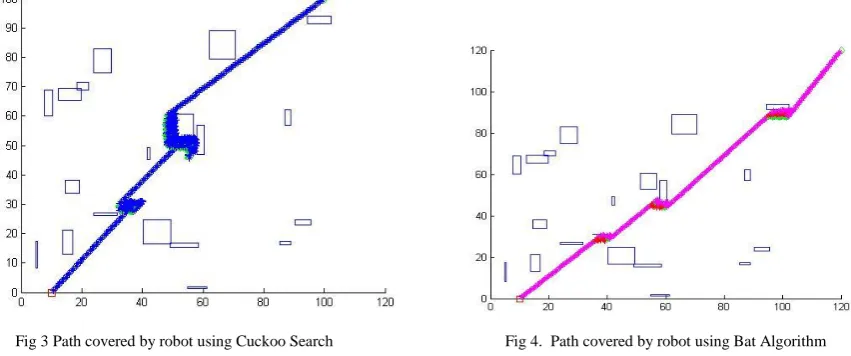
until any obstacle encountered or distance becomes zero. Here step is considered as 1. Robot encountered an obstacle at (X1, Y1) with values (37.70, 30.22) as shown in fig.2.
b. Description of the Proposed Solution:
As robot encounter the obstacle, it has to take some step back and here the proposed solution is applied for path planning.
i. Path planning using cuckoo search:
Here for cuckoo search the initial value of nest is initialized. Then the distance is calculated between the current and final position. Then minimum distance is calculated. According to minimum distance, select the best value of nest and declare it current position of robot. Then the value of sigma is calculated using the equation (1). Here the main process starts with calculating the cuckoo with levy flight, stepsize, and find the new solution until stopping criteria meet. Calculate the updated distance with new solution and compare both previous and updated distance. If updated distance is less than previous one then replace the value of d with updated distance if it is not then consider it worst solution and accept the previous solution. The process remains same until destination point achieved by it.
Fig 3 Path covered by robot using Cuckoo Search Fig 4. Path covered by robot using Bat Algorithm
ii. Bat Algorithm:
Bat algorithm is also applied for path planning. As obstacle encounters, robot has to start and has to take some step back and here bat algorithm is applied. Define the bat population (n), pulse rate (r), frequency (f) , loudness(A) and calculate the distance (d). Choose the best value of X1,Y1 CORRESPONDING TO minimum value of distance. Now generate modify the frequency with equation(5), update velocity and current position with equation (6),(7) respectively. Update the distance with current best position. If pulse rate is less than random then choose the solution among the best solution. Find out the local best solution by using equation(8).
ISSN(Online): 2320-9801 ISSN (Print): 2320-9798
I
nternational
J
ournal of
I
nnovative
R
esearch in
C
omputer
and
C
ommunication
E
ngineering
(An ISO 3297: 2007 Certified Organization)
Vol. 3, Issue 5, May 2015
V. PSEUDO CODE
A. Pseudo Code for Cuckoo Search
Begin
1) Choose the initial values of nest/cuckoos, say, x1, y1.
2) Measure the distance between initial and target values, say, d.
a. d=
3) Find the minimum value of d, say min (d).
4) Choose the best value of x1 and y1 according to value of d. 5) Calculate the value of sigma by using eq(i)
6) While(a<max iteration)or(stopping criterion)
i. Evaluate cuckoo randomly by levy flight ii. Calculate its stepsize by using eq(2) and iii. new solution by using eq(3), say updated x1, y1.
iv. Calculate the new updated distance with new solution, say, updated (d). v. Compare the distance
vi. If (updated(d) < d) then
1. Replace the value of d with updated(d) vii. Else
1. Consider it worst solution and destroy these values. viii. End if
7) End while End
B. Pseudo Code for Bat Algorithm
Begin
1) Define the bat population Si (i = 1, 2, ..., n) and veli
2) Initialize frequency feqi at Si
3) Define initial pulse rates ri and the loudness Ai
4) Measure the distance between initial and target values, say, d.
5) d=
6) Find the minimum value of d, say min (d).
7) Choose the best value of x1 and y1 according to value of d. 8) while (stopping criteria)
a. Adjust frequency for new solutions ,by using eg(5)
b. update velocity and location/solution, by using eq (6) and (7) respectively c. calculate the updated distance with updated values,
d. if (rand > pulse rate)
i. Choose the best solution.
ii. Select a local solution around best solution, by using eq(8) e. end if
f. Find new solution with random flying g. if ((rand < loudness) & (d <updated(d)))
i. Consider the new solutions
ii. Do some increment for ri and reduce Ai
ISSN(Online): 2320-9801 ISSN (Print): 2320-9798
I
nternational
J
ournal of
I
nnovative
R
esearch in
C
omputer
and
C
ommunication
E
ngineering
(An ISO 3297: 2007 Certified Organization)
Vol. 3, Issue 5, May 2015
VI. SIMULATION RESULTS
After applying proposed pseudo code of both cuckoo search and bat algorithm with different number of population and the results (number of iterations with different population) came from these are shown in table I and II. Bat algorithm found its best solution in second iteration while cuckoo search provide results in 2-3 iterations.
Table 1. simulation results for cuckoo search and bat algorithm
No. of population No. of iteration Complexity
Cuckoo search Bat algorithm Cuckoo search Bat algorithm
10 2 2 20 20
20 3 2 30 20
30 2 2 20 20
40 2 2 20 20
50 2 2 20 20
60 2 2 20 20
70 2 2 20 20
80 3 2 30 20
90 2 2 20 20
100 3 2 30 20
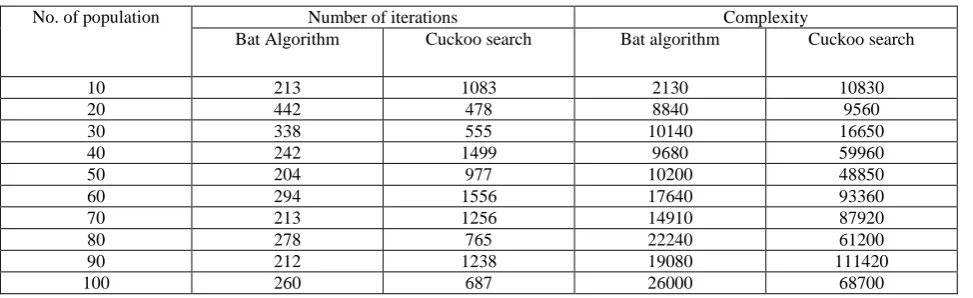
When same algorithms are applied for proposed problem i.e. path planning then bat algorithm provide optimal path with minimum number of iterations as compared to cuckoo search as shown in Table 2. Complexity is compared for both bat and cuckoo search in terms of:
Complexity = Number of population × Number of iterations (13)
Table 2. Simulation results for path planning using cuckoo search and bat algorithm
No. of population Number of iterations Complexity
Bat Algorithm Cuckoo search Bat algorithm Cuckoo search
10 213 1083 2130 10830
20 442 478 8840 9560
30 338 555 10140 16650
40 242 1499 9680 59960
50 204 977 10200 48850
60 294 1556 17640 93360
70 213 1256 14910 87920
80 278 765 22240 61200
90 212 1238 19080 111420
100 260 687 26000 68700
As table 1 and 2 represents the complexity for both algorithms bat algorithm provide better results as compared to cuckoo search. For different number of population bat algorithm gives less complexity and as a conclusion bat algorithm is better algorithm as compared to cuckoo search in terms of iterations and complexity.
ISSN(Online): 2320-9801 ISSN (Print): 2320-9798
I
nternational
J
ournal of
I
nnovative
R
esearch in
C
omputer
and
C
ommunication
E
ngineering
(An ISO 3297: 2007 Certified Organization)
Vol. 3, Issue 5, May 2015
VII. CONCLUSION AND FUTURE WORK
Bat Algorithm and Cuckoo search provide optimal solution as compared to previous techniques used for path planning. Between Bat and Cuckoo search Bat algorithm provides better results in terms of iterations and elapsed time as shown in table 1 and 2 in previous section. The same codes are executed more than 200 times. With each execution Bat algorithm provide optimal path as compared to cuckoo search whether they follow the same path or different path. In both cases Bat algorithm is better option for robotic path planning in static environment.
A combination of these techniques can be implemented for future work and better results. Here Path planning is done for static environment. For future work this can be a challenging topic for planning a path for dynamic environment. Here planning is done for 2-dimensional search space. For future work this can be implemented for 3-dimensional search space by adding Z-coordinate with X and Y coordinates. Sensor can be used to detect the obstacle.
REFERENCES
1. S. Deb, Xin-She Yang” Cuckoo Search via Lévy flights”, World Congress on Nature & Biologically Inspired Computing,IEEE publications, pp.210-214, 2009.
2. Jati, G.K..,” Discrete cuckoo search for traveling salesman problem”, 7th International Conference on Computing and Convergence Technology, pp. 993-997, 2012.
3. Ala'a Abu-Srhan and Essam Al Daoud,” A Hybrid Algorithm Using a Genetic Algorithm and Cuckoo Search Algorithm to Solve the Traveling Salesman Problem and its Application to Multiple Sequence Alignment”, International Journal of Advanced Science and Technology, vol.61, pp. 29-38, 2013.
4. Ehsan Valian ,” Improved Cuckoo Search Algorithm for Feed forward Neural Network Training”, International Journal of Artificial Intelligence & Applications, vol.2, pp.36-43, 2011.
5. Ei Ei mon, Moe Moe Zaw, “A Text-based Web Document Clustering System by Using Improved Cuckoo Search Clustering System Based on Levy Flight”, International Conference on Advances in Engineering and Technology, pp. 63-67, 2014.
6. Mehmet Karamanoglu et al.,” Cuckoo Search for Business Optimization Applications”, National Conference on Computing and Communication Systems, pp.1-5, 2012.
7. S. Deb, X. S. Yang, “Engineering optimization by cuckoo search”, Int. J. Mathematical Modelling and Numerical Optimisation, vol. 1, 2010, pp. 330-343.
8. Khairul Najmy ABDUL RANI et al.,” Nature-inspired Cuckoo Search Algorithm for Side Lobe Suppression in a Symmetric Linear Antenna Array”, RADIOENGINEERING, VOL. 21, pp.865-874, 2012.
9. Ehsan Valian et al.,” Improved Cuckoo Search Algorithm for Global Optimization”, International Journal of Communications and Information Technology, vol.1, pp.31-44, 2011.
10. Akajit Saelim et al., “Migration Planning using Modified Cuckoo Search Algorithm”, International Symposium on Communications and Information Technologies,IEEE publications,pp.621-626,2013.
11. Prabhneet kaur, Taranjot kaur,”A Comparative Study of Various Metaheuristic Algorithms” International Journal of Computer Science and Information Technologies, vol. 5, pp. 6701-6704,2014.
12. Hanif Halim, Ismail,” Bio-Inspired Optimization Method: A Review”, International Journal of Information Systems, vol. 1, pp.12-17, 2014. 13. Xin-She Yang, ”A New Metaheuristic Bat-Inspired Algorithm”.
14. Duˇsan Fister et al., “A Hybrid Bat Algorithm”, ELEKTROTEHNIˇSKI VESTNIK 80,ORIGINAL SCIENTIFIC PAPER, pp. 1-7, 2013. 15. Adis ALIHODZIC, Milan TUBA, “Framework for Bat Algorithm Optimization Metaheuristic”, Recent Researches in Medicine, Biology and
Bioscience, pp.157-162
16. De-yu Zhang and Zhi-guo Liu, “Study on Improved Algorithm for Mobile Agent Migration Path”, Third International Conference on Intelligent Network and Intelligent Systems, 2010.