A Valuation Process for Intellectual Property in a Technology P a r k
Environment
B y
Sanjoy Bose
Thesis submitted in partial fulfilment of the Requirements for the degree of
Doctor of Business Administration
Victoria Graduate School of Business
Victoria University
f
ICtER THESIS
658.570994 BOS 30001008601074 Bose, Sanjoy
IN APPRECIATION
I humbly dedicate this thesis to the m e m o r y of m y late wife Maureen, without whose inspiration, support and help it would never have happened.
ACKNOWLEDGEMENTS
I wish to express gratitude to m y supervisors, D r Nick Billington, and D r Sardar Islam and, for their enthusiastic support and timely guidance during the long research process. Their assistance will always be greatly appreciated.
I must also thank Dr K. B. Oh at the Graduate School of Management, La Trobe University, for his insightful comments throughout the various parts of this thesis. I also extend m y thanks to Professors R a y m o n d Harbridge and Geoffrey Durden for their continuous encouragement to bring this project to a successful conclusion.
Table of Contents APPRECIATION 2 ACKNOWLEDGEMENTS 3 LIST OF TABLES 9
LIST OF REFEREED PUBLICATIONS FROM THIS THESIS. 10 LIST OF APPENDIXES 12
ABSTRACT. 13 CHAPTER 1. INTRODUCTION _ 16
1.1 THE KNOWLEDGE ECONOMY. . 16
1.1.1 Biotechnology. 17 1.1.2 Information Technology 17 1.1.3 Energy and Environment 18 1.2 SIGNIFICANCE OF TECHNOLOGY 19 1.3 RESEARCH OBJECTIVES 21 1.3.1 Definition of the Technology Value Chain 21
1.3.2 Develop a Valuation Model. 21 1.4 LITERATURE REVIEW 22 1.4.1 Intellectual Property Valuation 22
1.4.2 Models 23 The following section briefly describe the formal valuation methods for valuing intellectual
capital, while chapter 2, literature review, examines each one in detail 23
1.4.3 Introduction 23 1.4.4 Discounted Cash Flow (DCF) Method 24
1.4.5 The Adjusted Present Value (APV) Method 24
1.4.6 Option Pricing. 24 1.4.7 The Capital Asset Pricing Model (CAPMO 25
1.5 LIMITATIONS OF EXISTING LITERATURE. 26 1.6 METHODOLOGY AND TECHNIQUES. 26 1.6.1 Case Study and Literature Review 27
1.6.2 Technical Review 28 1.6.3 Building the Valuation Process Model. 28
1.6.4 Data 28 1.6.5 Data Required 29
1.6.6 Data Collection and Analysis 29
1.7 CONCLUSION. 30 CHAPTER 2. LITERA TURE REVIEW 31
2.1 INTRODUCTION 31
2.1.1 Definition 31 2.2 IMPLICATION FOR VALUATION IN THIS STUDY 33
2.3 Importance of Intellectual Property to company value 33
2.4 CURRENT VALUA TION METHOD 35
2.4.1 Valuation and Price 35 2.4.2 Accounting Methods 37 2.4.3 Financial Methods 39 2.4.4 Discounted Cash Flow (DCF) Method 39
2.4.5 Adjusted Present Value 42 2.4.6 Equity Cash Flows 44 2.4.7 Valuing Opportunities: Option Pricing. 47
2.5. KNOWLEDGE ECONOMY: OPPORTUNITIES AND OPTIONS FOR VALUATION 48 2.6 OPTION PRICING AND OPTION PRICING MODELS. _ 53 2.7 OPTIONS PRICING MODELS AND A FIRM'S INVESTMENT DECISIONS. 55
2.8 EVALUATION OF THE OPTION PRICING MODEL 57
2.10 RISKS IN TECHNOLOGY VALUATION 64
2.10.1 Operational Risks 65
2.10.1.1 Marketing Risks 65
2.10.1.2 Research and Development Risks 65
2.10.1.3 Manufacturability Risks 66 2.10.1.4 Competitive Risks 66 2.11 THE NEED FOR A NEW VALUATION METHODOLOGY. 67
2.12 CONCLUSION. 71 CHAPTER 3. RESEARCH METHODOLOGIES 74
3.1 INTRODUCTION 74 3.2 GENERAL DISCUSSION. 74
3.2.1 CHOICE OF CASE STUDY METHOD FOR THIS RESEARCH 74
3.3 OVERVIEW OF RESEARCH METHOD 77 3.4 THEORETICAL FRAMEWORK. 78 3.5 DESIGNING THE CASE STUDIES 80
3.5.1 Study Question 81 3.5.2 Study Propositions 81 3.5.3 Unit of Analysis 82 3.5.4 Linking Data to Propositions, and Criteria for Interpreting the Findings 83
3.5.5 Criteria for Interpreting a Study's Findings 84 3.6 METHOLOGY OF TEST OFQUALITY 84
3.6.1 Construct Validity 85 3.6.2 Internal Validity 85 3.6.3External Validity 86 3.6.4 Reliability 87 3.7 THE USE OF MULTIPLE CASE STUDIES 88
3.8DATA COLLECTION 90 3.8.1 ASSUMPTIONS 92 3.8.2 Limitations of the Interviews Method. 92
3.8.3 Security and Non-disclosure Arrangements 93 3.9 PRINCIPLES OF DATA COLLECTION. 93 3.9.1 Use of Multiple Sources of Evidence 93
3.9.2 Surveys 94 3.9.3 Limitations of Postal Questionnaires 94
3.9.4 Postal Questionnaire Design 95
3.9.5 The Likert Scale 96 3.9.6Information Confidentiality 96
3.9.7 Multiple Sources of Evidence and Modification of Strategies 97
3.9.8 Create a Case Study Database 97 3.9.9 Maintain a Chain of Evidence ...99
3.10 ANALYSIS OF DATA 99 3.10.1 Case Studies and Surveys 99
3.10.2 General Strategies 100 3.10.3 Modes of Analysis 101 3.10.4 Use of Statistics in Data Analysis 103
3.10.5 Mean and Medians 103 3.10.6 Standard deviation 104 3.10.7 Assuring the Quality of Analysis 105
3.10.8 Developing the Econometric Model 106
3.11 CONCLUSION. 107 CHAPTER 4. CASE STUDIES 109
4.1 INTRODUCTION 109
4.2 BACKGROUND 109 The following sections describe links between intellectual capital and technology, and the
role of research in Australia which provide an important context for the valuation of
4.2.1 Technology and Intellectual Capital 109 4.2.2 Research and Development: the Australian Context Ill
4.2.3 Research and Development: An Overview of the Government's Policy Framework in
Australia 112 4.2.4 Research and Development: Commonwealth Government's Budget Support for
Supporting the National Policy Framework 112 4.2.5 Research and Development: The Role of Educational Institutions in Making
Investments in R &D within the National Framework 113 4.2.6 Research and Development: University Based Research and Research Parks 114
4.2.7 Research Park at La Trobe University: Creating, Developing and Commercialising
Intellectual Capital within a Framework of the National Agenda 115 4.2.8 La Trobe University's Strategic Approach to Research Commercialisation 116
43 C A S E STUDY 1: T H E W A L T E R A N D ELIZA H A L L INSTITUTE O F M E D I C A L R E S E A R C H
118
4.3.1 Biotechnology. 118 The following sections describe the biotech industry, and the various applications which
represent important investments in intellectual capital 118
4.3.2 Industry Background 118 4.3.3 Applications of Biotechnology 119
4.3.4 Treatment of Diseases 119 4.3.5 Agriculture and Related Industries 121
4.3.6 Environment 123 4.3.7 Chemical Industry 124 4.3.8 Establishment of a Biotechnology Centre 127
4.3.9 Major Areas of Research 127 The following sections describe the major areas of research in biotechnology which
represent substantial investments in intellectual capital. 127
4.3.10 Cancer andHaematology 128 4.3.11 Molecular Genetics of Cancer 128
4.3.12 Immunology 129 4.3.13 Autoimmunity and Transplantation 130
4.3.14 Structural Biology and Mouse Genome Manipulation Services 131
4.3.15 Management of Intellectual Property. 132
4.3.16 Finance 133
4.4 C A S E S T U D Y 2: W E B S Y T E C O R P O R A T I O N 133
4.4.1 Information Technology 133 The following sections describe the industry background and areas of research which
represent important investments in intellectual capital. 133
4.4.2 Industry Background 134 4.4.3 Applications of Information Technology 138
4.4.4 Internet Technologies 138 4.4.5 Software Technologies 139 4.4.6Supporting Technologies 139 4.4.7Photonic Communications Technologies 140
4.4.8 Digitisation, and Open Systems 140
4.4.9 Chip Technology 141 4.4.10 Resources 142
4.5 C A S E S T U D Y 3: E N V I R O N M E N T P R O T E C T I O N A U T H O R I T Y 144
4.5.1 Energy and Environment 145 4.5.2 Industry Background 145 4.5.3 Environment Protection Authority 750
4.5.4 Quality. 150 4.5.5 Role and Function 150
4.5.6 Operating Environment 151
4.5.7 Four Pillars 151 4.5.8 Looking to the Future 153
4.5.9 Resources 153 4.5.10 Government Financial Support 154
4.6 S U M M A R Y O F C A S E STUDIES 159
4.6.1 Results of Case Studies Analysis and Interpretation of the Value-Drivers 159
4.6.2 Profitability 160 4.6.3 Uniqueness of Innovation 161
4.6.4 Reputation of Research Team and Firm 161
4.6.5 Growth Prospects 161 4.6.6 Quality of Management 162 4.6.7 Economic Factors 162
4.6.8 Risks 163 4.6.9 Patent Protection 164
4.6.10 Productivity 164 4.6.11 Governmental Support 164
4.6.12 Cost Effectiveness 165 4.6.13 Correlation of Value-Drivers Between Industries 166
4.6.14 Conclusions and Implications for Biotechnology, Infotech and Energy &
Environment Technology Valuation 775 4.6.15 Conclusion and implications for designing the questions in the postal survey 7 79
CHAPTERS. RESULTS OF ANALYSIS OF QUESTIONNAIRE AND VALUATION MODELS
FOR THE INTELLECTUAL-CAPITAL SECTORS 180
5.1 INTRODUCTION 180
5.2 L O G I T M O D E L S 180
5.2.1 Interpretation of the Models 184 5.2.1.1 Biotechnology 185 5.2.1.2 Information Technology 186 5.2.1.3 Energy and Environment 757 5.2.1.4 Summary Output and Coefficient Results 188
5.2.1.5 The Properties of Estimated Coefficients 198 53 AUSTRALIAN MULTI-FACTOR T E C H N O L O G Y VALUATION M O D E L S ( A M T V M ) — 199
5.3.1 Biotechnology AMTVM. 200 5.3.2 Information Technology AMTVM 200 5.3.3 Energy & Environment AMTVM. 200
5.3.4 Conclusion 201
CHAPTER 6. ECONOMETRIC MODEL DEVELOPMENT 202
6.1 INTRODUCTION 202
6.2 M U L T D 7 A C T O R R E G R E S S I O N M O D E L S 202
6.2.1 Data Collection 206 63 A U S T R A L I A N M U L T I - F A C T O R T E C H N O L O G Y V A L U A T I O N M O D E L S 206
6.3.1 Biotechnology AMTVM 209 6.3.2 Information Technology AMTVM 209 6.3.3 Energy & Environment AMTVM. 270
6.4 T H E E S T I M A T E D V A L U A T I O N M O D E L S : R E S U L T S A N D F A C T O R A N A L Y S E S 210
6.4.1 Estimated Biotechnology AMTVM 277 6.4.1.1 Hypothesis tests 272 6.4.1.2 Empirical Results of the Biotech AMTVM. 214
6.4.2 Estimated Infotech AMTVM 275 6.4.2.1 Hypothesis Tests 276 6.4.2.2 Empirical Results of the Infotech AMTVM. 277
6.4.3 Estimated Energy & Environment AMTVM 275
6.4.3.1 Hypothesis tests 275 6.4.3.2 Empirical Results of the E&E AMTVM. 279
6.4.4 Limitations 220
6.5 F I N D I N G S 221
6.5.1 Biotech Valuation 227 6.5.2 Infotech Valuation 222 6.5.3 E&E Valuation • 222
CHAPTER 7. IMPLICATIONS AND CONCLUSIONS 224
7.1 I N T R O D U C T I O N 224 7.2 IMPLICATIONS A N D E X T R A P O L A T I O N S . 227
7.2.1 Literature Review 227 7.2.2 Case Studies and Survey 229 7.2.3 Statistical Analysis 230 7.2.4 Triangulation of Results 257 7.2.5 Relating Literature to Findings 233 7.2.6 Implications for Valuation 237 7.2.7 Implications for Strategic Management 239
7.2.8 Implications for Public Policy. 241 7.2.9 Implications for Equity Investment 244 13 CONCLUSIONS „ 246
7.3.1 Summary of Findings 246 7.3.2 Limitations of Research 247 7.3.3 Future Research 248 7.3.4 Conclusion 249
List of Tables
Table 1 Comparison of Value-Drivers in Different Sectors 159 -160
Table 2 Correlation of Value-Drivers Between Sectors 756 Table 5.1 Biotechnology Sector Summary Output 188 Table 5.2 Information Technology Sector Summary Output 188
Table 5.3 Energy and Environment Sector Summary Output 189
Table 5.4 Value of Every Value-Driver 199 Table 6.1 Pervasive value drivers identified from Logit Analysis 208
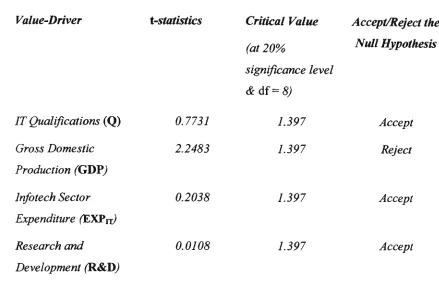
Table 6.2 t-Statistics Tests of the 4 Pervasive Value-Drivers Model — Biotech Sector 212 Table 6.3 t-Statistics Tests of the 3 Pervasive Value-Drivers Model - Biotech Sector
213
Table 6.4 t-Statistics Tests of the Pervasive Value-Drivers - Infotech Sector 216 Table 6.5 t-Statistics Tests of the Pervasive Value-Drivers - E&E Sector 218
List of Refereed Publications from this Thesis
Refereed Journal Articles
Bose, S. & Ho, T. (2003) Valuation of New Technologies and Other Financial Market Issues:
The Perspectives of Option Pricing Models. Narsee Monjee Institute of Management Studies
Management Review, Vol XIV, II, 1 - 11.
Bose, S. & Oh, K.B. (2003) An Empirical Evaluation of Option Pricing in Intellectual Capital, Journal of Intellectual Capital, v, pp
Oh, K.B. & Bose, S. (2003) Cross-Sectional Analysis of Value-Drivers in the knowledge
Economy, Internationa! Journal of Knowledge. Culture and Change Management
Oh, K.B. & Bose, S. (2003) The Determinants of Risk Premium in Electronic Commerce
Equity, Journal ofEcommerce
Bose, S. & Oh, K.B. (2004) A Cross-Sectional Analysis of Value-Drivers in the knowledge
Economy, International Journal of Knowledge, Culture and Change
Management (Forthcoming edition)
Refereed Conference Proceedings
Bose, S. & Oh, K.B. (2002) A critical evaluation of valuation models used to value intellectual property, In Young, S., Skatalova, E & Hashmi, S (eds) Proceedings: 23rd McMaster World Congress, January, Hamilton, Ontario ( C D R o m )
Bose, S., Oh, K.B. & Thomas, K. (2002) An Exploratory Identification of
management Issues in the Intellectual Capital Intensive Sector. Proceedings of the 16th ANZAM Conference, Beechworth Victoria, 4-1 December
Oh, K.B., Islam, S.M.N. & Bose, S. (2002) The policy implications of economic
variables on electronic commerce equity In Sohal, A & Cooney, R (eds) Proceedings: 6th International Research conference on quality, Innovation and Knowledge Management, Monash University, Kuala Lumpur (CD Rom)
Bose, S. & Islam, S.M.N. (2002) Valuation of New Technologies and other Financial Market Issues: The Perspective of Option Pricing Models, Asia Pacific Economic and Business Conference, Kuching, Sarawak, Malaysia, 2 - 4 October, 2002
Bose, S & Oh, K.B. (2003) An empirical evaluation of the issues of option pricing model in intellectual capital investments In 6th World Congress on the Management of
Intellectual Capital and Innovation, Hamilton Ontario, Canada, January 2003
Oh, K.B. & Bose, S (2003) Risk and Return issues of Stocks in the Knowledge
Economy, 7th International Conference on Global Business and Economic
Bose, S (2002) Option pricing models: implications for valuation of the n e w
technologies & financial market behavior, The international conference on economic
recovery and reform, Bankok, Thailand
Bose, S. & Oh, K.B. (2003) A cross-Sectional Analysis of Value-Drivers in the knowledge Economy, Third International Conference on Knowledge, Culture and Change, 8 - 1 1
January, Penang, Malaysia.
Bose, S. & Oh, O.B. (2003) An Empirical Evaluation of the Issues of Option Pricing Model in Intellectual Capital Investments, McMaster World Congress on Intellectual Capital;
Conference Proceedings in CD ROM, Hamilton, Canada
Bose, S. & Oh, K.B. (2004) Strategic Management of Intellectual Capital Value and Risk, McMaster World Congress on Intellectual Capital; Conference Proceedings in CD
ROM, Hamilton, Canada.
Bose, S & Oh, K.B. (2003) A Case Study of Strategic Intellectual Capital
M a n a g e m e n t in an SMB, The Fifth Lake International Conference on Small &Medium
Business, Hangzhou, China 2-5 November, 2003
Oh, K.B., Bose, S, & Billington, N. (2004) Financial Risk Issues in Intellectual Capital: A Study of the E-Commerce Sector, The 8th International Conference on Global Business and
Economic Development, Guadalajara, Mexico 7-10 January, 2004.
Bose, S. & Oh, K.B (2003) Value-Drivers and Strategic Management in the Knowledge Economy, Australian and New Zealand Academy of Management Conference, Fremantle, 2 -5 December.
Bose, S., Oh, K.B. & Wilkinson, D., (2004) Measuring Value in New Biotech Firms: An Empirical Modelling Approach, Forthcoming Fourth International Conference on
List of Appendixes
Appendix 1 Interview Script 270 Appendix 2 Questionnaire 277 Appendix 5.1 Biotechnology Input Data 292
Appendix 5.2 Information Technology Input Data 296 Appendix 5.3 Energy. & Environment Input Data ...300 Appendix 5.4 Dependent/Independent Variables Scores 303
Appendix 6.1 Biotech Sector Summary Output 304 Appendix 6.2 Infotech Sector Summary Output 305 Appendix 6.3 Energy and Environment Summary Output 307
Abstract
A Valuation Process for Intellectual Property in a Technology P a r k Environment
With the rapid development of the global economy, intellectual capital has become a
critical driver of a business's sustainability. T h e essential difference between companies
operating in the 'old' and the 'new' e c o n o m y is that, where value in the past w a s created
within industrial sectors such as manufacturing, education, retail, wholesale and financial
services, value in the future will be created primarily from the application of knowledge.
Increasingly, the main assets of 'smart' companies will be in the form of intellectual, and
not physical, capital. Technology development is a logical product of intellectual capital.
Thus, in the n e w economic paradigm, companies perceive technology developments as
necessary commercial activities to underpin their competitive standings, and provide a
platform for economic growth, profitability and shareholder value.
However, the development of commercially viable intellectual capital projects also
requires substantial investments in intellectual property, often without certainties of
success. Since valuation techniques and processes are crucial for business investments,
this paper evaluates the various methods that are currently used to value intellectual
capital and intellectual property, and finds that, in view of substantial inadequacies, there
has arisen an imperative need to develop a n e w process for valuing these.
The industries that were selected for this study based on their significance to the
development of the Australian knowledge e c o n o m y were the Biotechnology, Information
Technology and Energy and Environment.
The motivation for this research was to provide an empirical and quantitative contribution
to the understanding of intellectual capital and nascent technologies valuation. The
formulation of the models w a s based o n a n e w branch of research, referred to as
value-driver research, which has emerged in response to criticisms of the traditional valuation
Thus, the methodology adopted in this study w a s to identify, evaluate and analyse the key
factors, from a valuation perspective, that drive the value chain of nascent technologies
throughout the development process. There steps involved in the research process that led
to the development of the valuation process models were as follows:
(i) Consistent with current academic research which prescribes the need for n e w
valuation models for intellectual capital, the research identified the underlying
factors that create and drive value specific to each of the technologies being
looked at in this study by subjecting specific case studies pertaining to t h e m to
analysis, using case- study analysis software.
(ii) A questionnaire containing 4 0 questions were sent to 3 0 0 companies which
sought to establish if the value drivers identified from the case study analysis
were pervasively present in each of the industries in the study, or otherwise.
(iii) Subjected the respondents' data to statistical analysis to identify pervasive
value drivers.
(iv) Based on the statistical analysis, the research estimated a logistic regression
model for each of the industries based o n their individual value drivers. T h e
objective of using logit regression modeling techniques w a s to assure the
validity and rigour of the analysis. B y doing this, the specified logit equations
helped in explaining whether the set of independent variables (i.e.
value-drivers) were statistically significant in collectively deteraiining the value of
firms in each sector. T h e objective of this regression manipulation w a s to
statistically specify the value-drivers and determine the pervasiveness of these
variables on the dependent variable according to the scores given b y the
respondents to the questionnaire.
The thesis succeeded in developing robust, flexible models of a linear multi-beta type,
using the method of ordinary least squares ( O L S ) for estimating the value of intellectual
capital, and w a s given the title 'Australian Multi-Factor Technology Valuation
The final models were tested against empirical data, but the results appeared to at odds with the findings from the survey insofar as the n u m b e r of value drivers that aggregate to total value for each industry w a s concerned. H o w e v e r , the results of the analysis of empirical data related to a specific period of time, and for a specific population. Additionally, given the other limitations of research, this w a s this w a s quite a plausible outcome.
Chapter 1. Introduction
1.1 The Knowledge Economy
This paper is to conduct research on the valuation approaches used by managers in
technological-intensive companies for valuing their technologies specifically within
the confines of a technology park, and generally, in other environments. Companies
perceive technology developments as necessary commercial activities to underpin
their competitive standings, and provide a platform for economic growth, profitability
and shareholder value. There are several examples, Microsoft Inc. being one of the
best of these. T h e technologies developed by the computing, telecommunications,
consumer electronics, pharmaceutical and electronic media companies, a m o n g others,
change the w a y business is conducted and substantially change our h o m e live as well.
In the IT industry there is a disproportionate number of small companies w h o s e
revenues have grown by high comparative levels over the past decade. Recently in
America successful start-up firms in the IT industry such as C o m p a q , Oracle and Sun
Microsystems have shown higher growth relative to the general market. However,
such business developments also require substantial investments in intellectual
property, often without certainties of success. Since valuation techniques and
processes are crucial for business investments, this paper will evaluate the various
methods that are currently used and incorporate them, where appropriate, into the
development of a valuation process for n e w and evolving technologies.
The industries selected for this study based on their significance to the development of
the Australian knowledge economy1 are:
• Biotechnology
• Information Technology
• Energy and Environment
1
Information Industries Action Agenda - Dept. of Communications, Information Technology and the
1.1.1 Biotechnology
Biotechnology is viewed by several countries as a key to the marketplace of the 21st
century. This view w a s supported by John Gibbons, White House science adviser2, on
the basis of the C o m m e r c e Department's prediction that sales of biotech-derived
products will grow between 1 5 % and 2 0 % annually through 1997 and beyond3. In the
U.S. alone, total revenues for the biotechnology industry are currently estimated at
between $U.S. 4 -5 billion. But according to the C o m m e r c e Department, that figure
would have grown to $40 billion worldwide by the year 2000. Other estimates put it
over $U.S. 50 billion, and some as high as $U.S. 100 billion 4. It is little wonder that
James M c C a m a n t , editor of the Medical Technology Stock Letter, stated that for
investing in the future, biotech is '/?', because it could be m u c h bigger than anyone
expects (Georgiou 1994). Yet, m u c h of the technology, of which a great deal of
development work is done at technology parks, is risky, with no certainty of
producing future cash flows. In such a situation, valuation of these technologies, to
attract venture capital, is critically important to m a k e potential into reality.
1.1.2 Information Technology
Information Technology has emerged as a major form of intellectual property.
Microsoft's W i n d o w s , Oracle Corporation's Financial Databases, SAP's Accounting
Packages, provide clear evidence that software development, as a major form of
knowledge asset, can yield substantial profits and cash flows to the owners of
financial capital. T h e economic impact of information technology is substantial, and
cannot be underestimated. For example, while information technology firms m a k e up
only 8 % of the America's industries, they have contributed to over a third of the
recent economic growth5. U.S. government statistics support this, and indicates that
2
Quoted in Office of Technology Assessment ( O T A ) report, "Biotechnology in a Global Environment" Forward
3
Commerce, "Outlook" op cit., p. 83
4
Figures from Commerce, "Emerging" op. Cit.
5
one-third of the overall real growth in the country w a s attributed to IT, and IT will
continue to be the 'engine of continued economic growth' for decades to come6.
The business of IT, both actual and potential, is huge. Total spending on IT in 1996 in
the U.S. w a s approximately $500 billion, and more than $1 trillion worldwide7.
But the costs and risks associated with developing software are similar to those
involved with R & D in energy and environment, and biotechnology. The risks are
high, with n o guarantees of profits or cash flows, which provide major impediments to
investments. Thus valuation of such technologies at the R & D stage in technology
parks, which reduce risks for the venture capitalists and provide a better framework
for financial decision making is considered vitally important for success.
1.1.3 Energy and Environment
Countries are judged on their economic success on the basis of the degree
consumption of produced goods and services achieved by its citizens. Thus, it is
policy thrust of most countries to increase the well being of its people by achieving
economic growth. Indeed economic growth is seen as the only w a y to eradicate
poverty. But there is considerable doubt if economic growth can be sustained
continuously, without damaging and degrading the environment. There are conflicting
views on the desirability and effects of continuous growth, but environmental issues
connected with economic growth have become both politically and economically
sensitive. T h e United Nations Conference on the H u m a n Environment 1972 w a s
important because it established a link between concerns for the natural environment
to the problem of economic development in lesser-developed countries ( C o m m o n
1998). T h e issue then is to achieve economic growth to increase consumption and
alleviate poverty, consistent with maintaining and conserving the environment. Such a
concept, Sustainable Development, recognises, and even encourages, according to the
Brundtland Report ( C o m m o n 1998), economic growth in developing countries. But,
says the report, developing countries must play a large role and reap large benefits,
6
Ira Magaziner, Senior Adviser to the President, C M P Tech W e b , 5/12/98
7
while industrialised countries must use less material and energy in their production
activities.
R&D activities, therefore, is vitally necessary to underpin innovations consistent with
sustainable growth. Clearly, firms have to re-engineer the m a n n e r in which they carry
out their production activities, but it is both difficult and expensive for m a n y to
change over from tried and tested systems. M u c h of these R & D activities are carried
out in research parks, and appropriate valuation of these technologies is important to
attract venture capital.
1.2 Significance of Technology
With the rapid development of the global economy, intellectual capital has become a
critical driver of a business's sustainability. The essential difference between
companies operating in the 'old' and the 'new' e c o n o m y is that, where value in the
past w a s created within industrial sectors such as manufacturing, education, retail,
wholesale and financial services, value in the future will be created primarily from the
application of knowledge. Increasingly, the main assets of 'smart' companies will be
in the form of intellectual, and not physical capital. Technology development is a
logical product of intellectual capital.
The implications are clear, and have been adequately enunciated by several eminent
writers in recent years. In the 21st century, comparative advantage is likely to emerge
as a function of technology and skills, and h u m a n ingenuity will play a m u c h bigger
role. This is in contrast to the comparative advantage that nations derived in the past
from natural resource endowments and capital-labour ratios (Houghton 2000).
According to Houghton (2000), the next wave of economic growth is going to come
from knowledge-based businesses and can be characterised by the role of knowledge
as a factor of production, and its impact on skills, learning, organization and
Such developments appear to be powered by so called "entrepreneurial clusters", i.e.
R&D-intensive, concentrated areas which are at the forefront of IT and other
innovations such as the Silicon Valley in America, and T h a m e s Valley and Cambridge
in the U K (The Economist, 1997b). They reflect the development of high-tech firms
with linkages between the finance sector, a strong entrepreneurial culture, corporate
research laboratories and universities that produce synergistic benefits.
Technology, and more precisely, high technology provide the means for survival for
both a country and a corporation (Chacko 1988). Governments have not been blind to
this fact, and m a n y such as those of the U.S and Japan have encouraged and promoted
the development of technology within their o w n countries. O n e such form of their
commitment is to promote "entrepreneurial clusters", where technology is allowed to
incubate and develop under a protective and nurturing environment. While the
benefits of technology commercialization can produce huge financial returns, if
successful, the process itself is both complex and costly. It is, however, the valuation
aspects of these technologies, which are critically important from a commercial point
of view, that this thesis will be examining and evaluating. A n d finally, based upon
critical evaluations, proposals will be m a d e for refining and improving one or more
existing model(s) for use in judging the value of various technologies being developed
in technology parks.
The significance of this study will be to identify the critical underlying value drivers
for nascent technologies which are the output of the intellectual capital of a firm, to
enable management to evaluate the viability of the project at different stages during
the development process, and to develop a valuation process model incorporating
these factors in the context of a research and development environment in the three
1.3 Research Objectives
The research objectives of this investigation is described below.
1.3.1 Definition of the Technology Value Chain
It is well understood that capitalism is undergoing revolutionary change from mass
production system where the principal source of value w a s h u m a n labour to a n e w era
of innovation induced production and where the principal component of value
creation, productivity and economic growth is knowledge (Houghton and Sheehan
2000).
The motivation for this research is to provide an empirical and quantitative
contribution to the understanding of intellectual capital, and nascent technologies,
valuation. It will provide knowledge, insights and recommendations for a working
valuation model to venture capitalists entrepreneurs, consultants and investors in risk
management. This model will be based on a n e w branch of research, which has
emerged in response to criticisms of the traditional valuation methodologies. A full
discussion will follow in Chapter 2 Literature Review, and Chapter 3 Methodology.
13.2 Develop a Valuation Model
The chances of commercial success of nascent technologies, which are the output of
the intellectual capital, are fraught with danger. In such an environment, the
development of a valuation model in this research will provide a quantitative platform
or benchmark for attracting venture capital which will reduce both uncertainties and
dangers that n e w technologies encounter for investors. Following the analysis of case
studies and postal questionnaires, (Chapters 3 and 4), logit models will be developed
for valuing firms in the three high technology sectors and the outcome of the analysis
is expected to highlight several pervasive value drivers for each of the three high
technology sectors under investigation. From this analysis, the research will proceed
T h e quantitative approach involves using the identified pervasive value drivers from
the logit study to develop an econometric valuation model for intellectual capital. It
should be noted that the use of underlying value drivers as a m e a n s for estimating the
value of intellectual capital is a challenging endeavour, and is also a relatively n e w
area of research (Helfert 2000).
1.4 Literature Review
The information for this study will come from primary and secondary sources through
case study interviews, secondary literature research, and a survey of 300 companies
through a m e d i u m of a postal questionnaire. Chapter 2 consists of an extensive
literature review on traditional, current, and emerging valuation techniques and
models and identifies a critical knowledge gap: the absence of methodologies and
processes for the valuation of intellectual capital of knowledge-based firms. This
provides the motive and justification for this research, which is to develop a valuation
model of intellectual capital of firms, and contribute to knowledge in the field of
valuations of firms in the n e w economic paradigm.
1.4.1 Intellectual Propeiiy Valuation
Valuation is the act of attaching a monetary value to a useful thing of quality. In terms
of the business environment, valuation is important because it is the basis upon which
rational investments are m a d e in order to secure, a m o n g other things, future cash
flows. It is therefore the basis of wealth creation. T h e valuation of intellectual
property is particularly important because it has percolated through every aspect of
life, and in a knowledge economy, its importance as a driver of profitability and
wealth is unquestioned.
Because of the vexatious nature of valuing Intellectual Property, the models used for
valuation purposes revolve around the traditional ones like discounted cash flows and
the adjusted present value. H o w e v e r , such models are inadequate and inappropriate, as
A considerable body of research exists on the valuation of technologies. M o s t
processes are a mixture of traditional and hybrid types, and other context specific
models are institutionalised in a system with procedures and manuals (Copeland,
1995). But the formal method of discounted cash flow analysis ( D C F ) has emerged as
best practice for valuing corporate assets
In knowledge-based firms, where much of the assets is intangible, and in the form of
knowledge, skills and expertise, questions have arisen whether traditional financial or
accounting methods are able to capture the value of the intellectual capital of the firm.
In Chapter 2 Literature Review, a full discussion on these issues will be presented.
1.4.2 Models
The following section briefly describe the formal valuation methods for valuing
intellectual capital, while chapter 2, literature review, examines each one in detail
1.4.3 Introduction
Valuation is a fundamental necessity for business investments to occur. Thus we need
tools to determine what such investments are worth in terms of wealth creation. Such
tools b e c o m e particularly important for the 'new economy', in which firms are
required to m a k e major investments in intellectual property projects, primarily, to
remain in business, and furthermore, to compete effectively. Ittner and Larcker (1997)
stated that 'if you use the wrong measure, or if it doesn't m a p to economic
performance, not only have you wasted a lot of money.. .but you've also potentially
m a d e disastrous... decisions'. It is quite obvious that without appropriate valuation
tools, capital allocations could not take place in an environment in which ideas could
not be developed into effective, income producing products and services, and ensure a
continuing stream of cash flow in the future.
There exist today numerous models, techniques and tools for valuing technologies,
1.4.4 Discounted C a s h Flow ( D C F ) M e t h o d
A s stated earlier, most companies today use the discounted cash flow valuation
technique for valuing technologies. This approach represents discounting the future
cash flows arising from a firm's assets by its cost of capital and deducting initial
outlays, thus yielding its Net Present Value. But a number of severe limitations are
evident in this approach (Chew 1977), and these will be discussed at length in chapter
2.
1.4.5 The Adjusted Present Value (APV) Method
The APV method is an extension of the DCF method in that it concentrates on value
additivity. Managers can use A P V to break up a problem into pieces that m a k e sense
from the point of view of value adding on specific projects.
APV is better equipped to handle complexities of projects, because it allows such
projects to be split into pieces, for valuations to be m a d e on each piece, and then for
all the pieces to be added back (Myers 1984). However, the A P V model suffers from
the same inherent inadequacies as the D C F model, which will be discussed in chapter
2, literature review.
1.4.6 Option Pricing
The question of opportunities is another problem encountered with valuation issues.
Opportunities m a y be thought of as possible future operations. This opportunity m a y
be thought of as an option, which gives their owner the right, but not the obligation, to
m a k e an investment decision at a later date, at a predetermined price (Copeland,
Koller and Murrin, 1991).
While option pricing is flexible in that a rich set of flexibility options involved in
business decisions can be accounted for, the disadvantage of using this model is that it
stock price (Black-Scholes model) to value the entire opportunity of a n e w technology
in the options pricing approach, Damodaran (Fox 1998) uses the expected cash
inflows from introducing the product now, and the strike or exercise price of the stock
is replaced with the present value of the costs of developing and introducing the
product n o w .
Generally, the problems lie with the development of a body of accepted variance
values, not only for the particular type of intellectual property, but the particular
industry as well (Dixit & Pindyck 1995). T h e study of various scenarios producing
various cash flows would justify the use of a variance. Unfortunately, this is so
subjective that it allows for a range of viewpoints and interpretations. A s a result,
option pricing has not yet been widely used as a tool for valuing opportunities. (Smith,
1997)
1.4.7 The Capital Asset Pricing Model (CAPM)
The value of a technology may be stated to be the present value of its earnings over all
future periods (Chew 1997). Since considerable risks are involved in estimating future
earnings, the C A P M m a y be used as a valuation tool for assessing risk/returns
relationships. The model is based on the theory of the relationship between risk and
return. In its simplest interpretation it states that the expected risk premium on any
security equals its beta times the market risk premium (Brigham & Houston 1998;
Damodaran 1994).
While CAPM has considerable intuitive appeal (Brigham 1998), it has long been
recognised that the model suffers some strong limitations, which has raised concerns
about its validity. A recent study by F a m a and French (1992) found no historical
relationship between stocks' return and their market betas, confirming the view held
by a number of academics, stock market analysts and researchers. Thus, although the
C A P M represents considerable progress in asset pricing theory, there are deficiencies,
1.5 Limitations of Existing Literature
T h e identified limitations of existing literature are that there is n o literature for valuing
nascent technologies in research parks. Further, the models used to determine value
for nascent intellectual capital are inappropriate, since they were developed for a
different class of assets. In situations where such a realisation is in existence, the
processes used are ad hoc and unsystematic. In all these circumstances, the
uncertainty of accurate valuations would increase risks and impede investments in
firms investing in n e w technologies. These limitations will be discussed at length in
chapter 2, literature review.
Yet organisations are increasingly beginning to compete on the basis of their
intellectual property. But to remain competitive, firms have to m a k e investments in
intellectual capital. However, as stated earlier, investments in intellectual capital are
not underpinned with sufficiently good models which increases the risks and
uncertainties, impeding investments both in the business world, and more importantly,
in technology parks where technology is expected to develop in a protective
environment.
1.6 Methodology and Techniques
The methodology adopted in this study is to identify, evaluate and analyse the key
factors, from a valuation perspective, that drive the value chain of nascent
technologies throughout the development process. There steps involved in the
research process are briefly described as follows:
(i) Consistent with current academic research which prescribe the need for new
valuation models for intellectual capital (Heller 1994, Mavrinac 1996, Lev
1996, Heifer 2000), identify the underlying factors that create and drive
value specific to each of the technologies being looked at in this study by
subjecting specific case studies pertaining to them to analysis, using a
for its selection will be stated in Chapter 3, Methodology. T h e case studies
(Chapter 4) will be written from interviews conducted with a firm operating in
each of the industries selected for the study.
(ii) A questionnaire containing approximately 40 questions will be sent to 300
companies which will seek to establish if the value drivers identified from
the case study analysis are pervasive or otherwise (Chapter 3)
(iii) Subject the respondents' data to statistical analysis to identify pervasive
value drivers (Chapter 5)
(iv) Estimate a logistic regression model for each of the industries based on their
individual value drivers (Chapter 5)
(v) Based on the results arrived at in Chapter 5, develop a valuation process
model(s) for valuing intellectual capital of high technology firms, and
(vi) Test the model(s) developed for each of the industries against market data
relevant to that industry.
1.6.1 Case Study and Literature Review
The primary source of information on the factors will come from current literature,
and case studies drawn from companies in each of the three selected industries based
in technology parks. T h e case studies will be subjected to analysis using case study
analysis software. This will be followed by a general survey, using the m e d i u m of a
postal questionnaire, of 300 hundred companies, to test the validity of the data from
the case studies. T h e final selection of the factors for model building will be based on
their pervasiveness on the valuation of the technology at the pre-commercialisation, or
nascent, stage of development, and this will be discussed in detail in Chapter 3 on the
1.6.2 Technical Review
Statistical testing will be done on the factors to determine their significance and to
establish whether they should be included in the valuation process model based on the
relationships established from the case study, survey and literature review conducted.
T h e details of the statistics, the results, and the various tests to eliminate errors will be
discussed in Chapter 3 (methodology) and Chapter 5 (results).
1.6.3 Building the Valuation Process Model
The study will incorporate these factors into a generic valuation framework (model)
that best addresses the structure of valuation for nascent technologies. In Chapters 5
and 6, a comparative analysis will carried out using the s a m e process model but with
different variables specific to each industry to highlight characteristics and features
that might be generic, and others that are industry-specific, to promote understanding
of the complexity of and variations in technology valuation.
1.6.4 Data
The data required is initially obtained from materials provided by established
Research Park. A selection will be m a d e of three companies, from different industries,
for an in-depth study into the various aspects of technology valuation pertinent to the
industry. Empirical data will be obtained from a postal questionnaire covering 300
companies. Further, the time series data covering eleven years which will be used for
the multi-variate valuation models for the three sectors under investigation in this
research, will be obtained from several sources, predominantly from the Australian
1.6.5 Data Required
Data required for determining the valuation process in a research and development
environment include information relating to patents and their protection, R & D
expenditures, quality of management, marketing skills and options, industry
benchmarks and costs. A case study interview questionnaire (appendix 1) will be
constructed with the intention of uncovering the underlying value drivers, which will
be tested for significance by comparing them to the results of a general survey of 300
companies.
1.6.6 Data Collection and Analysis
This will be done in two stages, being at the exploratory research stage, and case
studies. A total of three companies will be selected for the case study. T h e data will be
analysed using N V T V O and Microsoft's E X C E L software, and S P S S , which is a
statistical package.
As stated earlier, in order to test the validity of the results, a survey covering 300
companies will be carried out using the m e d i u m of a postal questionnaire. T h e results
will be analysed using a statistical software (described in Chapters 3 and 5) to
establish the pervasiveness and significance of the value drivers in each of the three
industries selected for the study.
It is here that this research is aimed at making its major contribution to knowledge. By
analysing variables in three technologies that contribute to value, then developing a
process model to provide a basis of valuation, it is hoped some of the inadequacies
and gaps inherent in current knowledge will be addressed, thereby increasing the
1.7 Conclusion
This Chapter introduced the general concepts, an outline of the literature, and the
framework for this research. It identified the critical knowledge gap in valuation
techniques and methodologies which provides the justification and motivation of this
research. In the next Chapter, there is a detailed examination of the literature
pertaining to valuation methods that are currently in use for valuing assets. This is
followed by an evaluation of these methods. T h e purpose of this critical review is to
assess the validity, effectiveness, and relevance of the current methods for the
purposes of valuing intellectual properties, which will provide the justification for the
Chapter 2. Literature Review
2.1 Introduction
In Chapter 1, a brief introduction was made to the literature in the area of financial
valuation, particularly that pertaining to the difficult and complex subject of valuation
of intellectual capital. It w a s stated that, while there w a s sufficient literature on
valuation methodologies, they were not appropriate to the valuation of intellectual
capital and intellectual assets. This Chapter examines, in detail, the literature
pertaining to valuation methods that are currently in use for valuing assets, and m a k e s
an evaluation of these methods, in order to assess their validity, effectiveness, and
relevance for the purposes of valuing intellectual properties.
2.1.1 Definition
It is as well to commence with an explanation of the phrase 'intellectual property' and
c o m m e n t o n its relationship with intellectual capital, intellectual assets, and
intellectual resources. T h e current literature seems to assume an oneness of the terms
'intellectual property', 'intellectual asset', 'intellectual capital' as if they were
h o m o g e n o u s and interchangeable. In fact, very little literature is available which seeks
to distinguish these terms in relation to their valuation, and indeed, the underlying
value drivers, which is the focus of this research. E v e n the professional accounting
bodies have failed to provide guidelines within the context of what should be recorded
in the balance sheets of companies, in respect of intellectual capital.
The term 'intellectual property' refers to patents, trademarks, copyrights, and trade
secrets or know-how (Smith and Parr, 2000). This classification arises out the unique
characteristic, that owner(s) of such property, or an asset, can be protected by law
from unauthorised use, or possession of them by others, whether for profit or not.
W h e r e tangible or financial assets are concerned there is little distinction between an
asset and a property, because both are afforded the same protection of ownership by
s o m e distinction can be m a d e . Quite simply, an intellectual asset is a bank of
knowledge that is codified and defined, and includes plans, procedures, m e m o s ,
sketches, drawings and computer programs. A n y item o n this list that are legally
protected are called intellectual property, and m a y include patents, trademarks,
copyrights, and trade secrets (Sullivan 1998, Smith and Parr 2000). M o s t firms would
seek to legally protect all or part of their intellectual assets, which would convert them
to intellectual properties. Intellectual capital, on the other hand, is the knowledge
capability of a firm to produce assets that can b e c o m e profitable. Sullivan (1998)
define intellectual capital as 'simply, knowledge that can be converted into profits.
T h e link and relationship is clear: profitable intellectual assets cannot be created
unless there are the skills, knowledge, and managerial capability present in an
organisation. Therefore, what is important is that companies direct their efforts to
identifying, creating and nurturing the intellectual capital base of the firm that are n o w
regarded as critical drivers of profitability and value.
Another definition of intellectual capital can be found in the contribution of Sullivan
and Edvinsson8, w h o described it as 'knowledge that can be converted to value'. In
support of this definition they stated that
Intellectual capital is a topic of increasing interest to firms that derive their profits
from innovation and knowledge-intensive services. In m a n y cases, these 'knowledge
firms' find that the market place values them at a price far higher than their balance
sheets warrant. W h a t is the true value of c o m p a n y like Microsoft? It's m o r e that the
tangible assets; the company's value is in its intangible intellectual capital as well as
its ability to convert that into revenues.
In essence, intellectual capital is the knowledge capability of an organisation to
convert knowledge, skills and expertise into profitable intellectual assets, and include
inventions, technical know-how, design approaches, computer software and programs.
W h e n these assets b e c o m e protected by patents, copyrights, trademarks, and trade
secrets, they assume the character of an intellectual property.
8
2.2 Implication for Valuation in this Study
T h e focus of this study is the valuation process of intellectual capital, which provides
the foundation for the creation of intellectual assets. A t a nascent stage of their
development, intellectual assets are difficult, if not impossible, to value, mainly
because their commercial viability cannot be determined by traditional methodologies.
This is examined fully in the literature review that follows. Nevertheless, valuation at
any stage of the development of an intellectual asset is important, not least because
without data about an asset's value, n o investments will be possible to convert
commercial potential into profitable reality.
While the benefits of converting nascent technologies into commercial products and
services can produce huge financial returns, if successful, the process itself is both
complex and costly. It is, however, the valuation aspects of these technologies, which
are critically important from a commercial point of view, that this thesis will be
examining and evaluating. A n d finally, based upon critical evaluations, proposals will
be m a d e for refining and improving one or m o r e existing model(s) for use in judging
the value of various technologies being developed in technology parks.
As stated in Chapter 1, Introduction, the significance of this study will be to identify
the critical underlying valuation factors for technological development to enable
management to evaluate the viability of the project at different stages during the
development process and to develop a valuation process model incorporating these.
Research on valuation based on critical underlying value drivers to replace the
traditional methodologies and techniques follow severe criticism centered on their
inability to capture the true value of the intellectual capital of firms. This is discussed
in the following sections of this Chapter.
2.3 Importance of Intellectual Property to company value
Arthur (1996) states that diminishing returns hold sway in the traditional part
which consist of the knowledge-based industries. N e w economy businesses have been
achieving market capitalisation levels at a m u c h faster pace than those in the old
economy. Bontis (1996), states that different 'understandings', in the form of different
management techniques, strategies and government regulations are needed for
managing firms in the old and n e w economies. It is widely aserted that technology
(which is an output of intellectual capital) is the fundamental factor that will sustain
the current rate of growth, profitability and high share prices. L e h m a n n (1996) states
that economic growth and competitiveness will be determined by the ability to create,
o w n preserve and protect intellectual property. But the pace of technology
development is fast, and companies cannot afford to use outdated and redundant
intellectual properties in the face of ever increasing competition. Thus the role of
technology innovation and development becomes increasingly important from a
strategic viewpoint. D e L o n g (1996) states that the valuation of companies as
expressed in the share prices really reflect the underlying fundamentals, of which the
major one is technology, and which is also the factor that is transforming the economy
and generating a global economic boom.
Australia is no exception to the new economic paradigm where the economy's
fortunes are closely tied to the speed of the transformation that companies are able to
m a k e from the old to the n e w economy. According to Tegart, Johnston and Sheehan
(1998), knowledge and people are core resources in the knowledge-based economies
and 'matching the education and skills of the workforce, and government policy are
crucial for Australian industry to remain competitive in the global economy. T h e
knowledge sector includes the necessary pool of skilled workers w h o have the ability
to m a k e continual contributions to the development of intellectual property.
But knowledge and intellectual capital are not easy to measure, and there are
formidable obstacles to developing a perfect model for this purpose. Furthermore,
there are no public markets that would establish meaningful values. In fact, Drucker
(1993), argued that to calculate a meaningful 'return on knowledge' would be a near
impossible task, presumably because it is so difficult to price the value of intellectual
In spite of its undoubted importance, valuation techniques for intellectual capital
remain inadequate (Dabek 1999). For those assets being developed within technology
parks, the situation is even m o r e unsatisfactory. It will seen in Chapter 4, Case
Studies, that even large firms have no established framework for valuing their n e w
technologies, but use 'guesstimates' and 'rules of thumb' for this purpose.
The objective of this research, then, is to provide objective processes of valuation of
technologies that are in their early stages of development within the laboratories of L a
Trobe University's Research Park, which, with their commercialisation will, it is
hoped, provide the platform for profitability and growth, and prosperity.
2.4 Current Valuation Methods
Current valuation models are discussed and evaluated in the following sections.
2.4.1 Valuation and Price
The question 'what is value?' is sometimes difficult to define, although it is a fairly
basic question that an analyst might ask. There is a plethora of explanations provided
in m a n y economics and financial journals, and even Webster's Dictionary gives eight
different definitions of value. H o w e v e r none of them is satisfactory from a financial
decision making point of view. According to R a o (1992), value is really only
economic value, and social, ethical, and moral values are not central to it. This means
that value must have an identifiable nexus with profitability and wealth creation. Thus
investments in n e w technologies must be viewed as activities connected with
maintaining competitiveness by firms to create opportunities for future profits and
shareholder wealth. It is in this context that this research aims to m a k e a major
contribution: to uncover the underlying drivers of value in three key industries in
which value m a y be determined by their employment and utilisation of intellectual
For an asset to have value, it must be seen to have t w o characteristics: Firstly, it must
have the potential for providing benefits, and secondly, acquiring it must involve a
cost to the owner of the asset. A n example would be a manufacturing plant which,
which would have been acquired for a cash value, and would possesses an economic
value because it provides an opportunity for the owners to generate cash benefits by
using it to m a k e saleable goods. E v e n it the plant is obsolete, it might still possesses
s o m e economic benefits in the form of scrap value, or trade-in value. Thus, all
intellectual capital m a y have s o m e value, but this m a y not be significant. This
research is concerned with establishing significant and pervasive value drivers in each
of the three industries, with the objective of formulating a framework for valuing such
intellectual capital.
Value is associated with, and connected to, sacrifice. In other words, obtaining
benefits must involve s o m e initial sacrifice, and the potential benefits must be seen to
be directly related to the sacrifice. Benefits m a y be tangible or intangible, but tangible
benefits have the advantage of being physical, easily identifiable, and generally, easily
quantifiable. In valuing n e w technologies, this paper will be confined to measuring
tangible benefits, provided by acquiring the asset, in the form of cash flow streams, or
sale value, or value provided by any other way, for example, licensing the technology.
In terms of the acquisition of an asset, the word 'cost' has a special meaning. The true
cost of anything is the most valuable alternative given up or 'sacrificed'. This is
really the opportunity cost, and is the cost most relevant to financial decision making.
T h e identification of opportunity cost arises out of the recognition that every act of
choice involves an act of sacrifice. Benjamin Franklin stated:
"Remember that time is money. He that can earn ten shillings a day by his labour, and
goes abroad, or sits idle one half of that day, tho' he spends but six pence during his
diversion or idleness, ought not to reckon that the one expense; he has really spent or
rather thrown away five shillings besides.9"
9
Benjamin Franklin's 'Advice to a Y o u n g Tradesman', Papers, vol.3, pp.306-308, first printed on July 21. 1748. Reprinted in 'The Political Thoughts of Benjamin Franklin, ed. R.L. Ketcham
Opportunity costs are estimated by looking at alternatives that are available elsewhere.
Further, they are related to value because opportunity costs are reflected by the use of
appropriate discount rates in time-value calculations, which is one of the methods that
will be used in valuing n e w technologies.
Thus 'valuation' means the direct outcome of methods and processes used to value an
asset, while 'price' is about using the (valuation) outcome to reach an agreement for
buying and selling. In other words, price is about the exchange of ownership of an
asset for an agreed monetary value, while 'value' is an opinion(s) about an asset's
intrinsic worth.
Razgaitis (1999) states:
"Pricing is about using the valuation findings to reach an agreement. Pricing is the
internal and external communication of perceived value. Pricing is also the concrete
answer to valuation, the specification in monetary or equivalent terms of what is
offered for sale. Valuation as w e shall see, tends to produce a range of numbers, either
as a result of different methods used or as an expression of uncertainty in value;
pricing is the proposed number. Yet another w a y of expressing the difference is this:
Valuation is an opinion; pricing is a commitment."
2.4.2 Accounting Methods
While identifying intellectual assets within an organisation is difficult enough,
measurement of them is even m o r e arduous. T h e situation is not helped by the lack of
accounting standards, or even guidelines, by which an organisation can measure and
value identified intellectual assets, as the following section demonstrates. There are
several accounting valuation methods available, but one that is the only permitted for
financial reporting purposes is historical cost based. Unfortunately, this method fails
to capture the value of intellectual capital on the basis of opportunities available to
managers to proceed with the investment, sell it, delay its implementation, or seek
development, rather than compute its value through the input of knowledge, skills,
techniques, which are the hallmarks of a knowledge-based firm.
According to Mohammed J. Abdolmohammadi and Lynette Greenlay10 (1999), there
are three accounting methods that should be adopted for the purpose of measuring and
valuing intellectual capital.
The first method is termed the ROA method which uses the average pre-tax earnings
of a c o m p a n y for three to five years. W h e n divided by the average tangible assets of
the c o m p a n y over the same period, it will yield the Return on Assets ( R O A ) . It is then
compared with the company's industry average to calculate the difference. If this
difference is zero or negative, the company is seen not to have an excess intellectual
capital over its industry average. However, if the difference between the company's
R O A and its industry average is positive, then the company is assumed to have excess
intellectual capital over its industry. This excess R O A is then multiplied by the
company's average tangible assets to calculate an average annual excess earning. B y
dividing this excess earning by the company's average cost of capital, one is able to
derive an estimate of the value of its intellectual capital.
This method is simple to use and the information needed for it is readily available in
historical financial statements.
The second method, known as the Market Capitalization Method (MCM), reports the
excess of a company's market capitalization over its stockholders' equity as its
intellectual capital. Considering the effects of inflation or replacement costs would
further rectify the value.
This method is reasonably simple to use, and produces fairly accurate results.
However, to fine-tune this method, historical financial statements have to adjusted for
the effects of inflation, or replacement costs. Using historical data m a y distort the
measurement, particularly in industries with particularly large balances of old capital
assets, such as mines and heavy engineering production plants.
10