Automatic Search for A Variant of Division
Property Using Three Subsets
(Full Version)
Kai Hu, Meiqin Wang?
Key Laboratory of Cryptologic Technology and Information Security, Ministry of Education, Shandong University, Jinan, 250100, China
[email protected], [email protected]
Abstract. The division property proposed at Eurocrypt’15 is a novel technique to find integral distinguishers, which has been applied to most kinds of symmetric ciphers such as block ciphers, stream ciphers, and authenticated encryption, etc. The original division property is word-oriented, and later the bit-based one was proposed at FSE’16 to get bet-ter integral property, which is composed of conventional bit-based divi-sion property (two-subset dividivi-sion property) and bit-based dividivi-sion prop-erty using three subsets (three-subset division propprop-erty). Three-subset division property has more potential to achieve better integral distin-guishers compared with the two-subset division property. The bit-based division property could not be to apply to ciphers with large block sizes due to its unpractical complexity. At Asiacrypt’16, the two-subset divi-sion property was modeled using Mixed Integral Linear Programming (MILP) technique, and the limits of block sizes were eliminated. How-ever, there is still no efficient method searching for three-subset division property. The propagation rule of theXORoperation forL1, which is a set used in the three-set division property but not in two-set one, requires to remove some specific vectors, and new vectors generated fromLshould be appended toKwhenKey-XORoperation is applied, both of which are difficult for common automatic tools such as MILP, SMT or CP. In this paper, we overcome one of the two challenges, concretely, we address the problem to add new vectors intoKfromLin an automatic search model. Moreover, we present a new model automatically searching for a variant three-subset division property (VTDP) with STP solver. The variant is weaker than the original three-subset division property (OTDP) but it is still powerful in some ciphers. Most importantly, this model has no con-straints on the block size of target ciphers, which can also be applied to ARX and S-box based ciphers. As illustrations, some improved integral distinguishers have been achieved for SIMON32, SIMON32/48/64(102), SPECK32 and KATAN/KTANTAN32/48/64 according to the number of rounds or number of even/odd-parity bits.
Keywords: Division Property, Three-Subset, STP, Automatic Research ?
Corresponding author.
1
1
Introduction
Division property, a generalization of the integral property [6], was proposed by Todo at Eurocrypt’15 [12], which has been applied to most kinds of sym-metric ciphers, such as block ciphers, stream ciphers and authenticated encryp-tion [13,14],etc. The most impressive application is that it was used to break, for the first time, the full MISTY1 at CRYPTO’15 [13]. Furthermore, the divi-sion property made significant progress in the cube attack because the limits of practical data complexity have been eliminated [14].
Since the division property was put forward, this cryptanalytic technique has been further investigated. The original division property [12] is word-oriented, and it can only describe the algebraic degree of S-boxinstead of the particular Boolean function. In order to further consider the Boolean function of S-box, Boura et al. gave more precise description for S-box in division property at CRYPTO’16 [3].
At FSE’16, Todo and Morii [15] introduced the bit-based division property which depicts the components of target primitive at bit level so that more in-formation of the cipher structures can be utilized. Compared with the original word-level division property, the bit-based one is more likely to find better inte-gral characteristics. Bit-based division property family proposed in [15] includes two-subset and three-subset division property. The two- and three-subset divi-sion property classify all vectorsu∈Fn2 into two and three subsets, respectively,
according to the parity of a Boolean polynomial related tou. In detail, the parity is even or unknown for two-subset division property while even, odd or unknown for three-subset division property. Because the odd-parity set is extracted from the unknown set in three-subset division property, it means that more infor-mation of Boolean function is traced. Therefore, three-subset division property has more potential to achieve better integral distinguishers. For example, the 14-round integral characteristic of SIMON32 has been found by two-subset di-vision property while 15-round integral characteristic was found by three-subset division property [15].
Since the automatic search model for three-subset division property is still not constructed, it can be merely used on ciphers with small size until now. For two-subset division property, we only trace the set K but both the set K and L should be considered for three-subset division property. There are two challenges to face when we construct the automatic search model by MILP, SMT or CP. In one hand, the propagation rules forLare very different because some vectors which appear an even number of times should be removed fromL and the propagation rule of XORshould remove the vectors occurring an even number of times, too. On the other hand, some new vectors generated from vectors inLwill be added intoK.
In common MILP, SMT or CP models, the constraints are used only to narrow the range of the sets which the variables belong to. There are no direct methods which can solve the two following problems as far as we know,
1. decide the duplicated vectors which appear even times and remove them dynamically.
2. extend the range of a set which the specific variable belongs to.
In this paper, we introduce one new technique by an STP solver to overcome the second problem directly. We do not remove the duplicated vectors inLand then we get a variant of three-subset division property. Although VTDP is not more efficient than OTDP, we prove that the results of VTDP are valid and useful. Most importantly, we can automatically search for VTDP without the limits of block sizes. It can also be applied toS-boxbased and ARX ciphers.
1.1 Our Contributions
1.1.1 Automatic Search Algorithm for VTDP
In this paper, we introduce VTDP and construct a general model of automatic search for it. The details of our technical contributions are three-fold, which are listed as follows.
Models of Key-Independent Components for L. To search for VTDP, we should build the models for propagation forKandL. ForK, the models are the same as those in the two-subset division property [11,17], which can be referred directly. However, we should construct the models of all kinds of operations for L. We first give a variant propagation rule of XORfor L and construct the automatic search models for common component such as Copy, AND and XOR. Then, to make our models more general, we consider Modular Addition and S-boxalso.
Model forKey-XOR. The difficult problem in constructing the models for VTDP is how to update the setKwith the setLwhen a Key-XORoperation is applied to the state. By introducing the logical OR operation in STP, which is a simple but efficient solver for the theory of quantifier-free bit vectors, we succeed to solve this difficult problem. Thus, we can give a model for Key-XOR based on STP.
1.1.2 Applications
We apply our model to search for integral distinguishers of SIMON [1], SIMECK [18], SIMON(102) [7], SPECK [1], KATAN/KTANTAN [4]. The results are shown in Table1. Details for these applications are described as follows.
We first apply our model to SIMON and SIMECK. For SIMON32, VTDP can find 15 round integral distinguishers, which are more effective than two-subset division property. For the variant SIMON, SIMON(102), we get the improved integral distinguishers according to the number of even/odd-parity bits.
Compared with those from two-subset division property [9], we obtained the improved integral distinguishers for KATAN/KTANTAN32/48 concerning the number rounds also, better ones according to the number of even/odd-parity bits.
For ARX cipher SPECK32, we can find an additional integral characteristic which has the same length as that discovered by the two-subset division property.
1.2 Organization of The Paper
We briefly recall some background knowledge about the bit-based division prop-erty in Sect.2. In Sect.3, we introduce VTDP and construct the whole automatic search model for it. We show some applications of our model in Sect.4. At last, we conclude the paper in Sect.5.
2
Preliminaries
2.1 Bit-Based Division Property
Table 1.Results of VTDP for Some Ciphers
Cipher Data Round
Number of even/odd-parity bits
Time Reference
SIMON32 231 14 32 [17]
15 3 27s [15], Sect. 4.1
SIMON32(102) 231 20 1 [17]
20 3 25s Sect.4.1
SIMON48(102) 247 28 1 [17]
28 3 9.3s Sect.4.1
SIMON64(102) 263 36 1 [17]
36 3 1.1h Sect.4.1
KATAN/KTANTAN32 231 99 1 [9]
101 1 5.6h Sect.4.4
KATAN/KTANTAN48 247 63.5 1 [9]
64 1 16h Sect.4.4
KATAN/KTANTAN64 263 72.3 1 [9]
72.3 2 18h Sect.4.4
SPECK32 231 6 1 [11]
6 2 3.5m Sect.4.2
bit-based division property [15] where the propagation of integral characteris-tic can be described in a more dedicated manner for the concrete structures of the target primitives. As a result, more rounds of integral characteristics have been found with this new technique. For example, the integral distinguishers of SIMON32 have been improved from 10-round to 15-round.
Bit-based division property traces the propagation of vectorsu∈Fn
2
accord-ing to the parity ofπu(x) for allx, whereπu(x) is a polynomialπu(x) =Πixuii andxi, ui are thei-th bit of vectoru andv. For the traditional bit-based divi-sion property, only two cases are considered where u can be classified into two sets according to that the parity ofπu(x) is even or unknown. In this paper, we name it astwo-subset bit-based division property.
Definition 1 (Two-Subset Bit-Based Division Property [15]). Let X be a multiset whose elements take a value of Fn
2. Let K be a set whose elements
take an n-dimensional bit vector. When the multisetXhas the division property D1n
K , it fulfils the following conditions:
M
x∈X
πu(x) = (
unknown, if there exist k∈Ks.t. uk, 0, otherwise,
The two-subset bit-based division property uses the setKto represent the subset ofusuch that the parity ofπu(x) is unknown. According to [15], the two-subset
bit-based division property is insufficient to find more accurate integral charac-teristic because it cannot exploit the fact that the parity of πu(x) is definitely odd. Motivated by this fact, the three-subset bit-based division property is in-troduced in [15].
The three-subset bit-based division property classifies u into three sets on the basis of what the parity ofL
x∈Xπu(x) is unknown, definitely even or odd.
Therefore, the setKis used to represent the set ofuwith unknownLx∈Xπu(x),
and the setLis used to denote the set ofuwithLx∈Xπu(x) equal to one.
Definition 2 (Three-Subset Bit-Based Division Property[15]).LetXbe a multiset whose elements take a value of Fn
2. Let K and L be two sets whose
elements take n-dimensional bit vectors. When the multisetX has the division
property D1n
K,L, it fulfils the following conditions:
M
x∈X
πu(x) =
unknown, if there existk∈Ks.t.uk
1, else if there isl∈Ls.t. u=l 0, otherwise
.
According to [15], if there arek∈Kandk0 ∈Ksatisfyingkk0, thenkis redundant. Moreover, if there arel∈Landk∈K, the vectorlis also redundant ifl k. The redundant vectors inKand Lwill not affect the parity of πu(x) for anyu.
Since we only focus on the bit-based division property in this paper, all notations of division property is for the bit level by default if we do not declare it.
Propagation Rules
those forKare the same as those of two-subset one.
Rule 1 (Copy [15]) Let F be a copy function, where the input(x1, x2, . . . , xm)
takes values of(F2)n, and the output is calculated as(x1, x1, x2, x3, . . . , xm). Let XandYbe the input and output multiset, respectively. AssumethatXhasD1
m
K,L,
Yhas D1 m+1
K0,L0, whereK
0 and
L0 are computed as
K0 ← (
(0,0, k2, . . . , km), if k1= 0
(1,0, k2, . . . , km),(0,1, k2, . . . , km), if k1= 1 ,
L0← (
(0,0, l2, . . . , lm), ifl1= 0
(1,0, l2, . . . , lm),(0,1, l2, . . . , lm),(1,1, l2, . . . , lm), ifl1= 1
.
Rule 2 (AND[15]) Let F be a function compressed by an AND, where the in-put(x1, x2, . . . , xm)takes values of(F2)m, and the output is calculated as(x1∧ x2, x3, . . . , xm). Let XandY be the input and output multiset, respectively.
As-sume thatXhas D1m
K,L,Yhas D 1m−1
K0,L0, whereK
0 is computed fromk∈ Kas
K0← k
1+k2
2
, k3, k4, . . . , km
.
Moreover,L0 is computed froml∈Ls.t.(l1, l2) = (0,0) or(1,1)as
L0←
l1+l2 2
, l3, l4, . . . , lm
.
Rule 3 (XOR[15]) Let F be a function compressed by an XOR, where the in-put(x1, x2, . . . , xm)takes values of(F2)m, and the output is calculated as(x1⊕ x2, x3, . . . , xm). Let XandY be the input and output multiset, respectively.
As-sume that X has D1 m
K,L, Y has D 1m−1
K0,L0, where K
0 is computed from k ∈ K s.t. (k1, k2) = (0,0),(1,0), or (0,1)as
K0←(k1+k2, k3, k4, . . . , km).
Moreover,L0 is computed froml∈Ls.t.(l1, l2) = (0,0),(1,0), or(0,1) as
L0←−x (l1+l2, l3, l4, . . . , lm),
whereL←−x l means
L= (
L∪ {l} if the original Ldoes not include l,
L\{l} if the original Lincludes l.
Bouraet al.presented the propagation rules ofS-boxforKat bit-level in [3] for the first time. We summarize the technique in Rule4.
Rule 4 (Bit-Based S-box forK [3]) Let F :Fm
2 →Fn2 be a function of
sub-stitution composed of(f1, f2, . . . , fn), where the inputx= (x1, x2, . . . , xm)takes
values of(F2)m, and the output y= (y1, y2, . . . , yn)is calculated as
y1=f1(x1, x2, . . . , xm),
y2=f2(x1, x2, . . . , xm),
.. .
yn =fn(x1, x2, . . . , xm).
For each vectoru∈Krepresenting the input division property, check each vector
v∈Fn
2 whether the polynomialπv(y)contains any monomialπk0(x)thatk0k.
Modular Additionis the nonlinear component of ARX ciphers. TheModular Addition operation can be decomposed into a series of basic operations such as Copy, AND and XOR. Let x = (x0, x1, . . . , xn−1), y = (y0, y1, . . . , yn−1) and
z= (z0, z1, . . . , zn−1). Ifz=xy, the Boolean function ofzican be iteratively expressed as follows,
zn−1=xn−1⊕yn−1⊕cn−1, cn−1= 0,
zi=xi⊕yi⊕ci, ci=xi+1·yi+1⊕(xi+1⊕yi+1)·ci+1, i=n−2, n−3, . . . ,0.
With some auxiliary variables, Sunet al.modeledModular Additionat Aisacryp-t’17 in [11] as follows.
Rule 5 (Modular Additionfor K[11]) Let(a0, a1, . . . , an−1, b0, b1, . . . , bn−1,
d0, d1, . . . , dn−1)be a division trail of n-bitModular Additionoperation, to
de-scribe the division property propagation, the Copy, AND and XORmodels should be applied in a specific order specified in AppendixA.
Rule 6 (Key-XOR) AssumingF is a component ofKey-XOR,(K,L)and(K0,L0)
are the input and output division property, respectively. According to [15], the propagation is as follows,
L0 ←l, forl∈L,
K0 ←k, fork∈K,
K0 ←(l1, l2, . . . li∨1, . . . , lm), for l∈Lsatisfying li= 0,16i6m.
2.2 Automatic Search for Bit-Based Division Property
As pointed in [15], the time and memory complexities for bit-based division property are upper-bounded by 2n, wherendenotes the block length. Therefore, the bit-based division property was just applied to SIMON32 and SIMECK32 in [15].
Recently, the techniques of automatic search for distinguishers have devel-oped a lot. Automatic search can trace the transitions of sets in an efficient way. The propagation of vectors can be modeled by a serial of constrained op-timization or decision statements. The technique has been used to find better differential and linear characteristics. Especially, it is very efficient to search for the division property.
Xianget al.transformed the problem of finding two-subset division property into an MILP problem for the first time [17]. With the help of MILP solver Gurobi, they can find division property for ciphers with large block sizes, e.g., SIMON128 or PRESENT. To search for two-subset bit-based division property, they introduced the definition of two-subset division trail.
Definition 3 (Two-Subset Division Trail [17]). Let us consider the
any vectork∗i+1∈Ki+1, there must exit a vectork∗i ∈Ki such thatk∗i can
prop-agate to k∗i+1 by the propagation rules of the division property. Furthermore, for (k0,k1, . . . ,kr) ∈ K0×K1×. . .×Kr if ki can propagate to ki+1 for all i∈ {0,1, . . . , r−1}, we call (k0→k1→. . .→kr)anr-round division trail.
2.2.1 Models of Propagation with SMT/SAT Since we will use STP solver to implement our model, we introduce the SMT/SAT models for K de-scribing the basic componentsCopy,AND,XORand complex componentsModular Additionaccording to Rule5.
Model 1 (Bit-BasedCopy for K[11] ) Denote (a) −−→Copy (b0, b1) a division
trail of Copy operation, the following logical equations are sufficient to depict the propagation of bit-based division trail,
¯b
0∨¯b1= 1 a∨b0∨¯b1= 1
a∨¯b0∨b1= 1
¯
a∨b0∨b1= 1
.
Model 2 (Bit-BasedXOR forK [11]) Denote(a0, a1)−−→XOR (b)a division trail of XORfunction, the following logical equations are sufficient to evaluate the bit-based division trail throughXORoperation,
¯
a0∨¯a1= 1 a0∨a1∨¯b= 1
a0∨¯a1∨b= 1 ¯
a0∨a1∨b= 1 .
Model 3 (Bit-BasedAND forK [11]) Denote(a0, a1)−−→AND (b)a division trail
of ANDfunction, the following logical equations are sufficient to evaluate the bit-based division trail throughANDoperation,
¯
a1∨b= 1
a0∨a1∨¯b= 1
¯
a0∨b= 1
.
Model 4 (Bit-BasedModular Addition forK [11]) According to Rule5, we can use the models of basic operations Copy, AND and XOR and some auxiliary variables to implement the Modular Addition.
Assume that (a0
0, a01, . . . , a0n−1)→. . .→(ar0, ar1, . . . , arn−1) is anr-round
divi-sion trail for ann-bit length cipher. LetD1n
k denote the initial division property
withk= (k0, k1, . . . , kn−1), and then we append the following constraints to the
search model,
a0i =ki, i= 0,1,2,· · ·, n−1.
To check whether the i0-th (06i06n−1) output bit is balanced or not, we just add constraints onari (i= 0,1, . . . , n−1) that
ari = (
1, if i=i0,
0, else.
If there is a division trail, thei0-th output bit is decided as unknown; otherwise,
thei0-th output bit is balanced.
3
Search for Variant Three-Subset Division Property
3.1 Variant of Three-Subset Division Property
Firstly, we introduce a compromising propagation rule of XORforL for VTDP as follows,
Rule 7 (Variant XOR) Let F be a function compressed by an XOR, where the input (x1, x2, . . . , xm) takes values of (F2)m, and the output is calculated as
(x1 ⊕x2, x3, . . . , xm). Let X and Y be the input and output multiset,
respec-tively. Assuming that X has D1 m
K,L, Y has D 1m−1
K0,L0, where K
0 is computed from k∈Ks.t.(k1, k2) = (0,0),(1,0), or (0,1)as
K0←(k1+k2, k3, k4, . . . , km).
Moreover,L0 is computed froml∈Ls.t.(l1, l2) = (0,0),(1,0), or(0,1) as
L0 ←(l1+l2, l3, l4, . . . , lm),
In VTDP, we do not remove the duplicated vectors which appear even number of times in L, and there are no other differences between VTDP and OTDP.
In VTDP, some duplicated vectors which appear even times will further gen-erate some unexpected vectors in Land K by Key-XOR. As a result, there are many unexpected division trails inKandL. Note that these extra trails will not change the original division trails inherited from OTDP if we do not remove the redundant vectors. LetKV andLV be the set containing all the division trails from all the duplicated vectors which appears even times andKO andLO be the set containing all the division trails which are from the OTDP. The following proposition describes the relationships between VTDP and OTDP.
1. If VTDP indicates that the parity of the bit is not unknown (even or odd), the parity of this bit is not unknown, too, according to OTDP.
2. If VTDP indicates that the parity of the bit is even, the parity of this bit is really even.
3. If VTDP indicates that the parity of the bit is odd, the parity of this bit will be constant.
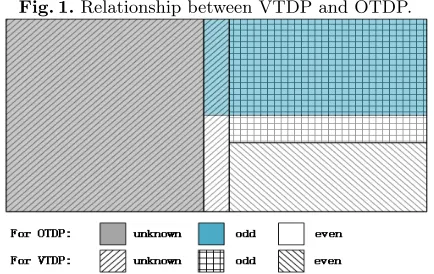
The proof is provided in AppendixB. According to Prop.1, we can illustrate the relationship between VTDP and OTDP by Fig.1. In Fig.1, the colors rep-resent the results based on OTDP while the line patterns stand for those based on VTDP. If one bit is determined as an odd-parity bit, we can know the bit is definitely not unknown. Therefore, we can still obtain some useful information from these results. In practice, we can encrypt all possible plaintexts by travers-ing all active plaintext bits under a random key, and Xor all the correpondtravers-ing considered ciphtext bits to determine the parity of the considered ciphertext bit-s. This parity result holds for any key, which can be applied to attack the target cipher with any key. In other words, with our searching result, the test for only one key can achieve the available integral distinguisher for any key. Thus, our searching result is significant for attack. It is reasonable to encrypt the plaintexts because we need all the details of the cipher structure except the key-schedule to construct the model to search for VTDP. Note that the requirement also lies in the algorithm to search for OTDP [15].
Fig. 1.Relationship between VTDP and OTDP.
3.2 Variant Three-Subset Division Trail
To model the the automatic search for VTDP, we introduce the variant three-subset division trail.
Definition 4 (Variant Three-Subset Division Trial). Let us consider the
Kr×Lr. Moreover, for any vector tuple (k∗i+1,l
∗ i+1), k
∗
i+1 ∈Ki+1 and l∗i+1 ∈
Li+1, there must exit a vector tuple (k∗i,l ∗ i), k
∗
i ∈ Ki and l∗i ∈ Li, such that (k∗i,l∗i) can propagate to (k∗i+1,l∗i+1) by the propagation rules of the division property fori= 0,1, . . . , r−1. Furthermore, for((k0,l0),(k1,l1), . . . ,(kr,lr))∈
K0×L0×K1×L1× · · · ×Kr×Lr, if (ki,li)can propagate to (ki+1,lk+1)for
all i∈ {0,1, . . . , r−1}, we call (k0,l0)→(k1,l1)→ · · · →(kr,lr)an r-round
variant three-subset division trail.
Similar to methods in [17], we decide the parity of one output bit by checking whether certain division trails exist. Therefore, we need to transform the prop-agation rules of each component into constraints and solve the problem by an MILP or SMT/SAT tool. We divide all components into key-independent and key-dependent components according to whether there are secret keys involved. For key-independent components, we construct the models ofCopy,AND,XOR andModular Additionoperations forLaccording to Rule 1, 2, 5 and 7. Since there is no rule of S-box forL, we give the rule and then model the S-boxin Sect.3.3for the first time.
For key-dependent components, we concentrate only on theKey-XOR opera-tion. We introduce a new technique that we can use the logical OR operation of STP solver to model the dependencies between K and L when a Key-XOR component is applied.
Note 1. Since redundant vectors do not affect the result of L
x∈Xπu(x), our
model will not remove them.
3.3 Models of VTDP for Key-Independent Components
Assuming thatf is a key-independent component of a cipher, (K,L) and (K0, L0) are the input and output division property off, respectively. In our automatic search model, we allocate variables to represent the vectors inK, L, K0 andL0 at the bit level at first and then the constraints are added on these variables according to the propagation rule of f. Note that the propagations ofK→f K0 andL→f L0 are conducted separately according to their own rules.
In this paper, we use STP solver to implement our model. STP is a simple but efficient solver for the theory of quantifier-free bit vectors. It is first intro-duced to find optimal differential characteristic by Mouha and Preneel [8]. At Asiacrypt’17, Sun et al. took it to search for division property [11]. We can de-scribe the propagation rules in CNF formulas using the method proposed in [11]. The automatic search models for Khas been listed in Sect. 2.1. We construct models for the basic operationsCopy,AND,XORandModular AdditionforLin a similar way.
ForCopy operation, leta, b0 and b1 be three binary variables and (a) Copy
−−−→ (b0, b1) be the division trail. There are four possible division trails according to
Rule 1, which are (0) →(0,0), (1) →(0,1), (1) → (1,0) and (1)→ (1,1). To make (a, b0, b1) follow these four division trails only we put constraints on a,b0
Model 5 (Bit-BasedCopy for L) Denote (a, b0, b1) a division trail of Copy
function, the following logical equations are sufficient to evaluate the bit-based division trail throughCopy operation,
a∨b0∨¯b1= 1
¯
a∨b0∨b1= 1
a∨¯b0= 1 .
ForANDoperation, leta0,a1andbbe three binary variables and (a0, a1)−−→AND (b) be the division trail. There are two possible division trails according to Rule
2, which are (0,0)→(0) and (1,1)→(1), To make (a0, a1, b) follow these two
division trails only we add constrains ona0,a1and bas follows.
Model 6 (Bit-BasedAND forL) Denote(a0, a1, b)a division trail ofAND
func-tion, the following logical equations are sufficient to evaluate the bit-based divi-sion trail troughANDoperation,
(
a0=b a1=b.
ForXORoperation, we follow the Rule7rather than Rule3, leta0,a1andbbe
three binary variables and (a0, a1)−−→XOR (b) be the division trail. There are three possible division trails according to Rule7, which are (0,0)→(0), (0,1)→(1) and (1,0) → (1). To make (a0, a1, b) follow these three division trails only we append constraints ona0, a1 andb as follows.
Model 7 (Bit-Based Variant XORfor L) Denote(a0, a1, b)a division trail of XOR function, the following logical equations are sufficient to evaluate the bit-based division trail trough XORoperation,
a0∨a1∨¯b= 1
¯
a1∨b= 1 ¯
a0∨a1∨b= 1 ¯
a0∨¯a1∨¯b= 1 .
Model 8 (Bit-BasedModular Addition forL) The model ofModular Addition
for L is totally same with that for K except that we use basic models of Copy,
ANDand variant XORforLrather thanK.
Modeling S-box forL
The rule to calculate all the division trails of anS-box for Kwas presented in [3,17]. Here we introduce the rules to find all the division trails forL.
y= (y1, y2, . . . , yn) is calculated as
y1=f1(x1, x2, . . . , xm),
y2=f2(x1, x2, . . . , xm), ..
.
yn =fn(x1, x2, . . . , xm).
Similar to Rule4, for each input vectoru∈L, we consider each output vector v ∈ Fn2 seperately to derive all the valid division trails. According to Def. 2,
for each vector v ∈ Fn
2, (u,v) is a valid division trail if the polynomialπv(y)
contains the monomialπu(x) but does not contain the monomialπu0(x) for any
u0 satisfyingu0 u.
We give Algorithm1to calculate all the valid division trails of S-boxforL.
Algorithm 1: Calculating Division Trails of S-boxforL Input: a vectorurepresenting the input division property
Output: A setLof vectors representing the output division property
1 ¯S={u¯|¯uu};
2 F(X) ={π¯u(x)|¯u∈S¯};
3 AllocateL=∅;
4 for each v∈Fn2 do
5 if πv(y) does not contain any monomial inF(X)andπv(y)contains
πu(x)then
6 L←v;
7 returnL;
To implement the model forS-box, firstly we use Algorithm 1 to compute all the division trails. Then we need to describe these trails in STP solver. We define an array variable to store all the trails and then use this array to add constraints on the variables representing the input and output division property2.
We provide an example to describe the methods to implement the model in AppendixC.
3.4 Model of VTDP for Key-XOR
ForKey-XOR operationfk, the input and output division properties are {K,L} and{K0,L0}, respectively. In our model, we use fourn-bit variablesK,L,K0 and L0 to denote them, wherenis the block size. Because the dependencies between
2
KandLwork on the block rather than a single bit, we usen-bit variables rather than binary variables.
According to Rule6,fk does not affect the propagation fromLtoL0. There-fore, the constraint on LandL0 isL0=L.
In many ciphers, round key is only XORed with a part of block. Without loss of generality, we assume that the round key is XORed with the lefts(16s6n) bits. This operation can be divided into two steps.
1 Allocaten-bit variablesVj(j∈ {0,1,2, . . . , s−1}). Check each bit ofL, i.e., L[0],L[1], . . . ,L[s−1], and assignVj as follows,
Vj= (
L ∨ej, ifL[j] = 0,
1, otherwise,
whereej is ann-bit unit vector whose bitj is one and1is the vector with all components one. If L[j] 6= 0, we set Vj as 1 because we use the STP statement IF-THEN-ELSE to implement it, which follows a strict grammar. Note that1has no effect on the search results.
2 Let{K0}={K} ∪ {V
0} ∪ {V1} ∪ · · · ∪ {Vs−1}.
In STP solver, we can implement the first step with an IF-THEN-ELSE branch statement as follows,
ASSERTLj= IFL[j] = 0 THENL ∨ ej ELSE1ENDIF;
For the second step, we use the following statement with the logical OR operation in STP to implement,
ASSERTK0=K ORK0=V0 ORK0=V1 OR . . . ORK0=Vs−1;
Algorithm2 concludes the model of theKey-XORoperation.
Note 2. We just know that the STP solver supports the logical OR operation, so our model relies on it. However, any tool that can implement the two steps is suitable to our algorithm also.
3.5 Initial and Stopping Rules for VTDP
Initial Rule
In [15], to search for three-subset division property, Todo and Morii set the initial division property as (k = 1,l), where the active bits of l are set as one or zero for constant bits. It is the same for VTDP. For example, if we find integral characteristic for SIMON32 using 231 chosen-plaintexts with first
bit constant, the initial division property is then set as (k=1,l=7fffffff). Let ((K0
0,K01, . . . ,Kn−0 1), (L00,L01, . . . ,L0n−1)) denote the initial division property,
wherenis the block size. The constraints on K0
i andL0i are K0
i = 1,fori= 0,1,2, . . . , n−1. L0
i = (
Algorithm 2: Generating Constraints of Propagation Rule of Key-XOR Input: n-bit variablesK,K0
,L,L0
.
Output: A setCwith constraints onK,K0,L,L0.
1 AllocateCas∅;
2 C← L0=L;
3 Allocaten-bit variablesVj (j= 0,1, . . . , s−1);
4 for j= 0;j < s;j=j+ 1do
5 if L[j] == 0then
6 C← Vj=L ∨ej;
7 else
8 C← Vj=1;
9 C← K0=KORK0=V0 ORK0=V1 OR · · · ORK0=Vs−1; 10 returnC;
Stopping Rule
Our automatic search model only focuses on the parity of one output bit. With-out loss of generality, we consider thei0-th output bit. According to Def.2, the
first step is to examine whether there is a unit vectorei0 ∈Kfor ther-th round, so we only need to set the constraints on (Kr
0,K1r, . . . ,Krn−1) as follows,
Kr i =
(
1, ifi=i0, 0, otherwise.
If the constraint problem has solutions, thei0-th bit is unknown, and our
algo-rithm stops. Otherwise, we need to remove the constraints onKr
i (06i6n−1) and add the following constraints on (Lr
0,Lr1, . . . ,Lrn−1),
Lr i =
(
1, ifi=i0, 0, otherwise.
If there is still no solution, thei0-th bit is balanced, otherwise the parity of the i0-th bit is even or odd.
3.6 Connection between Key-Independent and Key-XORComponents
Note that we use bit-level variables to model the key-independent components in Sect. 3.3, but the implementations for key-XOR are based on n-bit vari-ables. Therefore, in order to connect bit variables andn-bit variables, the con-catenation operation ”@” in STP is used to link them. Let the bit variables (L0,L1, . . . ,Ln−1) denote the output division property forLof a key-independent component, whose following operation is Key-XORwith input division property L0 ∈
Fn2. The link constraint on them is
Conversely, ifL0is the output of
Key-XORwhile (L0,L1, . . . ,Ln−1) are the input
of next key-independent component, we use the statement above, too.
3.7 Automatic Search Algorithm
In this subsection, we present the whole algorithm to decide the parity of the
i0-th output bit with the given initial input division property D1n
k,l for an n-bit
cipher. Firstly, we allocate all round variables and auxiliary variables with STP language. Secondly, all the constraints are set on these variables according to our models. At last, the variables related to the initial and stopping division property are constrained more according to the initial and stopping rules. We illustrate the whole framework in Algorithm3.
Since our algorithm is designed to decide one bit balanced or not, we can run the STP program paralleling to find integral distinguishers forr-round cipher.
4
Applications
In this section, we apply our model to SIMON, SIMECK, SIMON(102), SPECK, PRESENT and KATAN/KTANTAN. All our experiments are implemented on a server with 48 Intel(R) Xeon(R) CPU E5-2670 v3 @ 2.30GHz and 96 GB mem-ory. And some of the programs run in a parallel way as long as the memory is enough. In our illustrations, the character’?’ represents unknown,’*’ repre-sents even or odd and’0’stands for even. All the programs for these algorithms are public in websitehttps://github.com/VTDP/submission_for_ctrsa/.
4.1 VTDP of SIMON-Like Ciphers
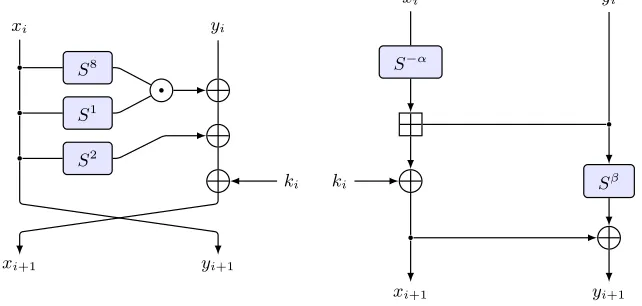
SIMON [1] is a family of lightweight block ciphers published by the U.S. National Security Agency (NSA) in 2013. SIMON adopts Feistel structure and it has a very compact round function which only involves bit-wiseAnd,XORandCircular Shift. The structure of one round SIMON encryption is depicted in Fig.2where
Sidenotes left circular shift byibits. According to the block size, SIMON family is composed of SIMON32, SIMON48, SIMON64, SIMON96, SIMON128.
For SIMON32, we identify a 15-round integral characteristic which is as fol-lows,
(7fff,ffff)−−→14r (????,????,????,????,?*??,????,*???,???*).
Then we can encrypt the corresponding 231chosen-plaintexts and determine the
three bits represented by’*’are all even, which is the same result as that in [15]. However, our automatic algorithm takes about 27 seconds which is much more efficient than that in [15]. Unfortunately, the results for SIMON48/64/96/128 with VTDP have no improvements compared with the previous distinguishers.
SIMECK32/48/64, respectively. All the integral characteristics from our algo-rithm are the same as those found by Xiang et al..
In [7], another variant of SIMON family named SIMON(102) is proposed with rotation constants (1,0,2).
For 20-round SIMON32(102), we find the following improved integral distin-guisher
(7fff,ffff)−−→19r (????,????,????,????,0*??,????,????,???*),
which has two additional odd or even parity bits compared with the previous best results,
(7fff,ffff)−−→19r (????,????,????,????,0???,????,????,????).
Similarly, for 28-round SIMON48(102) and 35-round SIMON64(102), a new distinguisher with two extra odd or even parity bits have been found, respec-tively.
(7fff,ffff,ffff)−−→27r
(????,????,????,????,????,????,0*??,????,????,????,???*).
(7fff,ffff,ffff,ffff)−−→35r
(????,????,????,????,????,????,????,????, 0*??,????,????,????,????,????,????,???*).
4.2 VTDP of ARX Cipher SPECK
SPECK [1] is a family of lightweight block ciphers published by NSA, too. Dif-ferent from SIMON, SPECK takes the Modular Additionas its nonlinear op-eration. According to the block size, SPECK family has 5 members, SPECK32, SPECK48, SPECK64, SPECK96 and SPECK128. Fig. 2 shows one round of SPECK whereSimeans left circular shift byibits and
represents theModular Additionoperation.
For SPECK32, there only exists one two-subset bit-based integral distin-guisher for 6 rounds with 231chosen-plaintexts as follows,
(ffff,ffdf)−→6r (????,????,????,???0,????,????,????,????).
However, based on VTDP, we can find one more distinguisher besides the above one,
(ffff,ffbf)−→6r (????,????,????,???*,????,????,????,????).
4.3 VTDP of S-Box Based Cipher PRESENT
In [17], Xianget al. found a 9-round integral distinguisher with 260
chosen-plaintexts under the two-subset division property framework. Our algorithm achieves the same result. Furthermore, If we use more data complexity such as 263chosen-plaintexts with the leftmost 63 bits active, we find a new distinguisher
with 28 balanced bits which is listed as follows, (ffff,ffff,ffff,fffe)−→9r
(???0,???0,???0,0000,???0,???0,???0,0000,???0,???0,???0,0000,???0,???0,???0,0000).
Note that this distinguisher can be found by Xianget al.’s model.
4.4 VTDP of KATAN/KTANTAN Family
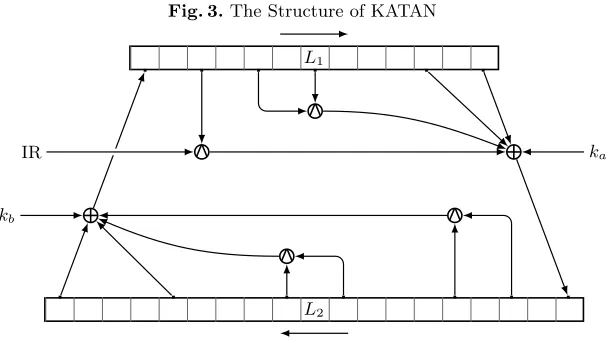
KATAN and KTANTAN [4] are two families of hardware oriented block ciphers and have three variants of 32-bit, 48-bit, 64-bit block. KATAN/KTANTAN takes a very simple structure composed of two LFSR’s which is depicted in Fig.3.
KATAN/KTANTAN32, 48, 64 conduct the round function once, twice and three times in one round with the same round key, respectively. The only differ-ence between KATAN and KTANTAN is the key schedule.
Compared with the previous results [9], we obtained the longer integral dis-tinguishers for KATAN/KTANTAN32 and 48 with our automatic algorithm for VTDP. Moreover, our identified integral characteristic for 7213-round
KATAN/KTANTAN64 has two more balanced bits.
For KATAN/KTANTAN32, Sunet al.found the following 99-round integral characteristic with the two-subset division property [9],
(fffb,ffff)−−→99r (????,????,????,????,????,????,????,???0).
However, our new distinguishers based on VTDP are listed as follows, (fffb,ffff)−−−→100r (????,????,????,????,????,????,????,??*0),
(fffb,ffff)−−−→101r (????,????,????,????,????,????,????,???*).
For 64- and 7212-round KATAN/KTANTAN48 and KATAN/KTANTAN64, respectively, the search program requires too much time to get VTDP. Therefore, we introduce a compromising strategy to simplify some propagation of vectors. For two-subset division property, we only traceK, but for three-subset division property,KandLare considered. In general, the program of two-subset division property will take less time than that of the three-subset one. In our program, we can trace Kand L for the first N rounds only; and appendu to Kfor all u ∈ L at the N-th round; then trace the modified K merely. Since after N
rounds, the program becomes a two-subset division property, the stopping rules should follow that of the two-subset division property.
For 64-round KATAN/KTANTAN48, the distinguisher we found is presented as follows (N = 100),
(ffff,efff,ffff)−−→64r
(????,????,????,????,????,????,????,????,????,????,???0),
which covers half more round than that in [9]. For KATAN/KTANTAN64, we find the same length of integral distinguisher with the previous best one [9] but ours has one more balanced bit as follows (N = 50),
(ffff,ffbf,ffff,ffff)−−−→72.3r
(????,????,????,????,????,????,????,????,????,????,????,????,????,????,??00).
5
Conclusions
In this paper, we proposed an automatic search model for a variant of three-subset division property and it can be applied to ciphers with large block sizes. Furthermore, we give the rules of S-box and Modular Addition for L, which extend the usage of three-subset division property. With this model, the better integral distinguishers have been found compared with the previous results.
Acknowledgement
The authors would like to thank Yosuke Todo for his important help to this paper. This work is supported by National Cryptography Development Fund (M-MJJ20170102), National Natural Science Foundation of China (Grant No.61572293) and Major Scientific and Technological Innovation Projects of Shandong Province, China (2017CXGC0704).
References
1. Ray Beaulieu, Douglas Shors, Jason Smith, Stefan Treatman-Clark, Bryan Weeks, and Louis Wingers. The SIMON and SPECK lightweight block ciphers. InPADAC, 2015, pages 175:1–175:6, 2015.
2. Andrey Bogdanov, Lars R. Knudsen, Gregor Leander, Christof Paar, Ax-el Poschmann, Matthew J. B. Robshaw, Yannick Seurin, and C. VikkAx-elsoe. PRESENT: an ultra-lightweight block cipher. InCHES 2007, pages 450–466, 2007. 3. Christina Boura and Anne Canteaut. Another view of the division property. In
CRYPTO 2016, pages 654–682, 2016.
4. Christophe De Canni`ere, Orr Dunkelman, and Miroslav Knezevic. KATAN and KTANTAN - A family of small and efficient hardware-oriented block ciphers. In CHES 2009, pages 272–288, 2009.
6. Lars R. Knudsen and David A. Wagner. Integral cryptanalysis. In FSE 2002, pages 112–127, 2002.
7. Stefan K¨olbl, Gregor Leander, and Tyge Tiessen. Observations on the SIMON block cipher family. InCRYPTO 2015, pages 161–185, 2015.
8. Nicky Mouha and Bart Preneel. Towards finding optimal differential characteristics for arx: Application to salsa20. Cryptology ePrint Archive, Report 2013/328, 2013. 9. Ling Sun, Wei Wang, Ru Liu, and Meiqin Wang. Milp-aided bit-based division property for arx-based block cipher. IACR Cryptology ePrint Archive, 2016:1101, 2016.
10. Ling Sun, Wei Wang, and Meiqin Wang. Milp-aided bit-based division property for primitives with non-bit-permutation linear layers. IACR Cryptology ePrint Archive, 2016:811, 2016.
11. Ling Sun, Wei Wang, and Meiqin Wang. Automatic search of bit-based division property for ARX ciphers and word-based division property. InASIACRYPT 2017, pages 128–157, 2017.
12. Yosuke Todo. Structural evaluation by generalized integral property. In EURO-CRYPT 2015.
13. Yosuke Todo. Integral cryptanalysis on full MISTY1. InCRYPTO 2015, pages 413–432, 2015.
14. Yosuke Todo, Takanori Isobe, Yonglin Hao, and Willi Meier. Cube attacks on non-blackbox polynomials based on division property. In CRYPTO 2017, pages 250–279, 2017.
15. Yosuke Todo and Masakatu Morii. Bit-based division property and application to simon family. InFast Software Encryption 2016, pages 357–377, 2016.
16. Qingju Wang, Lorenzo Grassi, and Christian Rechberger. Zero-sum partitions of PHOTON permutations. IACR Cryptology ePrint Archive, 2017:1211, 2017. 17. Zejun Xiang, Wentao Zhang, Zhenzhen Bao, and Dongdai Lin. Applying MILP
method to searching integral distinguishers based on division property for 6 lightweight block ciphers. InASIACRYPT 2016, pages 648–678, 2016.
A
Specification of
Modular Addition
Rules
(an−1)
Copy
−−→(an−1,0, an−1,1)
(bn−1)
Copy
−−→(bn−1,0, bn−1,1)
(an−1,0, bn−1,0)
XOR −−→(dn−1)
(an−1,1, bn−1,1)
AND −−→(v0)
(v0)−−→Copy (g0, r0)
(an−2)
Copy
−−→(an−2,0, an−2,1, an−2,2)
(bn−2)
Copy
−−→(bn−2,0, bn−2,1, bn−2,2)
(an−i,0, bn−i,0, gi−2)
XOR −−→(dn−i)
(an−i,1, bn−i,1)
AND −−→(vi−1)
(an−i,2, bn−i,2)
XOR
−−→(mi−2)
(mi−2, ri−2)
AND −−→(qi−2)
(vi−1, qi−2)
XOR −−→(wi−2)
(wi−2)
Copy
−−→(gi−1, ri−1)
(an−i−1)
Copy
−−→(an−i−1,0, an−i−1,1, an−i−1,2)
(bn−i−1)
Copy
−−→(bn−i−1,0, bn−i−1,1, bn−i−1,2)
iterated fori= 2,3, . . . , n−2,
(a1,0, b1,0, gn−3)
XOR −−→(d1)
(a1,1, b1,1)
AND −−→(vn−2)
(a1,2, b1,2)
XOR
−−→(mn−3)
(mn−3, rn−3)
AND −−→(qn−3)
(vn−2, qn−3)
XOR
−−→(wn−3)
(a0, b0, wn−3)
XOR −−→(d0)
where ai,j, bi,j, vi,mi,gi,ri,qi andwi are all auxiliary variables. We refer the readers to read [11] for more information about their usage.
B
Proof of Proposition 1
Proof. We divide all the situations into two categories.
1. If there is a division trail inKO which ends at the corresponding unit vector e, both the VTDP and OTDP will indicate that the parity of this bit is unknown.
(a) If there is a division trail inKV which ends ate, the VTDP will determine the parity is unknown.
(b) If there is no division trail in KV ending at e, the VTDP will indicate the parity of this bit is not unknown, either. Then we need to deter-mine whether the parity of the bit is even or odd. Again, we divide the situations into two subcases according toLV andLO.
i. If there is at least a duplicated division trail which appears odd number of times inLO which ends ate, both VTDP and OTDP will indicate that the parity of this bit is odd.
ii. If there are only division trails occuring even number of times3inLO ending at e, the parity of the bit is even definitely, but the result of VTDP will indicate that the parity of the bit is even or odd according to the fact whether there is a division trail ending atein LV.
C
Example for Implementation of S-box
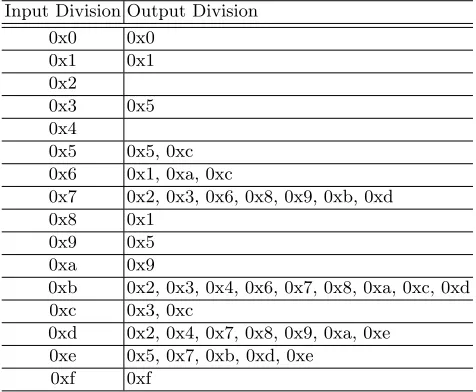
Example 1 (Division Trails for L of PRESENT S-box). We list the divi-sion trails of PRESENT S-box for L in Table2. Bit variables (L0,L1,L2,L3)
and (L0
0,L01,L02,L03)4denote the input and output division property forL.
First-ly, we allocate an array variable as SBOX with 4-bit index and 4-bit value in STP language5as follows,
SBOX : ARRAY BITVECTOR(4) OF BITVECTOR(4); And then we assign values to each item of the array according to Table2. ASSERTSBOX[0h0] =0h0;
ASSERTSBOX[0h1] =0h1; ASSERTSBOX[0h3] =0h5; ..
.
ASSERTSBOX[0h7] =0h2ORSBOX[0h7] =0h3OR · · · ORSBOX[0h7] =0hd; ..
.
ASSERTSBOX[0hf] =0hf;
At last, constraints on the input and output variables are set as follows, ASSERTSBOX[L0@L1@L2@L3] =L00@L
0
1@L
0
2@L
0
3; 3 Including the situation of zero division trail.
4
About the subscript, when we describe the principle, we follow the style which starts from 1 [15], but when we do the implementation, we start from 0.
5
where the character ”@” represents concatenation. According to Table 2, there is no division trail for input 0x2 and 0x4. Therefore, we need another two state-ments to exclude the two impossible input, where ”/=” meansunequal.
ASSERTL0@L1@L2@L3/= 0h2;
ASSERTL0@L1@L2@L3/= 0h4;
Input Division Output Division
0x0 0x0
0x1 0x1
0x2
0x3 0x5
0x4
0x5 0x5, 0xc
0x6 0x1, 0xa, 0xc
0x7 0x2, 0x3, 0x6, 0x8, 0x9, 0xb, 0xd
0x8 0x1
0x9 0x5
0xa 0x9
0xb 0x2, 0x3, 0x4, 0x6, 0x7, 0x8, 0xa, 0xc, 0xd
0xc 0x3, 0xc
0xd 0x2, 0x4, 0x7, 0x8, 0x9, 0xa, 0xe
0xe 0x5, 0x7, 0xb, 0xd, 0xe
0xf 0xf
Algorithm 3: Deciding Parity of thei0-th Output Bit. Input: A cipher with key-independent andKey-XORcomponents,
the initial and stopping division property. Output: UNKNOW,EVEN, orODDorEVEN
1 Allocate all the variables denoting the input and output division property;
2 for each componentOdo
3 if Ois key-independent then
4 Add constraints to the variables related toOaccording to the propagation rules ofO;
5 if OisKey-XOR then
6 Add constraints to the variables related toOaccording to the
propagation rules ofO;
7 Add the initial and stopping constraints forK;
8 Input above constraints to STP solver and run it;
9 if program has solutions then
10 returnUNKNOWN;
11 Remove the stopping constraints forKand add stopping constraints forL;
12 if program has solutions then 13 returnODDorEVEN;
14 else
15 returnEVEN;
Fig. 2.Round function of SIMON and SPECK
xi yi
S8
S1
S2
ki
xi+1 yi+1
xi yi
S−α
Sβ
xi+1 yi+1
Fig. 3.The Structure of KATAN
L1
L2
IR
kb