Oblivious Network RAM and Leveraging Parallelism to Achieve
Obliviousness
Dana Dachman-Soled1,3 ∗ Chang Liu2 † Charalampos Papamanthou1,3 ‡ Elaine Shi4 § Uzi Vishkin1,3 ¶
1: University of Maryland, Department of Electrical and Computer Engineering 2: University of Maryland, Department of Computer Science
3: University of Maryland Institute for Advanced Computer Studies (UMIACS) 4: Cornell University
January 12, 2017
Abstract
Oblivious RAM (ORAM) is a cryptographic primitive that allows a trusted CPU to securely access untrusted memory, such that the access patterns reveal nothing about sensitive data. ORAM is known to have broad applications in secure processor design and secure multi-party computation for big data. Unfortunately, due to a logarithmic lower bound by Goldreich and Ostrovsky (Journal of the ACM, ’96), ORAM is bound to incur a moderate cost in practice. In particular, with the latest developments in ORAM constructions, we are quickly approaching this limit, and the room for performance improvement is small.
In this paper, we consider new models of computation in which the cost of obliviousness can be fundamentally reduced in comparison with the standard ORAM model. We propose the Oblivious Network RAM model of computation, where a CPU communicates with multiple memory banks, such that the adversary observes only which bank the CPU is communicating with, but not the address offset within each memory bank. In other words, obliviousness within each bank comes for free—either because the architecture prevents a malicious party from ob-serving the address accessed within a bank, or because another solution is used to obfuscate memory accesses within each bank—and hence we only need to obfuscate communication pat-terns between the CPU and the memory banks. We present new constructions for obliviously simulating general or parallel programs in the Network RAM model. We describe applications of
∗
Email: [email protected]. Work supported in part by NSF CAREER award #CNS-1453045 and by a Ralph E. Powe Junior Faculty Enhancement Award.
†
Email: [email protected]. Work supported in part by NSF awards 1314857, 1453634, #CNS-1518765, #CNS-1514261, and Google Faculty Research Awards.
‡
Email: [email protected]. Work supported in part by NSF award #CNS-1514261, by a Google Faculty Research Award and by the National Security Agency.
§
Email: [email protected]. Work supported in part by NSF awards 1314857, 1453634, #CNS-1518765, #CNS-1514261, Google Faculty Research Awards, and a Sloan Fellowship. This work was done in part while a subset of the authors were visiting the Simons Institute for the Theory of Computing, supported by the Simons Foundation and by the DIMACS/Simons Collaboration in Cryptography through NSF award #CNS-1523467.
¶
our new model in secure processor design and in distributed storage applications with a network adversary.
1
Introduction
Oblivious RAM (ORAM), introduced by Goldreich and Ostrovsky [18,19], allows atrustedCPU (or a trusted computational node) to obliviously accessuntrustedmemory (or storage) during computa-tion, such that an adversary cannot gain any sensitive information by observing the data access pat-terns. Although the community initially viewed ORAM mainly from a theoretical perspective, there has recently been an upsurge in research on both new efficient algorithms (c.f. [8,13,24,39,42,46,49]) and practical systems [9,11,12,23,33,38,40,41,47,51] for ORAM. Still the most efficient ORAM im-plementations [10,40,42] require a relatively large bandwidth blowup, and part of this is inevitable in the standard ORAM model. Fundamentally, a well-known lower bound by Goldreich and Ostro-vsky states that any ORAM scheme with constant CPU cache must incur at least Ω(logN) blowup, where N is the number of memory words, in terms of bandwidth and runtime. To make ORAM techniques practical in real-life applications, we wish to further reduce its performance overhead. However, since latest ORAM schemes [42,46] have practical performance approaching the limit of the Goldreich-Ostrovsky lower bound, the room for improvement is small in the standard ORAM model. In this paper, we investigate the following question:
In what alternative, realistic models of computation can we significantly lower the cost of oblivious data accesses?
Motivated by practical applications, we propose the Network RAM (NRAM) model of compu-tation and correspondingly, Oblivious Network RAM (O-NRAM). In this new model, one or more CPUs interact withM memory banks during execution. Therefore, each memory reference includes a bank identifier, and an offset within the specified memory bank. We assume that an adversary cannot observe the address offset within a memory bank, but can observe which memory bank the CPU is communicating with. In other words, obliviousness within each bank “comes for free”. Un-der such a threat model, an Oblivious NRAM (O-NRAM) can be informally defined as an NRAM whose observable memory traces (consisting of the bank identifiers for each memory request) do not leak information about a program’s private inputs (beyond the length of the execution). In other words, in an O-NRAM, the sequence of bank identifiers accessed during a program’s execution must be provably obfuscated.
1.1 Practical Applications
Our NRAM models are motivated by two primary application domains:
Secure processor architecture. Today, secure processor architectures [1,12,33,38,43,44] are designed assuming that the memory system is passive and untrusted. In particular, an adversary can observe both memory contents and memory addresses during program execution. To secure against such an adversary, the trusted CPU must both encrypt data written to memory, and obfuscate memory access patterns.
(for decrypting memory addresses). This way, the CPU can encrypt the memory addresses before transmitting them over the insecure memory bus. In contrast with traditional passive memory, we refer to this new type of memory technology as active memory. In a simple model where a CPU communicates with a single active memory bank, obliviousness is automatically guaranteed, since the adversary can observe only encrypted memory contents and addresses. However, when there are multiple such active memory banks, we must obfuscate which memory bank the CPU is communicating with.
Distributed storage with a network adversary. Consider a scenario where a client (or a compute node) stores private, encrypted data on multiple distributed storage servers. We consider a setting where all endpoints (including the client and the storage servers) are trusted, but the network is an untrusted intermediary. In practice, trust in a storage server can be bootstrapped through means of trusted hardware such as the Trusted Platform Module (TPM) or as IBM 4758; and network communication between endpoints can be encrypted using standard SSL. Trusted storage servers have also been built in the systems community [3]. On the other hand, the untrusted network intermediary can take different forms in practice, e.g., an untrusted network router or WiFi access point, untrusted peers in a peer-to-peer network (e.g., Bitcoin, TOR), or packet sniffers in the same LAN. Achieving oblivious data access against such a network adversary is precisely captured by our O-NRAM model.
1.2 Background: The PRAM Model
Two of our main results deal with the parallel-RAM (PRAM) model, which is a synchronous generalization of the RAM model to the parallel processing setting. The PRAM model allows for an unbounded number of parallel processors with a shared memory. Each processor may access any shared memory cell and read/write conflicts are handled in various ways depending on the type of PRAM considered:
• Exclusive Read Exclusive Write (EREW) PRAM: A memory cell can be accessed by at most one processor in each time step.
• Concurrent Read Exclusive Write (CREW) PRAM: A memory cell can be read by multiple processors in a single time step, but can be written to by at most one processor in each time step.
• Concurrent Read Concurrent Write (CRCW) PRAM:A memory cell can be read and written to by multiple processors in a single time step. Reads are assumed to complete prior to the writes of the same time step. Concurrent writes are resolved in one of the following ways: (1) Common—all concurrent writes must write the same value; (2) Arbitrary—an arbitrary write request is successful; (3)Priority—processor id determines which processor is successful.
1.3 Results and Contributions
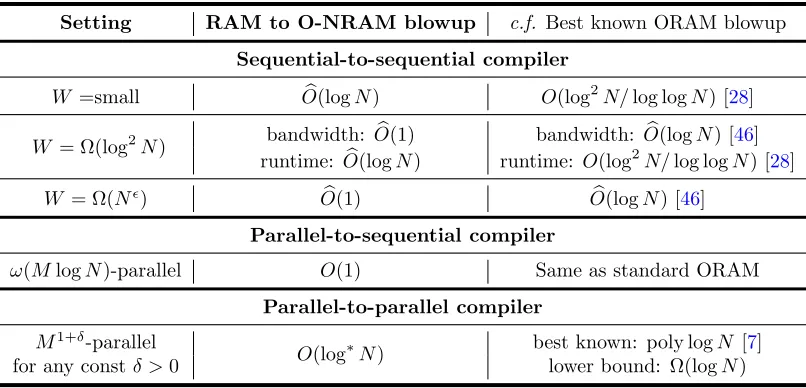
Setting RAM to O-NRAM blowup c.f. Best known ORAM blowup
Sequential-to-sequential compiler
W =small Ob(logN) O(log2N/log logN) [28]
W = Ω(log2N) bandwidth: Ob(1) bandwidth: Ob(logN) [46] runtime: Ob(logN) runtime: O(log
2
N/log logN) [28]
W = Ω(N) Ob(1) Ob(logN) [46]
Parallel-to-sequential compiler
ω(MlogN)-parallel O(1) Same as standard ORAM
Parallel-to-parallel compiler
M1+δ-parallel
O(log∗N) best known: poly logN [7]
for any constδ >0 lower bound: Ω(logN)
Table 1: A systematic study of “cost of obliviousness” in the Network ORAM model.
W denotes the memory word size in # bits, N denotes the total number of memory words, and
M denotes the number of memory banks. For simplicity, this table assumes that M = O(√N), and each bank hasO(√N) words. Like implicit in existing ORAM works [19,28], small word size assumes at least logN bits per word—enough to store a virtual address of the word.
within each bank, such that the obliviousness cost is significantly lower in comparison with the standard Oblivious (Parallel) RAMs. We give a summary of our results below.
First, observe that if there are only O(1) number of memory banks, there is a trivial solution with O(1) cost: just make one memory access (real or dummy) to each bank for each step of execution. On the other hand, if there are Ω(N) memory banks each of constant size (where N
denotes the total number of memory words), then the problem approaches standard ORAM [18,19] or OPRAM [7]. The intermediate parameters are therefore the most interesting. For simplicity, in this section, we mainly state our results for the most interesting case when the number of banks
M =O(√N), and each bank can store up to O(√N) words. In Sections 3, 4 and 5, our results will be stated for more general parameter choices. We now state our results (see also Table 1 for an overview).
“Sequential-to-sequential” compiler. First, we show that any RAM program can be oblivi-ously simulated on a Network RAM, consuming onlyO(1) words of local CPU cache, withOb(logN)
blowup in both runtime and bandwidth, where–throughout the paper–when we say the complex-ity of our scheme is Ob(f(N)), we mean that for any choice of h(N) = ω(f(N)), our scheme
attains complexity g(N) = O(h(N)). Further, when the RAM program has Ω(log2N) memory word size, it can be obliviously simulated on Network RAM with only Ob(1) bandwidth blowup
(assuming non-uniform memory word sizes as used by Stefanov et al. in [41]). In comparison, the best known (constant CPU cache) ORAM scheme has roughlyOb(logN) bandwidth blowup for
Ω(log2N) memory word size [46]. For smaller memory words, the best known ORAM scheme has
O(log2/log logN) blowup in both runtime and bandwidth [28].
prop-erty of the program, but are not in fact executing the program on a parallel machine. The overhead stated above is for the sequential setting, i.e., considering that both NRAM and O-NRAM have single processor. Our compiler works when the underlying PRAM program is in the EREW, CREW or common/arbitrary/priority CRCW model.
Beyond the low overhead discussed above, our compiled sequential O-NRAM has the additional benefit that it allows for an extremely simple prefetching algorithm. In recent work, Yu et al. [52] proposed a dynamic prefetching algorithm for ORAM, which greatly improved the practical perfor-mance of ORAM. We note that our parallel-to-sequential compiler achieves prefetching essentially for free: Since the underlying PRAM program will make many parallel memory accesses to each bank, and since the compiler knows these memory addresses ahead of time, these memory accesses can automatically be prefetched. We note that a similar observation was made by Vishkin [45], who suggested leveraging parallelism for performance improvement by using (compile-time) prefetching in serial or parallel systems.
“Parallel-to-parallel” compiler. Finally, we consider oblivious simulation in the parallel setting. We show that for any parallel program executing in t parallel steps with P = M1+δ processors, we can obliviously simulate the program on a Network PRAM with P0 =O(P/log∗P) processors, running in O(tlog∗P) time, thereby achieving O(log∗P) blowup in parallel time and bandwidth, and optimal work. In comparison, the best known OPRAM scheme has poly logN blowup in parallel time and bandwidth. The compiler works when the underlying program is in the EREW, CREW, common CRCW or arbitrary CRCW PRAM model. The resulting compiled program is in the arbitrary CRCW PRAM model.
1.4 Technical Highlights
Our most interesting technique is for the parallel-to-parallel compiler. We achieve this through an intermediate stepping stone where we first construct a parallel-to-sequential compiler (which may be of independent interest).
At a high level, the idea is to assign each virtual address to a pseudorandom memory bank (and this assignment stays the same during the entire execution). Suppose that a program is sufficiently parallel such that it always makes memory requests in P = ω(MlogN)-sized batches. For now, assume that all memory requests within a batch operate on distinct virtual addresses – if not we can leverage a hash table to suppress duplicates, using an additional “scratch” bank as the CPU’s working memory. Then, clearly each memory bank will in expectation serveP/M requests for each batch. With a simple Chernoff bound, we can conclude that each memory bank will serveO(P/M) requests for each batch, except with negligible probability. In a sequential setting, we can easily achieve O(1) bandwidth and runtime blowup: for each batch of memory requests, the CPU will sequentially access each bankO(P/M) number of times, padding with dummy accesses if necessary (see Section4).
However, additional difficulties arise when we try to execute the above algorithm in parallel. In each step, there is a batch ofP memory requests, one coming from each processor. However, each processor cannot perform its own memory request, since the adversary can observe which processor is talking to which memory bank and can detect duplicates (note this problem did not exist in the sequential case since there was only one processor). Instead, we wish to
2. pad the number of accesses to each bank to a worst-case maximum – as mentioned earlier, if we suppressed duplicate addresses, each bank hasO(P/M) requests with probability 1−negl(N).
At this point, we can assign processors to the memory requests in a round-robin manner, such that which processor accesses which bank is “fixed”. Now, to achieve the above two tasks in O(log∗P) parallel time, we need to employ non-trivial parallel algorithms for “colored com-paction” [4] and “static hashing” [5,17], for the arbitrary CRCW PRAM model, while using a scratch bank as working memory (see Section 5).
1.5 Related Work
Oblivious RAM (ORAM) was first proposed in a seminal work by Goldreich and Ostrovsky [18,19] where they laid a vision of employing an ORAM-capable secure processor to protect software against piracy. In their work, Goldreich and Ostrovsky showed both a poly-logarithmic upper-bound (commonly referred to as the hierarchical ORAM framework) and a logarithmic lower-bound for ORAM—both under constant CPU cache. Goldreich and Ostrovsky’s hierarchical construction was improved in several subsequent works [6,22,24,28,36,48–50]. Recently, Shiet al. proposed a new, tree-based paradigm for constructing ORAMs [39], thus leading to several new constructions that are simple and practically efficient [8,13,42,46]. Notably, Circuit ORAM [46] partially resolved the tightness of the Goldreich-Ostrovsky lower bound, by showing that certain stronger interpretations of their lower bound are indeed tight.
Theoretically, the best known ORAM scheme (with constant CPU cache) for small O(logN )-sized memory words1 is a construction by Kushilevitz et al. [28], achieving O(log2N/log logN) bandwidth and runtime blowup. Path ORAM (variant with O(1) CPU cache [47]) and Circuit ORAM can achieve better bounds for bigger memory words. For example, Circuit ORAM achieves
O(logN)ω(1) bandwidth blowup for a word size of Ω(log2N) bits; and for O(logN)ω(1) runtime blowup for a memory word size of N bits where 0 < <1 is any constant within the specified range.
ORAMs with larger CPU cache sizes (caching up to Nα words for any constant 0 < α < 1) have been suggested for cloud storage outsouring applications [22,41,50]. In this setting, Goodrich and Mitzenmacher [22] first showed how to achieveO(logN) bandwidth and runtime blowup.
Other than secure processors and cloud outsourcing, ORAM is also noted as a key primi-tive for scaling secure multi-party computation to big data [25,29,46,47]. In this context, Wang et al. [46,47] pointed out that the most relevant ORAM metric should be the circuit size rather than the traditionally considered bandwidth metrics. In the secure computation context, Lu and Ostrovsky [30] proposed a two-server ORAM scheme that achievesO(logN) runtime blowup. Sim-ilarly, ORAM can also be applied in other RAM-model cryptographic primitives such as (reusable) Garbled RAM [14–16,31,32].
Goodrich and Mitzenmacher [22] and Williams et al. [51] observed that computational tasks with inherent parallelism can be transformed into efficient, oblivious counterparts in the tradiotional ORAM setting—but our techniques apply to the NRAM model of computation. Finally, Oblivious RAM has been implemented in outsourced storage settings [40,41,48,50,51], on secure processors [9, 11,12,33,34,38], and atop secure multiparty computation [25,46,47].
Comparison of our parallel-to-parallel compiler with the work of [7]. Recently, Boyle,
1
Chung and Pass [7] proposed Oblivious Parallel RAM, and presented a construction for oblivious simulation of PRAMs in the PRAM model. Our result is incomparible to their result: Our security model is weaker than theirs since we assume obliviousness within each memory bank comes for free; on the other hand, we obtain far better asymptotical and concrete performance. We next elaborate further on the differences in the results and techniques of the two works. [7] provide a compiler from the EREW, CREW and CRCW PRAM models to the EREW PRAM model. The security notion achieved by their compiler provides security against adversaries who see the entire access pattern, as in standard oblivious RAM. However, their compiled program incurs a poly log overhead in both the parallel time and total work. Our compiler is a compiler from the EREW, CREW, common CRCW and arbitrary CRCW PRAM models to the arbitrary CRCW PRAM model and the security notion we achieve is the weaker notion of oblivious network RAM, which protects against adversaries who see the bank being accessed, but not the offset within the bank. On the other hand, our compiled program incurs only a log∗ time overhead and its work is asymptotically thesame as the underlying PRAM. Both our work and the work of [7] leverage previous results and techniques from the parallel computing literature. However, our techniques are primarily from the CRCW PRAM literature, while [7] use primarily techniques from the low-depth circuit literature, such as highly efficient sorting networks.
2
Definitions
2.1 Background: Random Access Machines (RAM)
We consider RAM programs to be interactive stateful systemshΠ,state, Di, consisting of a memory array Dof N memory words, a CPU state denotedstate, and a next instruction function Π which given the current CPU state and a value rdataread from memory, outputs the next instruction I
and an updated CPU state denotedstate0:
(state0, I)←Π(state,rdata)
Each instruction I is of the form I = (op, . . .), whereopis called the op-code whose value is read,
write, orstop. The initial CPU state is set to (start,∗,stateinit). Upon inputx, the RAM machine
executes, computes output z and terminates. CPU state is reset to (start,∗,stateinit) when the
computation on the current input terminates.
On input x, the execution of the RAM proceeds as follows. If state = (start,∗,stateinit), set state := (start, x,stateinit), and rdata := 0. Now, repeat the doNext() till termination, where doNext() is defined as below:
doNext()
1. Compute (I,state0) = Π(state,rdata). Set state:=state0. 2. IfI = (stop, z) then terminate with output z.
3. IfI = (write,vaddr,wdata) then setD[vaddr] :=wdata. 4. IfI = (read,vaddr,⊥) then setrdata:=D[vaddr].
2.2 Network RAM (NRAM)
can be written in the format vaddr:= (m,offset), where m ∈[M] is the bank identifier, andoffset is the offset within theBankm.
Otherwise, the definition of NRAM is identical to the definition of RAM.
Probablistic NRAM.Similar to the probablistic RAM notion formalized by Goldreich and Os-trovsky [18,19], we additionally define a probablistic NRAM. A probablistic NRAM is an NRAM whose CPU state is initialized with randomness ρ (that is unobservable to the adversary). If an NRAM is deterministic, we can simply assume that the CPU’s initial randomness is fixed toρ:= 0. Therefore, a deterministic NRAM can be considered as a special case of a probablistic NRAM.
Outcome of execution. Throughout the paper, we use the notation RAM(x) or NRAM(x) to denote the outcome of executing aRAMorNRAM on inputx. Similarly, for a probablisticNRAM, we use the notation NRAMρ(x) to denote the outcome of executing on input x, when the CPU’s
initial randomness isρ.
2.3 Oblivious Network RAM (O-NRAM)
Observable traces. To define Oblivious Network RAM, we need to first specify which part of the memory trace an adversary is allowed to observe during a program’s execution. As mentioned earlier in the introduction, each memory bank has trusted logic for encrypting and decrypting the memory offset. The offset within a bank is transferred in encrypted format on the memory bus. Hence,for each memory accessop:=“read” orop:=“write” to virtual addressvaddr:= (m,offset), the adversary observes only the op-codeop and the bank identifier m, but not the offset within the bank.
Definition 1 (Observable traces). For a probabilistic NRAM, we use the notation Trρ(NRAM, x) to denote its observable traces upon input x, and initial CPU randomness ρ:
Trρ(NRAM, x) :={(op1, m1),(op2, m2), . . . ,(opT, mT)}
where T is the total execution time of the NRAM, and (opi, mi) is the op-code and memory bank
identifier during step i∈[T]of the execution.
We remark that one can consider a slight variant model where the opcodes {opi}i∈[T] are also hidden from the adversary. Since to hide whether the operation is a read or write, one can simply perform one read and one write for each operation – the differences between these two models are insignificant for technical purposes. Therefore, in this paper, we consider the model whose observable traces are defined in Definition1).
Oblivious Network RAM.Intuitively, an NRAM is said to be oblivious, if for any two inputsx0 and x1 resulting in the same execution time, their observable memory traces are computationally indistinguishable to an adversary.
Definition 2 (Oblivious Network RAM). Consider an NRAM that runs in deterministic time
T = poly(λ). TheNRAM is said to be computationally oblivious if no polynomial-time adversaryA can win the following security game with more than 12 + negl(λ) probability. Similarly, the NRAM
is said to be statistically oblivious if no adversary, even computationally unbounded ones, can win the following game with more than 12 + negl(λ) probability.
• A chooses two inputsx0 andx1 and submits them to a challenger.
• The challenger selects ρ ∈ {0,1}λ, and a random bit b ∈ {0,1}. The challenger executes NRAM with initial randomness ρ and input xb for exactly T steps, and gives the adversary Trρ(NRAM, xb).
• A outputs a guess b0 of b, and wins the game if b0 =b.
2.4 Notion of Simulation
Definition 3 (Simulation). We say that a deterministic RAM := hΠ,state, Di can be correctly simulated by another probabilistic NRAM :=hΠ0,state0, D0i if for any input x for any initial CPU randomness ρ, RAM(x) = NRAMρ(x). Moreover, if NRAM is oblivious, we say that NRAM is an
oblivious simulation of RAM.
Below, we explain some subtleties regarding the model, and define the metrics for oblivious simulation.
Uniform vs. non-uniform memory word size. The O-NRAM simulation can either employ uniform memory word size or non-uniform memory word size. For example, the non-uniform word size model has been employed for recursion-based ORAMs in the literature [42,46]. In particular, Stefanov et al. describe a parametrization trick where they use a smaller word size for position map levels of the recursion [42].
Metrics for simulation overhead. In the ORAM literature, several performance metrics have been considered. To avoid confusion, we now explicitly define two metrics that we will adopt later. If an NRAM correctly simulates a RAM, we can quantify the overhead of the NRAM using the following metrics.
• Runtime blowup. If a RAM runs in time T, and its oblivious simulation runs in time T0, then the runtime blowup is defined to be T0/T. This notion is adopted by Goldreich and Ostrovsky in their original ORAM paper [18,19].
• Bandwidth blowup. If a RAM transfers Y bits between the CPU and memory, and its oblivious simulation transfers Y0 bits, then the bandwidth blowup is defined to be Y0/Y. Clearly, if the oblivious simulation is in a uniform word size model, then bandwidth blowup is equivalent to runtime blowup. However, bandwidth blowup may not be equal to runtime blowup in a non-uniform word size model.
3
Sequential Oblivious Simulation
3.1 First Attempt: Oblivious NRAM with O(M) CPU Cache
LetM denote the number of memory banks in our NRAM, where each bank hasO(N/M) capacity. We first describe a simple Oblivious NRAM with O(M) CPU private cache. Under a non-uniform memory word size model, Our O-NRAM construction achieves O(1) bandwidth blowup under Ω(log2N) memory word size. Later, in Section 3.2, we will describe how to reduce the CPU cache to O(1) by introducing an additional scratch memory bank of O(M) in size. In particular, an interesting parametrization point is when M =O(√N).
Our idea is inspired by the partition-based ORAM idea described by Stefanov, Shi, and Song [41]. For simplicity, Like many earlier ORAM works [19,39], we focus on presenting the algorithm for making memory accesses, namely theAccessalgorithm. A description of the full O-NRAM construc-tion is apparent from the Access algorithm: basically, the CPU interleaves computation (namely, computing the next-instruction function Π) with the memory accesses.
CPU private cache. The CPU needs to maintain the following metadata:
• A position map that stores which bank each memory word currently resides in. We use the notationposition[vaddr] to denote the bank identifier for the memory word at virtual address
vaddr. Although storing the position map takesO(NlogM) bits of CPU cache, we will later describe a recursion technique [39,41] that can reduce this storage toO(1); and
• An eviction cache consisting of M queues. The queues are used for temporarily buffering memory words before they are obliviously written back to the memory banks. Each queue m ∈[M] can be considered as an extension of them-th memory bank. The eviction cache is
O(M) +f(N), for anyf(N) =ω(logN) in size. For now, consider that the eviction cache is stored in the CPU cache, such that accesses to the eviction cache do not introduce memory accesses. Later in Section 3.2, we will move the eviction cache to a separate scratch bank – it turns out there is a small technicality with that requiring us to use a deamortized Cuckoo hash table [2].
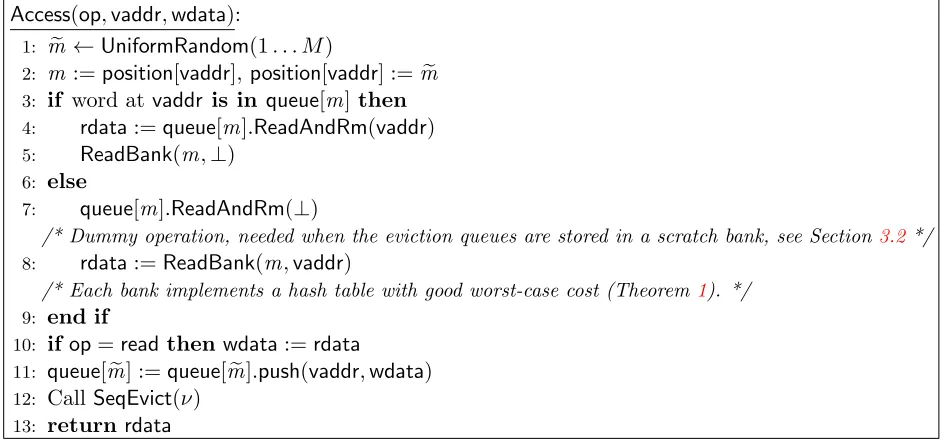
Memory access operations. Figure 1describes the algorithm for making a memory access. To access a memory word identified by virtual address vaddr, the CPU first looks up the position map m := position[vaddr] to find the bank identifier m where the memory word vaddr currently resides. Then, the CPU fetches the memory word vaddrfrom the bank m. Since the set of vaddr’s stored in any bank may be discontiguous, we first assume that each bank implements a hash table such that one can look up each memory location by its vaddr. Later, we will describe how to instantiate this hash table (Theorem 1). After fetching the memory word vaddr, the CPU assigns it to a fresh random bank me. However, to avoid leaking information, the memory word is not
immediately written back to the bank me. Instead, recall that the CPU maintains M queues for buffering memory words before write-back. At this point, the memory word at address vaddr is added to queue[m] — signifying that the memory worde vaddr is scheduled to be written back to
Bank e
m.
Access(op,vaddr,wdata):
1: me ←UniformRandom(1. . . M)
2: m :=position[vaddr],position[vaddr] :=me 3: if word atvaddr is in queue[m]then
4: rdata:=queue[m].ReadAndRm(vaddr) 5: ReadBank(m,⊥)
6: else
7: queue[m].ReadAndRm(⊥)
/* Dummy operation, needed when the eviction queues are stored in a scratch bank, see Section3.2*/ 8: rdata:=ReadBank(m,vaddr)
/* Each bank implements a hash table with good worst-case cost (Theorem1). */
9: end if
10: if op=read thenwdata:=rdata
11: queue[m] :=e queue[m]e .push(vaddr,wdata) 12: Call SeqEvict(ν)
13: return rdata
Figure 1: Algorithm for data access. Read or write a memory word identified by vaddr. If
op=read, the input parameterwdata=None, and the Access operation returns the newly fetched word. Ifop=write, theAccess operation writes the specifiedwdata to the memory word identified by vaddr, and returns the old value of the word atvaddr.
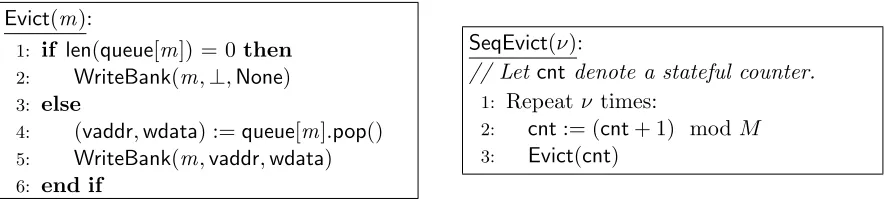
sequentially cycling through the queues. When a queue is chosen for eviction, an arbitrary block is popped from the queue and written back to the corresponding memory bank. If the chosen queue is empty, a dummy block is evicted to prevent leaking information. Stefanov et al. proved that such an eviction process is fast enough so that the CPU’s eviction cache load is bounded byO(M) except with negligible probability [41] – assuming thatM =ω(logN).
Lemma 1. The CPU’s eviction cache is bounded byO(M) +f(N), for anyf(N) =ω(logN) words except with negl(N) probability.
Proof. The proof follows from Stefanovet al. [41], and is a straightforward application of Chernoff bound.
Instantiating the per-bank hash table. In Figures1 and 2, we assume that each bank imple-ments a hash table with good worst-case performance. We now describe how to instantiate this hash table to achieveOb(1) cost per operation except with negligible failure probability.
A first idea is to implement a standard Cuckoo hash table [37] for each memory bank. In this way, lookup is worst-case constant time, whereas insertion is average-case constant time, and worst-case Ob(logN) time to achieve a failure probability negligible in N. To ensure obliviousness,
we can not reveal the insertion time – for example, insertion time can reveal the current usage of each bank, which in turns leaks additional information about the access pattern. However, we do not wish to incur this worst-case insertion time upon every write-back.
Evict(m):
1: if len(queue[m]) = 0then
2: WriteBank(m,⊥,None) 3: else
4: (vaddr,wdata) :=queue[m].pop() 5: WriteBank(m,vaddr,wdata) 6: end if
SeqEvict(ν):
// Let cntdenote a stateful counter. 1: Repeatν times:
2: cnt:= (cnt+ 1) mod M
3: Evict(cnt)
Figure 2: Background evicition algorithms with eviction rate ν. SeqEvict linearly cycles through the eviction queues to evict from. If a queue selected for eviction is empty, evict a dummy word for obliviousness. Countercntis a global variable.
the pending work associated with insertions. Upon every operation, perform a fixed amount of work at a rate faster than the amortized insertion cost of a standard Cuckoo hash table. For our application, we require that the failure probability be negligible in N. Therefore, we introduce a modified version of Arbitmanet al.’s theorem [2] as stated below.
Theorem 1 (Deamortized Cuckoo hash table: negligible failure probability version). There exists a deamortized Cuckoo hash table of capacity s = poly(N) such that with probability 1−negl(N), each insertion, deletion, and lookup operation is performed in worst-case Ob(1) time (not counting
the cost of operating on the queue) – as long as at any point in time at mostselements are stored in the data structure. The above deamortized Cuckoo hash table consumes O(s) +O(Nδ) space where 0< δ <1 is a constant.
In the above, the O(s) part of the space corresponds to the two tables T0 and T1 for storing the elements of the hash table, and the additional O(Nδ) space is for implementing the pending work queue (see Arbitman et al. [2] for more details). Specifically, Arbitmanet al. suggested that the work queue be implemented with constant number k of standard hash tables which are Nδ, for δ < 1, in size. To achieve negligible failure probability, we instead set k = k(N) to be any
k(N) =ω(1). We will discuss the details of our modified construction and analysis in Section 6.
Recursion. In the above scheme, the CPU stores both a position map of Θ(NlogN) bits, and an eviction cache containing Θ(M) memory words. On each data access, the CPU reads Θ(w) bits assuming each a memory word is ofw bits. Therefore, the bandwidth blowup isO(1).
We now show how to rely on a recursion idea to avoid storing this position map inside the CPU — for now, assume that the CPU still stores the eviction cache, which we will get rid of in Section 3.2. The idea is to recursively store the position map in smaller Oblivious NRAMs. Specifically, consider a sequence of ONRAMs denoted ONRAM0,ONRAM1, . . . ,ONRAMd, where
ONRAM0 is the actual data ONRAM, whereas all other ONRAMs are metadata ONRAMs. The position map of ONRAMi is stored inONRAMi+1, and the recursion is repeated until we reach an
ONRAMd of constant size. To access a memory word inONRAM0, the client first makes a position map lookup in ONRAM1 which triggers a recursive call to look up the position of the position in
ONRAM2, and so on.
levels than the data level (i.e., ONRAM0) – the latter trick allows one to reduce the bandwidth blowup for reasonably big memory words size. Below, we describe these parametrizations, state the bandwidth blowup and runtime blowup we achieve in each setting. Recall that as mentioned earlier, the bandwidth blowup and runtime blowup equate for a uniform memory word size setting; however, under non-uniform memory word sizes, the two metrics may not equate.
• Uniform memory word size. The depth of recursion is smaller when the memory word is larger.
– Assume that each memory word is at leastclogN bits in size for some constantc >1. In this case, the recursion depth is O(logN). Hence, the resulting O-NRAM has Ob(logN)
runtime blowup and bandwidth blowup.
– Assume that each memory word is at leastNbits in size for some constant 0< <1. In this case, the recursion depth is O(1). Hence, the resulting O-NRAM has Ob(1) runtime
blowup and bandwidth blowup.
• Non-uniform memory word size. Using a parametrization trick by Stefanov et al. [42], we can parametrize the position map recursion levels to have a different word size than the data level. Of particular interest is the following point of parametrization:
– Assume that each memory word of the original RAM is W = Ω(log2N) bits — this will be the word size for the data level of the recursion. For the position map levels, we will use a word size of Θ(logN) bits. In this way, the recursion depth is O(logN). For each access, the total number of bits transferred include one data word of W bits, and O(logN) words of O(logN) bits. Thus, we achieve Ob(1) bandwidth blowup, but
b
O(logN) run-time blowup.
Finally, observe that we need not create separate memory banks for each level of the recursion. In fact, the recursion levels can simply reuse the memory banks of the top data level, introducing only a constant factor blowup in the size of the memory bank.
3.2 Achieving O(1) Words of CPU Cache
We now explain how to reduce the CPU cache size to O(1), while storing the eviction queues in a separate scratch bank. It turns out that there is a small technicality when we try to do so, requiring the use of a special data structure as described below. When we move the eviction queues to the scratch bank, we would like each queue to support the operations: pop(),push() andReadAndRm(), as required by algorithms in Figures1 and2with worst-caseOb(1) cost except with negl(N) failure
probability. While a simple queue supports pop() andpush() with these time bounds, it does not not supportReadAndRm(). To achieve this, the scratch bank will maintain the following structures:
• Separately, store the entries of all M eviction queues in a single deamortized Cuckoo hash table [2] inside the scratch bank. Such a deamortized Cuckoo hash table can achieveOb(1) cost
per operation (insertion, removal, lookup) except with negligible failure probability. When an element ispopped from orpushed to any of the eviction queues, it is also inserted or removed in this big deamortized Cuckoo hash table. However, when an element must be read and removed from any of the eviction queues, then the element is looked up from the big hash table and it is just marked asdeleted. When time comes for this element to be popped from some queue during the eviction process, a dummy eviction is performed.
Theorem 2 (O-NRAM simulation of arbitrary RAM programs: uniformword size model). Any
N-word RAM with a word size of W =f(N) logN bits can be simulated by an Oblivious NRAM that consumesO(1)words of CPU cache, and withO(M)memory banks each ofO(M+N/M+Nδ) words in size, for any constant 0 < δ <1. The oblivious NRAM simulation incurs Ob(logf(N)N)
run-time blowup and bandwidth blowup. As special cases of interest:
• When the word size is W = N bits, the run-time blowup and bandwidth blowup are both
b
O(1).
• When the word size is W = clogN bits for some constant c > 1, the run-time blowup and bandwidth blowup are both Ob(logN).
Theorem 3 (O-NRAM simulation of arbitrary RAM programs: non-uniform word size model).
AnyN-word RAM with a word size ofW = Ω(log2N) bits can be simulated by an Oblivious NRAM (with non-uniform word sizes) that consumes O(W) bits of CPU cache, and with O(M) memory banks each ofO(W·(M+N/M+Nδ))bits in size. Further, the oblivious NRAM simulation incurs
b
O(1) bandwidth blowup and Ob(logN) run-time blowup.
Note that for the non-uniform version of the theorem, we state the memory bank and cache sizes in terms of bits instead of words to avoid confusion. In both the uniform and non-uniform versions of the theorem, an interesting point of parametrization is when M = O(√N), and each bank is O(W√N) bits in size. The proofs for these two theorems follow directly the analysis for the recursive construction of Oblivious NRAM from Section 3.1, given each access to the scratch bank costs only a constant overhead.
4
Sequential Oblivious Simulation of Parallel Programs
4.1 Parallel RAM
To formally characterize what it means for a program to exhibit a sufficient degree of parallelism, we will formally define a P-parallel RAM. In this section, the reader should think of parallelism as a property of the program to be simulated – we actually characterize costs assuming both the non-oblivious and the oblivious programs are executed on a sequential machine (different from Section5).
AnP-parallel RAM machine is the same as a RAM machine, except the next instruction function outputsP instructions which can be executed in parallel.
Definition 4(P-parallel RAM). An P-Parallel RAMis a RAM which has a next instruction func-tion Π = Π1, . . . ,ΠP such that on input (state=state1|| · · · ||stateP,rdata=rdata1|| · · · ||rdataP), Π
outputs P instructions (I1, . . . , IP) and P updated states state01, . . . ,state0P such that for p ∈ [P],
(Ip,state0p) = Πp(statep,rdatap). The instructions I1, . . . , IP satisfy one of the following:
• All of I1, . . . , IP are set to (stop, z) (with the same z).
• All of I1, . . . , IP are either of the form. (read,vaddr,⊥) or (write,vaddr,wdata).
Finally, the state state has size at mostO(P).
As a warmup exercise, we will first consider a special case where in each parallel step, the memory requests made by each processor in the underlying P-parallel RAM have distinct addresses—we refer to this model as a restricted PRAM. Later in Section 4.3, we will extend the result to the CRCW PRAM case. Thus, our final compiler works when the underlyingP-parallel RAM is in the EREW, CREW, or common/arbitrary/priority CRCW PRAM model.
Definition 5 (Restricted P-parallel RAM). For a P-parallel RAM denoted PRAM :=hD, state1,
. . ., stateP, Π1, . . .ΠPi, if every batch of instructions I1, . . . , IP have unique vaddr’s, we say that PRAM is a restricted P-parallel RAM.
4.2 Warmup: Restricted Parallel RAM to Oblivious NRAM
Our goal is to compile anyP-parallel RAM (not necessarily restricted), into an efficient O-NRAM. As an intermediate step that facilitates presentation, we begin with a basic construction of O-NRAM from anyrestricted, parallel RAM. In the following section, we extend to a construction of O-NRAM from any parallel RAM (not necessarily restricted).
LetPRAM:=hD,state1, . . . ,stateP,Π1, . . .ΠPibe a restrictedP-Parallel RAM, forP =ω(MlogN).
We now present an O-NRAM simulation of PRAM that requiresM + 1 memory banks, each with
O(N/M+P) physical memory, whereN is the database size.
Setup: Pseudorandomly assign memory words to banks. The setup phase takes the initial states of the PRAM, including the memory array Dand the initial CPU state, and compiles them into the initial states of the Oblivious NRAM denotedONRAM.
To do this, the setup algorithm chooses a secret keyK, and setsONRAM.state=PRAM.state||K. Each memory bank of ONRAM will be initialized as a Cuckoo hash table. Each memory word in the PRAM’s initial memory array D will be inserted into the bank numbered (PRFK(vaddr)
doNext(): //We only considerread and write instructions here but not stop.
1: For p := 1 toP: (opp,vaddrp,wdatap) := Πp(statep,rdatap) 2: (rdata1,rdata2, . . . ,rdatap) :=Access
opp,vaddrp,wdatap p∈[P]
Figure 3: Oblivious simulation of each step of the restricted parallel RAM.
Simulating each step of the PRAM’s execution. Each doNext() operation of thePRAM will be compiled into a sequence of instructions of theONRAM. We now describe how this compilation works. Our presentation focuses on the case when the next instruction’s op-codes are reads or writes. Wait or stop instructions are left unmodified during the compilation.
As shown in Figure 3, for each doNext instruction, we first compute the batch of instructions
I1, . . . , IP, by evaluating the P parallel next-instruction circuits Π1, . . . ,ΠP. This results in P
parallel read or write memory operations. This batch of P memory operations (whose memory addresses are guaranteed to be distinct in the restricted parallel RAM model) will then be served using the subroutineAccess.
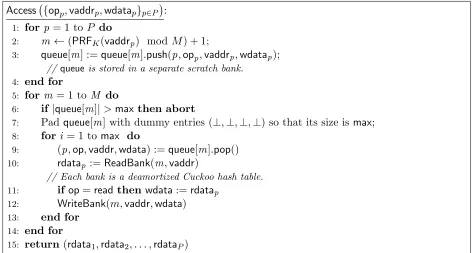
We now elaborate on the Access subroutine. Each batch will have P = ω(MlogN) memory operations whose virtual addresses are distinct. Since each virtual address is randomly assigned to one of the M banks, in expectation, each bank will get P/M = ω(logN) hits. Using a balls and bins analysis, we show that the number of hits for each bank is highly concentrated around the expectation. In fact, the probability of any constant factor, multiplicative deviation from the expectation is negligible inN. Therefore, we choosemax:= 2(P/M) for each bank, and make preciselymaxnumber of accesses to each memory bank. Specifically, theAccessalgorithm first scans through the batch of P =ω(MlogN) memory operations, and assigns them toM queues, where the m-th queue stores requests assigned to the m-th memory bank. Then, the Access algorithm sequentially serves the requests to memory banks 1,2, . . . , M, padding the number of accesses to each bank to max. This way, the access patterns to the banks are guaranteed to be oblivious.
The description of Figure 4makes use ofM queues with a total size ofP =ω(MlogN) words. It is not hard to see that these queues can be stored in an additional scratch bank of size O(P), incurring only constant number of accesses to the scratch bank per queue operation. Further, in Figure 4, the time at which the queues are accessed, and the number of times they are accessed are not dependent on input data (notice that Line7can be done by linearly scanning through each queue, incurring amax cost each queue).
Cost analysis. Sincemax= 2(P/M), in Figure4(see Theorem4), it is not hard to see each batch of P =ω(MlogN) memory operations will incur Θ(P) accesses to data banks in total, and Θ(P) accesses to the scratch bank. Therefore, theONRAM incurs only a constant factor more total work and bandwidth than the underlying PRAM.
Theorem 4. Let PRF be a family of pseudorandom functions, PRAM be a restricted P-Parallel RAM for P = ω(MlogN), and let max := 2(P/M). Then, the construction described above is an oblivious simulation of PRAM using M banks each of size O(N/M+P) words. The oblivious simulation performs total work that is constant factor larger than that of the underlying PRAM.
Access {opp,vaddrp,wdatap}p∈P
:
1: for p = 1 to P do
2: m ←(PRFK(vaddrp) modM) + 1;
3: queue[m] :=queue[m].push(p,opp,vaddrp,wdatap);
// queueis stored in a separate scratch bank.
4: end for
5: for m = 1 to M do
6: if|queue[m]|>max then abort
7: Padqueue[m] with dummy entries (⊥,⊥,⊥,⊥) so that its size is max; 8: fori= 1 to max do
9: (p,op,vaddr,wdata) :=queue[m].pop() 10: rdatap :=ReadBank(m,vaddr)
// Each bank is a deamortized Cuckoo hash table. 11: if op=read thenwdata:=rdatap
12: WriteBank(m,vaddr,wdata) 13: end for
14: end for
15: return (rdata1,rdata2, . . . ,rdataP)
Figure 4: Obliviously serving a batch of P memory requests with distinct virtual ad-dresses.
Lemma 2. Let max := 2(P/M). For any PRAM and any input x, abort on Line 6 of Figure 4 occurs only with negligible probability (over choice of the PRF).
Proof. We first replacePRF with a truly random functionf. Note that if we can prove the lemma for a truly random function, then the same should hold for PRF, since otherwise we obtain an adversary breaking pseudorandomness.
We argue that the probability that abort occurs on Line 6 of Figure4 in a particular step iof the execution is negligible. By taking a union bound over the (polynomial number of) steps of the execution, the lemma follows.
To upper bound the probability of abort in some step i, consider a thought experiment where we change the order of sampling the random variables: We run PRAM(x) to precompute all the PRAM’s instructions up to and including the i-th step of the execution (independently of f), obtaining P distinct virtual addresses, and only then choose the outputs of the random function
f on the fly. That is, when each virtual memory address vaddrp in step i is serviced, we choose m := f(vaddrp) uniformly and independently at random. Thus, in step i of the execution, there are P distinct virtual addresses (i.e., balls) to be thrown into M memory banks (i.e., bins). For
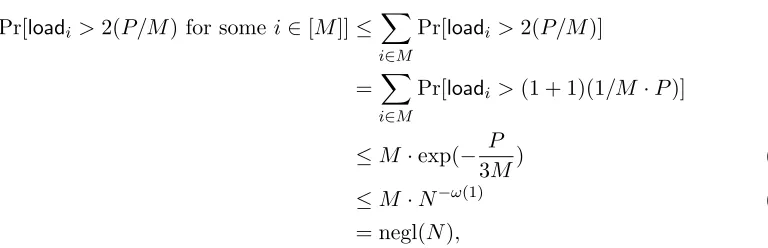
a bin i∈M whose load,loadi, exceeds 2(P/M) is
Pr[loadi>2(P/M) for some i∈[M]]≤
X
i∈M
Pr[loadi >2(P/M)]
= X
i∈M
Pr[loadi >(1 + 1)(1/M ·P)]
≤M ·exp(− P
3M) (4.1)
≤M ·N−ω(1) (4.2)
= negl(N),
where (4.1) follows due to standard multiplicative Chernoff bounds and (4.2) follows sinceP/M =
ω(logN).
We note that in order for the above argument to hold, the inputxcannot be chosen adaptively, and must be fixed before the PRAMemulation begins.
4.3 Parallel RAM to Oblivious NRAM
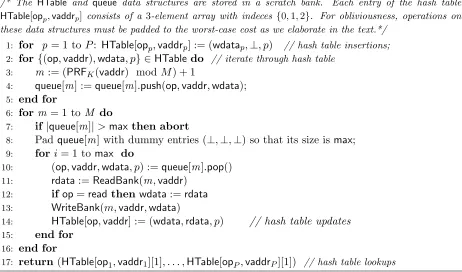
Use a hash table to suppress duplicates. In Section 4.2, we describe how to obliviously simulate a restricted parallel-RAM in the NRAM model. We now generalize this result to support any P-parallel RAM, not necessarily restricted ones. The difference is that for a genericP-parallel RAM, each batch ofP memory operations generated by the next-instruction circuit need not have distinct virtual addresses. For simplicity, imagine that the entire batch of memory operations are reads. In the extreme case, if allP =ω(MlogN) operations correspond to the same virtual address residing in bank m, then the CPU should not read bank m as many as P number of times. To address this issue, we rely on an additional Cuckoo hash table [37] denotedHTableto suppress the duplicate requests (see Figure 5, and thedoNextfunction is defined the same way as Section 4.2). The HTable will be stored in the scratch bank. For simplicity of presentation, we employ a fully deamortized Cuckoo hash table [20,21].2 As shown in Figure 5, we need to support hash table insertions, lookups, and moreover, we need to be able to iterate through the hash table. We now make a few remarks important for ensuring obliviousness. Line 1 of Figure 5 performs
P =ω(MlogN) number of insertions into the Cuckoo hash table. Due to the analysis of [20,21], we know that these insertions will takeO(P) number of accesses with all but negligible probability. Therefore, to execute Line 1 obliviously, we simply need to pad with dummy memory accesses to the scratch bank up to somemax0=c·P, for an appropriate constantc.
Next, we describe how to execute the loop at Line 2 obliviously. The total size of the Cuckoo hash table is O(P). To iterate over the hash table, we simply make a linear scan through the hash table. Some entries will correspond to dummy elements. When iterating over these dummy elements, we simply perform dummy operations for the for loop. Finally, observe that Line 17
performs a batch of P lookups to the Cuckoo hash table. Again, due to the analysis of [20,21],
Access {opp,vaddrp,wdatap, p}p∈P
:
/* The HTable and queue data structures are stored in a scratch bank. Each entry of the hash table HTable[opp,vaddrp] consists of a 3-element array with indeces {0,1,2}. For obliviousness, operations on these data structures must be padded to the worst-case cost as we elaborate in the text.*/
1: for p = 1 to P: HTable[opp,vaddrp] := (wdatap,⊥, p) // hash table insertions;
2: for {(op,vaddr),wdata, p} ∈HTabledo // iterate through hash table 3: m := (PRFK(vaddr) modM) + 1
4: queue[m] :=queue[m].push(op,vaddr,wdata); 5: end for
6: for m = 1 to M do
7: if|queue[m]|>max then abort
8: Padqueue[m] with dummy entries (⊥,⊥,⊥) so that its size is max; 9: fori= 1 to max do
10: (op,vaddr,wdata, p) :=queue[m].pop() 11: rdata:=ReadBank(m,vaddr)
12: if op=read thenwdata:=rdata
13: WriteBank(m,vaddr,wdata)
14: HTable[op,vaddr] := (wdata,rdata, p) // hash table updates 15: end for
16: end for
17: return (HTable[op1,vaddr1][1], . . . ,HTable[opP,vaddrP][1]) // hash table lookups
Figure 5: Obliviously serving a batch ofP memory request, not necessarily with distinct virtual addresses. The current description allows for the underlying PRAM to be EREW, CREW, common/arbitrary/priority CRCW, where we assume priority CRCW gives priority to maximum processor id p (priority for minimum processor id can be supported by iterating from p =P to 1 in line1).
we know that these lookups will take O(P) number of accesses to the scratch bank with all but negligible probability.
Cost analysis. Since max = 2(P/M) (see Theorem 4), it is not hard to see each batch of P =
ω(MlogN) memory operations will incurO(P) accesses to data banks in total, andO(P) accesses to the scratch bank. Note that this takes into account the fact that Line1and the for-loop starting at Line 2 are padded with dummy accesses. Therefore, the ONRAM incurs only a constant factor more total work and bandwidth than the underlying PRAM.
Theorem 5. Letmax= 2(P/M). Assume thatPRFis a secure pseudorandom function, andPRAM
is a P-Parallel RAM for P = ω(MlogN). Then, the above construction obliviously simulates
PRAM in the NRAM model, incurring only a constant factor blowup in total work and bandwidth consumption.
5
Parallel Oblivious Simulation of Parallel Programs
In the previous section, we considered sequential oblivious simulation of programs that exhibit parallelism – there, we considered parallelism as being a property of the program which will actually be executed on a sequential machine. In this section we considerparalleland oblivious simulations of parallel programs. Here, the programs will actually be executed on a parallel machine, and we consider classical metrics such as parallel runtime and total work as in the parallel algorithms literature.
We introduce the Network PRAM model – informally, this is a Network RAM with parallel processing capability. Our goal in this section will be to compile a PRAM into an Oblivious Network PRAM (O-NPRAM), a.k.a.,the “parallel-to-parallel compiler”.
Our O-NPRAM is the Network RAM analog of the Oblivious Parallel RAM (OPRAM) model by Boyle et al.[7]. Goldreich and Ostrovsky’s logarithmic ORAM lower bound (in the sequential execution model) directly implies the following lower bound for standard OPRAM [7]: Let PRAM
be an arbitrary PRAM withP processors running in parallel timet. Then, anyP-parallel OPRAM simulating PRAM must incur Ω(tlogN) parallel time. Clearly, OPRAM would also work in our Network RAM model albeit not the most efficient, since it is not exploiting the fact that the addresses in each bank are inherently oblivious. In this section, we show how to perform oblivious parallel simulation of “sufficiently parallel” programs in the Network RAM model, incurring only
O(log∗N) blowup in parallel runtime, and achieving optimal total work. Our techniques make use of fascinating results in the parallel algorithms literature [4,5,26].
5.1 Network PRAM (NPRAM) Definitions
Similar to our NRAM definition, an NPRAM is much the same as a standard PRAM, except that 1) memory is distributed across multiple banks, Bank1, . . . ,BankM; and 2) every virtual address
vaddr can be written in the format vaddr:= (m,offset), where m is the bank identifier, and offset is the offset within the Bankm. We use the notation P-parallel NPRAM to denote an NPRAM withP parallel processors, each withO(1) words of cache. If processors are initialized with secret randomness unobservable to the adversary, we call this a probablistic NPRAM.
Observable traces. In the NPRAM model, we assume that an adversary can observe the following parts of the memory trace: 1) which processor is making the request; 2) whether this is a read or write request; and 3) which bank the request is going to. The adversary is unable to observe the offset within a memory bank.
Definition 6 (Observable traces for NPRAM). For a probabilistic P-parallel NPRAM, we use
Trρ(NPRAM, x) to denote its observable traces upon input x, and initial CPU randomness ρ
(col-lective randomness over all processors):
Trρ(NPRAM, x) :=
(op11, m11), . . . ,(opP1, mP1)
, . . . , (op1T, m1T), . . . ,(opPT, mPT)
where T is the total parallel execution time of the NPRAM, and {(op1i, mi1), . . . ,(opPi , mPi )} is of the op-codes and memory bank identifiers for each processor during parallel step i ∈ [T] of the execution.
Metrics. We consider classical metrics adopted in the vast literature on parallel algorithms, namely, the parallel runtime and the total work. In particular, to characterize the oblivious simu-lation overhead, we will consider
• Parallel runtime blowup. The blowup of the parallel runtime comparing the O-NPRAM and the NPRAM.
• Total work blowup. The blowup of the total work comparing the O-NPRAM and the NPRAM. If the total work blowup isO(1), we say that the O-NPRAM achievesoptimaltotal work.
5.2 Construction of Oblivious Network PRAM
Preliminary: colored compaction. The colored compaction problem [4] is the following:
Givennobjects ofmdifferent colors, initially placed in a single source array, move the objects tomdifferent destination arrays, one for each color. In this paper, we assume that thespace for the m destination arrays are preallocated. We use the notation di to denote the number
of objects coloredifori∈[m].
Lemma 3 (Log∗-time parallel algorithm for colored compaction [4]). There is a constant > 0 such that for all given n, m, τ, d1, . . . , dm ∈ N, with m = O(n1−δ) for arbitrary fixed δ > 0,
and τ ≥ log∗n, there exists a parallel algorithm (in the arbitrary CRCW PRAM model) for the colored compaction problem (assuming preallocated destination arrays) withnobjects,mcolors, and
d1, . . . , dm number of objects for each color, executing in O(τ)time ondn/τeprocessors, consuming
O(n+Pm
i=1di) space, and succeeding with probability at least 1−2−n
.
Preliminary: parallel static hashing. We will also rely on a parallel, static hashing algorithm [5, 26], by Bast and Hagerup. The static parallel hashing problem takes n elements (possibly with duplicates), and in parallel creates a hash table of sizeO(n) of these elements, such that later each element can be visited in O(1) time. In our setting, we rely on the parallel hashing to suppress duplicate memory requests. Bast and Hagerup show the following lemma:
Lemma 4 (Log∗-time parallel static hashing [5,26]). There is a constant > 0 such that for all
τ ≥ log∗n, there is a parallel, static hashing algorithm (in the arbitrary CRCW PRAM model), such that hashing n elements (which need not be distinct) can be done in O(τ) parallel time, with
O(n/τ) processors and O(n) space, succeeding with1−2−(logn)τ /log
∗n
−2−n probability.
Construction. We now present a construction that allows us to compile a P-parallel PRAM, where P = M1+δ for any constant δ > 0, into a O(P/log∗P)-parallel Oblivious NPRAM. The resulting NPRAM has O(log∗P) blowup in parallel runtime, and is optimal in total amount of work.
parAccess {opp,vaddrp,wdatap}p∈P
:
/* All steps can be executed in O(log∗P) time with P0 =O(P/log∗P) processors with all but negligible probability.*/
1: Using the scratch bank as memory, run the parallel hashing algorithm on the batch of P =
M1+δ memory requests to suppress duplicate addresses. Denote the resulting set as S, and
pad S with dummy requests to the maximum lengthP.
2: In parallel, assign colors to each memory request in the array S. For each real memory access {op,vaddr,wdata}, its color is defined as (PRFK(vaddr) modM) + 1. Each dummy memory
access is assigned a random color. It is not hard to see that each color has no more than
max:= 2(P/M) requests except with negligible probability.
3: Using the scratch bank as memory, run the parallel colored compaction algorithm to assign the arrayS toM preallocated queues each of sizemax (residing in the scratch bank). 4: Now, each queue i∈ [M] contains max number of requests intended for bank i– some real,
some dummy. Serve all memory requests in the M queues in parallel. Each processor i∈[P0] is assigned the k-th memory request iff (k mod P0) =i. Dummy requests incur accesses to the corresponding banks as well.
For each request coming from processor p, the result of the fetch is stored in an arrayresult[p] in the scratch bank.
Figure 6: Obliviously serving a batch of P memory requests using P0 := O(P/log∗P)
processors inO(log∗P) time. In Steps 1, 2, and 3, each processor will make exactly one access to the scratch bank in each parallel execution step – even if the processor is idle in this step, it makes a dummy access to the scratch bank. Steps 1 through 3 are always padded to the worst-case parallel runtime.
Figure 6. Using a scratch bank as working memory, we first call the parallel hashing algorithm to suppress duplicate memory requests. Next, we call the parallel colored compaction algorithm to assign memory request to their respective queues – depending on the destination memory bank. Finally, we make these memory accesses, including dummy ones, in parallel.
Theorem 6. LetPRF be a secure pseudorandom function, letM =N for any constant >0. Let
PRAM be a P-parallel RAM for P = M1+δ, for constant δ >0. Then, there exists an Oblivious NPRAM simulation ofPRAM with the following properties:
• The Oblivious NPRAM consumes M banks each of which O(N/M+P) words in size. • If the underlying PRAM executes in t parallel steps, then the Oblivious NPRAM executes in
O(tlog∗P)parallel steps utilizingO(P/log∗P)processors. We also say that the NPRAM has
O(log∗P) blowup in parallel runtime.
• The total work of the Oblivious NPRAM is asymptotically the same as the underlyingPRAM.
Proof. We note that our underlying PRAM can be in the EREW, CREW, common CRCW or arbitrary CRCW models. Our compiled oblivious NPRAM is in the arbitrary CRCW model.
We now prove security and costs separately.
1 through 3 are also padded to the worst-case running time. Therefore, the observable memory traces of Steps 1 through 3 are perfectly simulatable without knowing secret inputs.
For Step 4 of the algorithm, since each of the M queues are of fixed length max, and each element is assigned to each processor in a round-robin manner, the bank number each processor will access is clearly independent of any secret inputs, and can be perfectly simulated (recall that dummy request incur accesses to the corresponding banks as well).
Costs. First, due to Lemma 2, each of the M queues will get at most 2(P/M) memory requests with probability 1−negl(N). This part of the argument is the same as Section4. Now, observe that the parallel runtime for Steps 2 and 4 are clearly O(log∗P) with O(P/log∗P) processors. Based on Lemmas 4 and 3, Steps 1 and 3 can be executed with a worst-case time of O(log∗P) on O(P/log∗P) processors as well. We note that the conditions M = N and P = M1+δ ensure negl(N) failure probability.
6
Analysis of Deamortized Cuckoo Hash Table
In this section, we first describe our modification of the Cuckoo hash table of Arbitman et al.[2]. Throughout this section, we follow [2] nearly verbatim.
Our data structure uses two tables T0 and T1, and two auxiliary data structures: a queue, and a cycle-detection mechanism. Each table consists of r = (1 +)n entries for some small constant
>0. Elements are inserted into the tables using two hash functionsh0, h1 :U →0, ..., r−1, which are independently chosen at the initialization phase. We assume that the auxiliary data structures satisfy the following properties:
1. The queue is constructed to storeg(N), for anyg(N) =ω(logN), number of elements at any point in time. It should support the operations Lookup, Delete, PushBack, PushFront, and PopFront in worst-case constant time (with overwhelming probability over the randomness of its initialization phase).
2. The cycle-detection mechanism is constructed to store g(N), for any g(N) = ω(logN), el-ements at any point in time. It should support the operations Lookup, Insert and Reset in worst-case Ob(logN) time (with all but negligible probability over the randomness of its
initialization phase).
An element x ∈ U can be stored in exactly one out of three possible places: entry h0(x) of table T0, entry h1(x) of table T1, or the queue. The lookup procedure is straightforward: when given an element x ∈ U, query the two tables and if needed, perform lookups in the queue. The deletion procedure is also straightforward by first searching for the element, and then deleting it. Our insertion procedure is parametrized by a valueL=L(N), for anyL(N)∈ω(1), and is defined as follows. Given a new element x ∈ U, we place the pair (x,0) at the back of the queue (the additional bit 0 indicates that the element should be inserted to table T0). Then, we take the pair at the head of the queue, denoted (y, b), and place y in entry Tb[hb(y)]. If this entry is not
occupied, we again take the pair that is currently stored at the head of the queue, and repeat the same process. If the entryTb[hb(y)] is occupied, however, we place its previous occupantzin entry
T1−b[h1−b(z)] and so on, as in the above description of cuckoo hashing. After L elements have
been moved, we place the current nestless element at the head of the queue, together with a bit indicating the next table to which it should be inserted, and terminate the insertion procedure.
Theorem 7 (Deamortized Cuckoo hash table: negligible failure probability version). There is an implementation of the above deamortized Cuckoo hash table of capacitys such that with probability 1−negl(N), each insertion, deletion, and lookup operation is performed in worst-case Ob(1) time
(not counting the cost of operating on the queue) – as long as at any point in time at mostselements are stored in the data structure. The above deamortized Cuckoo hash table consumesO(s) +O(Nδ) space where 0< δ <1 is a constant.
In the following, we describe the instantiation of the auxiliary data structures.
The queue. We will argue that with overwhelming probability the queue contains at mostg(N), for anyg(N)∈ω(logN), elements at any point in time. Therefore, we design the queue to store at mostg(N) elements, and allow the whole data structure to fail if the queue overflows. Although a classical queue can support the operations PushBack, PushHead, and PopFront in constant time, we also need to support the operations Lookup and Delete in k(N) time, for any k(N) = ω(1). One possible instantiation is to use k := k(N), for any k(N) ∈ ω(1), arrays A1, ..., Ak each of
size Nδ, for some δ < 1. Each entry of these arrays consists of a data element, a pointer to the previous element in the queue, and a pointer to the next element in the queue. In addition we maintain two global pointers: the first points to the head of the queue, and the second points to the end of the queue. The elements are stored using a function h chosen from a collection of pairwise independent hash functions. Specifically, each element x is stored in the first available entry amongst {A1[h(1, x)], ..., Ak[h(k, x)]}. For any element x, the probability that all of its k
possible entries are occupied when the queue contains at mostg(N) elements is upper bounded by (g(N)/Nδ)k, which can be made negligible by choosing an appropriate k.
The cycle-detection mechanism. As in the case of the queue, we will argue that with all but negligible probability the cycle-detection mechanism contains at most g(N), for any g(N) ∈
ω(logN), elements at any point in time. Therefore, we design the cycle-detection mechanism to store at most g(N) elements, and allow the whole data structure to fail if the cycle-detection mechanism overflows. One possible instantiation is to use the above-mentioned instantiation of the queue together with any standard augmentation that enables constant time resets.
Note that in our case of negligible failure probability, the size of the queue and the cycle detection mechanism are both bounded byg(N) =Ob(logN), instead of being bounded by logN as in [2]. It
is not hard to see that as long as the auxiliary data structures do not fail or overflow, all operations are performed in timeOb(1). Thus, our goal is to prove that with 1−negl(N) probability, the data
structures do not overflow.
We continue with the following definition, which will be useful for the efficiency analysis.
Definition 7. Given a setS ⊆ Uand two hash functionsh0, h1 :U → {0, ..., r−1}, the cuckoo graph is the bipartite graphG= (L, R, E), whereL=R ={0, ..., r−1} andE={(h0(x), h1(x)) :x∈S}.
For an elementx∈ U we denote byCS,h0,h1(x) the connected component that contains the edge (h0(x), h1(x)) in the cuckoo graph of the set S ⊆ U with functions h0 and h1.
Similarly to [2], in order to prove Theorem7, we require the following lemma:
Lemma 5. ForT =f(N), wheref(N) =ω(logN), andf(N) =o(logNlog logN), andc2 =ω(1), we have that for any setS ⊆ U of size N and for any x1, . . . , xT ∈S it holds that
Pr
" T X
i=1
|CS,h0,h1(xi)| ≥c2T
#
where the probability is taken over the random choice of the functions h0, h1 : U → {0, ..., r−1}, for r = (1 +)n.
The proof of Lemma 5will be discussed in Section 6.1.
Denote by E1 the event in which for every 1 ≤ j ≤ N/f(N), where f(N) = ω(logN), and
f(N) =o(logNlog logN), it holds that
f(N)
X
i=1
CS,h0,h1(x(j−1) log(N)+i)
≤c2f(N).
By using Lemma 5 and applying a union bound, we have that E1 occurs with probability 1−negl(N).
We denote by stash(Sj, h0, h1) the number of stashed elements in the cuckoo graph of Sj with
hash functions h0 and h1. Denote by E2 the event in which for every 1 ≤j ≤ N/f(N), it holds that stash(Sj, h0, h1)≤k. A lemma of Kirschet al.[27] implies that for k=ω(1), the probability of the eventE2 is at least 1−negl(N).
The following lemmas prove Theorem 7:
Lemma 6. Let π be a sequence of p(N) operations. Assuming that the events E1 and E2 occur, then during the execution of π the queue does not contain more than 2f(N) +k elements at any point in time.
Lemma 7. Letπ be a sequence ofp(N) operations. Assuming that the eventsE1 andE2 occur, then during the execution of π the cycle-detection mechanism does not contain more than (c2+ 1)f(N) elements at any point in time.
The proofs of Lemmas 6 and 7 follow exactly as in [2], except the logN parameter from [2] is replaced withf(N) in our proof andL(the time required per cuckoo hash operation) is finally set to
L(N) :=c2(N)(k(N) + 1) (so choosingL(N) =g(N) for anyg(N) =ω(1), we can find appropriate settings of c2(N), k(N) such that both c2(N), k(N)∈ω(1) andL(N) =c2(N)(k(N) + 1)).
6.1 Proving Lemma 5
As in [2], Lemma5is proved via Lemmas8and9below. Given these, the proof of Lemma5follows identically to the proof in [2].
Let G(N, N, p) denote the distribution on bipartite graphs G= ([N],[N], E) where each edge
is independently chosen with probability p. Given a graph G and a vertex v we denote byCG(v)
the connected component of v inG.
Lemma 8. Let N p=c for some constant0< c <1. For T =f(N), where f(N) =ω(logN), and
f(N) =o(logNlog logN), and c2=ω(1), we have that for any vertices v1, . . . , vT ∈L∪R
Pr
" T X
i=1
|CG(vi)| ≥c2T
#
≤negl(N),
where the graph G= (L, R, E) is sampled from G(N, N, p).