Available Online at www.ijcsmc.com
International Journal of Computer Science and Mobile Computing
A Monthly Journal of Computer Science and Information Technology
ISSN 2320–088X
IJCSMC, Vol. 4, Issue. 7, July 2015, pg.426 – 431
RESEARCH ARTICLE
Driver Drowsiness Detection Using
Multi-feature Analysis
Ms. Neha Sharma
1, Mr. B.L.Pal
2¹Computer Science and Engineering & Mewar University, India
²Computer Science and Engineering & Mewar University, India
1 [email protected]; 2 [email protected]
Abstract— now a day’s Road accidents are common in developed as well as developing countries. These accidents happen due to different - different reasons like sleeping disorders, working in night shift or more than eight hours as over time, side effects of medicine, alcohol, speeding, freakishness of teenager’s etc. One of the most important reasons is drowsiness. Drowsiness means sleepiness, which affects the performance of driving and leads to death of driver as well as passengers also. This is the reality because forty one percentage drivers have admitted that they fall asleep at some time and out of them twenty seven percentage drivers have admitted that sometimes they are really unable to open their eyes while driving. So, we are going to develop a system to detect the drowsiness on the basis of eye blinking to save the life of human being and also to decrease the rate of road-accidents all over the world because 2.5 percent fatal road accidents happen only due to drowsiness.
The numbers of tools have been developed to detect drowsing drivers on the different – different features like drifting from lane, missing exit, hitting sign board or strip etc. We have developed a tool with the help of camera, HAAR features and blinking rate of eyes to increase the accuracy of detection of drowsiness of drivers at minimum cost to save the lives, which is very easy to implement in any type of light motor vehicle.
Keywords—Drowsiness, HAAR, Eye Blinking, Face Detection, Eye Detection, Gray image, CREB, NREB etc.
I. INTRODUCTION
Driving with drowsiness is one of the most important reasons of traffic accidents. Driver fatigue is an important factor in a large number of vehicle accidents on the road. The development of technologies for detecting drowsiness at the wheel is a major challenge in the field of road accident prevention systems to save life. To decrease rate of road accident or improve the safety of driver as well as passenger, we should develop driver assistant tools. There are many technologies for drowsiness detection and can be divided into three main categories [1]:
Biological indicators,
Vehicle behavior, and
Face analysis.
The first type measures biological indicators such as brain waves, heart rate and pulse rate. These techniques have the best recognition accuracy but they require physical contact with the driver. They are expansive and time consuming. Thus, they are not practical.
The third type is face analysis. Since the human face is dynamic and has a high degree of variability, face detection is considered to be a difficult problem in computer vision research. Human eyes and mouth play an important role in face recognition and expression analysis. In fact, the eyes can be considered salient and relatively stable feature on the face in comparison with other facial features. Therefore, when we detect facial features, it is advantageous to detect eyes before the detection of other facial features. The position of other facial features can be estimated using the eye position. In addition, the size, the location and the image-plane rotation of face in the image can be normalized by only the position of both eyes. Continuous eye blinking duration and yawing is also play important role for analysis drowsiness state of human. The aim of this project is to develop a drowsiness detection system. The vision-based systems have been widely used because of its accuracy, inexpensiveness and quick responses
Our main motto is to designing a system that will accurately monitor the open or closed state of the driver’s eyes. It is believed that the symptoms of driver fatigue can be detected early enough to avoid a car accident by monitoring the eyes, Detection of fatigue involves a sequence of images of a face (capture in frames), and the observation of eye blink rate and head position. This project is focused on the localization of the eyes, which involves looking at the entire image of the face, and determining the position of the eyes. Once the position of the eyes is located, the system is designed to determine whether the eyes are opened or closed, and detect fatigue. The systems capture frame and detects the face and eyes using HAAR-like classifiers [2]. Alarm is activated to alert the driver by watching head position and counting eye blinking rate after detecting face and eyes of driver.
II. LITERATURESURVEY
There are several stages of sleep from stage one to stage five. The number of tool or system is developed to detect the drowsiness or assist the driver to decrease the road accident or save the life of driver or passenger or both [3-5].
But, these tools are not accurate or cheaper to detect the drowsiness on the basis of several points. Those points are described in section three of this paper.
III.LIMITATIONOFEXISTINGTOOLORSYSTEM
The numbers of tools or systems are developed to assist the driver on different – different parameters like steering movement, lane changing, eye closure, physiological signals etc. having the following limitation:
Steering movement cannot accurately measure the drowsiness because no lane driving is essential in all
countries till date.
Lane changing is e essential method to assists the driver only in developed countries like US and UK. Sensor technology based system is also implemented to detect the front object and assists the driver but
it does not detect the drowsiness [6].
Physiological signals based systems are also developed to detect drowsiness but this system is very complicated and costly.
Eye closure parameter is implemented with other different - different parameter’s to detect the drowsiness by observing long time eye closed position. But not on the basis of analyzing eye blinking rate for different – different activities.
We can design or model or develop a driver assistant system to remove the above discussed shortcoming of the present existing tool or system or model to detect drowsiness and assist the driver in real time situation in cheaper rate at proper time, which is explained in the next section of this paper.
IV.PROPOSEDSYSTEM
In the proposed system drowsiness detection is implemented on the basis of following parameters: Face detection of the driver,
Head position of the driver and
The block diagram (fig. 1) of working process has shown below as end users view:
Figure 1: Working process of system
In this model camera capture the stable scenes. The scene is analyzed on the basis of HAAR like classifier algorithm. To detect the drowsiness state following steps are followed:
Capture the scenes
Divide into frames,
Calculate ROI for each frame
Apply the threshold condition to detect the drowsiness state
If the certain condition detect then a warning signal is issued to alert the driver.
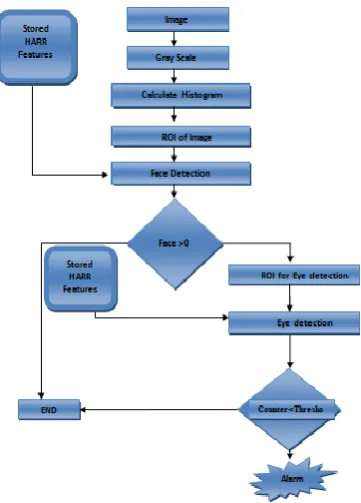
The flow chart (fig. 2) of the system proposed system is shown below in development point of view:
Figure 2: Flow chart of Purposed System
blinking rate. Blinking value is measured with the respect of frequency variation and blinking rate is measured with the respect of time. The relationship of time and frequency is represented by the equation [8].
f=1/t
The relationship between frequency and time is inversely proportional. So, If one factors value increases then another factor value reduces. These variations between factors also define on the bases of graph. The value of eye blinking is varying for different condition its show in below table. In normal condition the blinking rate is vary from 0.3-0.4 sec. the value is reduce during the conversation and it’s became 0.2 per second. In reading value is 0.07 and during the conversation value is 0.43 per second. So, the value of eye blinking is not constant it vary for different conditions [9]. The driver feels the tiredness in long driving and in night shift and its effect on the driver’s facial expression.
The sleeping stage is classified in three categories Stage I, Stage II and Stage III. Normal value of eye blinking is varying between 0.3 – 0.4. If value decreases from the normal condition then user is in the “First stage of sleepiness”. If value decreases from the first stage value then the user in “Second stage of sleepiness”. If value decreases from second stage value then the user in “Sleeping stage”. The variation in values is taken on the basis of blinking rate per minute in different-different condition. Eyes blinking rate for different activities has shown in the following table:
TABLE I
EYES BLINKING RATE IN DIFFERENT ACTIVITIES
This system is implemented by using OpenCV to detect face and eye [10].Detection of face and eyes are the based on the basis of frame comparison.
Calculation process of Eyes blinking with sleeping stages; Normal Eyes Blinking Rate (NREB) = 0.4 Current Eyes Blinking Rate = CREB If (CREB<NREB && CREB >0.3)
{
Cout<<”First stage of sleepiness”; // Single Beep If (CREB <0.3 && CREB>0.2) Cout<<”Second stage of sleepiness”;
// Second alert If (CREB <0.2)
Cout<<”Third stage of sleepiness”; // Continue alert
}
V. RESULT ANALYSIS
We tested this develop system on 20 people we got positive results on 17 people while we get negative results in three people. Our accuracy rate is 85% which is 5% grater then other develop system. The step by step results of finding the drowsiness stages are shown in following figures (fig. 3 -8):
Condition
Blink rate
in per
min.
Blink rate in
per seconds
In Normal
24
0.4
In Rest
17
0.2
In reading
4.5
0.07
In
Conversation
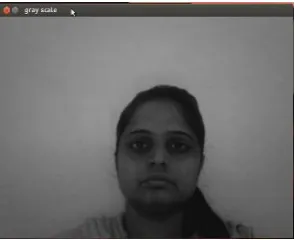
Figure 3: Original Image Figure 4: Gray Scale of input image
Figure 5: Histogram Equalizer of input image Figure 6: Detection of face and eye
Figure 7: First Stage of Drowsiness
Figure 8: Drowsy stage head moving down and eyes closed
VI.CONCLUSION
Drowsiness impairs driving. Impaired driving means fatal road accidents. A fatal road accident causes death of driver or passengers or both. But with the implementation of this tool, we can decrease road accidents rate because this tool is very helpful in detecting drowsiness as well as alarming the drivers within sufficient available time to save the life.
ACKNOWLEDGEMENT
Besides my advisor, I would like to thank the rest of my department professors or lecturers : Assistant professor Mr. Shiv Kumar, Mr. Amit Bhati and Mr. Rohit Maheswari, for their supports; I would like to thank our professors and best friend ,my younger sister supporting me spiritually throughout my life.
REFERENCES
[1] Data from Jackson W.J. (1999), Brain function: Sleep.In T Nosek (ed.), Essential of human physiology, Attlanta, Gold standard Mutimedia inc. & Medical College of Georgia
[2] Manoj Kateja, "Drowsy Driver Detection System: A Novel Approach Using Haar Like Features" IOSR Journal of Computer Engineering (IOSRJCE), Volume 2, Issue 4 (July-Aug. 2012), PP 22-25.
[3] Arun Sahayadhas, "Detecting Driver Drowsiness Based on Sensors: A Review", MDPI Sensors (Basel). 2012 Dec; 12(12): 16937–16953.
[4] Itenderpal singh,"DEVELOPMENT OF A DROWSINESS WARNING SYSTEM USING NEURAL NETWORK”, IJAREEIE Vol. 2, Issue 8, August 2013.
[5] Aashish Joshi, "Drowsy Driver Detection System”, IJCEM International Journal of Computational Engineering & Management, Vol. 17 Issue 3, May 2014.
[6] Agarwal,"Driver assstant system" Intelligent Transportation Systems, IEEE Transactions on (Volume:10 , Issue: 3.
[7] Ioana Bacivarov, Mircea Ionita, Peter Corcoran,” Statistical Models of Appearance for Eye Tracking and Eye-Blink Detection and Measurement”, volume 54, number 3, August 2008.
[8] www.en.wikipedia.org/wiki/frequncy.
[9] Jackson, W.J., “Brain function: Sleep”, In T. Nosek, Essentials of human physiology.