1653
Numerical Assessment Of Variable Piston
Geometry On The Performance And Emission
Phenomenon Of A Ci Engine
Hariram V, Godwin John J, Seralathan S, Guru Venkat I, Baji Babavali S K
Abstract : This experimental investigation is focused on analyzing the influence of piston shape geometries on the emission and performance characteristics of a compression ignition engine. In this study, Deutz made single cylinder engine equipped with hemispherical bowl shaped piston was experimented to understand its performance and emission behavior. The mathematical model of the test engine was developed and validated using Ricardo two zone flame let combustion model. Two piston geometries (shallow and deep toroidal) was developed using Gambit tool and the fluid flow analysis was analyzed through Fluent CFD codes. The tangential, radial and turbulence velocities estimated to understand the fitness of the developed model. The contours of velocity vector at static temperature and velocity magnitude during the combustion phenomenon for numerically simulated piston geometries illustrated that shallow torodial piston was better suited in the present scenario with enhanced performance and reduced NOx emissions.
Index Terms: Piston geometry, performance, emission, compression ignition engine, turbulence modelling, CFD. —————————— ——————————
1.
INTRODUCTION
NERGY conservation and environmental limitations are compelling a rapid change in the compression ignition engine of the automobiles. These new challenges have greatly augmented the intricacy of diesel engine to produce optimal operational performance along with the limitations of fuel economy standards and emissions. Few among the tools that is becoming increasingly significant in encountering these challenges are the mathematical modelling and computational fluid dynamic analysis [1]. This resulted in the simultaneous growth and recognition of the increasing supremacy of mathematical models and the availability of ever increasing computer capabilities. The combustion process in compression ignition engines is extremely complex and the interactions between two phases, liquid spray and gas phases adds complexity to the system. The process is a three dimensional with varying turbulence [2, 3]. The turbulence model of the engine combustion can be grouped engine performance, emission and detonation apart from combustion modelling. Recent developments have expanded the engine combustion modelling capability to understand the kinetic non-equilibrium process of nitric-oxide formation during the combustion process and early part of the expansion stroke [4]. Employing turbulent flow heat transfer correlations in the engine context resulted in better quantitative predictions. The predictive capability can significantly reduce the ‘engine design cycle’ and helps in identifying the regions where effort for technological improvement should be directed. Youtong et al. [5] formulated the KIVA 3v CFD based code to formulate the numerical combustion model of diesel – natural gas fuelled
diesel engine in the dual fuel mode. A smooth transition of the complex timescale combustion model with fuel injection, atomization, ignition and super-imposition with premixed natural gas between the various combustion regimes was simulated. Jung and Assanis [6] demonstrated the multi-dimensional quasi zone diesel injection model for combustion in a full cycle numerical modelling of turbo charged CI engine. The developed numerical model was accounted for the fuel air mixing and atomization, ignition, transient fuel spray characteristics, combustion and NOx – soot formation. The
result of the constant volume chamber test condition was validated against the experimental data. Roy and Victor et al. [7] compared the multi-dimensional and phenomenological modelling approaches of diesel and stratified charged engine. They have characterized the fuel-air mixing, fuel spray patterns, heat transfer capabilities and ignition process. John and Robert [8] measured cylinder average concentration of Nitric Oxide as a function of crank angle by quenching the total cylinder contents at various stages of combustion and expansion process. Abdul and Rajesh [9] numerically investigated the effect of piston shape geometry and initial swirl ratio on the engine’s emission and performance. Various piston geometries with rectangular and square cavity with corresponding variations in their piston to bowl geometrical were considered. The results indicated larger swirl ratio with increased turbulence kinetic energy enhanced the combustion quality to a larger extent. Manjumath et al. [10] optimized the engine parameters of the diesel engine when fuelled with dairy scum biodiesel having lower heating value and higher kinematic viscosity. The various piston bowl namely, re-entrant torodial, hemispherical, straight sided and torodial piston bowl geometries were analyzed with modified injection pressure and timing along with compression ratio.
E
———————————————
Hariram V, Department of Mechanical Engineering , Hindustan Institute of Technology and Science, Chennai, India.
E mail – [email protected]
Godwin John J, Department of Automobile Engineering, Hindustan Institute of Technology and Science, India
Seralathan S, Department of Mechanical Engineering , Hindustan Institute of Technology and Science, Chennai, India.
Guru Venkat I, Department of Mechanical Engineering , Hindustan Institute of Technology and Science, Chennai, India. Baji Babavali S K, Department of Mechanical Engineering,
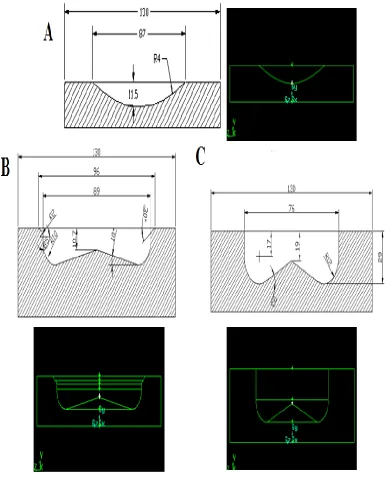
1654 Fig. 1. Comparison of piston geometries – Experimental hemispherical (A), Numerical Shallow toroidal (B) and Numerical Deep
toroidal (C)
Significant variations were observed in the turbulent kinetic energy, fuel droplet atomization, in-cylinder temperature, squish and swirl during combustion. In this study, the fluid flow behavior in the combustion chamber of the engine with variable piston configurations were analyzed. Ricardo two zone flame let combustion model (RTZF) was employed to understand the intake, compression and combustion process under real-time operating conditions and the averaged turbulence flow field and velocity are recorded in each of the variable geometry enabled piston configurations. The outcome indicated that the variation in piston configuration significantly influenced the combustion, performance and the emission formation inside the combustion chamber due to its variable throat area.
2
PISTON
BOWL
GEOMETRIES
AND
EXPERIMENTAL
SETUP
Deutz make F6L912Q model single cylinder water cooled naturally aspirated compression ignition engine was used in this experimental investigation. It generates a maximum power of 8.8 kW at the factory set compression ratio of 17:1. The fuel injector (SP-021 model) was located near the inlet valve. The engine run at a maximum speed of 1500 rpm. The opening and closing of the inlet and exhaust valve are tabulated in Table 1. AVL five gas analyzer was used to determine the concentration of NOx emission from the test engine. The test
1655 chamber with a lesser Diameter/Depth aspect ratio (Shallow
toroidal) and the piston B is also a toroidal chamber with higher Diameter/Depth aspect ratio (deep toroidal). Numerical simulations by using the Ricardo two zone flame let combustion model and k-ε model were carried out on the hemispherical bowl piston (existing) to validate the outcomes and the mathematical modeling was further extended to the theoretical version of shallow toroidal and deep torodial piston geometries as shown in Figure 1.
TABLE1
TEST ENGINE SPECIFICATION
Model and Make Deutz make / F6L912Q Type 4 S, water cooled, Naturally aspirated Number of cylinder One
Engine speed 1500 rpm Maximum power 8.8 kW Injection valve SP-021 Compression ratio 17 : 1
Injection position Intake near the valve
3
COMBUSTION
MODELLING
Multizone combustion model developed by Ricardo (RTZF) was used in this investigation. This model represents two zones namely, unburnt and burnt zone with simplified cohesive combustion phenomenon. The un-burnt region was further divided into mixed zones. In this developed RTZF model, during the pre-mixed combustion phase, the proto-typically separated air and fuel as divided sectors in the un-burnt region. The mixed zone fuses the molecular diffusivity and the fluid motion thereby forming the combustion equilibrium [11]. A progressive transformation takes place between the air and fuel for the un-burnt zone to mixed zone in agreement with the CI engine chemical and physical processes.
3.1 Engine combustion and Emission formation kinetics
The process of CI engine combustion is divided into three phases, namely, pre-combustion phase, combustion phase and after burning phase. In the primary phase, mixing and atomization of air and fuel takes place due to rate of mixing based on the concept of eddy current as given in Eq 1. During the combustion phase, low temperature controlled chemical kinetic driven combustion reaction and the high temperature controlled by turbulence were considered. Auto ignition played a key factor during the low temperature progressive reaction. This was followed by the exothermic process to convert the air-fuel mixture to combustible reactants at the end of its induction. This exothermic process is very rapid in nature. Turbulence drive high temperature reaction is followed through flame propagation. The time scale of the chemical process during the combustion phenomenon is derived using the adiabatic flame temperature equation as given in Eq 2, 3 and 4. The computational time stepping (single) during which the entire reactants of the combustion process are consumed is given in Eq 7.
ώ = −𝐶 ( )𝜌𝑌 ….. 1
𝜏 = 𝐵 exp(𝑇 /𝑇) ….. 2
ώ ∑(
….. 3
𝜏 = 𝑙 𝑆 ⁄ ….. 4
𝑆 = 𝑆 + 3𝑢 ….. 5
ώ = A𝜌 𝑆 𝐶(1 − 𝐶) ….. 6
ώ ∑
….. 7
NOx emission modelling was derived using the extended
Zeldovich mechanism during the post combustion process. Here, NO, NO2 and N20 are collectively grouped as NOx. The
governing equation for the formation of NOx inside the
combustion chamber at the end of the combustion process is given in the below process [12, 13]. Variation in the concentration of NOx post the combustion process in the
chamber and the mass fraction towards the change in the concentration of NOx with respect to time is given in Eq 8, 9
and 10. Arrhenius kinetic energy equation was employed to understand the heat releaser rate during the progressive and premixed combustion period as given in Eq 11.
𝑁 + 𝑁𝑂 → 𝑁 + 𝑂 𝑂 + 𝑁𝑂 → 𝑂 + 𝑁 𝑁 + 𝑂𝐻 → 𝑁𝑂 + 𝐻 𝑑[𝑁𝑂] = * ( [ ] [ ] ) ( ([ ] [ ] /( ) ……. 8 = ( )
( ) ……. 9
= − …….10
𝑅𝑅 = 𝐵𝑙𝜌 𝑥𝑓𝑣𝑥 exp (−
) 𝑉 ……. 11 As per the developed model, it is capable of inheriting both the kinetic phase and the mixing phase of the controlled combustion phenomenon of the CI engine combustion. Initially, the vaporization of fuel droplets takes place followed by the period of uncontrolled and controlled combustion.
TABLE2
EXPERIMENTAL RESULTS ON PERFORMANCE AND NOX EMISSION FOR EXISTING PISTON Engine Torque (Nm) Engine Brake power (kW) BSFC
(kg/kW hr) BTE (%)
NOx emission
(ppm)
0 0 0 0 210
2 0.413 0.0981 7.92 393
4 0.682 0.1792 14.12 421
6 0.981 0.1973 18.19 623
8 1.352 0.2493 22.51 791
10 1.503 0.2912 25.37 987
12 1.983 0.3537 29.35 1101 14 2.231 0.42172 31.13 1327 16 2.928 0.5921 35.79 1532
3
RESULTS
AND
DISCUSSION
1656 BTE was also seen to be escalated from 7.92% at low load to
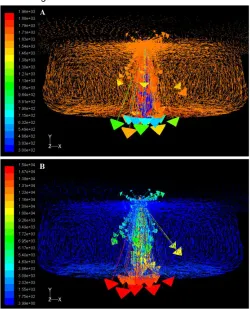
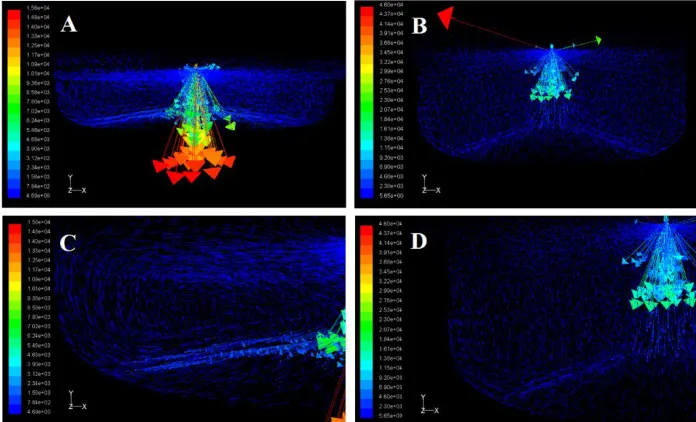
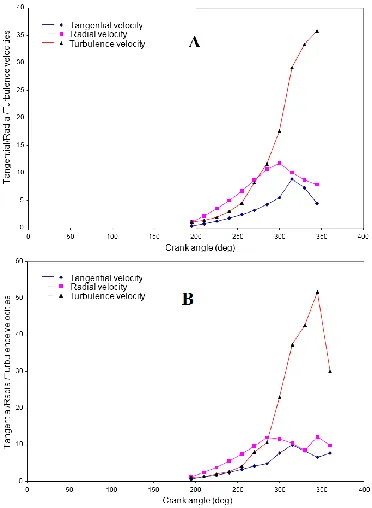
35.79% at full load condition. The oxides of nitrogen emission was showing increasing trend from 210 ppm to 1532 ppm for low and full load respectively. Figure 2A and 2B depicts the variation of velocity vector at static temperature and velocity magnitude during combustion. The turbulence effect and the radial velocity effect during the combustion process the hemispherical piston is discussed in below section [14, 15]. It is necessary to analyze the velocity vector at static temperature and velocity magnitude during the combustion process for both shallow toroidal and deep toroidal piston bowl respectively. Figure 3 and 4 exhibits the contours of velocity vector during the combustion phenomenon along with the variable turbulence factor inside the combustion chamber. It can be noted that shallow toroidal piston has shorter throat area while deep toroidal piston comprises of larger throat area. This significantly affects the compression ratio of the engine during the combustion process. As per the law of conservation of momentum, shallow toroidal piston with shorter throat area exhibit higher lower turbulence due to squeezing of air into the combustion chamber through the narrow channel and this can be evidenced in Figure 6A. On the other hand, larger throat area under deep toroidal piston, creates larger turbulence as shown in Figure 6B.
Fig. 2. Hemispherical piston (existing) - Velocity vector at static temperature (A) and velocity magnitude during
combustion (B)
3.1 Tangential velocity field
The measured and numerically calculated data’s pertaining to tangential velocity field and swirl ratio at the critical point for shallow toroidal and deep toroidal pistons were recorded. During the end of compression stroke, a good agreement between the tangential velocities of shallow and deep toroidal piston bowls are evidenced. At all critical point, the difference
between the shallow toroidal and deep toroidal piston bowls were less than 9.2 % on comparison with hemispherical bowl shaped piston and on an average, the values varied between 9.5% to 14.6% during the end of compression stroke. As the throat area was larger for shallow toroidal piston, the variation in tangential velocity near top dead center saw a sudden dip and rise due to the inherent swirl ratio [16].
3.2 Radial velocity field
Shallow toroidal, deep toroidal and hemispherical piston exhibited similar radial velocity field near the TDC point. Significant variation in the radial velocity was observed during the compression stroke after the TDC. The developed RTZF combustion model predicted a centripetal force initially started when the piston started from the BDC and further increased enormously till the piston reached the top dead center. The experimental outcomes indicated that the radial velocity thus created was on the positive node creating a deep centrifugal force which contradicts the law of conservation of mass. The localized radial velocity field was also measured at various critical point on the shallow and deep toroidal piston as carried out on the hemispherical piston and a substantial variation was noticed on the deep toroidal poison [14]. The entry of air for the deep toroidal piston had larger diameter than the shallow toroidal poison which influences the critical throat area. Shallow toroidal piston also showcased a significant squish effect near the top dead center creating a larger gradient towards radial velocity field.
3.3 Turbulence velocity field
The turbulent kinetic energy of the existing hemispherical piston is shown in Figure 5. LDV measurement techniques was adopted to determine the turbulent velocity field for shallow torodial, deep toroidal and hemispherical bowl shaped piston geometries. The critical point at 30oaTDC was
considered for measuring the turbulence velocity as it was also suggested by isotropic k-ε turbulence combustion model. The stronger relation between squish and swirl in the quiescent combustion zone was rationally precise for the assessment of fluid flow inside the combustion chamber. The turbulent kinetic energy for the hemispherical piston was found to be 0.13 J at 2obTDC whereas the numerical analysis
predicted the 0.134 J at 3.5obTDC. Similarly, the shallow
toroidal and deep toroidal piston geometries exhibited 0.138 J and 0.1412 J at 3.8obTDC and 3.9obTDC respectively. Table 3
compares the exhaust emission (NOx) and performance
1657 used in the combustion chamber. It also compares the
theoretical NOx emission with the mathematical model of the
existing hemispherical piston along with shallow and deep toroidal piston geometries. The emission model was validated by comparing the outcomes of Existing experimental and
numerical hemispherical piston bowl. With the escalation in engine load, the formation of NOx was also increased
significantly. At all loads, NOx emission of hemispherical piston
(existing) was higher with marginal variation with the numerical model of the same.
1658 Fig. 4. Comparison of velocity vector by velocity magnitude during combustion for Shallow torodial (A and C) and deep torodial
(B and D) piston geometries (Magnified view)
TABLE3
NUMERICAL RESULTS ON PERFORMANCE AND NOX EMISSION FOR HEMISPHERICAL (EXISTING), SHALLOW AND DEEP TORODIAL PISTON
Engine Torque (Nm)
Engine Brake power (BP in kW
Brake specific fuel consumption (BSFC in (kg/kW hr)
Brake thermal efficiency
(BTE in %) NOx emission (ppm)
A B C A B C A B C A B C
0 0 0 0 0 0 0 0 0 0 205 195 189
2 0.410 0.391 0.372 0.0972 0.0921 0.0899 7.82 6.95 6.81 389 381 373 4 0.679 0.672 0.662 0.1762 0.1691 0.1657 14.01 13.21 13.02 411 401 392 6 0.972 0.921 0.911 0.1968 0.1921 0.1901 18.21 17.92 17.54 621 635 593 8 1.342 1.295 1.286 0.2482 0.2310 0.2322 21.95 21.51 20.62 789 775 702 10 1.493 1.475 1.425 0.2902 0.2825 0.2810 24.25 24.94 23.94 978 922 892 12 1.972 1.943 1.921 0.3529 0.3431 0.3401 28.91 28.45 27.92 1045 1072 1085 14 2.210 2.193 2.103 0.4201 0.4101 0.4025 30.15 30.37 29.92 1317 1295 1220 16 2.915 2.911 2.892 0.5910 0.5725 0.5798 34.92 35.73 33.62 1527 1457 1359 Note: Numerical results of Hemispherical Existing piston (A), Shallow torodial piston (B) and Deep torodial piston (C)
.
1659 Fig. 6. Comparison of Tangential, radial and turbulence
velocities with crank angle for shallow toroidal (A) and deep toroidal (B) piston
Fig. 7. Comparison of NOx emission for hemispherical piston (Experimental and Numerical), Shallow torodial and deep
toroidal piston
Shallow depth toroidal piston exhibited relatively lower NOx on
comparison with the existing combustion chamber. Deep toroidal piston geometry displayed lower NOx across all
variations.
4 CONCLUSION
In the present study, an attempt was made to understand the effect of various piston bowl geometries on the performance and emission characteristics experimentally and numerically as well. Hemispherical piston bowl in the single cylinder CI engine was analyzed experimentally and it was also validated numerically with the support of Gambit and CFD Fluent. Shallow and deep toroidal piston geometries were modelled and annualized numerically. The following conclusions were arrived.
The shallow toroidal piston geometry had shorted throat area while deep toroidal piston geometry comprised of larger throat area.
Due to shorter throat area, shallow toroidal piston created 36 m/s of turbulence velocity inside the combustion chamber, whereas deep toroidal piston geometry with relatively larger throat area resulted in the turbulence velocity of 51.2 m/s, which is 29.41% higher and further deteriorated sharply.
The turbulent kinetic energy of the hemispherical piston was determined as 0.125 Joule at TDC.
The BSFC of the shallow toroidal piston was found to be 0.5725 kg/kW hr which was lower on comparison with other piston.
The BTE was found to be marginally better for shallow toroidal piston at 35.73% which was 0.2 % higher than deep toroidal and hemispherical piston bowls.
The NOx emission was considered to be moderate with 4.2% lower than the existing hemispherical piston geometry as 1457 ppm.
NOMENCLATURE AND ABBREVIATIONS
CFD Computational fluid dynamics TDC Top dead center
BDC Bottom dead center
RTZF Ricardo two zone flame let combustion model NOx Oxides of nitrogen
CR Compression ratio
Cmax Maximum combustion progress
Yseg
ά Segregated mass fraction
α Residual air
B Pre-exponential constant Ta Activation temperature
ρ Reactant density l Flame propagation length St Turbulence burning velocity
C Combustion progress Δt Computational time step
REFERENCES
[1] John, G., Hariram, V., Seralathan, S. Emission reduction using improved fuel properties of algal oil biodiesel and its blends. Energy Sources, Part A: Recovery, Utilization and Environmental Effects 40 (1) (2018), pp. 45-53. [2] Hariram, V., Vasanthaseelan, S. Optimization of base
catalysed transesterification and characterization of brassica napus (Canola seed) for the production of biodiesel. International Journal of ChemTech Research. 8(9) (2015), pp. 418-423.
[3] Hariram, V., John, J.G., Seralathan, S. Spectrometric analysis of algal biodiesel as a fuel derived through base-catalysed transesterification. International Journal of Ambient Energy. 40 (2) (2019), pp. 195-202.
[4] Venkatesan, H., Godwin, J.J., Sivamani, S. Data set for extraction and transesterification of bio-oil from Stoechospermum marginatum, a brown marine algae. Data in Brief .14 (2017), pp. 623-628.
1660 (2003), pp. 336-347.
[6] Jung, D., Assanis, D.N. Reduced quasi-dimensional combustion model of the direct injection diesel engine for performance and emission predictions. KSME International Journal. 18 (5) (2004), pp. 865 – 876. [7] Roy J. Primus., Victor W. Wong. Performance and
Combustion Modelling of Heterogeneous Charge Engines. SAE Transactions: Fuels and Lubricants. 94 (7) 1985, pp. 100-110
[8] John E. Dec., Robert E. Canaan. PLIF Imaging of NOx
Formation in a DI Diesel Engine SAE Transactions: Journal of engines. 107 (3) (1998), pp. 176-204.
[9] Abdul Gafoor C.P., Rajesh Gupta. Numerical investigation of piston bowl geometry and swirl ratio on emission from diesel engines. Energy Conversion and Management 101 (2015), pp. 541–551.
[10] Manjunath Channappagoudra, K. Ramesh, G. Manavendra. Comparative study of standard engine and modified engine with different piston bowl geometries operated with B20 fuel blend. Renewable Energy 133 (2019) 216-232.
[11] Venkatesan, H., John, G., Sivamani, S. Cotton seed biodiesel as alternative fuel: Production and its characterization analysis using spectroscopic studies.
International Journal of Renewable Energy Research. 7 (3) (2017), pp. 1333-1339.
[12] Hariram, V., Bharathwaaj, R. Application of zero-dimensional thermodynamic model for predicting combustion parameters of CI engine fuelled with biodiesel-diesel blends. Alexandria Engineering Journal 55 (4) (2016), pp. 3345-3354.
[13] Kun Lin Tay, Wenming Yang, Feiyang Zhao, Wenbin Yu, Balaji Mohan. Numerical investigation on the combined effects of varying piston bowl geometries and ramp injection rate-shapes on the combustion characteristics of a kerosene-diesel fuelled direct injection compression ignition engine. Energy Conversion and Management 136 (2017), pp. 1–10.
[14] Heywood JB. Internal combustion engine fundamentals. New York: McGraw- Hill; 1988.
[15] Prasad B, Sharma C, Anand T, Ravikrishna R. High swirl-inducing piston bowls in small diesel engines for emission reduction. Applied Energy 88 (7) (2011), pp. 2355–67. [16] Jaichandar S, Annamalai K. Effects of open combustion