ABSTRACT
JEELANI, IDRIS. Personalized Hazard Recognition Training for Construction Workers. (Under the direction of Dr. Alex Albert).
Proper hazard recognition is an essential element in the safety management process. When
safety hazards remain unrecognized or unmanaged, construction workers are more likely to
experience occupational injuries and illnesses. However, recent research has demonstrated that
a large proportion of safety hazards remain unrecognized in construction environments.
To improve hazard recognition levels, employers adopt a variety of safety and hazard
recognition training programs. Despite these efforts, desirable levels of hazard recognition
have not been achieved. This is partly because of weaknesses in traditional hazard recognition
methods and ineffective training practices. In fact, current hazard recognition method and
training programs are designed without a concrete understanding of why construction hazards
remain unrecognized in dynamic work environments.
To advance theory and practice, the objective of this study was twofold: (1) identify
downstream factors that impede thorough hazard recognition at the work interface, and (2)
develop and evaluate the first personalized training strategy targeted at improving hazard
recognition levels in construction.
The first objective was accomplished through an exploratory study where workers were
tasked with recognizing construction hazards in work-representative environments, and
follow-up brainstorming sessions were conducted to assess why certain hazards remained
unrecognized. The initial findings results were supplemented with input from an expert panel
yielded 13 factors that impede thorough hazard recognition within construction. The most
commonly observed factors were: (1) selective attention or inattention to certain hazard types,
(2) unexpected and unknown potential hazard set, and (3) the perception that certain hazards
impose low levels of safety risk.
The second objective was accomplished by developing a personalized hazard
recognition training strategy by incorporating training techniques known to improve stimuli
and threat detection in other domains such as medicine, the military, and aviation. The
techniques included: (1) visual cues to aid systematic hazard search, (2) personalized hazard
recognition performance feedback, (4) personalized eye-tracking visual attention feedback,
and (4) metacognitive prompts that trigger the adoption of remedial measures.
Following the development, the effectiveness of the training strategy in improving
hazard recognition was empirically evaluated using the non-concurrent multiple baseline
testing approach. The findings of the study showed that the participating workers on average
were able to identify only 42% of hazards prior to the introduction of the intervention, but were
able to recognize 77% of hazards in the intervention phase. The findings of this study will be
of interest to practicing professionals seeking to improve hazard recognition levels within
© Copyright 2016 Idris Jeelani
Personalized Hazard Recognition Training for Construction Workers
By
Idris Jeelani
A thesis submitted to the Graduate Faculty of North Carolina State University
in partial fulfillment of the requirements for the degree of
Master of Science
Civil Engineering
Raleigh, North Carolina 2016
APPROVED BY:
_______________________________ _______________________________
Dr. Alex Albert Dr. Edward Jaselskis
Committee Chair
ii
DEDICATION
iii
BIOGRAPHY
I was born and raised in a beautiful valley of Kashmir in the shadows of mighty Himalaya.
After high school, I joined the National Institute of Technology, Silchar, where I completed
my under graduate studies in Civil Engineering in 2011. My four years at NIT, Silchar played
a great role in shaping the person I am today. After completing my undergrad studies, I joined
Shapoorji Pallonji Engineering and Construction, a construction company based in India and
Middle East. I worked in the field for a year before being promoted to Sr. Engineer in contract
administration department, where I worked for another one and a half years. There I strongly
came to realize the acute need for well learned and informed individuals to manage the projects
efficiently to ensure they are completed on time, within budget and most importantly without
accidents and injuries. Hence, I decided to pursue a master’s degree in Construction
Engineering and Management and joined North Carolina State University, Raleigh in August
2014. During my masters, my research focus was on improving hazard recognition
performance of construction workers and upon graduation, I intend to continue the research in
iv
ACKNOWLEDGMENTS
This thesis could not have been possible without the immense help and support from my
advisor Dr. Alex Albert. It was him who inspired me to explore the field of construction safety
research. Dr. Albert has been a great mentor and I am sincerely grateful to him for his support
throughout my graduate study at NC State. I deeply appreciate his efforts in guiding me and
spending a great amount of time in helping me complete this thesis.
I would like to thank Dr. Edward Jaselskis for his guidance. He has always been helpful and
has provided me with his advice whenever I needed one. I would also like thank Dr. Roger
Azevado for being in my committee and contributing to this study. I am grateful to him for
providing valuable advice about learning techniques and metacognition.
I am thankful to my parents Mr. Khurshid Jeelani and Mrs. Masooda for their unconditional
love, sacrifice and patience. I cannot thank them enough for the sacrifices they have made to
give me a comfortable life and quality education. I am thankful to my brother Owais for his
fatherly affection, my sisters Urooj and Shaifta for their love and support and to Monisa for
being a caring elder sister to me. My Aunt Ghous-ul-Nisa, has always been an inspiration to
me, I am grateful for that. I thank my grandparents for their selfless love and prayers and my
nephews for the cheerful and joyous moments.
My friends, Nitisha, Amit, and Anindita have been a big part of my life. I am grateful to them
for always being there for me and sharing the most beautiful moments of my life. My time at
NC State would not have been as enjoyable without my friend Nitin.
v
TABLE OF CONTENTS
LIST OF TABLES ... ix
LIST OF FIGURES ... x
CHAPTER: 1 INTRODUCTION ... 1
Observed Problem ... 2
Research Goals... 3
Research Method Overview ... 4
Study 1: ... 5
Exploratory Study with Construction Workers ... 5
Exploratory Study with Expert Construction Professionals ... 5
Validation Study ... 6
Study 2: ... 6
Identify Effective Training Elements ... 7
Development of the Training Strategy ... 7
Analysis Phase ... 7
Thesis Format... 10
vi
CHAPTER 2: WHY CONSTRUCTION HAZARDS REMAIN UNRECOGNIZED AT
THE WORK INTERFACE ... 14
Abstract ... 15
Introduction ... 16
Background ... 19
Point of Departure and Research Objectives ... 24
Research Methods ... 26
Phase I: Exploratory Study with Construction Workers ... 26
Phase II: Exploratory Study with expert construction professionals ... 28
Research Findings ... 29
Validation Study ... 41
Study Limitations ... 46
Conclusion ... 47
References ... 48
CHAPTER 3: DEVELOPMENT OF PERSONALIZED HAZARD RECOGNITION TRAINING STRATEGY ... 54
Abstract ... 55
Introduction ... 56
vii
Research Objectives and Point Of Departure ... 62
Research Methods ... 63
Phase I: Identify core training program elements targeted at improving hazard recognition ... 63
Phase II: Integration of core training elements to develop the personalized training strategy ... 74
Phase III: Empirical testing of training strategy using non-concurrent multiple baseline testing ... 76
Results and Discussions ... 84
Contributions and Study Implications ... 88
Study Limitations and Future Research Recommendations ... 89
Conclusion ... 91
References ... 92
CHAPTER 4: CONCLUSIONS AND RECOMMENDATIONS ... 103
Introduction ... 104
Theoretical and Practical Research Contributions ... 105
Future Research ... 107
References ... 110
viii Appendix 1: Results from Hazard Recognition Exercise with Workers ... 114
Appendix 2: Sample Data form ... 118
ix
LIST OF TABLES
CHAPTER 2:
Table 1: Factors affecting hazard recognition at field level………. 44
CHAPTER 3:
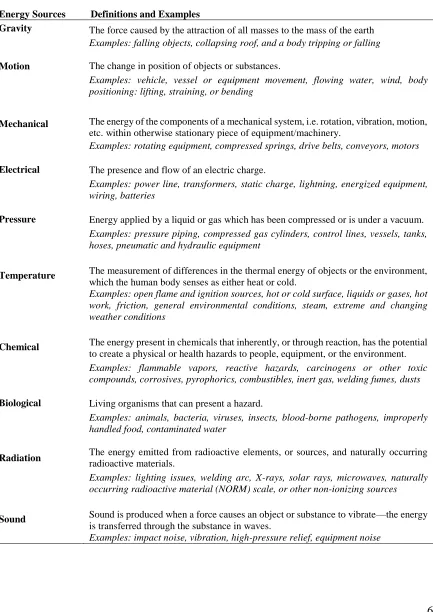
Table 1: Energy sources for hazard identification process……….. 66 Table 2: Results of non-concurrent multiple baseline experiment……….. 85
CHAPTER 4:
x
LIST OF FIGURES
CHAPTER 1:
Figure 1: Phases of Study 1 ….……… 3
Figure 2: Phases of Study 2 .……… 4
Figure 3: Detailed research overview.……… 7
CHAPTER 2: Figure 1: Role of hazard recognition in safety management ………... 20
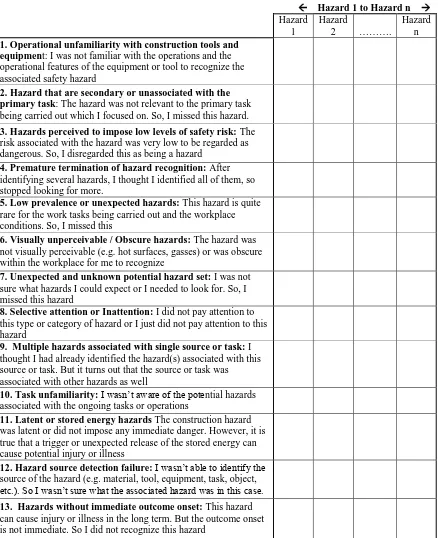
Figure 2: Validation Study Checklist………. 40
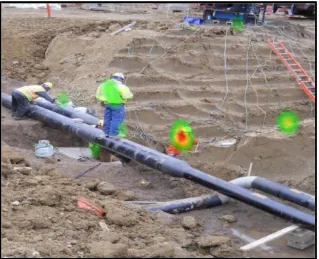
CHAPTER 3: Figure 1: Pilot study participant’s visual attention-map……….. 69
Figure 2: Metacognitive prompts for self-diagnosis and correction……… 73
Figure 3: Personalized Hazard recognition training strategy……….. 74
Figure 4: Non-concurrent multiple baseline testing approach……….………… 78
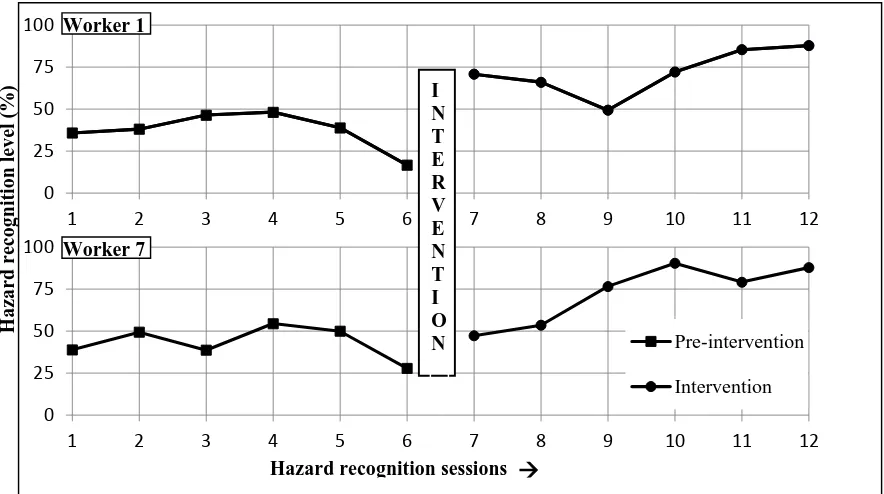
Figure 5: Hazard recognition performance of worker 1 and worker 7…………... 84
2
Observed Problem
Despite improvements in safety management practices, disproportionate injury rates continue
to be a universal problem in the construction industry. Every year more than 60,000 fatal
accidents are reported from construction projects around the world (Lingard 2013). Within the
United States, construction accounted for 16% of fatalities in 2014, although employing only
5% of the workforce (BLS 2016).
Over the last 50 years, the construction industry has undergone profound changes in terms of
safety enforcement, emphasis on safety training, and improvement in overall safety culture.
However, a desirable level of safety performance has not been achieved; and construction
workers continue to remain highly vulnerable to workplace injuries (Albert et al. 2014; Carter
and Smith 2006). Apart from humanitarian concerns, the cost of these injuries exceed $48
billion every year (Ahmed et al. 2006), and adversely impacts profit-margins (Jaselskis 1996)
and reputation. In fact, the staggering cost of construction injuries can threaten the survival of
construction companies (Zou and Sunindijo 2015).
One of the reasons for poor safety performance within construction is the inability of workers
to detect hazards in dynamic and rapidly changing work environments (Albert etal, 2013). In
fact, Haslam et al. (2005) showed that up to 42% of safety incidents can be traced to poor
hazard recognition and assessment performance.
Despite hazard recognition being one of the most essential steps in the safety management
3 Carter and Smith (2006) found that between 10 and 33.5% of hazards remained unrecognized
or inadequately assessed in projects in the U.K. Likewise, a study conducted by Bahn (2012)
revealed that novice workers fail to detect over 57% of hazards in occupational environments.
Recent studies in the United States suggest that over 40% of hazards remain unrecongized
(Albert et al. 2014) in work environments. These unrecognized hazards expose construction
workers to unanticpated safety risk that can potentially lead to catastrophic injuries and illness.
(Albert et al 2014).
To improve hazard recognition levels, several hazard recognition techniques and training
programs have been developed. Although beneficial, they have not completely addressed the
issue of poor hazard recognition within construction (Haslam et al. 2005; Perlman et al. 2014).
In fact, research has demonstrated that workers fail to recognize hazards despite having
adopted traditional hazard recognition methods, and having received substantial safety training
(Albert et al. 2014; Rozenfeld et al. 2010).
Research Goals
To improve hazard recognition levels, the objectives of this research were to (1) identify
underlying reasons why safety hazards remain unrecognized in construction workplaces, and
(2) develop and empirically evaluate the effectiveness of a personalized hazard recognition
4 This study represents the first research effort to develop and test a personalized need-based
hazard recognition training program in the context of the construction industry. This is also the
first research effort to examine why construction hazards remain unrecognized.
The results of the study will inform safety training professionals and construction managers of
effective training practices targeted at improving hazard recognition. Implementation of these
training practices can dramatically improve hazard recognition performance of workers which
is an important leading indicator of safety performance.
Research Method Overview
The research was completed in two successive studies. Study 1 focused on identifying why
construction hazards remain unrecognized, and study 2 focused on developing and evaluating
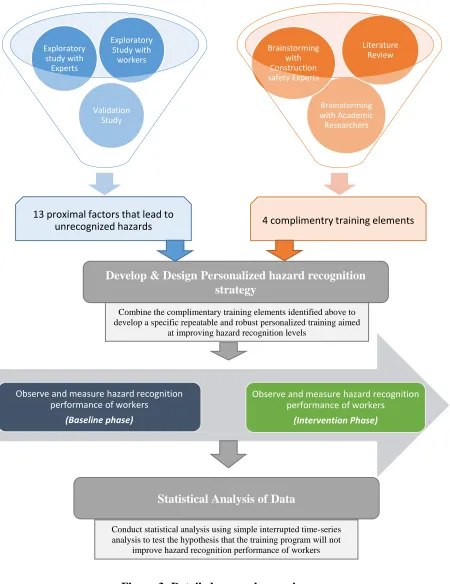
a personalize hazard recognition training strategy. The complete study plan is schematically
presented as Figure 3. The objective of study 1 was accomplished through observational
studies where construction workers were tasked with recognizing safety hazards in
construction case images captured from real projects in the United States. The results were
supplemented by input from an expert panel of construction professionals and academic
researchers.
The objective of study 2 was accomplished by developing an effective training strategy by
incorporating several effective training practices that have found successful applications in
other domains. Following development, the effectiveness of the training strategy in improving
hazard recognition performance of workers was evaluated using the non-concurrent multiple
5
Study 1: Why Construction Hazards remain Unrecognized?
Study 1 was completed in three phases as depicted in figure 1
Figure 1: Phases of Study 1 Exploratory Study with Construction Workers
Construction workers representing diverse specialty trades and construction projects were
tasked with identifying hazards in construction case images captured from real projects in the
United States. The data was collected and follow-up brainstorming sessions were conducted to
understand why construction hazards remain unrecognized.
Exploratory Study with Expert Construction Professionals
In the next phase, brain storming sessions were conducted with an expert panel consisting of
construction safety professionals and academic researchers to gather supplementary data to
3. VALIDATION STUDY
Validate study findings with new cohort of constuction workers
2. EXPLORATORY STUDY WITH EXPERT CONSTRUCTION PROFESSIONALS
Supplement findings of workers with expert input
1. EXPLORATORY STUDY WITH CONSTRUCTION WORKERS
6 augment finding from the first phase. A catalogue of factors impacting hazard recognition
performance was developed.
Validation Study
In the final phase, the findings of above two phases were validated with a new cohort of
construction workers. The result from the participating workers was then combined and
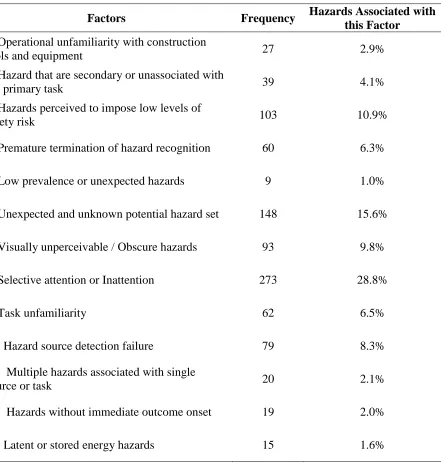
frequency tables were developed that examine the most common workplace impediments to
thorough hazard recognition.
Study 2: Development and evaluation of personalized Hazard recognition
training Strategy
Study 2 was completed in four phases depicted in figure 2.
Figure 2: Phases of Study 2
4. ANALYSIS AND REPORTING
Analyze data and report findings
3. EMPIRICAL TESTING
Evaluate the effectiveness of the training stattegy as an intervention with experimantal methods
2. DEVELOPMENT OF TRAINING STRATEGY
Develop a personalized training strategy by integrating the identified training practices
1. IDENTIFY EFFECTIVE TRAINING ELEMENTS
7
Identify Effective Training Elements
The objective of this phase was to identify individual core training elements that could
potentially be integrated to develop an effective personalized hazard recognition training
strategy. These core elements were identified through brainstorming sessions with an expert
panel followed by literature review sessions to identify best practices for integration and
implementation. The expert panel members asked to identify specific training elements to
address the issue of hazard recognition within construction.
Development of the Training Strategy
Following the identification of the training elements, the personalized training strategy was
developed by integrating the core elements identified in the previous phase. A structured and
repeatable training protocol was developed for the implementation of the training strategy.
Empirical Testing
To test the effectiveness of the devised training program, the longitudinal, non-concurrent
multiple baseline testing approach was used. Workers representing different trades and
construction projects participated in the study and were tasked with recognizing safety hazards
in construction case images, captured from construction projects across the United States. The
criterion measure was the proportion of hazards identified and the treatment variable was the
personalized hazard recognition training developed in the study.
Analysis Phase
After collecting data from the experimental study, rigorous statistical analysis, using
8 conducted. The null hypothesis was that the training strategy will not lead to improvements in
9
4 complimentry training elements
Brainstorming with Academic Researchers Brainstorming with Construction safety Experts Literature Review
13 proximal factors that lead to unrecognized hazards Validation Study Exploratory study with Experts Exploratory Study with workers
Develop & Design Personalized hazard recognition strategy
Combine the complimentary training elements identified above to develop a specific repeatable and robust personalized training aimed
at improving hazard recognition levels
Observe and measure hazard recognition performance of workers
(Baseline phase)
Observe and measure hazard recognition performance of workers
(Intervention Phase)
Statistical Analysis of Data
Conduct statistical analysis using simple interrupted time-series analysis to test the hypothesis that the training program will not
improve hazard recognition performance of workers
10
Thesis Format
The thesis is organized in a two journal paper format. Therefore, each of the subsequent
chapters contains their own abstract, motivation and background, theoretical and practical
contributions, research methods, conclusions, future research endeavors, and referenced
articles.
Chapter 2 of this thesis presents the research focusing on why construction hazards remain
unrecognized. Chapter 3 presents the development and testing of a personalized training
strategy designed to improve the hazard recognition performance of workers. The thesis
concludes with chapter 4 that presents the summarized findings, contributions, limitations and
recommendations for future research.
The thesis also includes 3 Appendices. They contain results of intervention experiments
11
References
Adbelhamid, T. S., Narang, P., and Schafer, D. W. (2011). “Quantifying workers’ hazard
identification using fuzzy signal detection theory.” Open Occupation. Health Safety J., 3,
18–30.
Ahmed, S. M., Azhar, S., Forbes, L. H. (2006). "Costs of Injuries/Illnesses and Fatalities
in Construction and their Impact on the Construction Economy." CIB W99 International
Conference on Global Unity for Safety and Health in Construction, Beijing, China.
Albert, A., Hallowell, M., Kleiner, B., Chen, A., and Golparvar-Fard M. (2014)
“Enhancing Construction Hazard Recognition with High-Fidelity Augmented Virtuality”.
Journal of Construction Engineering and Management 2014 140:7
Albert, A., Hallowell, M. R., Kleiner, B. M. (2013). "Enhancing Construction Hazard
Recognition and Communication with Energy-Based Cognitive Mnemonics and Safety
Meeting Maturity Model: Multiple Baseline Study." J. Constr. Eng. Manage., 140(2).
Bahn, S. (2013). “Workplace hazard identification and management: The case of an
underground mining operation.” Saf. Sci., 57, 129–137
Carter, G., and Smith, S. D. (2006). “Safety hazard identification on construction projects.”
12 Haslam, R. A., et al. (2005). “Contributing factors in construction accidents.” Appl. Ergon.,
36(4), 401–415.
Jaselskis, E., Anderson, S., and Russell (1996). Strategies for Achieving Excellence in
Construction Safety Performance J. Journal of Construction Engineering and
Management 1996 122:1, 61-70
Leigh, J. P. (2011), Economic Burden of Occupational Injury and Illness in the United
States. Milbank Quarterly, 89: 728–772. doi: 10.1111/j.1468-0009.2011.00648.x
Lingard, H. (2013). "Occupational Health and Safety in the Construction Industry."
Constr. Manage. Econ., 31(6), 505-514.
Perlman, A., Sacks, R., Barak, R. (2014). "Hazard Recognition and Risk Perception in
Construction." Saf. Sci., 64, 22-31.
Rozenfeld, O., Sacks, R., Rosenfeld, Y., Baum, H. (2010). "Construction Job Safety
Analysis." Saf. Sci., 48(4), 491-498.
Solman, G. J. F., Cheyne, J. A., & Smilek, D. (2011). Memory load affects visual search
processes without influencing search efficiency. Vision Research, 51(10), 1185–1191.
13 The U.S. Bureau of labor Statistics. (2016). Employed persons by industry, sex, race, and occupation. Retrieved from http://www.bls.gov/cps/cpsaat17.htm
The U.S. Bureau of labor Statistics. (2016). Fatal occupational injuries by industry and selected event or exposure, 2014. Retrieved from
http://www.bls.gov/news.release/cfoi.t02.htm
Waehrer, G. M., Dong, X. S., Miller, T., Haile, E., and Men, Y. (2007). “Costs of
occupational injuries in construction in the United States.” Accid. Anal. Prev., 39(6), 1258–
1266.
14
CHAPTER 2: WHY CONSTRUCTION HAZARDS REMAIN
15
Abstract
Recognizing and managing construction hazards is the central focus of all safety management
initiatives. When safety hazards remain unrecognized, the likelihood of occupational injuries
and illnesses increase substantially. Therefore, proper hazard recognition is an essential
prerequisite to effective safety management. However, recent research findings have
demonstrated that a large proportion of construction hazards remain unrecognized and
unmanaged in complex and dynamic work environments. Despite the importance of hazard
recognition, there is a dearth of research examining why construction hazards remain
unrecognized in work environments. While past studies have identified upstream factors such
as management support and experience that may indirectly impact hazard recognition; no study
has focused on downstream factors that directly influence performance when workers examine
the work environment. The objective of this exploratory research was to address this
knowledge gap by identifying downstream factors that impede thorough hazard recognition at
the work interface. The objectives of this research effort were accomplished in two
complementary phases. The first phase involved a hazard recognition activity where 8 workers
were tasked with identifying hazards in case images captured from real projects within the
United States. This was followed by an interview session where the workers were asked to
identify possible reasons why specific hazards remained unrecognized in the hazard
recognition activity. In the second phase, additional factors that impact hazard recognition and
16 professionals and academic researchers. Further, the experts examined the hazard recognition
results from the first phase and brainstorming sessions were held to determine possible reasons
why hazards remain unrecognized. The experts were also asked to provide relevant examples
for each identified factor. The research process yielded 13 factors that impact hazard
recognition. A follow-up validation study with construction workers revealed that the most
common reasons for not recognizing construction hazards at the work interface include: (1)
selective attention or inattention to certain hazard types, (2) unexpected and unknown potential
hazard set, and (3) the perception that certain hazards impose low levels of safety risk. The
findings of the study will be useful to researchers and practitioners seeking to develop
improved interventions for hazard recognition (e.g. training) that are cognizant of field-based
impediments to thorough hazard recognition.
Keywords: Construction Safety, Hazard recognition, Hazard identification, Safety management, Safety interventions, Safety training
Introduction
More than 60,000 fatal injuries are reported each year from construction projects around the
world (Lingard 2013). In the United States, the number of fatal construction injuries increased
by 16% from 781 in 2011 to 908 in 2014 (Bureau of Labor Statistics 2015). Non-fatal injury
rates resulting in days away from work increased by 5% in 2013 compared to 2012; although
significant reductions were observed in the preceding years (Center for Construction Research
17 in the workplace; despite significant advancements is safety research and practice. These
injuries inflict emotional and physical distress on workers and their families, and the annual
cost of such incidents exceed $48 billion in the United States (Ahmed et al. 2006). The cost of
construction injuries significant impinge on profit margins, and adversely impact project
success; and in some cases threaten the survival of construction companies (Zou and Sunindijo
2015).
To improve construction safety, researchers have devoted much effort to identifying and
understanding antecedent factors of construction incidents (Abdelhamid and Everett 2000;
Mitropoulos et al. 2005; Rajendran and Gambatese 2009). Among others, recent studies have
emphasized the issue of poor hazard recognition within construction. For example, Carter and
Smith (2006) argued that the likelihood of injuries dramatically increase when hazards remain
unrecognized in the workplace. Further, proper hazard recognition is a necessary prerequisite
to adopting effective safety interventions (Albert et al. 2014a). In fact, Haslam et al. (2005)
found that more than 42% of accidents within construction involve worker related factors such
as inadequate hazard recognition and appraisal skills.
To improve hazard recognition levels, employers adopt diverse hazard recognition techniques
and safety training programs. Although beneficial, hazard recognition methods and training
have not completely addressed the problem of poor hazard recognition within construction
(Carter and Smith 2006). In fact, research has demonstrated that workers fail to recognize
hazards despite having adopted traditional hazard recognition methods, and having received
18 While researchers and practitioners have grappled with these challenges, injury investigation
reports have generally recommended more training to improve hazard recognition and
management skills among workers (NIOSH 2016). These recommendations are generally
based on the assumption that inadequate safety knowledge is the primary causal factor leading
to poor hazard recognition and management within construction.
Although safety knowledge is essential, recent advances in the field of human factors have
demonstrated that a diverse array (i.e. apart from knowledge) of psychological, environmental,
and technical factors can influence human performance (Garrett and Teizer 2009). In other
words, apart from safety knowledge, several factors that are both external and internal to
human workers can influence hazard recognition performance.
Some of these factors are more distant or upstream in its causal link with hazard recognition
performance, and some others are more proximal. Upstream factors such as experience and
training can indirectly influence hazard recognition through more proximal factors such as
safety knowledge (i.e. knowledge gained through experience or training) (Perlman et al. 2014).
Although few studies have focused on examining such upstream factors, there is a dearth of
research on downstream field level challenges that directly influence hazard recognition
performance.
A better understanding of why hazards remain unrecognized at the work interface can facilitate
the design and adaption of more efficient upstream interventions (e.g. training) that facilitate
field-level hazard recognition. For example, interventions that are cognizant of the limitations
19 recognition performance. Accordingly, the objective of this exploratory research was to
identify specific field-level challenges and issues that impede thorough hazard recognition.
The study represents the first effort to identify and examine proximal downstream factors that
directly impact hazard recognition.
Background
Construction Hazard Recognition
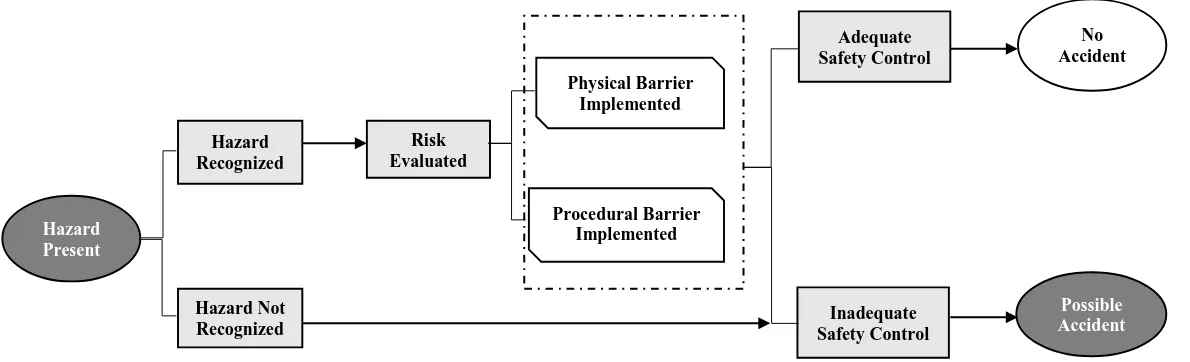
Hazard recognition is generally regarded as the first step in the safety management process as
shown in Figure 1.When hazards are recognized, workers can adopt effective safety measures
to control hazard exposure and reduce injury potential. On the other hand, when hazards remain
20
Figure 1: Role of hazard recognition in safety management
Physical Barrier Implemented
Procedural Barrier Implemented Hazard
Present
Hazard Not Recognized Hazard Recognized
Risk Evaluated
Adequate Safety Control
Inadequate Safety Control
Possible Accident
21 Because of the importance of hazard recognition, employers adopt several methods to improve
hazard recognition levels. These methods can generally be classified into two types; namely
predictive and retrospective hazard recognition methods. Predictive methods such as Job
hazard Analysis (JHA) focus on visualizing construction tasks that will be undertaken in the
near future and predicting expected hazards that may be encountered (Rozenfeld et al. 2010).
Methods such as pre-task safety planning and task demand analysis are also predictive in nature
(Mitropoulos and Namboodiri 2011).
While predictive methods are useful, these methods are associated with important limitations
that prevent thorough hazard recognition. The most significant limitation of these methods is
the assumption that workers are inherently skillful at predicting future work conditions and
expected hazards (Fleming 2009). However, past research has revealed that these assumptions
do not hold true in practice. For example, past research has shown that the dynamic nature of
construction projects make task visualization and prediction incredibly challenging for workers
(Mitropoulos et al. 2005). Further, task as imagined or planned is often very different from
how tasks are ultimately performed at the work interface (Borys 2012). Apart from these
primary limitations, predictive methods also do not generally support the recognition of
hazards unassociated with the primary tasks, hazards imposed by adjacent construction crews,
and those introduced by changes in scope and conditions (Albert et al. 2014a; Rozenfeld et al.
22 Retrospective hazard recognition methods such as lessons learned focus on extrapolating
knowledge gained from past safety incidents to new situations and projects (Behm and
Schneller 2012; Goh and Chua 2009). However, like predicative hazard recognition methods,
retrospective methods are also associated with important limitations. For example, past injury
reports generally do not capture detailed information for effective future learning. In addition,
useful information remains uncaptured from near misses and unreported safety incidents (Dong
et al. 2011). Also, the generalizability of lessons learned from projects and project types is
questionable.
Partly because of such limitations, a large proportion of construction hazards remains
unrecognized in construction projects irrespective of project type and project location. For
example, studies conducted in the United States in diverse projects revealed that more than
50% of construction hazards remained unidentified (Albert et al. 2013). In the U.K, Carter and
Smith (2006) revealed that up to 33% of hazards remained unrecognized in work method
statements. More shockingly, novice workers from Australia were unable to recognize 53% of
hazards in work representative environments (Bahn 2013). These unrecognized hazards expose
workers to unexpected safety risk that can result in catastrophic accidents and injuries. A
comprehensive understanding of why hazards remain unrecognized within construction can
23
Safety and Hazard Recognition Training
Field-level hazard recognition performance largely depends on the ability of workers to detect
hazard stimuli amidst irrelevant distractors. Therefore, a large proportion of safety training
efforts is devoted to equipping workers with the skill-sets necessary to recognize and manage
hazards in dynamic environments. However, recent research suggests that workers lack
essential safety skills despite having received substantial training (Perlman et al. 2014). Not
surprisingly, a large number of injury investigations reveal deficits in worker ability to
recognize and manage hazards, and recommend more training to prevent injury reoccurrence
(Haslam et al. 2005). Such observations have triggered a stream of research articles examining
why training efforts fail.
Among other reasons for training failure, several studies have investigated industry barriers to
effective training. For example, Goldenhar et al. (2001) argued that the transient nature of the
workforce and the temporal nature of projects discourages some employers from adopting
more effective and resource intensive training methods. Others have alluded to the assumption
held by certain employers that the additional cost of resource-intensive training methods may
increase construction cost; which in turn can impact the competitiveness during project
bidding. Apart from these primary industry barriers, other challenges include the scarcity of
resources and experienced training personnel, schedule constraining in fast-pace projects, and
language barriers among construction workers (Wang et al. 2010).
In addition to industry barriers, few studies have focused on design flaws inherent in training
24 adopt passive classroom-type instructional methods to meet regulatory requirements; but are
often ineffective for adult learners. Likewise, Burke et al. (2006) found that traditional training
methods fail to sufficiently engage workers, thereby limiting the transfer of safety knowledge.
In fact, Haslam et al. (2005) argue that that the adoption of ineffective and unengaging training
methods can instigate negative attitudes among workers to safety issues, and can have dire
consequences. Other reasons for training failure in construction identified in past research
include the use of ineffective instructional material and inexperienced trainers (Demirkesen
and Arditi 2015).
While past research has focused on addressing these issues, training interventions largely
ignore specific challenges workers experience during the hazard recognition process. Training
interventions built upon a better understanding of why construction hazards remain
unrecognized in the workplace can potentially improve hazard recognition and safety
performance within construction.
Point of Departure and Research Objectives
As discussed above, desirable levels of hazard recognition have not been achieved in
construction (Albert et al. 2013; Bahn 2013; Carter and Smith 2006). Prior research has
generally attributed such poor hazard recognition performance to ineffective training practices
and shortcomings with traditional hazard recognition methods (Perlman et al. 2014; Wilkins
2011). To overcome these issues, studies have focused on developing more effective training
25 However, much of these efforts have been performed without a concrete understanding of why
hazards remain unrecognized in the workplace.
For example, training interventions assume that hazards remain unrecognized primarily
because workers lack adequate safety knowledge (Haslam et al. 2005). Accordingly training
interventions focus on transferring safety knowledge efficiently. However, from a human
factors or systems perspective, a diverse array of factors that include psychological,
environmental, and technical factors can impact human performance (Garrett and Teizer 2009).
In other words, factors that are both internal and external to workers can impact whether
hazards are recognized. Therefore, designing and adopting hazard recognition techniques and
training interventions that are cognizant of weaknesses and strengths of workers can potentially
improve hazard recognition and safety performance.
To facilitate the development of such interventions, the objective of this study was to answer
the question: Why construction hazards remain unrecognized at the work interface? Because
several upstream and downstream factors may impact hazard recognition, the researchers
decided to limit the scope of the study to downstream factors and challenges that occur at the
work interface. Specifically, the focus is only limited to factors that impact hazard recognition
while workers examine the work environment to recognize safety hazards.
For example, the study does not focus on organization factors such as leadership support or
supervisor involvement which are more upstream in the causal link with field-level hazard
recognition (Hallowell and Gambatese 2009); nor does the study focus on social influences of
26 et al. 2010). Also, the study does not focus on personal or situational factors such as experience,
fatigue or emotional state (Tixier et al. 2014). The study also does not focus on factors that
may impact the accuracy of hazard recognition during the planning stage when conditions may
be relatively unpredictable with potential for scope changes. Rather, the study focused on
specific factors and challenges that impact hazard recognition when workers examine or scan
the workplace to identify safety hazards.
The findings of this study can be used by researchers and practitioners to develop improved
methods for field-level hazard recognition. In addition, the findings can be used to optimize
training interventions to specifically target hazard recognition skills based on a better
understanding of why construction hazards remain unrecognized at the workplace.
Research Methods
The objectives of the research were accomplished in two complementary phases where data
were gathered from 8 construction workers, 10 construction safety professionals, and 4
academic researchers. The following sections describe the research process in detail.
Phase I: Exploratory Study with Construction Workers
The first phase of the study focused on assessing why hazards remained unrecognized from
the perspective of workers. To gather this data, the researchers first recruited 8 construction
workers representing diverse specialty trades including 3 electricians, 2 plumbers, 2
maintenance workers, and 1 iron worker. The workers were employed in 4 construction
27 After gathering worker demographic information, the workers were asked to participate in a
hazard recognition activity. The hazard recognition activity involved identifying hazards in a
pre-selected set of construction case images that were captured from real projects within the
United States. The construction case images were gathered during a previous research effort
by an expert panel of construction professionals representing Construction Industry Institute
(CII) member organizations (Albert et al. 2013). From over 100 captured case images, the
expert panel selected 16 case images that represented diverse construction operations with a
variety of hazards. After the case images were selected, the expert panel pre-identified hazards
present in each of the case images through brainstorming sessions. An example case images
with pre-identified hazards can be found at Albert et al. (2013). The case images included
diverse work scenarios including welding, cutting, grinding, drilling, excavation, pipe laying,
crane rigging and lifting, and others. The number of hazards in each case image ranged from
between 8 to 17.
In the current study, the hazard recognition activity required that the workers identify hazards
from a random sample of 4 construction case images from the initial set of 16. As the workers
identified hazards verbally from each case image, the researchers cataloged the information.
At the end of the hazard recognition activity, the workers were presented with the catalogue
that contained information regarding the hazards that were successfully identified, and others
that remained unidentified. After the information was shared, brainstorming sessions were
28 results of the brainstorming sessions were recorded. The workers were also asked to identify
additional reasons why hazards may remain unrecognized apart from those that were relevant
to their hazard recognition activity.
Phase II: Exploratory Study with expert construction professionals
To gain a holistic perspective, the second phase focused on gathering supplementary data on
why construction hazards remain unrecognized from the perspective of construction safety
professionals and academic researchers. The data gathered in this phase was useful because
hazard recognition is a complex cognitive activity involving both conscious and unconscious
mental processes which may often be difficult to recognize, comprehend, and verbalize. Apart
from identifying why hazards remain unrecognized, this phase also focused on gathering
industry relevant examples of hazards that generally remain unrecognized for each underlying
reason.
In this phase, potential expert safety professionals were identified from the Associated General
Contractors (AGC) database and local construction projects within the Raleigh area. For the
purposes of this study, an expert was defined as a safety professional with over 10 years of
experience within construction with extensive knowledge in safety topics. Overall 10 safety
professionals accepted participation, and their accumulated experience in construction
exceeded 230 years. At the time of participation, all the expert participants were involved in
29 Apart from the industry experts, participation was also sought from academic researchers with
expertise in the area of construction safety. Overall 4 academic researchers whose research
focus was construction safety participated in the study.
The data were gathered from each expert participant in two stages. The first stage involved
in-depth interviews where the participants were asked to identify why construction hazards
remained unrecognized at the work interface. Specifically, the expert participants were asked
to imagine workers visually examining the work environment for construction hazards.
Following this, they were asked to identify possible reasons why certain hazards may remain
unrecognized during the examination process.
In the second stage, the results of the hazard recognition activity from one random worker
gathered in the first phase was shared with each of the expert participants. This was followed
by brainstorming sessions where the experts were asked to examine the results and identify
possible reasons why specific hazards remained unrecognized.
For each identified reason, the experts were asked to share additional industry-relevant
examples of hazards that may remain unrecognized because of the same phenomena. Overall,
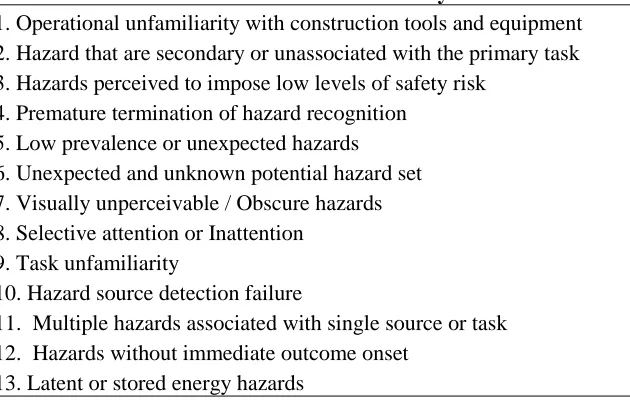
13 factors that impact hazard recognition at the work interface were identified along with
relevant examples in the first two phases of this study.
Research Findings
The research process yielded 13 factors that can impede through hazard recognition at the
30
Operational Unfamiliarity with construction tools and equipment
A large number of construction operations require the use of diverse equipment such as dozers,
forklifts, and cranes; and hand tool such as grinders, mechanical saws, and drills. These
equipment and tools expose workers to different hazards based on their application and
operational features. The research findings suggested that workers may not be familiar with
the operation and operational features of certain construction equipment and tools, and,
therefore, may not recognize associated safety hazards.
Two construction professionals pointed out that certain tools may be used for the same purpose,
however, they may have operational and feature differences. For example, chainsaws that may
be used to cut lumber, concrete, or pipes may be either operated using gas or electricity.
Accordingly, workers may be exposed to hazards such as an electric source or proximity to
flammable substances while operating such equipment. Failure to understand such differences
in operational features can lead to hazards that remain unrecognized. In fact, the data gathered
from phase I revealed that a participating worker mistook a gas operated saw as being operated
using electricity.
Another example brought up by the expert participants included hazards associated with
hydraulic equipment and tools that workers may not be aware of due to operational
unfamiliarity. Specifically, workers may not recognize significant safety hazards associated
with hydraulic fluids in equipment that are under high pressure, the flammable nature of
hydraulic fluids, and the potential for burns from hydraulic systems and fluids operating in
31
Hazards that are secondary or unassociated with the primary task
Phase I findings suggested that a number of hazards that were unassociated with the primary
task being performed remained unrecognized. These hazards were within the work
environment but were either secondary or unrelated to the primary task being performed.
Follow-up brainstorming sessions with the workers and construction experts revealed that
workers tend to focus attention on hazards associated with the primary task, while devoting
less attention to other hazards in the work vicinity.
For example, in a case image where excavation was on-going, several workers did not
recognize overhead powerlines. In another example, where the primary task was pipe-laying
in a trench, workers did not identify a propane gas tank beside the trench. Other examples
included not identifying the possibility of falling objects from overhead adjacent work, trip
hazards that were within the worksite but not proximate to the primary task, and the possibility
of struck by incidents while work is performed adjacent to a site-based traffic route. One of
the experts also indicated that inexperienced workers may not recognize vehicular traffic as a
potential hazard when the primary task is undertaken adjacent to roadways.
Hazards perceived to impose low levels of safety risk
Although industry experts from the previous study believed that certain hazards were relevant
to safe construction operations, a number of hazards were not identified by the workers during
the hazards recognition activity. The follow-up brainstorming sessions with workers revealed
32 risk. In other words, the workers did not report certain hazards during the hazard recognition
activity that they deemed to be within their safety risk tolerance threshold. Previous studies
have alluded to such differences in safety risk tolerances between workers and the
management.
Premature termination of hazard recognition
Construction environments generally contain numerous safety hazards. To ensure workplace
safety, workers are tasked with recognizing and managing all potential safety hazards.
However, workers tend to prematurely terminate the hazard recognition activity when they
believe an adequate number of hazards have been recognized.
One expert participant indicated that workers feel a sense “that the job is done” after a few
hazards are recognized. Another safety professional indicated that workers often begin with
recognizing the most mundane hazards such as trips, falls, pinch points, etc.; however, they
often stop prematurely without evaluating all potential hazards. He further added that, in most
cases, the mundane easily identifiable hazards are not the ones that hurt workers. The ones that
hurt them are often the ones they did not expect will hurt them.
In our examination of worker data, the workers on average stopped their hazard recognition
search process after they had identified 4 hazards. Several other hazards that were recognized
33
Low prevalence and unexpected hazards
Construction environments are dynamic, and no two construction projects are alike in all
aspects. Therefore, workers may be exposed to hazards that they rarely encounter in typical
projects, or they may encounter hazards that were unexpected. For example, an expert
participant pointed out that snake bites or attack by animals are relatively rare within the U.S.
construction industry, and, therefore, such hazards are unexpected and often remain
unrecognized. The same expert also pointed out that poisonous plants and insects rarely show
up on JSAs although they may be relevant.
Another participant mentioned that hydraulic failure of construction equipment are typically
rare, and such hazards often remain unrecognized until failure occurs. Others alluded to the
diverse array of chemical and biological hazards that workers may be exposed to in an
industrial setting, and in sanitary infrastructure projects which in many cases are unpredictable
and rare.
Visually unperceivable / obscure hazards
Workers largely depend on their visual perception of the work environment to recognize
workplace hazards. Hazards that are visually not perceivable are more likely to remain
unrecognized. For example, gases (e.g. CO, H2S), vapors (e.g. gasoline), and fumes (e.g. fumes
from hot work) that may be colorless and sometimes odorless are more difficult to recognize.
High temperature and high pressure pipelines are also generally difficult to recognize because
34 The expert participants mentioned that high temperatures that may be generated from boilers
and industrial plants may remain unrecognized because of visual unpercievability. Another
participant mentioned that the presence of underground utilities and electrical lines can remain
unperceived until contact is made in minor digging and trenching operations.
Apart from visually unperceivable hazards, certain hazards may be obscure within the
construction environment although they can be visually perceived. These include hidden
hazards such as electrical cables on the floor of a cluttered worksite, hand tools left among
other construction material, protruding nails within used or reusable formwork material and
others.
Unexpected and unknown potential hazard set
A typical construction environment contains numerous construction hazards. Workers are
tasked with recognizing and managing all potential hazards that can result in undesirable
hazard exposure. Even if a single serious hazard remains unrecognized, the consequence can
potentially be catastrophic. However, workers may not have precise knowledge of what
hazards to expect, what to look for, and how many of them to anticipated. When such
knowledge is absent, workers often are unaware of what to look for and how many hazards
can be expected.
To illustrate this phenomenon, consider a worker looking for his safety gloves. He has precise
information that he will need two of them (i.e. a pair) for both his hands. Therefore, it is
35 the worker has prior knowledge of the total number of gloves he would need to work safety
and efficiently. However, this is not the case with typical hazard recognition within
construction. While workers participate in hazard recognition, no prior knowledge is available
regarding the number of hazards they will need to look for. Further, there is no knowledge of
what to look for like in the case of specifically looking for the pair of safety gloves.
Because of the absence of such prior knowledge, workers may not know what hazards to
particularly look for, and how many of them can be anticipated at the work interface.
Subsequently, a number of hazards may remain unrecognized in the workplace.
Selective attention or Inattention
Although diverse construction operations are associated with numerous hazards, workers often
do not recognize certain hazards either due to selective attention or inattention. For example,
three workers selectively recognized “gravity” hazards such as trip, slip, and fall potential and
other hazards that may lead to stuck-by incidents; however, chemical, biological, and radiation
related hazards remained unrecognized. Some workers did not recognize electrical hazards at
all despite the presence of electrical cables and electrical equipment in several case images.
Another worker only recognized hazards that were in close proximity to workers depicted in
the case images, while ignoring other hazards. Further, as indicated previously, few workers
36 Apart from the findings from the case images, one expert participant indicated that workers
may pay close attention to hazards associated with their work task, but may not focus on
hazards that adjacent crews may impose on them. Another expert participant indicated that
workers while performing their own work tasks, may be oblivious to other hazards in their
vicinity.
Multiple hazards associated with single source or task
Certain hazard sources and activities may be associated with multiple hazards. For example,
an electric cable on the floor may be associated with a trip hazard and an electric hazard. In
these cases, workers often recognized only one of the hazards (e.g. potential for trip). In several
of these instances, workers claimed that they did not recognize other related hazards because
they through the hazard(s) associated with the source was already recognized. In another
example, workers recognized the sparks generated from a metal cutting operation as a potential
ignition source, but did not recognize the harmful fumes generated as a potential hazard.
Other expert participants pointed out that a large variety of construction tools and equipment
are associated with multiple hazards that may not all be recognized. For example, tools such
as welding machines, circular saws, drills, jack hammers and all construction equipment can
be associated with multiple hazards. Workers may assume that all hazards are recognized, even
if few hazards remain unrecognized.
37 Similar to operational unfamiliarity with construction equipment and tools that was discussed
earlier, workers may be unfamiliar with certain tasks and their associated safety hazards. This
may be because of a lack of experience with certain work tasks or being relatively new to the
construction industry. This may also be the case when certain workers may not be aware of
task procedures generally undertaken by specialty contractors such as utility work, mechanical
work, and demolition.
Although workers representing specific work trades may not be familiar with specialized work
tasks and their associated safety hazards, they may still be susceptible to exposure while
working in projects involving multiple contractors and crews.
Several of the expert participants pointed out that this was a major reason why certain hazards
remained unrecognized in the work environment. Another expert participant mentioned that
JSA cannot be accurate if workers are not aware of task procedures. A number of the
participants mentioned that several injuries are the result of hazard exposure when multiple
crews work in close proximity and workers are unaware of all potential hazards associated with
work tasks.
Task unfamiliarity and its association with hazard recognition was also noticed during the
hazard recognition activity with the participating workers. For example, when a case image
depicting a group of workers preparing to initiate an arc stud welding operation was presented,
the participating worker indicated that he was not aware of the operation being undertaken. As
a result, he did not recognize several hazards including the fact that sparks will be generated
38
Latent and stored energy hazards
Construction environments contain several dormant hazards that are not expected or
perceived as imposing any imminent danger. Such hazards often remain in work
environments as latent or stored energy for extended time periods without causing any harm.
However, the unexpected release or trigger of these latent sources of stored energy can result
in dramatic injury and illnesses. The dormant nature of such hazards often causes them to
remain unrecognized in construction environments.
The study participants mentioned several examples of latent and stored energy hazards. For
example, one participant mentioned that the unexpected rupture of high-pressure pipelines,
vessels, and hydraulic lines are fairly common within construction and is a leading cause of
fatal incidents. Other relevant examples included the potential for cave-ins during excavation
and trenching operations, the possibility of arc flash incidents while working on energized
equipment, the release of mechanical energy from compressed springs, and unexpected
chemical reactions and explosions at the workplace. Several of these types of hazards also
remained unrecognized during the hazard recognition activity with workers.
Hazard Source Detection Failure
Construction environments contain a variety of building materials, equipment, tools, chemicals
and environmental features that can cause harm, injury, or illnesses. However, workers may
39 For example, one expert participant pointed out that a worker may inadvertently contact a
certain irritant or chemical in an industrial setting. But the worker may not be able to identify
what the source or irritant was despite experiencing the outcome (i.e. irritation). Another
example cited by an expert participant was the presence of small patches of mold in structural
lumber. The worker may see the patches, but may not recognize that the patches indicate the
presence of mold that can cause undesirable health outcomes.
Another expert participant pointed out that workers in rehabilitation and maintenance projects
must be cautious of the presence of lead-based paints and asbestos. However, recognizing these
hazard sources among other workplace elements may be challenging.
Within the construction case images, some workers expressed their inability to detect certain
hazard sources. For example, certain containers contained industrial wastes and flammable
material. Although most workers indicated that the containers may contain hazardous material,
they were unsure of what the material precisely were. Most of these workers were also not
aware of the potential harm that may result from exposure to the elements.
In several instances, the participating workers were not able to recognize certain construction
equipment which were potential hazard sources. For example, some workers were unable to
recognize that an equipment depicted in the case image was an arc stud welding device. Such
40
Hazards without immediate outcome onset
Hazards that may not cause an immediate undesirable outcome often remain unrecognized in
workplaces. One expert participant claimed that hazards where the cause and effect
relationship is much more uncertain or not immediately observable often may not receive the
attention of workers. One example cited was the effect of exposure to sunlight. The expert
participant pointed out that that the exposure to UV radiations in sunlight can result in
sunburns. He added that sustained exposure to these radiations can also lead to skin cancer.
However, because the impacts are not immediate they often remain unrecognized.
Several participating participants alluded to other hazards of this type such as hazards
associated with manual lifting and the adoption of unsafe lifting techniques, and the effect of
adopting tools and equipment that induce body vibrations in workers where the effects are not
immediate.
Such instances were also prevalent in the hazard recognition activity with construction
workers. For example, work requiring improper body postures as depicted in the case images
remained unrecognized in many instances; although actions such as bending, kneeling,
crouching, and overhead work were present. In addition, hazards such as exposure to concrete
dust, silica, welding fumes, and others that do not manifest as immediate effects remained
41
Validation Study
To validate the research findings, a new cohort of 8 workers were recruited to participate in a
second hazard recognition activity study. The participating workers represented 4 different
trades including civil, electrical, mechanical, and an equipment operator. The workers were
employed in 5 different projects in the Southeastern United States during participation.
Similar to the initial study, the workers were tasked with identifying hazards from a random
set of 6 construction case images. After the hazard recognition activity, the hazards that were
successfully identified and those that remained unidentified were presented to each worker.
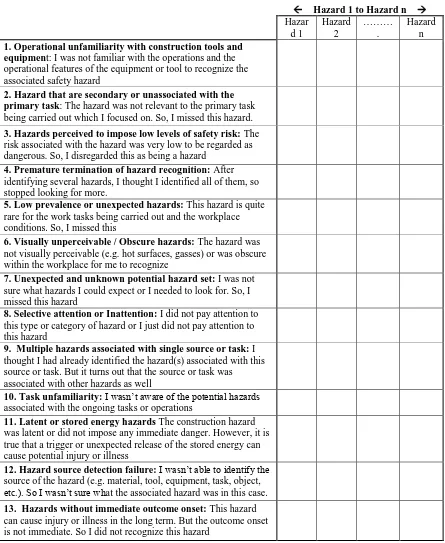
The workers were then presented with a checklist in the format shown in Figure 2, and each of
the factors was briefly explained to the workers. The workers were then asked to indicate on
the checklist all factors that were relevant to why specific hazards remained unrecognized
during the hazard recognition activity. The workers were allowed to select more than one factor