5.10 Imbalanced Learning for Functional State Assessment
Imbalanced Learning for Functio
n
al State Assessment
Feng Li, Frederick McKenzie and Jiang LiOld Dominion University
[email protected] [email protected] [email protected] Guangfan Zhang and Roger Xu
Intelligent Automation, Inc. [email protected]@i-a-i.com
Carl Richey and Tom Schnell University of Iowa
[email protected],edu [email protected]
Abstract This paper presents results of several imbalanced learning techniques applied to operator functional state assessment where the data is highly imbalanced, Le., some function states (majority classes) have much more training samples than other states (minority classes). Conventfonal machine learnirg techniques usually tend to clClssify all data samples into major~y classes and perform poorly for minority classes. In this study, we implemented five imbalanced learning techniques, including random under-sampling, random over-sampling, synthetic minor~y over-sampling technique (SMOTE), borderline-SMOTE and adaptive synthetic sampling (ADASYN) to solve this problem, Experimental results on a benchmark driving lest dataset show thai accuracies for minor~y classes could be improved dramatically w~h a cost of slight performance degradations for majority classes,
1.0 INTRODU
C
TION
An Operator Functional State (OFS) refers
to a multidimensional pattern of the human psychophysiological condition that mediates performance in relation to physiological and psychological costs [1], Accurate OFS assessment for human operators plays critical roles in automated aviation systems because it can ensure mission success and improve mission performances [2],
Researchers proposed various modeling tools to assess OFS, In Ref. [3], a stepwise discriminate analysis (SWDA) method and artificial neural networks (ANN) were proposed to perform OFS assessment As a nonlinear model, the ANN is considered more advantageous in complex task situations, especially if multiple features are
used, In Ref. [2], committee machines proved useful in improving the assessment accuracy. Errors of individual committee
members can be canceled if the errors are independent. Therefore, improvement can be achieved if individual members have low
biases and are less correlation I.e., they are
diversified [4]. In addition to the traditional "bagging" technique, which generates
multiple versions of prediction based on the
bootstrap technique to produce the final prediction [5], performing a feature selection
procedure before training can further reduce
correlations among committee members [2]. To successfully perform OFS assessment, however, researchers often face the challenge of modeling imbalanced data sets
where datasets are not balanced, i.e., some
OFS states have much more data samples than others do. In the machine learning community, those OFSs having more data
samples than others are named 'majority'
classes while those having less samples are called 'minority' classes. Traditional classifiers tend to classify all data samples
into majority classes, resulting in poor performances for minority classes [6], which is not acceptable for OFS assessment. Many imbalanced learning techniques have been proposed to balance performances among majority and minority classes. Those techniques could be divided into four
categories [6]: sampling methods, cost -sensitive methods, kernel-based methods, and active learning methods. Sampling methods aim to reduce the imbalance by
removing (under-sampling) samples from majority classes or generating (ov
er-sampling) more training samples for minority classes [7]. Cost-sensitive methods improve classification performance by using different cost matrices to compensate for
Imbala
n
ced Learning for Funct
i
onal State Assessment
Feng Lit Frederick McKenzie and Jiang Li
Old Dominion University
[email protected] [email protected] [email protected] Guangfan Zhang and Roger Xu
Intelligent Automation, Inc.
[email protected]@i-a-i.com
Carl Richey and Tom Schnell University of Iowa
[email protected] thomas-schnel/@uiowa.edu
Abstract. This paper presents results of several imbalanced learning techniques applied to operator functional state assessment
where the data is highly imbalanced, i.e., some function states (majority classes) have much more training samples lhan other states (minority classes). Conventional machine learning techniques usually tend \0 clClssify all data samples into major~y ciClsse5 and perform poorly for minority classes. In this study. we implemented five imbalanced leaming techniques, including random under-sampling, random over-sampling, synthetic minor~y over-sampling technique (SMOTE), borderline-SMOTE and adaptive synthetic
sampling (ADASYN) 10 solve this problem. Experimental results on a benchmark driving test dataset show thai accuracies for
minor~y classes could be improved dramatically with a cost of slight performance degradations for majority classes.
1.0 INTRODUCTION
An Operator Functional State (OFS) refers
to a multidimensional pattern of the human psychophysiological condition that mediates performance in relation to physiological and psychological costs [1]. Accurate OFS assessment for human operators plays critical roles in automated aviation systems
because it can ensure mission success and improve mission performances [2].
Researchers proposed various modeling tools to assess OFS. In Ref. [3], a stepwise discriminate analysis (SWDA) method and artificial neural networks (ANN) were proposed to perform OFS assessment. As a nonlinear model, the ANN is considered more advantageous in complex task situations, especially if multiple features are used. In Ref. [2], committee machines proved useful in improving the assessment accuracy. Errors of individual committee members can be canceled if the errors are independent. Therefore, improvement can be achieved if individual members have low
biases and are less correlation i.e., they are
diversified [4]. In addition to the traditional
"bagging" technique, which generates
multiple versions of prediction based on the
bootstrap technique to produce the final prediction [5], performing a feature selection
procedure before training can further reduce
correlations among committee members [2].
To successfully perform OFS assessment,
however, researchers often face the
challenge of modeling imbalanced data sets
where datasets are not balanced, i.e., some
OFS states have much more data samples than others do. In the machine learning community, those OFSs having more data
samples than others are named 'majority' classes while those having less samples are called 'minority' classes. Traditional classifiers tend to classify all data samples
into majority classes, resulting in poor performances for minority classes [6], which is not acceptable for OFS assessment. Many imbalanced learning techniques have been proposed to balance performances among majority and minority classes. Those techniques could be divided into four
categories [6]: sampling methods, cost -sensitive methods, kernel-based methods,
and active learning methods. Sampling methods aim to reduce the imbalance by
removing (under-sampling) samples from majority classes or generating (ov
er-sampling) more training samples for minority classes [7]. Cost-sensitive methods improve classification performance by using different cost matrices to compensate for
imbalanced classes (8]. Kernel based methods, such as the support vector
machine (SVM), are based on the principles of statistical learning and
Vapnik-Chervonenkis (VC) dimensions [9]. Active
learning is a type of iterative supervised learning technique, which is used in situations where unlabeled data is
abundant. Active learning is often integrated
into kernel-based learning methods by selecting the closest instance to the current hyper plane from the unseen training data and adding it to the training set to retrain the
model [10[.
We have developed an OFS assessment strategy based on a committee machine for a closed-loop adaptive task manage system, where the OFS assessment was treated as a regression problem [2]. In this paper, we redesigned a similar model for
the same task; however, we treated the
OFS assessment as a classification problem. Because the data sets are highly imbalanced, traditional classifiers failed to classify minority states. We implemented several imbalanced techniques to improve
classification performances for those minority OFS states.
The remainder of the paper is organized as
follows: Section 2 describes several
imbalanced learning techniques implemented in this paper. Section 3 presents the architecture of a committee classifier. Section 4 illustrates our experimental design, including implementation of the imbalanced learning
techniques and the design of a committee classifier. Section 5 shows our achieved experimental results. Section 6 provides
discussions for the results and Section 7 concludes the paper.
2.0 IMBALANCED LEARNING
TECHNIQUES
There exist many imbalanced learning
techniques in the literature as described in
the excellent review paper [6]. In our study, we implemented five of them as described below.
• Random under-sampling
• Random over-sampling
• Synthetic minority over-sampling
technique (SMOTE)
• Borderline-SMOTE
• Adaptive synthetic sampling (ADASYN)
All the methods have been detailed in the Ref. [6], including their implementations,
performances and limitations. The overall goal of those methods is to make data samples balanced among classes by dropping some data samples from majority
classes and adding samples to minority classes, and to keep roughly the equal number of data samples for all classes.
2.1 Random under-sampling
Random under-sampling was only applied
to majority classes. The method randomly
selects a number of majority data samples
to keep. This method may loss information in the majority classes.
2.2 Random over-sampling
The random over-sampling method was
only utilized to minority classes. In contrary to the random under-sampling technique, this method randomly selects data samples
from minority classes and duplicates them
till the data set is roughly balanced. This
method may lead to overfitting because data samples are repeatedly used.
2.3 SMOTE
To overcome the overfitting defect of the
random over-sampling method, SMOTE
generates or synthesizes new samples for
minority classes. To create a new synthetic
sample for a given data point (seed) from
minority classes, it first randomly selects
one of its K-nearest minority neighbors (K is specified by researchers arbitrarily). Then, a
random poi nt that is on the line between the seed and the selected neighbor will be synthesized as a new data sample. SMOTE
may lead to the problem of over
generalization [12]. The following methods,
Borderline-SMOTE and ADASYN. are
developed to overcome this limitation.
imbalanced classes (8]. Kernel based
methods, such as the support vector
machine (SVM), are based on the principles
of statistical learning and
Vapnik-Chervonenkis (VC) dimensions (9). Active
learning is a type of iterative supervised
learning technique, which is used in
situations where unlabeled data is
abundant. Active learning is often integrated
into kernel-based learning methods by
selecting the closest instance to the current hyper plane from the unseen training data and adding it to the training set to retrain the
model [10].
We have developed an OFS assessment strategy based on a committee machine for
a closed-loop adaptive task manage
system, where the OFS assessment was
treated as a regression problem [2]. In this
paper, we redesigned a similar model for
the same task; however, we treated the
OFS assessment as a classification
problem. Because the data sets are highly
imbalanced, traditional classifiers failed to
classify minority states. We implemented
several imbalanced techniques to improve
classification performances for those
minority OFS states.
The remainder of the paper is organized as
follows: Section 2 describes several
imbalanced learning techniques
implemented in this paper. Section 3
presents the architecture of a committee
classifier. Section 4 illustrates our
experimental design, including
implementation of the imbalanced learning
techniques and the design of a committee
classifier. Section 5 shows our achieved
experimental results. Section 6 provides
discussions for the results and Section 7 concludes the paper.
2.0 IMBALANCED LEARNING
TECHNIQUES
There exist many imbalanced learning
techniques in the literature as described in
the excellent review paper [6]. In our study,
we implemented five of them as described
below.
• Random under-sampling
• Random over-sampling
• Synthetic minority over-sampling
technique (SMOTE)
• Borderline-SMOTE
• Adaptive synthetic sampling (ADASYN)
All the methods have been detailed in the
Ref. [6], including their implementations,
performances and limitations. The overall
goal of those methods is to make data
samples balanced among classes by
dropping some data samples from majority
classes and adding samples to minority
classes, and to keep roughly the equal
number of data samples for all classes.
2.1
Random under-samplingRandom under-sampling was only applied
to majority classes. The method randomly
selects a number of majority data samples
to keep. This method may loss information in the majority classes.
2.2
Random over-samplingThe random over-sampling method was
only utilized to minority classes. In contrary
to the random under-sampling technique,
this method randomly selects data samples from minority classes and duplicates them till the data set is roughly balanced. This
method may lead to overfitting because
data samples are repeatedly used.
2.3 SMOTE
To overcome the overfitting defect of the
random over-sampling method, SMOTE
generates or synthesizes new samples for
minority classes. To create a new synthetic
sample for a given data point (seed) from
minority classes, it first randomly selects
one of its K-nearest minority neighbors (K is
specified by researchers arbitrarily). Then, a
random poi nt that is on the line between the
seed and the selected neighbor will be
synthesized as a new data sample. SMOTE
may lead to the problem of over
generalization {12]. The following methods,
Borderline-SMOTE and ADASYN. are
2.4 Borderline-SMOTE
Borderline-SMOTE and SMOTE differ in the
ways they select seeds. SMOTE may select
any minority sample as a seed while
Borderline-SMOTE only considers those
who are from minority classes and are on
the borderline between minority and
majority classes. A minority class sample is considered as on the borderline if majority of its M nearest samples belong to majority
classes (M is specified by researchers
arbitrarily).
2.5 ADASYN
The difference between ADASYN and
SMOTE is the amount of new data samples
to be synthesized for each seed. SMOTE
generates the same number of data
samples for each seed while ADASYN
syntheses data samples according to the
distribution of seeds. Considering K nearest
neighbors of a seed, the more belonging to
majority classes, the more new samples will be synthesized for the seed.
3.0 COMMITTEE MACHINE
A committee machine is an ensemble of
multiple estimators (committee members), which could be any learning method for
classification or regression. The output of a committee machine is fusion of the outputs
from all of its members. A theoretic
interpretation for the principle of committee
machine is that the errors from individual committee members can be canceled to
some extent if they are uncorrelated.
Research results show that the performance
improvement can be affected by two factors: accuracies of individual committee members and correlations among them [4].
For the first factor, selection of an appropriate individual model is essential, because a better performance will usually be achieved if each of the individual members performs well. For the second
factor, several techniques like bagging, boosting, averaging or voting, mixture of experts have proved effective [4]. In this paper, we use the following techniques to build the committee machine.
• Use the bootstrapping technique to
generate multiple 'copies' of the training data.
• Apply an advanced feature selection algorithm, Piecewise Linear Orthogonal
Floating Search (PLOFS) [111. to
diversify the committee members such that their performances are not highly correlated.
• Train a Multi-Layer Perceptron (MLP) by the standard Back Propagation (BP) algorithm as a base classification model
• Delete the committee members having
high biases (accuracy < 50%).
• Utilize the majority vote scheme to fuse decisions from committee members. For example, if majority of the 15 total committee members predict class 1, the
final output of the committee is class 1.
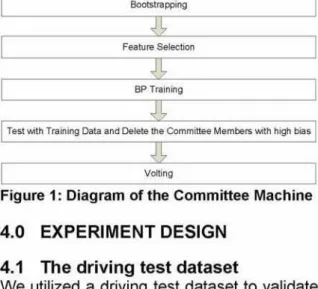
The system diagram of the committee
machine is shown in Figure. 1.
FUMe ~Iec!ion
BP Train""l
TeSlIOiIh Tra.,ing Oilla and DeIe!Eo!he Committee Membel5 "";th high bias
Voffing
Figure 1: Diagram of the Committee Machine
4.0 EXPERIMENT DESIGN
4
.
1 The driving test dataset
We utilized a driving test dataset to validate
our proposed method for OFS assessment. The dataset was collected by participants
performing a driving test over the course of two hours. The collected information includes description of the driving task, system dynamics related information,
performance measures, physiological
signals (128-channel EEG. ECG.
2.4 Bord
e
rline
-
SMOTE
Borderline-SMOTE and SMOTE differ in the ways they select seeds. SMOTE may select any minority sample as a seed while Borderline-SMOTE only considers those who are from minority classes and are on the borderline between minority and majority classes. A minority class sample is considered as on the borderline if majority of its M nearest samples belong to majority classes (M is specified by researchers arbitrarily).
2
.
5 ADASYN
The difference between ADASYN and SMOTE is the amount of new data samples to be synthesized for each seed. SMOTE
generates the same number of data samples for each seed while ADASYN syntheses data samples according to the distribution of seeds. Considering K nearest neighbors of a seed, the more belonging to majority classes, the more new samples will
be synthesized for the seed.
3.0 COMMITTEE MACHINE
A committee machine is an ensemble of multiple estimators (committee members),
which could be any learning method for classification or regression. The output of a committee machine is fusion of the outputs
from all of its members. A theoretic interpretation for the principle of committee machine is that the errors from individual committee members can be canceled to some extent if they are uncorrelated.
Research results show that the performance improvement can be affected by two factors:
accuracies of individual committee
members and correlations among them [4].
For the first factor, selection of an appropriate individual model is essential,
because a better performance will usually be achieved if each of the individual members performs well. For the second
factor, several techniques like bagging,
boosting, averaging or voting, mixture of experts have proved effective [4]. In this paper, we use the following techniques to build the committee machine.
• Use the bootstrapping technique to generate multiple 'copies' of the training data.
• Apply an advanced feature selection algorithm, Piecewise Linear Orthogonal
Floating Search (PLOFS) [111. to diversify the committee members such that their performances are not highly correlated.
• Train a Multi-Layer Perceptron (MLP) by the standard Back Propagation (BP)
algorithm as a base classification model
• Delete the committee members having high biases (accuracy < 50%).
• Utilize the majority vote scheme to fuse decisions from committee members. For example, if majority of the
15
total committee members predict class 1, the final output of the committee is class 1. The system diagram of the committeemachine is shown in Figure. 1.
BP T'~in.,g
VoI!ing
Figure 1: Diagram of the Committee Machine
4.0 EXPERIMENT DESIGN
4
.
1 The driving test dataset
We utilized a driving test dataset to validate our proposed method for OFS assessment. The dataset was collected by participants performing a driving test over the course of two hours. The collected information includes description of the driving task,
system dynamics related information,
performance measures, physiological signals (128-channel EEG. ECG.
respiration, etc.), and eye tracking. The
workload was also analyzed according to the driving conditions (city~driving, stopped,
highway passing, etc.), and seven OFSs, which indicate seven workload levels, were
defined.
Six subjects participated in the driving test and data was recorded in a separate file for each participant, resulting in six individual
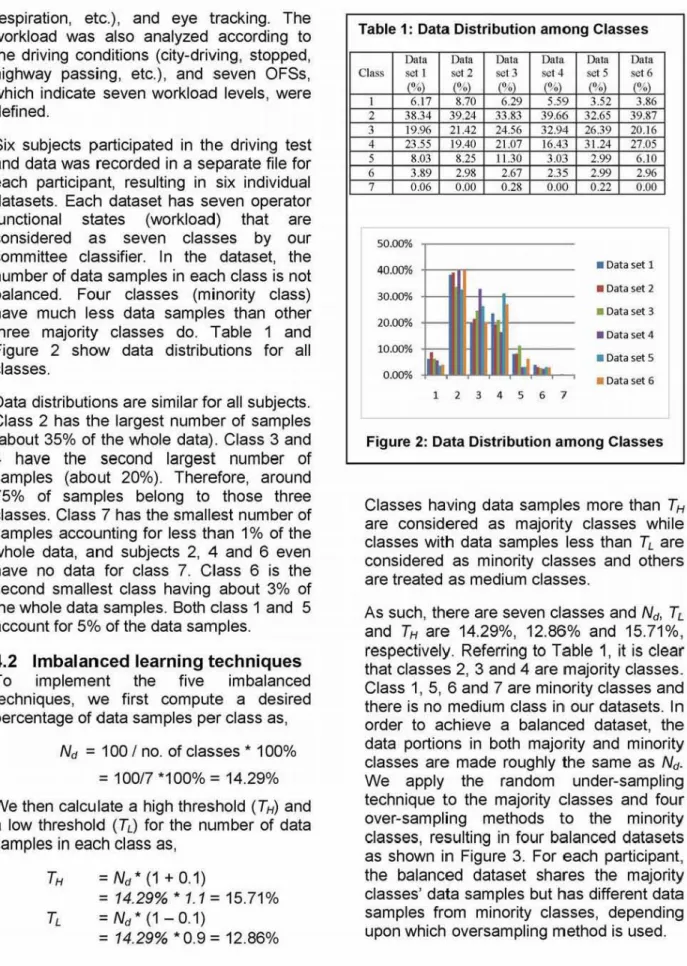
datasets. Each dataset has seven operator functional states (workload) that are considered as seven classes by our committee classifier. In the dataset, the number of data samples in each class is not balanced. Four classes (minority class) have much less data samples than other
three majority classes do. Table 1 and
Figure 2 show data distributions for all classes.
Data distributions are similar for all subjects. Class 2 has the largest number of samples (about 35% of the whole data). Class 3 and
4 have the
second
largest number
of
samples (about 20%). Therefore, around
75% of samples belong to those three classes. Class 7 has the smallest number of
samples accounting for less than 1 % of the whole data, and subjects 2, 4 and 6 even
have no data for class 7. Class 6 is the
second smallest class having about 3% of
the whole data samples. Both class 1 and 5 account for 5% of the data samples.
4
.2 Imbalan
ce
d learn
i
ng t
ec
hniqu
e
s
To implement the five imbalanced techniques, we first compute a desired percentage of data samples per class as,Nd = 100 I no. of classes * 100%
=
10017 *100% = 14.29% We then calculate a high threshold (TH) and a low threshold (Ttl for the number of datasamples in each class as, TH =Nd'(1+0.1) =
14.29% '
1
.
1
=15
.
71
%
h
=Nd'(1 - 0.1) = 14.29% * 0.9 = 12.86% Table 1: Data Distribution among Classes"'
"
0." J)ala 0. .. 00 .. Dala Class""
.
""
scI 3 sci""',
scI 6'
'
.
,
.
"
.
.
"
..
,.
"
.
.
,
6.17 8.70 6.29 5.59 3.52 3.86 2 38.34 39.24 33.83 39.66 32.65 39.87 3 19.96 21.42 24.56 32.94 26.39 20.16 4 23.55 19.40 21.07 16.43 31.24 27.05,
8.03 8.25 11.30 3.03 2.99 6.10 6 3.89 2.98 2.67 2.35 2.99 '.96 7 0.06 0.00 0.28 0.00 0.22 0.00 50.00% , -4000% • Data set 1 30.00% • Data set 2 • Data set 3 20.00% • Data set 4 10.00% • Data set 5 0.00% • Data set 6 1 2 3 4 5 6 7Figure 2: Data Distribution among Classes
Classes having data samples more than TH are considered as majority classes while classes with data samples less than TL are considered as minority classes and others
are treated as medium classes.
As such, there are seven classes and Nd , TL
and TH are 14.29%, 12.86% and 15.71%, respectively. Referring to Table 1, it is clear that classes 2, 3 and 4 are majority classes. Class 1, 5, 6 and 7 are minority classes and there is no medium class in our datasets. In order to achieve a balanced dataset, the data portions in both majority and minority classes are made roughly the same as Nd.
We apply the random under-sampling technique to the majority classes and four
over~sampling methods to the minority classes, resulting in four balanced datasets
as shown in Figure 3. For each participant, the balanced dataset shares the majority
classes' data samples but has different data samples from minority classes, depending upon which oversampling method is used.
respiration, etc.), and eye tracking. The
workload was also analyzed according to
the driving conditions (city~driving, stopped,
highway passing, etc.), and seven OFSs,
which indicate seven workload levels, were
defined.
Six subjects participated in the driving test and data was recorded in a separate file for
each participant, resulting in six individual
datasets. Each dataset has seven operator
functional states (workload) that are
considered as seven classes by our
committee classifier. In the dataset, the
number of data samples in each class is not
balanced. Four classes (minority class)
have much less data samples than other
three majority classes do. Table 1 and
Figure 2 show data distributions for all
classes.
Data distributions are similar for all subjects.
Class 2 has the largest number of samples
(about 35% of the whole data). Class 3 and
4 have the second largest
number
of
samples (about 20%). Therefore, around
75% of samples belong to those three
classes. Class 7 has the smallest number of
samples accounting for less than 1 % of the
whole data, and subjects 2, 4 and 6 even
have no data for class 7. Class 6 is the
second smallest class having about 3% of
the whole data samples. Both class 1 and 5
account for 5% of the data samples.
4.2
Imbalanced learning techniques
To implement the five imbalanced
techniques, we first compute a desired
percentage of data samples per class as,
Nd
=
100 1 no. of classes * 100%=
100/7 *100%=
14.29%We then calculate a high threshold (TH) and
a low threshold (Tt} for the number of data
samples in each class as,
TH = N,' (1+ 0.1)
= 14.29% * 1.1 = 15.71%
Tc
=N,'(1 - 0.1)= 14.29% * 0.9 = 12.86%
Table 1: Data Distribution among Classes
"'"
0." J),,, 0.""'"
l)ala Class .".
~"' ~J3 ~14 . " .,,6 '.
.
'
.
.
,
..
.
.
,
.
%,
6.17 8.70 6.29 5.59 3.52 3.86 2 38.34 39.24 33.83 39.66 32.65 39.87 3 19.96 21A2 24.56 32.94 26.39 20.16 4 23.55 19AO 21.07 16,43 31.24 27.05,
8.oJ 8.25 11.30 3.03 2.99 6.10 6 3.89 2.98 2.67 2.35 2.99 2.96 7 0.06 0.00 0.28 0.00 0.22 0.00 50.00% , -40.00% • Data set 1 30.()(l% • Data set 2 • Data set 3 20.00% • Data set 4 10.00% • Data set 5 0.00% • Data set 6 1 2 3 4 5 6 7Figure 2: Data Distribution among Classes
Classes having data samples more than TH
are considered as majority classes while
classes with data samples less than TL are
considered as minority classes and others
are treated as medium classes.
As such, there are seven classes and Nd , TL
and TH are 14.29%, 12.86% and 15.71%,
respectively. Referring to Table 1, it is cleat
that classes 2, 3 and 4 are majority classes. Class 1, 5, 6 and 7 are minority classes and
there is no medium class in our datasets. In
order to achieve a balanced dataset, the
data portions in both majority and minority
classes are made roughly the same as Nd •
We apply the random under~sampling
technique to the majority classes and four
over~sampling methods to the minority
classes, resulting in four balanced datasets
as shown in Figure 3. For each participant,
the balanced dataset shares the majority
classes' data samples but has different data
samples from minority classes, depending
Random
under.
f-o
sampling eillanced datil
Majority set 1
classes Random
over·
COpy sampllnQ
Medium eillanced data
classes SMOTE set 2
Minority
ordlln~
::::
eillanced dataclasses SMOTE set 3 Imbalanced AOASYNC
L..:::
ealanced data data " I ~"Figure 3: Generation of Balanced Datasets
4.3
Committee
classifier
The committee classifier consists of a bootstrap procedure, a feature selection process and a majority voting scheme (see Figure. 4). A MLP trained by the BP algorithm was implemented as the base classification model. Basic procedures performed by the committee classifier are as follows:
1. Randomly divide a subject's dataset into
two parts with equal number of data points, one for training and another for testing.
2. Generate M bootstrapped datasets for the training dataset.
3. Apply one of the imbalanced learning techniques to the bootstrapped datasets. A balanced dataset is then
obtained for each of the M datasets. 4. Select a set of most effective features
for each of the balanced datasets using
the PLOFS algorithm. Selected features for different datasets maybe different. 5. Train a MLP classifier for each of the
datasets using the features selected for that dataset.
6. Apply the trained MLP to the training and testing data sets.
7. Generate the final classification result by
majority voting. MLPs having training
accuracies greater than 50% are used
only. Repeat the above procedures by
exchanging the role of training and testing datasets.
8. Repeat the above steps for each of the
imbalanced learning techniques described in Section 3. Rondomly _ to ,,"0 p _ I j ~.,
r::~
r==
'
•
r-~r:"f~
.. ..l
·
·
~T7
y~ AwIy .... 11'>' I , " on leoting d.~,
-
,
,
-
,
,
-
"
•
Mo{ont'f•
Vo<o ~,
!
1'"
""",,
•
-
7
Figure 4: Design of the Committee Classifier
5
.
0 RESULTS
We trained a committee classifier for each of the six participants (datasets) and results are shown in Tables 2 - 7 and Figs. 5 -10. In the Tables, the 'Untreated' column illustrates results achieved on the original data sets. Other four columns present accuracies (in percentage) for each class
achieved by applying the four imbalanced
learning techniques to the minority classes.
The last row shows the average (overall)
Random under
-I-'
sampling eillilncad dillil
Majority set 1
cliiSseS Rilndom
over-Cop, sampUIl!I
Medium eillilnced datil
classes SMOTE set 2
Minority
..Q!:!!.Une-
::::
Billilncad dittilelilsses SMOTE set 3 Imbillancad AOASYNC
L..::::
Balanced data \lilt" 56t 56t 4Figure 3: Generation of Balanced Datasets
4.3
Committee classifier
The committee classifier consists of a
bootstrap procedure, a feature selection
process and a majority voting scheme (see
Figure. 4). A MLP trained by the BP
algorithm was implemented as the base
classification model. Basic procedures
performed by the committee classifier are as follows:
1. Randomly divide a subject's dataset into two parts with equal number of data points, one for training and another for testing.
2. Generate M bootstrapped datasets for the training dataset.
3. Apply one of the imbalanced learning
techniques to the bootstrapped
datasets. A balanced dataset is then
obtained for each of the M datasets.
4. Select a set of most effective features for each of the balanced datasets using
the PLOFS algorithm. Selected features
for different datasets maybe different. 5. Train a MLP classifier for each of the
datasets using the features selected for that dataset.
6. Apply the trained MLP to the training and testing data sets.
7. Generate the final classification result by
majority voting. MLPs having training
accuracies greater than 50% are used
only. Repeat the above procedures by exchanging the role of training and testing data sets.
8. Repeat the above steps for each of the
imbalanced learning techniques
described in Section 3.
I
~o-.,
7
,
Figure 4: Design of the Committee Classifier
5
.
0 RESULTS
We trained a committee classifier for each
of the six participants (datasets) and results are shown in Tables 2 - 7 and Figs. 5 -10.
In the Tables, the 'Untreated' column
illustrates results achieved on the original
data sets. Other four columns present
accuracies (in percentage) for each class
achieved by applying the four imbalanced
learning techniques to the minority classes.
accuracies achieved by each of the
techniques.
6.0 DISCUSSION
It
is obse
rv
ed that the classification
accuracies are highly imbalanced if no
imbalanced learning technique is used. For
instances, the minority class 7 always has
0% accuracy for all subjects but good
performances are usually achieved for
majority classes 2, 3 and 4. Classification
accuracies have been balanced among
minority and majority classes by applying
the four imbalanced learning techniques to
minority classes. Accuracies often have
been significantly improved for minority
classes while those for majority classes
have been decreased slightly. As a result,
the overall performance has been slightly
degraded. Note that different sampling
algorithms appear to perform similarly,
indicating the robustness of the imbalanced
learning techniques.
Table 2: Results for Dataset 1
Oass Smote 81.23% 81.01% 77.96% 78.86% 79.34% 120.00% 100.00% 80.00% 60.00% "'.00% 20.00% 0.00% • Untreated • OverSample • Border • AdiiSyn
Figure 5: Results for Dataset 1
Table 3: Results for Dataset 2
OaS$ 82.21% 81.76% 80.99% 81.70% 81.17% 120.00% , -100.00% SO.OO% 60.00% 40.00% 20.00% 0.00% • Untreated • OVerSample • Smote • Borde!" • AdaSyn
Figure 6: Results for Dataset 2
Table 4: Results for Dataset 3
Cluss 75.62% 72.74% 71.29% 73.24% 72.81% 120.00% 100.00% SO.OO% 60.00% "'.00% 20.00% 0.00% • Untreated • OverSample . Smote • Border • Ada$yn
Figure7: Results for Dataset 3 accuracies achieved by each of the
techniques.
6.0 DISCUSSION
I
t is
observed
that the classification
accuracies are highly imbalanced if no imbalanced learning technique is used. For instances, the minority class
7
always has 0% accuracy for all subjects but good performances are usually achieved for majority classes 2, 3 and 4. Classification accuracies have been balanced among minority and majority classes by applying the four imbalanced learning techniques to minority classes. Accuracies often have been significantly improved for minority classes while those for majority classes have been decreased slightly. As a result,the overall performance has been slightly degraded. Note that different sampling algorithms appear to perform similarly,
indicating the robustness of the imbalanced learning techniques. Table 2: Results for Dataset 1 O:ISS
u
"
1~'J.led I 94.27'l~ 2 99.75·~ 3 90.82' ... 4 70.53"",
2.80" • 6 57.02'~ 7 0'·"
"'.~ 81.23% ,II 120.00% 100.00% SO.OO% 60.00% ".00% 20.00% 0.00% o.'cr sam Ie 97.40% 98.58% 85.67'l. 57.30% 38.40'l" 89.26% 10M. 81.01% SmilIe 98.44°~ 99.08% 74.24·" 42.84~o 71.20010 82.64~. 100"{, 77.96% Bonl{'r Ada Sm 96.35% 97.40% 98.49'lo 98.99",. 77.78% 82.13% 66.85". 59.07% 15.60~(I 26.80°{, 66.1~o 73.55·,. 100% 100~" 78.86% 79.34~o • Untreated • DverSample • Smote • Border . AdasynFigure 5: Results for Dataset 1
Table 3: Results for Dataset 2
Qass 82,21% 81.76% 80.99"0 81.70·", 81.17"0 120.00% , -100.00% 80.00% 60.00% 40.00% 20.00% 0.00% • Untreated • OverSample • Smote • Border • AdaSyn Figure 6: Results for Dataset 2 Table 4: Results for Dataset 3 Class 75.62'\. 72.74% 71.29'l. 73.24~o 72.81% 120.00% 100.00% 80.00% 60.00% ".00% 20.00% 0.00% • Untreated • DverSample . Smote • Border • AdaSyn Figure7: Results for Dataset 3
Table 4: Results for Dataset 4
O'ISS Smote Border AdaS~-n
"
I. 84.72% 81.88% 79.72% 83.76~o 83.38% 120.()()% lOO.()()% 80.()()% 60.00% 40.()()% 20.()()% 0.00% • Untreated • OverSample . Smote • BorderFigure 7: Results for Dataset 4
Table 5: Results for Dataset 5
78.14% 68.67% 69.58% 72.16~o 71.69% 120.()()% lOO.()()% 80.()()% 60.00% 40.()()% 20.()()% 0.00% • Untreated • OvelSample . Smote • Border
Figure 8: Results for Dataset 5
Table 6: Results for Dataset 6
Oass SmOle Ikm:ler 120.00% lOO.()()% SQ.OO% 60.00% 40.()()% 20.()()% 0.00% • Untreated • OverSample . Smote • Border
Figure 9: Results for Dataset 6
7.0 CONCLUSIONS
We have implemented five different
imbalanced techniques for OFS assessment
and validated our methods on driving test
benchmark datasets. Experimental results
consistently show that classification
accuracies for minority classes in the tested
datasets are improved dramatically with a
cost of slight performance degradations for
majority classes, indicating that imbalanced
learning techniques could be very useful for
OFS assessment.
In a practical setting, an OFS assessment
model will be trained offline. We can utilize
the imbalanced learning techniques to
improve recognition accuracies of the
assessment model for minority OFSs
without severely decreasing assessment
effectiveness for majority OFSs. Once the
model is trained, it will then be able to
recognize all possible OFSs relatively
accurately on the fly. This is critical because
some minority OFSs may be highly
correlated to aviation safety.
Table 4: Results for Dataset 4
Oass
u
"
Onr SnM)(e Hordei' AdaS~-nIn:alcd S,
,
I 60.49% 88.~o 89.76~~ 85.85% 89.76~o 2 96.97% 93.87<1. 93.67<1. 95.9400 95.53% 3 90.39'l-. 72.74% 66.]6% 77.1300 75.64~~,
67.11% 70.27>'0 70.43% 72.430,. 71.26·. 5 34.23~0 63.96·0 61.2600 51.350• 53.15~ .. 6 44.19'10 96.51·0 96.51°" 87.2100 95.35". Q\'~" 84.72% 81.88% 79.7?>. 83.7600 83.38·0 .11 II 120.00% 100.00% 80.00% 60.00% 40.00% 20.00% O.OO"~ • Untreated • OverSample . Smote • Border Figure 7: Results for Dataset 4 Table 5: Results for Dataset 5 18.[4". 68.67". 69.580• 12. 1M. 71.690;. 120.00% 100.00% 80.00% 60.00% 40.00% 20.00% 0.00% • Untreated • OverSample aSmote • Border . AdaSynFigure 8: Results for Dataset 5
Table 6: Results for Dataset 6
Oass
u
"
Onr SnllOle HOI"dcr AdaS~'1I In:Uled SlII;;;;'", I 92.86% 97.32"0 99.11% 98.21~. 95.54~o 2 97.23~. 93.18~. 93.00~. 93.78~. 94.90~. 3 89.23~. 75.04% 71.62% 85.30". 74.3M",
68.28°. 59.2400 49.30~0 6420·0 60.13~0 5 3.95°. 43.5000 55.37~o 10.7J~0 27.68~0 6 29.07°. 87.21°. 83.72% 60.47·0 82.56". <Ncr 79.91° 0 77.53% 74.53% 7IU<P-. 76.91% .11 120.00% 100.00% 80.00% • Untreated 60.00% a OverSample 40.00% aSmole 20.00% 0.00% . Border...
...,..
"''''
... ';: . AdaSyn"
.5Figure 9: Results for Dataset 6
7
.0 CO
N
CLUSIONS
We have implemented five different
imbalanced techniques for OFS assessment and validated our methods on driving test benchmark datasets. Experimental results
consistently show that classification
accuracies for minority classes in the tested datasets are improved dramatically with a
cost of slight performance degradations for majority classes, indicating that imbalanced learning techniques could be very useful for
OFS assessment.
In a practical setting, an OFS assessment model will be trained offline. We can utilize
the imbalanced learning techniques to
improve recognition accuracies of the assessment model for minority OFSs
without severely decreasing assessment
effectiveness for majority OFSs. Once the model is trained, it will then be able to recognize all possible OFSs relatively accurately on the fly. This is critical because some minority OFSs may be highly
Our future work includes further testing the
applicabjlity of more imbalanced learning techniques to the OFS assessment task.,
validating those methods on more subjects'
data sets and integrating the most effective scheme into a real time OFS assessment system.
8.0
ACKNOWLEDGEMENT
This project was funded by the NASA (Contract
No: NNX10CB27C). We thank Dr. Alan T. Pope,
our COTR, for his comments and suggestions as we performed this research. We also thank Dr. Kara Latorella for her comments and feedback during various discussions over the course of this project
9.0
REFERENCES
[1]. NATO Advanced Research Workshop on Operator Functional State and Impaired
Performance in Complex Work
Environments (2002 II Ciocco), "Operator
Functional State: The Assessment and
Prediction of Human Performance Degradation in Complex Tasks," (NATO Asi) (Vol 355).
[2]. Guangfan Zhang, Roger Xu, Wei Wang,
Jiang Li, Tom Schnell, Mike Keller,
"Individualized Cognitive Modeling for
Closed-Loop Task Mitigation," ModSim World Conference, 2009, Virginia Beach, VA [3]. Glenn F. Wilson and Chris A. Russell,
"Operator Functional State Classification
Using Multiple Psychophysiological Features in an Air Traffic Control TaSk," Human Factors: The Journal of the Human Factors
and Ergonomics Society 2003 45:381.
{4]. Volker Tresp," Committee Machines," a
book chapter in: Handbook for Neural Network Signal Processing, eRe Press, 2001.
[5]. Leo Breiman, "Bagging Predictors," Machine
Learning, 24 (2), pp. 123-140, 1996.
[6]. Haibo He, "Learning from Imbalanced Data,"
IEEE Transactions on Knoledge and Data Engineering, Vol. 21, NO. 9, September 2009.
{7]. A. Estabrooks, T. Jo, and N. Japkowicz, "A
Multiple Resampling Method for Learning from Imbalanced Data Sets," Computational
Intelligence, vol. 20, pp. 18-36, 2004.
{8]. C. Elkan, "The Foundations of
Cost-Sensitive Learning," Proc. Int'I Joint Cont. Artificial Intelligence, pp. 973-978, 2001.
{9]. Corinna Cortes and V. Vapnik, "Support-Vector Networks," Machine Learning, 20 (3),
pp. 272, 297, 1995.
(10]. Seyda Ertekin, Jian Huang, C. Lee Giles, "Active Learning for Class Imbalance Problem," Annual ACM Conference on Research and Development in Information Retrieval, 2007.
[11]. Jiang Li et al., "Feature Selection Using
a Piecewise Linear Network," IEEE Trans. Neural Network, vol. 17, no. 5, pp.
1101-1115,2006.
(12]. B.X. Wang and N. Japkowicz,
"Imbalanced Data Set Learning with Synthetic Samples", Proc. IRIS Machine
Learning Workshop, 2004.
Our future work includes further testing the
applicability of more imbalanced learning techniques to the OFS assessment task, validating those methods on more subjects'
data sets and integrating the most effective scheme into a real time OFS assessment
system.
8.0
ACKNOWLEDGEMENT
This project was funded by the NASA (Contract
No: NNX10CB27C). We thank Dr. Alan T. Pope, our COTR, for his comments and suggestions as we performed this research. We also thank Dr. Kara Latorella for her comments and feedback during various discussions over the course of this project
9.0 REFERENCES
[1]. NATO Advanced Research Workshop on Operator Functional State and Impaired
Perfonnance in Complex Work
Environments (2002 : II Ciocco), ·Operator
Functional State: The Assessment and
Prediction of Human Perfonnance Degradation in Complex Tasks," (NATO Asi) (Vol 355).
[2]. Guangfan Zhang, Roger Xu, Wei Wang,
Jiang U, Tom Schnell, Mike Keller,
"Individualized Cognitive Modeling for
Closed-Loop Task Mitigation," ModSim World Conference, 2009, Virginia Beach, VA [3]. Glenn F. Wilson and Chris A. Russell,
"Operator Functional State Classification
Using Multiple Psychophysiological Features in an Air Traffic Control Task," Human Factors: The Journal of the Human Factors
and Ergonomics Society 2003 45:381.
[4]. Volker Tresp," Committee Machines,~ a
book chapter in: Handbook for Neural
Network Signal Processing, eRe Press,
2001.
[5]. Leo Breiman, "Bagging Predictors," Machine
Learning, 24 (2), pp. 123-140, 1996.
[6]. Haibo He, "Learning from Imbalanced Data,"
IEEE Transactions on Knoledge and Data Engineering, Vol. 21, NO. 9, September 2009.
(7]. A. Estabrooks, T. Jo, and N. Japkowicz, MA
Multiple Resampling Method for Learning
from Imbalanced Data Sets,· Computational
Intelligence, vol. 20, pp. 18-36, 2004.
[8]. C. Elkan, "The Foundations of Cost-Sensitive Learning,· Proc. Int'I Joint Cont. Artificial Intelligence, pp. 973-978, 2001.
19]. Corinna Cortes and V. Vapnik, "Support-Vector Networks," Machine Learning, 20 (3), pp. 272, 297, 1995.
(101. Seyda Ertekin, Jian Huang, C. Lee
Giles, "Active Learning for Class Imbalance
Problem," Annual ACM Conference on Research and Development in Information Retrieval, 2007.
Ill]. Jiang Li et al., "Feature Selection Using
a Piecewise Linear Network," IEEE Trans. Neural Network, vol. 17, no. 5, pp.
1101-1115.2006.
[12].